
Quick Answer
Treat failed payouts as incidents with one owner. Assemble the payout ID, provider reference, rail, failure status, and attempt history; classify the cause and confirm the previous funds outcome before a new attempt. Hold unresolved outcomes, beneficiary mismatches, and compliance flags. Reuse an idempotency key for the same request, and link any authorized replacement with its own attempt ID. Close with provider or bank outcome evidence reconciled to the ledger and recipient-facing status.
Failed payout recovery starts with operator control, not retry luck#
Treat a failed payout as an operator-controlled incident, not something you solve with a retry button. This guide gives Finance, Ops, and Engineering a shared sequence. It is meant to reduce manual escalations, duplicate-payment mistakes, and back-and-forth when someone asks what happened to the money.
That distinction matters. The OCC defines merchant processing as the settlement of credit and debit card payment transactions by banks for merchants, and separates that scope from issuing payment cards. The OCC also notes those principles may apply to other types of electronic payments. Useful context, but a different job. Here, the problem is outbound money to contractors, creators, and marketplace sellers, not collecting a customer charge or optimizing subscription recovery through Failed Payment Recovery tactics.
Before you start#
Start by defining the unit of work as a payout incident with a single current owner. If your team cannot immediately see the payout ID, provider reference, payment rail, latest failure status, attempt history, and case owner, do not retry yet. The first recovery gain often comes from ownership and evidence discipline, not from sending the same transfer again.
Set a hard boundary on what enters this process. Include failed disbursements across your payout rails when the recipient did not receive funds as intended. Exclude subscription charge collection, card authorization recovery, and dunning. Those are related payment operations, but the success criteria, controls, and failure modes differ enough that mixing them creates noise fast.
Define success before you touch retries#
The outcome you want is straightforward: faster recovery for legitimate failures, lower duplicate risk when reattempting, and cleaner records for reconciliation and compliance review. A provider dashboard showing “sent” is not closure proof. Confirm the provider or bank outcome and the funds position, reconcile the ledger, and align the recipient-facing status. Retain a process for later returns or status changes.
If the status chain is incomplete, a blind replay can create duplicate payout risk if the original transfer settles later. Pause the retry and verify the last confirmed state first.
Build around controlled decisions, not retry luck. Keep one incident record from first failure to close-out, require an accountable owner, and treat every reattempt as something that must be explainable afterward. The rest of this guide follows that sequence so your teams can move quickly without handing Finance a preventable cleanup job later.
You might also find this useful: Rejected Payment Recovery: What Happens When a Bank Rejects a Contractor Payout and How to Fix It.
Payout failures are a different problem than Failed Payment Recovery#
Failed payment recovery and payout recovery solve different problems, so using the same playbook will optimize the wrong outcome. Failed payment recovery is about rescuing an inbound charge. Payout recovery starts after money is sent out and depends on whether funds reached the recipient's bank account or debit card, which is how Stripe Connect defines a payout.
Separate collection recovery from payout recovery#
Stripe's failed payment recovery guidance shows the difference clearly: it includes tactics like automatic email reminders and easy payment update options. Those are useful when a customer charge fails and you are trying to recover revenue.
Payout operations need different decisions: you need to track delivery status, verify beneficiary details, clear compliance gates, and decide what to do next when a disbursement fails across rails such as ACH, Wire, SEPA, PIX, or UPI. Before adopting any "recovery" tactic, run one test: does it explain where the transfer stopped and whether the block is data, compliance, or rail-related? If not, it is not a payout operating model.
Use vendor claims as input, not as your design#
Use vendor material as pattern input, not as your payout design. Listings on G2, FlyCode, Slicker, and subscription-focused tools like Stripe Smart Retries, Paddle Retain, and Vindicia Retain can surface ideas on retry timing, messaging, or segmentation, but they do not replace payout controls.
The common failure mode is importing dunning logic into outbound money movement, then retrying while a beneficiary mismatch or compliance hold is still unresolved. When you evaluate tools, look for payout-specific states, provider references, and explicit post-failure decision paths, not only recovery-rate claims.
If you want a deeper dive, read Revenue Recovery Playbook for Platforms: From Failed Payment to Recovered Subscriber in 7 Steps.
What to prepare before you retry anything#
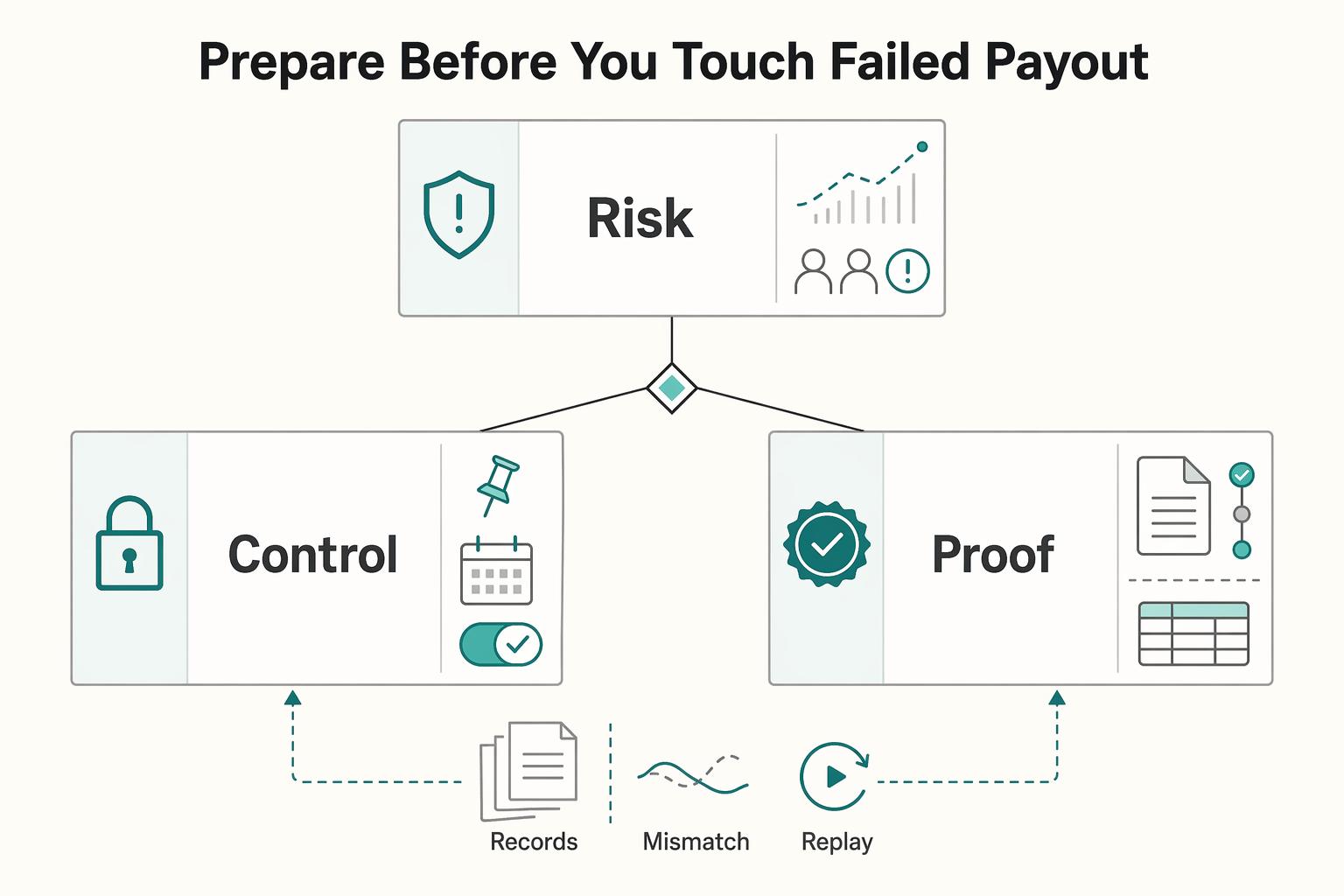
Do not retry until one person can pick up the case cold and explain why this attempt should work now. Blind replays against missing beneficiary data, unresolved policy checks, or stale status events create duplicate risk and harder reconciliation later.
Build a minimum incident packet#
Open one incident record for each failed payout before any replay. Include:
- payout ID
- provider reference
- failure code or status text
- rail used: ACH, Wire, SEPA, PIX, or UPI
- attempt history
- current case owner
Readiness test: can Ops explain where the payout stopped and what changed since the last attempt without jumping across multiple tools? If not, hold the retry.
Define owner handoffs before launch#
Set handoffs before incidents happen. Ops owns triage and first classification. Engineering owns idempotency and webhook integrity so late or duplicated status events do not trigger unsafe retries. Finance owns reconciliation sign-off before the case is closed.
| Team | Primary responsibility |
|---|---|
| Ops | Triage and first classification |
| Engineering | Idempotency and webhook integrity so late or duplicated status events do not trigger unsafe retries |
| Finance | Reconciliation sign-off before the case is closed |
Handoff test: run one failed case from alert to closure and confirm each step has one owner, one trigger, and one expected output.
Lock policy prerequisites first#
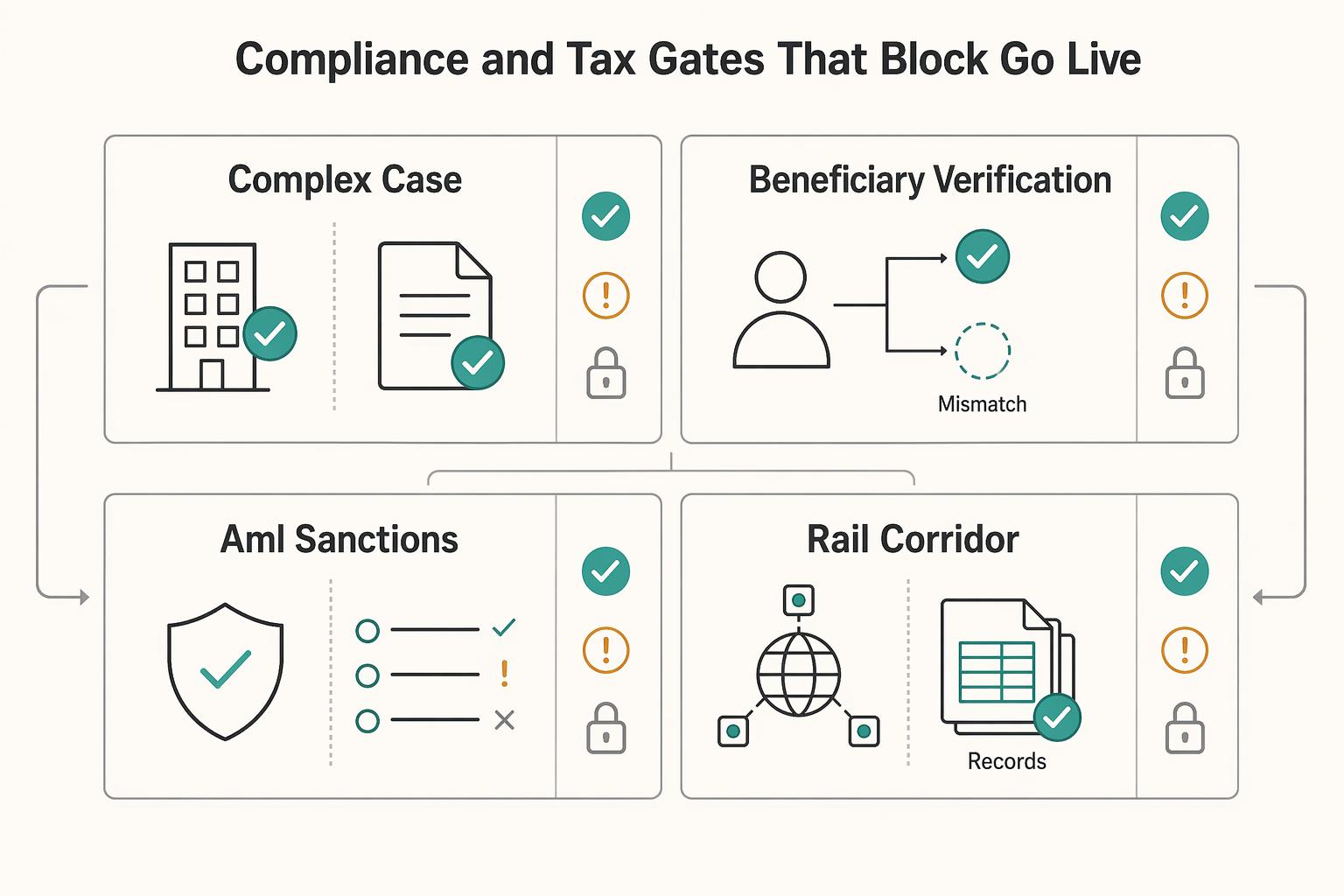
Confirm eligibility before replaying. Check KYC, KYB, and AML gating status, recipient profile completeness, and any market or program constraints your setup applies. If any item is unresolved, route the case to remediation instead of retrying.
Some payout failures are delivery failures; others are policy blocks labeled as payment errors.
Step 1 classify failed payouts by cause and assign a single owner#
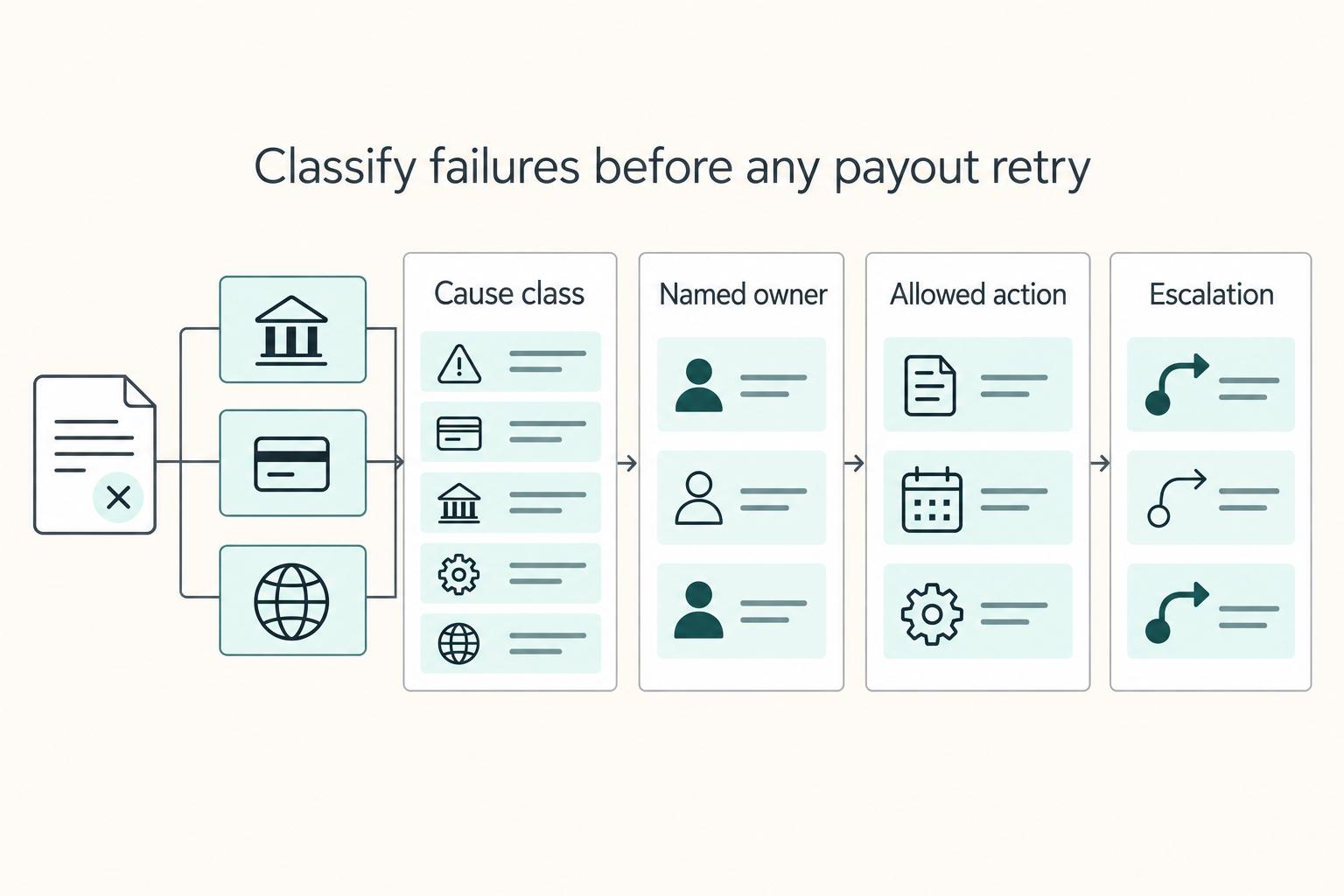
Classify the failure before you retry anything, and assign one accountable owner to that class. A single "failed" bucket is not useful because it does not tell Ops, Engineering, Compliance, or Finance what happens next.
Build a cause taxonomy that is operational for your team, then map each class to a default owner, an allowed next action, and an escalation path. Keep the model simple enough to route quickly, but specific enough that ownership is clear and cases do not bounce between teams.
Use this checkpoint on every incident record: can a different operator, working cold, see the cause class, named owner, latest status event, and next allowed action from one place? If not, your labels are too vague to control recovery risk.
Do not collapse rail behavior into one bucket. The OCC payment-systems guidance treats ACH as a product-specific risk area and separates wire transfer transaction and settlement flow, so your classification and ownership should reflect rail-level differences instead of treating all payout failures the same.
If you want the inbound counterpart, see A Guide to Dunning Management for Failed Payments.
Step 2 apply rail-specific retry rules with idempotency and stop conditions#
Use reason-aware retry rules, not one global retry timer. A single schedule treats hard rejects and recoverable failures the same, which leads to wasted retries and weaker recovery outcomes.
Retry only when the cause is recoverable and the previous attempt is confirmed not paid, canceled, or returned with the funds available for a replacement. Start with the failed rail’s documented recovery rules. If beneficiary mismatch, recipient-data issues, or compliance holds remain open, stop automated retries and route to manual review. An unresolved outcome must be investigated before a new financial instruction is sent.
Build a rail matrix your team can execute#
Keep one matrix for Ops and Engineering. Define retry windows and attempt caps from your approved policy, provider behavior, and internal failure history.
| Rail | Common fail modes | Retry window | Max attempts | Manual-review trigger | Recipient message template |
|---|---|---|---|---|---|
| ACH | Hard reject, soft/transient failure, recipient-data issue, compliance hold | Per approved ACH policy (transient failures only) | Per policy | Repeated hard reject, unresolved mismatch, open compliance flag | "We could not complete your payout. If action is needed, please confirm your payout details in your account." |
| Wire | Hard reject, soft/transient failure, beneficiary mismatch, compliance hold | Per approved wire policy (transient failures only) | Per policy | Repeated hard reject, unresolved mismatch, open compliance flag | "Your payout is on hold while we verify beneficiary details. We will contact you only if an update is required." |
| SEPA | Hard reject, soft/transient failure, recipient-data issue, compliance hold | Per approved SEPA policy (transient failures only) | Per policy | Repeated hard reject, unresolved mismatch, open compliance flag | "We could not complete your payout. Please update your payout details only if you receive an action request." |
| PIX | Hard reject, soft/transient failure, recipient-data issue, compliance hold | Per approved PIX policy (transient failures only) | Per policy | Repeated hard reject, unresolved mismatch, open compliance flag | "Your payout did not complete. If we need an update from you, we will send a secure request." |
| UPI | Hard reject, soft/transient failure, recipient-data issue, compliance hold | Per approved UPI policy (transient failures only) | Per policy | Repeated hard reject, unresolved mismatch, open compliance flag | "We could not complete your payout. Please confirm your payout ID only if we ask you to review it." |
Do not message recipients on every failure event. Message when the recipient can actually take corrective action.
Enforce stop conditions and replay controls#
Move to manual review, or block the next attempt, when any of these apply:
| Control point | Required state or action |
|---|---|
| Repeated hard reject on the same case | Move to manual review |
| Unresolved beneficiary or recipient mismatch | Move to manual review |
| Open compliance flag | Move to manual review |
| Incomplete prior-cycle status or reconciliation trail | Move to manual review |
| Prior attempt status event | Confirmed terminal non-payment, cancellation, or return with funds accounted for; unresolved outcomes block a new financial attempt |
| Ledger posting | Reconciled to the confirmed funds outcome before a new financial attempt |
| Exception queue | Updated with current state, next allowed action, and provider reference before the next attempt |
Keep one durable business payout ID and a separate attempt ID. Reuse the same provider idempotency key only when retrying the same request with the same parameters, within the provider’s key-retention rules. A genuinely new replacement after confirmed non-payment can require a new key, especially when corrected details change the request. Link it to the original intent and authorize it explicitly; a key alone does not prove that a previous attempt was unpaid.
Step 3 fix recipient details and communicate next actions#
When retries stop, request only the exact recipient detail that can unblock the payout. Failed payouts can come from different causes, and a single mistyped beneficiary or account field can leave a transfer stuck, so generic "payment failed" notices create noise instead of resolution.
If the failure points to beneficiary details, ask only for beneficiary fields. If it points to routing data, ask only for routing fields. Keep the request specific so the recipient is not guessing or editing unrelated information.
Send the smallest useful request#
Each message should include the field category to review, a payout or case reference, and the next action. Avoid broad "update your payment details" language unless you truly need a full resubmission.
| Audience | Trigger | What to send |
|---|---|---|
| Recipient | Data is needed to fix the payout | Exact detail type to review, secure update path, case reference, and what happens after submission |
| Ops | Hard reject repeats, mismatch is unresolved, or alternate rail review is needed | Incident summary, current owner, failure code, provider reference, and blocked next action |
| Finance | Cash state and ledger state do not match | Exception notice with payout ID, provider reference, current ledger state, and reconciliation owner |
If you offer self-serve correction, keep every edit auditable. Log masked old and new values, the actor, timestamp, and payout, case, and provider references. Keep any necessary full bank details in restricted storage, rather than exposing them in routine case logs.
Change the rail only with confirmation#
After the original attempt is confirmed not paid or returned, an eligible replacement may use another supported rail with explicit recipient confirmation. A failed Wire payout could use SEPA only where the recipient, corridor, and provider support it. Resolve beneficiary mismatches and compliance holds first; changing rails is not a workaround for them.
Do not switch rails silently. Confirm the new method with the recipient, collect any rail-specific fields, and record that confirmation before creating a new instruction. If confirmation or eligibility is unclear, keep the case with Ops.
Step 4 reconcile the ledger and close the incident with evidence#
Close the incident only when the provider outcome and your ledger match, and the evidence is complete enough for someone else to follow end to end. Provider final status alone is not closure.
Build a real close-out pack#
Treat closure as an internal-controls step, not admin cleanup. Before marking a case resolved, attach:
- original payout request or instruction record
- provider reference IDs for each attempt
- retry timeline with timestamps and owner handoffs
- final payout status and the event that set it
- reconciliation proof from ledger or export artifacts showing the final journal outcome
Use a simple test: can Finance trace what was requested, what happened at the provider, what was posted internally, and why the case is closed without relying on chat or memory? If not, keep the case open.
Verify the chain end to end#
Compare the linked request, provider outcome, ledger journal, and recipient-facing status before closure. Webhooks can arrive out of order or more than once, so reconstruct state from durable references and the provider’s current record rather than event delivery order.
| Step | What to confirm |
|---|---|
| Original request | Matches the amount, recipient, and rail used in the provider attempt |
| Provider event/reference | Explains the final outcome, including retries or reroutes |
| Ledger journal | Reflects that same outcome |
| Payout status update | Was updated from that evidence, not from assumption |
If the chain is not explainable in sequence, reopen the case and repair the records before closure.
Review recurring patterns and push corrective actions#
After closure, run a short pattern check: same rail, same processor path, or same onboarding gap. If you see repetition, log one specific corrective action and route it to the product backlog or owning team.
Keep the action concrete, for example: add beneficiary-name validation before first Wire payout, or block retry when provider reference is missing from the case.
Choose your tooling model with a scoring table before rollout#
Choose build, buy, or hybrid with a weighted scorecard before rollout, and prioritize evidence over pitch. If your payout-failure volume is low but edge cases are messy, hybrid is usually the safer starting point; if volume is high and patterns are repeatable, deeper automation is more likely to pay off.
Build a weighted scorecard before vendor selection#
Use weighted criteria for integration fit, control ownership, and operational burden. Estimate engineering maintenance, provider coverage, exception handling, and reconciliation work against your own volumes and workflows rather than transferring unrelated software-project statistics into the decision.
| Option | Integration fit with your payout provider, ledger, bank feeds, and ERP | Compliance posture check | Operational burden | Best fit |
|---|---|---|---|---|
| Build | Strongest when payout logic is highly custom across internal systems | You own controls and audit trail outputs | Highest engineering and maintenance load | High volume, repeatable patterns, strict internal requirements |
| Buy | Fastest only when product data model and event flow match yours | Validate evidence and scope before relying on it | Lower engineering load, higher vendor/process management | Standardized use cases with low customization needs |
| Hybrid | Balanced when you keep core triage and reconciliation logic in-house and automate narrow slices | Shared responsibility across your team and vendor | Moderate | Lower volume with high edge-case variation |
Give integration fit more weight than headline lift claims. If a tool cannot map payout IDs, provider references, retry events, and final ledger outcomes cleanly, Ops workload usually rises even when demos look strong.
Pressure-test vendor narratives against payout reality#
Evaluate outbound payout capabilities directly. A tool that recovers failed customer charges may not support recipient-detail remediation, confirmed non-payment checks, controlled replacement attempts, or payout-to-ledger reconciliation. Require a demonstration using your payout provider, references, failure classes, and finance exports before treating recovery claims as evidence of fit.
Ask vendors to demonstrate:
- how failed payouts are classified by cause, not only retried
- how provider events are tied to your internal payout IDs
- how payout exceptions are surfaced for manual action
- what reconciliation and audit-ready export evidence Finance receives
Run a controlled pilot with explicit acceptance checks#
Do not select on lift messaging alone. Run a controlled pilot with explicit acceptance criteria: real-failure ingestion, idempotency preservation, full retry history, and close-out evidence that reconciles.
Use the same verification chain as incident closure: request -> provider event -> ledger journal -> payout status update. If the pilot fails that chain on a small cohort, stop rollout and fix fit first.
Related: Payout Method Comparison Tool: ACH Wire SEPA PIX UPI and More for Platform Operators.
Next steps your team can execute this week#
You can make meaningful progress this week without a redesign: clarify ownership, stop uncontrolled retries, and require a complete record before closing incidents.
- Confirm your failure taxonomy and owner mapping.
Keep a small set of failure classes your team already uses, assign one primary owner to each class, and name the escalation owner. Anyone opening a failed payout should see ownership and handoff rules immediately.
- Publish rail-specific retry rules for ACH, Wire, SEPA, PIX, and UPI.
For each rail, document when retries are allowed, when they must stop, who can override, and what recipient message is sent. If a rail rule is not settled yet, default that path to manual review.
- Implement idempotency enforcement and retry-cycle verification checkpoints.
Tie each recovery attempt to the same business payout record, with a distinct attempt ID. A request retry and a replacement payout are different operations: do not send a new financial instruction until the prior attempt’s non-payment and funds position are confirmed.
- Stand up recipient data-fix flows plus internal escalation paths.
Ask recipients for the exact field that needs correction instead of sending generic failure notices, and log each change event. Escalate internally when resolution moves beyond routine Ops handling, especially when payment status and reconciliation records do not align.
- Define incident close-out evidence requirements and run one pilot cohort before broad rollout.
Choose one system of record for payout incidents and define the close-out pack your teams require. Pilot the process on one cohort first, and expand only after you can consistently trace each case from request through final status and reconciliation artifacts.
Frequently Asked Questions
What is failed payout recovery for platform operators?
Payout recovery is operational follow-up after a recipient disbursement fails. Classify the cause, verify the previous funds outcome, resolve recipient or control issues, and authorize any replacement using the provider’s documented rules.
How is failed payout recovery different from failed payment recovery?
Failed payment recovery focuses on failed customer payments. Stripe's "Failed payment recovery 101" covers topics like identifying causes of failed payments and legal considerations, which can be useful background but is not a payout operating policy. Payment-recovery discussions can also emphasize metrics like transaction authorization rate and Invoice Success Rate, and those should not be assumed to define payout-operations performance.
What are the table-stakes features in a payout recovery platform?
Require a linked case packet, cause classification, named owner, controlled retry history, recipient-data correction flow, provider outcome evidence, and reconciliation close-out. Validate that these capabilities fit your payout rails and providers; inbound subscription dunning is a different workflow.
When should we automate retries and when should we force manual review?
Use provider guidance, applicable obligations, and internal controls. Automate only a recoverable case with confirmed terminal non-payment or return, accounted-for funds, and resolved release conditions. Hold uncertain outcomes, beneficiary mismatches, and open compliance flags for investigation.
What should we evaluate first when comparing payout recovery vendors?
Confirm that the product supports outbound payout incidents, not just failed customer charges. Test your provider references, recipient corrections, replacement authorization, duplicate protection, and finance close-out in a bounded pilot before relying on recovery claims.
How do we prevent duplicate payouts during retries?
Confirm terminal non-payment, cancellation, or return and reconcile the funds before authorizing a replacement. Keep the business payout ID stable and track each attempt separately. Reuse a provider idempotency key only for the same request and within its retention rules; use a new authorized attempt and key where required for a genuine replacement. Hold unresolved outcomes for investigation.
What evidence should Finance require before an incident is marked resolved?
Finance should be able to trace the original business payout, each attempt and provider reference, replacement authorization, confirmed provider or bank funds outcome, ledger reconciliation, and consistent recipient-facing status. Retain a route for later returns or status changes.
Try a related tool
Researched and edited by the Gruv editorial team. Gruv builds cross-border billing, payouts, and finance-operations software for global businesses.
Sources
Educational content only. Not legal, tax, or financial advice.
Related Posts

Revenue Recovery Playbook: Recover Failed Subscriber Payments in 7 Steps
A subscriber whose renewal fails may still want the service. Product owns the customer path and access policy, engineering owns payment state and event processing, and finance owns collection reconciliation. Give support a view of the invoice, failure reason and next action so a customer receives one consistent answer.
Payout Method Comparison Tool for Platform Operators Across ACH, SEPA, PIX, and UPI
Use this comparison matrix as a decision worksheet for ACH, bank wires, SEPA, Pix and UPI. Swift messaging may support a bank wire; it is not itself the settlement rail. Choose a corridor/currency and eligible recipient first, then compare timing, total cost and operational fit.
Bank-Rejected Contractor Payout Recovery for Platform Teams
Bank rejections happen in contractor payouts, but your response cannot be improvised. A payout can fail and be voided before completion, or it can be returned after failing to reach the recipient. In either case, your team still needs an explicit decision on liability, ledger state, and next action.