
Quick Answer
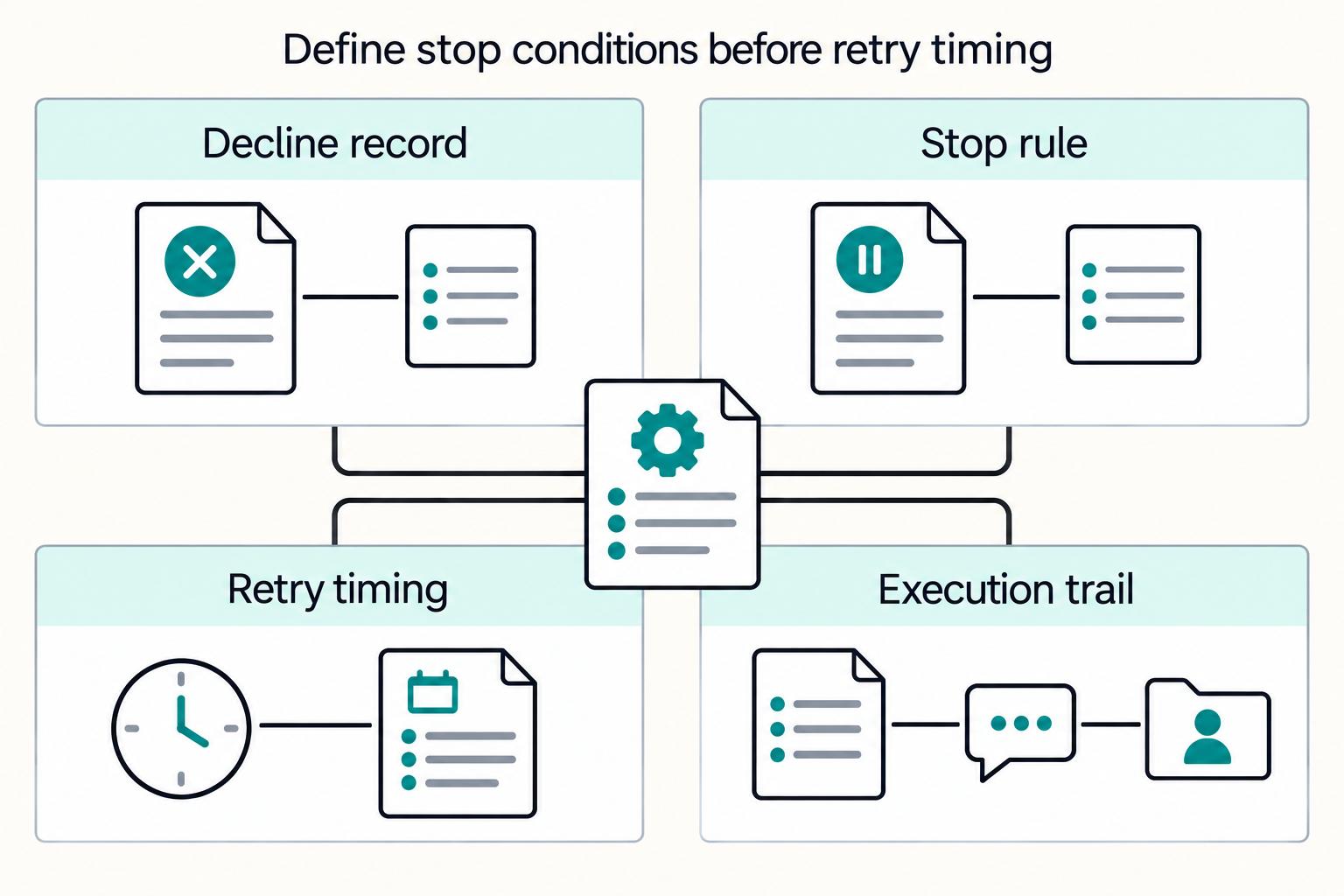
Classify failed payments with the provider's decline and advice codes. Stop prohibited reattempts, send customer-fixable failures to an update path, and retry eligible failures on method-specific rules. Connect each attempt to dunning and a durable payment state, then judge the policy by recovery, cost and customer friction.
Why One Recovery Flow Does Not Work Everywhere#
Treat failed payment retry logic as a revenue recovery decision, not a billing toggle. The job is to recover valid revenue while controlling processing cost, customer friction, and compliance or security risk.
Step 1 Set the outcome before you touch settings#
Start with the outcome, not the settings. A payment failure is a declined or unprocessed attempt, but the real question is what recovery result you want and what retry behavior you are willing to stop. That framing matters because failures hurt customer experience and can drive both short- and long-term revenue loss.
Do not optimize for retry volume alone. A practical checkpoint is whether each retry has a clear reason visible in your billing or orchestration history. If you cannot explain why an attempt was retried, you do not yet have a dependable policy.
Step 2 Separate recoverable failures from stop signals#
Your first control is failure classification. Payment failures are commonly split into soft declines and hard declines.
| Failure type | What it means | Retry stance |
|---|---|---|
| Hard decline | Decline that cannot be retried on the same credentials without a change | Stop on those credentials; request customer action |
| Soft decline | Temporary decline | Retry only after the underlying issue is resolved |
Stripe's card-decline guidance distinguishes advice such as do_not_try_again, try_again_later, and confirm_card_data. Use the provider's current response and method rules, not a soft/hard label alone. If your system cannot map a failure to the next action, changing cadence will not fix the real problem.
Step 3 Assign ownership to the tradeoffs#
Retry policy balances multiple outcomes: recovered revenue, processing cost, customer experience, and risk. Stripe also flags regulatory compliance and security as challenge areas, so more automation is not automatically better recovery.
Set ownership explicitly. Decide who owns customer-facing behavior and stop conditions, who keeps retry decisions observable and reliable, and who reviews whether recovery is improving without disproportionate cost or confusion. Treat dynamic retry scheduling as a testable option, not a default truth.
For the finance impact of payment failures, see Revenue Leakage from Payment Failures: How Much Are Failed Transactions Really Costing Your Platform?.
What failed payment retry logic should optimize#
The goal is business recovery, not retry volume: recover valid revenue and reduce involuntary churn.
Step 1 Define success in business terms#
Start with the commercial outcome, not attempt count. A recovered payment matters because it can retain a subscriber who did not intend to leave but failed because of a payment issue.
Use a simple scorecard. Did you recover valid revenue and reduce involuntary churn without adding avoidable cost or customer confusion? Your Payment Retry history should make those results visible to both Product and Finance.
Step 2 Separate payment success from good retries#
A higher payment success rate does not automatically mean better retries. A retry is only good when it targets a recoverable failure with a clear basis, such as payment type and processor response codes.
That is why failure type comes first. Stop attempts on the same credentials when the provider says not to retry; send customer-fixable failures to an update or authentication path. Retry temporary failures only when the response and method rules permit it. If you reward volume instead, you can get wasted attempts and added cost.
Step 3 Set scope boundaries early#
Be explicit about scope: Payment Retry and Dunning Management here, not dispute or chargeback handling. After a failed payment, the next action here is either a retry decision or customer prompting, such as card-update communication, not a disputes workflow.
Write that boundary into policy so routing stays measurable. If retry recovery confidence drops, hand off to dunning and customer communication. If it is a disputes event, route it out of retry logic.
What to prepare before changing retry settings#
Change retry settings only after you can verify platform readiness and operational control. Otherwise, even policy changes that look correct on paper can break in execution.
| Step | Focus | What to prepare |
|---|---|---|
| 1 | Baseline | Current failure patterns, retry outcomes, and where retries stop in one place |
| 2 | Evidence pack | Labels, definitions, and retry settings teams use today |
| 3 | Capability readiness | Which retry, routing, decline-code and dunning controls the chosen provider actually exposes |
| 4 | Operational controls | Scheduling dependencies, system interdependencies, rerun requirements, and who monitors and resolves failed jobs |
Step 1 Build one working baseline#
Start with one baseline that reflects how the business runs today. Document current failure patterns, retry outcomes, and where retries stop using a consistent internal view. Keep that baseline in one place so decisions start from observed behavior, not assumptions.
Step 2 Create a shared evidence pack#
Use one evidence pack for the labels, definitions, and retry settings teams use today. If teams cannot interpret the same failed payment record the same way, align definitions before you change policy.
Step 3 Confirm capability and setup readiness#
Before changing policy, confirm which retry, routing, decline-code and dunning controls your chosen billing provider actually exposes. Check whether retry scheduling is enabled, whether another layer also retries the charge, and whether you can stop or override a scheduled attempt before rollout.
Step 4 Lock operational controls and owners#
Do not change settings without clear operators and controls. Document scheduling dependencies, system interdependencies, rerun requirements, and who monitors and resolves failed jobs. Maintain clear ownership in the runbook so changes can be reviewed and rolled back quickly when needed.
Build a decline decision table before you touch cadence#
Build the decline decision table first, then tune timing. This is where retry logic becomes explicit policy instead of a generic setting.
Step 1 Define one shared table#
Use one matrix across teams so the same failure gets the same next action. Start with decline type, common cause, and recommended action, then add internal columns if they help operations.
| Decline type | Example cause | Retry or stop | Delay pattern | Customer message | Fallback method |
|---|---|---|---|---|---|
| Soft decline | Insufficient funds | Retry | Use your approved schedule, not one blanket every 24 hours | Say you will retry automatically when that matches policy | Escalate to customer outreach or dunning if failures continue |
| Soft decline | Network timeout | Retry | Use your approved path for temporary failures | Usually no immediate outreach unless failures continue | Escalate to customer outreach or dunning if failures continue |
| Hard decline | Stolen card or closed account | Stop | No automated retry | Ask the customer to update payment details | Move to Dunning Management |
One shared table does two things at once: it forces policy choices into the open, and it gives support, finance, and product a common reference when something goes wrong.
Step 2 Split soft vs hard declines in Error Classification#
Classify failures before setting cadence. Temporary conditions such as insufficient funds can be candidates for a permitted retry; stolen or closed cards require a stop on the same credentials and customer action. A timeout may be an uncertain technical result, so reconcile whether a charge occurred before creating a new attempt.
Do not let one generic failed label drive all behavior. If classification does not change the next action, tighten it before you change retry timing.
Step 3 Set stop rules before scheduling rules#
Stop logic matters more than spacing. Blind or aggressive re-attempts can add avoidable costs and can conflict with the card network and provider rules that apply to that transaction.
Define what ends retries before you define delay, then set timing only where retry is still justified. If a row cannot answer "what ends this path," it is not ready.
Step 4 Add clear escalation into Dunning Management#
When retry confidence drops, move from retries to customer outreach or dunning management. Keep the handoff explicit: retry path first, outreach path next.
Match messaging to the path. If you are retrying, say so. If you are stopping, ask for an update clearly.
Step 5 Verify the table is observable in execution#
Before rollout, define how each major path will be monitored, for example retried, stopped, or moved to dunning, so outcomes are easier to audit and debug.
If the execution trail does not make the path clear, refine the implementation before changing cadence at scale.
For a step-by-step recovery workflow, see Revenue Recovery Playbook for Platforms: From Failed Payment to Recovered Subscriber in 7 Steps.
Turn this matrix into an execution checklist, then align retry and stop rules with the status and webhook surfaces available in the Gruv docs, where enabled.
Choose static or dynamic timing with explicit tradeoffs#
Once your decision table says what is retryable, use the simplest timing model you can defend with your own outcomes and cost data. Start with static timing when retry volume is manageable and operations capacity is limited. Expand to Dynamic Retries or Smart Retries only if method-level and region-level variance in your data is clearly creating misses or waste.
Step 1 Start with static timing when operations need clarity#
Use a fixed schedule when you need policy that product, finance, and support can read, explain, and review quickly. Static timing can be a cleaner operational default until you can show that one cadence is producing over-retries in some paths and under-retries in others.
Step 2 Treat dynamic or machine-led timing as a controlled test#
Move to dynamic timing only when differences by payment method, geography, or billing context are large enough to justify the added complexity. Treat any Machine Learning timing layer as a hypothesis. Require a holdout, a named owner, and a rollback rule before broad rollout.
A useful warning from retry systems more broadly is that fixed retry counts can ignore probability. Treat that as design caution, not as proof of payment-retry uplift.
Step 3 Compare vendor controls and retry cost#
Compare providers on the controls this workflow needs: decline and advice codes, method eligibility, retry caps, override paths, customer messaging, and a traceable outcome. Then calculate the incremental cost of an attempted retry using your actual provider agreement and method mix.
| Cost or control | What to confirm | Decision use |
|---|---|---|
| Attempt charges | Whether unsuccessful or repeated attempts incur a charge under your agreement | Compare cost per recovered invoice |
| Method and region mix | Actual provider fees and eligibility by payment method and country | Keep overrides focused on viable segments |
| Retry ownership | Which billing, gateway or orchestration layer schedules the next attempt | Prevent duplicate schedules |
| Customer impact | Support contacts and cancellations after retries and messages | Stop an override that harms trust or retention |
A recovered invoice is worth measuring against additional attempts and customer contact, not against a public card-processing fee table. Finance should use the prices and obligations in its own provider agreement, then compare net recovery by method and region.
Step 4 When false-positive retry cost rises, narrow scope before increasing frequency#
If retries are driving higher support load, processor cost, or low-probability reattempts, reduce automation breadth first. Trim ambiguous paths until each automated route is observable and auditable as retried, recovered, stopped, or moved to dunning.
For a step-by-step walkthrough, see How to Implement Intelligent Payment Retries: Timing Signals and ML-Based Approaches.
Set method-specific retry rules instead of one global policy#
Do not run one retry policy across every payment method. One pattern can hide real differences in retry eligibility and blur stop versus retry decisions.
Step 1 Split policy by payment method#
Define separate retry lanes for cards and each non-card method you support. Recurly describes Intelligent Retries for declined recurring credit card payments and explicitly excludes direct debit from Intelligent automatic retries, so one global rule will not fit every method.
Before changing policy, confirm you can see method-level outcomes in your retry history and configuration tooling. Recurly also notes dashboard or config access is required and that the feature may not be included in Starter or Pro plans, so validate access before committing to method-specific controls.
Step 2 Treat card retries as decline-aware, not card-wide#
For recurring card payments, treat retries as selective. Recurly's Intelligent Retries targets soft declines; a billing-information update or forced collection can change the handling of a hard decline. For a Stripe card charge, follow its decline and advice codes before scheduling another attempt.
In practice, separate retryable card failures from failures that should stop and move to customer action. That keeps card automation from inflating attempts that were unlikely to recover.
Step 3 Use exceptions as a controlled path#
Use exception paths only as a deliberate choice, not as an automatic second attempt after every decline. Keep non-retryable failures on a stop path even when another path is available.
When you test an exception path, review whether it produced recovered payments or just more retry noise. The goal is cleaner recovery, not extra attempt volume.
Step 4 Keep caps and spacing independent by method#
In your retry configuration, keep retry caps and timing windows independent by method. This avoids cross-method contamination where one method's cadence is applied to another with different eligibility or exclusions.
Use limits that match the product and method. Recurly's Intelligent Retries limit is 20 total transaction attempts or 60 days from invoice creation for eligible recurring cards. That is a Recurly product limit, not a universal card-network allowance; the applicable provider, network, dunning and method rules may stop attempts sooner.
Adapt retries by region and billing moment#
Once retries are split by method, localize timing by market and billing moment instead of running one global clock. Start with payer local time and billing-cycle context, then add market overrides only where the recovery upside or churn risk justifies the added complexity.
Step 1 Map retries to local payer time before changing cadence#
A single UTC retry timestamp can land at very different local moments across markets. Record the payer's local time and compare your own outcomes by local hour, weekday and billing cycle before adding a market override.
Start with the billing moment that matters most. When the original charge failed, what local time was it for the payer, and what day did it occur in that market? Segment the result by decline and advice code so a timing test does not silently include failures that need customer action.
Use a simple checkpoint: your retry history should show both the original failure time in UTC and the payer-local date and hour targeted by your policy. If you cannot compare outcomes by local hour, you are not really running a regional timing policy.
Step 2 Prioritize high-CAC subscription markets first#
Do not tune every market at once. Start where recurring volume and observed failure pressure are high enough to measure, and where the value of retention justifies the test. Use your own baseline rather than a vendor's failure-rate benchmark.
Pick initial markets where recurring volume is meaningful, failures are concentrated enough to measure, and replacement cost is high. That gives Finance and Revenue Operations teams a narrow test lane with material financial impact.
Before changing timing, capture a short baseline: method mix, decline mix, current recovery rate, attempts per recovered payment, and processing cost. Without before-and-after evidence, you cannot judge whether the override paid for itself.
Step 3 Define market overrides only when the difference is material#
Create a market override only when your data shows materially different timing behavior. Compare it with an unchanged lane and check recovered revenue, attempts, cost and customer contact. The answer is selective customization, not endless customization.
Use an override when you can show all of the following:
- Distinct timing patterns by local hour, weekday, or billing-cycle moment.
- Meaningful economic upside, for example high CAC, high failure volume, or costly churn.
- Clear monitoring and rollback without confusing method rules or reporting.
Also respect product boundaries. Recurly's Intelligent Retries applies to eligible recurring credit cards and excludes direct debit. Its separate Direct Debit Retries product handles supported ACH, BACS, BECS and SEPA insufficient-funds failures under different limits and gateway conditions. Confirm which feature and method are enabled before applying any cap or cadence.
Step 4 Compare recovery and cost side by side so Finance Operations can decide fast#
Regional timing changes should be easy to approve and easy to reverse. Use a side-by-side market view, baseline versus override, so Finance and Revenue Operations teams can quickly judge whether recovery gains cover added attempts, fees, and handling effort.
At minimum, review weekly:
- recovered invoices or recovered revenue
- average retry attempts per recovered payment
- incremental transaction cost
- payment-related support contacts
- cancellations or involuntary churn after failed payment
Set rollback criteria before launch. If an override increases attempts and fees without improving recovery versus baseline, remove it. Smart timing can incorporate local time and calendar effects, but approval should still be economic. Keep overrides few, documented, and accountable.
Related: How Finance Teams Measure ROI in Failed Payment Recovery Campaigns.
Connect retries to dunning and customer experience#
Set a clear handoff: use silent retries while recovery still looks plausible, and switch to customer action as soon as signals show the customer needs to fix something. Do not rely on attempt count alone.
Step 1 Classify the handoff from silent retry to customer action#
Dunning starts when a scheduled payment fails, but customer outreach does not have to be your first move. A common flow is retries first, then customer notifications if retries fail, and this works best when you classify failure types well.
| Branch | Next action | Article signal |
|---|---|---|
| Likely temporary failures | Retry silently | Recovery still looks plausible |
| Customer-fixable failures, for example outdated details | Notify and request a payment method update | The customer needs to fix something |
| Recovery no longer viable | Stop recovery and follow suspension or cancellation rules | Do not rely on attempt count alone |
Use a simple branch rule for each decline class:
- retry silently for likely temporary failures
- notify and request a payment method update for customer-fixable failures, for example outdated details
- stop recovery and follow suspension or cancellation rules when recovery is no longer viable
If support cannot see which branch a customer is in, your handoff logic is too vague.
Step 2 Align Dunning Management with every visible retry state#
Your retry state and customer messaging should match across email, in-app UI, and support macros. If one touchpoint says "we'll retry" and another says "update your card," you create avoidable confusion.
For each state, define one message set that clearly says:
- whether automatic retries are still running
- whether service remains active during a grace period
- what action, if any, the customer must take now
Run a same-day walkthrough of one failed invoice across billing logs, outbound messages, UI banners, and the support view. If status or next step conflicts anywhere, fix that before adding more retry complexity. If you need deeper operating detail, see A Guide to Dunning Management for Failed Payments.
Step 3 Add a switch rule for low-confidence recovery#
Your retry policy needs an explicit switch. When recovery confidence drops, stop adding attempts and prompt for updated payment details. This should be driven by decline type and observed outcomes, not just "attempt three" or "day seven."
A practical trigger is either of these:
- the failure is customer-fixable, or
- repeated retries continue to fail
Then move to an action-required path with clear instructions to update the payment method.
Step 4 Protect continuity in Subscription & Recurring Billing#
In Subscription & Recurring Billing, decide the grace period from your service policy, recovery evidence and customer impact. Keep access and status messaging aligned while recovery is still allowed, then make any suspension or cancellation step clear before it happens.
Use a grace period for recoverable failures, keep status messaging explicit, and make the final escalation predictable. If recovery attempts fail, suspension or cancellation can be the end state, but it should not surprise the customer.
Related reading: A Guide to Dunning Management for Failed Payments.
Implement safely with idempotency and webhook discipline#
Once you have decided when to retry and when to ask the customer to act, execution has to be duplicate-safe and state-driven. Without that discipline, delivery retries can create duplicate side effects and inconsistent payment state.
Step 1 Enforce stable idempotency keys#
Separate a new billing attempt from replay of the same request. Give each intended charge attempt its own stable idempotency key and reuse that key only when repeating that request after an uncertain result. For inbound webhooks, deduplicate delivery by event ID and guard the underlying invoice or payment transition as well; distinct events can describe the same business effect.
Make the dedupe record and financial state transition atomic or durably recoverable together. A unique event insert alone does not make a charge or ledger effect exactly once, and a short-lived cache cannot prove long-term financial state. Avoid read-then-insert checks that race under concurrency.
A practical check is to replay the same webhook and the same outbound charge request, then confirm that each replay leaves one intended state transition. Separately test a genuinely new scheduled attempt so deduplication does not suppress it.
Step 2 Tie Webhook Retry Logic to durable state changes#
Webhook Retry Logic should protect delivery reliability, while charge decisions stay tied to your billing state rules.
Move invoice or payment status only with a durable transition. If a webhook arrives late, out of order, or more than once, recheck stored state and no-op when the effect already happened. Verify signatures and timestamp tolerance according to the sender's current webhook guidance; do not copy one provider's replay window into every integration.
Step 3 Make every retry traceable in Payment Orchestration#
In Payment Orchestration, make each retry traceable end to end. Log the retry key, external event ID, object ID, prior status, new status, and transition reason so incidents can be reconstructed.
If your retry policy cannot answer "which event created this state change?", your audit trail is too thin. Any retry path that mutates state without a matching, queryable event record is a control gap.
Run weekly governance with economics-first checkpoints#
Economic drift can appear even after implementation. Recovery can improve while margin or customer trust gets worse. Treat retry logic as an ongoing operating decision and review it on a regular cadence with business-impact outcomes.
Step 1 Build a four-metric scorecard#
Keep one compact scorecard that Revenue Operations and Finance Operations can review on a regular cadence.
| Metric | What to measure | Why it matters | Verification check |
|---|---|---|---|
| Recovery yield | Revenue or invoices recovered after retries | Shows whether retries are actually collecting money | Verify recovery ties to a retry event, not a later manual save or payment method update |
| Incremental processing cost | Additional retry-related processor cost | Prevents recovery gains that reduce margin | Compare current retry-driven cost to your baseline by segment |
| Support impact | Ticket volume, contact rate, and complaint themes tied to payment retries | Catches customer friction that recovery metrics miss | Sample tickets and confirm linkage to retry timing, dunning, or duplicate-looking attempts |
| Churn saved | Subscribers retained after recovery instead of canceling or lapsing | Keeps focus on recurring revenue, not a single invoice | Confirm the account stays active after the billing event |
If one metric rises while the others deteriorate, treat that as a warning, not a win. In subscriptions, billing state changes continuously, so governance should be continuous too.
Step 2 Pre-agree rollback rules with named owners#
Set rollback triggers before testing any retry change. Assign named owners: for example, Revenue Operations for the commercial readout, Finance Operations for ledger and revenue-recognition impact, and product or engineering for rollback execution.
The key is not a perfect threshold, but a pre-agreed one. When confidence drops below that line, hand off to a human, pause expansion, and revert to the last stable baseline.
Capture each policy change in a short decision record: owner, start date, affected methods or regions, expected upside, rollback trigger, and where the evidence lives in Payment Orchestration.
Step 3 Segment before you trust any uplift#
Do not trust aggregate uplift alone. Review outcomes by payment method, region, and decline class so weak segments do not hide inside blended results.
The same retry rule can help one slice and hurt another. Governance should include both total and segmented views of the same scorecard before you call a change successful.
Step 4 Keep a vendor-neutral test lane#
Treat Smart Retries and Dynamic Retries as testable hypotheses, not defaults. Keep a controlled baseline lane unchanged so you can compare outcomes without vendor framing.
Keep that lane stable and avoid bundling unrelated changes in the same window. Also keep explicit fallbacks ready, because small environment shifts can break automated flows. If a new feature does not beat baseline across recovery, cost, support load, and retained subscribers, do not widen rollout.
Common mistakes that quietly destroy retry performance#
When retry results look noisy, timing is often not the real problem. It is usually one of four policy mistakes.
Step 1 Tighten Error Classification#
Treating every unsuccessful payment as the same failed outcome can be expensive. Coarse Error Classification pushes too many cases into retries, which can inflate retry traffic.
Make each retry path traceable in Payment Orchestration or payment event history. If you cannot clearly see why a payment was retried versus stopped, the policy is too broad. Broad loops also increase retry-storm risk when a dependency is unstable.
Step 2 Reconcile routed retries with Finance Operations#
Payment Gateway Routing can improve recovery, but only if reconciliation stays intact after automated reroutes. Finance Operations should verify that post-retry charge records, settlement records, and payout data match before counting revenue as cleanly recovered.
Reconcile a recovered invoice to its charge, settlement and ledger records before counting it as collected revenue. A later platform payout is a separate movement and should not be used as the sole proof that the customer charge recovered.
Step 3 Coordinate retries with Dunning Management#
Retries and Dunning Management need one shared state, or customers can receive mixed messages. Align retry state, customer messaging, and stop rules so billing UI and outbound communication say the same thing.
After policy changes, review support tickets against retry and message timestamps. If messages conflict, reduce automated attempts and move faster to customer action. For deeper messaging rules, see A Guide to Dunning Management for Failed Payments.
Step 4 Validate vendor defaults against your own mix#
Vendor defaults are a starting point, not proof that your economics work. Payment gateway fees can materially affect profitability, and fee impact grows with volume, so recovery gains can still reduce margin.
Validate cost by method and region using your own provider agreement and observed retry history. Include any attempt-related charges, customer contact cost and downstream losses from duplicate or poorly timed attempts. Public payment-processing prices do not tell you the incremental cost of this retry policy.
If approval rates vary by market or payment rail, see Gateway Routing for Platforms: How to Use Multiple Payment Gateways to Maximize Approval Rates.
Conclusion#
The retry logic that holds up is decline-aware, bounded, and auditable, not the one with the highest attempt count. Use this checklist to recover revenue without adding avoidable cost, customer frustration, or operational risk.
- Define success before changing settings. Align stakeholders on what counts as healthy recovery versus expensive extra attempts.
- Build and approve a decline decision table. For each decline and advice code, set retry or stop, a permitted timing path, customer message, and escalation route.
- Set caps and spacing in the retry controls your provider supports. Check current method, provider and network rules; avoid one global schedule or a borrowed universal attempt ceiling.
- Add timing overrides only when your evidence shows a clear recovery, cost, or churn impact. If the case is weak, leave the override out.
- Align retry states with customer messages. Map each rule to visible states such as
scheduled,processing,succeeded,failed, andabandoned, with fields likeattemptCountandmaxAttempts. - Enforce idempotency and disciplined retry execution. Track retry state on the transaction or in a separate schedule record, and route permanently failed charges to explicit escalation or dead-letter handling.
- Review results on a regular cadence, roll back quickly when economics worsen, and keep one controlled test lane for new logic.
If you keep one rule, keep this one: add complexity only when the data earns it. Decline-aware timing, bounded attempts, visible state, and fast rollback usually protect margin better than chasing headline recovery rates.
If you want a practical review of your retry design before rollout, talk with Gruv.
Frequently Asked Questions
What is failed payment retry logic in plain business terms?
Failed payment retry logic is the policy that decides whether a declined charge gets another attempt, when that retry happens, and when to stop. Its business goal is to recover valid revenue and reduce involuntary churn without creating avoidable customer frustration.
How many retries should a subscription business run before stopping?
There is no universal retry count. Use the provider's decline and advice codes, method-specific rules, and your dunning window to set a cap. Stripe recommends no more than eight retries for charges that permit retries; Recurly's 20-attempt or 60-day limit applies to its Intelligent Retries product, not every network or payment method.
When should we not retry a failed payment?
Do not retry failures that are unlikely to succeed if repeated. Invalid credentials and similar authentication failures belong on a stop path. Route those cases to customer action or internal remediation instead of looping more attempts.
What is the difference between static schedules and `Smart Retries`?
Static schedules use fixed retry timing you define in advance. Smart Retries are positioned as data-driven timing decisions that tailor attempts by decline patterns such as soft versus hard declines. The tradeoff is predictability versus adaptability, so smart logic should still be tested against your baseline.
How should retry rules change across payment methods and regions?
Do not force one global policy when your own data shows meaningful differences in recovery or customer response. Split rules only where the difference is real and measurable across methods or markets. Keep overrides limited and documented so outcomes stay explainable.
Should `Exponential Backoff` be used for payment attempts or only for `Webhook Retry Logic`?
Use backoff for transient API or webhook delivery failures according to the provider's response and retry guidance. Billing charge attempts need a separate, decline-aware schedule, not a technical retry loop measured in seconds.
How do retries and `Dunning Management` work together without hurting customer trust?
Retries and Dunning Management should stay coordinated so charge attempts and customer outreach do not conflict. Use retries for recoverable cases, then switch to clear customer action when recovery confidence drops. Mixed signals can turn a recoverable miss into frustration and cancellation.
Researched and edited by the Gruv editorial team. Gruv builds cross-border billing, payouts, and finance-operations software for global businesses.
Sources
Includes 2 external sources outside the trusted-domain allowlist.
Educational content only. Not legal, tax, or financial advice.
Related Posts

The Freelance Payment Penalty: A Modeled Audit of Platform Fees, FX Spreads, and Payout Delays
The money rarely disappears through a single, easy-to-spot fee. The real loss is stacked. A marketplace takes its commission, a processor adds a charge for international cards, a bank or payment company converts the currency at a spread, a platform holds the funds before release, and a wire sheds a little to intermediaries on the way in. Each layer looks defensible on its own, but the worker feels the combined result as a smaller deposit and a later payday.

How to Respond to a Subpoena for Business Records
Move fast, but do not produce records on instinct. If you need to **respond to a subpoena for business records**, your immediate job is to control deadlines, preserve records, and make any later production defensible.

A US Expat's Guide to Investing in UCITS ETFs to Avoid PFIC Issues
The real problem is a two-system conflict. U.S. tax treatment can punish the wrong fund choice, while local product-access constraints can block the funds you want to buy in the first place. For **us expat ucits etfs**, the practical question is not "Which product is best?" It is "What can I access, report, and keep doing every year without guessing?" Use this four-part filter before any trade: