
Quick Answer
Implement intelligent payment retries by classifying failed payments into retryable and non-retryable paths, enforcing scheme and provider limits, and using rules or machine learning to choose retry timing inside those boundaries. Log decline codes, issuer responses, idempotency keys, route decisions, and outcomes so operators can audit every attempt. Then test the new logic against your fixed retry baseline and scale only where recovery improves without raising duplicate-charge risk. Provider keys cover unchanged transport replays, not global cross-processor duplication: keep a stable parent payment record, one execution owner and a hold on unknown outcomes before a new authorization.
Why intelligent payment retries matter for platform operators#
If your team still uses a fixed retry schedule, recovery outcomes can depend heavily on timing. Use a governed decision system: policy rules first exclude ineligible failures and enforce network limits; rules or machine learning then choose timing only for eligible attempts.
That distinction matters because retry timing affects revenue recovery and involuntary churn, not just model quality. The gap between "retry every 24 hours" and "retry when approval odds are higher" can change whether an account recovers or churns.
Step 1 replace blind cadence with decisioned timing#
Fixed schedules are easy to run, but they treat very different failure types as if they were the same. Dynamic timing uses available signals to rank candidate retry windows instead of applying one preset interval to every decline.
Before you tune anything, make sure each failed attempt logs decline codes and issuer response data in a queryable way. Without failure-code and recovery-outcome breakdowns, tuning timing or reviewing policy decisions becomes guesswork.
Step 2 keep the model inside explicit policy boundaries#
The model should decide when to retry, not whether every decline deserves another attempt. Network and provider guidance includes response-code-based retry handling, and some decline signals should not be retried at all, including Do Not Try Again instructions.
Over-retrying non-retryable declines can waste attempts and increase rule risk. Put hard policy stops in front of model scoring so blocked paths never enter retry selection.
Step 3 treat retries as a cross-functional control point#
Intelligent retries are not a model-only project. Effective implementation requires coordination across engineering, payments, fraud detection, and risk management.
Set checkpoints your operators can audit: attempt timestamp, failure code, retry decision, outcome, and the policy version that allowed the next attempt. If your team cannot explain why attempts happened, treat the system as not production-ready yet.
Step 4 anchor decisions to real network and provider constraints#
Card-failure recovery is constrained by scheme and provider rules. Checkout.com guidance notes that Visa increased the applicable allowance to 20 retries in a rolling 30 days from May 19, 2025, excluding do-not-retry cases and with separate customer-initiated and merchant-initiated counters. It lists Mastercard limits of up to 10 retries in 24 hours and 35 in a rolling 30 days for the same card, excluding non-retryable advice. Verify the applicable acquirer, region, transaction type and rule version before configuring these examples.
| Network/source | Limit | Window or note |
|---|---|---|
| Visa (Checkout.com guidance) | 20 applicable retries | Rolling 30 days from May 19, 2025; exclude do-not-retry cases; separate CIT/MIT counters |
| Mastercard (Checkout.com guidance) | Up to 10 retries | 24 hours, same card; exclude non-retryable advice |
| Mastercard (Checkout.com guidance) | 35 retries | Rolling 30 days, same card; exclude non-retryable advice |
Do not hardcode one universal limit. Confirm current limits with your acquirer, processor, and network documentation, then encode those counters and guardrails directly in your scheduler.
Related: Fraud Detection for Payment Platforms: Machine Learning and Rule-Based Approaches.
What intelligent retry timing is and what it is not#
Intelligent retry timing is a constrained decision system for failed payments, not a fixed retry cadence. It chooses when to retry based on dynamic signals, and in some stacks it can also include condition-based processor routing after a failed attempt instead of retrying the same way on a fixed schedule.
The sequence matters. Start with decline evidence, then apply policy. Decline codes, network or issuer response signals, and provider-specific decline taxonomies should inform the decision, but only after policy and no-retry rules filter what is eligible.
AI-powered payment recovery is a supervised layer, not an autonomous black box. The model should choose among eligible retry options inside hard stops, with hard declines and blocked scenarios excluded before scoring.
Stripe Billing Smart Retries is a useful reference for failed subscription and invoice payments. Stripe recommends 8 tries within 2 weeks and offers windows of 1 week, 2 weeks, 3 weeks, 1 month or 2 months. Its documented exclusions include hard declines, missing payment methods, India-issued cards and disconnected Connect accounts; local payment method retries have separate settings and limits. Treat the timing recommendation as a trial baseline, while applicable stop rules and counters remain binding.
What to prepare before implementation starts#
Start with operational discovery using available failed-payment samples and labelled data gaps. Build a defensible failure baseline as you investigate. Before changing live retry logic, establish clear governance and retry-safe execution controls; incomplete records need not prevent initial architecture or vendor evaluation.
Gather a failure baseline#
Pull available failed-payment history with decline codes, provider outcomes and your current retry schedule by segment. Label missing fields and unresolved outcomes, and use that sample to identify instrumentation work before live changes.
Use segmentation you can act on now, such as processor and currency, plus any card or market splits you already operate. The baseline should answer three questions: which decline reasons drive failed volume, what happens after each retry attempt today, and how schedules differ by segment.
Minimum fields before logic changes:
- processor-level decline code
- issuer response code when available
- provider outcome and final payment status
- current retry timing and attempt count
- processor or route used per attempt
- whether payment details changed before recovery
Keep that last field explicit. Hard declines stay blocked unless verified remediation permits a fresh eligibility assessment. A payment-method update does not override a cancellation, do-not-retry instruction or other continuing policy stop. Separate timing effects from payment-method updates.
Define ownership before policy is encoded#
Set owners before implementation starts. Make ownership explicit for customer-impact targets (including involuntary churn), retry policy (including do-not-retry guidance and any applicable retry limits), and execution safety controls such as idempotency, retry state, and event integrity.
This helps prevent policy drift under pressure. Over-retrying can create network-fee risk, so retry ceilings and blocked-code handling need explicit ops governance.
Confirm the control surfaces exist#
Verify your stack can apply decisions where they matter: the retry scheduler, processor routing hooks if route changes after failure are in scope, and logs with practical failure context.
| Field | Requirement |
|---|---|
| attempt ID | Persist at minimum |
| idempotency key | Persist at minimum |
| chosen route | Persist at minimum |
| decline code | Persist at minimum |
| issuer response code | Persist at minimum |
| scheduled retry time | Persist at minimum |
| execution time | Persist at minimum |
| final outcome | Persist at minimum |
| network advice or decline fields | Log if available |
At minimum, persist attempt ID, idempotency key, chosen route, decline code, issuer response code, scheduled retry time, execution time, and final outcome. If available, also log network advice or decline fields because they add handling context.
Run a staging failure test before launch and confirm repeated requests with the same idempotency key return the original result rather than creating a second charge.
Set acceptance criteria before build#
Define pass or fail before you ship. Include reduced involuntary churn, better recovery efficiency versus the current baseline, and no increase in duplicate-charge incidents. Track payment acceptance rate alongside recovered amount so you do not mistake more attempts for better outcomes.
Keep rollout decisions cohort-aware. If results improve in one decline cohort but regress in another, constrain the new logic to the cohort where it is working.
Step 1 classify failures into retryable and non-retryable paths#
Classify each failed payment into retryable or non-retryable before you change timing. Otherwise, basic retries can repeat the wrong decision faster.
Build a decision matrix from structured fields, not message text. Start from decline_code, then map with issuer and network signals: soft declines are temporary and may recover, while hard declines are not immediately recoverable and should stay blocked until corrective action resolves the issue.
Build the matrix from raw signals, not processor message text#
Use processor decline codes plus issuer or network response fields as the source of truth. Keep internal reason buckets, but tie them to raw fields so operations and engineering can audit decisions.
| Signal or example | Default path | What to do |
|---|---|---|
| Issuer or switch inoperative; issuer not available | Retryable | Confirm policy eligibility, then choose timing within limits |
| Visa merchant advice 2 in specified Visa Acceptance processor mappings | Candidate after policy checks | Cannot approve now; verify field mapping and counters before retry |
| Invalid card/account states (for example invalid card number, no such issuer, closed account, lost or stolen card) | Non-retryable | Stop auto-retries and trigger customer or support action |
| Mastercard merchant advice 03 in the documented mapping | Non-retryable | Do not try again; do not confuse with Visa data-quality advice 3 |
| Missing category or advice signal where expected | Non-retryable by default | Hold for review or customer action instead of guessing |
When issuer or network guidance conflicts with processor-level mapping, use issuer or network guidance.
Encode explicit stop conditions for Visa and Mastercard#
Hard-stop rules prevent ad hoc overrides when teams are under recovery pressure.
For Visa, distinguish the response category from other numeric fields. In the Visa Acceptance merchant-advice field documentation, certain processor mappings use Visa 1 for never approve, 2 for cannot approve now and 3 for data-quality problems requiring revalidation. That is not a universal mapping: Mastercard advice 03 means do not try again, and other processor mappings differ. Preserve the scheme, processor and field name with the raw value. Hold missing required guidance for review, and enforce the current acquirer-approved retry ceiling.
For Mastercard, interpret merchant advice in the applicable processor mapping: 03 is do not try again and 21 is do not honor. Enforce delay advice, such as 24 for one hour and 25 for 24 hours, alongside the configured brand-specific counters. Checkout.com lists up to 10 retries in 24 hours and 35 in a rolling 30 days for the same card; confirm scope with your acquirer before applying those limits.
Persist the evidence behind each eligibility decision#
Every allow or block outcome should be explainable from one record. Persist, at minimum:
- processor
decline_code - issuer response field, for example
issuerInformation.responseCode, when available merchant_advice_codeor equivalent when available- card brand, attempt count, and counter window
- internal reason bucket
- eligibility outcome, either
retryableornon-retryable - policy rule ID and policy version, recommended for auditability
Verification checkpoint: sample recent declines and compare classifier outputs against raw fields. If the same issuer or network signal lands in both paths without a clear brand, region, or transaction-type reason, tighten your mapping before you move on to timing or ML.
Step 2 choose timing logic from rules first, then machine learning#
Rules should define what is allowed. Machine learning should rank timing inside those bounds. That keeps retry permission tied to decline evidence from Step 1 while still letting you optimize when to attempt recovery.
Start with bounded windows, not open-ended optimization#
Use decline evidence (such as decline_code or gateway response fields) to assign each retryable failure to a narrow timing window. Keep timing decisions anchored to the same evidence pack from Step 1, not a standalone model score.
This is the practical middle ground between Basic retries and full AI-powered payment recovery. Stripe supports both a custom retry schedule and Smart Retries. Zuora similarly supports manually configured retry logic based on gateway response codes or AI-driven Smart Retry. A practical default is to let policy define what is allowed, and let smarter timing choose when within that allowed set.
Compare the three timing strategies before you commit#
| Timing strategy | How it works | Where it fits | Main risk |
|---|---|---|---|
| Fixed schedule | Retry on a set schedule | Baseline and control group | Same timing for very different failure causes |
| Rule-based dynamic windows | Map retry windows to decline-code or gateway-response-code groups | Starting point when auditability and sparse-data handling matter | Rules drift if you do not review outcomes |
| ML-ranked windows | Model ranks retry timing inside policy-approved windows | Useful when you have clean historical outcomes | Added complexity without clear incremental gain |
Keep a fixed schedule as a baseline so you can measure whether extra complexity is justified. Start simple and add complexity only when measured recovery and operating costs warrant it.
Keep the baseline rules-heavy when data is thin#
If outcome data is limited or signal quality is inconsistent, keep rules as the production layer and use ML as assistive scoring only. That means ML can rank candidate moments inside an approved window, but it should not decide eligibility or override stop conditions.
Use stability checks alongside average recovery. If performance varies sharply across your own cohorts, keep rules primary until you can explain where the model helps and where it does not.
Verify with side-by-side metrics and real execution limits#
Test scheduled retries, rule-based windows, and ML-ranked windows on the same cohorts. Zuora exposes retry-effectiveness metrics; use that same evaluation pattern even if you build your own reporting.
| Product | Setting or limit | Value |
|---|---|---|
| Stripe Billing Smart Retries | Supported subscription/invoice flows | Recommended 8 tries within 2 weeks; documented exclusions apply |
| Stripe Billing Smart Retries | Configured duration | 1, 2 or 3 weeks; 1 or 2 months |
| Zuora Configurable Payment Retry | Hourly batch processing | Up to 24 runs per day; disable overlapping out-of-box retry |
| Recurly Subscriptions Intelligent Retries | Recurring credit cards; upgraded plan required on Starter/Pro | 20 total attempts or 60 days from invoice creation; not ACH/SEPA |
Validate execution constraints before promising fine-grained timing. Zuora Configurable Payment Retry evaluates completed payment runs on an hourly batch cycle, supports up to 24 runs per day and requires disabling its out-of-box retry mechanism to avoid overlapping schedules. Pending asynchronous payments are not failed payments ready for retry. Recurly Subscriptions Intelligent Retries applies to recurring credit-card transactions, not ACH or SEPA; its documented limits are 20 total attempts or 60 days since invoice creation, and manual attempts consume the allowance. It is unavailable on Starter and Pro without upgrading. Assign one retry owner per payment so native and custom schedulers cannot send overlapping attempts.
Verification checkpoint: for a recent sample of retryable failures, confirm each chosen retry time can be traced to three fields in one record: decline evidence, allowed timing window, and ranking method used.
If you want a deeper dive, read How to Use Machine Learning to Reduce Payment Failures on Your Subscription Platform.
Step 3 design cross-processor retry paths without duplicate charging risk#
Treat cross-processor retries as a controlled path. Define where a second processor is allowed and separate outage failover from performance routing. A timeout or unknown result is not a confirmed failure: hold new authorizations until the original outcome is resolved through provider queries, webhooks or reconciliation. Use one execution owner for the parent payment and provider-scoped idempotency for transport replays; provider keys alone do not prevent cross-provider duplicates.
Step 2 set your timing windows. Step 3 decides whether a failed payment stays on the same processor or can move to another, based on explicit eligibility rules rather than recovery charts alone.
Define where a second processor is actually allowed#
Cross-processor retry behavior is conditional, and some failures should not be retried on another processor. Document your eligibility rules up front so route changes are deliberate and auditable.
Capture fields for each allowed route pair, such as:
- merchant entity or MID
- billing country or card country, if used in routing
- currency and amount bands, if relevant
- original processor and allowed retry processor
- whether 3DS or similar auth state blocks rerouting
- failure class that permits a second attempt
- rule owner and effective date
Stripe supports rule-based routing conditions such as card country, currency, and amount. Checkout.com also makes fallback order and card eligibility explicit. The goal is not a universal matrix. It is a clear, platform-specific policy you can explain and operate.
Separate continuity failover from recovery optimization#
Keep failover and optimization as separate decisions. Failover is continuity logic when the primary path is unavailable. Optimization is route selection to improve approval odds for eligible transactions.
| Route type | Trigger | Main goal | What should block it |
|---|---|---|---|
| Outage failover | Confirmed failure or known unavailable path, with prior outcome resolved | Continuity | Unknown, in-flight or already successful prior outcome; policy block or unsupported authentication/capability |
| Performance routing | Eligible payment with multiple viable processors | Better authorization quality | Unknown or active prior attempt, missing eligibility, unsupported capability or weak benefit evidence |
| No reroute | Failure should stay on original path or stop | Risk control | Duplicate risk, unsupported capability, or policy block |
This separation keeps incident response clear and prevents every routing change from being labeled "smart" without evidence.
Coordinate duplicate prevention across providers#
Replay safety must cover the full execution path across processors. One failure mode to plan for is late upstream status: one processor appears to have failed, fallback is sent, then a late success status arrives from the original path.
Stripe idempotency keys can be pruned once they are at least 24 hours old. Adyen documents company-account keys valid for 7 to 14 days after submission, with no duplicate check across separate regional endpoints. Keep a durable platform record of payment outcomes and attempt keys; neither window supplies a global cross-provider duplicate guarantee.
Keep a stable parent payment ID across routes and a distinct attempt ID for each newly eligible authorization. A transport replay of an unchanged request reuses its attempt ID and provider key. A new provider route uses a new attempt and provider key only after the prior attempt is confirmed failed and policy permits another authorization. Hold unknown or in-flight outcomes, and serialize execution for the parent payment.
A practical check: confirm each fallback is traceable under the parent payment with the original and new attempt IDs, provider keys, route decision, prior outcome and final financial result. Keep the late-success test below: traceability helps diagnose duplication, while execution ownership and outcome checks prevent it.
Compare routes on reversibility, not just approvals#
Evaluate route candidates on three dimensions every time: authorization quality, latency, and operational reversibility. Approval lift alone is not enough if late or conflicting statuses are hard to unwind and explain.
Use processor-level success and accepted-volume analytics, then add post-authorization checks such as duplicate incidents, reconciliation effort for ambiguous outcomes, and manual intervention load. If a route improves approvals but is weak on reversibility, keep it out of automated traffic until execution controls are stronger.
Step 4 implement the execution layer with traceable events#
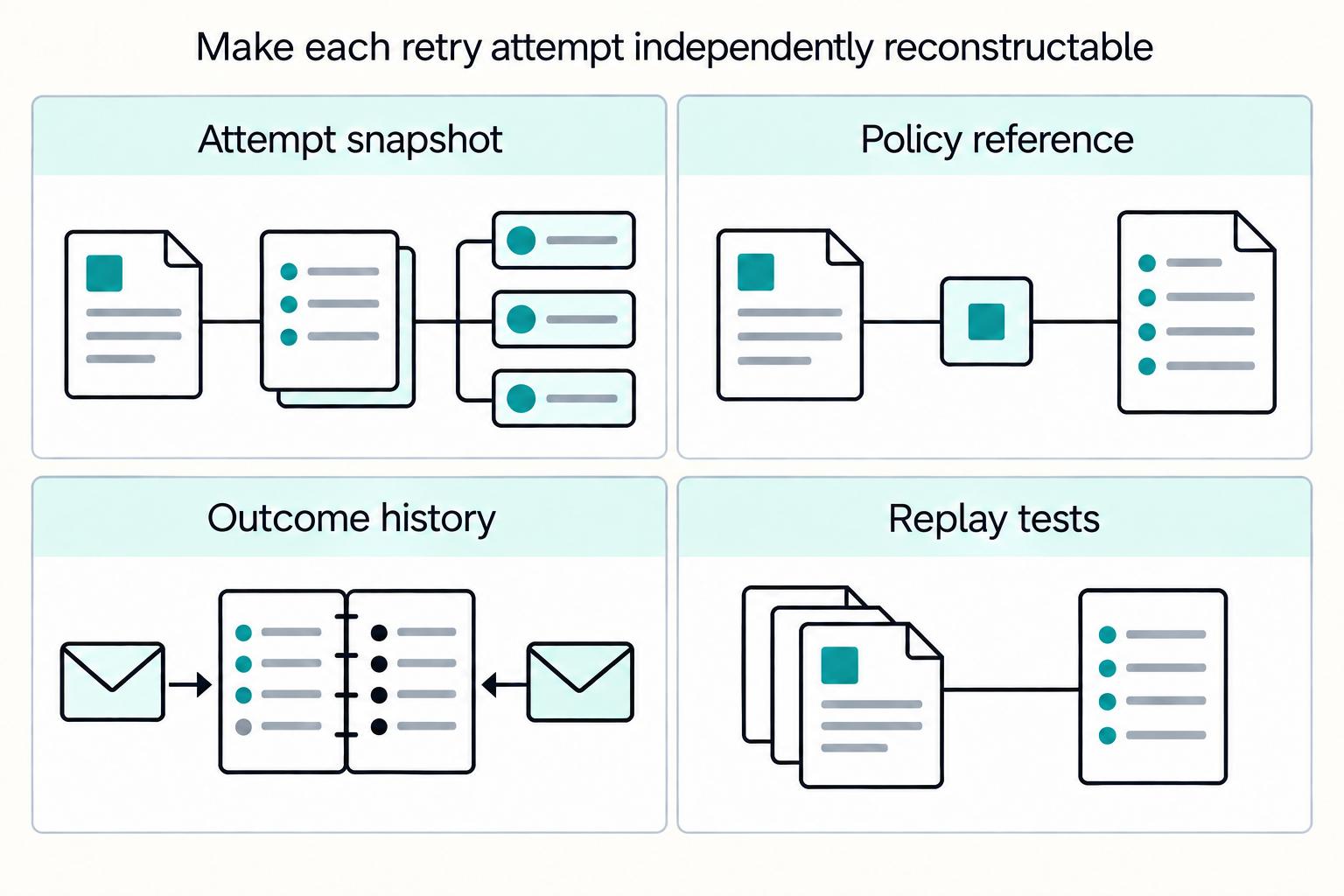
Your execution layer should make every retry reconstructable. If you cannot show what was sent, under which policy version, and what came back from the provider or issuer, you cannot reliably control retry risk.
Create a stateful attempt record#
Treat each retry as its own immutable attempt record. Stripe's PaymentIntent model is a useful reference because it keeps payment state and attempt history tied to one lifecycle. Your internal model should aim for the same traceability, even if provider behavior differs.
Capture these fields when the retry is created:
- internal attempt ID and parent payment ID
- transaction parameters, including amount, currency, and payment method type
- chosen route or processor
- retry reason and eligibility decision
- policy version or rule ID
- provider idempotency key and request timestamp
After send, do not mutate the snapshot. If amount, currency, payment method or route changes, reassess eligibility and create a new attempt record only when a new authorization is permitted; reuse the original key only for an unchanged transport replay.
Persist request and outcome events with timestamps#
Store outbound requests and inbound outcomes with their event and receipt times; webhook delivery can be duplicated or out of order. Verify the provider signature, durably store or enqueue the accepted event, then return 2xx quickly before complex processing. If durable acceptance fails, do not acknowledge success. Deduplicate processing and reconcile state rather than treating arrival order as the financial sequence.
Persist the decline fields you receive, including issuer or network response data when present. Preserve raw codes as strings with their scheme, processor and field name, and handle nulls. Numeric labels can mean different things across networks and mappings; do not infer eligibility from a bare code.
A useful standard for disputes is simple: finance ops should be able to open one payment and see a clear timeline of retries, outcomes, and final state without stitching multiple systems by hand.
Mask sensitive fields, keep useful metadata#
Keep audit metadata, not sensitive payloads. Good metadata examples are policy_version, retry_rule_id, internal_attempt_id, and route tags.
Do not store card or bank account details in metadata or retry logs; use token references. For PAN display, PCI DSS normally limits visibility to the BIN and last four digits, with a documented business justification and approved access for more. Display masking is separate from the requirement to render stored PAN unreadable; neither permits storing sensitive authentication data in retry logs.
Add deterministic replay tests#
Make replay safety a release gate. The rule is simple: the same idempotency key with the same inputs must not create duplicate financial movement.
Test at least:
- same idempotency key, same parameters, repeated send
- same key, changed amount or currency
- same key, changed payment method
- route change with a new attempt record and a new idempotency key
- replay after timeout or server error
Pass only when unchanged transport replays create no additional financial operation, and each genuine business retry is a separately permitted authorization. Also test concurrent workers, duplicate and out-of-order webhooks, and a timeout followed by late success: unknown outcomes must not trigger a second authorization. Keep a durable mapping from parent payment to attempts and provider keys. Stripe permits keys up to 255 characters and can prune them after at least 24 hours; your platform outcome record must survive that window.
Step 5 apply scheme and customer guardrails before scaling volume#
Before you optimize recovery, make your scheduler enforce guardrails. If a retry is ineligible by scheme rules or creates avoidable financial, operational, or reputational risk, block it even when your model predicts lift.
Encode scheme-specific counters#
Enforce retry limits at retry creation time, with separate counters by scheme and by CIT or MIT where required.
| Scheme path | Track in scheduler | Enforce |
|---|---|---|
| Visa CIT | Separate rolling customer-initiated counter | Category 1: do not reattempt. Hold missing required guidance; use the actual processor field mapping and current acquirer limits. |
| Visa MIT | Separate rolling merchant-initiated counter | Checkout.com notes 20 applicable retries in rolling 30 days from May 19, 2025, excluding do-not-retry cases; verify your acquirer and transaction scope. |
| Mastercard | Same-card 24-hour and rolling 30-day counters | Documented MAC 03 and 21 block retry; MAC 24 requires one-hour delay. Checkout.com examples are 10 in 24 hours and 35 in 30 days; verify scope. |
Your attempt record should include scheme, CIT/MIT, rolling counter values, and the issuer or network advice field used for the decision. Without those fields, you cannot reliably prove why a retry was allowed.
Cap customer friction and stop non-retryable paths#
Repeated soft declines are a signal to slow down, not keep knocking. Cap retry frequency after repeated soft declines, then switch to customer remediation, for example failed-payment outreach that points the customer to update payment details.
Treat hard declines as non-retryable on that payment method. A verified payment-data correction can trigger a fresh eligibility assessment, but must not bypass cancellation, do-not-retry advice or remaining policy limits.
When recovery lift conflicts with compliance or financial, operational, or reputational risk, choose the lower-risk behavior and log the exception with the policy version and reason.
Related reading: How to Build a Payment Sandbox for Testing Before Going Live.
Step 6 decide build vs buy with explicit tradeoffs#
Choose buy-first when speed and operational certainty matter most. Choose build-first when retry logic and processor routing are core product IP and you are prepared to own them. A smart-retry API can accelerate launch, but it does not remove your policy ownership.
Vendor timing tools can simplify implementation. Stripe Billing Smart Retries documents a recommended default of 8 tries within 2 weeks for its supported subscription and invoice flows; that is a product-specific trial baseline, not a universal retry policy. You still need controls for hard versus soft declines, eligibility, network limits, overlapping schedulers and customer friction.
Use this decision test#
| Decision area | Buy first when this is true | Build first when this is true |
|---|---|---|
| Timeline | You need recovery gains quickly and want to avoid a long internal build for timing logic | You can absorb a longer delivery cycle and fund ongoing data and infrastructure work |
| Control | Vendor timing is acceptable because you can still enforce your own policy layer | You need retry behavior tightly coupled to your own payment and product flows |
| Data portability | Available vendor attempt and decision data is sufficient for your audit and analysis needs | You need full control of decision inputs, outputs, and history in your own stack |
| Incident ownership | You want lower model and platform burden while keeping local policy exceptions | You are ready to own mapping quality, model performance, and on-call reliability end to end |
Do not outsource policy logic by accident#
Even with vendor timing, enforce the applicable network constraints before creating an attempt. Interpret decline and advice fields using the actual scheme and processor mapping, then apply the current acquirer-approved limits for the region and transaction type. Block ineligible retries by category, customer instruction and counter state; vendor timing does not reopen a stopped payment.
Be honest about build ownership#
In-house gives you flexibility, especially when routing and orchestration are strategic. It also requires sustained ownership across software engineering, payments, fraud and risk context, large datasets, data latency, and system performance, not just model training. Before committing, confirm you can reliably record the decline signal, any advice signal, chosen retry time, policy version, route choice, and allow or block reason for every attempt.
If you need clean retry reconciliation across attempts, recoveries, and reversals, see How to Build a Deterministic Ledger for a Payment Platform.
Before committing to build or buy, validate your retry architecture, idempotency behavior, and event surfaces against the Gruv docs.
Step 7 operate, measure, and tune without fooling yourself#
Intelligent retry timing works best when you run it as an operating discipline, not a success story. Use a balanced scorecard, segment results by failure cohort and processor path, and keep a real control before broad rollout.
Track balanced outcomes, not just recovered dollars#
Start with the core recovery KPIs: failed payments, failure rate, recovered payments, and recovery rate. Those show whether failed volume is actually being recovered, and recovered-payment volume is a direct check on whether your strategy is adding value.
Then add business-health guardrails beside gross recovery, including dispute and chargeback levels. If recovery rises while disputes rise, that is not a clean win. There is no universal formula for "net recovery quality," so define your internal scorecard once and keep it stable across tests.
Break out results by decline cohort and processor path#
Do not trust aggregate lift alone. Report results by decline cohort using decline codes and network decline codes where available, so you can see how outcomes vary across failure types.
Do the same for routing. If you run cross-processor retries, tag each attempt with original processor, retry processor, and whether the retry stayed on the same path or moved.
At minimum, each attempt record should include:
- attempt ID plus customer or invoice reference
- decline code and network decline code, if present
- retry strategy or policy version
- timing mode, such as
Basic retriesversus ML timing - processor path, including a cross-processor flag
- final outcome, such as recovered, failed, disputed, or canceled
Test against Basic retries before broad rollout#
Keep a control path. Run A/B tests that send a defined share of traffic to the new timing logic and the rest to your current baseline, usually Basic retries.
Let tests run long enough to capture billing behavior, often days or weeks rather than a single-day snapshot. Review outcomes by decline cohort and processor path, not only top-line recovery rate.
Tune on a recurring cadence and avoid reactive edits#
Set a recurring review cadence for model and policy updates, and use the same evidence pack each cycle. Recalibrate with controls instead of ad hoc edits after one noisy week.
Avoid changing timing, routing, and messaging all at once when you evaluate performance. Isolating changes helps avoid false attribution.
Common implementation mistakes and fast recovery actions#
If retry performance is weak, do not tune timing first. Fix decline classification, replay safety, local validation, and terminal-state handling before you push timing logic harder.
Step 1 split soft declines into real eligibility buckets#
Treating all soft declines as one retryable pool is a core mistake. Soft declines are temporary, but issuer and scheme response signals still point to different failure causes, and some scheme-code outcomes should not be retried.
Recover by rebuilding eligibility from issuer and acquirer response codes, not a single soft-decline label. Verification point: each attempt should retain the processor decline code, issuer or acquirer response signal, and the policy rule that allowed the retry.
Step 2 enforce idempotency before expanding cross-processor retries#
Routing-first optimization without replay and outcome controls creates duplicate-charge risk. Expand only after provider-scoped keys, parent-payment execution ownership and unknown-outcome holds pass the relevant tests.
Pause route expansion until replay and concurrency tests pass. An unchanged transport replay must not create another financial operation, and late or unknown upstream outcomes must block a new authorization. A genuinely eligible fallback uses its own attempt and key under the same parent payment.
Step 3 test vendor claims against your own retry baseline#
Vendor uplift claims are useful for prioritization, not approval. Provider guidance emphasizes merchant-specific experimentation, so treat benchmark results as hypotheses.
Run controlled tests against your current retry baseline, segmented by decline cohorts and routing paths. Stripe Billing Smart Retries recommends 8 tries within 2 weeks for its supported subscription and invoice flows; use that scoped default as a hypothesis, not proof for your mix.
Step 4 add hard-stop logic for hard declines#
Hard declines stay stopped pending verified remediation and a fresh eligibility assessment. A continuing do-not-retry instruction or cancellation remains binding even if payment details change.
Recover by enforcing terminal states in code and routing customers to remediation instead of silent reattempts. This reduces inflated decline ratios and lowers exposure to excessive-retry compliance risk, especially since Visa and Mastercard retry ceilings can vary by provider setup and should be revalidated in your stack.
Your next step with a copy-paste launch checklist#
If you only do six things before launch, do these. The goal is simple: make retries policy-safe, duplicate-safe, and measurable before you increase volume.
- Define eligibility before tuning timing.
Treat soft declines as candidates only after eligibility checks. A new payment method or corrected account state prompts reassessment of a hard decline, without overriding cancellation, do-not-retry advice or counters. Store the raw decline, scheme, processor, field name, issuer response, advice and the rule ID that allowed or blocked the retry.
- Encode scheme limits in the scheduler, not in a wiki.
Use scheme-specific counters and preserve the acquirer-approved rule version in configuration. Checkout.com guidance lists 20 applicable Visa retries in rolling 30 days from May 19, 2025, excluding do-not-retry cases and with separate CIT and MIT counters; Mastercard examples are 10 in 24 hours and 35 in rolling 30 days for the same card, excluding non-retryable advice. Verify your own scope before adopting these values. In the documented Mastercard advice mapping, 24 means wait one hour and 25 means wait 24 hours; do not apply those numbers to a different network or response field.
- Ship idempotent execution and traceable events first.
Make unchanged transport replays idempotent before scaling. Keep provider keys on immutable attempt records linked to a stable parent payment, use one execution owner and hold unknown outcomes before any new authorization. Retain platform records for reconciliation beyond provider key windows: Stripe can prune keys after at least 24 hours, so 24 hours is not a durable duplicate-prevention guarantee. Log request time, route, policy version, issuer responses and final outcome.
- Run an A/B against
Basic retriesand judge recovery quality, not just lift.
Use your current retry logic as the control and define the trial window and required sample volume before starting, covering the relevant billing and retry windows. Report first-attempt authorization rate separately from all-attempt success, recovery, fees, disputes and duplicates; do not improve a metric by silently excluding failed retries. If lift only comes from more attempts while net recovered value, duplicate risk or remediation outcomes worsen, it is not a win.
- Choose build vs
Smart retriestooling by ownership capacity.
Buy when speed and operational maturity matter most, especially when platform tooling lets you enable smart retries or custom schedules without code. Build when you can own decline mapping, counter enforcement, idempotent execution, experiment design, and incident response over time. Do not decide from vendor headline claims alone.
- Publish a regular review with explicit rollback triggers.
Set a review cadence that fits your operating model (for example, weekly) and review eligibility changes, counter breaches, duplicate-risk incidents, control versus treatment recovery quality, and new do-not-retry patterns. Set rollback triggers before launch: idempotency failures, retries past configured counters, or treatment underperforming control on net recovery quality.
If you want a rollout-readiness check on policy gates, routing, and auditability for your market, start with a focused review via contact.
Frequently Asked Questions
What is intelligent payment retry timing?
It is a governed approach to failed payments that uses rules or machine learning to choose timing for eligible retries. Policy first excludes non-retryable cases and enforces issuer, network and provider limits. Routing can change only when supported and separately permitted; ML does not override those controls.
How does machine learning choose retry times better than fixed schedules?
A fixed schedule applies the same timing pattern to eligible failures. ML-based timing ranks allowed windows using dynamic signals. Whether that improves recovery over uniform delays must be tested against your baseline, including fees, customer friction and duplicate risk.
What signals matter most for retry timing?
Start with decline codes and any advice or issuer guidance, preserving the scheme, processor and field name. Apply the corresponding eligibility rules and counters before selecting timing. Use provider keys for unchanged transport replays, a stable parent payment record and one execution owner; hold unknown outcomes before authorizing a new attempt.
When should you not retry a failed payment?
Do not retry confirmed hard declines, non-reattemptable categories or policy-blocked scenarios. Visa Category 1 means do not reattempt; interpret other numeric fields using their actual processor mapping. Hold unresolved outcomes and missing required guidance. Stop at applicable ceilings or when customer remediation is required; remediation prompts reassessment rather than overriding a continuing stop.
How many retries are too many?
Retries are too many when they exceed applicable rules or add cost and customer risk without recovery benefit. Checkout.com guidance notes a Visa allowance of 20 retries in a rolling 30 days from May 19, 2025 for applicable cases, excluding do-not-retry outcomes and with separate CIT and MIT counters. It lists Mastercard limits of 10 in 24 hours and 35 in 30 days for the same card, excluding non-retryable advice. Verify your processor, acquirer, region, transaction type and current rule version before configuring those examples.
Should we build in-house or use a smart retries API?
There is no single best answer. A smart retries API can reduce implementation burden, while in-house logic can be appropriate when custom routing and control are strategic. Sources support both custom retry schedules and AI-driven smart retry, and note that building equivalent optimization internally can be time-consuming and technically complex.
Do cross-processor retries always improve recovery?
No. They can help when a prior failure is confirmed, another route is eligible and the provider supports it. A timeout or unknown result must be resolved before a new authorization. Provider idempotency keys are not global across processors: retain a parent payment record, serialize execution and recheck policy before creating a distinct fallback attempt.
Researched and edited by the Gruv editorial team. Gruv builds cross-border billing, payouts, and finance-operations software for global businesses.
Sources
Includes 3 external sources outside the trusted-domain allowlist.
- developer.paypal.com/braintree/articles/control-panel/transaction...trusted
- docs.stripe.com/billing/revenue-recovery/smart-retriestrusted
- docs.stripe.com/api/idempotent_requeststrusted
- paypal.com/us/brc/article/avoid-excessive-retries-penal...trusted
- stripe.com/blog/how-we-built-it-smart-retriestrusted
- developer.mastercard.com/mastercard-send-disbursements/documentation/...external
- developer.visaacceptance.com/docs/vas/en-us/payments/developer/ctv/rest/p...external
- developer.visaacceptance.com/docs/cybs/en-us/api-fields/reference/all/so/...external
Educational content only. Not legal, tax, or financial advice.
Related Posts

The Freelance Payment Penalty: A Modeled Audit of Platform Fees, FX Spreads, and Payout Delays
The money rarely disappears through a single, easy-to-spot fee. The real loss is stacked. A marketplace takes its commission, a processor adds a charge for international cards, a bank or payment company converts the currency at a spread, a platform holds the funds before release, and a wire sheds a little to intermediaries on the way in. Each layer looks defensible on its own, but the worker feels the combined result as a smaller deposit and a later payday.

How to Respond to a Subpoena for Business Records
Move fast, but do not produce records on instinct. If you need to **respond to a subpoena for business records**, your immediate job is to control deadlines, preserve records, and make any later production defensible.
A US Expat's Guide to Investing in UCITS ETFs to Avoid PFIC Issues
The real problem is a two-system conflict. U.S. tax treatment can punish the wrong fund choice, while local product-access constraints can block the funds you want to buy in the first place. For **us expat ucits etfs**, the practical question is not "Which product is best?" It is "What can I access, report, and keep doing every year without guessing?" Use this four-part filter before any trade: