

Quick Answer
Separate the decision into recognition software and payout execution, then buy only after operating proof is on the table. Ask for a country-by-method matrix, a reconciliation export with payout IDs and provider references, and clear cost drivers beyond per-reward pricing. Runa and Tremendous both show broad option coverage publicly, but those disclosures do not confirm your exact market-method path. Pick the vendor your finance team can model, your product team can instrument, and your support team can run when failures occur.
What changes when recognition payouts scale#
Treat recognition software and payout delivery as two separate buying decisions. If your team will own disbursement outcomes, start with finance and operations, not the reward catalog. That matters even more for global programs, where cross-border execution, multi-currency budgets, and payout-choice expectations can turn a simple recognition launch into a margin and support problem.
Tremendous offers gift cards, prepaid cards, monetary options and donations. Runa Payout Link lets a sender deliver a balance for recipient redemption. Runa currently advertises reach across 190 countries and funding in 30 currencies; Tremendous pricing lists 2,500+ reward options. These are catalog and network disclosures, not proof that every method is available for a particular employee, country or program.
That is why this article looks at these options through a finance and operations lens, not a feature-list lens. A vendor can look strong because it has a large reward count, familiar brands, or polished recognition workflows. None of that tells you enough about payout method depth, FX exposure, reconciliation effort, or what happens when a recipient needs a locally relevant option instead of a gift card. Before you get attached to any platform demo, ask for three concrete things:
- A country-by-method support matrix, not just "global" coverage language. You want to see where gift cards, wallet-style options, prepaid cards, bank or debit transfers, and recipient-choice flows are actually supported.
- A sample audit and reconciliation pack. At minimum, that means payout IDs, provider references, status changes, and an export finance can tie back to program events.
- Commercial detail beyond per-reward pricing. If your economics depend on cross-border delivery, you need to understand what drives cost when recipients choose different methods or when only part of an issued balance is used.
A common failure mode is buying for recognition UX first, then discovering later that broad catalogs do not always equal reliable disbursement coverage, or that finance cannot model gross-to-net payout cost by market. Support load can rise when recipients cannot redeem through a preferred method, and the cleanup often lands with product, HR, and finance together.
The goal here is simple: help you decide which option fits your monetization model, operating capacity, and cross-border payout reality. We will compare recognition vendors and payout infrastructure on the things that actually determine whether the program scales cleanly: coverage depth, unit economics clarity, integration ownership, reconciliation controls, and failure handling.
Who this list is for and how we will judge options#
This list is for teams that own payout outcomes after a reward is issued, not just recognition UX. It is built for founders, product leaders, and finance operators choosing between recognition-led tools like Kudos and payout-led infrastructure like Runa for HR, which is positioned around real-time payouts for HR platforms.
| Criterion | What it covers |
|---|---|
| Payout coverage depth | Whether the vendor can show country-by-method support for the payout types you need. |
| Unit economics clarity | Whether finance can model cost drivers before launch instead of learning them in production. |
| Integration effort | What product and engineering must build, test, and maintain. |
| Reconciliation controls | Whether program events can be tied to payout records with usable exports and references. |
| Failure handling | What support and resolution look like when payout events do not go as expected. |
Those five criteria run through every option in this list.
Recognition products help teams acknowledge and reward employee behavior. Their category label does not establish who owns disbursement, reporting or recipient support.
That split matters in practice. Bonusly is positioned around peer recognition with points redemption, and Achievers emphasizes engagement, retention, and performance outcomes. If your goal is mainly culture and engagement, those tools may fit. If you own disbursement outcomes, validate payout evidence early with concrete operating proof.
Related: How to Create an Employee Recognition Program.
Best employee recognition payout options by operating need#
If your team owns reward delivery, map the required recognition and payout responsibilities first. Compare candidates against both sets of requirements before procurement.
| Option | Best for | Publicly disclosed endpoint types | Global coverage disclosure | Integration ownership clue | Reconciliation evidence on cited pages | Commercial model clarity on cited pages |
|---|---|---|---|---|---|---|
| Runa | Candidate for embedded recipient choice, subject to market and program verification | Gift cards, bank transfers, and open-balance choice via Runa Payout Link across currencies, brands, and payout types | Payout Link advertises 190 countries and funding in 30 currencies; confirm each payout method | "One integration and contract" | Not shown in cited pages | Limited in cited excerpts |
| Tremendous | Candidate for incentive-catalog rollout | Gift cards, prepaid cards, monetary options, and donations | Worldwide positioning, but no country-by-method matrix in cited pages | Reward and payout scope is clear; detailed ownership model is not | Pricing lists financial reporting reconciliation; inspect the actual export | No platform/subscription fees; monetary and credit-card funding charges disclosed |
| Kudos plus payout partner | Recognition-first stack with partner-led rewards | Depends on partner; not established on the cited Kudos page | Not established on cited page | Kudos-side HRIS integration is clear; payout responsibilities must be mapped separately | Not shown in cited pages | Depends on partner structure |
| Recognition-suite cohort | Engagement-first shortlist building | Vendor-specific reward catalogs; inspect methods rather than counting options | Uneven from cited sources | Requires vendor-specific diligence | Not shown in cited pages | Uneven from cited sources |
- Evaluate Runa when you need embedded recipient choice. Its Payout Link workflow supports sending a balance for recipient redemption. Confirm program eligibility, exact countries and methods, available status records and contractual responsibilities before comparing it with other candidates.
Use a hard gate before selection: request country-by-method coverage for your launch markets and a sample payout-status export. The open issues in the cited material are cost and implementation detail.
- Evaluate Tremendous for an incentive catalog with API access. Its current pricing lists 2,500+ reward options, including gift cards, prepaid cards, monetary options and donations. Catalog size does not establish implementation speed.
Its pricing page lists reward tracking and financial reporting reconciliation. Inspect those exports, controls and API behavior against your own close requirements before selection.
- Kudos plus a payout partner fits teams that prioritize recognition UX first. The cited proof is on HR system connectivity: Kudos states it integrates easily with HRIS platforms.
Treat payout as a separate diligence track. Before you sign, define ownership for payout IDs, exception handling, and ledger-ready exports if finance close requirements are in scope.
- Use recognition suites to form an engagement-focused shortlist. Compare the actual recognition workflow, then verify the payout responsibilities and evidence for each shortlisted vendor.
Still, the cited sources do not establish equivalent disbursement rails, reconciliation depth, or commercial mechanics across the cohort, so move vendors forward only after payout-specific proof.
Payout coverage details that matter more than reward count#
Reward count is a weak selection filter. Coverage is about which payout methods work in each market, with clear caveats when a method is unavailable.
- Start with endpoint types, then assess scale.
Compare the actual method classes for each candidate: gift cards, prepaid cards, local bank transfers, card payouts and recipient-choice balances where supported. Runa and Tremendous offer different choices by program and market. Require the provider to confirm each launch corridor rather than assuming its full network is available through one integration.
- Treat catalog brands as appeal signals, not disbursement proof.
Brands such as Edenred, Sodexo, Pluxee, and Perkbox can help with recipient appeal, but they do not prove payout reliability. Reward Gateway's recipient messaging focuses on where rewards can be spent or redeemed, and Pluxee messaging emphasizes merchant-network usage. That is useful for catalog evaluation, not settlement behavior, exception handling, or reconciliation quality.
- Require country-by-method matrices before rollout.
Ask vendors for dated support tables by method class and country, with explicit "where supported" notes. For Tremendous, include redemption-region behavior (options shown by recipient country) and restricted-country caveats tied to banking regulations. This avoids launching on broad claims like "more than 200 countries" or "2,000+ options" and then discovering method gaps at redemption.
| Vendor or layer | Launch markets | Blocked markets | Fallback methods | User communication rules |
|---|---|---|---|---|
| Runa | Only recipient/country combinations where the required payout method and program are vendor-confirmed | Not established publicly by country in the cited pages | Use Runa Payout Link where supported to preserve recipient choice across payout types | Do not promise the same method everywhere |
| Tremendous | Only countries where the needed option class is confirmed at redemption | Require the restricted-country list because some sends are prohibited by banking regulations | Expect country-dependent option sets and define an alternate method before launch | Tell recipients options may vary by country and are shown at redemption |
| Catalog-brand layer only | Treat as non-launch proof until the payout provider confirms send capability | Unknown until the underlying provider shares support tables | Use another verified method or exclude the market | Say where rewards can be redeemed, not that payout is available in all markets |
Related reading: Accounts Receivable Automation for Platforms to Collect from Enterprise Buyers at Scale.
Unit economics and pricing tradeoffs before you sign#
Price the exact payout paths you plan to use, not a headline per-reward fee. If finance cannot model gross-to-net payout cost by segment, pause selection even if a vendor scores well in recognition-market evaluations.
- Funding flow can be the first hidden fee.
Per-reward pricing is only one layer. Tremendous publicly says "No minimums or subscriptions," but it also says credit cards may incur a 3% processing fee, so unit economics can change before disbursement starts. Keep funding method and payout method separate in your model, and ask for a sample invoice or fee exhibit that breaks out card funding, payout charges, and other transaction lines.
- Payout method mix usually drives more cost than the platform headline.
Public pricing can vary sharply by method: gift cards, prepaid cards, or donations are listed as free, while Venmo, PayPal, Cash App, and bank transfers may incur a 4-6% fee. Model your likely future mix by country, payout type, and funding method before approval, especially if you may add more cash-like options over time.
- Cross-border and FX costs can stack across the flow.
Stripe Global Payouts provides a separate pricing example, not a quote for a recognition vendor. Its cross-border pricing includes the sender-country standard payout fee, a destination-dependent 0.25–1.25% cross-border fee, and FX charges where conversion occurs. Conversions between USD, EUR and GBP add 0.50%; other conversions are 1% for US senders or 2% for non-US senders. Intra-Eurozone transfers have no cross-border fee but retain the standard payout fee. Model only the eligible sender, destination and currency path you would actually use.
- Operational overhead belongs in total cost, even when not shown as a fee line.
Support and reconciliation work affect margin. Tremendous explicitly references a "Dedicated recipient support team" and "Financial reporting reconciliation," so treat those as evaluation items, not back-office assumptions. Request a current pricing sheet or contract exhibit, a sample reconciliation export, and an exceptions list for failed or delayed rewards.
| Cost factor | Public signal you can use now | What to model before signature |
|---|---|---|
| Fixed fees | Tremendous says "No minimums or subscriptions." Public pages for other vendors may not disclose minimum commits. | Separate platform access cost from transaction cost. Mark non-public contract terms as unknown until paper review. |
| Variable fees | Tremendous monetary options may incur 4–6%; gift cards, prepaid cards and donations have no sending fee. Confirm who bears the fee and any minimum. | Build segment models by payout type, currency, and average reward value. |
| FX treatment | Stripe Global Payouts separately charges a standard payout fee, applicable cross-border percentage and conversion charge; it is a different product from Stripe Connect. | Map each currency handoff from funding to recipient receipt. Do not assume a single conversion event. |
| Contract lock-ins | Public pricing may show no subscription, but often does not confirm minimum commits, term length, or termination rights. | Require contract review before final selection. Treat unknown lock-ins as commercial risk. |
| Operational overhead assumptions | Some vendors explicitly mention recipient support and financial reporting reconciliation. | Estimate support touch rate, finance review time, and exception-handling cost per 1,000 payouts. |
Compare a recognition suite with integrated rewards against a separate recognition-and-payout stack using the same countries, methods, implementation work and support assumptions. The right structure depends on the program; neither category alone establishes launch speed or margin.
Include employer payroll and tax responsibilities in the program design. For US employees, IRS Publication 15-B states that cash and cash-equivalent rewards such as gift cards are not excludable as de minimis benefits, regardless of amount. Taxable employee benefits generally require payroll reporting and applicable employment taxes; a reward provider’s W-9/1099 tooling does not replace employee wage reporting. Assign the employer/payroll owner to value and report rewards, decide any gross-up and handle corrections. Verify local treatment for other countries before rollout.
Integration ownership and implementation order for product and finance#
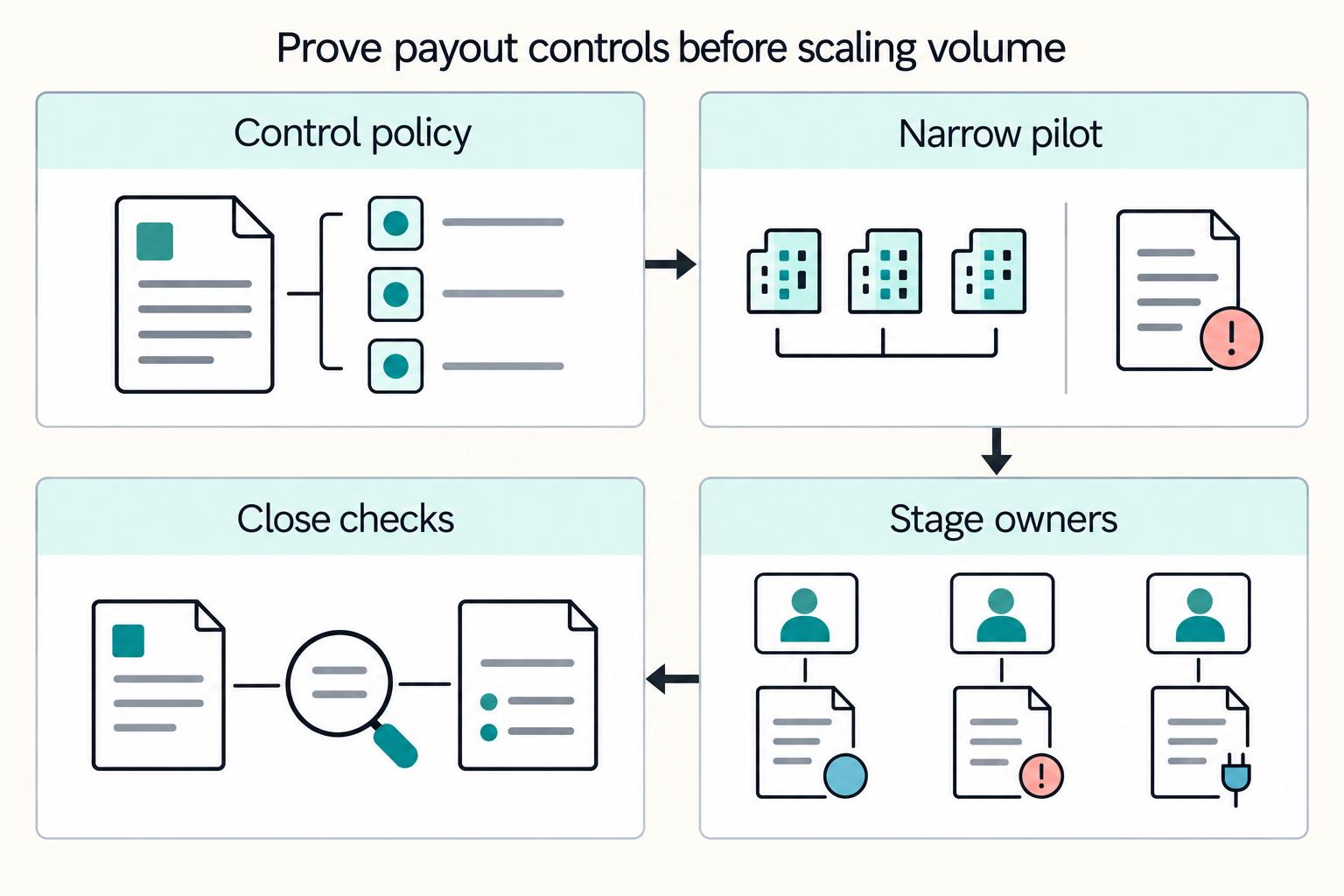
Assign ownership before vendor selection, or integration risk will spill across teams. Define who owns payout initiation, status truth, exception triage, and month-end reconciliation before any API work starts.
- Set owners by payout moment, not department label.
Product should own when a reward becomes payable and what users see at each status. Engineering should own request handling, retry safety, webhook consumption, and status mapping. Finance should own exception rules and close-period reconciliation. A short ownership map for initiation, async status updates, failed or delayed payouts, and reconciliation is usually enough to expose gaps early.
- Require proof of retry safety and webhook reliability.
Persist one authorized reward obligation and its request identifier before sending. Tremendous order creation uses a stable external_id: the same identifier and payload returns the existing order, while conflicting parameters return 409. A funding top-up key alone does not prevent duplicate rewards. Verify signed webhooks, durably store each event once and then acknowledge it; process it asynchronously and deduplicate Tremendous events by uuid. Its webhook documentation expects HTTP 200 and retries up to 17 times. A delivered webhook proves delivery of an event, not that an employee received funds. If an order outcome is unknown, retrieve it by the original reference or investigate with the provider; do not issue a fresh reward or switch providers until you establish that the first obligation was not paid.
- Sequence rollout in stages, then expand to recognition tools.
Start with sandbox testing, then a limited pilot, then production guardrails, then broader rollout into tools like Kudos or Awardco. Tremendous documents a fully featured Sandbox and an explicit switch to production credentials when ready to go live, and Stripe test keys are intended for testing without affecting live data. In sandbox and pilot, test failure paths, simulate webhook events, and confirm your endpoint returns success codes consistently. Expand only after your team can trace each initiated payout to final status without manual stitching across messages and spreadsheets.
For a step-by-step walkthrough, see Automating B2B Rebate Calculations and Disbursements for Platforms.
Controls and audit evidence your finance team will ask for#
Your setup is ready to launch when each recognition event is authorized, traceable through delivery and redemption, reportable, and supported by documented cancellation or recovery limits. A completed payout may be irreversible; operational recovery is not a promise that funds can be recalled.
| Artifact | Why it matters |
|---|---|
| Payout request trail | Lets the team trace one reward from request to payout. |
| Provider reference mapping | Helps verify each handoff has an external reference. |
| Ledger-ready exports | Supports reporting without spreadsheet stitching. |
| Reversal handling | Documents cancellation, refund and recovery limits for each status and method |
| Exception logs | Provides evidence for investigating payout issues. |
- Ask for an audit evidence pack, not just a dashboard.
Request five artifacts up front: payout request trail, provider reference mapping, ledger-ready exports, reversal handling, and exception logs. If the vendor affects controls tied to your financial reporting, ask whether they have SOC 1 coverage or a clear plan to obtain it. A quick test is to trace one reward from request to payout and verify each handoff has a timestamp, actor, amount, and external reference.
- Prove approval controls before high-value rewards go live.
Do not assume a recognition suite has the approval behavior you need. Confirm who can approve, whether approval responsibility is explicitly assignable, what happens when an approver is unavailable, and whether edits after approval trigger re-approval. Treat it as a control gap if a requester can bypass approval or if the trail does not preserve the original amount and approver.
- Reconcile by payout method and partner, not by catalog size.
Method breadth increases control complexity, so finance needs method-level evidence instead of a single "rewards sent" total. If your catalog includes partners such as Edenred or Pluxee, confirm how each payout appears in exports and whether cards, wallets, and prepaid rails follow the same reconciliation path or separate ones. Also verify that reports include refunds, deposits, and order payments, since those are core reconciliation inputs.
- Set a hard go-live gate tied to close readiness.
Do not launch until finance can tie a program event to the disbursement event and close the reporting loop without manual patchwork. In practice, test webhook event notifications over HTTPS, match those events to payout reconciliation batches or CSV exports, and then to ledger posting. Include at least one exception case, for example a reversal or failed payout, in pilot validation.
If control design is part of your rollout, see Internal Controls for AP Platforms to Prevent Fraudulent Disbursements.
Failure handling and support model before scale#
If you cannot classify, measure, and route payout failures, keep the program in pilot.
| Failure test | Grounded example | What to verify |
|---|---|---|
| Expired links | Provider-confirmed expired or invalid redemption link | Verify the user message, internal status, retry behavior, and whether finance can match the same external reference in exports. |
| Endpoint eligibility failures | A method unavailable for the recipient, country or card | Verify the user message, internal status, retry behavior, and whether finance can match the same external reference in exports. |
| Delayed provider recovery | Provider-confirmed pending or unknown outcome | Verify the user message, internal status, retry behavior, and whether finance can match the same external reference in exports. |
| Duplicate retries | Duplicate requests and webhook redelivery for the same obligation | Verify the user message, internal status, retry behavior, and whether finance can match the same external reference in exports. |
- Run four failure tests before launch.
Test expired links, method ineligibility, provider delay and duplicate requests. Use the chosen provider’s documented errors and recovery rules rather than borrowing codes from another product. For each case, verify the user message, original obligation and external reference, permitted action and finance export. A delay is not a confirmed failure; prevent reissue while the original payment may still complete.
- Compare support posture by post-complaint actions, not marketing claims.
For each provider and method, document whether edit, resend, cancel or refund is permitted before delivery, claim or redemption, and what happens to funded balances. Ask support to demonstrate those actions and their reconciliation records. Treat a fallback as a new payment only after the original obligation is conclusively unpaid or canceled; sending another link to the same reward is a different operation.
- Set escalation by failure class and make triage measurable.
Assign one owner per failure class: duplicate-request risk goes to engineering for identifier and event checks; provider delay or unknown status stays under timed investigation; a lost or expired link follows the existing reward’s documented resend path; and confirmed unrecoverable exceptions go to finance for the appropriate accounting decision. Preserve the obligation and provider references throughout. Track open failures by class, age and owner before expanding globally.
Conclusion#
-
Choose economics with method-level evidence. Tremendous lists 2,500+ reward options, but catalog size does not reveal the cost of a particular funding and redemption path. Model fees, minimums, who bears them, FX and tax-related program costs before signature.
-
Treat failure handling as a launch blocker, not a later cleanup item. Coverage claims can sound strong across many countries and currencies, yet the practical question is what happens when a payout cannot complete. Payouts have real failure states, and some can be held for review rather than paid out externally, so you need the vendor to show status definitions, freeze or review logic, and who owns communication when something stalls. A common risk is approving a provider because the happy path looks polished, then finding gaps in failure operations once the first batch breaks.
-
Make audit evidence part of vendor selection, not contract fine print. The winning choice is the one that gives finance a way to match payouts back to the transactions they relate to, with security and compliance evidence included in the selection process. Your RFP should force detailed, comparable answers, not broad claims. Ask for sample reconciliation outputs, the fields used to tie payout records to underlying transactions, and the exact evidence pack your team will rely on at month end.
That last point is often where weak options get exposed. A provider may have broad reward choice, but if it cannot give you payout-to-transaction mapping and exports that support close, the operational burden shifts back to your team. You can end up stitching together dashboards, invoices, and exception emails by hand. That is exactly the kind of invisible cost that makes a program look cheaper than it is.
So use this list to narrow the market, then force proof where it matters most: economics, controls, and operating reliability. Ask direct questions, require artifacts, and verify them with a pilot or live sample data set whenever possible. If pricing is still vague, or coverage is still described at a marketing level instead of method by market, treat that as risk now. It will not become simpler after launch.
Frequently Asked Questions
What is the difference between an employee recognition platform and a reward disbursement infrastructure provider?
Recognition software manages employee acknowledgement, program rules and reward experiences. Disbursement infrastructure executes the reward or payment and exposes its delivery and reporting records. A product may combine both; map contractual and operational responsibilities rather than assuming the label determines them.
When should an HR platform embed payout rails instead of offering gift-card-only rewards?
Embed rails when gift cards stop matching your use case: cross-border programs, configurable recipient choice, or a need to support more than one payout option. Provider docs show a practical distinction here because some let recipients choose across configured payout options rather than forcing a single reward type. A good checkpoint is whether you can get and verify a country-by-method support matrix before launch. One risk is selling "global choice" without verifying where a wallet, prepaid card, or ACH option is actually available.
Which payout methods are most practical for global employee recognition programs?
Choose methods that fit the employees and launch countries: gift cards, prepaid cards, local bank transfers and wallets where eligible. ACH is a US bank-transfer option, not a universal global rail. Require method-by-country and recipient eligibility evidence, plus a documented fallback that cannot duplicate an earlier payment.
What usually drives total cost in employee recognition disbursements at scale?
Total cost should include transaction-level payout costs, not just the visible reward fee. Finance should ask for reporting that shows costs at the transaction level, similar to a settlement details report, so you can see what each disbursement actually cost. If your team cannot model transaction-level payout cost by segment, pause selection even if the pitch looks strong on the surface.
How should finance teams reconcile recognition payouts across multiple providers?
Reconciliation should tie payout batches back to underlying transactions using downloadable reports and API-accessible payout details. In practice, your team should use provider reports to track and reconcile payout transactions across accounts and providers. The red flag is a provider that gives you only summary invoices or dashboard totals, because that makes it harder to close the books or investigate disputes.
What should be in an RFP for employee recognition payout infrastructure in 2026?
Include both functional and non-functional requirements: payout methods, configurable recipient choice, reconciliation outputs, plus security and compliance evidence. You should also ask how the provider safeguards sensitive data and how quickly it responds to incidents, because those are baseline payments questions, not nice-to-haves. For this category, add exact requests for method-by-market coverage, downloadable and API-based reconciliation data, and security/compliance documentation before you score finalists.
Try a related tool
Researched and edited by the Gruv editorial team. Gruv builds cross-border billing, payouts, and finance-operations software for global businesses.
Sources
Includes 5 external sources outside the trusted-domain allowlist.
- docs.stripe.com/workbench/event-destinationstrusted
- docs.stripe.com/global-payouts/pricingtrusted
- irs.gov/publications/p15btrusted
- achievers.com/blog/employee-reward-platforms-enterprise-hrexternal
- developers.tremendous.com/docs/introductionexternal
- developers.tremendous.com/docs/webhooks-1external
- gartner.com/reviews/market/employee-recognition-and-rewa...external
- gartner.com/reviews/product/bonuslyexternal
Educational content only. Not legal, tax, or financial advice.
Related Posts

5 Reasons Insurers Should Modernize Claim Disbursements with Digital Payout Platforms
Claims payouts are a visible part of the insurer’s service after a loss. Paper delivery, unclear status and payment reissues can add waiting and support work. Evaluate whether a digital payout model removes those specific frictions for your claimants.

How to Create an Employee Recognition Program for Distributed Teams
If your recognition program was built around office habits, it can miss people and create fairness problems. The problem usually is not intent. It is design. Recognition stops working when people do not experience it as fair, visible, and accessible.
Tipalti Payouts Explained for AP-Centric Supplier Disbursements
For platform teams, understanding Tipalti payouts means deciding which workflow to buy and who will operate it. Ask whether its AP or Mass Payments product fits your approvals, reconciliation needs, payee experience, and launch countries. The product name alone does not establish that scope.