
Quick Answer
A go-live payout compliance checklist should define the release gates that must clear before money moves, name who can hold, release, or escalate exceptions, and specify the evidence your team must retain. Before launch, validate beneficiary bank data, confirm provider licences and permits, test sanctions, AML, tax, and recordkeeping workflows, and prove every payout decision can be reconstructed from system records.
What to Confirm Before Global Payout Go-Live#
Use your global payout compliance checklist as a go-live decision tool, not just a list of control themes. Cross-border payouts pass through multiple systems, currencies, intermediaries, and rules. Before launch, your checklist should make three things explicit: what must be verified before money moves, who approves exceptions, and what evidence you will retain if a payout is delayed, rejected, or questioned.
Incorrect or incomplete beneficiary details can cause rejection, delay or misdirection. Validate the required account, routing, country and currency fields for the selected route, while distinguishing syntax/usability checks from proof that the account belongs to the payee.
Banks and payment providers also run KYC and AML checks as part of compliance review. Your launch standard should turn those requirements, along with internal finance and operations needs, into clear release decisions your team can execute consistently. At minimum, your pre-launch review should answer:
- What are the non-negotiable checks before the first payout is released?
- Who owns each decision when payee data is missing, inconsistent, or escalated?
- What evidence will you retain to prove the check ran and the payout outcome matched the decision?
Use the checklist to assess current capability and identify day-zero gaps. Two practical checkpoints are beneficiary data validation and provider due diligence. Verify that bank-detail checks are reliable, and confirm your provider has the necessary licences and permits for cross-border payments with acceptable security and compliance standards.
The goal is proportionate, defensible controls for the markets, payee types, and payout rails you are enabling first, then more depth where actual transaction and exception patterns justify it. If you are launching contractor, seller, or creator payouts, coverage can vary by market and program, so use local legal and tax counsel for country-specific obligations.
For the ongoing review cadence after launch, see Build a Global Contractor Payment Compliance Calendar for Monthly, Quarterly, and Annual Obligations.
Set the go-live standard before you buy more tooling#
Set your release standard before you add tools. If your team cannot state what must be true before money moves, tooling will only automate unclear decisions. Start by defining six control domains in one go-live control statement:
- Applicable identity and ownership verification
- Sanctions and prohibited-activity handling
- Applicable AML program and suspicious-activity reporting
- Tax-document, withholding and payment-reporting responsibilities
- Required record retention and transferable payment data
- Governance and named escalation authority
Map duties to the entity, activity and jurisdiction first. For defined U.S.-regulated MSBs, 31 CFR 1022.210 requires a written risk-commensurate AML program; applicable SAR rules are separate. 31 CFR 1010.410(e)/(f) sets role-specific transmittal record/transfer rules for covered financial institutions, including a USD 3,000 threshold in that scope. These are not universal platform payout thresholds or a global checklist.
Use a hard internal launch gate. No live payout should be released unless your documented control checks are complete and your filing and recordkeeping paths are operational. Position this as house policy, not as a FinCEN-mandated payout-release rule.
Before first live traffic, document escalation for:
- Who receives potential suspicious activity cases for SAR review
- Who owns FinCEN-related reporting decisions
- Who can place and maintain payout holds during review
Before you move into market design, prove the control statement works in practice with two operator checks:
- Confirm your evidence pack can produce the current AML policy version, alert disposition, approver, and timestamp on demand.
- Test missing-required-field failure handling, since filings or submissions can be rejected when required elements are missing.
The output here should be a concise control statement with named owners, escalation paths, and evidence checkpoints for launch and exceptions.
If you need to translate these release gates into an operational workflow with audit trails and retries, review the Gruv docs.
Lock scope by market and payout rail before control design#
Lock scope before you design controls: name the first-wave markets, map each to a real payout rail, and set an explicit operating model for each path.
Freeze first-wave markets#
Inventory launch markets as named entries by country or jurisdiction, not a single regional bucket. Assign one status per market: in scope now, defer, or blocked pending counsel.
Use a readiness gate before marking anything in scope now. If you cannot show sufficient staff, time, financial, and legal resources, keep that market out of the first release.
If you need a country-by-country planning frame, use Cross-Border Compliance Checklist for Platform Payouts: Licenses Registrations and Reporting by Country.
Map payout paths by rail#
For each market, map the production rail you expect to use, for example SWIFT, correspondent banking, local rails, or wallet-based settlement rails. Do not treat a single provider integration as a single control surface. One integration can expose multiple rails, but rail-level operations and evidence still need to be defined.
Compare local and cross-border payout routes using actual recipient eligibility, currency, final net amount, timing, return behavior and evidence. Card-acquiring acceptance claims describe collections and do not prove payout routing quality.
| Rail or path | Decide now | Minimum evidence checkpoint |
|---|---|---|
| SWIFT | Which corridors use it first and through which provider or bank path | Route decision, approver, payout confirmation, and reconciliation record |
| Correspondent banking | Where intermediary-bank paths are expected | Planned path and confirmation artifacts explaining payment movement |
| Local rails | Which markets use local instead of cross-border routes | Market-to-rail decision, provider used, and reconciliation proof |
| Wallet rails | Where wallet-based settlement is used by market and payee type | Stricter destination-change control, approval trail, and payout confirmation |
Choose the operating model before detailed controls#
Document where operations are direct versus handled indirectly through a third party. Do not leave this implicit. For each market and rail path, name who owns execution, approvals, and evidence retention. If ownership is unclear, mark the market blocked pending counsel.
The final artifact is one market-by-rail matrix with status (in scope now / defer / blocked pending counsel), rail, operating model, and owner.
Assign control ownership and escalation authority#
Once your market-by-rail matrix is fixed, assign named decision owners for your internal workflow. If your process includes hold, release, permanent block, or payout-escalation actions, name who can take each action so the controls are usable in real operations.
Put one accountable owner on each control domain#
A simple RACI can work, but map it to people, not only teams. For each control, document one accountable owner, one execution owner, and a clear handoff when work moves from routine handling to judgment.
| Control area | Accountable owner | Execution owner | Verification checkpoint |
|---|---|---|---|
| KYC and KYB | Named Compliance owner | Ops, with Engineering support for intake and status | Internal identity-check status is documented before release decisions |
| Sanctions screening and PEP review (if in scope) | Named Compliance approver | Ops or screening queue for initial routing | Hold, release, or block outcome records person, timestamp, and reason |
| AML alerts and potential SAR review | Named AML investigations owner | Compliance or Risk analyst | Escalation path for suspicious activity review is documented |
| Tax forms | Named Finance or Tax Ops owner | Ops or onboarding team | Tax-form workflow ownership and release dependency are documented |
| Audit exports and filing data | Engineering owner for extraction plus business sign-off owner | Engineering with Compliance or Finance | Test export is reproducible and includes required filing fields |
Queues can route work, but decision authority should still be explicit. Shared inboxes can support intake, but final decision ownership should be documented in your workflow.
Separate action authority from case handling#
If your workflow uses temporary hold, release-after-review, and permanent-block actions, define named approvers for each. These actions can sit with different teams, but each should have named primary and backup coverage.
Engineering can implement controls, Ops can process cases, and Legal can advise. Your approval matrix should still show who has final release authority when a case becomes judgment-based.
Define the FinCEN escalation path before first use#
If the entity falls within applicable MSB rules, document the actual AML and suspicious-activity filing duties, owner and decision path. A risk alert is not automatically a reportable SAR, and a platform/provider label does not establish which legal category applies.
Where a foreign-located MSB has U.S. registration and agent requirements, confirm that scope and the required service-of-process arrangement. Keep the registration evidence and owner separately from ordinary payout-case routing.
Test evidence and filing failure points#
Ownership is only real if evidence can be produced under pressure. Run a simulated case in each critical lane and verify that you can produce the alert source, reviewer, decision, and payout action.
For required filings, test the actual submission schema, mandatory fields, validation failures and correction/retry process. Keep restricted suspicious-activity material out of routine payee or customer exports under the applicable confidentiality rules.
The final output for this section is a live approval matrix with named people and backups, plus an on-call escalation tree usable during a real payout incident.
Build onboarding controls with risk tiers, not one-size-fits-all checks#
Use tiered onboarding as an internal operating policy, then make first-release rules explicit in a decision tree your team can apply consistently.
Set risk tiers from the applicable legal/program framework and your observed exposure: payee type, jurisdiction, amount/activity pattern, account changes and rail. These are operating inputs, not a substitute for required checks. Document the required evidence and release criteria for each tier.
For business payees, determine applicable entity, ownership and control verification requirements and any internal release conditions. Record the approved name/classification and evidence; distinguish an unresolved requirement from an explainable document-name difference.
Define enhanced review triggers before go-live so judgment calls are not improvised in live traffic. Keep those triggers documented as internal policy: do not assume corridor-, rail-, or profile-based trigger rules are already specified for you.
The final output for this section is an onboarding decision tree with named tiers, required documents by tier, enhanced-review triggers, and a clearly labeled internal entity rule for incomplete ownership or control data.
Implement sanctions and AML controls that can actually stop bad payouts#
Onboarding tiers only matter if live controls can still stop release, so make sanctions and AML checks a real payout gate.
Screen the full payout context before release#
Run sanctions screening before the first payout, then rescreen active payees using a risk-based approach. Do not screen names alone: include relevant people, entities, and jurisdictions, and check both country-based and list-based sanctions.
Use current KYC/KYB/CDD and live payout data at the time of approval. If key payee details changed since the last clear result, rescreen before funds move.
Monitor for explainable AML risk signals#
Start with a small rule set your team can operate consistently, then tune it as you learn:
- Unexpected velocity spikes versus expected payout activity
- Jurisdiction anomalies against expected patterns
- Material shifts in transaction amount or behavior profile
Route alerts into clear case states, for example new, under review, cleared, hold, or blocked. Keep alert quality high early. False-positive flooding is a known AML failure mode and can hide real risk.
Put stop rules in writing#
Write the release rules down so teams do not improvise in live queues:
- Potential sanctions match: hold execution while the authorized reviewer verifies identifiers and applicable sanctions scope
- Confirmed prohibition: apply the required blocking or rejection treatment and reporting; internal case closure alone cannot authorize release
- Suspicious-activity signal: apply the documented review/hold path and determine applicable reporting duties separately
- Release only after documented authorized clearance and all applicable gates; retain the legal or policy basis
Document what was reviewed, what matched or did not match, the disposition reason, and who approved the outcome.
Keep Travel Rule data transferable where applicable#
Map applicable funds-transmittal and Travel Rule duties to the legal role and jurisdiction. In the U.S., covered financial-institution requirements in 31 CFR 1010.410(e)/(f) are role- and transaction-specific; FATF recommendations require implementation through applicable national rules. Record which data must be collected, retained or sent to the next institution for your actual route.
Define the output artifact#
Use an alert triage log that captures core fields such as case ID, payee ID, trigger type, disposition reason, approver, and timestamp. If a peer cannot reconstruct why a payout was blocked or released from the log alone, tighten the control design before go-live.
For a step-by-step walkthrough, see Crypto Payout Compliance for Blockchain Disbursements in 2026.
Treat tax onboarding as a release gate, not a back-office cleanup task#
A clear onboarding result is still not enough if tax data is unresolved. Put tax onboarding on the same release path as your other payout controls so you catch bad data before money moves and before remediation multiplies.
Capture tax form data and reconcile it to the payee record#
Before first payout, decide which tax data your policy expects for that payee and record structured data, not just an uploaded file.
Reconcile tax documentation with the approved payee and reporting classification. A trading name, disregarded-entity owner name or distinct permitted address can explain differences. Review unexplained mismatches under the applicable form instructions; do not force every role into one identical name/address record.
Define internal treatment for missing required information and separately determine legal withholding and reporting. A collection hold is not a substitute for required filing, and failed TIN matching does not by itself permit omitting a required return.
Put 1099 readiness into normal operations, not January triage#
Define internal handoffs before launch, including who owns exceptions and who owns reporting readiness checks.
Calendar each applicable form’s filing and recipient-statement deadline for the reporting year, including weekend/holiday adjustments and allowed delivery consent. Form 1099-NEC ordinarily uses January 31, while other information returns can have different deadlines. Missing or unmatched data needs remediation without dropping required reporting.
Add one recurring reconciliation checkpoint: export payout data to CSV and confirm payments tied to each client or payee are fully accounted for. This simple control can catch payout-ledger and reporting-population drift early.
Route tax-data changes through review#
Do not let tax status live only in email threads or spreadsheet notes while payouts keep flowing. When legal name, address, or TIN changes, or when tax data no longer matches the approved profile, send the account back to review under a defined process.
Keep correction handling explicit. For 1099 field corrections, such as TIN, legal name, or address, route requests through the platform flow to payer-side review and tie payout decisions to that case.
Define the tax status ledger#
The output artifact for this section is a tax status ledger that keeps payout operations, reporting, and remediation tied to one decision record. Include at least:
- payee ID, payee type, and jurisdiction
- tax form type on file
- legal name, address, and TIN match status
- tax review status and hold reason
- payout status and last approved release timestamp
- 1099 readiness flag, reporting year, and reconciliation status
- correction case owner and resolution timestamp
Specify the audit evidence pack your team must produce on demand#
Your evidence pack should let a reviewer reconstruct any payout decision without relying on inboxes, chat threads, or memory. This is where policy turns into operation-level evidence that Internal Audit, Compliance, and external auditors can actually test.
1. Make each payout decision reconstructable#
For any payout ID, your record should connect the full decision chain: what was reviewed, who decided, and the final release, hold, or reject action.
Use a simple test: can the record answer, in one place, what was reviewed, who decided, and what happened next? If those answers are split across multiple tools with no clear link, you have fragments, not an audit-ready documentation trail.
2. Keep a tamper-evident event trail for material state changes#
Do not rely on final status alone. Keep a tamper-evident audit log for material state changes tied to payout controls. That includes holds, releases, rejects, escalations, overrides, and profile changes that trigger re-review.
For each event, preserve enough context to show when it happened, who acted, what changed, and why. This is what proves a control operated on a real case, not just on paper.
3. Define export and handling standards before requests arrive#
Set a standard export package in advance: what is included, who can assemble it, and how retrieval works. Keep it consistent enough for internal and external review while maintaining clear handling boundaries for restricted materials.
Define authorized exports, retrieval owners and restricted materials in advance. Map retention to each record and legal scope: BSA rules include five-year periods for specified records, while current OFAC transaction-record rules use ten years. Do not apply one blanket period to all payee documents. Review the policy after relevant legal/program changes and on a scheduled internal cadence.
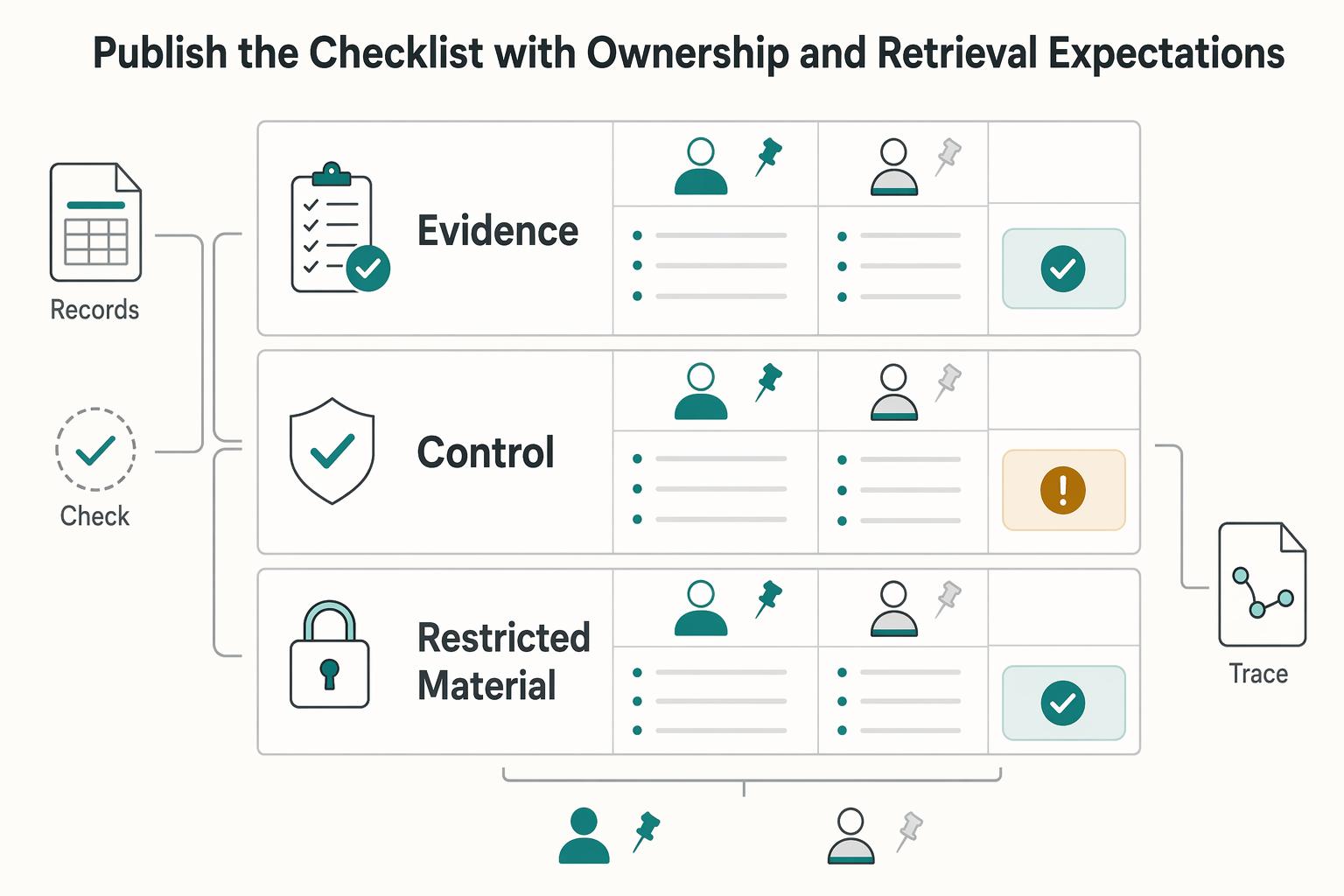
4. Publish the checklist with ownership and retrieval expectations#
Use a master checklist as the operating artifact. Assign a primary owner and backup owner for every item so retrieval does not depend on one person.
| Evidence item | What it must prove | Owner and backup | System of record | Retrieval expectation |
|---|---|---|---|---|
| Payout decision record | End-to-end traceability from review through release, hold, or reject | Compliance Ops owner + backup | Payout ledger or case system | Documented process |
| Control review history | Screening or risk-review result, disposition, approver, and timestamps | Controls owner + backup | Review and case tools | Documented process |
| Supporting documentation status | Required-document status, exception handling, review decision, and decision link | Operations owner + backup | Record store and profile system | Documented process |
| Restricted-material export rule | What is excluded from routine exports and who must approve access | Compliance lead + Legal backup | Access-controlled repository | Documented process |
For a detailed reference on payout rail details by market, see Bank Code vs. Routing Number vs. Sort Code: A Global Platform Payout Reference Guide.
Decide what must exist at day zero and what can wait until day ninety#
At go-live, prioritize controls that can block a non-compliant payout and any FinCEN or BSA duties that apply to your operating model. Defer optimization work to a dated backlog with clear ownership.
What cannot wait#
Your day-zero baseline should include enforceable payout-release gates from your control framework and named escalation owners. Manual handling is only acceptable if it can actually stop release and leaves a clear decision record.
For applicable U.S. MSB duties, verify the actual program, reporting and retention requirements before launch; keep unrelated corporate/individual foreign-account filings on their own scoped workflow.
- Risk-commensurate written AML program where required
- Applicable suspicious-activity review and filing ownership, with restricted access
- Required funds-transmittal data and record-retention operations for the actual legal role
- Applicable registration and provider/program approvals
- Submission validation, correction and evidence retrieval for required filings
| Control area | Day-zero requirement | Pre-launch verification |
|---|---|---|
| Release gating | Applicable release gates and authorized clearance are enforceable; confirmed legal prohibitions remain blocked/rejected as required | Test one pass case and one hold case end to end |
| FinCEN or BSA core operations | AML program, SAR ownership flow, and record-retention method are operational | Confirm owners, approval path, and retained event history |
| Record/data scope | Required fields, retention and restricted exports mapped by record and legal role | Reproduce a sample record and verify access, retention and downstream-data handling |
| Filing readiness | Filing data includes required elements and clear error handling | Validate submission payload quality before production use |
What can wait until day ninety#
Day ninety is for optional depth, not missing obligations. Use it for deeper scenario analytics, corridor-specific tuning, and automation of repeat alert classes only after your manual disposition pattern is stable.
Do not push basic completion controls to day ninety. If errors are discovered, the amendment flow must already work. If required filing elements are missing, submissions can be rejected, so data-quality checks belong in the launch baseline.
The guardrail for deferrals#
Do not defer controls your legal mapping identifies as required in markets where you are already live. Defer tuning, not release-critical or filing-critical obligations.
For each deferred item in your phased backlog, record:
- the control being deferred
- the risk created by the delay
- the interim control used now
- the owner and target date
- the evidence used to prove the interim control operated
Run pre-launch sanity checks on real payout scenarios#
Approve go-live only after end-to-end payout simulations match your written decision rules and can be explained from logs, not configuration screenshots or policy text alone.
Mirror your documented release, hold, and escalation paths. The exact scenario set, gate logic, and artifact list are internal policy choices, so define them explicitly before launch.
Before you sign off, verify that each simulation can be reconstructed from system records within the audit window your team defines, including:
- what triggered the decision path
- what control or reviewer made the decision
- what final payout state was reached
If a scenario cannot be reconstructed clearly, treat it as a potential no-go until the gap is resolved. If you need a practical workflow reference for those tests, review the Gruv docs.
Monitor the first month as a controlled risk window#
Treat the first month after go-live as a controlled risk window, not steady state, so you can catch drift before assessment windows reduce response time.
Watch the controls that fail quietly#
Track a short control-health set and review trends, not just counts:
- KPI movement in your monitoring program
- remediation aging
- evidence completeness
- upcoming scan or assessment checkpoints (including quarterly scans where applicable)
Use these as early indicators of work that is stalling or being pushed downstream. Each review cycle, sample real transactions and compare actual treatment to your disclosed policy and written decision rules. If a held or delayed transaction is later released, the reason should be reconstructable from system records and approval history.
Use regular reviews to change what is not working#
Run recurring cross-functional reviews across Compliance, Ops, Finance, Legal, and Engineering to adjust controls based on observed outcomes, not status reporting. Use review outputs to guide changes, then update escalation playbooks before small gaps accumulate.
Use clear decision logic. If KPI trends worsen while aging work is increasing, fix triage capacity, matching logic, or case routing before loosening release gates. If reviews surface higher-risk activity in a segment treated as low risk, raise that tier before optimizing speed.
Keep a jurisdiction watch with source discipline#
Maintain a regulatory-change watch list for in-scope markets. Verify legal references against official publications before acting. FederalRegister.gov is useful for monitoring, but it states that legal research should be verified against an official edition of the Federal Register.
Close month one with a compliance operating report for leadership and audit stakeholders. Include document types, named owners, key metrics, notable incidents, policy changes made, and open watch items so you have a dated, accountable evidence record. For recurring filings and operating deadlines, keep a companion Global Contractor Payment Compliance Calendar for Monthly, Quarterly, and Annual Obligations.
Conclusion#
A credible go-live checklist is not a topic list. It is a set of release gates, named decisions, and retrievable evidence that can stand up under scrutiny. Before money moves, your team should be able to answer yes to three questions:
- Do release gates block payouts when required data is incomplete? This includes identity and ownership checks, sanctions checks, and other required prerequisites for release.
- Is there a clear decision owner for hold, release, block, and suspicious-activity escalation decisions? If ownership is unclear, suspicious-activity alerts may remain unresolved.
- Can you retrieve an evidence pack for a sample payout from system records? Onboarding data, sanctions checks, risk assessments, and transaction logs should already be archived in audit-ready form.
If any answer is no, treat it as a launch blocker. If you cannot show who approved a payout, why they approved it, and what records supported that decision, you increase compliance risk, including fines, frozen funds, and reputational damage.
Use a retrieval test as an operator checkpoint. Pick a real or simulated payout and confirm you can produce the onboarding result, sanctions check result, current risk assessment, monitoring status, approver, and release action without relying on chat history or memory.
Test beneficiary-data quality on valid, invalid and changed records. Verify the selected route’s required identifiers and retain the validation method and result. Format validation does not establish ownership, and a corrected destination must pass approval and the original-attempt safety checks before release.
From there, expand with a risk-based approach rather than one uniform review path. Start with controls that prevent high-impact failures, then add depth by jurisdiction and risk profile as operations mature, including SAR handling where required and FATF Travel Rule data handling where applicable.
If your team is validating day-0 controls across multiple payout rails, talk with Gruv to confirm market and program coverage before go-live.
Frequently Asked Questions
What is a global payout compliance checklist before go-live?
A global payout compliance checklist is a practical pre-launch control set that tells you what must clear before money moves, who can approve exceptions, and what evidence you keep. Its job is to catch high-impact failures before release, because compliance mistakes can lead to fines, back payments, reputational damage, and operational disruption. In practice, it focuses on release-critical checks rather than documenting every possible rule.
What checks are mandatory before the first cross-border payout is released?
Determine the entity, activity, market, recipient and rail requirements: provider/program permission, required identity and beneficiary information, sanctions treatment, applicable AML and tax duties, and retention/evidence. If workers or payroll are involved, assess the engagement and payroll setup separately. Test each actual release gate; there is no single worldwide mandatory form list.
Who should own payout compliance decisions across Compliance, Legal, Finance, Ops, and Engineering?
Assign one accountable owner and backup per applicable control, with separate authority for execution and judgment-based clearance. Keep hold, release, block/reject and filing decisions explicit in the approval matrix and test a cross-team handoff before launch.
What evidence should we retain to satisfy audit and regulator requests?
Retain the market/rail scope, required verification evidence, screening disposition and legal/policy basis, approved amount, release approver, provider attempt/status and reconciliation references. Set retention and restricted export rules per applicable record type; ordinary case access does not authorize disclosure of restricted reporting materials.
How do we avoid overbuilding controls while still meeting AML, sanctions, and tax obligations?
Map required checks to the actual entity, activity and jurisdiction, then choose internal risk tiers and proportional monitoring. Start with an operable alert set and named reviewers. Defer optional tuning only with working interim controls; do not defer required sanctions treatment, reporting or release gates.
When should a payout be held, escalated, or permanently blocked?
Hold uncertain or incomplete required checks for review. Escalate possible sanctions matches and suspicious-activity signals to authorized owners. Confirmed prohibitions require the applicable blocking or rejection action and reporting; a reviewer cannot override them merely by closing the case. Release only on documented authorized clearance.
Can one global policy cover every country we pay into?
No. A global policy can set baseline principles, but local rules still apply by jurisdiction. Use a global baseline plus country-specific requirements for items like worker engagement and payroll or tax setup, and review each new market accordingly. For a country-by-country structure, see Cross-Border Compliance Checklist for Platform Payouts: Licenses Registrations and Reporting by Country.
Researched and edited by the Gruv editorial team. Gruv builds cross-border billing, payouts, and finance-operations software for global businesses.
Sources
Educational content only. Not legal, tax, or financial advice.
Related Posts

The Freelance Payment Penalty: A Modeled Audit of Platform Fees, FX Spreads, and Payout Delays
The money rarely disappears through a single, easy-to-spot fee. The real loss is stacked. A marketplace takes its commission, a processor adds a charge for international cards, a bank or payment company converts the currency at a spread, a platform holds the funds before release, and a wire sheds a little to intermediaries on the way in. Each layer looks defensible on its own, but the worker feels the combined result as a smaller deposit and a later payday.

How to Respond to a Subpoena for Business Records
Move fast, but do not produce records on instinct. If you need to **respond to a subpoena for business records**, your immediate job is to control deadlines, preserve records, and make any later production defensible.

A US Expat's Guide to Investing in UCITS ETFs to Avoid PFIC Issues
The real problem is a two-system conflict. U.S. tax treatment can punish the wrong fund choice, while local product-access constraints can block the funds you want to buy in the first place. For **us expat ucits etfs**, the practical question is not "Which product is best?" It is "What can I access, report, and keep doing every year without guessing?" Use this four-part filter before any trade: