
Quick Answer
No. Treat NPP or PayTo as payment capability, not as proof of tax readiness. For Australia, launch only after your team has a documented ABN and GST decision, clear owner sign-off, and evidence that can explain retries, reversals, and approvals. If GST registration is required, the article flags the 21-day ATO timing risk. Keep scope narrow until one payout can be traced from request to provider reference, ledger posting, and reconciliation output.
If your Australia launch case depends on the payment rail alone, you are not ready yet#
If your Australia launch case depends on the payment rail alone, you are not ready yet. The harder launch question is usually not how money moves. It is whether your Australian Taxation Office position, ownership, and records are solid enough to survive real operations.
Before you start#
Use this guide as a go or no-go check for a platform operator, not as a product tour. The practical question is simple: are your contractor payouts in Australia controlled enough to launch now, or should you hold scope until compliance and evidence are tighter?
A payout flow can look clean in a demo and still fail in production. That usually happens when no one can show who decided the GST treatment, who owns exceptions, or what record proves why a payment was retried, reversed, or approved.
Step 1 Check the ATO basics first#
Start with what is actually confirmed. The ATO says not every business or enterprise needs to be registered for GST. It also says penalties may apply if you fail to register when required, and once registration is required, you need to do so within 21 days. Before you register, you need an Australian business number, or ABN.
That is your first real checkpoint. Before you debate payout rails, confirm whether your business may need GST registration, whether you already have an ABN, and who owns that determination internally. If your launch team cannot answer those three points in writing, you have a compliance gap, not a payments gap.
For non-resident businesses, the ATO lists multiple GST registration options, including simplified, standard, and standard GST-only. The standard GST registration path matters operationally because it supports registering, lodging, and paying under the standard system, including lodging a Business Activity Statement and paying GST monthly or quarterly. A modern payout experience does not remove that obligation.
Step 2 Separate rail choice from compliance ownership#
Keep these as two separate decisions. One decision is which payment capability you use. The other is what your platform still has to classify, approve, retain, and reconcile for ATO-facing compliance. Those are different jobs, usually owned by different people, and mixing them is a common failure mode.
Use a blunt rule here: if legal or finance has not signed off on the ATO interpretation, do not let product treat Australia as launch-ready. What matters most is not branding on the rail. It is whether you can trace a contractor payout from request to retained evidence, and whether a named owner can explain your GST and ABN position without guessing.
Step 3 Use the rest of the guide to make a launch call.
Use the rest of this guide to pressure-test that decision with concrete checkpoints: rollout limits, verification points, failure recovery actions, and a copy-paste checklist. If your ATO basics are already settled, the later sections help you decide scope and sequencing. If they are not, the right move is usually to narrow the launch or wait until ownership and evidence are in place.
We covered related operator issues in How Platform Operators Pay Contractors in Indonesia With GoPay, OVO, DANA, or BI Fast.
What NPP and PayTo actually change for contractor payouts#
Treat NPP and PayTo as rail labels you still need to verify, not as proof that your Australia contractor launch is operationally or ATO-ready.
Step 1 Verify rail behavior from provider documentation#
Do not assume common shorthand claims about NPP infrastructure, PayTo mandate mechanics, or what Osko and PayID mean for payout controls. Before you design around those assumptions, get current provider documents that define who initiates payment, what authorization record exists, which status events are returned, and what reference carries into reconciliation.
Use a hard checkpoint: if your team cannot point to a current provider spec, agreement artifact, or implementation guide for each claimed behavior, treat that behavior as unconfirmed. Also avoid relying on archived community answers, which the ATO notes may be out of date.
Step 2 Keep ATO obligations on a separate track#
ATO-facing obligations are a separate decision from rail choice. The ATO states that not every business needs GST registration, but if registration is required, registration is due within 21 days. For relevant non-resident setups, the standard GST path includes lodging BAS and paying GST monthly or quarterly.
If your GST position or BAS ownership is unresolved, rail selection should not be treated as launch readiness.
Step 3 Use rail labels only after they map to controls#
Rail names do not define who approves exceptions, who retains evidence, or how failed payouts are reconciled. Your operating proof should be concrete: provider terms, payout status definitions, retained records where relevant, and a trace from payment request to ledger entry.
Related: How to Pay Contractors in Colombia: PSE Nequi and DIAN Compliance for Platform Operators.
What to prepare before you build#
Before you build, treat Australia launch readiness as an evidence check, not a rail decision. You are not ready to ship if you cannot show your ABN/GST decision path, payout state traceability, and clear exception ownership.
Build a minimum evidence pack:
- Payout flow diagram
- Control ownership list across product, legal, finance, and ops
- Reconciliation design
- Exception-handling policy for accounts payable and payroll-adjacent flows
Add ATO readiness to that same pack:
- Current ABN status
- GST registration determination
- If GST registration is required, proof you can complete it within 21 days
- For non-resident setups, whether standard GST registration applies, including BAS lodgment/payment flow (monthly or quarterly) and whether an Australian registered tax agent is needed
Set named owners before launch. Assign who signs off on ATO interpretation, who owns reconciliation design, and who maintains any PayTo agreement records required by your provider.
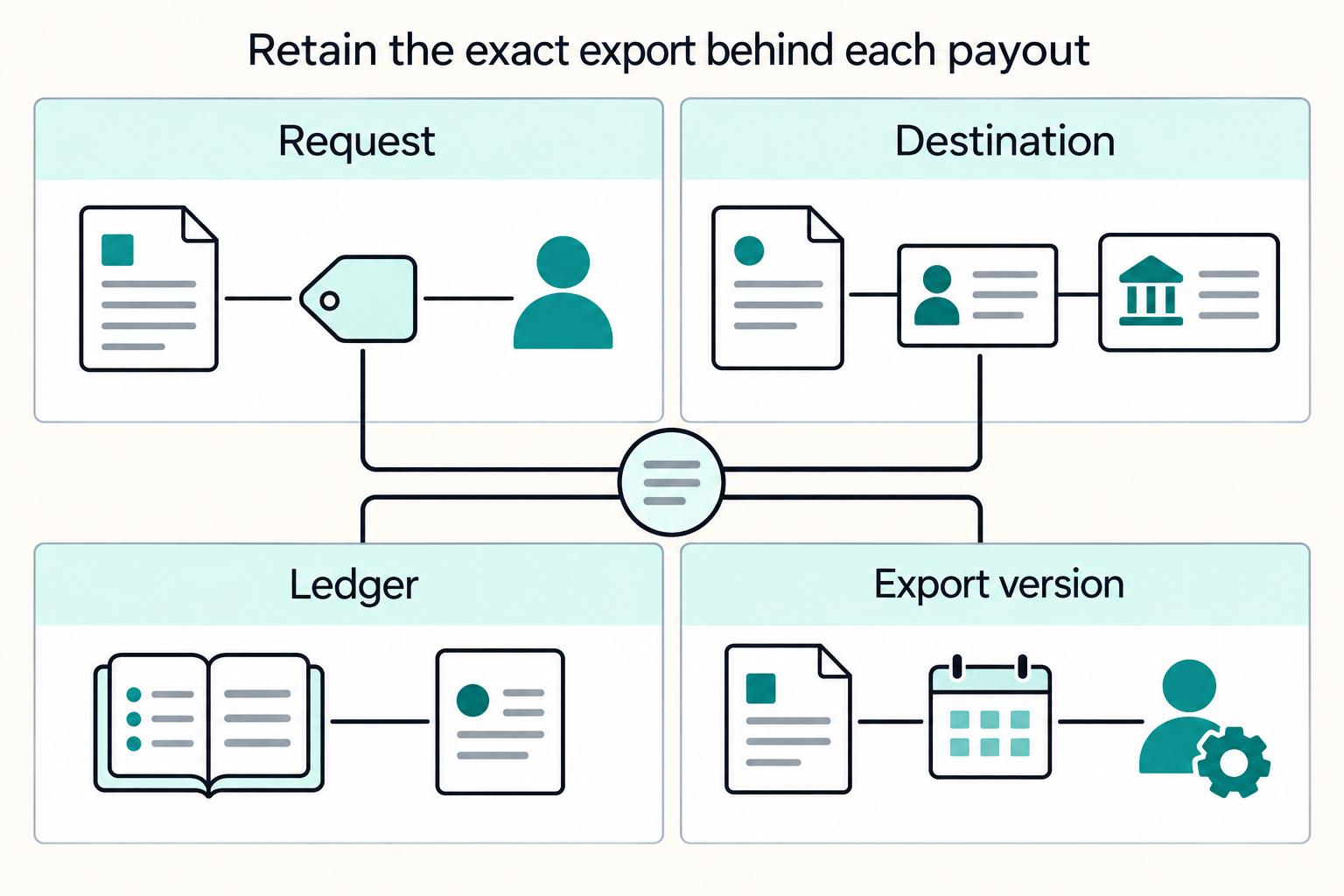
Define a system-of-record path from API request to ledger posting to export artifacts, and require traceability for each payout state change. Then run launch checkpoints: sandbox success and failure cases, idempotent retry behavior, and reconciliation closure against bank account-to-bank account payment events.
That is the threshold: dated decisions, named owners, and a document trail strong enough to explain what happened after money moves.
Need the full breakdown? Read Pay Contractors in Japan with Zengin, FX Controls, and My Number Compliance.
Compare NPP push flows, PayTo pull flows, and direct debit for platform use#
Use this comparison as an operator decision template, not as proof of rail mechanics or tax compliance. In the material here, the hard requirements are ATO ABN/GST obligations, so treat rail behavior as something you must verify in provider documentation before build.
Step 1 Build the table around evidence and exception handling#
If you are evaluating a preauthorized pull model, assess PayTo agreement design first. If you are evaluating one-way disbursement, assess an NPP payout path first. In either case, confirm the exact authorization and initiation mechanics with your provider.
| Rail option | Authorization model | Initiation party | Recurring suitability | Failure visibility | Ops overhead |
|---|---|---|---|---|---|
| NPP | Verify authorization basis in provider docs and internal approvals | Verify who triggers each payment event | Assess against your actual payout pattern | Require states you can map to pending, paid, failed, and reversed | Lower only if retries, references, and reconciliation close cleanly |
| PayTo | Verify agreement creation, storage, amendment, and revocation records | Verify who can initiate once an agreement is active | Assess where preauthorization and repeat usage are needed | Require both agreement-state and payment-state visibility | Higher if agreement lifecycle ownership is split across teams |
| Direct debit | Verify mandate capture, storage, and retention obligations | Verify who initiates collections and how returns/disputes surface | Assess only if mandate administration fits your model | Require documented return and exception reporting | Often higher when mandate queues and payment exception queues are separate |
The key decision test is simple: when status is disputed, can your team show one traceable chain from request to provider reference to ledger to exported reconciliation artifact.
Step 2 Decide on lifecycle complexity before speed#
For most platform teams, mandate lifecycle complexity drives risk more than raw payment speed. Any agreement- or mandate-based option adds state to manage: creation, amendment, suspension, cancellation, and proof of what was active when money moved.
Set a launch checkpoint: one test payment must be traceable end to end, and if an agreement or mandate artifact exists, that identifier must be in the same trace.
Step 3 Keep rail choice separate from ATO obligations#
Rail selection does not replace ATO compliance decisions. The ATO states you need an ABN before registering for GST, and once GST registration is required, registration must occur within 21 days. For non-residents using Standard GST registration, BAS lodgment and GST payment are monthly or quarterly, and electronic lodgment from outside Australia is not available, so an Australian registered tax agent may be needed.
Recommendation: choose the rail that best fits your initiation and reconciliation needs, but keep separate ownership for ABN status, GST pathway, and BAS handling. On the available evidence, rail choice does not resolve contractor classification or full ATO reporting scope.
You might also find this useful: How to Pay Contractors in Ghana: GhIPSS MoMo and GRA Compliance for Platform Operators.
Design the end-to-end contractor payout sequence#
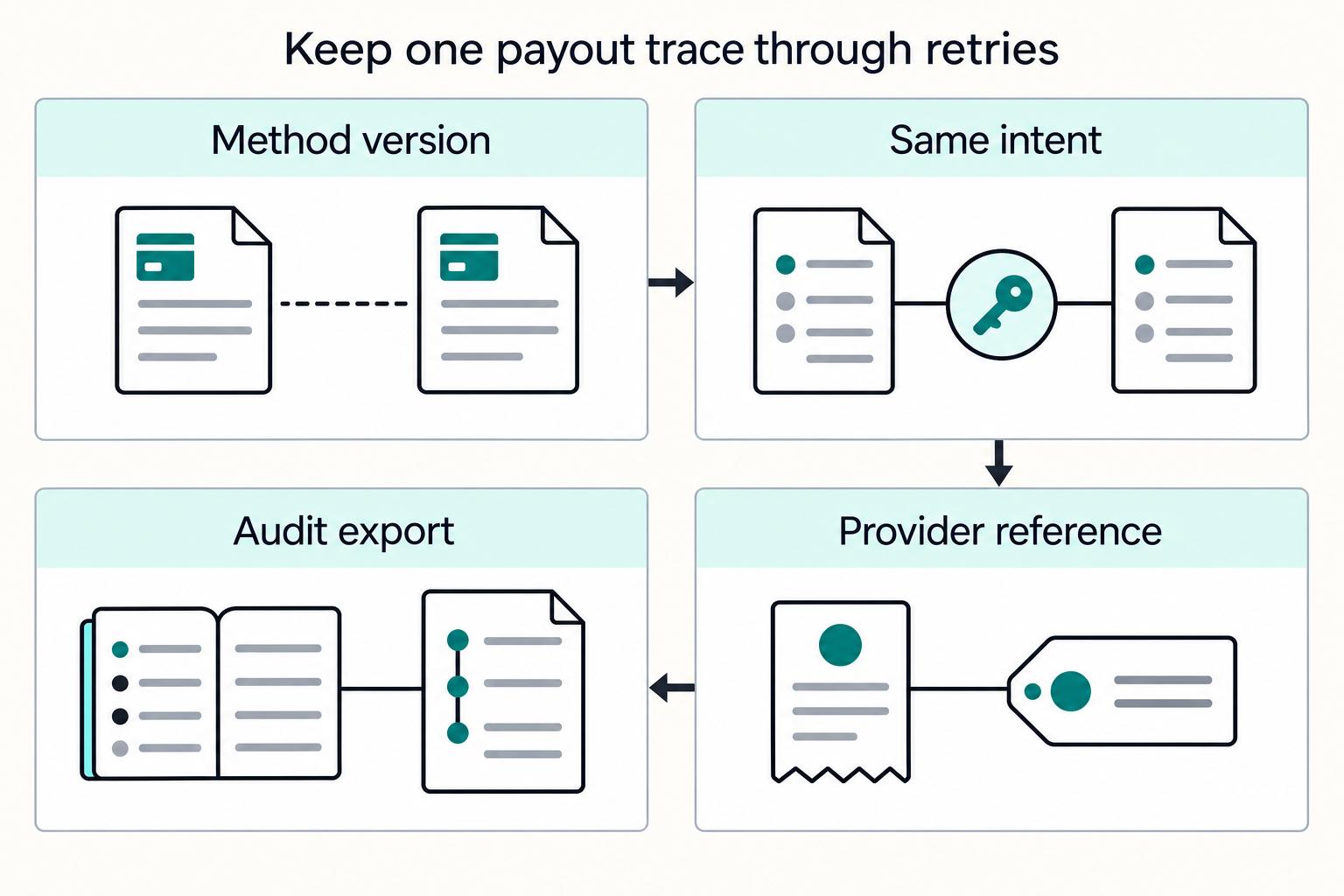
Design this as one evidence chain from onboarding to reconciliation export, not as separate team handoffs. If a single payout cannot be traced end to end, disputes and unmatched movements become expensive to resolve.
Start with one boundary: the Australia-specific facts here are ABN/GST prerequisites and timing, not payout-rail mechanics. You need an ABN before registering for GST; once GST registration is required, registration must be completed within 21 days; and for non-resident businesses using Standard GST registration, BAS lodgment and GST payment are monthly or quarterly. Treat the sequence below as an operator control design, not as a claim about NPP, PayTo, or direct debit rules.
Sequence the payout flow as one trace#
- Contractor onboarding: Store contractor identity and your internal Australia-readiness decision trail, including ABN/GST ownership and next action.
- Payout method setup: Store a versioned method record so you can reconstruct what was active at payment time.
- Payment initiation: Use a stable request key and duplicate-prevention logic so retries map back to the same payment intent.
- Provider acknowledgment: Capture and link the provider transaction reference to the internal payment record.
- Ledger posting: Apply a single posting path per intended payout outcome.
- Status event handling: Process events as controlled state transitions, including duplicate-event handling.
- Export-ready audit trail: Export one reconciliation row that ties internal ID, external reference, state history, and timestamps.
Define non-negotiables before launch#
Use deterministic payout states and keep them consistent across product, support, and finance: pending, paid, failed, and reversed. Tie each payout to artifacts you can retrieve quickly, including PayTo agreement reference, when used, provider transaction reference, and reconciliation output. The operational test is simple: one pilot payout should remain traceable after retries and duplicate events, with no ambiguity in final state or ledger impact.
If you want a deeper dive, read How to Pay Contractors in Peru: Yape Plin and SBS Compliance for Platform Operators.
Set ATO compliance boundaries and ownership early#
Set written ATO ownership before you scale payouts: implementing NPP or PayTo does not, by itself, settle your GST position or broader contractor tax treatment.
Step 1 Build a control matrix that separates confirmed obligations from unresolved interpretation#
Use one matrix with columns for decision area, current confirmed position, named owner, and retained evidence.
| Area | What you can state now | Named owner | Evidence to retain |
|---|---|---|---|
| GST registration timing | If GST registration is required, you must register within 21 days; penalties may apply if you fail to register when required | Tax or legal owner | Policy version, registration decision log, approval record |
| Non-resident registration path | Non-residents can use simplified, standard, or standard GST-only registration pathways | Tax owner | Path selection memo, approval record |
| Standard GST registration details (if used) | Requires an ABN and identity proof; GST lodgment/payment is monthly or quarterly; from outside Australia, electronic lodgment is not available and an Australian registered tax agent may be needed | Tax owner or external adviser owner | ABN record, lodgment plan, agent engagement record, if used |
| Contractor-specific tax treatment | Confirm classification, withholding, payroll tax, and super obligations with a qualified adviser | Legal and compliance sign-off owner | Open issues log, escalation path, dated legal review |
A practical checkpoint: for any payout scenario, someone should be able to classify it immediately as a GST registration decision, a standard-path operational task, or an unresolved legal interpretation.
Step 2 Assign owners, review cadence, and escalation paths before launch#
Name individual owners, not team aliases, for GST registration status, payout approvals, exception review, and retained payment evidence, including PayTo agreement artifacts where relevant. If you rely on Standard GST registration, explicitly assign who owns the ABN step, who tracks the 21-day registration deadline once required, and who runs the monthly or quarterly lodgment cadence.
Step 3 Do not scale while ATO interpretation is unresolved#
If legal interpretation is still open, do not scale contractor payouts in Australia. Run limited mechanics testing only until ATO-related ownership, review cadence, and escalation contacts are approved in writing.
Keep your audit pack complete: current policy version, decision log, payout approvals, exception outcomes, ABN/GST registration records where relevant, and retained PayTo agreement artifacts linked to payout records.
This pairs well with our guide on How to Pay Contractors in India: FEMA Compliance TDS Deduction and Bank Transfer Mechanics.
Decide go live scope and rollout order#
Keep the first Australia launch intentionally narrow, and only expand after reconciliation and GST operability are consistently working.
Step 1 Constrain the first Australia cohort and lock payout windows#
Start with one defined Australia cohort and fixed payout windows instead of continuous availability. This gives AP a predictable cycle to review exceptions, match payment activity to ledger entries, and confirm retained artifacts are usable when issues appear.
Set the compliance gate before launch. If GST registration becomes required, ATO says registration must be completed within 21 days, and penalties may apply if you fail to register when required. If you are a non-resident using Standard GST registration, confirm ownership for the ABN step and for BAS lodgment/payment on a monthly or quarterly cadence. If ownership is still unclear, keep rollout in pilot scope.
Step 2 Freeze expansion after two broken close cycles#
Use a fixed rule: if reconciliation breaks across two close cycles, freeze expansion. Do not add contractors, payout paths, or broader Australia coverage until the break is visible, understood, and consistently resolved.
Define "break" in your own records up front, then apply it consistently at close. The goal is not zero incidents; the goal is a close process supported by traceable evidence rather than reconstruction.
Step 3 Prioritize rollout paths with high operator visibility#
Prioritize rollout paths that keep payout status and exception handling easy for operators to follow during close. Expansion should come after status handling and exception review are stable across repeated cycles.
For non-resident teams on Standard GST registration, operating limits also matter: you cannot lodge electronically from outside Australia and may need an Australian registered tax agent. Keep the initial path operationally simple, then expand once filing ownership and close reliability are holding.
For a step-by-step walkthrough, see How to Pay Contractors in Malaysia: DuitNow and Bank Negara FX Compliance for Platforms.
Prevent common mistakes and recover fast#
The quickest recovery is to split payment rollout from tax and compliance controls, then restart only after ownership and evidence are clear.
| Mistake | Recovery | Grounded details |
|---|---|---|
| Treating payment capability as compliance completion | Re-baseline responsibilities | If GST registration is required, register within 21 days; confirm an ABN is in place before GST registration; if a person is engaged as an employee for that activity, treat it as a classification red flag because they are not entitled to an ABN for that activity. |
| Reopening rollout before non-resident GST operations are assigned | Choose the non-resident GST registration path deliberately | Decide whether Standard GST-only registration fits, and assign who handles GST payment and BAS lodgment monthly or quarterly before expanding scope. |
| Retrying payouts while evidence is incomplete | Pause retries | Wait until finance and engineering can close each payout window with a traceable record of what was initiated, what posted, what failed, and what remains unresolved. |
| Using weak policy sources for operating decisions | Remove archived community-thread guidance | Rely on current ATO and ABR pages for GST, ABN, and worker-treatment decisions. |
- Mistake: treating payment capability as compliance completion.
Recovery: Re-baseline responsibilities. If GST registration is required, register within 21 days. Confirm an ABN is in place before GST registration. If a person is engaged as an employee for that activity, treat it as a classification red flag because they are not entitled to an ABN for that activity.
- Mistake: reopening rollout before non-resident GST operations are assigned.
Recovery: Choose the non-resident GST registration path deliberately, including whether Standard GST-only registration fits, and assign who handles GST payment and BAS lodgment monthly or quarterly before expanding scope.
- Mistake: retrying payouts while evidence is incomplete.
Recovery: Pause retries until finance and engineering can close each payout window with a traceable record of what was initiated, what posted, what failed, and what remains unresolved.
- Mistake: using weak policy sources for operating decisions.
Recovery: Remove archived community-thread guidance from decision logs for GST, ABN, and worker-treatment decisions, and rely on current ATO and ABR pages.
Conclusion#
The practical answer is to split your launch decision in two. Use your selected payment rail, including NPP or PayTo where relevant, to judge rail capability, but treat Australian Taxation Office (ATO) compliance as a separate go-live gate with its own owners, evidence, and review.
That may sound stricter than a typical payments launch, but it prevents a common mistake: letting a successful payment test stand in for a compliant operating model. If your team can move money but cannot show who owns GST registration decisions, ABN prerequisites, approval records, and retained payout evidence, you are not ready to scale. Expand only when both conditions are true: payment operations hold up in production-like tests, and compliance responsibility is explicit enough that another operator could review it and reach the same answer.
If you take one rule from this guide, make it this one: do not treat rail readiness as compliance readiness. In Australia, those are related decisions, but they are not the same decision. Use this checklist as your final go or no-go screen:
- Match the rail to the payout scenario.
Confirm the rail you plan to use fits the exact contractor payout motion you are launching, not a provider marketing page. Your verification point should be scenario-level: first payout, repeat payout, failed payout, changed authorization state, and disputed status. If your team still describes the decision as "the payment can go through," pause and tighten the use case.
- Verify payment-state control before launch.
Check the current payment authorization or state before any first payout or retry after a change, and make sure retries are idempotent. The minimum evidence pack should let you trace one payout from approval to provider transaction reference to ledger posting to reconciliation closure. A red flag is any retry path that depends on support memory instead of a current status record.
- Assign ATO ownership in writing.
Someone needs to own the GST registration decision, and that decision may carry timing requirements. The ATO says penalties may apply if you fail to register when required, and once registration is required you need to do so within 21 days. Before GST registration, you need an ABN. For non-residents, confirm which GST path applies, including standard, simplified, or standard GST-only, and if you use standard GST registration, confirm who will lodge BAS and pay GST monthly or quarterly.
- Set rollout limits and failure triggers.
Define the first cohort, the rollback trigger, and the named escalation contacts across finance, engineering, and compliance. Add one more checkpoint if you operate from outside Australia: under standard GST registration, you cannot lodge electronically from outside Australia and may need an Australian registered tax agent. If you do not know who handles that before launch, keep the cohort small or do not go live.
Related reading: Pay Contractors in Argentina Under FX Restrictions as a Platform Operator.
Frequently Asked Questions
Can I pay contractors in Australia using New Payments Platform (NPP) alone?
Payment rails alone do not settle ATO compliance. The grounded position is that GST obligations are separate: not every business must register for GST, but penalties may apply if you do not register when required, and if registration is required you must register within 21 days. You also need an ABN before GST registration.
Is PayTo a push or pull model, and why does that matter for contractor payouts?
Confirm PayTo push vs pull mechanics directly in your provider documentation before you set payout operations or controls.
Does PayTo replace direct debit for every platform use case?
No broad replacement claim is supported here. Treat PayTo and direct debit as separate until your provider documentation and legal review confirm fit for your specific use case.
Does using NPP or PayTo automatically satisfy Australian Taxation Office (ATO) compliance?
No. The ATO is clear that not every business must register for GST, but penalties may apply if you fail to register when required, and once registration is required you need to do it within 21 days. Before you register, you need an ABN, and non-residents may need to choose between different GST registration pathways, including standard, simplified, and standard GST-only options.
What should a platform operator verify before launching PayTo agreement-based payouts?
For ATO-facing compliance, verify whether GST registration is required, confirm ABN readiness, and confirm the correct non-resident GST pathway where relevant. If you are a non-resident using Standard GST registration, confirm who will lodge BAS and pay GST monthly or quarterly.
Who should own failures, reversals, and reconciliation in an Australia payout stack?
The ownership model for payout failures and reconciliation is not documented here. One clear guardrail: do not rely on archived ATO Community thread advice for current policy, because the page states the information may not be up to date.
Try a related tool
Researched and edited by the Gruv editorial team. Gruv builds cross-border billing, payouts, and finance-operations software for global businesses.
Sources
Educational content only. Not legal, tax, or financial advice.
Related Posts
Pay Contractors in Peru with Yape, PLIN, and SBS Checks
Treat Peru as a posture decision, not just a rail decision. If you choose a local wallet-style method first, then sort out contractor status, tax data, and evidence later, you may get a smoother payout experience. You also raise launch risk in areas that are much harder to fix once money starts moving.

How Platform Operators Pay Contractors in Colombia with PSE Nequi and DIAN Controls
Treat Colombia contractor payouts as a launch decision with a real stop condition, not something you clean up after the first transfers go out. This guide is for platform operators deciding whether to launch Colombia now, with current team and vendor capacity, not for generic advice on hiring freelancers.

Pay Contractors in Ghana with GhIPSS, MoMo, and GRA Controls
**Step 1: Treat this as a go or no-go operator guide, not a hiring explainer.** If you are deciding whether to launch Ghana, the useful question is not "can we hire contractors there?" The real question is whether you can support payouts through the rails your users prefer, connect those flows to local tax obligations, and absorb the operational risk when something breaks. That is the lens for the rest of this guide.