
Quick Answer
Establish the contractor’s tax and classification status, collect the applicable invoice, and confirm the funding and receipt route with the receiving institution. Agree currency, fees and conversion terms, test a small payout, and reconcile invoice, payable, provider result and account credit before scaling.
Decide whether your Argentina payout route is ready#
Step 1. Identify the transaction and recipient. To pay contractors in Argentina, establish who is supplying the service, whether the receipt is an export of services, and how funds reach the recipient’s account. A local ARS transfer is only one leg of that design: it does not establish how a foreign client’s funds enter the country or satisfy foreign-exchange obligations.
That framing matters because a market can look attractive at a high level and still be the wrong next launch. A country can be commercially interesting and operationally premature at the same time. If your team does not have a named owner for onboarding, payout exceptions, and legal escalation, treat that as a red flag before you build anything country-specific.
Step 2. Separate the known controls from the unknown mechanics. Some parts of the problem are clear enough to plan around. ARS is the local currency, and the Banco Central de la República Argentina (BCRA) is the central bank. Contractor compliance, at a minimum, means dealing with local labor, tax, and data-security obligations, and worker classification is a core control because misclassification is a major risk.
These are not abstract concerns. In practice, rollout planning touches contract terms, tax-data collection, payout eligibility, and evidence retention from day one. A useful checkpoint before a go or no-go call is simple: can your team show where classification is reviewed, where tax inputs are collected, and where payout approvals are logged? If that answer is fuzzy, your launch readiness is also fuzzy.
Step 3. Separate receipt of foreign funds from local distribution. Record the foreign payer, Argentine service provider, invoice, first receipt date, authorized FX intermediary and final recipient account. A provider dashboard showing “paid” cannot establish that each of these steps used the correct legal route.
Use a hard-evidence rule early. For every payout design you consider, ask for the provider's supported route, the currency steps, the exception cases, and the documents you would need to retain if a payout is questioned later. If a partner cannot explain those pieces clearly, or if counsel has not confirmed the open country-specific points, the country is not launch-ready for you.
This guide checks the BCRA’s consolidated rules current on October 4, 2026. Keep the rule version and receiving bank’s document requirements in your launch file; older country summaries can describe conditions that have since changed.
Decide if Argentina is launch-ready for your platform#
Argentina is launch-ready when your team can run onboarding, payouts and compliance controls with named owners and tested evidence. Document a lawful alternative or a controlled pause and notification process if the primary route fails.
| Readiness check | What to verify | Action if missing |
|---|---|---|
| Volume, FX, and exception load | Expected contractor volume justifies country-specific support, finance, and legal handling; FX handling and payout exceptions are treated as core operating constraints | Plan manual review capacity before go-live |
| Ownership for onboarding and tax/compliance inputs | Accountable ownership exists for contractor onboarding, tax-data collection, and payout eligibility checks | Prioritize a lower-friction market first if you cannot staff this ownership |
| Provider dependency | Document the normal route and an approved alternative, or a controlled pause and contractor notification process when no alternative is available | Resolve route availability and recovery ownership before volume increases |
| Pilot evidence | Success criteria are set for payout success rate, exception turnaround, and audit evidence completeness; each pilot payout can retrieve contractor record, service agreement, tax profile inputs, approval log, provider reference, and settlement status | Pause rollout if evidence is incomplete or exceptions do not close consistently |
Step 1. Screen for volume, FX handling risk, and exception load. Start with a blunt filter: does expected contractor volume justify country-specific support, finance, and legal handling? Treat FX handling and payout exceptions as core operating constraints, not edge cases. If your expected manual review load is high, plan that capacity before go-live.
Step 2. Assign ownership for onboarding and tax/compliance inputs. Name the person who checks contractor tax status, classification and payout eligibility. Review the actual role, supervision, hours and commercial independence rather than treating a platform contract as sufficient evidence of independent status.
Step 3. Pressure-test provider dependency before GTM. Test the primary route and document an alternative where lawful and available. A second provider is useful resilience, not a universal legal requirement. If a compliant alternative does not exist, specify how you pause, notify contractors and resolve overdue obligations.
Step 4. Define success before build, then verify in a pilot. Set success criteria upfront for payout success rate, exception turnaround, and audit evidence completeness, then run a small pilot. For each pilot payout, confirm you can retrieve the contractor record, service agreement, tax profile inputs, approval log, provider reference, and settlement status without stitching across multiple tools. If that evidence is incomplete or exceptions do not close consistently, pause rollout.
Gather prerequisites before first contractor payout#
Before you send the first payout in Argentina, lock the record and the owners. If the document set, approval path, or payout traceability is still implied, you are not ready to move money.
Step 1. Build the minimum contractor record. Prepare one payout-ready packet with the contractor profile, signed service agreement, tax profile inputs, and a defined path for any Argentine tax forms you need to collect or validate. Keep this record unified instead of split across onboarding, legal, and finance tools.
Step 2. Assign named owners for classification and approvals. Treat independent contractor classification as a controlled decision, not a shared assumption, because it affects contract terms, IP ownership, invoice handling, and tax reporting. Set clear ownership across legal, ops, and product so classification changes and payout eligibility stay aligned.
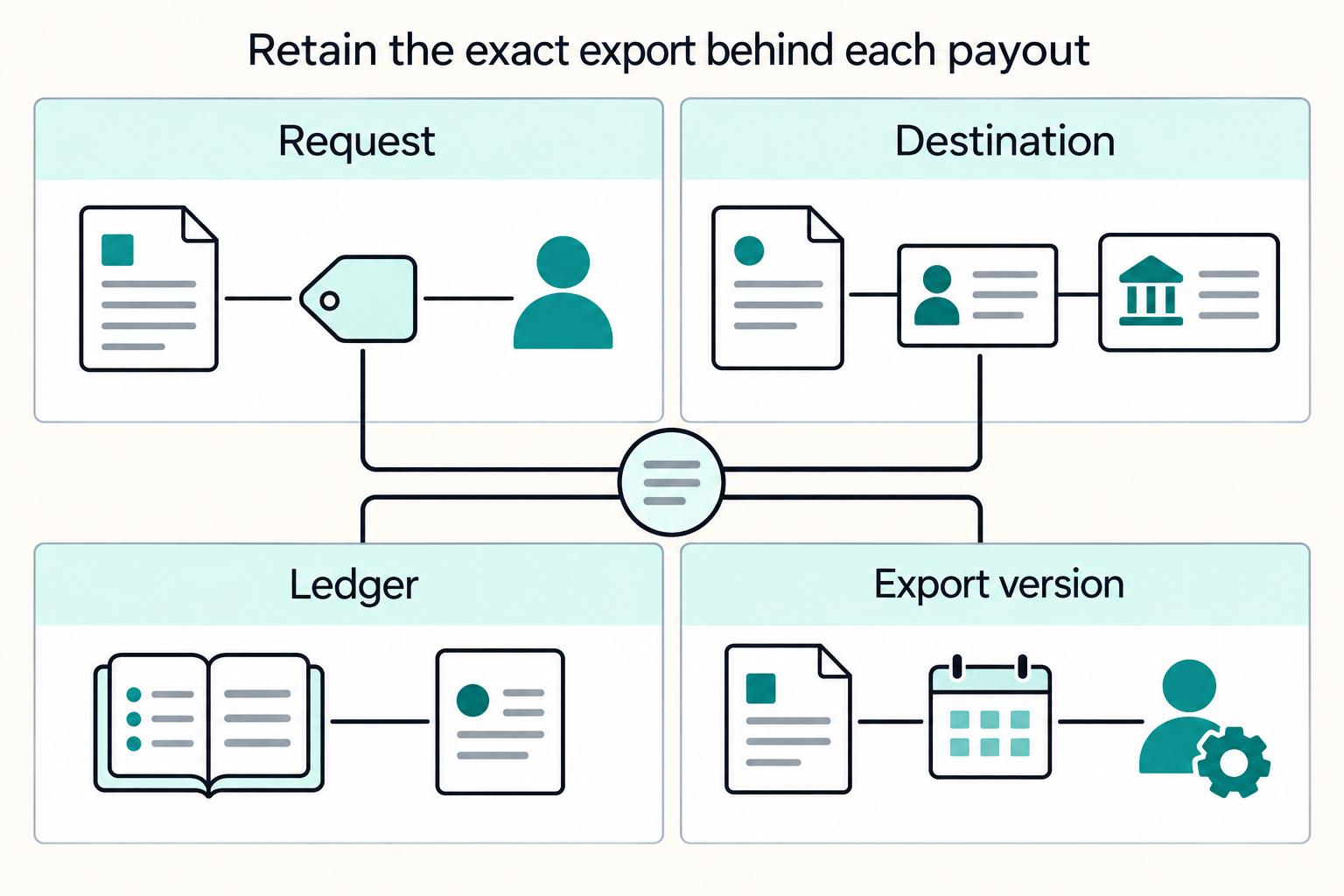
Step 3. Confirm payout controls in your stack. Whether you use global payroll software or direct rails, verify idempotency keys, reliable webhook handling, reconciliation exports, and ledger-level traceability before launch. You should be able to follow a payout from internal request ID to provider reference and final settlement status.
Step 4. Log unresolved dependencies before go-live. Record open BCRA interpretation, payout currency constraints and provider coverage caveats with an owner. Do not switch to an unverified route merely to keep a batch moving. Use the approved alternative or the documented hold-and-notify process.
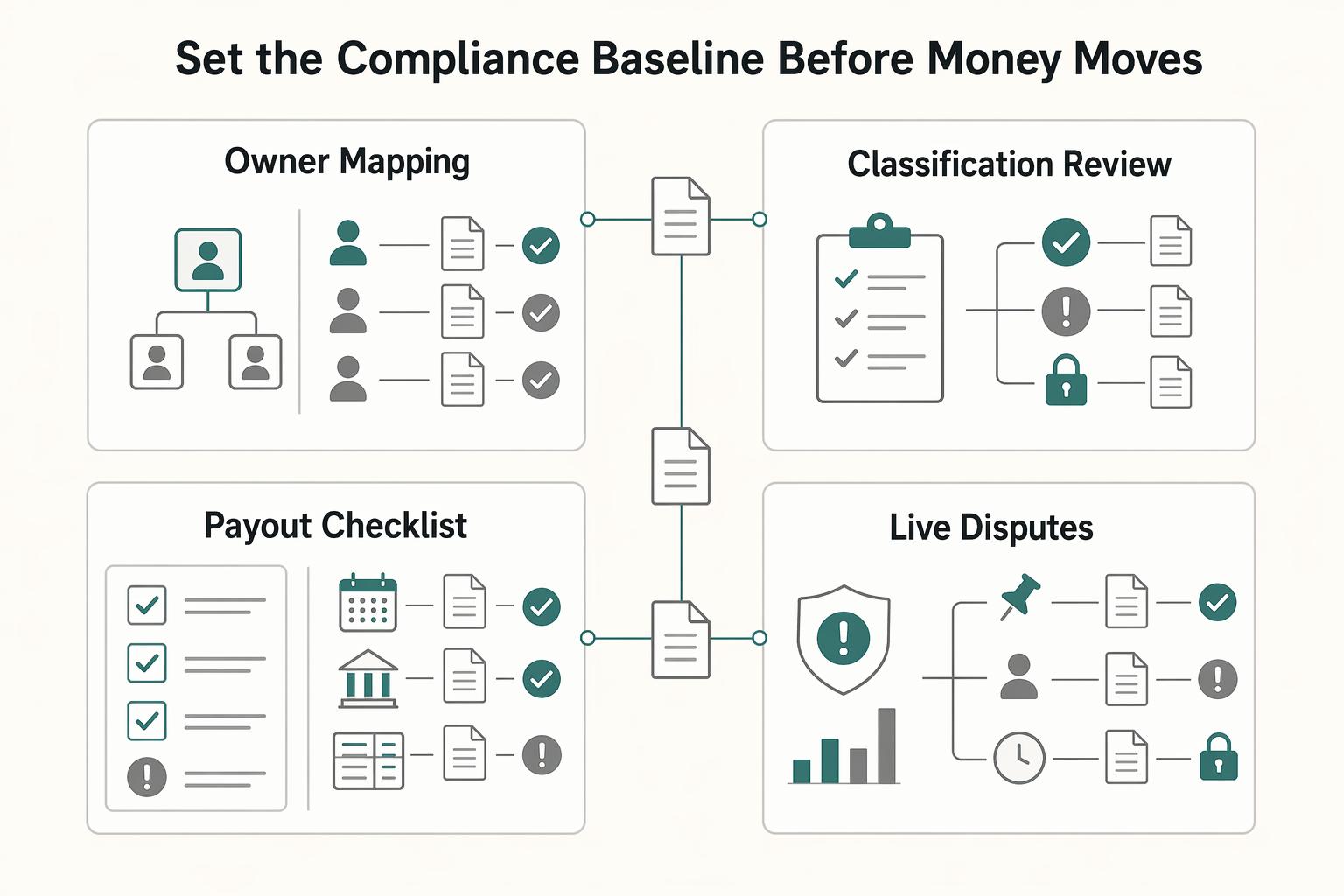
Set the compliance baseline before money moves#
Set the baseline as a release gate, not a policy note. Before the first transfer, you should be able to show who owns each decision, what record supports it, and how exceptions are handled.
| Control | What the record should show | Escalation point |
|---|---|---|
| Owner mapping | Separate labor classification under the LCT and applicable reforms, tax administration through ARCA, and foreign-exchange requirements administered by BCRA | Each open item needs an owner, a current view, and an exception log |
| Classification review | Onboarding checks and contract review, then periodic re-validation of independent contractor classification | When role scope or working patterns change, route the file back through legal review |
| Payout checklist | Verified identity, signed service agreement, complete tax data, and an eligible payout route | Eligible means the route is traceable end to end for finance and can produce auditable records, including receipts where available |
| Go-live and disputes | Legal sign-off on classification assumptions before live payouts | Document who can pause payouts, who reviews disputes, and what happens while a file is under review |
-
Map compliance lanes to clear owners. Separate labor classification, ARCA tax registration and invoicing, and BCRA foreign-exchange handling. Record the applicable rule, evidence date and owner for each lane. A contractor agreement does not replace tax or bank documentation.
-
Use classification controls that are reviewed over time. Start with onboarding checks and contract review, then re-validate periodically so your independent contractor classification does not drift from actual working arrangements. When role scope or working patterns change, route the file back through legal review instead of relying on the original approval.
-
Define a minimum compliant payout checklist for ops. Before release, your file should show verified identity, a signed service agreement, complete tax data, and an eligible payout route. Eligible should mean the route is traceable end to end for finance and can produce auditable records, including receipts where available.
-
Require go-live sign-off and a dispute path. Record legal sign-off on classification assumptions before live payouts, and document who can pause payouts, who reviews disputes, and what happens while a file is under review. This keeps payment execution aligned with compliance decisions instead of treating disputes as later cleanup.
For a resident monotributista exporting services, ARCA’s guidance requires a Factura E and an enabled export point of sale. Link the authorized invoice to the contractor’s CUIT, service agreement and payment. Check the contractor’s actual tax regime and turnover eligibility; do not apply a monotributo checklist to every supplier. ARCA also requires the payment-date field for electronic service-export invoices.
Choose payout rails and FX handling based on risk tolerance#
Choose the account and funding route before choosing the provider interface. Separate cross-border receipt, any conversion and the final local transfer. A platform-managed payout service orchestrates those legs; it is not a distinct Argentine settlement rail.
| Rail | Compliance burden | FX risk | Operational complexity | Recovery speed |
|---|---|---|---|---|
| Cross-border bank receipt | Receiving bank verifies the service-export concept and supporting documents | Foreign-currency receipt or conversion depends on the applicable route | Track first receipt, bank processing and local credit separately | Resolve with the sending and receiving institutions; do not infer failure from a delayed callback |
| Local bank or virtual-account transfer | Verify account ownership, CBU/CVU, supported currency and account limits | An ARS transfer settles pesos; any earlier conversion needs separate evidence | Reconcile the local transfer to its funding and invoice | Use final transfer status and actual account movement before retrying |
| Provider-managed bank or wallet route | Identify the institutions and accounts used beneath the provider interface | Capture the rate, quote expiry, fees and recipient net amount | Consolidated records help only if each funding and settlement leg is visible | Require an owner for holds, returns and unknown outcomes |
Set the settlement objective before you pick the rail#
ARS settlement specifies the number of pesos the contractor receives; it does not guarantee purchasing power. State whether the obligation is a fixed ARS amount or a foreign-currency amount converted under an agreed rule. Define who pays fees and bears rate changes before sending a quote.
For a worked currency example, suppose the approved obligation is USD 1,000 and the agreed illustrative rate is ARS 1,200 per dollar, with an ARS 5,000 recipient deduction. The net transfer is ARS 1,195,000. If the contract promises ARS 1,200,000 net, the platform must instead fund the deduction. Save the quote, expiry, fee allocation and recipient credit; these assumed numbers are not a current exchange-rate quote. A qualifying foreign-currency receipt follows a different route and should not be silently converted under this example.
Match rail choice to compliance and tax traceability#
For resident-to-nonresident service exports, BCRA section 2.2 generally requires entry and conversion of receipts within 20 business days of receipt or foreign-account credit. The natural-person exception permits timely entry into the recipient’s own foreign-currency account at a local financial institution with fiscal neutrality. Section 2.2.2.1 in the September 2026 text contains no annual USD 36,000 ceiling. Ask the receiving bank to confirm eligibility and retain its FX tickets; an offshore wallet balance alone is not this local-account route.
Treat stablecoins as a conditional route#
A stablecoin transfer does not by itself establish compliance with the service-export receipt rules. Before offering it, establish recipient acceptance, the legal and tax treatment, entry/conversion obligations and a documented redemption path. If that route cannot be supported, offer an eligible conventional route rather than treating crypto as a way around a bank hold.
Related: How to Pay Contractors in Mexico: SPEI CoDi and SAT Compliance for Foreign Platforms.
Build payout operations that survive failure modes#
Your payout flow should assume failures will happen and prevent them from becoming accounting breaks. In Argentina, where transfer rails can credit quickly across bank and virtual accounts, pre-send controls matter more than post-send cleanup.
| Failure mode | Handling | Control |
|---|---|---|
| Duplicate attempts | Reuse the logical payout key; establish the first attempt’s outcome before creating another | A timeout is an unknown outcome, not a failed transfer |
| Expired FX quote | Refresh and obtain approval before submitting | Use the provider’s documented expiry and error behavior; HTTP 400 is not an Argentina-wide rule |
| Returned transfer | Record the return, repair the cause and authorize a new attempt | Keep the original payout and return references linked |
| Unmatched account movement | Record actual funds in controlled clearing and investigate allocation | Do not suppress a real bank movement because the matching record is missing |
| Duplicate or delayed webhook | Deduplicate event delivery and validate allowed state transitions | Document this provider’s retry window and retrieve authoritative status when needed |
- Set a strict order of operations before release of funds.
Approve contractor eligibility, record the payable, complete payment authorization and then submit the transfer. Distinguish provider acceptance from final credit. BCRA describes local immediate transfers between bank and virtual accounts as available 24/7 with credit within 15 seconds. That local capability is not an end-to-end SLA for cross-border funding, FX review or every provider integration. Merchant QR payments within Transferencias 3.0 are a separate use case.
- Treat each failure mode as a separate workflow.
Handle duplicates, stale quotes, returns and unmatched funds separately. For a timeout after submission, query the original payout before retrying. For an expired quote, refresh the rate and approvals. For a return, reverse or clear the actual movement under finance’s policy and repair the recipient details. For unmatched funds, retain the bank evidence and post to controlled clearing pending allocation.
- Make retries replay-safe and callbacks deterministic.
Use a stable logical payout key within the provider’s supported idempotency scope. Keep your request ID, the provider’s diagnostic request identifier and the payout reference separate. Deduplicate callback event IDs and validate state transitions. Record retry windows from the integration documentation instead of assuming a three-day window applies to Argentine rails.
- Build an evidence pack per payout cycle and stop batching if traceability breaks.
For each payout, keep the request ID, provider reference, event history, final ledger entries, and exception notes. For Argentina audit readiness, keep the electronic comprobante or other original support you rely on, linked back to the contractor record. Use a hard stop for ARS batches: if you cannot tie request to provider reference to ledger posting, pause batching and fix the root cause first.
Compare Argentina with other rollout candidates#
Sequence by operational certainty, not market narrative. Put Argentina first only when FX and compliance unknowns are already bounded in your operating design. Otherwise, pilot where your rail and regulator map is clearer and exceptions are easier to control.
Build a country sequence table before you commit product time#
Use rail and regulator names as diligence anchors, not as shorthand for easy or hard. The real test is whether you can define a routine payout path, an exception path, and a document set without guessing.
| Market | Rails and regulators to map | What is grounded in this section | Sequencing signal |
|---|---|---|---|
| Argentina | ARCA invoicing, BCRA service-export receipt rules and local bank/virtual-account transfer support | Cross-border entry, currency handling and local distribution are separate steps; verify the actual recipient’s route | Launch when the invoice, bank documentation, supported currency and recovery path have been tested |
| Peru | Yape, Plin, SBS | This section does not establish operational behavior for these rails or regulator actions | Move ahead of Argentina only if your own review shows a clearer path for onboarding, payout handling, and exceptions |
| Mexico | SPEI, CoDi, SAT | This section does not establish operational behavior for these rails or regulator actions | Move ahead of Argentina only if your team can define payout and compliance handling with fewer open questions |
| Kenya | M-Pesa, Pesalink, KRA | This section does not establish operational behavior for these rails or regulator actions | Move ahead of Argentina only if partner coverage, documents, and failure handling are clearer than your Argentina design |
Readiness check: each country row should name the routine route, authority map, required documents and exception owner. Specify an approved alternative or a controlled pause if no lawful route is available. Resolve missing fields before the first payout.
Compare operational load, not market upside#
The core comparison is operator load. In Argentina, macro constraints can directly affect payout design, so FX handling, settlement behavior, and fallback planning need tighter definition before launch.
Compare the same flow in each market: foreign funding, recipient eligibility, conversion, local settlement and recovery. Count manual reviews and exception resolution time in the pilot. A second rail may improve resilience, but maintaining two untested routes adds operational work without proving readiness.
Choose the first launch based on timing and evidence quality#
If your GTM depends on fast onboarding and fewer payout exceptions, launch where your document checks, payout route, and exception ownership are least ambiguous. That may be Argentina, but only if your evidence pack is complete.
For each market, keep a one-page memo naming the payer and recipient types, invoice requirements, funding route, supported currencies, fees and recovery owner. For Argentina, attach the current BCRA version and receiving bank requirements. Country labels or regional momentum cannot establish that a specific provider route works.
If the case for Argentina is mostly LATAM momentum, pause. Sequence by verified operational readiness, then expand with fewer surprises.
For a comparable Latin America payout workflow, see How to Pay Contractors in Peru: Yape Plin and SBS Compliance for Platform Operators.
Common mistakes that create compliance or payout rework#
Most compliance and payout rework comes from locking assumptions too early. When regional guidance or a provider summary becomes your decision record, you often end up rebuilding contracts, payout logic, or finance controls after payouts have started.
Localize your legal and FX assumptions#
Argentina’s Law 27,802 was published on March 6, 2026. Refresh classification analysis against the applicable current law and actual working arrangement. Do not read a summary about platform workers as a blanket exemption for every contractor working through a digital business.
Keep a source, date and owner for every BCRA or ARS routing assumption. For example, the September 2026 update records the natural-person service-export exception without the older annual cap. A route rejected by the bank needs a documented resolution, not a switch based on a stale sales summary.
Lock classification controls before enabling payouts#
Lock contractor-classification controls before payouts go live. Cross-border contractor payments become complex when fees, tax paperwork, and classification rules intersect, and misclassification risk is the risk that a contractor is later treated as an employee. That distinction affects contract terms, IP ownership, invoice handling, and tax reporting.
Use a clear activation gate: completed contractor profile, signed service agreement, classification review, and tax data before first payout. A common failure pattern is launching first and trying to standardize agreements only after exceptions appear.
Build reconciliation and model flexibility from day one#
Design reconciliation from the start or routine issues become finance fire drills. Payment rails affect speed, FX, and settlement, and currency conversion can materially change payout outcomes.
Track each payout from invoice and payable to funding, provider reference and final account credit. Contractor administration services can help with documents and payments. An EOR employs workers; consider that employment model when the role should be employment, rather than using it as a label for outsourced contractor payouts.
Conclusion and copy-paste launch checklist#
Launch once the contractor record, invoice, funding route, currency policy and pilot settlement evidence agree. Unresolved receiving-bank requirements or FX treatment should keep that route conditional. Decide who resolves a hold and what contractors are told before you expand volume.
Use this as a final go or no-go pass before broader release.
- Confirm authority mapping.
Make sure your internal memo or counsel note explicitly maps the labor, tax, and enforcement steps you are relying on. The verification point is simple: one reviewer should be able to open a single record and see who owns classification decisions, what assumptions were approved, and where disputes or edge cases escalate. If that record does not exist, you are not ready.
- Lock the payout rail and FX policy.
Your launch file should name the primary rail, settlement approach and country-level FX assumptions, plus a lawful alternative or controlled pause if the preferred path fails. Finance, ops and product should use the same conversion rule and exception path. Document who repairs stale quotes, returned transfers and unavailable routes, and who notifies contractors.
- Validate the onboarding evidence pack.
Before the first live payout, confirm that every contractor record contains the service agreement, tax data collected at onboarding, payout-method eligibility, and a named exception route. Do not rely on scattered attachments across email, CRM, and payment tools. If ops cannot produce the file quickly during a review, missing paperwork will show up later as payout delays or rework, not as a clean pre-launch issue.
- Run a pilot batch and reconcile it completely.
Send a limited batch first and require full evidence from request to provider result to ledger entry as an internal launch control. Your checkpoint here is auditability, not speed: request ID, provider reference, final amount, settlement result, and exception notes should all match. If even one payout cannot be tied cleanly from initiation through reconciliation, stop and fix the design before you scale volume.
- Pause expansion when a checkpoint fails.
When a checkpoint fails, keep the failed payout, invoice, bank evidence and exception owner together. Continue only after the route or record is repaired and the affected payment reconciles. A documented pause is preferable to changing currencies, accounts or providers without an approved explanation.
Related reading: How to Write a Payments and Compliance Policy for Your Gig Platform.
Frequently Asked Questions
What are the minimum compliance checks before paying contractors in Argentina?
Verify identity, the signed service agreement, classification, tax registration and invoice requirements for the supplier’s actual regime. Use ARCA, the current tax authority, rather than an AFIP-only onboarding checklist. Match the account owner and supported currency, and retain the bank or provider documents supporting the payment route.
Do contractors in Argentina always need to be paid in Argentine peso (ARS)?
No. The BCRA rules include a conditional foreign-currency receipt route for natural-person service exporters. The recipient’s tax status, account and receiving bank process matter. Define those before promising either ARS conversion or foreign-currency credit; a foreign wallet is not interchangeable with a qualifying local bank account.
How should a platform reduce FX risk without creating reconciliation complexity?
Use a limited set of payout routes and apply one quoting and settlement rule per route. If treasury flexibility matters, keep tight quote-expiry controls and log the approved FX assumption with the payout record. The failure mode is mixing conversion logic across rails, which makes it hard to match the request amount, provider reference, and final ledger amount.
When should we use an EOR versus direct contractor payouts in Argentina?
Use direct or administrated contractor payouts for a genuine independent service relationship. Use an EOR when you need an employment arrangement through a local employer. Payment exceptions or thin internal support may justify a contractor administration provider, but do not themselves establish that an EOR is the correct model.
What operational controls matter most for payout compliance at scale?
Verify identity and account ownership, supported currency, authorization and invoice-to-bank traceability. Separate callback retries from new payments and handle returns and unknown outcomes explicitly. Assign the contractor and platform’s actual tax/reporting duties by regime and entity role; there is no established universal monthly-or-quarterly platform reporting rule in this guide.
When is regional LATAM guidance not enough for Argentina decisions?
Country-specific analysis is needed for classification, ARCA registration and invoicing, and BCRA service-export receipts. Document the actual payer, recipient, account and service. Regional guidance cannot establish the documents or currency treatment for that transaction.
Try a related tool
Where Gruv fits
Researched and edited by the Gruv editorial team. Gruv builds cross-border billing, payouts, and finance-operations software for global businesses.
Sources
Educational content only. Not legal, tax, or financial advice.
Related Posts
Pay Contractors in Peru with Yape, PLIN, and SBS Checks
Treat Peru as a posture decision, not just a rail decision. If you choose a local wallet-style method first, then sort out contractor status, tax data, and evidence later, you may get a smoother payout experience. You also raise launch risk in areas that are much harder to fix once money starts moving.

Pay Contractors in Mexico: SPEI, CoDi and SAT Records
Paying a contractor in Mexico involves an accepted service obligation, the supplier’s tax documents and a money movement. A SPEI transfer does not classify a worker, and a CFDI invoice does not prove that a bank account was credited. Link these records while keeping their different meanings visible.

How to Pay Contractors in Kenya with M-Pesa, PesaLink, and KRA Controls
Kenya is worth serious consideration for contractor payouts, but you should not greenlight a launch just because M-Pesa is familiar and PesaLink is on the shortlist. The real decision is practical. Confirm which rail fits your contractor base, put local compliance and tax controls in place before money moves, and keep enough evidence to explain each payout later.