

Quick Answer
Define contractor cohorts first, then assign one primary payout rail and one fallback before any integration work. Release payments only when the contractor record shows KRA PIN status, tax-treatment ownership, and traceable payout references in the same place finance reconciles. Treat M-Pesa and PesaLink interoperability claims as unconfirmed until provider documentation and test results match your exact flow. If that evidence is missing, keep the item in a known-versus-unknown register and hold scale.
What to know before paying contractors in Kenya#
Kenya is worth serious consideration for contractor payouts, but you should not greenlight a launch just because M-Pesa is familiar and PesaLink is on the shortlist. The real decision is practical. Confirm which rail fits your contractor base, put local compliance and tax controls in place before money moves, and keep enough evidence to explain each payout later.
Before you start#
Treat channel names as market signals, not proof you are launch-ready. PesaLink is described as an instant payments offering in Kenya, and an IPSL document describes Integrated Payment Services Limited as providing digital transaction solutions through the PesaLink platform. That tells you the rail matters. It does not prove your provider supports your use case, your recipients can receive funds the way you expect, or that a claimed M-Pesa to PesaLink path is ready for your product.
| Step | Checkpoint | Do not rely on |
|---|---|---|
| Define contractor scenarios before integration | For each contractor segment, name a primary payout route, a fallback route, and the exact provider evidence you will accept before go-live | Starting build work while domestic and cross-border cases are still mixed together |
| Lock the compliance posture early | A payout should not move from approved to sent unless its compliance status is visible in the same record finance will later reconcile | Treating compliance and tax control as month-end cleanup |
| Build a known-versus-unknown register | Log every launch assumption, who verified it, what document or test proved it, and what remains unresolved | Claims about rail availability, integration status, or payout behavior without current provider documentation or a successful test |
Step 1. Define the contractor scenarios before you discuss integration. Start with how contractors actually receive money, not with the rails your team already knows. If your target users are mobile-money-first, validate M-Pesa first. If they are bank-account-based, PesaLink or bank transfer may be the better fit. Your checkpoint is simple: for each contractor segment, you should be able to name a primary payout route, a fallback route, and the exact provider evidence you will accept before go-live. A common failure mode is starting build work while domestic and cross-border cases are still mixed together.
Step 2. Lock the compliance posture early, even if some details still need local review. You do not need every edge case solved on day one, but you do need a clear rule for when a contractor is payout-ready. That usually means deciding which compliance or tax records must exist before release, who owns exceptions, and where required tax treatment will be recorded for your model. The checkpoint is operational: a payout should not move from approved to sent unless its compliance status is visible in the same record finance will later reconcile. The red flag is treating compliance and tax control as month-end cleanup.
Step 3. Build a known-versus-unknown register and make it part of the launch decision. Kenya appears in SIIPS 2025 acknowledgements among countries whose central banks and instant payment operators provided data. That is useful context about active payment infrastructure. It is not evidence for your specific provider connectivity, reconciliation detail, or exception handling. Keep a short log of every launch assumption, who verified it, what document or test proved it, and what remains unresolved. If a claim about rail availability, integration status, or payout behavior cannot be tied to current provider documentation or a successful test, treat it as unconfirmed and plan around that uncertainty.
That is the lens for the rest of this guide. Choose rails based on contractor reality, not brand familiarity, and build compliance and verification into the product decision from the start.
What to prepare before you start paying contractors in Kenya#
Launch readiness is not rail familiarity; it is clear scope, named ownership, and decision records you can audit. SIIPS 2024 and SIIPS 2025 acknowledging Kenya as a data-contributing market is useful context, but it is not proof that your specific payout setup is ready.
Step 1. Confirm your payout scope. Separate domestic Kenya disbursements from any cross-border flows in your rollout plan. For each contractor cohort, define one primary route and one fallback route before build starts.
Step 2. Define your minimum compliance pack before onboarding starts. Set an internal rule for what records and checks must exist before a contractor is payout-ready, and who can approve exceptions. Because detailed contractor tax procedures are not established, treat any KRA-related workflow detail as a local validation item, not an assumption.
Step 3. Assign named owners across product, finance, and ops. Assign ownership for payout path design, filing and evidence review responsibilities, and exception handling. If rejected records or compliance holds do not have owners, they stay unresolved until payout day.
Step 4. Create one source of truth for every payout decision. From day one, log each status change with timestamp, actor, reason, and document reference in one record. Keep payout route, compliance state, approvals, instruction status, and exception notes together so finance, ops, and engineering are working from the same evidence.
If you're comparing East African payout setups, our Tanzania guide covers similar mobile money and FX-control considerations: How to Pay Contractors in Tanzania: M-Pesa Tanzania and BoT FX Rules for Platforms.
Choose M-Pesa, PesaLink, or bank rails by contractor scenario#
Choose the rail by contractor profile, then lock a fallback before go-live. Use one primary and one approved fallback per cohort so wallet, bank, and cross-border cases do not collapse into one unclear payout lane.
Step 1. Match each contractor segment to a primary rail#
| Rail | Use when | Operational dependency | Reconciliation data to log | Pre-approved fallback |
|---|---|---|---|---|
| M-Pesa | Contractors are mobile-money-first | Wallet-ready recipient data and confirmed provider support | Wallet identifier, provider reference, final status, failure reason | PesaLink or bank transfer only if bank details are already collected |
| PesaLink | Contractors are paid to bank accounts and faster domestic movement is part of your payout promise | Valid bank account data and confirmed routing in your provider flow | Account reference, provider reference, reject code, timestamp | Standard bank transfer |
| Bank transfer via Equity Bank, KCB, or another partner bank | Contractors want bank settlement and you run a bank-led payout lane | High-quality account data and controlled file/API operations | Instruction ID, bank reference, posting status | PesaLink only where your provider setup supports it |
| SWIFT | Cross-border exception cases | Full international banking data and extra review controls | SWIFT reference, beneficiary bank details, review notes | No default fallback; use local rails only when local receipt is available |
Treat this as an operator design table, not a claim about fees, limits, or SLAs.
Step 2. Apply the hard rule consistently#
If your contractors are primarily mobile-money-first, start with M-Pesa. If they are bank-account-based and speed is important to your operating model, prioritize PesaLink.
Keep SWIFT as a targeted cross-border option, not your default domestic Kenya rail. Even though real-time payments are often described as moving "within seconds rather than days," do not merge domestic and international payout promises into one lane.
Step 3. Treat integration claims as conditional until verified#
Treat any claim about M-Pesa and PesaLink interoperability, including claims tied to Safaricom PLC, as conditional until your current provider documentation and test evidence confirm your exact path. Kenya's Digital Economy Blueprint acknowledges both the Central Bank of Kenya and the Kenya Revenue Authority, and it notes Safaricom among organizations that provided inputs; that context does not by itself prove live interoperability for your implementation.
Before go-live, require per-profile reroute rules and visible evidence for the original provider reference, status check result, and idempotency key. If those controls are missing, your fallback process is not ready, and duplicate payouts become a real operational risk.
For another example of how local rails can reduce payout friction and control risk, see How to Pay Contractors in Nigeria Using Local Rails for Compliance-Safe Operations.
Build KRA compliance controls before the first payout batch#
Set KRA compliance as a release gate before batching payouts. If tax-readiness evidence is incomplete, hold the payout even when M-Pesa or bank recipient data is valid.
| Control | Keep or define | Record |
|---|---|---|
| Tax registration checks | Keep separate from payment-rail readiness | KRA PIN, PIN registration status, reviewer, check date, and evidence link |
| Tax treatment decision | Define the decision path for withholding treatment before the first live batch | Contractor type used, tax lane selected, approver, and attached evidence |
| Tax lane scope | Document which contractor scenarios route through review | Individual Income Tax, PAYE, and VAT review |
| KRA M-Service use | Use as a touchpoint and track remittance-workflow unknowns | Written known-versus-unknown log |
Step 1. Separate tax registration checks from payout readiness#
Keep tax-readiness fields separate from payment-rail readiness in the contractor record. Treat KRA PIN and PIN registration status as independent checks with their own reviewer, check date, and evidence link so ops can see exactly why a payout is blocked.
Step 2. Record how tax treatment is chosen for each contractor type#
Define the decision path for withholding treatment before the first live batch. For each payout, store the contractor type used, the tax lane selected, approver, and attached evidence so the decision is explainable later.
Step 3. Clarify which tax lanes are actually in scope#
Document which contractor scenarios you route through Individual Income Tax, Pay As You Earn (PAYE), and Value Added Tax (VAT) review. If a lane is not clearly scoped for a contractor model, treat it as an unresolved launch item instead of deciding inside production payout runs.
Step 4. Use KRA M-Service carefully and track unknowns#
Use KRA M-Service as a touchpoint, but keep a written known-versus-unknown log for your remittance workflow. UK HMRC guidance supports habits like registering before filing and keeping records, but it does not establish Kenya-specific rules, rates, deadlines, or remittance steps; do not import UK dates such as 5 October or 31 January into Kenya logic.
Related: How to Pay Contractors in Peru: Yape Plin and SBS Compliance for Platform Operators.
Set up the payout operation so finance and engineering see the same truth#
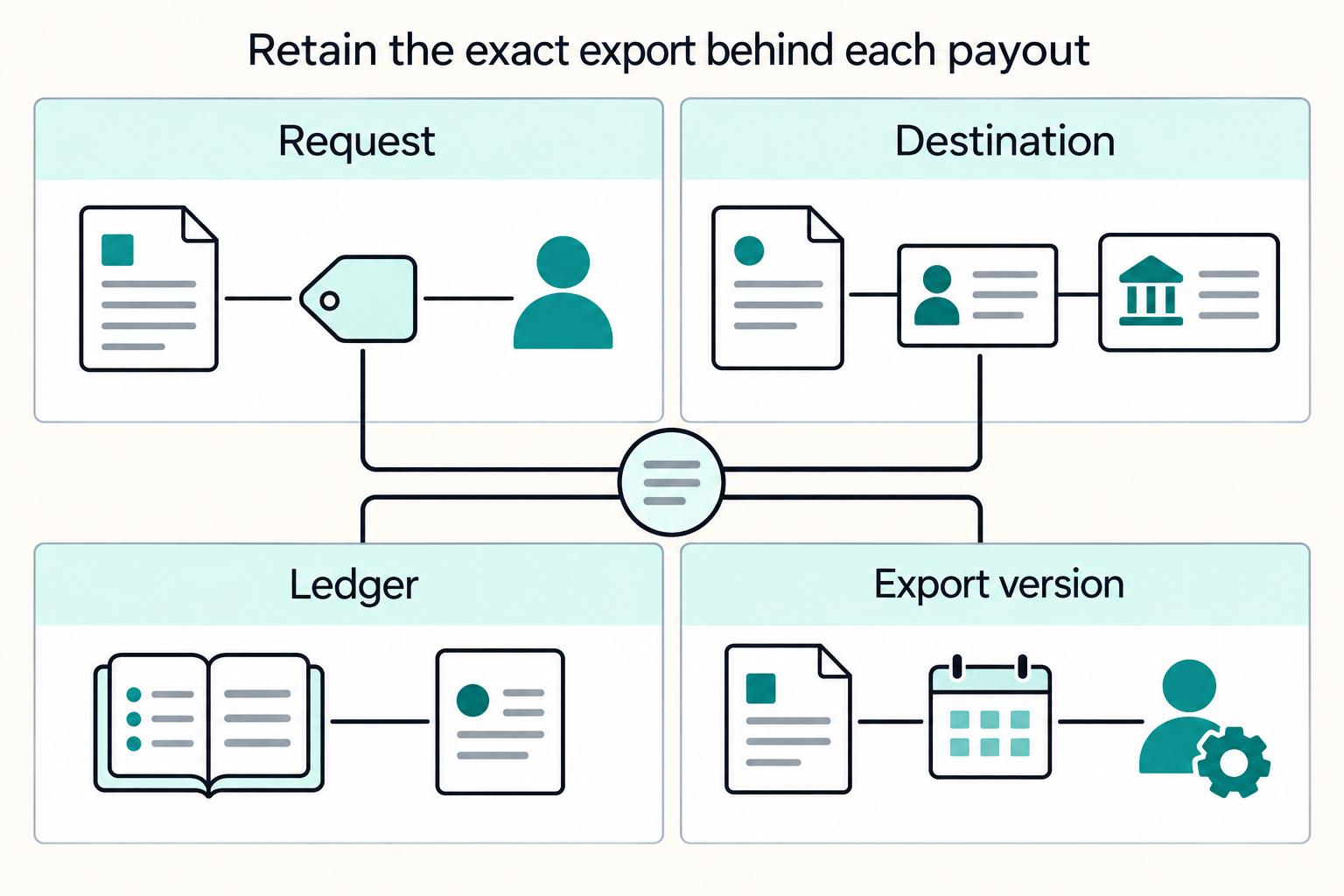
Use one transaction record as your operating truth from approval to reconciliation. When payout history splits across systems, teams stop debating decisions and start debating data.
Step 1. Map one order of operations and write each stage to the same record. Use one consistent sequence for every payout: contractor verification, payment instruction, provider response, ledger posting, and reconciliation export. At each stage, capture timestamp, actor or service, and evidence link in the same transaction record so finance and engineering are reading the same timeline.
Step 2. Treat idempotent retries as an internal duplicate-control rule. Use one stable internal payout ID per intended disbursement and reuse it across retries. Keep internal payout ID and provider reference ID as separate fields, then attach late provider responses to the original payout instead of opening a second transaction.
Step 3. Standardize batch statuses and require provider references once available. Define statuses as internal controls, not a legal taxonomy:
| Status | Use it when | What finance should expect |
|---|---|---|
| Queued | Approved internally but not yet sent | No external movement yet |
| Sent | Submitted to provider, outcome still pending | Await provider outcome/reference |
| Failed | Provider rejected or payout did not complete | No completed disbursement |
| Reversed | Money moved, then was returned/reversed | Offset entry and exception review |
| Manually reviewed | Held for human decision | No automatic retry |
Require provider reference IDs in the transaction record whenever the provider returns one, including successful, failed, and reversed outcomes.
Step 4. Build a monthly evidence pack that ties payout events to tax records. As an internal audit control, assemble a monthly pack that connects payout events, reconciliation outputs, ledger entries, and your Withholding Tax records and KRA reporting artifacts. Include reviewer decisions for manually handled items so exceptions are traceable without rebuilding history at month-end.
Handle failures and compliance exceptions without blocking the whole program#
Handle exceptions at the payout-record level so one issue does not stall unrelated payouts. Keep the batch moving, and make each hold clear enough that finance can resolve it from the record without an engineering log pull.
Step 1. Isolate exceptions on the original payout record. When a payout needs review or fails, move only that item to a held or failed state and continue processing the rest of the batch. The control to test is simple: from one batch view, finance should be able to see which payouts are blocked, in progress, and completed.
Step 2. Use one internal exception taxonomy across rails. Use the same exception labels across M-Pesa, PesaLink, SWIFT, or any other route so reporting stays comparable month to month. Keep the rail as a separate field on the payout record so teams can compare exception patterns without mixing classification and routing context.
Step 3. Predefine recovery paths and re-approval points. Define recovery actions before go-live so operators are not improvising during incidents. Keep retries tied to the same internal payout ID until outcome is clear, and require a fresh approval when material fields change, for example beneficiary details, rail, currency, or tax treatment.
If fallback uses a corporate bank account, keep the governing bank documents attached to the case. NCBA states its Key Facts Document should be read with the General Terms and Conditions, Tariff Guide, and product brochures, and that the General Terms and Conditions prevail where inconsistent.
Step 4. Keep an auditable exception trail connected to the contractor and payout records. Your exception log should live in the same operational record set as payout status, attempted rail, and provider reference when available, plus the linked contractor and internal tax-treatment status. A practical check is whether finance can take one held or reversed payout and explain owner, current state, and next action from that record alone.
For a step-by-step walkthrough, see Gig Worker Tax Compliance at Scale: How Platforms Handle 1099s W-8s and DAC7 for 50000+ Contractors.
Separate confirmed facts from market claims before go live#
Before go-live, treat assumptions as a control point, not a footnote. If a Kenya-specific assumption affects tax handling, routing, or settlement, log it as known, unknown, or unverified and decide explicitly whether the evidence is strong enough to launch.
Step 1. Track assumptions in a known-vs-unknown register. Keep a short operating register with the assumption, why it matters, current evidence, owner, and next proof needed. Prioritize items that can block payouts or tax handling, including KRA M-Service capabilities, claimed M-Pesa-PesaLink integration status, and any Central Bank of Kenya posture being treated as settled. Mark an item as "known" only when you have current official documentation or written provider confirmation.
Step 2. Treat market claims as signals until verified. Use social posts, opinion pieces, and event commentary to find leads, but not as launch evidence. Apply a simple standard: if official documentation is missing or core terms are unclear, do not make it a production dependency. As of June 2024, a cited Kenya case noted no official documentation on program parameters, benefits, or costs, and said donor-engagement terms and vendor contracts were unclear.
Step 3. Require explicit sign-off on unresolved unknowns. If unknowns remain at launch, require written acceptance from product, finance, and ops, with a fallback and stop condition. For open items tied to Kenya Revenue Authority process, Central Bank of Kenya posture, or provider connectivity, record owner, review date, and trigger action if the assumption fails. This prevents "probably true" assumptions from quietly becoming production policy.
Roll out in phases with clear no-go checkpoints#
Scale only when the pilot is fully explainable end to end, with no unresolved compliance evidence. Start with one narrow contractor cohort in Kenya, and treat the first wave as a control test for reconciliation, exception handling, and record integrity, not a speed test.
| Gate | Requirement | No-go if |
|---|---|---|
| First cohort | Use a cohort with similar payout attributes and define reconciliation and exception criteria across repeated pilot runs | Teams still need spreadsheet stitching, manual wallet checks, or engineering intervention to explain payout outcomes |
| Compliance evidence before scale | Complete evidence pack per paid contractor | KRA PIN status, Withholding Tax treatment rationale, or payout traceability is missing or unclear |
| Tax-operations gate | Assign owners for Tax Compliance Certificate handling and Kenya Revenue Authority reporting, and run a month-end dry run on the pilot cohort | The team cannot produce contractor-level payout history, tax treatment, certificate status where relevant, and reporting outputs without rebuilding data trails |
Step 1. Keep the first cohort narrow and reconciliation-complete. Use a cohort with similar payout attributes so failures are easier to diagnose. Before running the first batch, define your reconciliation and exception criteria, then test them across repeated pilot runs. Do not expand if teams still need spreadsheet stitching, manual wallet checks, or engineering intervention to explain payout outcomes.
Step 2. Apply a hard go/no-go rule for compliance evidence. Before increasing volume, require a complete evidence pack per paid contractor, including:
- KRA PIN status captured before release
- Withholding Tax treatment recorded with its rationale
- Payout traceability from provider/transaction reference to your internal payout record
If any of those links are missing or unclear, treat it as a no-go for scale.
Step 3. Add a tax-operations gate before broader rollout. Assign clear owners for Tax Compliance Certificate handling and Kenya Revenue Authority reporting, and define when payout operations hands records to finance. Run a month-end dry run on the pilot cohort and confirm the team can produce contractor-level payout history, tax treatment, certificate status where relevant, and reporting outputs without rebuilding data trails.
Where public information is incomplete, tighten your gate, not your assumptions. In this research set, a cited Kenya/PesaLink page was unavailable at retrieval time, and broader industry projections are described as assumption-based and subject to risks and uncertainties. If a provider claim, rail status, or tax-handling assumption lacks current documentation or written confirmation, keep it out of the scale decision.
Read How to Write a Payments and Compliance Policy for Your Gig Platform if you want the companion policy view.
Conclusion#
The right launch call is straightforward. Choose payout paths based on contractor reality, not brand familiarity, and do not scale until compliance and payout evidence can stand up to scrutiny. Kenya has a real digital-business context, but broad market signals are not the same as production proof. UNCTAD makes that point plainly in another context by noting that mentioning a firm or process does not imply endorsement, and the same discipline should shape your go-live standard.
Use this as your copy-and-paste launch checklist:
- Confirm payout path by contractor segment.
Decide which payout path each contractor segment is expected to use. Your verification point is not a slide or a vendor promise. It is a contractor-level record showing the intended payout path, the recipient detail you collected, and the fallback path if that method fails.
- Validate compliance prerequisites before release.
If payout-related compliance or tax treatment is still unclear for a contractor group, stop there and hold that group rather than pushing the whole batch through. A common failure is treating these decisions as something finance can clean up after payment. You want the decision, owner, and supporting record attached before money moves.
- Confirm duplicate-handling and record-capture controls.
However you build payouts, make sure retries and reprocessing are controlled and that each payout can be traced in your records. The checkpoint is practical: finance should be able to match a payout instruction to the corresponding transaction history without asking engineering to reconstruct the trail from logs.
- Define failure recovery before the first live batch.
Do not wait for your first timeout, rejection, or reversal to decide what happens next. Write down which failures can be retried, which require manual review, and who owns each escalation path. If your team cannot answer that in advance, you are not operationally ready.
- Approve go-live only after a signed known-versus-unknown review.
Keep an explicit list of what is confirmed, what is assumed, and what still needs primary documentation, especially around provider connectivity and tax steps. Product, finance, and ops should all sign off on that list. If any unknown would change whether you can pay legally, reconcile accurately, or recover failed payouts, it is a no-go item, not a note for later.
That is the real standard for a Kenya contractor-payments compliance-platform launch: not whether the market sounds ready, but whether your evidence pack, controls, and exception handling are ready.
Frequently Asked Questions
What is the practical difference between paying contractors through M-Pesa versus PesaLink in Kenya?
In the material behind this guide, PesaLink is described as enabling instant digital transactions, and IPSL is described as the entity behind it. M-Pesa is referenced here only as part of Kenya’s digital network, not with enough operational detail to compare recipient rules, reconciliation output, or exception handling side by side. For launch decisions, treat them as different payment options that each need separate proof on settlement evidence and failure recovery, not interchangeable labels.
Is M-Pesa and PesaLink integration fully confirmed and live for platform payouts?
No, not from the sources used for this section. The available PesaLink material here is a Scribd upload with AI-enhanced metadata, so it is not enough to confirm live platform payout support or a working M-Pesa connection. If a provider cannot show current primary documentation, sample payout evidence, and named support ownership, keep that item in your unknowns register.
What must a platform validate before paying a contractor under Kenya Revenue Authority rules?
The clearest validated checkpoint in this research set is the KRA PIN, which is referenced as part of the Kenya setup process. Before release, confirm the contractor record contains the KRA PIN status you checked, then keep the payout reference and your tax treatment decision tied to that record. The verification point is straightforward. Finance should be able to pull the contractor, the PIN check result, and the payout trace without asking engineering to rebuild the trail.
How should we handle Withholding Tax when contractor residency or classification is unclear?
Do not guess, and do not pay first with a plan to clean it up later. This guide does not provide official withholding rates, thresholds, or remittance steps, so the right move is to hold that payout, collect the missing residency or classification evidence, and get tax sign-off before release. A common failure mode is relying on profile text or payment preference instead of documentary status.
What is KRA M-Service useful for in contractor payout compliance operations?
The exact KRA M-Service capabilities for contractor payout compliance aren't confirmed. Use it only as a possible Kenya Revenue Authority step until your tax owner verifies what can actually be checked or evidenced there. If your team plans to depend on it, require a written note or screenshot-based evidence pack so the process does not live only in tribal knowledge.
When should we use SWIFT, Wise, or Payoneer instead of domestic Kenya rails?
Treat SWIFT, Wise, or Payoneer as a separate decision track, especially when a payment is cross-border or the recipient cannot receive your domestic option. The practical check is whether you have clear recipient requirements, traceable references, and month-end evidence, or are just swapping one unknown for another.
Try a related tool
Researched and edited by the Gruv editorial team. Gruv builds cross-border billing, payouts, and finance-operations software for global businesses.
Sources
Includes 2 external sources outside the trusted-domain allowlist.
- business.gov.uk/support/business-structures-governance-and-e...trusted
- documents1.worldbank.org/curated/en/784831625137368238/pdf/Building-F...trusted
- documents1.worldbank.org/curated/en/099112425071537101/pdf/P509058-c0...trusted
- elibrary.imf.org/view/journals/087/2025/004/article-A001-en.xmltrusted
- ilo.org/sites/default/files/2024-06/24004-ILO-Digita...trusted
- thedocs.worldbank.org/en/doc/345341601590631958-0090022020/origina...trusted
- africanenda.org/uploads/files/siips2025/SIIPS2025-mainreport...external
- africanenda.org/uploads/files/siips-2024-mainreport-EN.pdfexternal
Educational content only. Not legal, tax, or financial advice.
Related Posts

How to Pay Contractors in Tanzania with M-Pesa and BoT FX Boundaries
Tanzania is worth evaluating for contractor payouts, but the decision is not about market interest alone. It comes down to whether your model can operate inside Bank of Tanzania boundaries and still deliver a payout experience that finance, compliance, and contractor support can defend.
Pay Contractors in Peru with Yape, PLIN, and SBS Checks
Treat Peru as a posture decision, not just a rail decision. If you choose a local wallet-style method first, then sort out contractor status, tax data, and evidence later, you may get a smoother payout experience. You also raise launch risk in areas that are much harder to fix once money starts moving.

Pay Contractors in Mexico: SPEI, CoDi, SAT, and CFDI Decisions for Platforms
Mexico contractor payouts usually break for a simple reason: teams launch from a generic Latin America plan, then discover that payout rail choices, tax steps, and operating structure cannot be separated in practice. If you are evaluating multiple rails and operating models at the same time, you need Mexico-specific decisions before you send the first live payout.