
Quick Answer
Define the scope as NGN domestic contractor payouts in Nigeria, then run a fixed operating sequence before scale. Collect a minimum evidence pack (legal name, payout destination, KYC status, and hold/review flags), apply eligibility gates, submit, capture callbacks, and close only after reconciliation. Use local rails only for cohorts where pilot records show complete traceability from payout request to final ledger posting. In batch operations, treat "submitted" as in-flight and "reconciled" as the true finish state.
Nigeria contractor payouts on local rails start with the operating model#
Start by mapping how contractor funds reach a Nigerian account in NGN: source funding, currency conversion when needed, beneficiary validation, transfer submission and reconciliation. A local payout leg does not remove the cross-border funding or FX decisions upstream.
Step 1 Define local rails narrowly#
Use local rails to mean domestic payment pathways for NGN disbursement. Record the provider, supported recipient institutions and account types, funding currency and status-query capability. A provider routing a transfer through a local partner is different from your business directly participating in the payment system.
Your first checkpoint is simple: write a one-line scope statement and make every owner sign off on it. It should name the country, currency, recipient type, and purpose. For example: "Nigeria contractor payouts in NGN through domestic payout pathways." If your team cannot agree on that sentence, you are not ready to compare routes or promise delivery outcomes.
Step 2 Choose NGN rails only when the operating case is clear#
Use local NGN payouts when the contractor has agreed to receive naira, the destination is supported and the provider has approved your business and payout purpose. Compare a supported foreign-currency or wire route when the recipient needs another currency or local coverage is unavailable. Keep unresolved legal or compliance holds in place on every route.
The red flag is assuming "local" automatically means easier. It may be easier for the recipient, but your internal burden can still rise if validation, approval policy, or reconciliation discipline is weak. If you cannot explain why this segment should stay on a domestic route, split the cohort and route only the clearly supported cases first.
Step 3 Commit to a decision-ready output before build starts#
This guide should end in something your team can operate, not just discuss. By the time planning is done, you should have four concrete artifacts:
- a build order for how payouts move from request to completion
- compliance gates that decide what blocks payout and what goes to review
- failure recovery rules for rejected, delayed, or mismatched payouts
- a copy and paste launch checklist your team can use before go live
A good check is whether Finance, Ops, and Engineering can all point to the same decision record and see the same route rules. One common mistake is starting integration work before those rules exist, then discovering later that payout exceptions, tax handling, or compliance review paths were never defined. When that happens, local rails stop being a routing choice and become a cleanup project.
Related: Local Currency Payouts vs USD Payouts: What Contractors Prefer and What Platforms Should Offer.
What to prepare before you send the first payout#
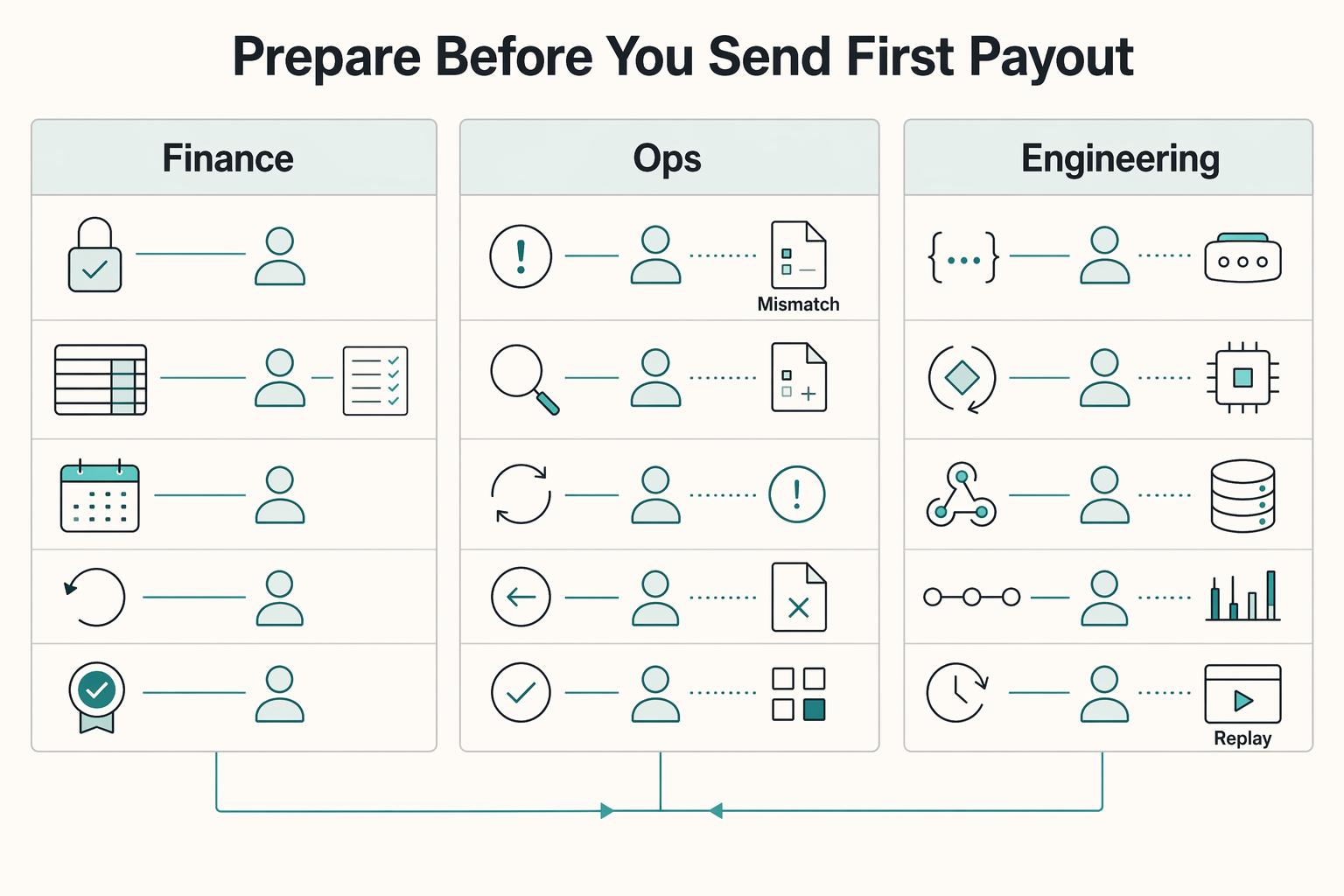
Before the first payout, lock scope to NGN, assign clear owners, and standardize the minimum contractor record so your team can run approvals, exceptions, and reconciliation without ambiguity.
| Owner | Primary responsibility | Named systems or outcomes |
|---|---|---|
| Finance | Approval policy | Ledger reconciliation |
| Ops | Exception handling | Rejected or mismatched payouts |
| Engineering | Webhooks and idempotency | Request/callback event trail |
Step 1: Assign owners in writing. Finance owns approval policy and ledger reconciliation. Ops owns exception handling for rejected or mismatched payouts. Engineering owns webhooks, idempotency, and the request/callback event trail. Keep one owner per stage: approval, submission, retry, reversal, and closeout.
Step 2: Gather the minimum evidence pack. Require the same core fields on every contractor before test payouts:
- legal name
- payout destination details
- KYC status
- internal policy flags for holds or manual review
This upfront discipline matters because setup can be due-diligence heavy, and payment setup choices tie directly to fees, tax handling, and compliance strategy.
Step 3: Freeze product scope. Decide whether launch includes collection through virtual-account identifiers, direct funded payouts or another provider-supported model. A virtual account helps identify incoming payments; it does not by itself establish who holds the underlying funds or what safeguarding applies. Document that funding arrangement separately.
Step 4: Define launch acceptance criteria before go-live. Set your success-rate target, max unresolved exception count, and daily Finance reconciliation sign-off in advance. If "ready to launch" is not explicit, delay first payout.
How Nigeria’s local payment leg works#
The domestic leg usually starts after your provider has usable NGN funds and an approved beneficiary. Confirm whether your transfer uses NIBSS Instant Payment (NIP), another bank pathway or a supported wallet route; do not infer the rail from a “local payout” label.
NIBSS describes NIP as an account-based real-time transfer service. Beneficiary funds can be available before inter-institution settlement, which uses deferred net settlement. Recipient credit, provider reporting and Finance reconciliation therefore remain distinct checkpoints.
Step 1: Validate the destination. Check the required account format and institution identifier, then use the provider’s beneficiary-name enquiry where available. NIP includes Name Enquiry and Transaction Status Query services. A syntactically valid number alone does not establish the correct recipient; resolve name mismatches before approval and preserve the verified destination snapshot.
Step 2: Measure the whole journey. Separate funding and FX time from the domestic transfer leg. Measure submission-to-recipient-credit and time-to-confirmation independently. NIP is designed for instant value, but an API timeout or delayed callback still needs a status query before you treat a payment as failed or resend it.
Step 3: Publish specific coverage. Name supported institutions, destination types, limits, funding prerequisites and the provider’s exception process. Use the tested corridor to set customer expectations rather than an unqualified promise that every Nigerian payout is instant.
For funding and recipient-currency decisions, compare local-currency and USD payouts.
Choose local rails or alternatives using explicit decision rules#
Choose a local NGN route for an eligible contractor cohort only after a pilot demonstrates supported destinations, usable funding, traceable status updates and reconciliation. Operational gaps may justify a supported alternative; a legal or compliance hold must be resolved before any route is used.
Step 1 Choose a default route from evidence, not copy#
Set a default only after you confirm your records support end-to-end traceability: internal payout ID, beneficiary identifier, provider reference, submission timestamp, callback status, and final ledger posting reference. If those fields are not consistently present, keep that segment off the default path until the gap is fixed.
Step 2 Score each route on control quality#
Compare options on the same decision criteria every time:
| Route option | Recipient experience | Failure visibility via webhooks | Retry safety with idempotency | Reconciliation burden | Exception handling effort |
|---|---|---|---|---|---|
| Local NGN rails | Score from your pilot evidence | Score from your pilot evidence | Score from your pilot evidence | Score from your pilot evidence | Score from your pilot evidence |
| Cross-border bank transfer or wire | Score from your pilot evidence | Score from your pilot evidence | Score from your pilot evidence | Score from your pilot evidence | Score from your pilot evidence |
| Supported alternative provider / manual resolution | Score from your pilot evidence | Score from your pilot evidence | Score from your pilot evidence | Score from your pilot evidence | Score from your pilot evidence |
Use this as a pass/fail tool, not a marketing comparison.
Step 3 Split mixed cohorts instead of forcing one path#
Split mixed cohorts by recipient currency, supported institution, funding arrangement and applicable requirements. Record the reason in each payout. An alternative provider may solve a coverage gap, but must not become a way to bypass a compliance hold or send a second transfer while the first is unresolved.
For cross-border funding and foreign-currency destinations, compare wires and local rails. Keep the contractor invoice linked to the payout record so Finance can trace the amount due, deductions and net payment.
Build compliance gates before scaling volume#
Make payout eligibility a hard stop before approval. If you launch first and clean up later, you usually create avoidable rework across bad payouts, missing tax records, and weak audit trails.
| Item | Article handling | Evidence or data |
|---|---|---|
| Identity checks | Apply requirements for the individual payee and provider model | Decision, review date and evidence reference |
| Business checks | Apply to business payees and your business onboarding as required | Entity verification and decision evidence |
| Screening / review | Enforce applicable provider and legal requirements | Hold reason, reviewer and release authority |
| Invoice and Nigerian tax treatment | Determine for the actual engagement | Gross invoice, applicable deductions, net payable and Finance approval |
| Payer-specific reporting | Assess separately where the payer’s jurisdiction brings it into scope | Required form, reporting owner and retention policy |
Step 1 Gate payout eligibility before route assignment#
Apply the identity and business checks required by your provider, payment model and applicable law before release. KYB belongs to business payees or your own business onboarding; do not require every individual contractor to have a business profile. Keep the applicable screening result, review date and decision evidence linked to the payout.
Use a simple readiness test in pilot traffic: open one payout record and confirm you can see identity status, business status (where relevant), AML outcome, and the timestamp of the latest decision in that same record. If Ops can still push a payout forward with missing fields, the gate is not real.
Step 2 Separate business tax checks from identity checks#
Separate invoice and tax treatment from identity screening. Record the contractor’s status, service, payer location, agreed gross amount and any applicable withholding or VAT treatment. Assign Finance to establish the rule for the actual engagement rather than assuming every Nigerian contractor payout requires the same tax documents.
US W-8 or W-9 documentation and information reporting can matter when a US payer or US tax connection brings them into scope. They are not a universal Nigerian onboarding checklist, and Form 1099 is a payer reporting form rather than a document every contractor supplies. Confirm the applicable document and reporting duty before making it a release condition.
Distinguish a legally required hold from missing internal paperwork. Give each held payment an owner, reason, evidence request and next review date. If a document is not legally or contractually required to release a payment, escalate the gap without creating an indefinite hold on an otherwise due invoice.
Step 3 Require audit evidence for every payout state change#
Define required evidence for each payout transition: received, compliance cleared, held for review, approved, submitted, callback received, posted to ledger, reconciled, or reversed. For each change, retain the outcome, reason code, actor, timestamp, related document ID, and provider reference needed for ledger tie-out.
Test this before scale: Finance and the responsible compliance owner should reconstruct one held payout and one successful payout from their records. Check that the hold reason, resolution, approval and provider references are visible without relying on a chat transcript.
Implement the payout lifecycle in a strict order#
Once eligibility is enforced, sequencing becomes the next control. Define one payout lifecycle your team follows every time so outcomes stay safe, timely, and affordable in practice, not just in policy.
Step 1 Create the payout request before execution#
Create a durable payout request first, then let later stages act on that record. Keep the request complete enough for review (payee, amount, currency, destination snapshot, actor, and timestamp) so Ops and Finance can verify what was approved.
Step 2 Apply compliance gates before route and submission#
Apply the requirements identified for this payee and payment model before submission. A failed eligibility decision stays attached to the payout even if Ops considers a different route. Revalidate material changes to beneficiary details or payout purpose before releasing funds.
Step 3 Define event handling rules before go-live#
Store one durable logical payout ID plus a separate attempt ID for each submission. Map provider references and callback statuses to that record, authenticate callbacks and deduplicate repeated events. A timeout means unknown outcome until a status query or provider confirmation resolves it; never create a fresh payment merely because the first response was lost.
Step 4 Close only after documented verification#
Close the payout only when recipient outcome, provider balance or statement movement, approved amount and ledger posting agree. Keep unresolved amounts and statuses in an exception queue. If funds are returned, match and recredit the actual return before using that balance for a replacement payment.
Run payout batches with controls finance teams can trust#
Treat batching as an auditable control unit, not just a bulk transfer file. For Nigeria local-rail contractor payouts, define batch states, evidence requirements, and stop rules before volume scales.
| Batch metric | How to use it | Article note |
|---|---|---|
| Queued count | Track batch health as an operations queue | Do not treat batching as just a finance summary |
| Success count | Track per batch | Headline success rate alone can hide a growing exception queue |
| Retry count | Track per batch | Retries can hide a growing exception queue |
| Unresolved exceptions | Track per batch | Pause new submissions on that route or cohort if exception rate crosses your internal threshold |
| Aging per batch | Track per batch | Settlement times and error rates vary across institutions |
-
Define internal batch states before volume grows. Use statuses such as draft, approved, submitted, partially failed, completed, and reconciled as internal control points. Document each state’s control boundary: what it means, what evidence is required, and what can no longer change. Before a batch leaves draft, each payout should have a frozen destination snapshot, compliance clearance, and verified beneficiary details, including account-format checks and beneficiary-name verification where available. For any batch ID, Finance should be able to see creator, approver, state-change timestamps, and included payout IDs.
-
Require dual approval for unusual or high-risk batches, and capture override evidence. Do not let one person both prepare and release a batch when value, retry volume, or manual exceptions are outside normal patterns. If a hold is overridden, require a reason code and short note on the batch record, not in chat or email. Keep approver identity, timestamps, reason code, and supporting documentation in the audit trail.
-
Monitor batch health as an operations queue. Track queued, confirmed-success, confirmed-failure, pending/unknown and returned counts and amounts, plus retries and exception age. Compare institution and provider cohorts using the same observation window. A success rate that excludes unresolved attempts can hide the queue your team still needs to clear.
-
Publish a daily control report and pause on exception spikes. Tie batch totals to audit-trail records and reconciliation outcomes, with separate views for submitted, completed, partially failed, and reconciled states. Treat submitted as in-flight, not done; close only after reconciliation and exception handling are complete. If exception rate crosses your internal threshold, pause new submissions on that route or cohort and clear the root-cause queue first.
For a step-by-step walkthrough, see How Australian Agencies Can Pay US Contractors With Lower Risk.
Common failure patterns and how to recover fast#
Contain the affected route or cohort, then resolve each payout from its saved references. A delayed response, incorrect destination and returned transfer require different recovery actions. The following procedures give Ops a decision path without treating all failures as permission to replay.
1. Unknown outcome after a timeout#
Keep the payout pending, query its provider reference and record the response. If status remains unknown, escalate to the provider and tell the contractor that confirmation is pending. Resume or replace only after the original attempt is definitively resolved; an elapsed internal SLA alone does not prove failure.
2. Rejected destination or beneficiary mismatch#
Keep the rejection code and original destination snapshot. Ask the contractor to confirm corrected bank details through your approved channel, repeat validation and obtain any required approval. Submit a new attempt only after confirming the rejected attempt cannot settle.
3. Returned funds or ledger mismatch#
Match a returned credit to the original transfer, including fees and amount differences. Finance should confirm available funds and the ledger reversal or adjustment. Keep a partial or unmatched return in the exception queue; do not mark it recovered because a reversal notification arrived.
4. Duplicate callbacks or disputed recipient credit#
Deduplicate callbacks by durable event and payout identifiers, and prevent repeated ledger posting. If the contractor reports non-receipt despite a success status, obtain the provider’s transfer evidence and investigate with the receiving institution through the provider. Do not send a second payment while the first credit remains unconfirmed.
Related reading: How to Classify a Worker as an Employee vs. an Independent Contractor in the US.
Copy this launch checklist before going live#
Treat go-live as an evidence exercise: each route, control, and finance-close step should be testable and documented before you scale.
- Document route rules by contractor cohort.
Define who goes to local NGN rails, who goes to an alternative route, and the exact switch condition for each case. Keep this written so Ops can identify the correct route from the contractor record without escalation.
- Prove webhook handling and idempotent retries with saved test evidence.
Run and retain test cases for accepted payouts, rejects, delayed callbacks, duplicate callbacks, and manual exception release. Keep request ID, provider reference, callback payload, final ledger state, and operator notes together so outcomes are traceable.
- Enable compliance and tax-document gates before live payouts.
Confirm applicable identity, business and screening requirements have release controls and named owners. Finance should document the engagement’s tax treatment and any payer-specific reporting forms. Keep required evidence linked to the payment, and do not treat US forms or foreign-account reporting as universal Nigerian contractor prerequisites.
Keep collection, funding and payout evidence separate.
For a contractor owed NGN 100,000, retain the gross invoice, any properly determined deduction and net payable. If source funds require FX, record the quote, expiry, rate, fees and usable NGN funding. Reconcile the approved net transfer to recipient outcome and provider statement; an incoming collection reference is not proof of an outgoing payment.
- Validate reconciliation and audit exports with Finance sign-off.
Run a full-day test batch and confirm counts, totals, and statuses tie from payout submission through daily ledger reconciliation outputs. Finance should verify the audit trail is sufficient to reconstruct approvals, manual changes, and state transitions.
- Launch in phases and expand only after stable batch behavior.
Start with a small cohort, monitor exception aging daily, and pause expansion if repeat failures appear. Do not scale a route while rejects, unmatched ledger entries, or unresolved compliance holds remain unexplained.
Frequently Asked Questions
What does "local rails" mean for contractor payouts in Nigeria?
Local rails are domestic NGN payment pathways, including NIBSS Instant Payment where the provider supports it. NIP is designed for real-time beneficiary value, while inter-institution settlement happens separately. Validate the institution and account format and use beneficiary-name enquiry where available; a 10-digit format check alone does not prove account ownership.
How should we choose between local NGN payouts and cross-border alternatives?
Choose local NGN payout routes when contractors want to receive in naira and you want to reduce delayed credits, failed transfers, and expensive conversion-path friction that can show up in cross-border sending. Route choice is not one-size-fits-all; coverage, institution-level reliability, and your SLA should drive the decision by payout flow. If your source funds are not in NGN, remember the naira is exposed to significant FX volatility, so conversion timing can become an operating issue, not just a treasury issue. For edge cases, this guide pairs well with International Wire Transfer for Platforms: When to Use Wires vs. Local Rails for Cross-Border Payouts.
Which compliance checks should block payout versus trigger manual review?
Block when a requirement applicable to the payee and payment model is unmet. Manual review needs a named owner, reason, evidence request and release authority. Individual contractors and business payees need different checks. A different route does not remove a legal hold.
What controls are mandatory for reliable payout operations at scale?
Common reliability controls include request idempotency, webhook or callback capture, audit notes for manual changes, and regular ledger reconciliation. It also helps to separate submitted from reconciled: an upstream success signal is not the same as a finance-close signal. A red flag is any setup where an operator can resend a payout without seeing the original request ID, provider reference, and last accepted status.
How should Finance, Ops, and Engineering split ownership before launch?
A practical split is Finance for amounts, tax treatment and reconciliation sign-off; Ops for beneficiary follow-up and exception ownership; Engineering for durable payout identifiers, callback intake, status queries and duplicate-safe posting. Prove it before launch: Finance closes a sample batch, Ops resolves a rejected destination, and Engineering handles a duplicate callback without a second transfer or ledger entry.
How do we run payout batches safely without slowing down month-end close?
Validate each beneficiary before submission, approve the batch and track counts and amounts by confirmed outcome. Keep pending and unknown payments visible alongside success and failure. Reconcile provider statements and ledger postings daily, with owners and aging for exceptions. Expand only after sampled institutions and recipient types show stable results.
Try a related tool
Researched and edited by the Gruv editorial team. Gruv builds cross-border billing, payouts, and finance-operations software for global businesses.
Sources
Includes 1 external source outside the trusted-domain allowlist.
Educational content only. Not legal, tax, or financial advice.
Related Posts

FedNow vs RTP for Gig Platform Contractor Payouts
You are not choosing a payments theory memo. You are choosing the institution-backed rail path your bank and provider can actually run for contractor payouts now: FedNow, RTP, or one first and the other after validation.
When Platforms Should Use Wires vs Local Rails for Cross-Border Payouts
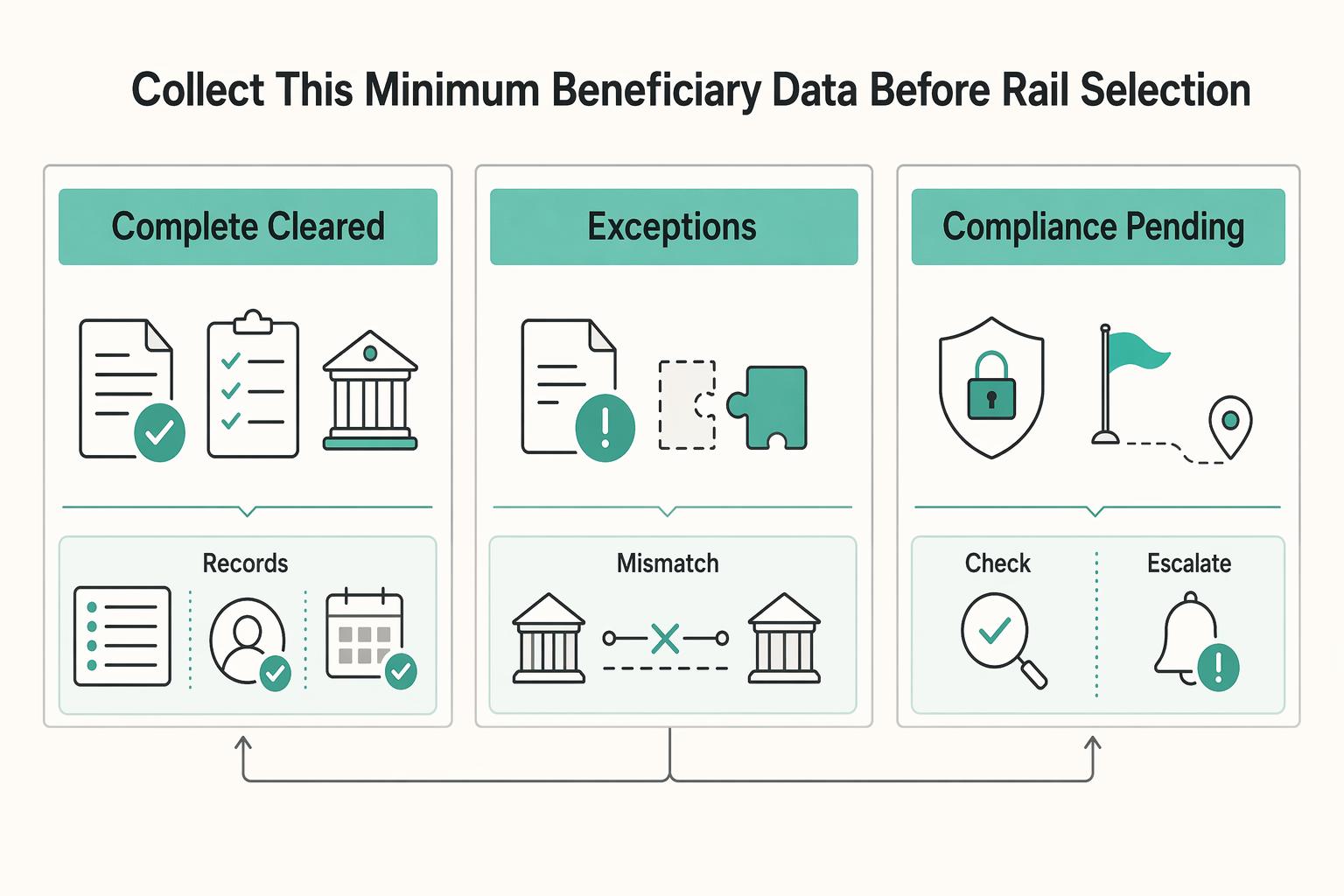
Treat rail choice as product logic, not team habit. No rail wins everywhere. SWIFT and local payment rails solve different payout risks, so your job is to route each payout by destination, currency, speed, and cost, not by whichever option sounds more global or more modern.
Local Currency Payouts vs USD Payouts for Contractor Platforms
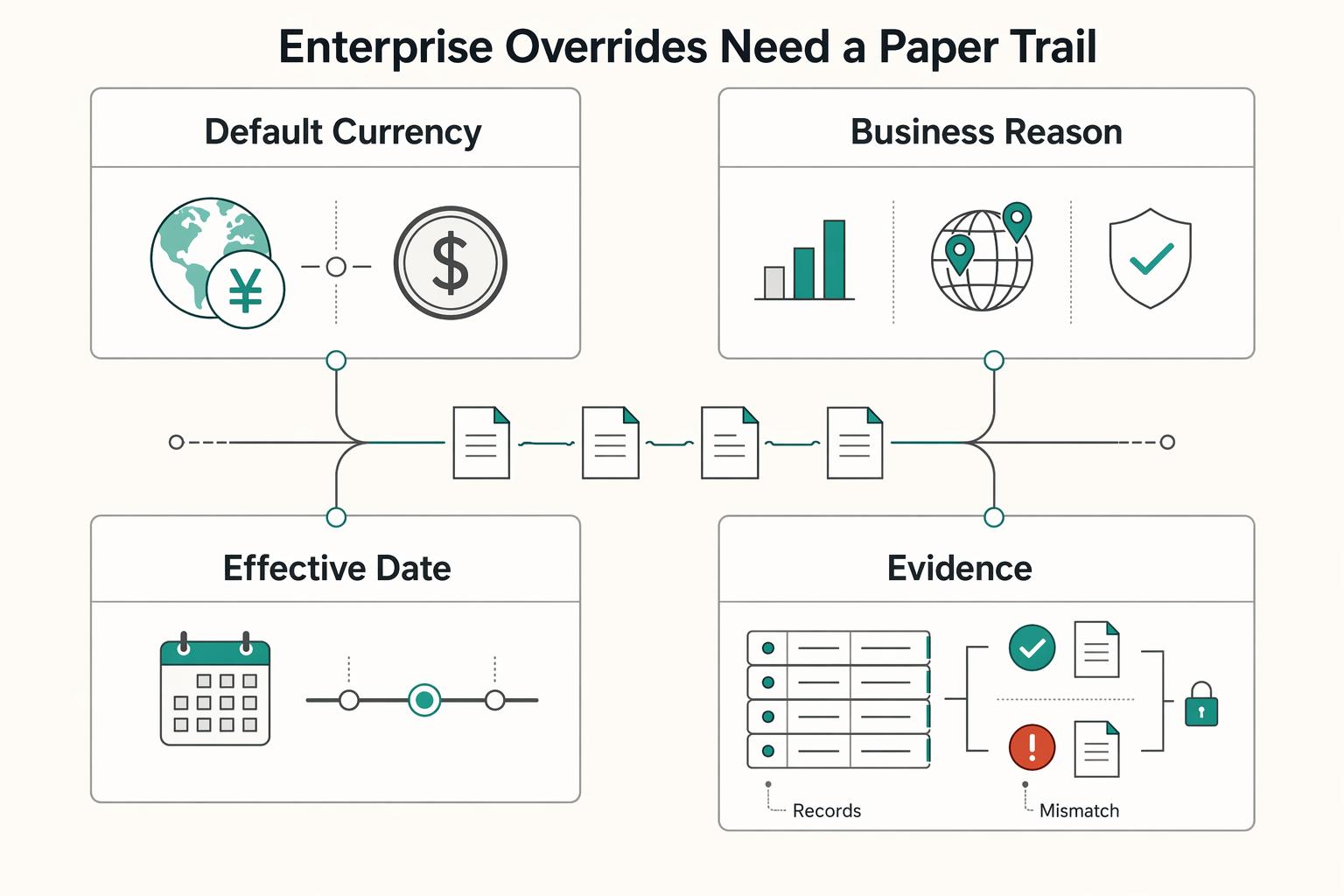
USD versus local currency is not just a finance setting. For a platform, it changes compliance scope, recipient certainty, reconciliation effort, and how much engineering depth your payout layer needs. In practice, many teams avoid picking one currency forever. A common approach is to set corridor-level rules: use local currency where it is legally and operationally supported, and keep USD as a fallback where legal, coverage, or operational constraints are still real.