
Quick Answer
Start by locking scope to flows you can prove: contractor status, signed agreement, tax data, and payout traceability. In Peru, treat Yape and PLIN as commercial rail options, not automatic legal clearance, until SBS exposure is mapped to your exact model. Require SUNAT-ready Recibo por Honorarios Electrónico handling before first payout, then run a bounded pilot with fallback rails, idempotency keys, and freeze triggers if reversals or reconciliation gaps appear.
Why this Peru payout decision is harder than it looks#
Treat Peru as a posture decision, not just a rail decision. If you choose a local wallet-style method first, then sort out contractor status, tax data, and evidence later, you may get a smoother payout experience. You also raise launch risk in areas that are much harder to fix once money starts moving.
Step 1. Define the decision as more than a payment-method choice#
A platform operator entering Peru is not simply choosing between bank transfers and local wallet-style payout options. You are also deciding how strict your onboarding gates will be for each independent contractor, which documents must exist before the first payout, and how much legal uncertainty you are willing to carry as you scale. Those choices are linked. A faster wallet experience may help adoption, but it does not reduce the need to prove who the payee is, why they are being paid, and what records support the payment.
A useful early checkpoint is simple. Write your intended payout model in one sentence per flow. For example, local contractor paid domestically, cross-border contractor paid to a bank account, or local contractor paid through a wallet-linked method. If legal, payments, and operations describe the same flow differently, you are not ready to assess risk.
Step 2. Separate published facts from interpretation#
This is where teams often get overconfident. Public Peru fintech material can be useful, but some of it is explicitly framed as discussion material rather than official regulatory certainty. The EY FinTech Business Guide 2024/2025, first digital edition October 2024, includes interviews with representatives from the Peruvian Superintendency of Banking, Insurance, and Private Pension Fund Management Companies (SBS). That is helpful context, but the guide also says interviewee views do not necessarily reflect EY or MRE positions, and that EY and MRE assume no responsibility for the accuracy of those claims or comments. The IFC diagnostic cited here also says it does not guarantee accuracy, reliability, or completeness.
Your verification point here should be a source register, not a loose stack of links. For each requirement or assumption, log the source, date, owner, and confidence label: confirmed, inferred, or unknown. A common failure mode is treating an interview, article summary, or vendor statement as if it were a binding SBS position.
Step 3. Set a speed-versus-certainty rule before launch pressure builds#
The core tension is straightforward. Local wallet-style options may improve contractor experience and local acceptance, but unresolved SBS interpretation questions can change the risk profile of the exact model you plan to run. So the decision is not simply whether to support wallet-linked payouts. It is what evidence threshold must be met before you allow wallet-linked payouts, and what fallback rail you will use if that threshold is not met.
If local wallet familiarity is central to acquisition in Peru, you may still decide to support it early, but only with bounded scope and explicit legal review. If the SBS interpretation for your model is still unclear, do not hide that uncertainty inside a product choice. Freeze scale, document the open point, and make leadership approve the risk in writing. That is how you keep the expansion evidence-led instead of momentum-led.
What to prepare before you start paying contractors in Peru#
Do this preparation before choosing rails: you are not launch-ready until each contractor flow, tax document requirement, and approval owner is defined and testable.
Step 1. Map the exact payout flows you intend to support#
Define each flow as its own operating case. At minimum, separate domestic wallet-linked payouts in Peru from bank-based cross-border payments, then decide whether launch includes one or both.
Keep the wallet legal review model-specific. Obligations can vary by operator type, so legal needs your exact flow before it can assess SBS exposure. Your checkpoint: one page per flow with payee type, payout rail, and fallback rail.
Step 2. Assemble the minimum evidence pack#
Before first payout, assemble the minimum file for each contractor flow:
| Evidence item | Details |
|---|---|
| Contractor agreement | Draft for the flow |
| Worker classification | Criteria and escalation path for edge cases |
| Tax fields | Needed to support Recibo por Honorarios for independent services |
| Identity and payment details | Identity document type and payment details (method, amount, date) |
| RHE payment status step | Mark whether payment is al contado or al crédito when issuing Recibo por Honorarios Electrónico |
| SUNAT registration control | Owner and control for registering received payments by SUNAT's décimo día hábil del mes siguiente deadline |
- Contractor agreement draft for the flow.
- Worker-classification criteria and escalation path for edge cases.
- Tax fields needed to support Recibo por Honorarios for independent services.
- Identity document type and payment details (method, amount, date).
- Process step to mark whether payment is
al contadooral créditowhen issuing Recibo por Honorarios Electrónico. - Owner and control for registering received payments by SUNAT's
décimo día hábil del mes siguientedeadline.
Step 3. Sequence ownership before any pilot goes live#
Assign one owner each for Peruvian law review, payments operations, and engineering release approval, then require signoff in a single sequence.
Set a hard pre-launch gate: no pilot until you can show how SUNAT validation, digital signature, and SUNAT submission are handled in the payout lifecycle for the relevant document flow. If you cannot show that end to end, pause before launch.
If you want a deeper dive, read How to Pay Contractors in Colombia: PSE Nequi and DIAN Compliance for Platform Operators.
Separate confirmed rules from unresolved SBS questions#
Once your contractor file and ownership sequence are in place, separate what is confirmed from what is still unresolved. With the current evidence pack, keep SBS and wallet interpretation clearly in the unresolved lane until counsel maps your exact operating model.
Step 1. Build a decision table that makes uncertainty explicit#
Use one launch table and assign a confidence label to every line: Confirmed, Inferred, or Unknown.
| Topic | Confirmed requirements | Open questions |
|---|---|---|
| SUNAT, electronic invoicing, classification, and reporting | Only include items backed by rule-level documentation in your file. | If support is missing or indirect, keep the item open and label it Inferred or Unknown. |
| SBS interpretation for electronic wallets (including Yape and PLIN) | Keep this blank unless legal review has mapped your exact model and obligations. | Treat all SBS-related interpretation as unresolved until that mapping is complete. |
| Source quality check | You can confirm that some sources are context only (for example, a country diagnostic with a completeness disclaimer, or an archive index page). | Any legal conclusion that depends on those context-only sources remains open. |
Step 2. Keep Yape and PLIN assumptions unconfirmed until legal model mapping is complete#
Do not treat wallet familiarity as legal confirmation. Until counsel reviews your exact flow and role, keep Yape/PLIN obligations in Unknown or Inferred, not Confirmed.
Step 3. Tie each label to an owner and next action#
For each item, record the label, owner, evidence on file, and next step. Leadership should approve scope with explicit uncertainty visible, not implied certainty.
For a step-by-step walkthrough, see How Platform Operators Pay Contractors in Indonesia With GoPay, OVO, DANA, or BI Fast.
Decide when Yape and PLIN are optional vs mandatory for your launch#
Treat Yape and PLIN as commercially mandatory only if contractor acquisition or retention clearly depends on them. Treat them as legally unresolved until counsel maps your exact model to the Superintendencia de Banca, Seguros y AFP (SBS) in writing.
Step 1. Score commercial necessity before product appeal#
Use one rail-selection matrix across Yape, PLIN, and at least one non-wallet fallback. Score each rail on contractor preference, operational complexity, compliance uncertainty, and failure recovery burden.
| Rail option | Contractor preference | Operational complexity | Compliance uncertainty | Failure recovery burden |
|---|---|---|---|---|
| Yape | High only if target contractors explicitly expect it | Moderate to high if wallet exceptions are not yet operationalized | Keep unresolved until counsel reviews your funds flow and role | High if failures require manual rerouting |
| PLIN | Same test as Yape: expected vs merely preferred | Moderate to high for similar wallet-support reasons | Keep unresolved until model mapping is complete | High without clean fallback and traceability |
| Non-wallet alternative | May be lower on familiarity in wallet-led segments | Often more predictable if already supported in ops | Usually clearer if legal/payment roles are already understood | Usually easier if retries/reversals are already documented |
If wallets are marked high priority, back that with evidence in your launch file. If contractors prefer wallets but still onboard without them, wallets are optional for launch and important for roadmap sequencing.
Step 2. Match rollout path to uncertainty#
If wallet familiarity is central, support wallets early but keep scope constrained: limited volume, limited cohort, and a documented fallback rail. If SBS interpretation is still open, phased rails are usually the lower-exposure path until legal mapping and exception handling are complete.
Be strict about source quality in your legal packet. The Cuatrecasas 2025 Edition explicitly says it is not thorough legal advice and is bounded to information available as of August 31, 2025. The EY FinTech guide includes interviews whose opinions are the interviewees' own responsibility. Use counsel analysis tied to your exact flow for go/no-go decisions.
Step 3. Set stop/go checkpoints before scaling#
Define freeze triggers before expansion and enforce them:
- Freeze if any SBS wallet-related issue is still
Unknownat expansion time. - Freeze if payout success trend deterioration is pushing ops into manual recovery as the default.
- Freeze if reconciliation gaps appear between payout requests, provider references, and internal records.
Every scale decision should cite an owner, last review date, and supporting document. If that chain is missing, treat the wallet rollout as a pilot assumption, not a scaled launch decision.
Wallet-first can improve adoption speed when digital payments are valued for agility and convenience, but phased rails usually lower regulatory and operational exposure while SBS interpretation remains unresolved.
Set up contractor onboarding controls that prevent rework later#
Before any money moves, tie payout eligibility to completed onboarding controls. In Peru, most avoidable rework starts when classification, contract terms, or tax records are incomplete at first payout.
Step 1. Classify the working relationship before first payout#
Make classification integrity the first gate. In Peru, a locación de servicios is based on non-subordination to the client, and labor analysis applies the principle of primacy of reality, so actual working conditions matter more than labels. If facts are mixed or point to subordination, escalate before enabling payouts.
Keep this control auditable: record the decision, supporting facts, reviewer, and date in the onboarding file.
Step 2. Require signed agreements that match how you will actually pay#
Enable payouts only after a signed, current agreement is on file and aligned to the real payout model. The agreement should match payment timing, payout method, required documentation, and how failed payouts or corrections are handled.
This avoids a common rework pattern: onboarding under a generic contract, then adding Yape, PLIN, or another method without updating terms. Because SBS-related obligations vary by operating model, keep the signed version, effective date, and acceptance record tied to the contractor profile.
Step 3. Collect tax data once and gate payout on completion#
Set tax controls so the RHE flow is workable before first payout. SUNAT states independent workers issue Recibo por Honorarios Electrónico only electronically (since 1 de abril de 2017), so your onboarding record needs to support that process upfront.
Validate the tax data required for issuance: payment modality (al contado or al crédito), and, when payment is not immediate, outstanding amount and due date fields. Operationally, keep one rule: no payout permission until classification is approved, the agreement is signed, and tax data is complete.
Related reading: How to Pay Contractors in Kenya with M-Pesa, PesaLink, and KRA Controls.
Execute a controlled Peru pilot with tight policy gates#
Keep the Peru pilot narrow and policy-driven: limited cohort, predefined Yape/PLIN scenarios, retry-safe payouts, and explicit hold rules when records do not match.
Step 1. Limit the first cohort and predefine the wallet scenarios#
Start with a small contractor cohort in Peru and a fixed set of payout scenarios you can review end to end, such as one Yape path, one PLIN path, and one fallback path.
Before first payout, require one approved payout method on file, a matching contract record, and complete tax information for your payout workflow. Do not let wallet destination changes bypass that check.
Step 2. Make payout submission retry-safe and track state changes explicitly#
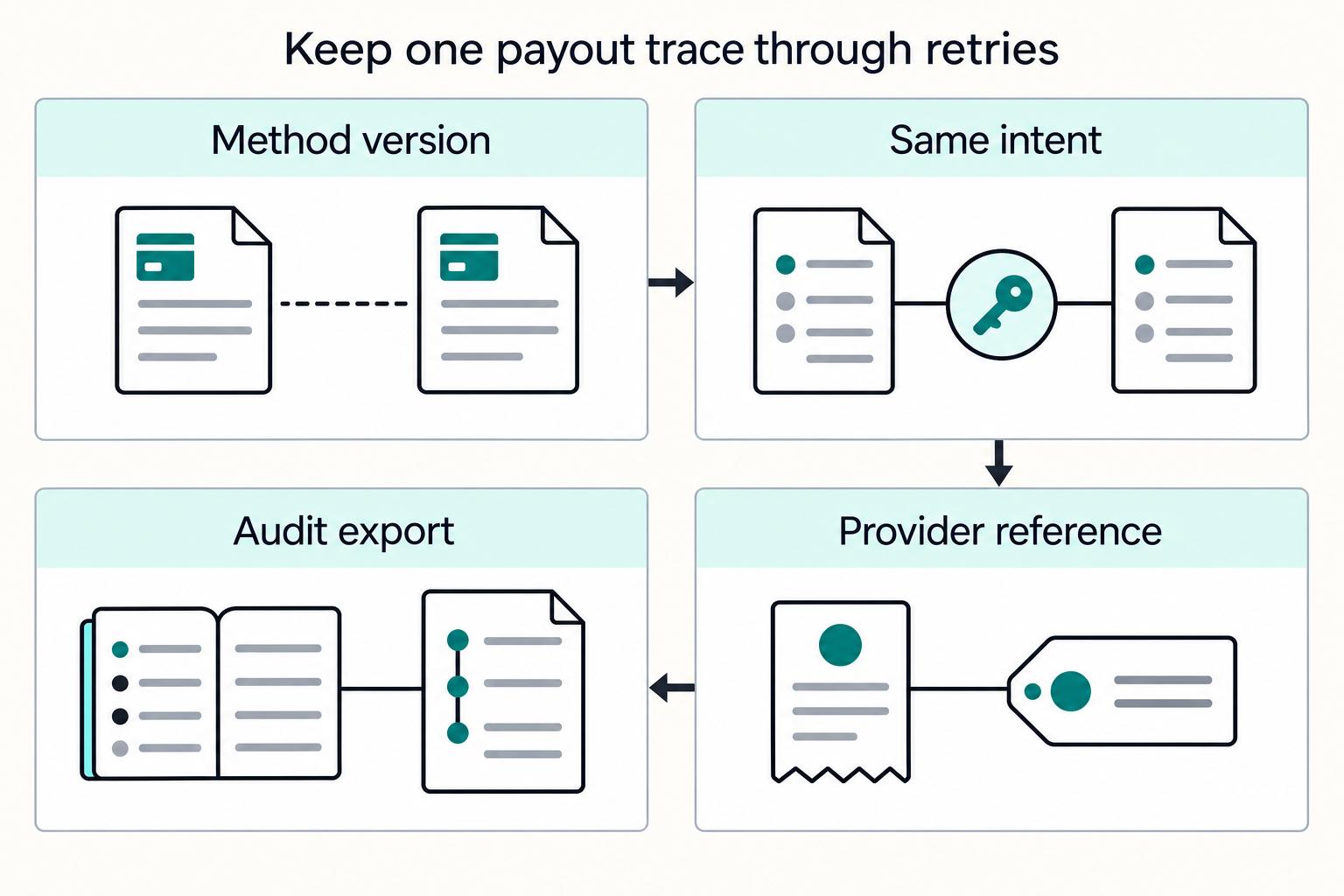
Configure idempotent payout submission from day one. Use a unique idempotency key per payout instruction so retries do not create duplicate wallet disbursements for the same obligation.
Track payout states as operational checkpoints, not just provider messages. Keep an internal flow such as submitted -> accepted -> failed -> reversed -> manually reviewed, and map provider states underneath it (for example ACCEPTED, PENDING, or PENDING_COMPLIANCE_ASSESSMENT). Treat reversal risk as ongoing, since some payout lifecycles can move from SUCCEEDED to REVERSED.
Step 3. Define manual holds and documented resolution before launch#
Set exception playbooks before go-live. If wallet delivery fails, tax information is missing, or payout details conflict with contract records, route to manual hold and require documented resolution before resubmission.
Given reported SBS continuity measures for digital wallets and phased effective dates cited as 1 de junio de 2025 and 1 de enero de 2026, do not run the pilot without incident ownership, recovery steps, alternate channels, and a stop rule for repeated failures.
Build reconciliation and audit evidence from the first transaction#
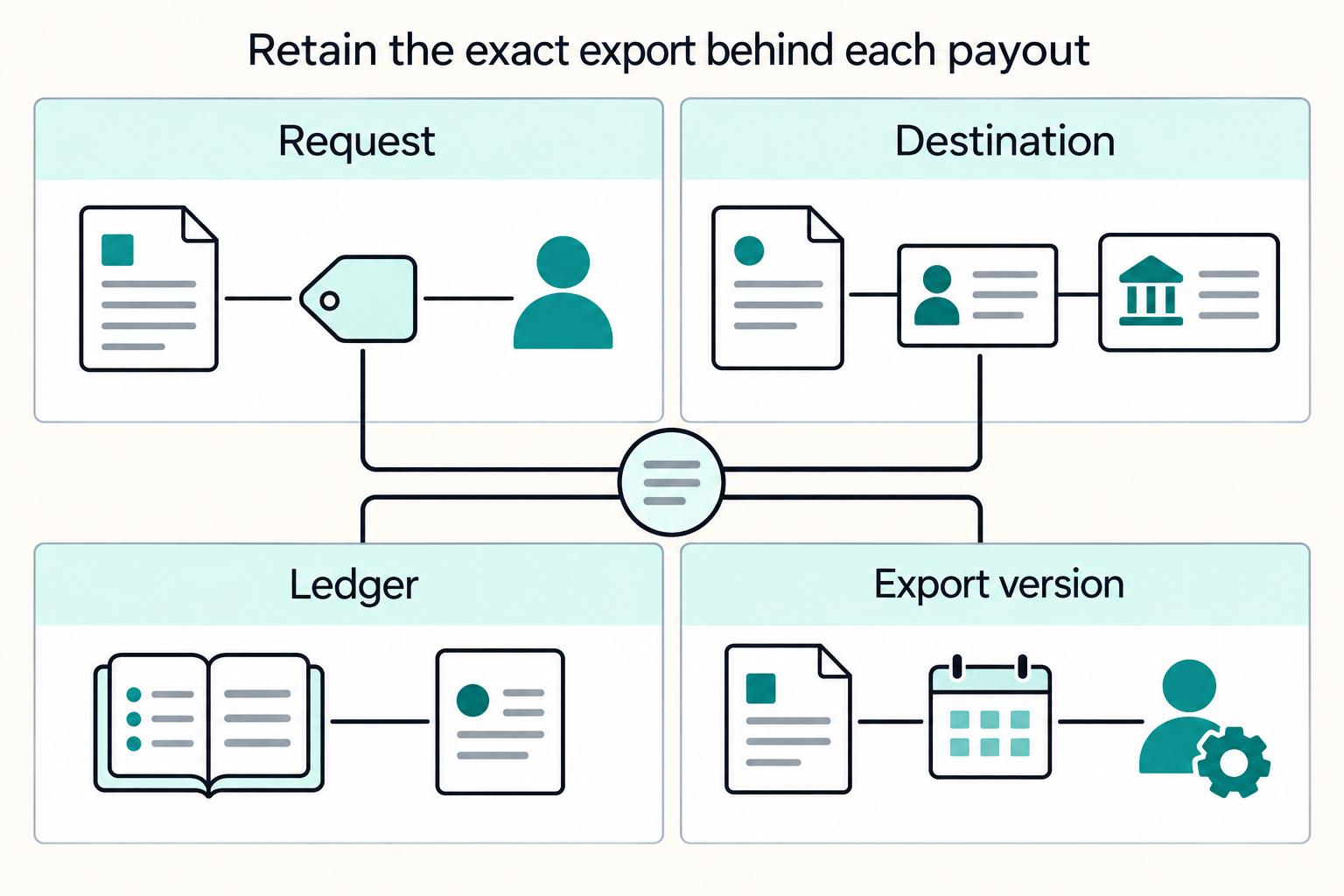
Design reconciliation from day one, not after exceptions pile up. In Peru, the practical approach is to make each payout traceable from internal request to ledger entry to export artifact, then review that trail on a fixed internal cadence against your SUNAT and electronic invoicing process.
Step 1. Capture a complete payout chain for every transaction#
Keep one unbroken record per payout. At minimum, retain the internal payout request ID, provider reference, destination identifier submitted, ledger posting ID, and the exact export artifact used downstream.
Your checkpoint is simple: starting from any payout ID, ops should retrieve the full trail quickly without engineering log pulls. Preserve immutable references (export filename, generation timestamp, row count, and actor/service account) so you can prove what left the platform at a specific time.
Step 2. Reconcile on a fixed cadence against tax handling, not only payment status#
Run reconciliation on a fixed schedule and include tax/electronic invoicing handling, not just payment completion. The cadence is an internal control decision, but it should be frequent enough to catch missing artifacts before period-close cleanup.
If a payout is marked complete but its tax support trail is missing, move it to exception handling immediately. Treat a record as unreconciled when payment events and ledger entries align but supporting SUNAT/e-invoicing process evidence does not.
Use caution with informal interpretation: some Peru fintech material is interview-based and explicitly frames interview views as not necessarily institutional or official positions. Build audit readiness on transaction evidence and control evidence, not commentary.
Step 3. Maintain a monthly compliance folder per contractor population#
Maintain a monthly compliance folder as an internal control, even if law does not prescribe that exact packaging. Include the records that show who was paid, why, how tax handling was applied, and how exceptions were resolved.
| Folder item | Include |
|---|---|
| Classification | worker classification records or approval notes for each independent contractor |
| Contract | signed contract version active at payout time |
| Tax support | tax profile artifacts and electronic invoicing support used by your process |
| Exceptions | payout exception logs for failed, reversed, and manually reviewed items |
| Signoff | reconciliation signoff with reviewer and date |
At minimum, include:
- worker classification records or approval notes for each independent contractor
- signed contract version active at payout time
- tax profile artifacts and electronic invoicing support used by your process
- payout exception logs for failed, reversed, and manually reviewed items
- reconciliation signoff with reviewer and date
The test is practical: can you answer an audit question without rebuilding history across multiple systems? If not, tighten naming, versioning, and trace links back to the original payout request ID and provider reference.
Common mistakes in Peru contractor payouts and how to recover fast#
The highest-risk mistake is scaling on assumptions instead of confirmed obligations. Recover fastest by capping rollout scope, then fixing evidence and controls in order.
| Mistake | Recovery | Checkpoint |
|---|---|---|
| Treating SBS interpretations as settled facts | Put every unresolved point in a legal-risk register with owner, date raised, affected flow, and launch impact. | Leadership can see what is confirmed, inferred, and unknown before expanding rollout. |
| Onboarding contractors without documented worker-classification logic | Pause new payouts for new profiles, re-review active contractors, and attach the approval note, contract version in force, and tax profile to each file before resuming scale. | You can show not just that someone was paid, but why they were eligible to be treated as an independent contractor. |
| Scaling Yape or PLIN without fallback rails | Enable a backup payout path, define when ops can switch rails, and publish incident handling for failed, reversed, or stuck transfers. | Retry logic prevents duplicate payouts when wallet status is unclear. |
| Weak SUNAT and electronic-invoicing reporting discipline | Backfill missing records immediately, assign a single owner, and tie each missing artifact to the original payout request ID and provider reference before restarting recurring reconciliations with signoff. | Any accepted payout missing supporting tax or invoicing records stays in the exception queue until complete. |
- Mistake: treating SBS interpretations as settled facts.
Recovery: Put every unresolved point in a legal-risk register with owner, date raised, affected flow, and launch impact. This is especially important when using market guidance with stated limits: the Cuatrecasas Doing Business in Peru 2025 Edition says it "must not be considered a thorough analysis of Peruvian law" and was drafted from information available on August 31, 2025. Checkpoint: Leadership can see what is confirmed, inferred, and unknown before expanding rollout.
- Mistake: onboarding contractors without documented worker-classification logic.
Recovery: Pause new payouts for new profiles, re-review active contractors, and attach the approval note, contract version in force, and tax profile to each file before resuming scale. Checkpoint: You can show not just that someone was paid, but why they were eligible to be treated as an independent contractor.
- Mistake: scaling Yape or PLIN without fallback rails.
Recovery: Enable a backup payout path, define when ops can switch rails, and publish incident handling for failed, reversed, or stuck transfers. Checkpoint: Retry logic prevents duplicate payouts when wallet status is unclear.
- Mistake: weak SUNAT and electronic-invoicing reporting discipline.
Recovery: Backfill missing records immediately, assign a single owner, and tie each missing artifact to the original payout request ID and provider reference before restarting recurring reconciliations with signoff. Checkpoint: Any accepted payout missing supporting tax or invoicing records stays in the exception queue until complete.
Related: How to Pay Contractors in Ghana: GhIPSS MoMo and GRA Compliance for Platform Operators.
Make the launch decision and use this copy-paste checklist#
Use a conservative go/no-go rule: do not launch this Peru flow on momentum. Launch only when SUNAT and electronic invoicing obligations for your model are confirmed in the real payout path, and SBS unknowns are either resolved or explicitly bounded in writing.
This standard is practical because orientation sources are not model-specific legal answers. EY's FinTech Business Guide 2024/2025 includes interviews with SBS and fintech network representatives, while EY and the MRE also state they assume no responsibility for interviewee claims or comments. If your SBS position still rests on commentary rather than advice mapped to your contractor payout design, delay broad wallet rollout.
Step 1. Freeze the decision memo before release. Keep one short memo in the launch packet labeling each issue as confirmed, inferred, or unknown. For Peru, name the exact phase-one rail scope: Yape, PLIN, bank payouts, or a defined combination, plus fallback if wallet handling is paused. Verify legal, payments ops, and product all point to the same approved scope document and date.
Step 2. Test the evidence chain, not just transfer success. Run an end-to-end test using the records you expect to retain. Before a contractor is payout-eligible, confirm one traceable file trail links the classification decision, signed agreement, tax profile, payout request ID, provider reference, and ledger result. If funds move but approval basis is fragmented across systems, your launch controls are not ready.
Step 3. Bound unknowns and assign recovery ownership. If any SBS question remains open, narrow scope instead of treating it as settled. Document who can stop payouts, who escalates to counsel, and which recovery path applies when a wallet payout fails, reverses, or requires manual review. If pause and restart ownership is unclear, guardrails are not operational.
Add this to your launch check:
- Worker classification logic approved for all contractor types in Peru.
- Compliant contractor agreements signed and linked to payout eligibility.
- Required tax information collected, validated, and auditable.
- Rail decision documented for Yape, PLIN, and fallback payout paths.
- Reconciliation and audit trail tested across payout lifecycle events.
- Launch guardrails defined: stop/go triggers, escalation owners, and recovery procedures.
If one box is still open, keep scope narrow until evidence catches up.
Frequently Asked Questions
What must a platform operator verify before paying contractors in Peru for the first time?
Verify what is actually confirmed versus inferred in your legal and tax position, then document it before launch. A practical first checkpoint is a short memo that labels each issue as confirmed, inferred, or unknown, and notes source limits such as the Cuatrecasas Doing Business in Peru 2025 Edition disclaimer that it is not a thorough analysis of Peruvian law and was drafted using information available on August 31, 2025.
Are Yape and PLIN required to compete in Peru, or can we launch without them?
This guide does not establish that Yape or PLIN are legally required for market entry. It also does not provide a complete legal determination on launch readiness without them, so treat wallet adoption as a commercial rollout choice and confirm legal conclusions separately.
What is clearly known today about SUNAT and electronic invoicing for contractor payouts?
What is clearly known here is mostly the limit of what can be claimed: this guide does not state the filing steps, invoice triggers, thresholds, or timing rules for contractor payouts. Treat SUNAT and electronic invoicing as items that require local tax mapping before you finalize payout controls.
What remains unknown about SBS obligations for wallet-linked payout flows?
The open question is how your exact wallet-linked model maps to obligations involving the Superintendencia de Banca, Seguros y AFP (SBS). The SBS material here defines FinTech broadly and refers to Peru’s financial, insurance, and private pension sectors as “supervised systems,” but it does not specify which obligations apply to a contractor payout flow using local wallets. The EY 2024/2025 guide also states interviewees are exclusively responsible for their own views, so interview commentary should not be treated as binding guidance.
How should worker classification risk change our payout design and onboarding gates?
These sources do not provide worker-classification tests or contractor-agreement requirements, so they cannot define payout gates by themselves. Treat classification as an unresolved legal item and require explicit local legal/tax confirmation before first payout in ambiguous cases.
When should we prioritize cross-border bank payouts over local electronic wallets?
Do not assume Peru-specific instant-payment operational rules or a mandated rail priority apply. A conservative internal approach is to keep cross-border bank payouts primary until wallet-linked obligations and exception handling are clearly documented and approved.
What evidence should we keep to pass internal audits and external compliance reviews?
There is no mandatory evidence checklist to point to. As an internal control, keep one consistent file trail linking contractor record and payout flow, including approval notes, contract version, tax profile, payout request ID, provider reference, ledger entry, and exception or manual-review notes.
Try a related tool
Researched and edited by the Gruv editorial team. Gruv builds cross-border billing, payouts, and finance-operations software for global businesses.
Sources
Includes 2 external sources outside the trusted-domain allowlist.
- bcrp.gob.pe/eng-docs/Publications/Annual-Reports/2024/an...trusted
- oecd.org/content/dam/oecd/en/publications/reports/202...trusted
- orientacion.sunat.gob.pe/sites/default/files/inline-files/emisionrhco...trusted
- orientacion.sunat.gob.pe/01-recibo-por-honorarios-concepto-usotrusted
- sbs.gob.pe/Portals/0/Archivos/2023/FinTechEcosystem-202...trusted
- trade.ec.europa.eu/access-to-markets/en/country-assets/pe_labou...trusted
- archive.org/stream/iucnmammalreddat82thor/iucnmammalredd...external
- archive.org/stream/Virginia_Beach_Sun_1973-04/Virginia_B...external
Educational content only. Not legal, tax, or financial advice.
Related Posts

How Platform Operators Pay Contractors in Colombia with PSE Nequi and DIAN Controls
Treat Colombia contractor payouts as a launch decision with a real stop condition, not something you clean up after the first transfers go out. This guide is for platform operators deciding whether to launch Colombia now, with current team and vendor capacity, not for generic advice on hiring freelancers.

Pay Contractors in Ghana with GhIPSS, MoMo, and GRA Controls
**Step 1: Treat this as a go or no-go operator guide, not a hiring explainer.** If you are deciding whether to launch Ghana, the useful question is not "can we hire contractors there?" The real question is whether you can support payouts through the rails your users prefer, connect those flows to local tax obligations, and absorb the operational risk when something breaks. That is the lens for the rest of this guide.
Pay Contractors in Australia with NPP PayTo and ATO-Ready Controls
If your Australia launch case depends on the payment rail alone, you are not ready yet. The harder launch question is usually not how money moves. It is whether your Australian Taxation Office position, ownership, and records are solid enough to survive real operations.