
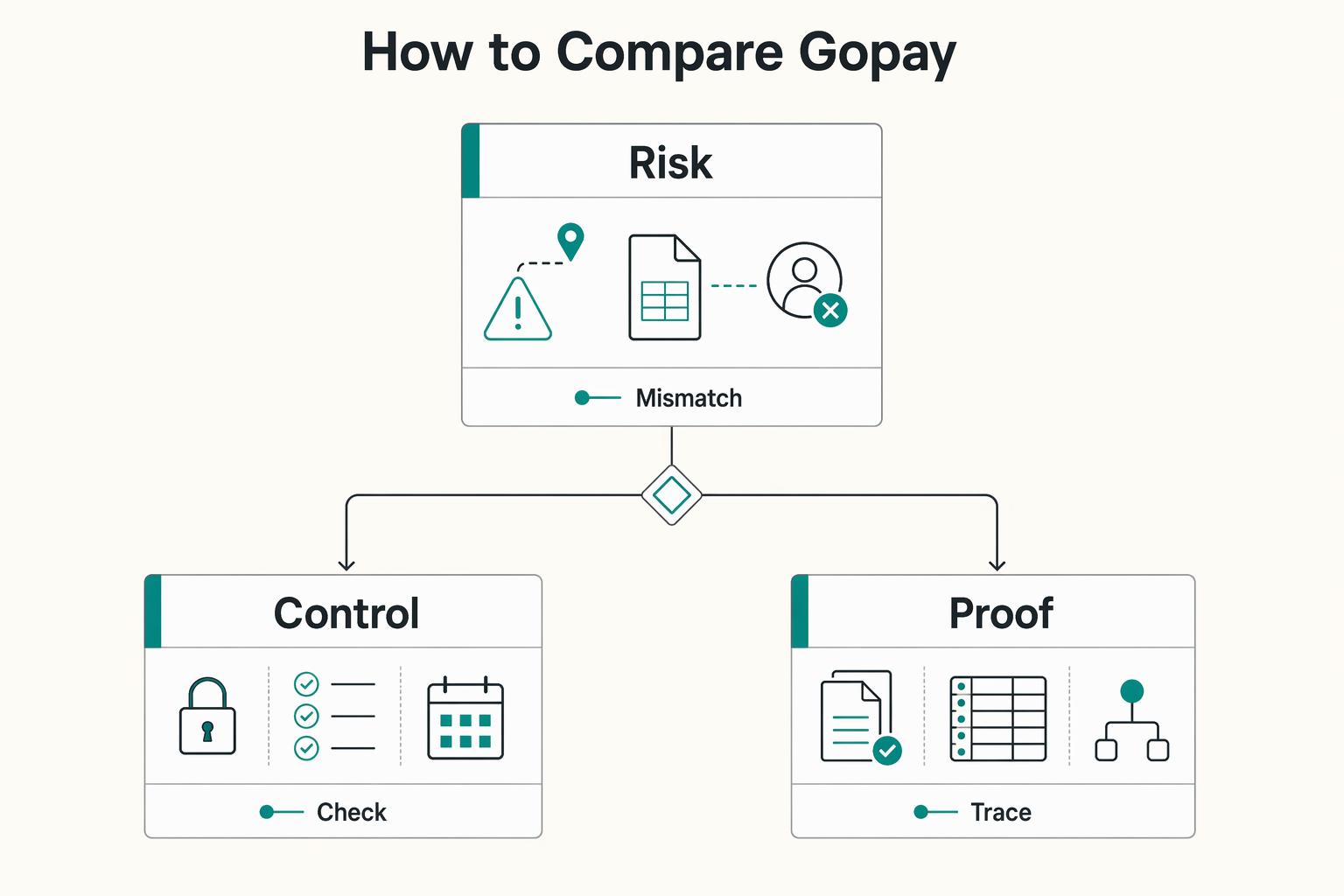
Quick Answer
Choose an approved payout provider route to the contractor’s verified wallet or bank endpoint. GoPay, OVO and DANA are wallet destinations; BI-FAST is bank transfer infrastructure. Confirm payer tax treatment, funding, recipient capacity and account-specific limits before live release. Persist one payout operation, recover delayed status without a second transfer, and reconcile net entitlement, fees and any reversal.
How to compare GoPay, OVO, DANA, and BI Fast#
Treat rail choice as an execution decision. If you are evaluating Indonesia for contractor payouts, the first mistake is choosing a rail because the brand is familiar. For platform operators, the real question is simpler: can your team run the payout path cleanly for independent contractors, keep records straight, and support the compliance posture that comes with tax rules, contracts, and sensitive data handling?
This guide compares GoPay, OVO, DANA, and BI Fast through an operator lens, not a consumer one. You are not choosing a logo for checkout. You are choosing where payout failures will surface, how much manual review your team can absorb, and how much evidence you can gather before launch. If your internal owner cannot explain how a payout will be initiated, tracked, and reconciled from start to finish, you are not ready to commit product or go-to-market resources.
GoPay, OVO and DANA are wallet destinations; BI-FAST is Bank Indonesia’s retail transfer infrastructure, reached through a participating bank or payout provider. Bank Indonesia describes real-time availability 24/7. That infrastructure characteristic is not a guarantee for your provider’s complete funding, review and delivery flow.
Public payout documentation can establish useful mechanics. For example, Xendit documents Indonesian wallet disbursements and a local BI-FAST route. Your merchant account must still be approved for the actual payer, contractor use case, funding origin and destination. Consumer wallet familiarity does not establish that approval or an integration with Gruv.
Use this comparison to reduce rollout risk, not to force an early answer. The goal is to help you choose between wallet routes and transfer infrastructure based on operational fit, compliance friction, and rollout risk. That means calling out where evidence is incomplete instead of smoothing over the gaps. For a decision this sensitive, false certainty costs more than a slower pilot.
A common failure mode is locking product design around a rail before legal and finance have confirmed contractor terms, tax treatment, and recordkeeping expectations. Another is under-scoping security controls because payouts look like a treasury problem rather than a data problem. As you read, keep a small evidence pack beside the comparison: contract template, tax interpretation, data-handling assumptions, and a list of unknowns for each rail. That will tell you faster than market noise whether the payout path is actually launchable for your business.
For a step-by-step walkthrough, see How Platform Operators Pay Creators Globally Across YouTube, Twitch, and Substack.
What you need to prepare before testing payouts in Indonesia#
Prepare four things before rail testing: a fixed payout scope, a minimum evidence pack, explicit operating limits, and a documented unknowns list for each rail.
| Preparation area | What to set or collect | Note |
|---|---|---|
| Payout scope | Payee type, payout cadence, and currency path | Resolve differences first if finance, legal, and product describe the flow differently |
| Minimum evidence pack | Tax-interpretation note, foreign-exchange check, and Bank Indonesia-facing compliance assumptions | Record the owner, document date, and open questions; if a point has no document, label it as an assumption |
| Operating constraints | Acceptable failure rate, reconciliation timing per payout cycle, and manual-ops capacity | Set these before any pilot |
| Rail verification checklist | Current documentation for fee schedules, settlement commitments, and integration prerequisites for GoPay, OVO, DANA, and BI Fast | Treat undocumented points as unresolved |
-
Define payout scope in one plain-language line. Specify payee type, payout cadence, and currency path, for example IDR-originating versus non-IDR-originating flow. If finance, legal, and product describe that flow differently, resolve that first.
-
Build a minimum evidence pack. Keep it short: your tax-interpretation note, your foreign-exchange check, and your Bank Indonesia-facing compliance assumptions for this payout model. For each item, record the owner, document date, and open questions. If a point has no document, label it as an assumption.
-
Set operating constraints before any pilot. Define acceptable failure rate, reconciliation timing per payout cycle, and manual-ops capacity for exception handling. This prevents you from selecting a rail that works in a demo but fails under real operational load.
-
Collect current payout documentation rather than checkout documentation. For each route, record supported recipient identifiers, account or wallet capacity, amount limits, funding requirements, fees, status retrieval and reversal handling. Confirm which API version and enabled account configuration the documentation describes.
With that prep complete, your comparison is based on operating evidence rather than brand familiarity.
How GoPay OVO DANA and BI Fast differ for contractor payouts#
Start with rail intent, not popularity: GoPay, OVO, and DANA as wallet-style endpoints, and BI Fast as the bank-transfer side for this decision. Then evaluate each option on operational fit for contractor payouts, not consumer mindshare.
Separate rail intent before you compare names#
For wallet payouts, collect the selected wallet and its registered mobile number plus any required holder name; validate the provider’s expected number format rather than applying bank-account validation. For bank payouts, collect bank/channel code, account number and required holder details. Xendit’s Indonesia guide gives bank-specific lengths and wallet-number formatting; preserve leading zeroes as text.
Verify that the endpoint belongs to the intended contractor, then version it. A contractor changing from one wallet to a bank account is a beneficiary change requiring verification, not permission to resend an unresolved payout. Retain the old endpoint on the original attempt so support can reconstruct where it was sent.
Evaluate payout behavior, not market mindshare#
Use a side-by-side view that keeps knowns and unknowns explicit.
| Rail | Recipient coverage assumptions | Operational complexity | Reconciliation burden | Policy-gate exposure | Known unknowns to verify |
|---|---|---|---|---|---|
| GoPay | Verified registered wallet number and required holder details | Validate channel/API format and wallet capacity | Provider payout ID and status retrieval | Approved account use case and required tax treatment | Enabled channel, amount/balance limits, fees and reversal handling |
| OVO | Verified OVO endpoint | Validate wallet identity and capacity | Provider payout ID and status retrieval | Same payer obligations; provider-specific eligibility | Enabled channel, limits, fees and recovery |
| DANA | Verified DANA endpoint | Validate wallet identity and capacity | Provider payout ID and status retrieval | Same payer obligations; provider-specific eligibility | Enabled channel, limits, fees and recovery |
| BI-FAST bank route | Verified bank code and account details | Participating provider route and amount limit | Payout and bank references; descriptions may be truncated | Approved funding, recipient and payer treatment | Provider delivery estimate, fees and failure/reversal states |
Use a decision rule tied to your main risk#
If your main risk is fragmented recipient endpoints, prioritize the setup that reduces endpoint variance across your contractor base. If your main risk is reconciliation and payout control, prioritize the option with the clearest status and audit mapping in your operating flow.
Use this fail check before the pilot: can finance map one payout request to one recipient identifier, one status trail, and one final ledger outcome without manual interpretation across teams? If not, keep the pilot narrow and treat cost or adoption claims as secondary until the operating evidence is complete.
For a regional comparison, read How to Pay Contractors in Singapore: FAST PayNow and MAS Compliance for Platforms.
Which compliance checks can block launch first#
The first launch blocker is usually unresolved compliance assumptions, not the payout rail name. Before you scale any GoPay, OVO, DANA, or BI Fast path, confirm your contractor classification and contract posture, then document how you will handle IDR payment records and exceptions.
Resolve worker status, payer identity and tax treatment before live release. A signed contractor label does not itself establish classification, and a wallet destination does not change the underlying service relationship or payer obligations.
Confirm classification and contract posture first#
Treat this as your first internal gate so rail design does not harden around assumptions you may need to reverse later.
| Check | Owner | Evidence artifact | Go/no-go question |
|---|---|---|---|
| Independent contractor classification | Legal or employment counsel | Written classification position | Can you explain why this population is treated as contractors? |
| Contract posture | Legal and operations | Agreement template and onboarding checklist | Do terms match the payout model and records you plan to keep? |
| Exception ownership | Operations and compliance | Named owner and escalation path | Is there a clear owner when a case does not fit the default flow? |
Run remaining checks in a practical internal order#
Review tax, foreign-exchange funding, data handling and provider eligibility together before the first live payment. Indonesia’s tax authority includes nonemployee service income within PPh 21 categories. Contractor self-reporting does not establish that the payer has no withholding obligation; determine the applicable treatment from payer status, recipient type, residence and service facts, then retain any required withholding evidence.
Record agreed gross compensation, applicable deductions, net contractor entitlement and who bears transfer or conversion fees. For an illustrative IDR 2,000,000 net entitlement with a separately borne IDR 5,000 provider fee, the platform needs IDR 2,005,000 of cash; the fee does not reduce the contractor’s recorded entitlement. These figures illustrate reconciliation, not a tax rate or provider quote.
Set a hard rollout gate#
Complete required account approval, recipient checks and the documented tax and funding treatment before the first live payout. Broader rollout adds a separate gate: demonstrate actual status recovery, reconciliation and staffed exception handling for each enabled route.
A sandbox can test request validation without proving live eligibility or recipient receipt. Use approved low-value live tests only after the required checks; record whether any test was simulated or actually delivered. Do not use a constrained live pilot to bypass an unresolved compliance requirement.
How to decide wallet rails versus BI Fast for your first launch#
Once each option has a written compliance answer set, choose your first-launch rail on operating fit, not consumer mindshare. For most teams, the right first rail is the one your payout ops team can reconcile cleanly in IDR with the fewest exception paths.
Segment your launch by operating model#
Start by splitting cohorts by operating model, because each model fails in different places. A marketplace with many small payouts usually puts more pressure on recipient endpoint friction and volume handling. A services platform with scheduled contractor runs usually puts more pressure on predictable batch operations, status tracking, and month-end reconciliation. A mixed model often needs a primary rail plus a fallback path.
Use one internal sheet with three fields per cohort: payout frequency, payout size band, and the recipient endpoint you can reliably collect at onboarding. This keeps rail decisions tied to what you can actually execute and document.
Score each option on weighted factors#
Score each option against four factors, and set weights before you score so the decision stays consistent:
| Factor | What to assess |
|---|---|
| Recipient readiness | Can contractors receive funds through this endpoint without extra education or data repair? |
| Payout operations load | How much manual handling is needed for retries, endpoint fixes, and status follow-up? |
| Reconciliation clarity | How easily can finance match payout requests, confirmations, and contractor records? |
| Compliance overhead under foreign exchange regulations | How many extra assumptions, reviews, or exception cases this rail adds to your IDR flow? |
Under time pressure, a simple 1-5 scale with written reasons for high scores helps keep optimism in check. In an evolving regulatory environment, adoption upside should not outweigh weak answers on foreign exchange regulations, IDR handling, or Bank Indonesia assumptions.
Apply a scenario contrast, then use a hard tie-breaker#
For a cohort that already supplies verified bank details and needs scheduled IDR payouts, test the provider’s BI-FAST bank route first. For contractors whose verified receiving endpoint is a supported wallet, test that wallet route. Wallet balance or transaction capacity can constrain a payout even when the mobile number is valid; verify current account tier and available capacity rather than splitting payments to evade limits.
If payout ops headcount is thin, choose the option with fewer manual exception paths even when projected adoption looks better on paper. Validate with one end-to-end sample cycle: recipient data captured, payout initiated, status returned, record matched, and exception ownership confirmed.
Related: How to Pay Contractors in Turkey: FAST EFT and MASAK Compliance for Platform Operators.
How to run a controlled pilot without creating reconciliation debt#
Run a narrow, traceable pilot first, and expand only when exception handling stays inside your pre-set limit. The fastest way to create reconciliation debt is testing too many contractor mixes, rails, and payout timings in one cycle.
Keep one cohort, cadence and currency path fixed. Test representative recipient endpoints in separate small runs; the same person need not have every wallet or bank destination, so note differences in recipient readiness when comparing outcomes. Obtain approval for the test amounts and avoid promising a universal delivery time.
Make each payout auditable end to end. Assign one internal payout ID per request and carry it through request creation, submission, status updates, final disposition, and ledger mapping. This gives ops and finance a single event chain to review when records do not align.
Handle duplicate requests and delayed confirmation differently. Persist the payout operation and provider idempotency key before submission, then attach the returned payout ID. Xendit’s integration guide supports retrying a timed-out request with the same key. Do not generate a new payment or switch to a fallback route while the original attempt is unresolved.
Reconcile each cycle by liability, attempt and outcome. In a hypothetical three-payout run of IDR 1,000,000 each, two confirmed deliveries and one unresolved attempt leave IDR 1,000,000 awaiting an outcome, not automatically available for another route. If a previously delivered payout reverses, record the returned funds and reopen the obligation through an authorized recovery process.
Related reading: How to Pay International Contractors With Fewer Delays and Disputes.
Common rollout mistakes in Indonesia and how to recover#
Avoidable rework usually starts when market familiarity is treated as rollout proof. After your pilot, expand only where payout evidence is complete.
| Mistake | Problem signal | Recovery |
|---|---|---|
| Choosing rails from consumer mindshare alone | Recognition is not enough for contractor payouts | Re-rank options against contractor payout criteria; keep one comparison sheet per option, and treat any blank field as a launch blocker |
| Treating merchant-payment signals as payout-rail evidence | QRIS and BI Fast should not be treated as interchangeable for contractor operations | Split merchant-payment inputs from payout-operation inputs before approval; if the pack is mostly merchant context, relabel it and pause the payout decision |
| Resending an unresolved attempt through another route | Timeout or accepted status mistaken for failure | Retrieve the original payout and hold fallback until its disposition is known |
Do not substitute recognition for endpoint readiness. Verify the intended contractor’s destination, account capacity and enabled provider channel. A wallet that supports merchant checkout may require a different payout product and onboarding.
Use provider status definitions. Xendit documents accepted requests as not yet sent and notes that successful payouts can later reverse. Preserve accepted, requested, delivered, failed and reversed distinctions in your internal mapping; a pending attempt is not a failed instruction.
Keep a decision log of account-specific limits, fees, review requirements and unsupported destinations. When a rule changes, update the dated configuration for new attempts while preserving old instruction and beneficiary versions. A rollback stops future releases; it does not undo transfers already sent.
For another instant-payment model, read How Platform Teams Pay Brazil Contractors with Pix.
The copy-paste launch checklist for platform operators#
Use this as an internal readiness gate, not as proof that Indonesia-specific payout decisions are already validated. If any line is still an assumption, pause expansion.
-
Lock the payout scope in plain language. Write your working scope for independent contractors in Indonesia, your planned IDR payout path, and your intended disbursement cadence in one sentence so product, ops, and finance are aligned.
-
Freeze the rail decision and the non-decisions. If you are evaluating GoPay, OVO, DANA, and BI Fast, treat that as a shortlist until you document why each option is in or out. Keep the same four fields visible for each rail: recipient endpoint required, status visibility, reconciliation reference returned, and compliance evidence on file.
-
Complete payer and recipient checks before live release. Record classification, applicable tax treatment, any withholding evidence, approved funding route and beneficiary verification. Retain the owner, supporting document and dated decision.
-
Assign operating controls before go-live. Name the exception-queue owner, set reconciliation reporting cadence, and define a rollback trigger your team can execute without debate.
-
Require pilot proof before widening coverage. Check pilot outcomes against pre-set success metrics and verify record-level alignment across payout requests, statuses, and reconciliation references before expanding recipient coverage.
If part of your workforce is unbanked, read Paying the Unbanked: How Platforms Reach Contractors Without Bank Accounts in Developing Markets.
Conclusion#
The right call in Indonesia is not the rail your team recognizes first. It is the route that gives you acceptable compliance risk, enough operational control, and payout records your finance team can reconcile without guesswork.
-
Choose a receiving endpoint, not an adoption statistic. A verified wallet destination may fit one cohort while a verified bank route fits another. Use payout documentation and account approval to establish eligibility; mobile-payment forecasts and merchant acceptance studies do not establish contractor disbursement behavior.
-
Make the go or no-go decision on evidence your operators can inspect. Before you scale, each shortlisted route should have a written answer for four basics: recipient endpoint requirements, payout status visibility, returned reconciliation reference, and the compliance assumptions tied to contractor classification, tax documentation, and local regulatory review points. Your checkpoint is simple: after a payout cycle, every transaction should either match cleanly from your ledger to the provider record or land in a named exception queue with an owner. If you still have unmatched payouts, delayed confirmations you cannot explain, or duplicate-request risk that depends on manual detective work, you do not have enough control yet.
-
Pause expansion when unknowns are still driving the decision. Exact fee tables, settlement-time guarantees, and sweeping claims that BI Fast is better than wallet rails for contractor payouts require direct confirmation from your provider. So if the internal argument still hinges on an assumed fee advantage, assumed speed, or assumed interchangeability with QRIS-style payment familiarity, stop there. Get the missing answers in writing from the provider or the relevant compliance reviewer, then rerun the comparison. Scaling volume before those gaps are closed usually turns a small pilot uncertainty into recurring reconciliation debt.
That is the practical finish line for this decision. If you can verify the rail behavior, document the compliance posture, and explain every exception path, move forward carefully. If you cannot, wait, close the evidence gaps, and protect the launch from preventable payout and audit problems later.
Frequently Asked Questions
Can I pay independent contractors in Indonesia through GoPay, OVO, or DANA as a platform operator?
A provider can support these wallet destinations: Xendit’s public disbursement documentation lists GoPay, OVO and DANA. Confirm your account’s approved use case, funding route, wallet identifiers and limits before sending contractor payments. Destination support alone is not account approval.
What does BI Fast change for contractor payouts compared with e-wallet routes?
BI-FAST provides 24/7 retail transfer infrastructure for bank routes. Wallet payouts target a supported wallet account, usually identified by a registered mobile number. Compare the provider’s complete workflow, limits and status evidence; infrastructure availability alone does not promise end-to-end payout speed.
How should I compare digital wallets and BI Fast when fee and settlement data are incomplete?
Compare documented total cost and observed delivery for the same amount and currency path. Include funding, conversion, provider fees and any recipient deduction. Mark unavailable pricing as unresolved; do not infer a provider fee from the BI-FAST infrastructure fee or a consumer transfer price.
Which compliance checks should be completed before the first payout goes live in Indonesia?
Confirm contractor status, payer and recipient tax treatment, any applicable withholding and reporting, approved funding and currency handling, provider eligibility and recipient checks before live release. Nonemployee service income can fall within PPh 21; paying through a wallet does not remove payer tax obligations.
Is QRIS relevant for contractor payouts, or mainly for merchant payments?
Merchant QRIS acceptance does not by itself establish contractor disbursement support. If a provider offers a separate transfer product, evaluate its documented endpoints, authorization, limits and payout status rather than treating a merchant payment QR as an interchangeable payout instruction.
What is the safest first pilot design for B2B contractor payouts in IDR?
Use one approved cohort, cadence and currency path. Test recipient validation, a successful payment, duplicate submission, delayed status and an authorized failure recovery. Reconcile liability, payout ID, fees and outcome before expanding; distinguish simulated tests from live receipt.
Try a related tool
Researched and edited by the Gruv editorial team. Gruv builds cross-border billing, payouts, and finance-operations software for global businesses.
Sources
Includes 5 external sources outside the trusted-domain allowlist.
Educational content only. Not legal, tax, or financial advice.
Related Posts
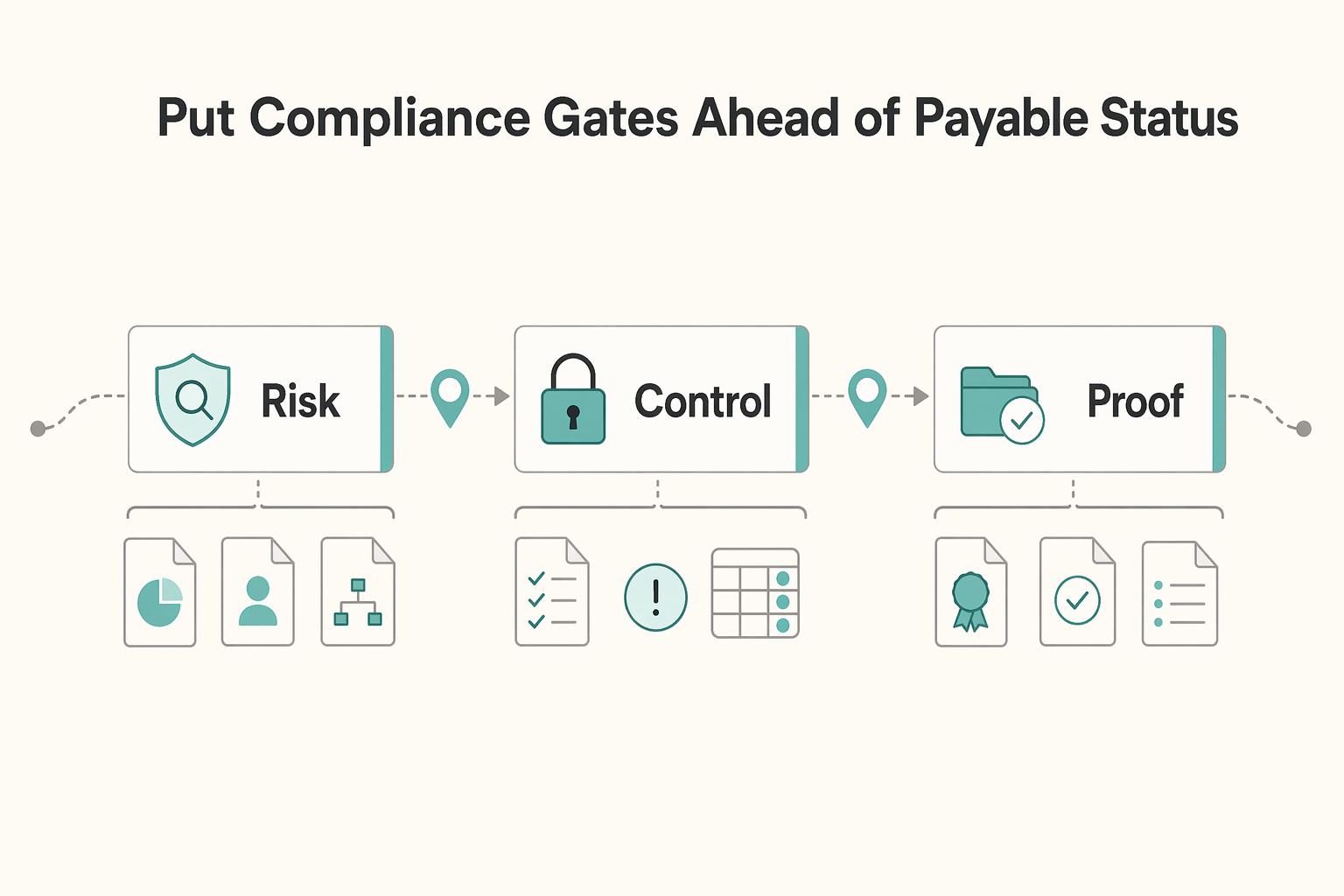
Paying Contractors in Singapore with FAST, PayNow, and MAS Checks
Singapore can work for contractor payouts, but only if a bank or provider supports your exact flow and you can prove it end to end. Having payment rails is not the same as being ready to launch. The practical call is simple: treat PayNow, and the broader MAS-linked payments context, as a strong starting signal, then run every product and compliance assumption through verification before you commit engineering time or a market launch.
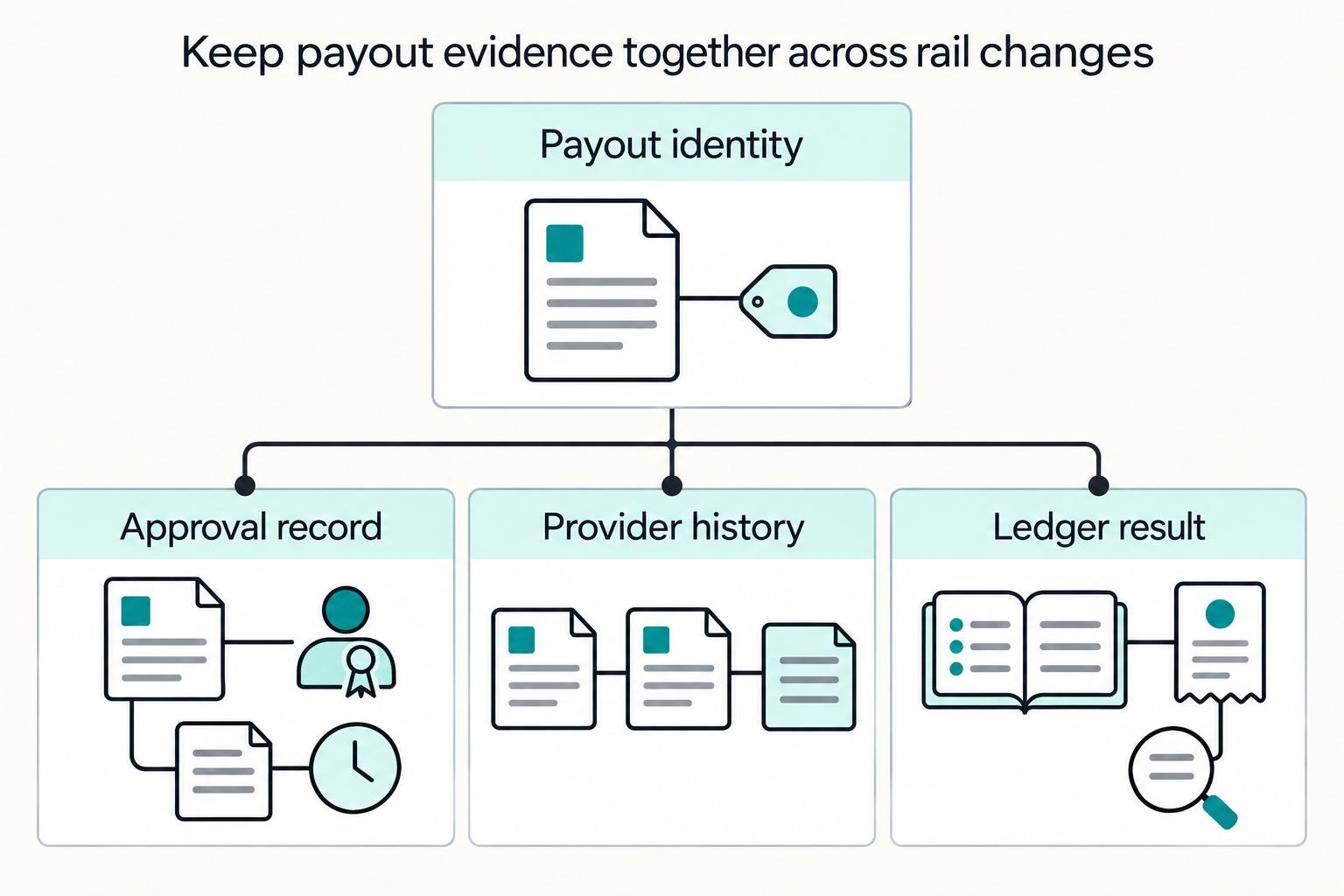
Pay Contractors in Turkey on FAST and EFT With MASAK Controls
Use FAST for eligible TRY transfers that need round-the-clock processing, and EFT for amounts or routes outside your provider’s FAST support. First separate the commercial obligation from the payment service: who owes the contractor, who converts or holds funds, and which licensed institution executes the transfer? That map determines your controls and avoids treating a rail choice as a tax or employment decision.

Paying Unbanked Contractors in Developing Markets: Best Payout Routes for Platforms
If your team needs to send money to contractors, creators, freelancers, marketplace sellers, or other non-payroll recipients across borders, the payout decision can look deceptively simple at first. On paper, you are choosing a payment rail. In practice, you are choosing an operating model that affects onboarding, compliance, support load, engineering effort, treasury visibility, failure recovery, and the degree of legal risk your company is willing to carry.