
Quick Answer
Yes, Singapore is viable for contractor payouts, but the article’s core answer is conditional: treat FAST/PayNow as a strong signal and make launch decisions only after provider terms, identifier support, and request-to-ledger evidence are verified for your exact flow.
Prove the Singapore payout path end to end#
Singapore can work for contractor payouts, but only if a bank or provider supports your exact flow and you can prove it end to end. Having payment rails is not the same as being ready to launch. The practical call is simple: treat PayNow, and the broader MAS-linked payments context, as a strong starting signal, then run every product and compliance assumption through verification before you commit engineering time or a market launch.
The cited material gives you something useful, but narrower than many teams assume. PayNow was introduced in 2017 by the Association of Banks in Singapore. The source set says it supports instant transfers using identifiers such as a mobile number or NRIC/FIN instead of full bank account details. It also describes PayNow as accessible to most bank account holders in Singapore. On the policy side, MAS appears in the sources as a policy and regulatory actor in Singapore's fintech and payments context, and the market is described as one where authorities see fintech as a growth area.
That is enough to justify serious evaluation. It is not enough to say your contractor payout model is operationally or regulatorily ready.
Start with a narrower go or no-go question#
The useful question is not, "Does Singapore have digital payment rails?" Ask this instead: can you prove that your intended payout flow, recipient types, identifiers, controls, and exception handling are all supported by evidence you can defend? That shift matters because teams often confuse public rail availability with product-level readiness.
A common failure mode is building the happy path first, then discovering later that the provider contract, compliance interpretation, or reconciliation model does not support the payout journey you planned. If your team cannot show how a payout request becomes an auditable ledger event with a traceable recipient identifier and a documented fallback path, pause the launch decision.
Before you start#
Start with this checkpoint pack:
- Confirm source-backed facts only. Keep a short note that separates what is explicitly supported, such as PayNow's introduction in 2017 and identifier-based transfers, from what still needs provider or legal confirmation.
- Define your evidence pack. At minimum, keep the relevant MAS context, the PayNow capability source, your intended recipient types, and your internal assumptions about KYC, AML, and payout approval boundaries.
- Verify implementation scope with a real counterparty. Ask your bank, payment provider, or legal adviser to confirm supported identifiers, return handling, reconciliation artifacts, and any restrictions tied to your exact use case.
- Set one hard stop. No launch if request-to-ledger traceability depends on manual reconstruction.
By the end of this guide, you should be able to make a cleaner decision: proceed because the supported facts line up with your product and controls, or hold because too much of the launch case still rests on assumptions. That is the right standard for this launch decision.
This pairs well with our guide on How Platform Operators Pay Contractors in Colombia with PSE Nequi and DIAN Controls.
What FAST and PayNow actually enable for contractor payouts in Singapore#
Your payout path depends on counterparty terms that can change requirements, prioritize product-specific clauses, and deny access. Start by confirming what a real provider will approve for your use case.
Step 1. Treat capability as unverified until your provider confirms it#
Do not scope your product from market-level assumptions alone. The clearest concrete evidence comes from GXS business account terms, and it points to conditional access: you must meet requirements the bank may set over time, and the bank can approve or reject applications at its discretion.
Step 2. Confirm which terms actually govern your payout flow#
Before design, verify document hierarchy and controlling terms. The GXS terms state that where General Terms and Specific Terms conflict, Specific Terms prevail. For any provider you evaluate, get the exact terms that govern outbound payments and your intended operating setup.
Step 3. Build for rejection and changing scope#
If approval is discretionary and requirements can change, design fallback paths before you build. Keep a backup provider option, a manual hold path, and a clear stop condition for any payout activity that is not explicitly confirmed in the governing terms.
The decision rule here is simple: continue evaluation, but do not treat FAST or PayNow enablement as confirmed for your contractor flow until your counterparty approves it under the terms that apply to your account.
For nearby Southeast Asia rail design, compare How Platform Operators Pay Contractors in Indonesia With GoPay, OVO, DANA, or BI Fast.
Prerequisites to prepare before you design payout flows#
Set these prerequisites before any screen, API, or ledger build. If you cannot classify the recipient, verify the identifier basis, and trace a payout from request to ledger, you are not ready to launch.
Step 1. Define payout personas before you map any rail#
Start with recipient type, not rail choice. The supported individual path is PayNow linkage via mobile number or NRIC/FIN, after which transfers can use that identifier without entering bank account details.
Use two explicit branches in your design:
- Individual contractor: identifier path tied to mobile number or NRIC/FIN
- Entity contractor: separate business-recipient path marked unverified until your provider confirms mechanics in writing
The outline references UEN/PayNow Corporate, but entity payout behavior should be treated as a separate validation item. Confirm those mechanics with your participating bank or payment partner.
Step 2. Build a minimum evidence pack before build-out#
Do not begin engineering until evidence and assumptions are in one place. At minimum, keep:
- the statement that MAS supports PayNow
- the background note that PayNow was introduced by the Association of Banks in Singapore in 2017
- the specific bank/provider terms for the product you intend to use
- your internal assumptions on KYC/KYB/AML boundaries, clearly labeled as assumptions with owner/date
Avoid treating generic PayNow language as permission for your exact use case. Confirm specific MAS or ABS obligation thresholds for your contractor flow directly with your provider or a qualified adviser.
Step 3. Confirm the data model before engineering starts#
Lock the core payout fields up front: legal name, recipient type, payout identifier type, identifier value, provider reference ID, internal payout request ID, and reconciliation key.
If you may support UEN or VPA later, model those identifier types now but keep them inactive until counterparties confirm support. Keep identifier type separate from identifier value, and provider references separate from internal IDs, so failures can be traced cleanly.
Step 4. Pause if you cannot prove request-to-ledger traceability#
Your launch gate is traceability, not payout speed. You should be able to show one full chain from payout request to provider submission to returned reference to ledger posting without manual reconstruction.
If you cannot produce that chain, pause launch.
You might also find this useful: How to Pay Contractors in Mexico: SPEI CoDi and SAT Compliance for Foreign Platforms.
Choose your market entry path direct participation or partner access#
If your near-term priority is speed with controlled risk, start partner-led. Move toward direct participation only after you have written confirmation of your access path, legal posture, and stable payout operations.
Step 1. Compare where uncertainty sits first#
After your recipient model is defined, decide whether you want uncertainty concentrated in your own setup or in a provider relationship. A direct posture can give you more control over integration behavior. A partner path means you integrate through an institution already in the PayNow banking network, which includes DBS/POSB, OCBC Bank, UOB, HSBC, Maybank, Standard Chartered, and Citibank.
Use this as a working comparison, then validate each point in writing before build-out:
| Decision criterion | Direct posture | Partner led access | What to verify before build |
|---|---|---|---|
| Legal and access exposure | More questions stay with your team | More questions move into provider contracts and onboarding docs | Written legal view of your role and provider confirmation of allowed product scope |
| API and gateway behavior | More room to shape request and status handling | More dependence on provider API rules | API docs, callback fields, error codes, retry ownership |
| Launch planning | Front-loaded dependency on your own approvals and setup | Front-loaded dependency on provider onboarding and approvals | Dated onboarding plan, test access, named approval owners |
| Operations and reconciliation | More direct ownership of exceptions and tracing design | Shared ownership, but your controls still need to be complete | Exportable references from request through ledger posting |
Step 2. Pressure test interoperability before committing#
PayNow is described here as supporting instant transfers through proxy identifiers, including mobile number and Singapore NRIC/FIN. For contractor payouts, verify the individual flow you can support first.
If your roadmap includes entity flows, including PayNow Corporate via UEN, treat that as unconfirmed until a bank or partner documents exact support. Ask for supported identifier types, sample payloads, success and failure evidence, and return handling. If those artifacts are missing, your scope is still unclear.
Apply the same discipline to fallback routing. Do not assume a failed PayNow attempt can move cleanly to another channel without side effects. Require written failure codes, retry ownership, and reference-handling rules so one payout request can still be traced end to end.
Step 3. Set milestones before pursuing deeper control#
Use partner-led access as the initial operating baseline, then define explicit milestones for reconsidering direct participation: stable error patterns, low manual reconciliation effort, and explainable exceptions.
Keep market context in view while planning longer-term control. Project Nexus Phase 3 blueprint completion was in July 2024, with live implementation expected between 2025 and 2026 across named regional corridors. That context can shape future architecture decisions, but it should not push you into overbuilding at launch.
Recommendation: start partner led, require precise product and evidence documentation, and revisit direct participation only after your payout lane is operationally stable.
Related reading: Pay Contractors in Japan with Zengin, FX Controls, and My Number Compliance.
Step 1 set up contractor onboarding and payout identity mapping#
Before the first payout, lock each contractor to one verified payout identity path and keep them non-payable until the control evidence is complete. Start by classifying the recipient as an individual or an entity, then collect only the identifier route your bank or partner has confirmed for your program.
Classify before you collect#
Do not collect multiple identifier routes unless you have a clear rule for which one is used at payout time. A practical minimum record is: legal name, recipient type, selected identifier type, masked identifier in the UI, and payout method status. The checkpoint is simple: the identifier on file is the one you intend to pay against.
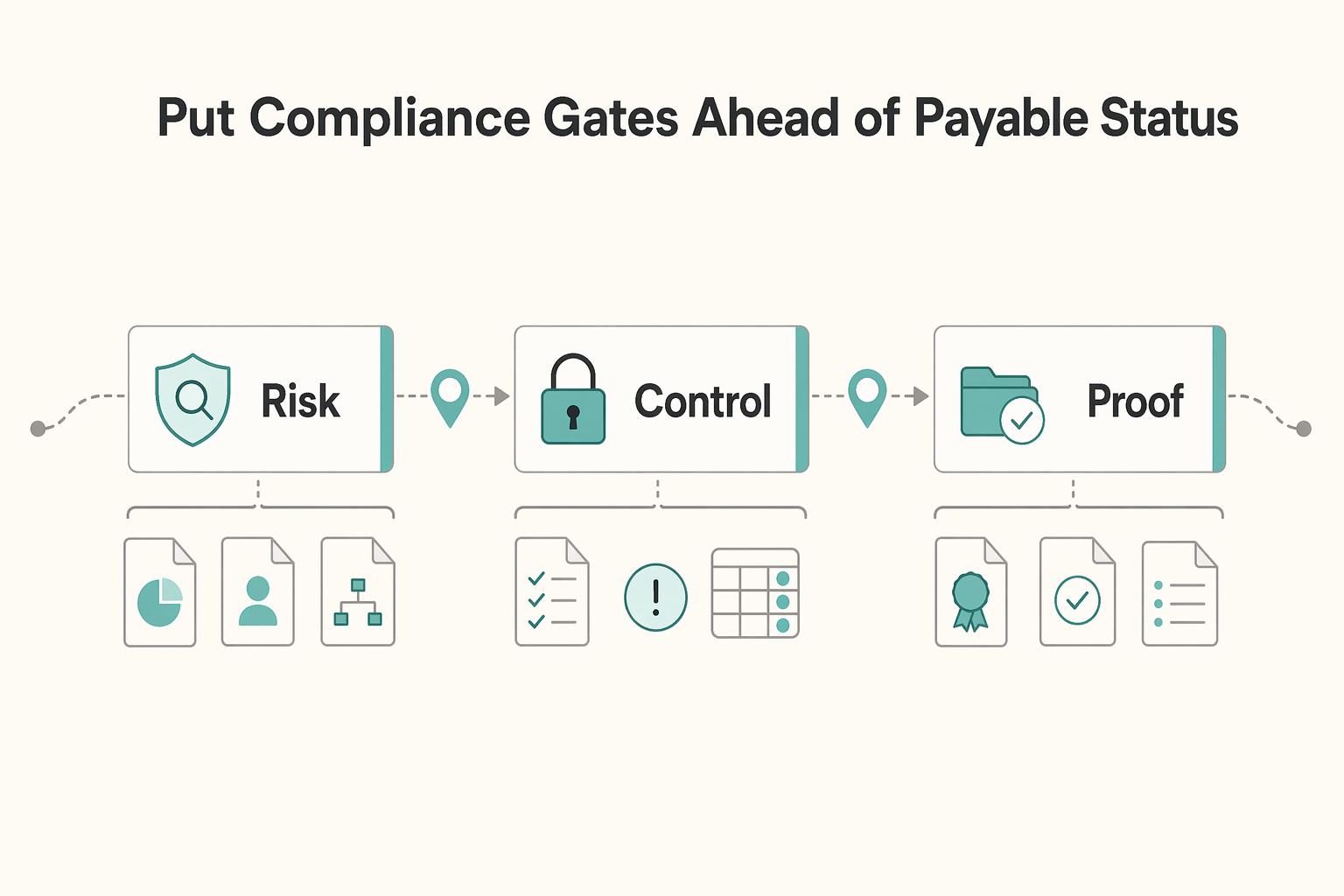
Put compliance gates ahead of payable status#
Payment speed is not the gate here; control is. MAS Project Orchid explicitly includes anti-money laundering and terrorist financing risks as a design consideration, so sanctions/AML checks should be completed before the first payout attempt.
A contractor should stay non-payable until you can export evidence for:
- identity evidence linked to the contractor record
- sanctions or AML screening result with timestamp
- program or market approval where your policy requires it
- selected payout identifier type and masked value
- approver identity and approval log when manual review is triggered
If any item is only visible in an admin screen and not exportable, treat onboarding as incomplete.
Verify the payout method explicitly#
Require explicit payout-method confirmation, and show masked identifiers to contractors and ops users. If the identifier changes, reset the payout method to unverified and require fresh confirmation, plus any policy re-checks your program requires.
Your checkpoint for this step should be strict: no contractor moves to payable status until identity evidence, payout identifier, and approval logs are complete, reviewable, and exportable on demand.
For a step-by-step walkthrough, see How to Pay Contractors in Malaysia: DuitNow and Bank Negara FX Compliance for Platforms.
Step 2 execute payouts with idempotency status tracking and reconciliation#
At this step, the priority is control: one payout intent should resolve to one outcome, one ledger effect, and one traceable record path.
Submit once and journal once#
Run payouts in a fixed sequence: create request, apply policy gate, submit transfer, capture provider reference, post ledger journal, then emit status events. Keeping this order makes retries and incident review easier to manage.
Use one idempotency key per payout intent across create and retry paths. If contractor, amount, currency, destination, and payout purpose are unchanged, treat it as the same intent; if those fields change, create a new intent and key.
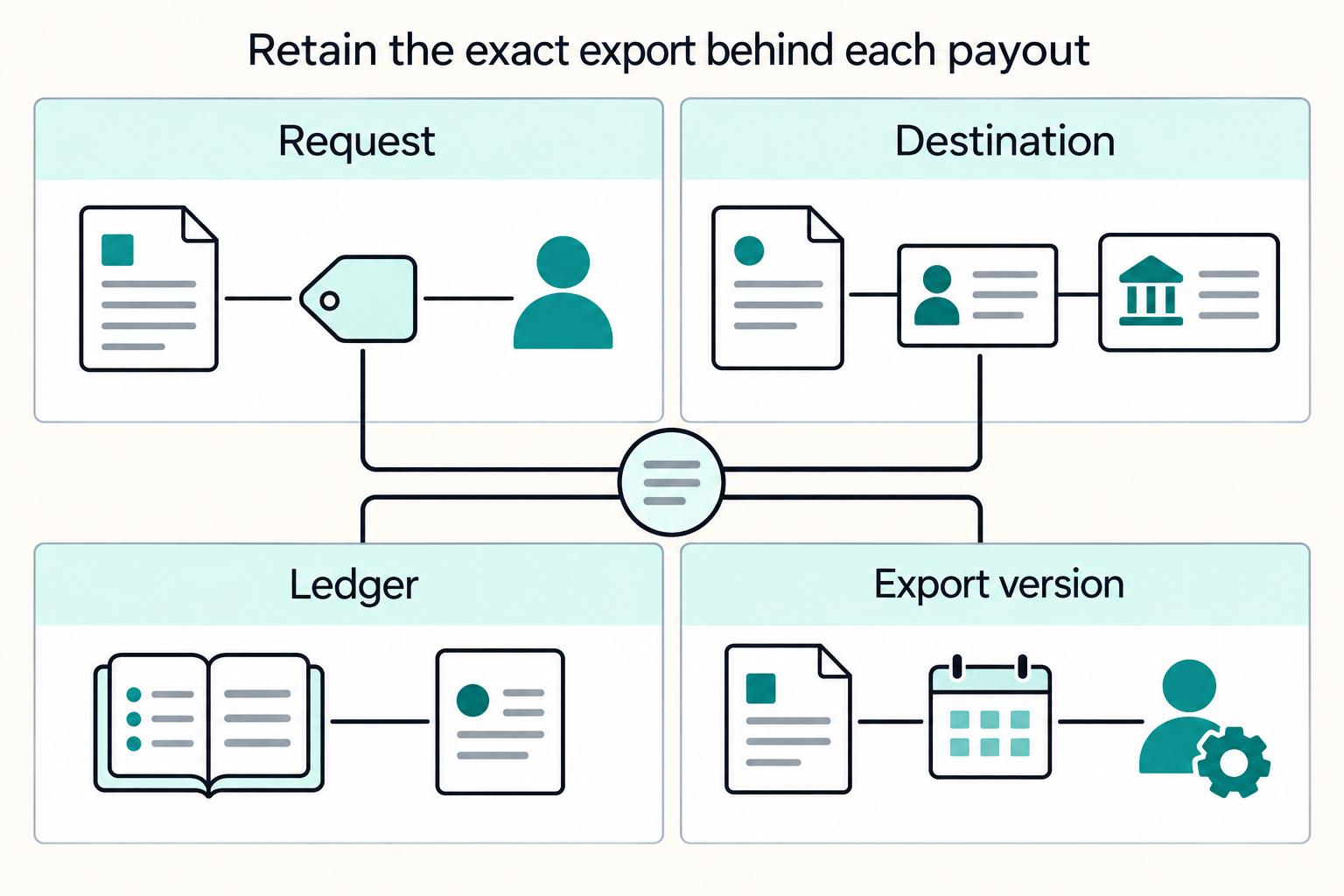
For each payout, keep an exportable record with: internal payout ID, idempotency key, contractor ID, destination identifier type, masked destination value, provider reference, batch ID (if used), policy decision result, and timestamps for request creation, submission, and ledger posting.
Make status visible to Payments Ops#
Keep the internal lifecycle short so each payout is in exactly one state at a time: accepted, pending, completed, failed, or returned. These are internal operating labels.
Pair every non-final state with a failure reason, if any, and a clear next-action owner. Ops should be able to see, without digging through logs: what happened last, who acts next, whether the ledger moved, and whether retry is allowed, blocked, or under review.
Reconcile from the ledger outward#
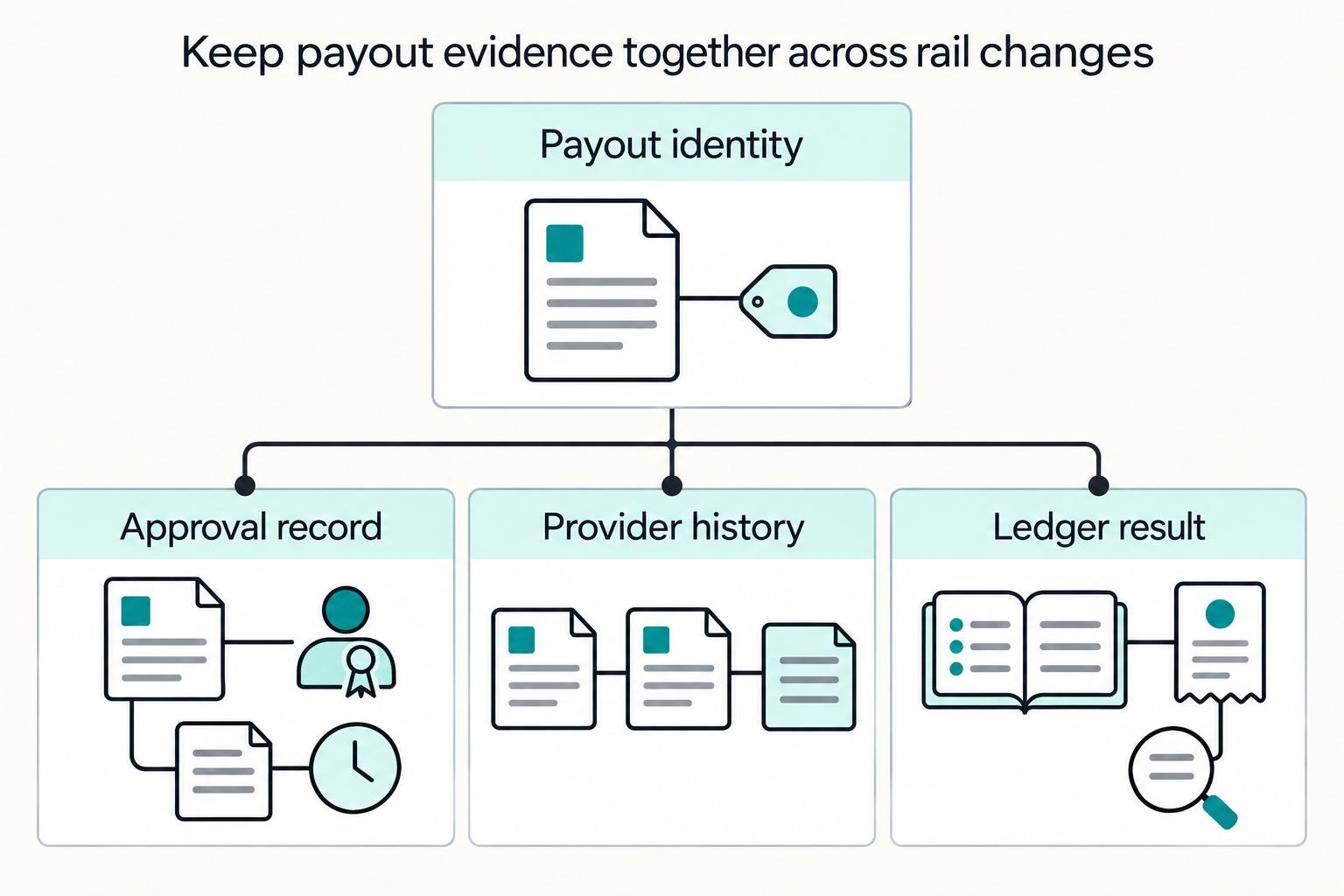
Treat the ledger as your source of truth, and treat wallet or dashboard balances as derived views. Reconciliation should join internal payout ID, provider reference, and ledger journal ID, then tie each record back to batch and current status.
If any link is missing, route it to an exceptions queue instead of patching records manually. Your launch checkpoint is practical: pick one payout and show the full path from request to policy decision to submission to journal to final status quickly and consistently.
Related: How to Pay Contractors in Peru: Yape Plin and SBS Compliance for Platform Operators.
Common failure modes in Singapore payouts and how to recover#
Recovery discipline matters as much as rail speed. Even with real-time rails, Singapore payout operations can break, so define recovery paths before you scale volume.
| Failure mode | Required handling | Record or trigger |
|---|---|---|
| Identifier mismatch between contractor type and payout destination | Treat it as an internal control risk; fix mapping first, then retry under controlled review | Export legal name, contractor type, identifier type, masked destination value, and last updater |
| Payout created but blocked by policy | Use a documented release decision instead of re-submission | Keep payout ID, hold reason, reviewer identity, decision, timestamp, and case note |
| Unmatched or delayed provider events | Route them to an exceptions queue, not directly into ledger corrections | Escalate when provider reference, payout ID, or journal link is missing |
Step 1. Correct identifier mapping before any retry#
A practical failure mode is identifier mismatch between contractor type and payout destination. In PayNow-style flows, that can mean treating a business recipient like an individual proxy setup, or vice versa.
Treat this as an internal control risk rather than a proven local rule. Keep recipient classification and identifier type in separate fields, and make sure you can export legal name, contractor type, identifier type, masked destination value, and last updater. If a payout fails here, fix mapping first, then retry under controlled review with the original case history intact.
Step 2. Formalize release of policy-gated holds#
When a payout is created but blocked by policy, the recovery path is governance, not re-submission. Require a documented release decision that states who approved, when, and why the hold was released or maintained.
A minimal record is payout ID, hold reason, reviewer identity, decision, timestamp, and case note. The operational test is simple: Finance or Compliance should be able to reconstruct the decision without hunting through chat logs.
Step 3. Isolate unmatched callbacks and outage-driven mismatches#
Unmatched or delayed provider events should go to an exceptions queue, not directly into ledger corrections. This is a real operational risk. An outage on 26 September impacted some FAST/PayNow transactions, multiple DBS incidents occurred in that year, and a 1 November MAS action imposed a six-month pause on DBS non-essential IT changes.
Use those incidents as a design signal: callbacks and status feeds can get noisy during disruptions. Route unmatched events to a dedicated queue with clear ownership and escalation when provider reference, payout ID, or journal link is missing.
If your provider contract does not clearly define reversal handling or cutoff behavior during disruptions, treat that as a launch blocker, not a post-launch optimization.
If you want a deeper dive, read How to Pay Contractors in Turkey: FAST EFT and MASAK Compliance for Platform Operators.
Decision checkpoints for go no go in the first 90 days#
Use a go decision only when your team can defend its assumptions and trace one payout end to end without manual reconstruction.
| Decision | Checkpoint |
|---|---|
| Go | You have documented MAS-aligned assumptions, clear scope for recipient types, and no open ownership gaps |
| Hold | Product, Compliance, and Finance still disagree on contractor classification, tax handling ownership, or payout exception ownership |
| Go | One payout can be traced from API request to provider reference to ledger posting to export record |
| Hold | Your team cannot clearly explain who detects failed or returned payouts, who decides next action, and where that decision is recorded |
Step 1. Verify your regulatory and rail assumptions#
Treat Monetary Authority of Singapore material as a boundary, not as sign-off on your design. The cited payments document includes dedicated sections on the legal and regulatory framework and interbank settlement systems, and the March 31, 2026 market summary reports continued progress in real-time payment networks. Use that context to frame assumptions, but do not treat it as proof of your own eligibility posture or first-90-day routing stability.
Step 2. Prove one transaction is fully traceable#
Run one real test payout and show the full chain: API request, idempotency key, recipient identifier type, provider reference, ledger journal link, final status, and export artifact. If any link in that chain depends on chat history or spreadsheet stitching, keep this as a hold.
Step 3. Define failure ownership before volume#
Before launch, write down your own operating window, triage owner, and escalation path for failed or returned payouts. Ask one direct question: who detects the failure, who decides next action, and where is that decision recorded? If that answer is unclear, hold.
Need the full breakdown? Read How to Pay Contractors in India: FEMA Compliance TDS Deduction and Bank Transfer Mechanics.
Conclusion and next step#
Singapore can be a credible market to prioritize for contractor payouts. A Singapore fintech guide updated on March 31, 2026 says the sector has seen continued progress in real-time payment networks. That is useful context if you want faster local disbursements than traditional international wires, which often come with fees, delays, and weak transparency.
That said, your expansion call should not rest on rail quality alone. The real test is simpler and harder: can you run contractor payouts with evidence you can export, reconciliation you can trust, and named owners for every failure state? If the answer is still "mostly," you are not ready to scale, even if local real-time rails look attractive on paper.
- Start with a narrow pilot cohort.
Pick one recipient segment first, not every contractor type at once. Keep the first cohort small enough that Operations, Finance, and Compliance can manually review edge cases without slowing the whole business. Verification point: every payout in the pilot should leave behind a complete evidence pack, including recipient classification, the exact payout identifier you stored, approval history, the provider reference you received, and the final ledger posting.
- Force end-to-end traceability before adding volume.
Your team should be able to trace one payment from payout request to transfer submission to ledger result without asking in Slack or rebuilding the story from screenshots. If you need manual reconstruction to explain where money went, pause the rollout. A common failure mode is not the rail itself but bad operational hygiene: stale identifiers, mismatched provider callbacks, or no clear owner for returned or failed payouts. Those issues turn a fast transfer method into a support queue and an audit problem.
- Treat broader expansion as phase two, not proof of phase one.
Cross-border progress matters, and the same Singapore guide notes expansion through Project Nexus, with the Phase 3 blueprint completed by July 2024 and live implementation expected in 2025 to 2026. That is useful market context, but it does not remove the need to prove your domestic contractor flow first. Decision rule: if you cannot show clean evidence, reconciliation, and recovery handling for a small Singapore pilot, do not add more payout routes, more recipient types, or more automation yet.
The practical next step is to run that pilot and make passing those checkpoints a release condition, not a nice-to-have. When your first batch of payouts can be reviewed end to end with no gaps in evidence and no ambiguity in ownership, then you have something worth scaling.
Frequently Asked Questions
Is PayNow the same as FAST?
FAST means Fast And Secure Transfers, while PayNow is described as a digital payment service introduced by the Association of Banks in Singapore in 2017 for instant transfers using linked identifiers (for example, mobile number or NRIC/FIN). They are related but described differently. For a formal MAS or ABS rail-versus-overlay definition, consult the relevant authority.
Can non-bank institutions use FAST and PayNow in Singapore?
Whether eligible non-bank financial institutions or a Major Payment Institution can directly access FAST or PayNow is not confirmed here. If that question affects your launch path, get confirmation from primary MAS materials or provider contracts.
Can platforms pay business contractors through PayNow Corporate?
Treat PayNow Corporate, entity payout support, and UEN-linked contractor flows as unconfirmed. If this matters for your use case, get written confirmation from the participating bank or payment partner.
Are FAST and PayNow always available for real-time payouts?
The cited excerpts do not prove 24/7/365 availability. They support instant transfers, but they do not state a contractual uptime promise.
Does this guide provide a full contractor payout compliance checklist?
No. They establish what PayNow is, that it supports identifier-based transfers, and that MAS is described as supporting the service, but they do not provide a contractor-specific compliance checklist.
What should founders validate beyond rail access before launch?
The safest additional check is identifier flow: confirm which proxies are supported and how the recipient links that identifier to a bank account before payout.
Try a related tool
Researched and edited by the Gruv editorial team. Gruv builds cross-border billing, payouts, and finance-operations software for global businesses.
Sources
Includes 1 external source outside the trusted-domain allowlist.
- fastpayments.worldbank.org/sites/default/files/2021-11/Fast%20Payment%2...trusted
- isomer-user-content.by.gov.sg/166/70612553-4328-44e7-a752-afe275f1c432/Tra...trusted
- mas.gov.sg/~/media/MAS/Singapore%20Financial%20Centre/W...trusted
- sec.gov/Archives/edgar/data/2047190/0001493152240505...trusted
- sec.gov/Archives/edgar/data/2025416/0001193125252407...trusted
- sipa.columbia.edu/sites/default/files/2025-06/For_Publication_...trusted
- stripe.com/resources/more/paynow-an-in-depth-guidetrusted
- accesspartnership.com/wp-content/uploads/2026/01/ACCA_FSI2021_Rele...external
Educational content only. Not legal, tax, or financial advice.
Related Posts
Pay Contractors in Turkey on FAST and EFT With MASAK Controls
Start with a narrow decision, not a country-level yes or no. If you can support Turkish lira payouts, treat FAST as a likely primary rail, and accept that MASAK and EFT details still need local confirmation, a controlled pilot in Turkey is reasonable. If those unknowns affect whether you can legally monitor, release, or reconcile contractor payouts, delay direct launch or use an Employer of Record as an interim model.
Pay Contractors in Peru with Yape, PLIN, and SBS Checks
Treat Peru as a posture decision, not just a rail decision. If you choose a local wallet-style method first, then sort out contractor status, tax data, and evidence later, you may get a smoother payout experience. You also raise launch risk in areas that are much harder to fix once money starts moving.

Pay Contractors in Mexico: SPEI, CoDi, SAT, and CFDI Decisions for Platforms
Mexico contractor payouts usually break for a simple reason: teams launch from a generic Latin America plan, then discover that payout rail choices, tax steps, and operating structure cannot be separated in practice. If you are evaluating multiple rails and operating models at the same time, you need Mexico-specific decisions before you send the first live payout.