
Quick Answer
Start by deciding whether your team can operate and defend a Japan payout model before writing integration code. The article recommends using Zengin and FX context to frame decisions, then requiring provider-backed requirements, named owners, and an auditable record from approval through reconciliation. It also calls out that My Number obligations are not established by the overview sources alone, so unresolved items should block broad release and stay in a constrained pilot until legal and compliance sign-off is complete.
Why this guide matters for platform operators entering Japan#
If you are deciding whether to launch contractor payouts in Japan, start with the operating question before the product question. You need to know whether you can enter the market with controls your team can run, explain, and audit. This guide is for founders, payments leads, and ops owners making that call, not for consumers comparing remittance apps.
Check for a primary source behind each build decision#
Treat this as a decision guide, not an implementation spec. The real question is whether your team can choose a workable Japan rollout path before spending engineering time on bank fields, payout UX, or local assumptions that may later prove wrong.
That matters because much of the source material sits at the wrong altitude for operator decisions. One of these sources, BIS FSI Insights No. 33 from July 2021, explicitly says these papers aim to contribute to regulatory and supervisory policy discussions and that the views are the authors' own. Another, the April 2022 Baker McKenzie Asia Pacific fast-payments guide, presents itself as a reference resource. Useful context, yes. Platform-ready rules for your contractor payout product, no.
Use a simple checkpoint: for each important build decision, ask whether you have a current primary source or provider requirement that actually supports it. If the answer is "we inferred it from an overview paper," do not code it yet.
Separate infrastructure context from field-level platform requirements#
Use this guide to separate what names like the Zengin System and FXYCS can help you understand from what they do not establish on their own. At a high level, they help frame domestic-transfer versus FX-related questions. On their own, they do not give you field-level platform requirements, guaranteed payout timing, or a complete Japan-specific compliance position for paying contractors.
That distinction is where teams get into trouble. A common failure mode is treating infrastructure context as if it settles onboarding, reconciliation, exception handling, or My Number obligations. It does not. Where the coverage stops short, say so plainly in your internal record and route the issue to legal, compliance, or your banking partner for a written interpretation.
Define success before you commit to a build#
Define success before you commit to a build.
In practice, you want an evidence pack before you approve launch:
- the dated reference you relied on
- your internal interpretation of what it does and does not prove
- the owner who approved that interpretation
- the open unknowns that block scale, even if they do not block a narrow pilot
If you cannot produce that paper trail, you are not ready for a broad rollout. Japan may still be a good market for you, but the right next move is a constrained launch plan with explicit unknowns, not a full build based on an optimistic reading of reference material.
You might also find this useful: How to Pay Contractors in Morocco: CIH Bank CMI and Bank Al-Maghrib FX Rules.
What to prepare before you build or launch#
Before you build anything for Japan, assemble a launch file that can survive audit and disagreement. If you cannot show what source you relied on, who interpreted it, and what remains unresolved, you are not ready for broad release.
| Area | What to prepare | Operator check |
|---|---|---|
| Evidence pack | Pull the Bank of Japan and Japanese Bankers Association materials you are actually relying on, add internal legal and compliance interpretation, and date every item. | Note what each item proves and what it does not prove. |
| Ownership | Split responsibility across payments ops, legal and compliance, engineering, and reconciliation, then name a single decision owner for each. | Your team should know who can decide, who can advise, and who only implements. |
| Minimum controls | Decide how approvals, status monitoring, and reconciliation evidence will work in your model. | Every payout can be traced from an internal record to a provider reference to a final status update. |
| Risk posture | If legal or compliance interpretation is still unsettled, delay a full rollout and run a tightly scoped pilot cohort first. | Use written unknowns, expansion gates, and a clear stop condition. |
- Build an evidence pack from named sources. Pull the Bank of Japan and Japanese Bankers Association materials you are actually relying on, then add your internal legal and compliance interpretation beside each one. Date every item, note what it proves and what it does not, and keep the file current. That matters in a market where the 01/09/2025 GLI Japan chapter says there has been a series of significant fintech-related regulatory changes.
- Assign one owner per workstream. Split responsibility across payments ops, legal and compliance, engineering, and reconciliation, then name a single decision owner for each. The practical checkpoint is simple: if a bank field, settlement rule, or compliance question comes up, your team should know exactly who can decide, who can advise, and who only implements.
- Set a minimum control baseline before coding. At minimum, decide how approvals, status monitoring, and reconciliation evidence will work in your model. A workable verification rule is that every payout can be traced from an internal record to a provider reference to a final status update. If your provider exposes explicit lifecycle events, such as a transaction status update step, store those states and the timestamps that produced them.
- Choose your risk posture now, not during incident response. If legal or compliance interpretation is still unsettled, delay a full rollout and run a tightly scoped pilot cohort first. A common failure mode is treating an overview source as permission to scale. The better move is a narrow launch with written unknowns, expansion gates, and a clear stop condition.
For a step-by-step walkthrough, see How to Pay Contractors in Bangladesh: BEFTN bKash and Bangladesh Bank FX Rules.
Understand the rails stack before making product decisions#
Once your evidence pack exists, the next mistake is treating rail names as product specs. Start with a simple map of the questions you need answered, then be equally clear about what your current source set does not prove.
- Separate domestic-transfer questions from FX questions.
In your design notes, do not collapse domestic bank-transfer handling and FX-related handling into one assumed flow just because both may sit inside a Japan payout launch. This section does not define Japan rail roles, message fields, or operational responsibilities, so use it to frame questions, not to settle them.
- Keep high-level reports separate from implementation evidence.
The March 2004 East Asia settlement-systems report was commissioned by Japan's Ministry of Finance, and the World Bank's September 2021 fast payments report is part of the Fast Payments Toolkit and explicitly lists topics like messaging standards and APIs. Useful background, yes. Proof of your onboarding fields, return handling, or platform obligations, no.
- Do not turn overview topics into customer promises.
A report that discusses fast payments, messaging standards, or APIs is not the same thing as a provider commitment on timing, cutoffs, or exception handling. The practical test is simple: if your team wants to promise an outcome externally, make sure you can point to current provider or bank documentation, not just a general report.
This is the limitation that trips up many launches. Infrastructure documents describe system design and high-level topics. They do not, by themselves, give you exact onboarding requirements, field formatting, return-code behavior, or platform policy rules. The World Bank document even states that it does not guarantee the accuracy of the data included in the work, which is a useful reminder not to treat overview material as binding implementation guidance.
So the rule is straightforward: use rail documents to frame your architecture, but do not let them approve your build. For that, you still need named provider, bank, or regulator materials, plus a written internal interpretation of every unresolved point.
Choose your payout architecture based on control versus speed#
Once you have separated domestic and FX questions on paper, the next choice is who owns the messy parts. Regulatory context, including a BIS section on digital payment and e-money services provided by non-banks, is useful here, but it does not tell you whether a partner-led or more directly managed model is right for your Japan launch.
Document the reason before choosing a partner-led route#
If you are considering a partner-led route, make sure the reason is documented. That path can reduce what your team must interpret or operate directly, but how much control, visibility, or support a specific provider will actually give you is not established.
Use a simple checkpoint: can your team answer these three questions in writing without guessing? Who owns legal interpretation for your contractor payout model in Japan? Who investigates a returned payout versus an FX-related funding issue? What records will you retain to explain a payout decision months later? If those answers are still vague, do not assume a lighter operating model will solve them for you.
A common failure mode is overvaluing launch speed in engineering and undervaluing support and reconciliation effort. Teams wire a provider quickly, then discover their internal status model cannot distinguish one kind of exception from another. That creates customer-facing confusion fast, especially if domestic and FX-related issues land in one queue with one generic failure reason.
Name the specific benefit before taking deeper ownership#
If you are considering deeper ownership, make sure the benefit is specific. That usually means custom approval logic, separate tracking for different payout legs, more detailed internal mapping, or tighter exception handling. The benefit is not abstract flexibility. It is the ability to match your payout states, reconciliations, and investigations to how your product actually behaves.
The cost is that you own more unresolved edge cases. You will need a named evidence pack before launch: partner or bank specifications, sample rejection or return artifacts where available, and an internal decision log for anything left unresolved. If you cannot produce that pack on request, deeper ownership is probably premature.
A useful verification test is to simulate failure before you sign off on architecture. Pick two cases: a payout that fails after submission, and an FX-related issue before payout submission. If your proposed design cannot show different timestamps, owners, and records for those cases, you are taking on custom build cost without getting real control in return.
Score both paths against operator checkpoints before committing#
Score the two paths against operator checkpoints, not slogans. The table below does not tell you the answer for Japan. It tells you what you must pin down before committing.
| Decision checkpoint | Partner-led routing | Deeper ownership |
|---|---|---|
| Required docs | Get the provider's named onboarding and compliance document list for your exact use case in Japan. Do not rely on sales summaries. | Collect provider or bank specs plus your own internal interpretation and approval records. Missing documents are a launch blocker. |
| Integration scope | Confirm which submission and status details the provider abstracts, and which ones you still receive back. | List the states, references, and exception paths your own system would need to model. |
| Failure handling | Confirm which failures the provider resolves, which ones they only surface, and what evidence they return for investigation. | Define your own ownership for returns, rejects, retries, and manual reviews before launch. |
| Escalation path | Make sure you know whether your team escalates to account support, operations, or a bank-facing team at the provider. | Make sure you have a documented path to the relevant provider or banking contact, plus internal incident ownership. |
| Audit-readiness | Check whether the provider gives you approval, submission, status, and payout reference data you can retain. | Check whether your own logs, internal records, and decision notes can explain a payout end to end. |
If you are still undecided, use this rule: pick the path that gives you the clearest evidence trail first, not the one with the best demo. In this market, the harder problem is usually proving what happened and why, not sending the first payout.
If you want a deeper dive, read How to Pay Contractors in UAE: UAEFTS AMLSCU Compliance and WPS Rules for Platforms.
Set FX rules and settlement controls before first payout#
The architecture you chose now needs an FX and settlement policy attached to it. If you do not define that policy before launch, your first exception case will force the rules into existence under pressure, which is the worst time to decide who can convert, when, and on what evidence.
Define your conversion policy as an internal control#
Define your conversion policy as an internal control, not as an assumption about the rail. Do not assume a Japan-specific quote standard, expiry rule, or conversion rulebook exists, so you need to write one for your own operation.
At minimum, decide three things in advance: when indicative pricing is acceptable, when a firmer rate commitment is needed, and who is allowed to approve the timing of conversion. If funding and payout can be separated in time, you also need an explicit stale-quote rule and a clear record of what happened to the earlier quote reference.
Run the verification in testing, not after a postmortem. Force one quote-related exception in UAT and confirm that your platform follows the policy you wrote, records the relevant timestamps, and leaves a visible reason for ops. A common failure mode is letting rate assumptions survive a delay in funding, which then creates a reconciliation difference nobody can explain cleanly.
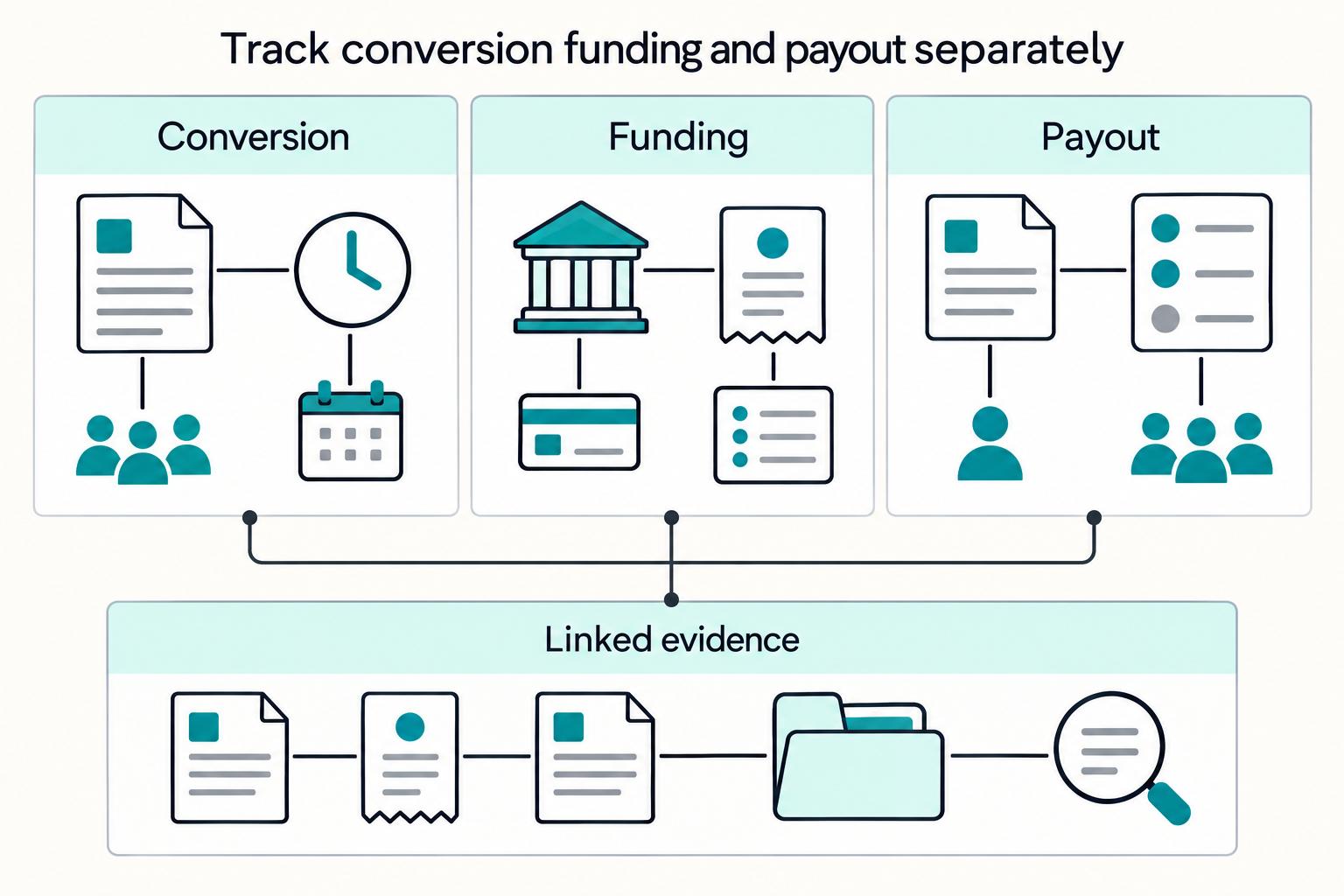
Track conversion, funding, and payout as separate events#
Track conversion, funding, and payout as separate operational events. That matters because the BIS material describes payment arrangements in developed economies as complex and interdependent, and that is exactly why one generic "processing" status is not enough.
The exact checkpoints are not defined here, so treat the table below as a minimum internal model to document and test:
| Stage | Minimum internal checkpoints | What must be attached |
|---|---|---|
| FX quote and conversion | quote requested, quote accepted, quote expired or converted | quote timestamp, quote reference, approver or rule id |
| Funding path | funding initiated, funding confirmed, funding exception | provider or bank reference, amount, currency, event time |
| Payout path | payout submitted, accepted, returned or investigated | payout reference, beneficiary record id, status time |
If your ops team cannot tell from one screen whether a payout is blocked before funding or after payout submission, your status model is too coarse.
Set an approval threshold and name the decision owner#
If FX volatility matters in your model, set an internal approval threshold and name the decision owner. Do not assume a ready-made threshold exists, so make it explicit in your own operating policy rather than leaving it to ad hoc judgment.
Every conversion and every payout should map to a trail that ties together the internal payout ID, conversion event, provider reference, amount, timestamps, and final outcome. A good checkpoint is to pick one test payout and ask a different operator to reconstruct it end to end without contacting the provider. If they cannot do that from your records alone, you are not ready for live exceptions, disputes, or audit review.
Scope My Number compliance with explicit knowns and unknowns#
The audit trail you set for FX should stop where sensitive identifiers enter the picture. Treat any decision involving My Number or other sensitive identifiers as a formal compliance gate: if your team cannot point to an approved rule for collection, storage, access, and retention, do not assume the Japan payout flow is ready for scale.
This section gives you context, not a finished operating rule. The clearest source-backed signal is that the Japan Financial Services Agency frames its report around AML/CFT/CPF, includes "Risks involved in settlement of funds", flags e-KYC as a risk area, and names Fund Transfer Service Providers as a sector. That is enough to justify a formal compliance review. It is not enough to infer a My Number procedure for contractor payouts.
Map what is established and what is still unresolved#
Map what is actually established and what is still unresolved before anyone builds data collection into the flow.
| Established from sources | Not established from sources |
|---|---|
| My Number: This article does not specify any My Number handling rules for contractor payout workflows. | My Number: Whether your contractor payout model requires collection at all, plus any exact handling, retention, masking, encryption, or access rule. Legal interpretation required before scale launch. |
| Payment Services Act context: This article does not establish obligations specific to this platform use case. | Platform-specific obligations: Any exact licensing, registration, disclosure, or operating duty for your contractor payout model. Legal interpretation required before scale launch. |
| Platform risk context: The FSA material titled Current Status and Challenges (As of March 2022), published in April 2022, gives broad risk context for settlement of funds, non-face-to-face activity, e-KYC, and Fund Transfer Service Providers. | Production checklist: Not provided: a production-ready checklist, exact retention periods, or field-level rules for sensitive identifiers in this use case. Legal interpretation required before scale launch. |
Keep this matrix in your launch pack and make it visible to product, legal, ops, and engineering. A common failure mode is letting one team read infrastructure or policy papers as if they were direct implementation instructions. That is especially risky here because the BIS paper and the World Bank report both carry disclaimer language about authorship and views, so they are useful context, not authority for your production compliance posture in Japan.
Set a binary policy gate for sensitive identifiers#
Set a minimum policy gate and make it binary: no production payout flow moves forward until approved handling rules exist for any sensitive identifiers your model requires.
At minimum, your approved policy should answer five operator questions in plain English: do you collect the identifier, why do you collect it, where is it stored, who can access it, and when is it removed or no longer available in ordinary operations. If any one of those answers is missing, keep the item out of production and keep any pilot tightly limited and manually reviewed.
The evidence pack for this gate should not be vague. Ask for documented legal or compliance sign-off, a data inventory showing every entry point and storage location, an access matrix by role, and a written decision on retention and access controls. If the answer is "we will decide once the provider integration is ready," you do not have a policy gate yet.
One red flag to watch for is accidental spread. Teams often avoid storing a sensitive field in the main database, then leak it into support tickets, CSV exports, webhook payload logs, or reconciliation notes. That defeats the point of your control even if the core record is handled correctly.
Verify the controls before each rollout phase#
Verify the controls before each rollout phase, not after an exception or audit request forces the test.
Use phase gates with evidence attached:
- Before sandbox exit: confirm legal has signed off on the unresolved items list and that engineering can show masking behavior in UI, exports, and internal tooling where the policy requires it.
- Before pilot launch: confirm privacy and access controls in a live-like environment, verify any approved encryption behavior is implemented as documented, and capture screenshots or test records that prove restricted roles cannot view raw values.
- Before broader production rollout: confirm audit logs record access to the sensitive field, policy changes, and admin overrides, and retain that evidence with the rollout approval.
Make the verification hands-on. Pick one test record, follow it through onboarding, payout submission, support tooling, and export paths, and prove the identifier appears only where policy allows. If an operator with ordinary payout permissions can still see or export the raw value, treat that as a launch blocker, not a cleanup task.
That is the right threshold for a Japan payout launch. Where the record is silent, the correct move is not to improvise. It is to document the gap, get legal interpretation, and block scale launch until the control evidence exists.
We covered this in detail in How to Pay Contractors in Malaysia: DuitNow and Bank Negara FX Compliance for Platforms.
Implement the flow step by step from onboarding to reconciliation#
Treat the Japan payout flow as an internal control design, not as something already fully specified. Do not assume a production-ready contractor payout sequence already exists, so define one explicitly, validate it with your provider, and keep legal and ops sign-off attached to each stage.
| Step | Action | Check |
|---|---|---|
| Step 1 | Separate required operating data from unresolved compliance data, and decide which fields your platform stores, which fields the provider receives, and which fields should never enter ordinary support tools, exports, or logs. | One test record should make it from onboarding to payout draft without leaking sensitive fields into CSV exports, ticket notes, or callback logs. |
| Step 2 | Create a funding event tied to a unique internal payout batch or instruction ID that follows the payment through funding, conversion, submission, and reconciliation. | From a single record, answer who approved the payment, which provider reference it maps to, and whether the funded amount matches the expected payout path. |
| Step 3 | If conversion is needed, record its own timestamp, approver, rate source, and provider reference, then pass the resulting funded amount into the payout stage as a separate confirmed input. | Keep FX-related events separate from payout events. |
| Step 4 | Define a clear state model with your provider or bank, and make callbacks or file returns append to status history rather than overwrite it. | Document Japan-specific webhook states, retry rules, or Zengin EDI requirements before launch rather than assuming them. |
| Step 5 | Decide what close artifacts you need for each cycle, such as approval records, provider-reference mapping, internal transaction records, and exception notes. | Prove you can trace one completed payout and one failed or returned item from internal approval to provider reference to final disposition. |
- Step 1: Onboard payer and payee data with validation gates.
Start by separating required operating data from unresolved compliance data. For each payer and payee, decide which fields your platform stores, which fields the provider receives, and which fields should never enter ordinary support tools, exports, or logs. Your first checkpoint is simple: one test record should make it from onboarding to payout draft without leaking sensitive fields into CSV exports, ticket notes, or callback logs. A common failure mode is collecting "just in case" data during onboarding and later discovering that no approved rule exists for retention or access.
- Step 2: Collect funding and lock the transaction intent before money moves.
Once the record is valid, create a funding event tied to a unique internal payout batch or instruction ID. That ID should follow the payment through funding, conversion, submission, and reconciliation so finance and support are not matching by amount and date alone after the fact. Your operator check here is whether you can answer three questions from a single record: who approved the payment, which provider reference it maps to, and whether the funded amount matches the expected payout path. If you cannot answer those quickly, your exception queue will grow fast.
- Step 3: Convert only when your policy allows it, and keep FX-related events separate from payout events.
Japan-specific domestic-versus-FX processing rules for your use case are not established, so do not blur those into one status. If conversion is needed, record its own timestamp, approver, rate source, and provider reference, then pass the resulting funded amount into the payout stage as a separate confirmed input. If your provider or bank uses ISO 20022 message schemas or related code sets, keep those mappings versioned and reviewed because the external code sets are maintained quarterly and updated by end February, end of May, end of August, and end of November.
- Step 4: Submit the payout with explicit asynchronous states.
Do not design this like a synchronous card authorization. Define a clear state model with your provider or bank, and make callbacks or file returns append to status history rather than overwrite it. Japan-specific webhook states, retry rules, or Zengin EDI requirements are not defined here, so document those items before launch rather than assuming them.
- Step 5: Reconcile every payout cycle and close exceptions with evidence, not memory.
Decide what close artifacts you need for each cycle, such as approval records, provider-reference mapping, internal transaction records, and exception notes, and test them before launch. Verification should be hands-on: pick one completed payout and one failed or returned item, then prove you can trace both from internal approval to provider reference to final disposition. If a returned payment cannot be tied back to the original instruction without manual spreadsheet work, your design is not ready for scale.
One recommendation matters more than the rest: keep status history and money-movement history separate but linked. Teams often collapse funding, FX, and payout into one "paid" or "failed" flag, which feels simpler until the first return, reversal, or rate dispute lands. For a capable operator, the better threshold is stricter: if you cannot reconstruct the full lifecycle from approval to reconciliation using references and stored evidence, pause expansion until you can.
Handle common mistakes before they become launch blockers#
Once your flow is mapped end to end, the next failure point is usually interpretation, not code. The fastest way to stall a Japan launch is to build against overview material, blend separate rails into one status model, or leave sensitive-identifier decisions floating between teams.
| Issue | Source-backed context | Implication |
|---|---|---|
| JBA material | The Japanese Bankers Association says its payment systems booklet is broad in scope and should be used with other materials. | No launch-critical requirement should rely only on a JBA overview reference without matching provider documentation or counsel review. |
| Domestic transfer vs FXYCS | JBA lists domestic customer transfers and the Foreign Exchange Yen Clearing System separately, and BOJ describes the BOJ-NET Funds Transfer System as settling private-sector systems that include both the Domestic Funds Transfer System and FXYCS. | Do not use one combined Japan bank payout status unless you can still tell whether the issue arose in the domestic transfer path or the FX-related path. |
| Zengin operating windows | BOJ states that the Zengin System started 24/7 operation by launching the More Time System, alongside the Core Time System window that regularly runs from 8:30 to 15:30 on weekdays. | This is infrastructure context, not the same as your end-to-end payout SLA. |
| My Number handling | The Digital Agency says My Number use is legally bounded and laws and regulations decide who can use it and in what situations; its guidance also refers to access control and encryption. | Treat any My Number use as an explicit legal and compliance review item and confirm access and security controls before launch. |
- Treat JBA material as orientation, not as your build spec.
The Japanese Bankers Association is useful for understanding the market, but its own payment systems booklet says it is broad in scope and should be used with other materials. If you turn that overview straight into product requirements, you will end up inventing field rules, cutoff assumptions, or exception handling that isn't actually established. A practical fix is to keep a simple requirement register where each item is tagged as one of three things: source overview, provider-specific rule, or legal interpretation. The checkpoint is blunt and effective: no launch-critical requirement should rely only on a JBA overview reference without matching provider documentation or counsel review.
- Split domestic transfer logic from FXYCS logic from day one.
JBA lists domestic customer transfers and the Foreign Exchange Yen Clearing System separately, and the Bank of Japan describes the BOJ-NET Funds Transfer System as settling private-sector systems that include both the Domestic Funds Transfer System and FXYCS. That should stop you from using one combined "Japan bank payout" status unless you can still tell whether the issue arose in the domestic transfer path or the FX-related path.
- Do not turn Zengin operating windows into blanket customer promises.
BOJ states that the Zengin System started 24/7 operation by launching the More Time System, alongside the Core Time System window that regularly runs from 8:30 to 15:30 on weekdays. That is useful infrastructure context, but it is not the same as your end-to-end payout SLA. Approval cutoffs, funding timing, provider processing, bank acceptance, and exception handling can still change what your users experience.
- Do not assume My Number is always required, or that your team can improvise its handling.
The Digital Agency says My Number use is legally bounded and that laws and regulations decide who can use it and in what situations. Its guidance also refers to security controls such as access control and encryption. So if My Number could enter your payout flow at all, treat that as an explicit legal and compliance review item and confirm your access and security controls before launch.
Related reading: How to Pay Contractors in India: FEMA Compliance TDS Deduction and Bank Transfer Mechanics.
Frequently Asked Questions
What does the Zengin system prove for a Japan contractor payout launch?
It helps you frame domestic transfer mechanics, but it does not by itself prove field-level platform requirements or customer promises for a contractor payout build.
When should a platform separate Zengin work from FX and cross-border review?
Separate them as soon as you define the launch file. Keep domestic transfer evidence for domestic-routing questions, and hold FX and cross-border interpretations on a second track until counsel or your banking partner confirms them in writing.
Does My Number settle contractor onboarding scope on its own?
No. Treat it as one compliance input in a broader operating file, not as a full onboarding specification for every payout scenario.
What records should ops keep before the first pilot payout in Japan?
Keep the dated source record, the internal interpretation, the owner approval, the payout batch reference, and the reconciliation trail that ties each step together.
When should you pause launch and ask for written legal or banking guidance?
Pause when your team is inferring field rules, cutoff promises, or My Number obligations from overview material alone. That is the point where a written interpretation should replace internal guesswork.
What is the safest first pilot for contractor payouts in Japan?
Use a narrow cohort, one documented payout path, and explicit stop conditions before you widen scope. That keeps the first Japan rollout evidence-led instead of assumption-led.
Try a related tool
Where Gruv fits
Researched and edited by the Gruv editorial team. Gruv builds cross-border billing, payouts, and finance-operations software for global businesses.
Sources
- bis.org/fsi/publ/insights33.pdftrusted
- bis.org/cpmi/publ/d55.pdftrusted
- ecb.europa.eu/pub/pdf/other/paymentsystem201009en.pdftrusted
- elibrary.imf.org/display/book/9781557756268/back-1.xmltrusted
- euro.ecom.cmu.edu/resources/elibrary/epay/Settlement_systems.pdftrusted
- fastpayments.worldbank.org/sites/default/files/2021-11/Fast%20Payment%2...trusted
- science.gov/topicpages/a/aronia+Mitschurinii+choke.html....trusted
- science.gov/topicpages/v/variable+cross-sectional+areatrusted
Educational content only. Not legal, tax, or financial advice.
Related Posts
Pay Contractors in UAE with Clear WPS Boundaries and UAEFTS Checks
Write down the exact flow you want to launch in the United Arab Emirates: who contracts with the worker, who holds funds, who instructs the payout, and where the money actually moves. If you cannot explain it on one page, you are not choosing a payout feature yet. You are still defining a regulated operating model.

Paying Contractors in Sri Lanka with CBSL and LankaPay Decision Checks
Start with regulatory certainty. For a platform operator, Sri Lanka should not be screened from a payout product page or a rail feature list first. Real institutional signals exist, but they still do not prove that your exact contractor payout flow is permitted, eligible, and operationally supportable.
Paying Contractors in Morocco with CIH, CMI, and Bank Al-Maghrib FX Constraints
Treat Morocco as an operational validation decision, not just a commercial opportunity. The real question is whether you can verify, with current primary evidence, that your contractor payout path works through the institutions you plan to use.