
Quick Answer
Pay contractors in Malaysia by separating domestic MYR payouts from any cross-border FX step, and launch only when each rule is backed by Bank Negara Malaysia or signed partner documentation. Treat DuitNow or DuitNow Transfer as local payout candidates only after partner confirmation, require an FX approval gate for any currency conversion, and keep a complete payout record from request to reconciliation.
What Paying Contractors in Malaysia Requires#
The core decision is simple. Can you pay contractors in Malaysia with acceptable speed, cost, and control by potentially using DuitNow for the local payout leg while treating cross-border FX as a separate compliance decision? If you collapse those into one choice, you risk building a flow that looks efficient but breaks on approvals, evidence, or both.
BNM's own framing sets the baseline. BNM frames its role around monetary and financial stability and a resilient payment network with public confidence. In the cited material, e-payment transactions rose from 9.3 billion in 2022 to 11.5 billion in 2023. Credit transfer services were the largest share of e-payments, and DuitNow Transfer was the preferred credit transfer option with 39% market share in 2023.
What the material does not confirm matters just as much. It does not establish contractor-specific FX documentation, purpose codes, approval thresholds, or partner cut-off behavior. It also does not show that using DuitNow alone satisfies cross-border FX obligations. So this guide is about rollout and control design, not legal advice or a binding licensing determination.
Before you start#
Use a strict evidence rule. If a requirement is not traceable to BNM materials or a partner's documented process, treat it as unverified and keep it out of production.
Use the BNM material that discusses payment systems and the money services business together as a checkpoint. That includes "Diagram 1: Snapshot of e-Payment and Money Services Business." Use it as a shared reference across product, compliance, treasury, and engineering, and flag partner claims that cannot be matched to source material or written partner controls.
Do not treat rail choice as compliance coverage. Choosing DuitNow Transfer for local disbursement does not, by itself, settle upstream FX compliance. Keep security and customer-information controls in scope from day one as well. BNM communications include administrative monetary penalty signals tied to cybersecurity and customer information protection breaches.
By the end of this guide, you should have a launch-ready sequence for four decisions. You need to define the rail role at each step, when payouts stay domestic versus move into an FX-reviewed lane, where approvals and exception blocks sit in product flow, and what evidence to retain for each payout state. The goal is a defensible yes-or-no launch decision, not a frictionless-by-default promise.
Start with what is known and unknown in Malaysia#
Treat Malaysia as a BNM-first market. Everything else stays unverified until a licensed partner gives you written, contract-backed operating rules. If a requirement is not traceable to Bank Negara Malaysia or a documented partner process, do not ship it in production logic.
Step 1 Anchor on what is actually authoritative#
Start with BNM. In the cited material, BNM is identified as Malaysia's central bank with a mandate for monetary and financial stability, so it is your top reference point for payment-system expectations. For each launch assumption, attach one of two artifacts:
- A BNM document
- A named partner artifact
For partner evidence, Malaysia-specific bank local rules are a useful checkpoint. MUFG Bank (Malaysia) Berhad local rules, for example, state that local provisions take precedence over baseline agreement terms, so where they conflict, local rules control.
Step 2 Mark unknowns before they become build errors#
A contractor-specific FX document checklist, confirmed purpose-code requirements, any numeric FX threshold or approval cutoff, or confirmed details on the PayNet-DuitNow operating relationship are not established. Specific BNM ORR January 2026 requirements are also not confirmed.
Do not turn assumptions into product behavior. If a partner cannot show the exact operating note, form, or approval rule in writing, label it unverified and block release.
Step 3 Use a credibility ladder and block launch below it#
Not all inputs deserve equal weight. Use this order for decisions:
| Source type | Order | Treatment |
|---|---|---|
| Official BNM material | 1 | Start with BNM |
| Licensed partner documentation and signed operating process | 2 | Use when the operating process is documented and signed |
| Industry commentary | 3 | Treat as a red flag if it is more specific than official or partner records |
If commentary is more specific than official or partner records, treat that as a red flag. Also account for disclosure scope in partner terms. The cited Malaysia local rules allow disclosure when required by law, regulation, governmental directive, or request. Your evidence pack and privacy review therefore need to cover regulator-facing disclosures, not just routine payout operations.
Gather prerequisites and evidence before you build#
Do not start product work for Malaysia payouts until each planned flow is backed by either a BNM document or a named partner artifact. If a rule is not documented, keep it out of production behavior.
Step 1 Build the minimum evidence pack#
Start with the basic facts of the flow: contractor type, payout corridor, expected volume, payout frequency, and whether settlement is in Malaysian Ringgit. That baseline drives later decisions on approvals and reconciliation.
Split flows early into domestic MYR versus conversion or offshore paths so exception risk is visible before launch. Before partner design discussions, you should be able to answer who is paid, in what currency, from where, how often, and at what volume.
Step 2 Collect partner artifacts before product work starts#
Treat operational details as partner-confirmed, not assumed. For Malaysia, request written artifacts for connectivity scope, transfer availability, fallback handling, and cut-off behavior, and mark any missing item as unverified.
Prioritize product-level and local-rule documents over high-level summaries. MUFG Malaysia local rules state that local provisions prevail over conflicting baseline terms, and Al Rajhi's Specific Terms and Conditions state that product-specific terms prevail for that product or service. Your evidence pack should therefore include the actual local or product terms used for your flow.
Step 3 Name the compliance owners and approval path#
Set named owners before the first test payout: one for compliance sign-off, one for exception review, and one for regulator-facing records tied to BNM expectations. The ownership model should be specific enough that operations can immediately decide whether to release, hold, or escalate.
That is not just internal process hygiene. MUFG Malaysia rules require compliance with tax, AML, and terrorism-financing laws, and allow disclosure to authorities including BNM and CCRIS, so records must be complete and easy to retrieve.
Step 4 Prepare technical controls before first live payout#
Release controls need to exist before go-live, not after the first incident. Define controls for payout creation, retry handling, and ledger recording before payout finalization, and treat them as operational safeguards rather than BNM-mandated requirements.
For each test payout, retain a complete trace with provider reference, ledger entry, and final status. Keep security and customer-information handling in launch scope as well. BNM's annual report notes an administrative monetary penalty announced on 01 April 2026 for cybersecurity and customer information protection breaches.
Related reading: Pay Contractors in Mexico: SPEI, CoDi, SAT, and CFDI Decisions for Platforms.
Choose your payout rail mix for contractor scenarios#
Assign each rail one operational job, and block launch for any scenario that still rests on assumptions. For contractor payouts, treat any FPX-versus-DuitNow role split as unverified until confirmed.
Step 1 Assign rail roles as a working model, not a confirmed fact#
Use a provisional split to keep design decisions clear: keep FPX in collection discussions, and keep DuitNow or DuitNow Transfer in disbursement discussions, until your partner confirms scope in writing. That keeps you from building payout behavior on unverified rail assumptions.
Do not present that split as approved architecture. FPX is not confirmed for your collection design, and DuitNow or DuitNow Transfer is not confirmed as the correct payout rail for your contractor flow. Treat both as verification items tied to partner artifacts.
Before sign-off, confirm that your assumptions were checked against current BNM materials, including the dated checkpoints shown as 31 March 2026 (publication announcements) and 27 March 2026 (Reference Rate Framework policy-document update). That is an evidence check, not rail approval.
Step 2 Keep one decision table that separates assumptions from launch-ready scenarios#
Keep a single decision table so the team stays honest about what is proven and what is still pending.
| Scenario | Working rail assignment | Verify before launch | Launch rule |
|---|---|---|---|
| Domestic contractor payout | Treat DuitNow or DuitNow Transfer as payout candidates only after partner confirmation | Connectivity scope, supported product, beneficiary data requirements, cut-off behavior, and applicable partner terms | Launch only with written confirmation |
| Refund or reversal case | Do not assume the original rail supports automated reversal | Whether reversals are supported, who initiates them, and reconciliation evidence | If unconfirmed, use manual exception handling |
| Failed beneficiary details | Do not auto-reroute on first failure | Correction path, duplicate-prevention controls, and whether a new instruction is required | Hold, correct data, then retry per documented process |
| High-volume batch day | Do not assume single-payment behavior will hold at volume | Batch support, queueing behavior, cut-offs, fallback handling, and reconciliation output | Scale only after partner-confirmed volume behavior |
The key control is status discipline. Each row is either confirmed or unverified. If it depends on undocumented network behavior, it is not production-ready.
Step 3 Define fallback logic before go-live#
If a DuitNow path is your primary route, document fallback behavior before first release: retry handling, alternate-route conditions, and the point where a human owner takes over. If partner documentation does not define this clearly, keep fallback handling manual. Set duplicate-prevention expectations in the same playbook so retries and operator actions cannot trigger multiple releases for one payout intent.
Step 4 Use secondary material as context, not approval#
Secondary sources can help you understand the market, but they should not drive launch approval. For launch decisions, rely on BNM and licensed-partner documentation.
World Bank fast-payments material from September 2021 and Malaysia-focused material from October 2022 may inform background only, and the World Bank explicitly notes it does not guarantee data accuracy. UNCTAD also states that mention of a firm or licensed process is not an endorsement. For rail assignment, treat those sources as context, not sign-off.
Related: How to Pay Contractors in Morocco: CIH Bank CMI and Bank Al-Maghrib FX Rules.
Separate domestic MYR payouts from cross-border FX flows#
Draw a hard boundary between domestic MYR payouts and cross-border FX flows, and block any payout that crosses a currency boundary until FX compliance evidence is approved and attached.
This keeps the control model clean. Local payout execution and cross-border conversion can create different approval paths, exception patterns, and audit questions.
Step 1 Draw the currency boundary before mapping rails#
Classify each payout request using four fields: source funding currency, settlement account currency, contractor payout currency, and beneficiary country. Do not rely on invoice currency alone.
A practical working rule is straightforward: if movement stays in MYR for a domestic beneficiary, route it to the local lane. If any leg requires conversion, route it to the FX lane first.
Your verification point is simple. An operator should be able to classify every payout from request data alone, without memory or side-channel notes.
Step 2 Keep the domestic MYR lane narrow#
If the contractor is paid domestically in MYR, keep the release path strictly local and keep conversion logic out of it. For domestic records, keep the evidence focused on beneficiary details, payout reference, ledger posting, and provider confirmation. Add an explicit FX not applicable field so domestic payouts are not later mixed with manual conversion notes.
Step 3 Gate cross-border release on approved FX evidence#
If a payout crosses a currency boundary, FX approval must be a release gate. Do not release until FX evidence is complete, reviewed, and linked to the payout. Keep an internal evidence pack with:
| Evidence item | Note |
|---|---|
| Requested amount and source currency | Retain |
| Contractor settlement currency | Retain |
| Quote or rate reference | If provided by your partner |
| Timestamp when the rate was obtained | Retain |
| Current validity status for the quote or rate | Retain |
| Approver identity and approval time | Retain |
| Beneficiary details matched to the payout instruction | Retain |
| Partner artifact for the conversion route or arrangement | Retain |
This is an operator control standard, not a claim about exact BNM-required fields for contractor payouts. BNM is Malaysia's central bank, and 31 March 2026 is a public recency checkpoint from the Annual Report 2025 publication. If approval is missing or the quote or rate is no longer valid under partner terms, hold the payout.
Step 4 Compare conversion patterns before promising speed#
Before you publish payout SLAs or customer-facing timing copy, compare lane behavior directly in your own operations.
| Lane pattern | Conversion timing | Quote expiry behavior | Payout SLA impact | Reconciliation complexity | Exception frequency |
|---|---|---|---|---|---|
| Domestic MYR local payout | No conversion in payout path | Not applicable | Typically least exposed to FX-related delays | Usually lower | Often lower when scope stays strictly domestic |
| Cross-border with pre-approved conversion before payout release | Conversion completed before release queue | Expiry checked before release and tied to approved event | Often more predictable, with upfront review time | Medium, because FX and payout records must stay linked | Medium |
| Cross-border with conversion at release time | Conversion occurs near execution | Higher sensitivity to stale quotes and approval timing | Can be more variable | Can be higher | Can be higher |
If you want control and audit clarity, pre-approve conversion before release queue entry. If you convert at release time, use stricter hold logic, stronger duplicate prevention, and clearer processing-state messaging.
Industry reporting also describes high market concentration as a barrier for entrants. Keeping local and FX lanes separate reduces redesign risk if conversion partners or approval flows change later.
For a step-by-step walkthrough, see How Platform Operators Pay Contractors in Indonesia With GoPay, OVO, DANA, or BI Fast.
Build compliance gates and approval checkpoints into product flow#
Treat compliance as release logic in your product flow, with clear internal holds at onboarding, payout creation, conversion approval, and post-settlement review. Start strict, then relax only after your own error rates and evidence quality stay consistently strong.
| Gate | Main check | If not |
|---|---|---|
| Onboarding | Required onboarding checks under internal policy and partner requirements are complete | No payout eligibility until checks are complete |
| Payout creation | Validate the request against the approved contractor record and approved payout route | Use block conditions on the payout object |
| Conversion approval | Require FX approval before release for payouts that cross a currency boundary | Hold the payout |
| Post-settlement review | Confirm execution matched what was approved and followed the expected path | Route exceptions through a structured queue |
Step 1 Gate contractor onboarding#
Onboarding should be the first hard gate. No payout eligibility until required onboarding checks under your internal policy and partner requirements are complete.
Store the decision trail, not just pass or fail: artifact ID, reviewer, approval time, and policy version. This aligns with a risk-first posture without claiming BNM prescribes this exact gate design. BNM describes its mandate around monetary and financial stability, and its public updates include enforcement actions. Your operator should be able to see active, pending, or blocked eligibility with a reason code directly in the profile.
Step 2 Gate payout creation#
At payout creation, validate the request against the approved contractor record and approved payout route before it enters execution.
Use explicit block conditions on the payout object, including missing required internal checks, record mismatches, or unapproved routes, so downstream teams see the same hold reason. If licensing or regulator-boundary questions arise, treat them as formal diligence checkpoints with compliance and partner review, not assumptions embedded in product logic.
Step 3 Gate conversion approval#
If a payout crosses a currency boundary, require FX approval before release. Hold the payout when approval is missing, the quote is no longer valid under partner terms, or the instruction no longer matches the approved record. Keep link integrity strict by attaching a durable conversion reference with quote timestamp, approval timestamp, approver identity, and current validity status.
Step 4 Gate post-settlement review#
Post-settlement review is where weak controls usually show up. Run a check to confirm execution matched what was approved and followed the expected path.
Route exceptions through a structured queue: receive, assess, assign, investigate, resolve. Track exception volume, aging, and root causes, and relax release conditions only after you can show consistently low exception rates, fast resolution, and complete evidence trails.
Before you lock release conditions, map each checkpoint to payout policy gates and status handling in Gruv Payouts.
Design the end-to-end money trail for audit and reconciliation#
Make one internal payout record chain mandatory, and block any workflow state change that breaks it. BNM material in scope here does not define a contractor-payout field schema, so treat this as your control design, not a claimed Malaysia regulatory template.
Step 1 Define one traceable payout chain#
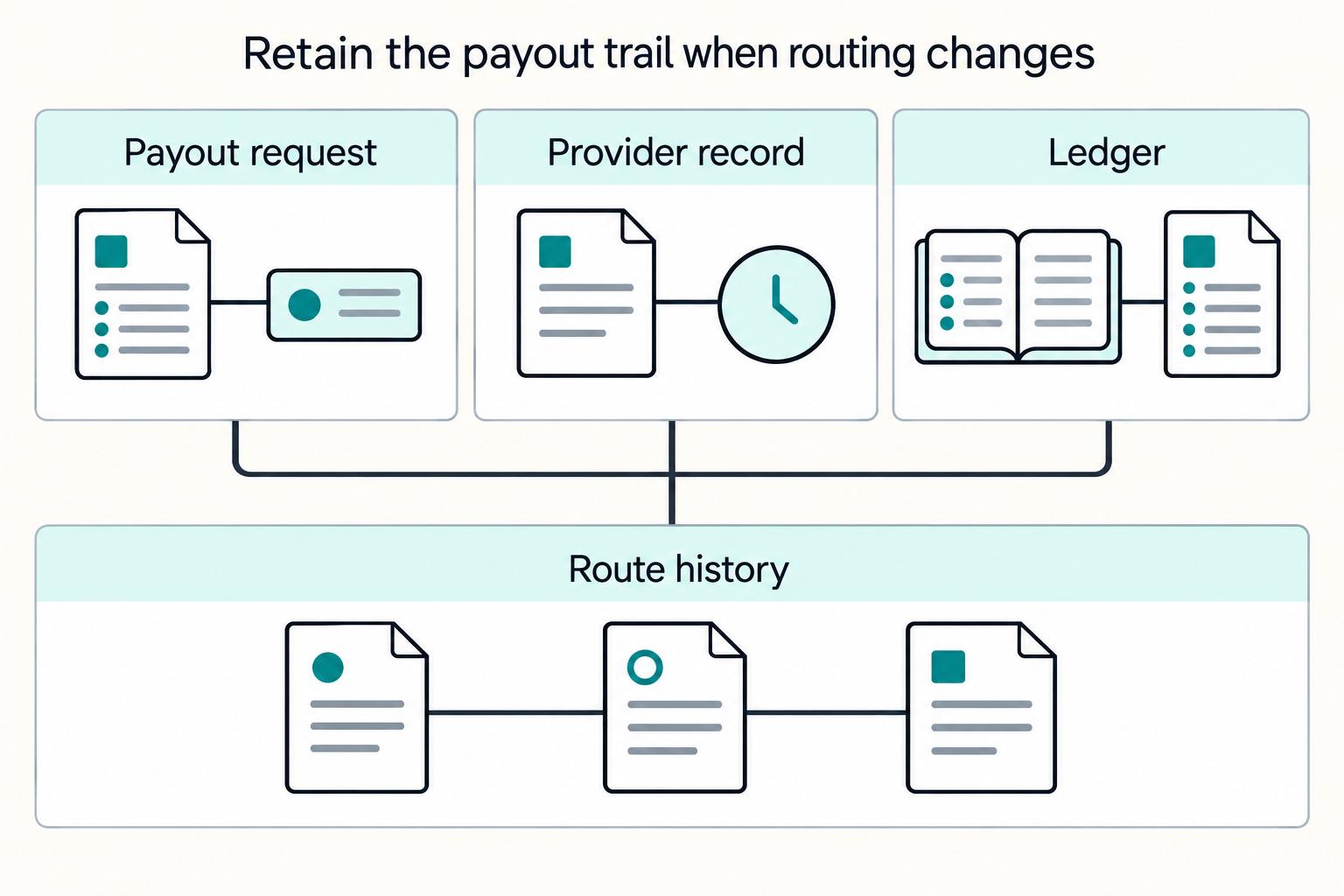
Use one internal sequence for every payout: payout request -> provider reference -> ledger journal -> status webhook -> reconciliation export. If any link is missing, the payout is not fully reconcilable, even when funds were delivered.
Keep every link on the same payout object so teams can trace forward and backward without stitching together side systems. A quick operational check is whether finance can move across all five records quickly for settled payouts. If they can only find the export row, the chain is not reliable yet.
Step 2 Attach rail and compliance context to the same record#
Store rail choice and compliance context on that same payout record, not in separate tools. Include the attempted rail, executed rail, fallback decision if any, and release-decision context.
For Malaysia flows, you can tag whether execution used a DuitNow path or another rail in your internal operating model. Keep FX context explicit as well: mark when FX is not applicable for domestic MYR, and when it is applicable, store the related decision record from your partner flow.
Fast-payments guidance documents describe push and pull transaction and message flows. Apply that principle internally by preserving a durable handoff trail at each state transition.
Step 3 Build month-end controls before volume arrives#
Month-end controls should be in place before volume arrives, not after reconciliation starts slipping. Focus on three control groups:
- unmatched payouts queue for paid statuses without ledger or export alignment, and ledgered payouts without a terminal provider outcome in your review window
- duplicate-attempt detection using idempotency keys plus secondary similarity checks
- exception aging report owned by finance ops, grouped by age, rail, and blocker type
If old exceptions keep reappearing in exports, treat that as an ownership and data-model issue, not just an operations backlog.
Step 4 Prove the trail holds under failure#
Test failure paths before relying on this in production: delayed webhook, late provider reference, reroute to fallback rail, and duplicate retry. Your export should still show one economic payout, one clear ledger outcome, and a visible detour history.
For Malaysia flows, treat this as an internal operating standard. DuitNow-specific reconciliation requirements, fallback rules, and contractor payout SLAs are not defined here.
Implement step by step rollout from pilot to scale#
Start with a controlled pilot, harden failure handling next, and scale only when controls remain explainable under stress. Treat fast-payments lifecycle material as sequencing guidance, not Malaysia rule text, and anchor production controls to BNM expectations plus your licensed partner process.
Step 1 Launch a narrow pilot#
Keep the first live release narrow: one Malaysia cohort, one payout type, and capped live volume that your team can review directly. The goal is control validation, not growth.
Document your payment-flow assumptions with your partner before the first live transfers: intended use case, required beneficiary data, expected outcome states, and fallback decision path. Keep those assumptions tied to partner artifacts in your evidence pack rather than treating product specs as approval.
Keep pilot scope tight enough that failed payouts are reviewed quickly and traced end to end on the payout record. At this stage, avoid mixing domestic and cross-border flows if that would blur root-cause analysis.
Step 2 Harden failure paths before adding volume#
Do not add volume until failure handling survives pressure. For status-event handling in particular, run scenarios such as delayed or duplicate event delivery, late provider references, and retries while status updates are still in flight.
For FX-linked flows, if quote-validity checks are in scope, test rejection handling as a control outcome rather than as a hardcoded timeout target. The key checks are whether release blocks correctly, approvals or rejections are recorded, and reasons remain visible on the payout object.
Concurrency testing should still end with one clear economic payout story, one ledger truth, and a complete sequence of attempted state changes. If those outcomes break, hardening is incomplete.
Step 3 Scale with batches, monitoring, and segmented approvals#
Add payout batches only after single-payout controls hold under failure. Batching increases blast radius, so monitoring and approvals need to tighten before volume expands.
Track operational health across partner submission, terminal status receipt, and reconciliation completion, with visible aging exceptions by flow, batch, and blocker type. If you segment approvals by risk, treat it as internal policy rather than a regulator mandate, keeping stronger review for higher-risk or FX-linked exceptions.
Do not treat payout success rate alone as a scale signal. If exception queues age or audit records are incomplete on edge cases, pause and fix controls before expanding cohorts or payout types.
| Rollout stage | Verify before promotion | Blockers |
|---|---|---|
| Step 1 pilot | Success and failures are traceable end to end; exceptions clear promptly; reconciliation completes for the pilot set; audit records are complete | Missing provider references, unexplained status gaps, manual fixes outside the payout record |
| Step 2 hardening | Failure-path tests end with one clear payout story; quote-validity rejection handling behaves as designed when in scope; retries avoid duplicate economic outcomes | Duplicate sends, overrides without approver evidence, unresolved race conditions |
| Step 3 scale | Batch runs reconcile cleanly; monitoring surfaces aging items early; approval routing follows documented internal policy; finance can close exceptions without engineering log forensics | Batch-level mismatches, growing exception backlog, bypassed internal risk reviews |
Use this as a gate, not a reporting exercise. If any checkpoint is weak, hold rollout and remediate before scaling.
Handle failures and exceptions without breaking trust#
Trust is easier to maintain when every exception follows one consistent internal path: classify, freeze, diagnose, retry or reroute only after the cause is clear, notify clearly, then close with evidence. Use this as an internal operating rule for domestic and FX-linked payouts so failures stay controlled and explainable. This sequence is an internal runbook, not a quoted Malaysian regulatory mandate.
Step 1 Classify the failure before anyone retries#
Do not start with "try again." Start by classifying the exception, because each class can need a different response. Treat these classes as internal triage labels, not regulatory definitions.
| Failure class | What it can mean | First thing to verify |
|---|---|---|
| Beneficiary error | Recipient details are wrong, outdated, or mismatched | Compare payout request, beneficiary record, and partner rejection detail on the same payout ID |
| Rail downtime | Submission failed, timed out, or status updates stalled | Check whether a provider reference exists and whether the partner accepted the payout |
| Conversion rejection | The FX step did not pass release conditions | Verify quote ID, expiry, approval state, and whether funds were reserved or released |
| Compliance hold | The payout is paused for review due to missing or unresolved checks | Confirm hold reason, owner, and the blocking artifact |
A useful checkpoint is whether an operator can identify the class from the payout record without engineering logs.
Step 2 Freeze and diagnose on the payout record#
When an exception is raised, stop automated release on that payout ID. Do not send a second instruction until you know whether the first one reached a partner.
Check whether you have a partner reference or only an internal request ID. No partner reference can indicate a pre-submission issue. A partner reference means the payout is potentially live until proven otherwise.
If the exception touches FX controls, customer information, or another control your team treats as high risk, require manual approval before automated replay. This is an internal control choice, not a quoted BNM mandate. A BNM notice dated 01 April 2026 reports an administrative monetary penalty tied to cybersecurity and customer information protection breaches, which is a reminder that weak exception handling can increase risk.
Step 3 Retry or reroute only when the cause is proven#
Do not retry by default. Beneficiary errors often require a return, corrected details, and a new attempt linked to the failed one.
Rail downtime may justify retry only after you confirm the first submission was not accepted. Conversion rejection should usually remain held until the next action is explicitly approved.
Treat partner terms updates as a control trigger too. Public bank terms can change with prior notice, for example at least 21 days in one published set of terms, and continued use after notice can be treated as acceptance. Recheck status mapping, return handling, and customer wording before re-enabling broad auto-retries.
Step 4 Notify with clear status language and close with evidence#
For internal consistency, map status language to one operational meaning. These labels are internal conventions; confirm whether BNM or PayNet defines equivalent statuses with your compliance adviser or official guidance:
- Processing: the payout is progressing in normal flow and no contractor action is required yet.
- Held: the payout is paused for review or missing information and will not be replayed until cleared.
- Returned: this attempt will not settle and funds are being, or have been, moved back to the source balance.
Close only when the case record is complete: payout ID, provider reference, ledger journal, partner response or webhook payload, approver identity for manual review, and final customer notification. If finance cannot reconstruct the case from the record alone, it is not closed.
Common mistakes when paying contractors in Malaysia and how to recover#
The most expensive failures usually start before execution, when teams treat assumptions as approved operating rules. Recovery means defining what is actually approved for rails, compliance, and audit evidence, then blocking everything else.
Step 1 Treat rail access and compliance as separate approvals#
Rail availability is not the same as compliance approval. For Malaysia, partner local rules can override base terms, so first identify which signed document governs each covered payout path.
Recover by assigning separate owners: one for rail operations and one for compliance evidence. For each path, confirm the governing document, approver, and scope of obligation. Include affiliated account-owner coverage where applicable, not only the primary contracting entity.
Step 2 Build your rail map from signed artifacts, not assumptions#
A common failure is mapping rails from internal shorthand instead of partner-issued documents. A verified FPX-DuitNow role split for contractor payouts is not established, so treat those mappings as unverified until documented.
Recover by rebuilding the matrix from signed terms, local rules, and partner-issued documentation for each payout and exception flow. Re-run integration tests against that matrix and block launch for any rail decision without a partner-issued source document.
Step 3 Keep exploratory programs out of core launch criteria#
Exploratory program commentary is not a production control. Confirm production-readiness conclusions for RMJDT or Regulatory Sandbox activity directly with BNM or your licensed partner before launch.
Recover by splitting decisions into two tracks: core launch controls, meaning contracted, tested, and operationally owned, and exploratory monitoring. If a release decision depends on commentary rather than signed terms or partner controls, mark it unverified and keep it out of launch gating.
Step 4 Fix audit lineage so exceptions are defensible#
Weak evidence chains turn routine exceptions into legal and operational risk. The grounded baseline is strict. Customers must comply with applicable tax, AML, and terrorism-financing laws in Malaysia and elsewhere. Partner flows may involve data disclosure to authorities, including Bank Negara Malaysia, CCRIS-related bodies, or investigating officers.
Recover with one complete payout case record: internal request ID, provider reference if available, governing partner document, compliance decision record, and the customer or affiliate entity tied to the account. Also record what data was shared and the authority path used. If that chain is incomplete, keep the case open.
Decide if stablecoin options belong in your Malaysia launch#
Treat stablecoin paths as optional and separate from your core Malaysia contractor-payout launch unless your signed operating documents and partner coverage explicitly support them. Do not make stablecoin a default payout design without that support.
Step 1 Keep core launch gates tied to proven payout operations#
Prioritize predictable core payout execution first, and keep digital-asset exploration on a separate track with separate ownership and release criteria. That keeps launch decisions tied to contracted, testable operations instead of commentary.
For any stablecoin path, require the same operating basics before launch inclusion: a governing document, a named operating partner, an internal approver, and a defined exception path. If any of those are missing, keep it out of core scope.
Step 2 Confirm your evidence is actually Malaysia payout evidence#
Before relying on any source for Malaysia payout policy, confirm that it is an actual Malaysia payout-policy or operating document for contractor disbursements, not a filing from a different jurisdiction or context.
The same filing also does not provide a fixed commencement date. It says commencement would be "as soon as practicable after the effective date." If your stablecoin case depends on this type of source, the support is not strong enough for core Malaysia launch decisions.
Step 3 Add complexity only after reliability is established#
If your first launch goal is dependable contractor payouts, prove core payout reliability before adding stablecoin complexity. Stablecoin evaluation can follow as a separate, program-specific decision once core operations are repeatable and defensible.
Conclusion#
Do not launch just because one rail is available. Launch only when you can prove a controlled payout design: domestic MYR disbursement is treated separately from cross-border conversion, and every critical assumption is backed by an official source or signed partner evidence.
- Confirm BNM-aligned assumptions and partner obligations first.
Anchor your operating posture to Bank Negara Malaysia signals on resilience, stability, and supervisory oversight. Do not rely on inferred roles, partner marketing, or sandbox commentary. Your evidence pack should identify each entity in the chain, who handles each payment activity, where MSB responsibility may sit, and the exact document behind each production assumption. If an item lacks an official BNM source or signed partner document, keep it unverified and block launch.
- Lock rail assignment across DuitNow and fallback paths.
Rail routing cannot live as tribal knowledge. Assign each rail to a specific job, define failure handling, and document escalation ownership. The grounded signal is that DuitNow Transfer was the preferred option in 2023 with 39% share of credit transfer services. That supports prioritizing it for credit-transfer-style payouts, not as a reason to skip fallback design. For any payout attempt, your team should be able to show which rail was chosen, why, what retry path applies, and who owns manual recovery.
- Enforce FX approval and stale-quote rejection before release.
Where your flow includes both domestic MYR and FX, keep local MYR disbursement out of conversion logic. For any FX flow, require recorded evidence before funds move: conversion owner, quote used, quote timestamp, and approving rule or approver. Define the timeout and purpose-code control with your provider and enforce it in product. If stale quotes can be overridden without an approval trail, the control is not launch-ready.
- Validate the full audit trail from request to ledger to export.
Before scale, trace payouts end to end: request, provider reference, ledger journal, status update, and reconciliation export. This is how you catch the gap between a dashboard "success" and a payout finance can close. Require provider reference IDs on every payout state change and keep rail and FX context attached to the record. If exceptions are resolved outside the ledger, or finance needs engineering log reconstruction, you are still in pilot mode.
- Use pilot metrics, not market size, as the go-no-go gate.
BNM-reported adoption numbers, including 11.5 billion e-payment transactions in 2023 versus 9.3 billion in 2022 and 343 transactions per capita, show market usage, not operational readiness. Your go-no-go should come from pilot outcomes: payout success rate, exception clearance time, reconciliation completion, and audit-record completeness. Scale only after those hold under real batch days and real exception handling.
If any one of these five controls is missing, you do not yet have a launch-ready Malaysia payout operation. You have an integration with open risk. When your pilot metrics are in, turn the launch checklist into an implementation runbook with Gruv Docs.
Frequently Asked Questions
Is **DuitNow** alone enough to pay contractors in Malaysia compliantly?
No. This guide does not show that DuitNow alone is sufficient for compliant contractor payouts. Treat local rail support as incomplete until official sources and signed partner documents confirm the full operating and compliance model.
What is the practical difference between **FPX** and **DuitNow Transfer** for platform payout design?
The article does not establish an authoritative FPX versus DuitNow Transfer rule for contractor payouts. Use bank or payout partner documentation to confirm which rail is enabled for each job in your flow and what fallback behavior is supported in production.
Who sets payment-system expectations in Malaysia, **BNM** or **PayNet**?
There is no clean, proven responsibility split between BNM and PayNet. For launch decisions, map each production assumption to an official source or a signed partner document instead of inferred roles.
What should we verify first for **FX compliance** before turning on cross-border contractor payouts?
Verify who owns conversion, what pricing and settlement terms are documented, and what records are retained for review. The article treats cited FX and settlement figures as provider claims and diligence inputs, not regulatory conclusions.
Do we need to consider **RENTAS** for contractor payout architecture, or only for specific settlement patterns?
The article does not support a definitive yes-or-no answer for default contractor payout architecture. Treat RENTAS as a specific design decision only when your partner architecture or settlement model explicitly requires it.
Are **RMJDT** and other digital-asset routes relevant for mainstream contractor payouts today?
Not as a mainstream default based on this evidence. Keep digital-asset routes separate from core launch scope unless your operating and partner documents explicitly support them for production use.
Where Gruv fits
Researched and edited by the Gruv editorial team. Gruv builds cross-border billing, payouts, and finance-operations software for global businesses.
Sources
Includes 3 external sources outside the trusted-domain allowlist.
- bnm.gov.my/documents/20124/21185005/ar2025_en_book.pdftrusted
- bnm.gov.my/documents/20124/12142010/ar2023_en_ch1e.pdftrusted
- fastpayments.worldbank.org/sites/default/files/2021-11/Fast%20Payment%2...trusted
- openknowledge.worldbank.org/bitstreams/1d1394b1-2695-58b4-a28f-c0a3c721b...trusted
- sec.gov/Archives/edgar/data/2047190/0001493152240505...trusted
- adb.org/sites/default/files/publication/1109771/unlo...external
- alrajhibank.com.my/assets/pdf/tnc/Specific_Terms_and_Conditions...external
- amro-asia.org/wp-content/uploads/2025/10/AMRO-AFSR-2025_Ch...external
Educational content only. Not legal, tax, or financial advice.
Related Posts

The Freelance Payment Penalty: A Modeled Audit of Platform Fees, FX Spreads, and Payout Delays
The money rarely disappears through a single, easy-to-spot fee. The real loss is stacked. A marketplace takes its commission, a processor adds a charge for international cards, a bank or payment company converts the currency at a spread, a platform holds the funds before release, and a wire sheds a little to intermediaries on the way in. Each layer looks defensible on its own, but the worker feels the combined result as a smaller deposit and a later payday.

How to Respond to a Subpoena for Business Records
Move fast, but do not produce records on instinct. If you need to **respond to a subpoena for business records**, your immediate job is to control deadlines, preserve records, and make any later production defensible.
A US Expat's Guide to Investing in UCITS ETFs to Avoid PFIC Issues
The real problem is a two-system conflict. U.S. tax treatment can punish the wrong fund choice, while local product-access constraints can block the funds you want to buy in the first place. For **us expat ucits etfs**, the practical question is not "Which product is best?" It is "What can I access, report, and keep doing every year without guessing?" Use this four-part filter before any trade: