

Quick Answer
GovPay is for payments to government organizations, not contractor payouts. CEFTS can provide a Sri Lankan domestic bank transfer through participating institutions. For a foreign platform, verify the licensed inbound remittance and FX leg before selecting a domestic last mile.
Choose the Sri Lanka payout path by money movement#
Start with regulatory certainty. For a platform operator, Sri Lanka should not be screened from a payout product page or a rail feature list first. Real institutional signals exist, but they still do not prove that your exact contractor payout flow is permitted, eligible, and operationally supportable.
Step 1 Set the decision lens#
This guide is for teams deciding whether Sri Lanka deserves product, compliance, and GTM investment. That is a different decision from a single employer sending money to one independent contractor. You are testing whether a repeatable payout model can survive review, exceptions, and scale, not whether one transfer can be made somehow.
That distinction matters because platform risk compounds fast. A one-off payment can sometimes be handled manually. A platform launch creates recurring exposure across onboarding, payout execution, reconciliation, support, and auditability. If the rule basis is weak, the failure does not stay inside Payments Ops. It spreads into product promises, onboarding copy, contracts, and finance controls.
Step 2 Anchor on what is actually confirmed#
CBSL describes CEFTS as a 24/7 real-time fund-transfer system between participating Sri Lankan institutions. The receiving customer can be credited within seconds, while interbank settlement runs in later RTGS cycles. This is a domestic last-mile capability; it is not, by itself, proof that a foreign platform may originate a cross-border contractor payment through CEFTS.
GovPay and LankaPay’s Government Payment Platform serve payments to connected government organizations for taxes, fines, fees and other public services. Their use of CEFTS does not make GovPay a contractor-disbursement product. A foreign payer needs a documented cross-border entry path through a licensed bank or other authorized provider, plus a verified domestic last mile.
Verification checkpoint: before anyone scopes engineering, create a short evidence log with the claim, source type, document name, owner, and decision impact. If a claim about rail eligibility or FX permissions cannot be tied to formal documentation, mark it unverified.
Step 3 Separate reachability from launch readiness#
Sri Lanka may look operationally reachable at first glance. The problem is that the foreign exchange rule path for platform contractor payouts is not confirmed, and rail eligibility for your exact payer-to-contractor flow is not confirmed. That is enough uncertainty to stop premature build work.
A common failure mode is treating visible payment infrastructure as proof of launch readiness. If your team assumes a named rail or banking path will work, then discovers late that eligibility or FX interpretation is unclear, you burn roadmap time and create GTM debt. The promise of this guide is narrower and more useful: separate confirmed facts from unknowns, then invest only after the evidence-based checkpoints are cleared.
Gather the minimum inputs before you model Sri Lanka expansion#
Model Sri Lanka only after each payout flow is explicitly defined and owned; otherwise domestic, cross-border, one-off, and recurring cases get conflated and your assumptions break later.
| Input | Required details | Control rule |
|---|---|---|
| Use case scope | Who pays, who gets paid, where funds start, where they land, and whether the flow is one-off or recurring | Keep domestic LKR disbursements separate from non-LKR or cross-border flows |
| Entity map | Payer entity, payee type (independent contractor), settlement currency, and required banking channels | Stop before rail comparison or support-load estimates if any row is missing a named payer, currency, or channel |
| Evidence ownership | Compliance owns primary-source evidence; operations owns channel, exception, and reconciliation assumptions | Record the exact payment or FX source, the flow it covers, and any gap requiring provider confirmation |
| Pre-launch folder | Draft contractual agreements, contractor classification policy, and unresolved foreign exchange-rule questions | Assign an owner, status, and target answer date before treating build estimates as decision-ready if an open question could block LKR movement or cross-border execution |
Step 1 Confirm the use case scope. Write one sentence per flow: who pays, who gets paid, where funds start, where they land, and whether the flow is one-off or recurring. Keep domestic LKR disbursements separate from non-LKR or cross-border flows, and split any flow that depends on different assumptions.
Step 2 Build the entity map. For each flow, list the payer entity, payee type (independent contractor), settlement currency (LKR or non-LKR), and required banking channels. If any row is missing a named payer, currency, or channel, stop before rail comparison or support-load estimates.
Step 3 Assign evidence owners. Set compliance as owner for primary-source evidence and operations as owner for channel, exception, and reconciliation assumptions. For each payment or FX claim, record the source, date, covered flow and unresolved question. A CBSL page describing a domestic rail does not by itself confirm a foreign-funded contractor payout.
Step 4 Create the pre-launch folder. Include draft contractual agreements, your contractor classification policy, and a live list of unresolved foreign exchange-rule questions. If an open question could block LKR movement or cross-border execution, assign an owner, status, and target answer date before treating build estimates as decision-ready.
Separate verified facts from assumptions before any build work#
Before you commit engineering scope, separate what CBSL materials confirm from what your payout design still assumes. verified means primary-source CBSL statutory and oversight context only; rail fit, FX permission, and vendor capability stay unverified until directly evidenced.
Step 1 Verify the product, not just the regulator. CBSL identifies CEFTS as domestic real-time interbank infrastructure. GovPay identifies its payees as government organizations. These facts separate domestic contractor credits from government collections and from cross-border receipt/FX conversion. Record the primary URL and date for each product claim.
Do not infer the foreign-originating payment route from CEFTS availability. Ask the prospective licensed bank or regulated provider how it receives foreign funds, applies FX and due diligence, credits the Sri Lankan payee, handles returns and supplies reconciliation evidence. Confirm current CBSL foreign-exchange requirements for this exact legal payer and contractor activity.
Step 2 Put each product in the right lane. GovPay is for government collections. CEFTS can be a domestic Sri Lankan last mile through a participating institution. A cross-border contractor payment needs its own authorized inbound remittance path before either domestic transfer is considered.
Rail name, rail positioning, and cross-border contractor suitability are different checks. Treating them as one decision usually causes premature build work.
Step 3 Use a known-unknown matrix with strict source separation.
| Claim | Source type | Confidence | Decision impact |
|---|---|---|---|
| CEFTS supports domestic real-time transfers between members | CBSL payments-and-settlements description | Verified product role | High |
| GovPay collects for government organizations | GovPay and LankaPay product pages | Verified product role; not contractor payout | High |
| Foreign platform can send contractor pay via a chosen provider | Provider contract and compliance confirmation required | Open for the specific flow | High |
| FX conversion, pricing, returns and payout reporting | Dated bank/provider terms and applicable CBSL directions | Open until documented | High |
For each high-impact row, require a document link, capture date, owner, and next validation action. Missing any one of these keeps the row open.
Step 4 Freeze build scope until high-impact unknowns have owners and dates. Set one rule: no build commitment past discovery until every high-impact unknown has an owner, a validation path, and a target date. Apply this to LankaPay flow eligibility, any FX interpretation tied to contractor payouts, and any vendor capability claim you plan to rely on.
For a step-by-step walkthrough, see How Platform Operators Pay Creators Globally Across YouTube, Twitch, and Substack.
Decide when LankaPay is relevant and when to use alternate rails#
Use LankaPay only when your exact payout flow is explicitly documented; until then, treat it as a lead and run bank-led alternatives.
Start by classifying directionality before naming a rail: incoming collection, domestic transfer within Sri Lanka, or cross-border disbursement to a contractor. This keeps scope decisions tied to the actual money movement instead of a platform label.
LankaPay operates relevant domestic infrastructure, but product names answer different questions. CEFTS is a candidate for a domestic bank-to-bank credit; GovPay is a government-collection platform. Neither alone authorizes a foreign-originating contractor disbursement.
For a CEFTS last mile, document the participating bank or provider, Sri Lankan beneficiary account eligibility, LKR amount, operating cutoffs, reversal handling and provider reference. Then separately document the foreign-funding leg and FX treatment. Ask whether the chosen provider can originate each leg under its actual licence and contract.
| Flow scenario | What is supported now | Operating rule |
|---|---|---|
| Government fee or tax collection | GovPay is designed for payments to connected public organizations | Use only for eligible government services, not contractor pay |
| Domestic Sri Lanka contractor credit | CEFTS supports 24/7 transfers among participating institutions | Validate beneficiary eligibility, provider access, limits, exceptions and reconciliation |
| Foreign platform to Sri Lankan contractor | Requires an authorized cross-border inbound leg plus a domestic credit | Obtain bank/provider and legal/FX confirmation for exact payer, payee, purpose and currency |
A viable architecture may combine an authorized inbound remittance with a domestic credit. Do not sign off until the provider documents both legs, FX conversion, contractor classification, funding time, payout status and return path.
Keep the evidence pack focused on CBSL, LankaPay, GovPay and the proposed regulated provider. Unrelated social-media or digital-signature references do not establish payout eligibility.
Related: How to Pay Contractors in Ethiopia: Telebirr and NBE FX Rules for Platform Operators.
Build your payout architecture with hard go or no-go checkpoints#
Treat this as a gated decision, not a build-first project: run a bank-first path and a platform-orchestrated path in parallel, and stop launch if you cannot tie FX treatment to a clearly permitted payer-payee flow.
Step 1 Draft two candidate architectures before committing engineering time. In a bank-first path, your platform prepares instructions and an authorized bank or cross-border provider executes the inbound movement and local delivery. Ask that provider for the exact beneficiary route, currency, timing, returns and reconciliation evidence. Use a platform-orchestrated path only if your payout object enforces pre-send controls (classification, contract checks, documented FX interpretation, and written provider flow confirmation) before anything becomes ready to send.
Step 2 Run fixed checkpoints in order, with one artifact per gate.
| Gate | Required output |
|---|---|
| Contractor classification | Policy memo with definition, reviewer, and stored evidence |
| Contractual agreements | Signed agreement coverage for payer entity, relationship, payout currency, and beneficiary-change control |
| FX rule interpretation | Legal sign-off tied to the exact payer-payee flow |
| Rail eligibility | Written bank/provider confirmation naming your specific flow |
| Operational fallback | Ops SOP for rejects, holds, reroutes, and ownership |
If a gate has no clear document with owner, date, and scope, that gate is still open.
Step 3 Apply one hard stop rule on FX uncertainty. If FX treatment cannot be mapped to a clearly permitted flow for your exact payer-payee pattern, pause launch and stay in discovery only. Discovery is document collection, provider/legal clarification, and design refinement, not production payouts.
Step 4 Define failure handling before first live payout. Model these as first-class states: rejected payout, held transfer, unmatched beneficiary details, and retryable technical failure. Retries should run only through idempotent processing with a stable payout ID to prevent duplicates, and your audit trail should capture state transitions, approvals, and the policy/legal basis for release.
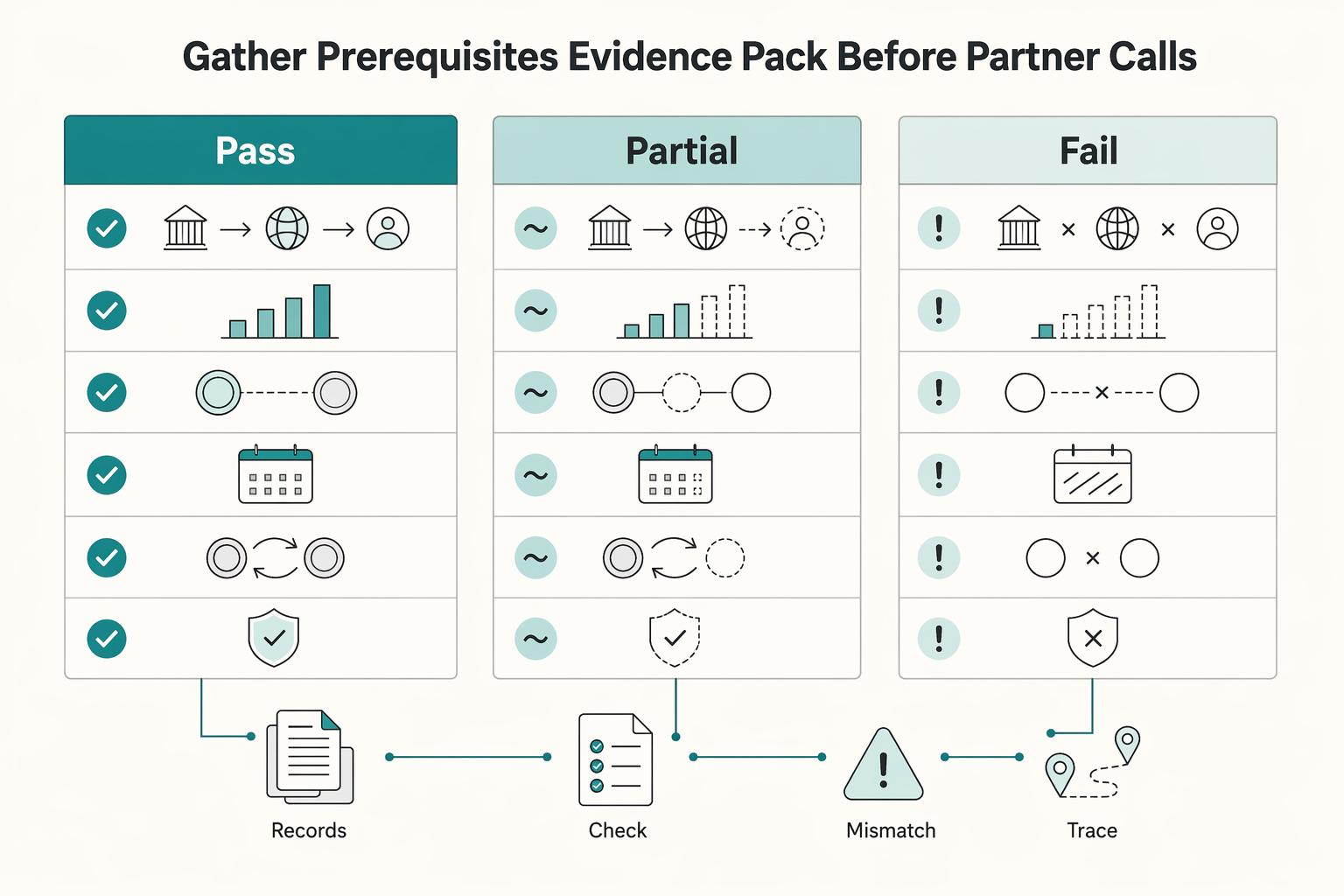
Build the compliance and operations evidence pack before pilot#
Do not start the pilot until every document that can stop, delay, or misroute an LKR payout is filed, assigned, and reviewable. If a document affects fund release, treat it as a launch dependency.
Step 1 Collect the highest-authority documents first. Start with CBSL payment-system material for the domestic rail and current CBSL foreign-exchange directions for the proposed inbound leg. Add LankaPay product material, then written bank or authorized-provider confirmation for the actual payer, contractor, purpose, currency and account. Label each document by the specific decision it supports; a general rail description cannot clear a cross-border FX question.
For LankaPay materials, store exact product pages, scheme documents, screenshots, emails, and bank confirmations, and label each item by what it actually proves. If a document does not name your payer, payee, fund direction, or settlement pattern, mark it as informational only.
Step 2 Build an assumptions register for institution touchpoints. Do not invent requirements for the Inland Revenue Department, Sri Lanka Customs, or the Department of Commerce; document assumptions and ownership instead. For each step, record whether your flow is expected to involve it, why, who validates it, and when it must be rechecked.
At minimum, each row should include: flow name, assumption text, linked evidence, owner, status, last review date, and revalidation expiry date. If an assumption affects LKR movement, set a hard expiry before pilot.
Step 3 Create the operating checklist and decision gates. Use one checklist that covers payee identity artifacts, contract and contractor records, and exception evidence (rejections, holds, escalations). Keep current beneficiary details in the same path your ops reviewer uses so holds can be resolved without cross-system searching.
Run two formal checkpoints, one for Finance and one for Payments Ops, and close each checkpoint with only one status: approve, reject, or request clarification. The pack is not complete unless a reviewer can open one folder and see the current contract, identity evidence, routing assumptions, and latest payout-path decision.
Run a constrained pilot and measure operational risk before scaling#
Run the pilot to surface ambiguity, not to prove volume. Keep scope tight enough that you can trace each payout end to end and isolate whether issues come from onboarding, reconciliation, rail handling, or unresolved FX interpretation.
Step 1 Constrain the cohort#
Start with a cohort small enough to review by hand and simple enough to explain in one page. Keep it to one payer entity, one contractor type, one contract template, and the narrowest payout path you consider viable. If open questions involve LankaPay, CEFTS, or the exact LKR settlement rail, keep those cases separate from other payout routes.
Your objective is clean state visibility for every payout: onboarding decision, beneficiary details used, payout instruction, bank or rail response, and reconciliation result. Payments Ops should be able to answer one question for each payment without side threads: completed, held, rejected, returned, or unresolved.
Step 2 Sequence the pilot in controlled stages#
Do not compress stages because early payouts appear to work. Use this order:
| Stage | Requirement | Limit or evidence |
|---|---|---|
| Complete onboarding checks | Confirm identity artifacts, contract record, contractor classification record, and approved beneficiary details before funds move | Before funds move |
| Send a small payout batch | Keep the batch small enough for manual finance and ops review of each transaction | Manual finance and ops review of each transaction |
| Review reconciliation before sending more | Match each initiated payout to a final accounting outcome | Any missing final state means reconciliation is incomplete |
| Run an exception drill | Test at least one realistic failure path end to end | Retain the rejection note, approval, beneficiary-data changes, and retry or cancel decision |
| Expand only after review | Increase complexity one dimension at a time | For example, more payees, then new bank pattern, then rail-interpretation changes |
Step 3 Measure readiness and write the launch memo#
Track three readiness signals: completion status visibility, exception resolution time, and reconciliation completeness. If you cannot produce these quickly from pilot records, the operating model is not ready to scale.
Set one explicit stop rule before launch: if repeated exceptions trace to unclear CBSL interpretation, unclear FX rules, or unconfirmed rail scope involving LankaPay or CEFTS, pause scaling and reopen legal and rail validation. That is a compliance-risk problem: exposure to legal or regulatory sanctions, financial loss, or reputational damage.
Close with a short launch memo signed by owners who can block rollout. State the jurisdiction, tested flow, source and provider evidence, unresolved items, and decision: scale with conditions, defer pending evidence, or exit for now.
Avoid the common mistakes that make Sri Lanka launches stall late#
Late stalls usually happen when partial evidence gets treated as launch-ready evidence. Keep every claim, channel choice, and GTM commitment tied to a specific payout flow and a source you can actually review.
- Mistake: treating CEFTS availability as proof your contractor flow is eligible.
Recovery: require flow-specific eligibility confirmation for the exact payer, payee type, settlement currency, and fund direction. Track each proposed path as confirmed, assumed, or open before launch messaging.
- Mistake: relying on generic contractor advice while payout gating skips classification review.
Recovery: codify a classification check before payout setup. If classification is unclear, hold the payee from payout onboarding until the record is resolved and ownership is clear.
- Mistake: mixing higher-confidence sources with low-confidence or inaccessible claims.
Recovery: rank sources by authority and by the flow they actually cover. A general market summary cannot establish that a licensed provider can execute your specific inbound and domestic legs.
- Mistake: launching GTM before the evidence pack is complete.
Recovery: use a pre-launch checklist with Ops, Finance, and legal reviewers as an internal control, then block external launch actions until launch-critical items are approved or explicitly logged as unresolved with an owner and next review date.
Make the launch call with a copy and paste readiness checklist#
The defensible interim call is delay pending evidence. The goal is not to prove Sri Lanka is promising in theory, but to prove your exact payout flow is allowed and operable.
| Checklist item | What yes means |
|---|---|
| Verified regulator scope | Primary material is accessible and reviewable, not just references or PDF titles |
| Verified rail eligibility | The exact rail is confirmed in writing for your payer entity, contractor payee type, and payout direction |
| Documented foreign exchange rules interpretation | You have a written interpretation for this exact payout pattern, not a general CBSL reference |
| Approved contractor classification controls | Classification controls are documented, owned, and approved |
| Tested exception handling | Exception paths are tested and evidenced, not just designed |
| Signed pilot outcome | A pilot memo explicitly records launch, delay, or deprioritize, with rationale |
Step 1 Force every readiness line to yes or no#
Copy this into your launch memo and force each line to yes or no:
- Verified regulator scope
Primary material is accessible and reviewable, not just references or PDF titles.
- Verified rail eligibility
The exact rail is confirmed in writing for your payer entity, contractor payee type, and payout direction.
- Documented foreign exchange rules interpretation
You have a written interpretation for this exact payout pattern, not a general CBSL reference.
- Approved contractor classification controls
Classification controls are documented, owned, and approved.
- Tested exception handling
Exception paths are tested and evidenced, not just designed.
- Signed pilot outcome
A pilot memo explicitly records launch, delay, or deprioritize, with rationale.
Step 2 Make one explicit call in one sentence#
Make one explicit call per path: exclude GovPay for contractor payouts; investigate a licensed inbound provider and CEFTS-capable domestic last mile. Delay engineering commitment for the cross-border leg until the provider confirms legal/FX scope, access, pricing, returns and reconciliation for the actual payer and contractor.
The product distinction is now supported by CBSL, GovPay and LankaPay primary material. The remaining blocker is flow-specific provider and legal evidence, not a lack of information about what GovPay or CEFTS do.
Step 3 Record first-phase limits or missing proofs in writing#
If you launch after closing gaps, set first-phase limits and revalidation dates in writing. If you delay, publish the exact missing proofs, owners, and deadlines.
Expansion quality is decided by evidence and operations readiness, not surface-level market narratives.
Frequently Asked Questions
Who regulates payment systems in Sri Lanka for platform payout decisions?
The Central Bank of Sri Lanka regulates and supervises payment and settlement systems. Start with its payment-system and foreign-exchange materials, then get written confirmation from the bank or authorized provider for the exact contractor payout flow.
What does the Payment and Settlement Systems Act establish at a practical level for operators?
Treat available references as formal oversight context only. Published summaries do not provide enough act text to map operator obligations line by line. Do not convert the Act into product requirements from summary references alone. If your build depends on a specific obligation, pull the underlying legal text or a written interpretation before you ship.
What is LankaPay Government Payment Platform designed to handle?
GovPay and LankaPay’s Government Payment Platform are designed to collect payments for connected government organizations, including taxes and service fees. They are not a route for paying private contractors. LankaPay says the platform uses CEFTS for real-time credit to eligible government recipients.
Does current evidence confirm LankaPay for cross-border contractor payouts?
No. GovPay does not cover private contractor payouts. CEFTS is a domestic real-time transfer system; using it as the last mile for a foreign-funded contractor payment requires a bank or authorized provider to document the cross-border receipt, FX handling and permitted domestic disbursement for the specific flow.
What is known versus unknown about CBSL foreign exchange rules?
CBSL is the payment-system and foreign-exchange authority. CEFTS is domestic infrastructure, while CBSL materials distinguish service-export proceeds and other inward remittances. The precise documentation, conversion and timing rule for a foreign platform paying a Sri Lankan contractor depends on the payer, payee, purpose, account and licensed provider. Obtain current written provider/compliance confirmation before launch; do not apply an old goods-export or worker-remittance rule by analogy.
What should founders validate first before committing product engineering?
Validate the exact money movement, not the market story. Your first checkpoint should name the payer entity, contractor payee type, settlement currency, and intended channel, then attach one piece of written evidence for each. If you cannot evidence FX treatment and rail eligibility for that exact flow, keep work in discovery rather than building payout logic.
When should a platform choose bank-led channels instead of a platform-led payout setup?
Choose the bank-led route when your proposed rail scope is still unclear, especially for cross-border contractor payouts. It is often the lower-risk interim option when open questions are about eligibility or foreign exchange handling, because a bank can confirm whether your exact flow is acceptable before you hard-code product behavior. In Sri Lanka, use that conservative posture until LankaPay scope and CBSL-sensitive FX points are documented for your use case.
Try a related tool
Where Gruv fits
Researched and edited by the Gruv editorial team. Gruv builds cross-border billing, payouts, and finance-operations software for global businesses.
Sources
Includes 2 external sources outside the trusted-domain allowlist.
- cbsl.gov.lk/en/node/168trusted
- cbsl.gov.lk/en/node/17766trusted
- govpay.lk/enexternal
- lankapay.net/en/for-financial/lankapay-online-payment-pla...external
Educational content only. Not legal, tax, or financial advice.
Related Posts
Paying Contractors in Morocco with CIH, CMI, and Bank Al-Maghrib FX Constraints
Treat Morocco as an operational validation decision, not just a commercial opportunity. The real question is whether you can verify, with current primary evidence, that your contractor payout path works through the institutions you plan to use.

Pay Contractors in Ethiopia with Telebirr and NBE FX Checks
Telebirr is a real payment service, with documented bulk disbursement and international-remittance capabilities. The useful question for a platform is which product, entity and funding path can pay its Ethiopian contractors for the stated commercial purpose. A local wallet transfer and a cross-border service payment require different evidence.

How to Pay Contractors in Tanzania with M-Pesa and BoT FX Boundaries
Tanzania is worth evaluating for contractor payouts, but the decision is not about market interest alone. It comes down to whether your model can operate inside Bank of Tanzania boundaries and still deliver a payout experience that finance, compliance, and contractor support can defend.