
Quick Answer
Pay contractors in Bangladesh through a documented official route, usually cross-border first, and add local BDT rails only after provider evidence confirms the path. The article does not show BEFTN is required, and it does not confirm bKash contractor eligibility. Before launch, set worker-classification and tax-form controls, use Authorized Dealer FX quotes with benchmark checks, and require reconciliation-ready payout records.
Why Bangladesh Contractor Payouts Need an Operator Lens#
Use an operator lens because payout decisions can fail on data quality and control gaps. In the material available, some fields are explicitly unavailable (..), and some totals may not reconcile exactly because of rounding. Do not treat every table value as exact or complete. Set a few control checkpoints before you plan rollout:
- Standardize currency labels in your documents and processes (
BDT= taka,US$= U.S. dollars). - Treat
..as missing or not separately reported data, not as zero. - Build reconciliation tolerance for rounded tables instead of forcing exact matches.
- Treat
1 US$ ≈ 84.02 BDTas dated 2019 context only, not a live FX assumption.
That gives you a practical go or no-go path. Validate rail fit and FX control requirements, and capture evidence before you commit rollout resources.
For a step-by-step walkthrough, see How Platform Operators Pay Contractors in Colombia with PSE Nequi and DIAN Controls.
What to Prepare Before You Build Any Bangladesh Payout Flow#
Before you design integrations, build a short prep pack that separates confirmed facts from assumptions. That keeps remittance examples from quietly turning into contractor-payout decisions without verification.
Define your payout mix first#
Start by defining your payout mix in Taka (BDT) versus non-local currency. For each contractor segment, record the settlement currency, destination type, such as local bank account versus international transfer, and whether an international bank transfer path is in scope. Your checkpoint is simple: every payout path has a named destination type and currency, not just a generic "Bangladesh supported" label.
Keep bKash and VAT as separate assumptions#
Keep bKash and VAT as separate assumption branches until verified. bKash is documented as an official remittance channel in a remittance-incentive context, but that does not confirm contractor payout eligibility. Informal channels like Hundi are also documented as not eligible for the remittance incentive.
If your team references a digital VAT and tax payment solution, keep it in the assumptions register rather than treating it as a confirmed design decision.
Set a compliance packet template#
Set a compliance packet template before onboarding. Include contractor type, tax-form path fields used by your internal tax process, payout approval owner, and approval timestamp. Treat this as internal control documentation, not proof of Bangladesh-specific filing requirements.
Log the unknowns that can block launch#
Create a written unknowns log for anything your materials do not state clearly. Include BEFTN handling details, Bangladesh Bank FX rules interpretation, bKash contractor eligibility, and VAT assumptions, each with an owner, date opened, evidence needed, and decision deadline. If any unknown could change rail selection or compliance handling, mark it as a launch blocker until resolved.
Related: How to Pay Contractors in Morocco: CIH Bank CMI and Bank Al-Maghrib FX Rules.
Compare Bangladesh Payout Rails Before Picking a Provider#
Compare rails by evidence quality, not coverage claims. If most payouts settle in Taka (BDT), drive the shortlist by who can prove Bangladesh rail depth, not who claims the broadest global reach. Build one matrix across BEFTN, Local Rails, SWIFT, and other international bank transfers, and mark every field as proven or unknown.
| Rail | Speed band to request from provider | Failure visibility to require | Reconciliation depth to require |
|---|---|---|---|
| BEFTN | Provider-stated payout-to-settlement band for BDT payouts, including any cutoff assumptions they disclose | Clear status lifecycle, rejection and return states, and whether final outcome is exposed or only submission status | A reference you can tie to your payout record and final settlement evidence |
| Local Rails | Exact rail used in Bangladesh, stated settlement band in Taka, and whether timing changes by destination type | Return-reason detail, whether failures are synchronous or delayed, and who owns retries | Traceable payout reference, destination confirmation, and enough data to match returns to original payments |
| SWIFT | Provider-stated timeline for this corridor, not a generic global average | Visibility into pending, failed, returned, and completed states, with timestamps | Transfer reference chain your treasury and payout support teams can reconcile end to end |
| Other international bank transfers | Actual transfer method if not standard SWIFT messaging, plus expected timing | Explicit failure states and what is visible to you versus opaque | Exportable references and settlement records, not only dashboard-level success labels |
The current grounding does not confirm BEFTN or SWIFT contractor-payout specifics, such as speed benchmarks, fee levels, return codes, or failure rates, so keep those fields as unknown until providers supply verifiable artifacts.
Use one decision rule early: if BDT settlement is your default case, local-first evidence can narrow the shortlist. Speed matters, and failure and return visibility should be required proof points before go-live.
Keep bKash as a separate branch until contractor payout eligibility is verified. The material supports mobile wallet use in a remittance context and distinguishes formal channels, such as bank account or mobile wallet, from informal channels like Hundi, which are ineligible for the remittance incentive. It does not confirm contractor payout support. Do not infer contractor eligibility from remittance examples.
Ask for artifacts, not summaries. Require status lifecycle detail, return and rejection reason coverage, and retry behavior you can validate in product, API docs, or export samples. If that proof is missing, keep the gap marked as unknown and do not treat the rail as decision-ready.
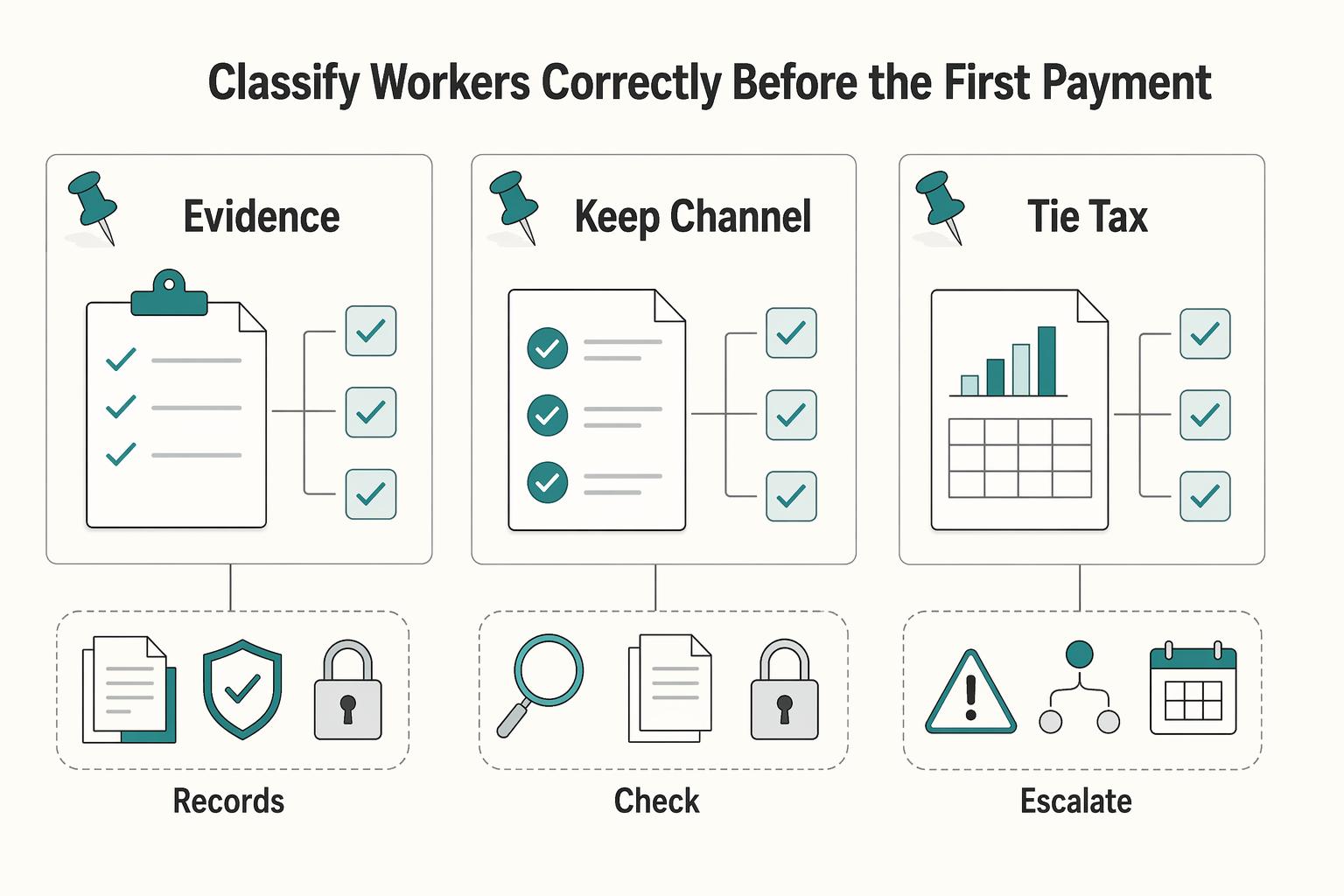
Classify Workers Correctly Before the First Payment#
Treat classification as an internal checkpoint before payout activation. Your team should require a written, reviewable decision before enabling any rail. Use this minimum flow:
- Create a classification record first.
Document the worker-type decision, the reasoning, the reviewer, and approval date before rails, wallet setup, or FX configuration.
- Gate payout activation on approved evidence as an internal control.
Do not move a payee to ready state until the approved classification record is attached to the same payout profile that will be funded.
- Keep channel eligibility separate from worker status.
The available material supports remittances through official channels, such as a local bank account or mobile wallet, and says informal channels like Hundi are not eligible for the remittance incentive. This does not establish contractor status or confirm contractor payout eligibility.
- Tie tax onboarding to your internal classification branch.
If your process uses forms like W-8BEN or W-8BEN-E and downstream 1042-S mapping, collect and link them consistently, but do not treat them as Bangladesh-specific requirements from this material.
If your team cannot defend the classification in plain writing, pause onboarding and escalate for legal review before configuring payouts.
Related reading: How to Pay Contractors in Kenya with M-Pesa, PesaLink, and KRA Controls.
Build an FX Policy That Survives Real Operations#
Once classification is approved, FX policy becomes the next hard gate. Under FE Circular No. 38, Authorised Dealers (ADs) can transact at freely negotiated rates, so the control question is not whether rates move. It is how quotes are sourced, validated, approved, retried, and recorded.
Set one FX policy table before first live conversion#
Use one shared table across product, finance, and ops. Keep it anchored to what is supported here: negotiated AD pricing; Bangladesh Bank's daily reference benchmark exchange rate effective January 12, 2025; the twice-daily reporting trigger at or above 1.00 lac US dollar equivalent effective January 5, 2025; and Bangladesh Bank's February 2, 2025 forward-rate calculation guidance.
| Scenario | Rate source | Quote lifetime | Fallback behavior | Approval threshold |
|---|---|---|---|---|
| Spot conversion for SWIFT payout | Executing AD (or provider via its AD) quote, checked against Bangladesh Bank daily reference benchmark | Internal limit; expire if validity is unclear or changed | Reject stale quote, requote, re-confirm payout amount before release | Escalate large tickets; align controls with the 1.00 lac US dollar equivalent reporting trigger |
| Spot conversion for local Taka payout | Executing AD quote for BDT settlement, benchmark checked same day | Internal limit; shorter when posted rates are marked indicative | If quote expires, rebuild payout with fresh BDT amount | Maker-checker approval for first payout, high-value payout, or out-of-tolerance variance |
| Locked or forward-priced conversion | Forward or locked AD quote using Bangladesh Bank's uniform forward-calculation approach (February 2, 2025 guidance) | Per documented contract or treasury confirmation window | If lock cannot be honored, stop and re-approve; do not auto-fallback to spot | Treasury sign-off required |
Minimum audit fields per payout are AD or provider, quote timestamp, benchmark-check timestamp, approver, and final Taka amount.
Decide where to lock FX and where to execute live#
Lock conversion when payout-amount certainty matters most, especially for batches or higher-value payouts. Bangladesh Bank's February 20, 2025 risk-management update points to hedging tools, including forwards, options, and swaps, which supports a managed approach to rate risk.
Allow real-time execution when release timing matters more and you can tolerate some rate movement between approval and execution. SWIFT flows can support traceability through UETR, but correspondent chains can still be delayed when instructions contain errors or omissions. For local rails, keep the same quote-drift controls between funding and payout creation.
A practical rule: if you promise a BDT amount, either lock earlier or requote immediately before release.
Make stale-quote rejection and retry rules explicit#
A universal Bangladesh Bank quote lifetime is not established, so define your own internal expiry and enforce it mechanically. Bank rate sheets in the evidence describe posted rates as indicative. They may also require treasury requotes at larger ticket sizes, for example USD 10,000 on one sheet and USD 5,000 applicability on another. Treat those as bank-specific operating rules, not market-wide legal limits.
Use a fixed retry sequence:
- Reject conversion if the quote is expired, missing, or not tied to the payout instruction.
- Requote before payout submission.
- Recalculate the final Taka amount and re-approve if variance breaches internal tolerance.
- Cancel and recreate the payout object if amount, rate, or funding reference changes.
Control point: the ledger Taka amount, payout instruction amount, and settlement-confirmed amount should match. If they do not, log an FX exception.
Separate spread, fee, and operational loss in reporting#
Do not report FX cost as one blended line. Track at least:
- Provider spread: executed rate versus your chosen benchmark, such as the Bangladesh Bank daily reference benchmark or a documented treasury benchmark.
- Transfer fee: explicit payment or correspondent charges.
- Operational loss event: stale-quote impact, repair fees, rejected instructions, duplicate conversions, or delayed cancellations.
This gives finance a corridor-level view of true landed cost per successful payout. Add a policy review date in the table itself, since available guidance shows that FX circular updates and validity windows can change over time.
Decide Your Operating Model for Cross Border and Local Payouts#
Pick one default path first. A conservative starting path is a cross-border remittance through an official channel. Add a local BDT path only after you can verify it end to end.
Choose a default model before onboarding#
Use one explicit model at launch:
- Cross-border first: international remittance through a bank, money transfer operator, or fintech.
- Local-first: a Bangladesh payout route your provider has already validated for your use case.
The material supports official channels like bank accounts and, in a remittance context, mobile wallets. It does not confirm contractor eligibility for every local route, so treat local-first as a validate-first choice, not a default assumption.
Gate go-live on what you can prove#
Make operational proof your first checkpoint, not pricing. In the available evidence, informal channels like Hundi are ineligible in the remittance-incentive context, while official channels are the expected route.
Use this rule: if your provider cannot show the official payout route and the named beneficiary endpoint in Bangladesh, the corridor is not ready.
Apply the same caution to wallet proposals, including bKash. Keep them blocked until eligibility is confirmed for your specific flow.
Use software labels for coordination, not validation#
Treat tooling labels as operational metadata, not proof of route readiness.
For Bangladesh, require the provider to state the actual path per payout: funding currency, settlement currency, including BDT where applicable, beneficiary endpoint type, and payout confirmation record. If the tool only shows a generic "local payout" label, you still have an unresolved operating risk.
Keep evidence separate by payout path#
Track records by route so review and support teams can verify what actually happened:
| Payout path | What to confirm before release | Record to retain |
|---|---|---|
| Cross-border transfer | Official channel, beneficiary bank endpoint, payout instruction details | Provider confirmation and payout record |
| Local BDT bank payout | Local route used, beneficiary account endpoint, final payout instruction | Local payout record and settlement confirmation |
| Wallet-based payout | Allowed use case for your flow, beneficiary identifier checks | Written eligibility confirmation and payout confirmation |
If you cannot clearly answer "cross-border or local BDT, through which official channel, with what proof," stay on the simpler cross-border model until you can.
If you want a deeper dive, read How to Pay Contractors in Sri Lanka: LankaPay and CBSL FX Rules for Platform Operators.
Implement the End to End Flow in Gruv With Control Points#
Design the flow so one approved payout instruction maps to one ledger entry, even though provider updates may arrive many times. The pattern is straightforward: approve once, create once, accept duplicate-safe updates, then reconcile by reference before marking paid.
Collect onboarding data and enforce compliance gates#
Do not move to payout creation until required KYC or KYB onboarding data is complete. The guidance in the available material is to collect requirements before launch, not fill gaps as they appear.
For Bangladesh remittance handling, keep an explicit compliance checkpoint tied to the Bangladesh Bank circular dated July 26, 2020, addressed to Authorized Dealers. Include review of tax-at-source, VAT, and other applicable levies. Keep that review status visible in the process.
Use a hard block for first payout attempts when KYC or KYB is unresolved.
Lock quote and create payout idempotently#
Create the quote and payout request as linked records, then submit with a single idempotency key so retries do not create a second transfer after a timeout or connection failure. With Stripe-style behavior, reusing the same key returns the same result, including error outcomes.
Persist the idempotency key, request fingerprint, and provider reference fields you will use for reconciliation on SWIFT or local rails. Keep provider-specific key rules in policy. Stripe keys can be up to 255 characters and may be removed after at least 24 hours. Adyen keys have a 64-character maximum and minimum validity of 7 days.
Your retry check should always pass one test: one internal payout instruction, one provider object reference.
Process provider responses through webhooks first#
Handle asynchronous status through webhooks, not polling alone. Acknowledge with 2xx, persist the message, then process it through your event pipeline.
Assume duplicate delivery and deduplicate by event identity before any state change. Map each event to the internal payout using the provider object reference carried in the event payload.
Do not post final ledger state directly from a raw webhook without duplicate and mapping checks.
Reconcile each international bank transfer to the ledger#
Treat the ledger as source of truth and provider data as reference evidence. For each international bank transfer event, reconcile the internal payout ID, provider object ID, idempotency key, payment reference number, status history, and final provider-reported settlement outcome.
For SWIFT-path investigations, payment reference numbers are an operational control point, and tracker visibility may be limited to the past 60 days. If reference data is missing in your ledger from day one, later investigations become much weaker.
Mark paid only when both conditions are true: a provider success state is present and the reference trail matches the ledger record. If either is missing, keep the payout in exception review.
Define Your Reconciliation and Evidence Pack From Day One#
Define the evidence pack as an internal control from day one, not as a presumed Bangladesh regulatory checklist. If a payout cannot be explained from approval to settlement with one clear record trail, keep it out of the paid state.
Standardize the pack for every payout#
Use one required evidence bundle per payout cycle before closure. Keep the approval record, transfer channel used, and settlement confirmation tied to the ledger reference in one place.
Your test should be practical: another operator should be able to open the record and quickly confirm what was approved, how it was sent, and whether it settled. If that trail is incomplete, route the payout to exception review.
Capture Bangladesh-specific assumptions explicitly#
If incentive treatment affects your payout logic, record it explicitly. The available material says eligibility depends on official channels, such as a bank account or mobile wallet, and that informal channels like Hundi are not eligible.
The same material also describes eligibility around a Bangladeshi sender living or working legally abroad and a beneficiary in Bangladesh with a local bank account or mobile wallet. If you reference the current 2.5% incentive treatment, keep that as an operational assumption to verify, not as standalone legal proof.
Store tax and VAT artifacts under your own policy#
If your broader process includes W-8BEN, W-8BEN-E, or 1042-S outputs, store them under your internal masking and access policy. Bangladesh-specific storage requirements for those forms are not established, so keep that boundary explicit.
Apply the same boundary to VAT handling: treat VAT notes or tooling steps as internal process choices unless you have separate primary-source confirmation.
Run an exception register that survives review#
Keep a live exception register for payouts that break the expected path, using fields your team chooses, for example owner, root cause, and closure date. Treat this as your internal audit-readiness control, not as a stated Bangladesh legal requirement.
Review closed exceptions on a regular cadence and check whether each record clearly shows what failed, who owned it, and how it was resolved. If that is hard to answer quickly, your evidence pack is still too thin.
Plan for Failure Modes Before You Launch at Scale#
Before scaling, write a failure policy that is conservative by default. Plan for common payout failures, and treat Bangladesh-specific rail, FX, classification, and wallet assumptions as unverified until primary documentation confirms them.
Map failure states by rail before any volume launch#
If you plan to use multiple rails, build separate failure maps for each, for example Local Rails and SWIFT. Do not assume Bangladesh-specific failure rates or timing. Define only the minimum statuses your provider must expose so your team can tell a fixable error from a manual-review case.
| Failure state | What it means here | Evidence |
|---|---|---|
| Rejected beneficiary details | Beneficiary details are rejected | Reason text attached to the payout record |
| Delayed settlement | Settlement is delayed | Usable status artifact attached to the payout record |
| Unmatched returns | Returns do not match the original payout | Return reference attached to the payout record |
| Ambiguous statuses | Pending, processing, or failed with no clear reason | Usable status artifact or reason text attached to the payout record |
For each rail, track at least:
- rejected beneficiary details
- delayed settlement
- unmatched returns
- ambiguous statuses, for example pending, processing, or failed with no clear reason
Require evidence for each state: a usable status artifact, return reference, or reason text attached to the payout record. If that evidence is missing in testing, treat reconciliation as unresolved.
Set recovery rules and escalate FX uncertainty#
Define recovery paths in advance, such as auto-retry, rail switch, and manual review. Because Bangladesh Bank FX escalation triggers or thresholds are not verified here, send any FX-interpretation uncertainty to manual review.
Use practical guardrails:
- auto-retry only for clearly operational failures where the original payout has not settled
- switch rails only after confirmation that the first path did not settle and beneficiary details are still valid
- escalate when statuses are ambiguous, returns do not match the original ledger amount, or someone is relying on memory for Bangladesh Bank FX rules
Before any retry, require a closed-loop check of provider reference, current status, and fund availability.
Add a misclassification recovery path, not just an onboarding gate#
If a worker-status issue appears after activation, pause payouts first. Then re-check your internal worker classification criteria and move the case out of the independent contractor flow until compliance or legal review closes it.
Frame this as internal risk control, not as a statement of Bangladesh law, because a legally reliable Bangladesh test or a mandatory remediation sequence is not established. Keep clear records of the original classification basis, why the case reopened, who approved suspension, and the final rerouting decision.
Treat unclear bKash eligibility as a hard blocker#
If bKash contractor-payout eligibility is not formally verified, keep it blocked. Do not scale on assumption.
There is an access gap in the current material. One cited source returned Access Denied with error reference #18.899b3e17.1775376874.19fe4892, which leaves section-critical operational claims unverified. Log this as an unresolved unknown, and do not use a workaround in place of confirmed eligibility.
Run a 30 Day Pilot With Go No Go Gates#
Run this as a closed, evidence-first pilot. This 30-day structure is an internal operating plan, not an externally validated sequence. If Bangladesh rail or FX-rule uncertainty is still unresolved at day 30, that is an automatic no-go. Use the failure map from the previous section as your scoring baseline.
| Pilot period | Main focus | What to verify |
|---|---|---|
| Week 1 | Onboard a controlled Bangladesh cohort and test SWIFT plus one local payout option | Complete document trail for each test user, plus usable status and beneficiary-validation evidence for each rail under test |
| Week 2 | Execute low-risk live payouts in Taka (BDT) | Time from release to final status, manual reconciliation effort, and completeness of payout evidence |
| Week 3 | Stress exception handling | Rejected beneficiary details, delayed settlement, unmatched returns, ambiguous in-flight statuses, controlled retries, and audit exports |
| Week 4 | Hold a hard go or no-go review | Payout reliability, FX variance control, and unknowns closure |
Onboard a controlled cohort in Week 1#
Use a small Bangladesh cohort your team can review manually end to end. The goal is not coverage; it is to prove that each payout record has a complete approval trail before funds move. That includes the classification basis, beneficiary details, selected payout method, and any tax forms your own cross-border process already uses where applicable to your reporting model.
Test SWIFT and one local payout option, but keep local-wallet assumptions conservative. If bKash contractor eligibility is not formally verified, keep it out of scope. The operational checkpoint is narrower: official channels are described as bank account or mobile wallet paths, while informal channels like hundi should remain out of scope.
Week 1 passes only if each test user has a complete document trail and each rail under test provides usable status and beneficiary-validation evidence.
Execute low-risk live payouts in Week 2#
Run low-risk live payouts in Taka (BDT) and judge rails only on observable operating evidence. Do not infer market-wide performance from pilot volume.
Track three operator outcomes per rail:
- time from release to final status
- manual reconciliation effort
- completeness of payout evidence for later audit
Mark failures when status remains ambiguous or provider references cannot be tied cleanly to your ledger, even if funds eventually arrive.
Stress exception handling in Week 3#
Deliberately test the failure cases from your map: rejected beneficiary details, delayed settlement, unmatched returns, and ambiguous in-flight statuses. Confirm that retries are controlled and cannot create duplicate transfers.
Also verify your audit exports. If your process includes tax documentation, confirm those links persist into payout and reconciliation exports. A payout you cannot explain later is still a pilot failure.
Hold a hard go or no-go review in Week 4#
Make the decision on fixed gates, not optimism:
- Payout reliability
Pilot payouts complete with no unresolved ambiguous statuses or unexplained returns.
- FX variance control
Each test shows a clear record of rate handling and final ledger outcome, without relying on outdated reference rates as current pricing.
- Unknowns closure
Open questions on Bangladesh Bank FX handling, local-rail behavior, or wallet eligibility are resolved with primary evidence, or explicitly logged as unresolved.
If unknowns still drive key decisions, delay expansion and keep the pilot closed. Treat data gaps as real risk, not as a placeholder for assumptions.
When your pilot criteria are set, map them into a payout workflow with approval controls, retry safety, and status tracking in Gruv Payouts.
Ask These Vendor Questions Before Signing#
Use verifiable product evidence as your signing gate for Bangladesh, not a country list or a sales claim. When legislation status is part of the pitch, verify it against a public tracker such as UNCTAD's Cyberlawtracker.
| Question area | What to request | Treat as unresolved when |
|---|---|---|
| Live rail proof | A live or sandbox Bangladesh flow showing rail selection, status changes, and failure or return reason detail | The vendor can only provide screenshots without status lifecycle or export evidence |
| Bangladesh FX rule handling | Where FX requirements are handled in product logic, approvals, and exports, plus a sample export with currency, rate handling, timestamps, and approval or user evidence | The response relies on historical FX references as current validation |
| Wallet scope versus tax-payment scope | Written evidence that clearly separates bKash contractor payouts from any VAT or tax-payment flow | The vendor gives a generic "wallet payments supported" statement |
| Native versus manual tax-document work | Step-by-step handling for W-8BEN, W-8BEN-E, and 1042-S, with sample records or exports | Bangladesh-specific behavior cannot be separately reported |
Demand live rail proof#
Ask the vendor to show a live or sandbox Bangladesh flow with the exact payout rail options they claim to support. Confirm that the payout record shows rail selection, status changes, and any failure or return reason detail they can provide.
Your pass condition is practical: one successful path and one failed or returned path, each with references you can reconcile in your ledger. If they can only provide screenshots without status lifecycle or export evidence, treat the answer as unresolved.
Press on Bangladesh FX rule handling#
Ask where Bangladesh FX requirements are handled in product logic, approvals, and exports. A credible response should show which fields are captured, which controls run before release, and what audit evidence is exportable.
Request a sample export with currency, rate handling, timestamps, and approval or user evidence. Treat historical FX references as historical only. For example, 1 US$ ≈ 84.02 BDT on February 19, 2019 does not validate current BDT handling.
Split wallet scope from tax-payment scope#
Ask whether bKash is supported for contractor payouts, and request documentation separate from any VAT or tax-payment flow. Do not accept a generic "wallet payments supported" statement as proof of contractor payout support.
Your checkpoint is written product or compliance evidence that clearly separates use case, beneficiary type, and retained records.
Map native versus manual tax-document work#
Ask whether and how the vendor handles W-8BEN, W-8BEN-E, and 1042-S step by step. Confirm what is native, what is manual, and what links back to payout and reconciliation records.
Require sample records or exports, not verbal confirmation. If Bangladesh-specific behavior cannot be separately reported, treat it as missing data rather than a positive answer.
Conclusion and Copy Paste Launch Checklist#
Launch only when the payout flow is document-complete, and keep Bangladesh-specific rail, FX, and compliance unknowns explicit until they are confirmed in writing.
- Confirm rail strategy for Bangladesh: choose a primary route and fallback based on confirmed provider coverage and execution evidence.
- Confirm pre-send transfer inputs: recipient full legal name, route-appropriate banking identifiers, transfer purpose, sender identity verification path, and payment reference.
- Confirm failure handling for known risks: name-match issues, incorrect account identifiers, and clear reject or retry ownership.
- Confirm compliance ownership: documented compliance controls and tax-document workflow requirements as confirmed in writing for this corridor.
- Confirm FX governance: a written policy for quote source, quote-expiry handling, and approval ownership, with Bangladesh-specific rule interpretations marked as pending until confirmed.
- Confirm ops readiness: idempotent payout flow, status tracking, reconciliation evidence pack, and exception logging.
- Confirm open-risk log: unresolved rail choices, unresolved
bKashscope, unresolved regulatory interpretations, and a named go or no-go decision owner. - Block launch unless unresolved rail, FX, and compliance risks are explicitly accepted at go or no-go.
If you want to confirm Bangladesh coverage and rollout constraints before scaling, talk with Gruv.
Frequently Asked Questions
Is BEFTN required to pay contractors in Bangladesh or just one local payout option?
There is nothing here that establishes BEFTN as required for contractor payouts. Treat it as one local payout option and choose based on provider evidence for rail selection, status history, and return visibility.
Can bKash be used for contractor payouts, or is it mainly for VAT and tax-payment workflows?
The article does not confirm bKash for contractor payouts. It supports bKash as an official remittance channel in the available material, but that does not prove contractor-payout eligibility. It also does not show that bKash is mainly for VAT or tax-payment workflows, so require written scope and beneficiary evidence before using it.
What changes operationally when paying contractors from abroad versus paying through local rails in Bangladesh?
Cross-border bank transfers usually need more setup detail, including account number, SWIFT or BIC, and sometimes intermediary bank information. One cited source says traditional bank transfers to Bangladesh usually take 3-7 working days and can be delayed by compliance and multi-bank processing. For local rails, the key check is Bangladesh-specific evidence on payout lifecycle, return reasons, and reconcilable exports.
How should a platform choose between SWIFT and Local Rails for contractor payouts?
Use SWIFT when you need a known cross-border bank route and can accept multi-day settlement. Add local rails only after the vendor proves Bangladesh-specific execution and reconciliation detail, not just country coverage. Fast-arrival claims alone do not prove contractor payout behavior for your flow.
Which contractor classification checks matter most under the Labor Act of Bangladesh?
This guide does not provide a defensible set of Labor Act contractor-classification tests. Treat classification as an open compliance gap and require a written internal decision before enabling payouts. If classification is material to launch, get jurisdiction-specific legal guidance before scaling.
What are the minimum tax-document steps before first payout for cross-border contractors?
The article does not establish a definitive legal minimum for W-8BEN, W-8BEN-E, or 1042-S before first payout. Use an internal release gate that ties each payout record to a documented tax-form path and reviewer. If that path is unclear, pause the payout until documentation and review are complete.
Where Gruv fits
Researched and edited by the Gruv editorial team. Gruv builds cross-border billing, payouts, and finance-operations software for global businesses.
Sources
Includes 6 external sources outside the trusted-domain allowlist.
- docs.stripe.com/api/idempotent_requeststrusted
- socialprotection.gov.bd/wp-content/uploads/2024/04/Bangladesh-CODI-C...trusted
- agranibank.org/assets/reports/annual/Annual_Report-2024_240...external
- bb.org.bd/mediaroom/circulars/fepd/jul262020fepd31e.pdfexternal
- btca-production-site.s3.amazonaws.com/document_files/8/document_files/Bangladesh_C...external
- businessgo.hsbc.com/en/tools/payment-trackerexternal
- cdn5.ogrlegal.com/files/forex/fepd/dec312024fepd38e.pdfexternal
- cdn5.ogrlegal.com/files/forex/fepd/feb022025fepdl05e.pdfexternal
Educational content only. Not legal, tax, or financial advice.
Related Posts

The Freelance Payment Penalty: A Modeled Audit of Platform Fees, FX Spreads, and Payout Delays
The money rarely disappears through a single, easy-to-spot fee. The real loss is stacked. A marketplace takes its commission, a processor adds a charge for international cards, a bank or payment company converts the currency at a spread, a platform holds the funds before release, and a wire sheds a little to intermediaries on the way in. Each layer looks defensible on its own, but the worker feels the combined result as a smaller deposit and a later payday.

How to Respond to a Subpoena for Business Records
Move fast, but do not produce records on instinct. If you need to **respond to a subpoena for business records**, your immediate job is to control deadlines, preserve records, and make any later production defensible.

A US Expat's Guide to Investing in UCITS ETFs to Avoid PFIC Issues
The real problem is a two-system conflict. U.S. tax treatment can punish the wrong fund choice, while local product-access constraints can block the funds you want to buy in the first place. For **us expat ucits etfs**, the practical question is not "Which product is best?" It is "What can I access, report, and keep doing every year without guessing?" Use this four-part filter before any trade: