Use a strict launch gate: choose one primary rail (GIP-first or MMI-first), assign named owners for GRA and SSNIT dependencies, and require evidence before first live payout. Keep Ghana in no-go status until TIN and Tax Registration handling are documented and testable, with fallback rules for delayed or failed payout states. Treat public references as orientation only, then validate tax and classification assumptions with local advisors before scaling.
Step 1: Treat this as a go or no-go operator guide, not a hiring explainer. If you are deciding whether to launch Ghana, the useful question is not "can we hire contractors there?" The real question is whether you can support payouts through the rails your users prefer, connect those flows to local tax obligations, and absorb the operational risk when something breaks. That is the lens for the rest of this guide.
This guide is intentionally narrower and more practical than a generic market overview. The focus is the connection between payout rail choices, especially instant-payment and mobile-money rails, and the compliance work and rollout risk those choices create. If that connection is weak or too uncertain, the right answer may be to delay launch rather than build around assumptions.
Step 2: Use public material for direction, not false confidence. A lot of Ghana material is useful for orientation but weak for implementation. The Trade.gov Ghana Country Commercial Guide is a good example. It helps you understand market conditions, but it is not a payout operations manual. It will not, by itself, tell you how to design contractor disbursement logic, evidence retention, or tax-facing controls.
The same caution applies when teams lean on payment-provider legal pages as if they were compliance instructions. Paystack's Ghana terms content, for example, is policy and legal text about platform services and privacy scope. That can help you understand service boundaries, but it is not a substitute for verified tax treatment, filing responsibility, or contractor classification analysis.
A simple checkpoint helps here. If your internal memo cites terms pages or high-level country guides as the basis for launch approval, you are still in discovery, not execution.
Step 3: Make evidence limits explicit before you spend engineering time. This guide gives you decision rules, likely pressure points, and the questions that need answers. It does not pretend that public excerpts alone settle Ghana tax or labor treatment. Some public sources are only useful for navigation, including tax pages you may find while researching local requirements. The unknowns need to be called out and validated with local tax and legal advisors before you scale.
That matters most where rail design and compliance meet. SIIPS 2025 is useful because it includes Ghana in its instant-payments coverage and notes that central banks and IPS operators in Ghana contributed data. What it does not give you is a rollout answer. There are no settlement promises, no fee assumptions, no contractor tax treatment, and no launch-ready controls. Misclassification is another real risk. Even general Ghana contractor guidance explicitly flags it, which is enough reason to keep contractor logic separate from payroll assumptions until counsel confirms the boundary.
A practical recommendation is to keep a confirmed-versus-assumed register from day one. For each item, record the source, the date checked, the owner, and whether local counsel has validated it. If you cannot do that yet, you are not ready to scale Ghana, even if the market demand looks strong.
Related: How to Pay Contractors in Mexico: SPEI CoDi and SAT Compliance for Foreign Platforms.
Use a strict go/no-go scorecard and launch only when demand, rail access, compliance ownership, and ops capacity are all clearly owned. If any one of those is still unclear, delay.
| Decision line | What to confirm now | Go signal | No-go signal |
|---|---|---|---|
| Demand | Verifiable customer pull, expected contractor volume, payout frequency, and preferred payout endpoint type | Evidence is current and specific | Assumptions or weak intent only |
| Payout rail access | Practical access path to the rails you plan to use | Access path is clear and testable | Coverage or behavior is still uncertain |
| Compliance ownership | Named internal owners for GRA filing work and SSNIT remittance checks | Individual owners are assigned | Ownership is shared, vague, or deferred |
| Internal ops capacity | Day-to-day ability to run exceptions, records, and handoffs | Operating process is documented | "We will handle it later" |
SIIPS 2025 and SIIPS 2023 both acknowledge Ghana among countries whose central banks and IPS operators provided data. Treat that as a useful market signal, not proof of your launch readiness.
For entry path, decide explicitly what you value more right now: partner-led speed or direct-integration control over GhIPSS Instant Pay and Mobile Money Interoperability behavior. Make that tradeoff before build starts, then validate with provider diligence.
Set one executive checkpoint before approval: proceed only if Tax Registration and TIN handling are assigned to named people with a documented process. If that assignment is not written and accepted, keep Ghana in no-go status.
You might also find this useful: How to Pay Contractors in Kenya: M-Pesa Pesalink and KRA Compliance for Platforms.
Do not start build until your evidence pack clearly separates confirmed facts from open items and assigns an owner to each gap. In this section's sources, public confirmation is narrow, so your pack should prevent false certainty and mid-build rework.
| Pack item | What to include | Gate rule |
|---|---|---|
| Identity artifacts | Entity record and any current TIN or Tax Registration record; label each item as confirmed or unconfirmed | Names and identifiers align across artifacts, or the mismatch is documented with an owner and next step |
| Compliance scope memo | Launch items that may touch Domestic Tax, E-Services, and the Taxpayer Portal; keep each line to item, owner, current status, and whether the basis is source-confirmed or pending advisor review | Treat these as scope areas, not settled procedures |
| Known vs unknown register | Question, current answer, source, owner, and next proof needed | If a claim about portal process or tax treatment has no source-backed basis or advisor confirmation, keep it in unknown until validated |
Start with the legal-entity records you already control for the entity that will contract, hold funds, or appear in tax-facing records. Include your entity record and any current TIN or Tax Registration record you have, and label each item as confirmed or unconfirmed instead of guessing.
Use one checkpoint before build: either names and identifiers align across artifacts, or the mismatch is documented with an owner and next step.
Create a one-page memo listing launch items that may touch Domestic Tax, E-Services, and the Taxpayer Portal. Keep each line to: item, owner, current status, and whether the basis is source-confirmed or pending advisor review.
Treat these as scope areas, not settled procedures, because this grounding pack does not provide those workflow steps. If you use a payment partner, note data responsibility explicitly: Paystack says its services are primarily for "Merchants," says it acts as a "Data Processor" on behalf of Merchants, and says it is not responsible for Merchants' privacy practices.
Before build, keep a simple register with five fields: question, current answer, source, owner, and next proof needed. Use it to block decisions that depend on assumptions presented as facts.
A practical standard is strict: if a claim about portal process or tax treatment has no source-backed basis or advisor confirmation, keep it in unknown until validated.
This pairs well with our guide on How to Launch a Legal Compliance Platform for Freelancers and Handle Their Payments.
Make a primary rail decision first, and treat dual-rail as a later step only after you have enough operating evidence. In Ghana, the key tradeoff is not which rail sounds broader, but which one you can run with clearer status handling, cleaner reconciliation, and fewer unsupported assumptions.
Use an explicit decision rule in your launch memo: if your recipient evidence is mobile-first and cash-out behavior is mobile-money-oriented, prioritize an MMI-first rollout; if recipients are mostly bank-linked, test GIP-first. Keep that rule tied to evidence you already collect, such as onboarding responses, pilot feedback, or payout history.
Set a simple checkpoint before build: tag pilot recipients as mobile-first, bank-first, or unclear, and keep the supporting note for each tag. If too much of your cohort is still unclear, defer dual-rail build assumptions until you have better signal.
Compare GIP and MMI with provider-confirmed answers in three areas: settlement expectations, operational complexity, and payout experience.
| Area | Questions to answer | Answer source |
|---|---|---|
| Settlement expectations | Which statuses are exposed, and what event confirms finality? | Provider-confirmed answers |
| Operational complexity | Which beneficiary fields and validation checks are required, and which references are returned for reconciliation? | Provider-confirmed answers |
| Payout experience | What does the recipient need to do, what can they verify, and how will support resolve not received reports? | Provider-confirmed answers |
Keep the evidence boundary explicit. The SIIPS 2023 and SIIPS 2025 excerpts acknowledge Ghana and Ghana's IPS operators as contributors, but those visible excerpts are acknowledgements, not rail-level implementation specifications. Use that context for market framing, not as proof of settlement behavior, interoperability, or endpoint coverage.
Set fallback so it protects continuity without creating duplicate disbursements: reroute only when the first rail has not reached a terminal state, and do not resend after acceptance without checking provider status and reference.
Use an internal payout state model (for example created, submitted, provider-pending, paid, failed-retryable, failed-final, manual-review) so retry and hold decisions are auditable. Then test delayed callbacks, pre-ack transport errors, and final failures to confirm one payout intent stays traceable end to end.
Document uncertainty plainly: confirm interoperability behavior across GhIPSS and MoMo endpoints, status finality, and routing constraints with providers in writing before positioning your rollout as dual-rail-ready.
If you want a deeper dive, read How to Pay Contractors in Peru: Yape Plin and SBS Compliance for Platform Operators.
Tie tax handling to the same payout events you use operationally. If tax treatment is reconstructed after funds move, support load and misclassification risk both rise.
Step 1: Map each contractor payout event to a GRA decision point. Start with product events, not rates or forms: contractor onboarded, invoice approved, payout created, payout paid, payout reversed, and period closed. For each event, define whether it creates a GRA-facing question (including Taxpayer Portal handling where applicable) and what evidence you need to support the decision later.
Use a minimum record per payout: who was paid, service description, invoice or work reference, payout date, paying entity, contractor classification, and internal payout ID. If you collect tax identifiers (such as TIN or tax registration status), store them as verified fields with owner and timestamp, not free text.
| Category | When it may be implicated | What to capture before automation |
|---|---|---|
| Withholding Tax | When a contractor payout may trigger withholding treatment | Payment reason, contractor type, payer entity, invoice reference, tax decision owner |
| Personal Income Tax or Corporate Income Tax | When treatment depends on whether the payee is an individual or a business | Counterparty type, contract record, invoice issuer name, supporting tax memo |
| Domestic Tax items such as Value Added Tax, NHIL/GETFund, or Communication Service Tax | Only when the transaction model puts those categories in scope | Service description, invoice tax lines, applicability flag, advisor-confirmed rule note |
Checkpoint: pick one paid transaction and confirm the record alone shows why the category was chosen and who approved it.
Step 2: Keep contractor and employee logic separate before automation. Do not let payroll defaults flow into contractor payouts. Do not add PAYE deductions, employer fields, or payroll onboarding steps to contractor flows unless local legal review confirms the basis in your Ghana model.
A common failure mode is reusing an employee flow because the fields already exist. If classification is ambiguous, route to manual review and local counsel instead of switching treatment silently.
Keep a short evidence pack: contractor agreement template, classification memo, invoice sample, payout ledger export, and the list of employee-only fields excluded from contractor onboarding.
Step 3: Build a filing matrix with an explicit "not applicable" state. Keep the matrix alongside your payout ledger, not in a personal spreadsheet. At minimum include: tax category, trigger event, data source, internal owner, GRA touchpoint, advisor status, and retained evidence.
Where Ghana-specific treatment is unconfirmed, mark it as pending legal confirmation, not handled. This is especially important for Domestic Tax labels so teams do not collect irrelevant data from every contractor by default.
Step 4: Add a pre-scale counsel checkpoint for TCC and SSNIT risk. Before scaling volume, get written local counsel confirmation on whether Tax Clearance Certificate dependencies or SSNIT cross-checks affect your contractor flows, entity setup, or recipient types. Treat this as a release gate tied to your operating model, not a universal assumption.
Final test: run sample cases end to end and confirm you can classify the payee, trace the payout, route tax ownership correctly, and explain why PAYE and SSNIT were or were not implicated.
For a step-by-step walkthrough, see Gig Worker Tax Compliance at Scale: How Platforms Handle 1099s W-8s and DAC7 for 50000+ Contractors.
At launch, a clear operating sequence usually reduces preventable payout and compliance exceptions more than rail choice alone. Build one flow that runs in order: contractor onboarding, compliance gate, rail selection, payout initiation, provider confirmation, and reconciliation close.
Step 1: Gate before disbursement. Set a hard compliance checkpoint before payout initiation so incomplete records do not move into payment execution. In practice, this means the contractor profile, payer entity, work or invoice reference, classification record, and any tax fields your team requires are complete enough for later review. If something is missing, hold the payout in a visible review state instead of patching records after submission.
Step 2: Make retries replay-safe. Use one internal payout ID per intended payout and retry with the same request identity so timeout or network retries do not create parallel payout paths. Treat provider updates as state changes after submission, and use webhook-driven status updates where available to keep request and outcome separate. Keep a fallback status-check path if webhook coverage is incomplete, but avoid marking a payout final only from a nonfatal submission response.
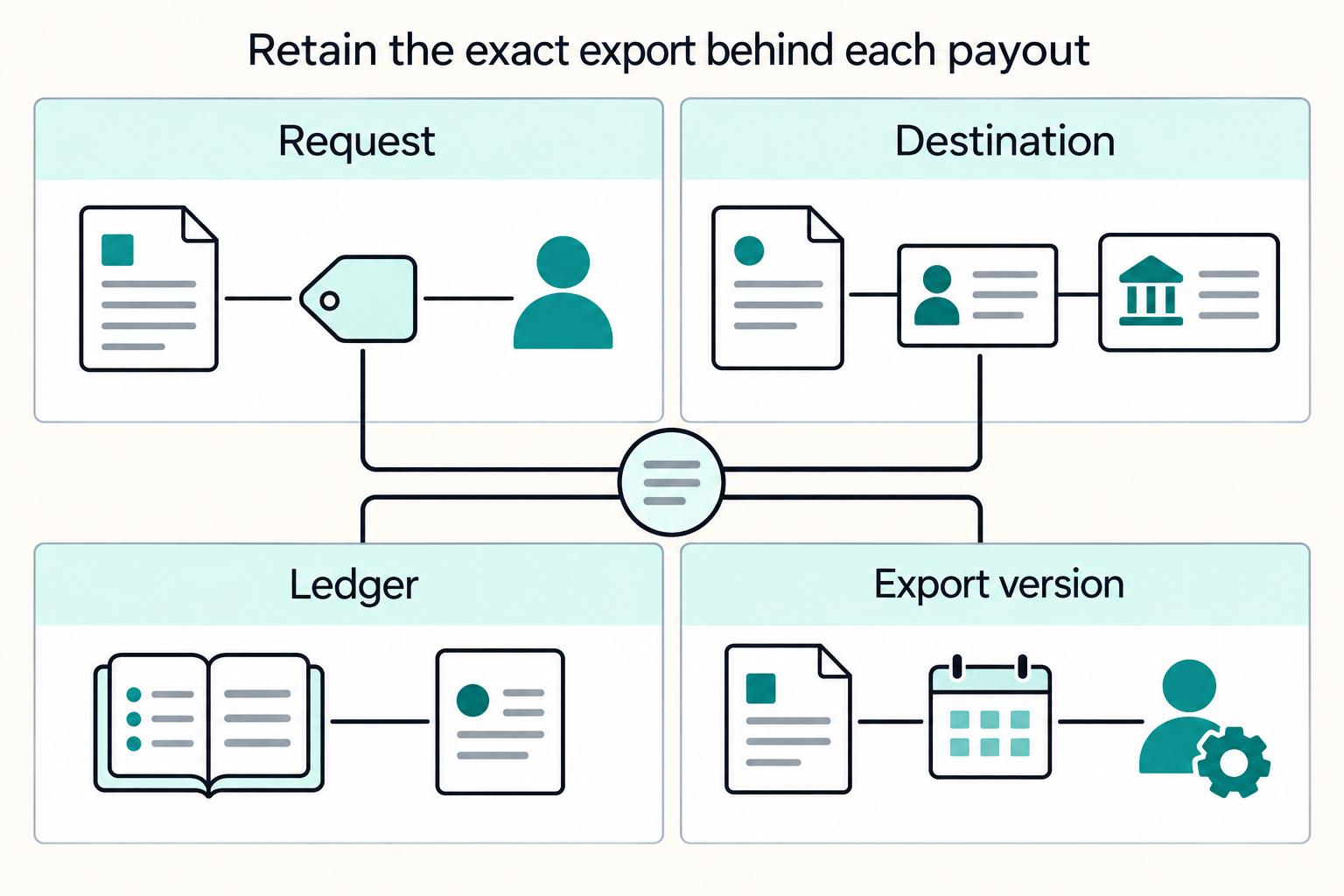
Step 3: Keep one trace from request to close. Tie each payout event across request, provider status, internal ledger posting, and period-close export so finance and compliance can review one coherent record. Store stable references that connect those systems, and require that link set before reconciliation is closed.
We covered this in detail in How Platform Operators Pay Creators Globally Across YouTube, Twitch, and Substack.
Do not scale payout volume until exceptions are routine to resolve and reconciliation is easy to prove from records, not chat threads or spreadsheets.
Step 1. Classify failures before scale. Use clear exception buckets so every failed or ambiguous payout has one owner, one next action, and one evidence requirement: rejected beneficiary details, delayed provider callbacks, unmatched credits, and tax-data mismatches. The taxonomy does not need to be perfect, but each case should be traceable from the payout record alone.
Step 2. Separate retry paths from compliance holds. Treat retryable operational issues differently from record-quality or tax-data conflicts. If beneficiary details are wrong, hold for correction and review before resubmission; if callback timing is the problem, resolve status on the existing idempotent request instead of sending a duplicate payout. Escalate mismatches between payout records and tax records to compliance owners before funds move.
Step 3. Require daily and period-close reconciliation packs. Reconciliation is comparing internal records against external statements to verify accuracy. Your daily pack should tie internal ledger entries to provider references, payout status, contractor IDs, and open exceptions; your period-close pack should connect that same population to tax-support evidence used for internal review and submission workflows.
Step 4. Keep a hard release gate. No scale-up until exception queues and evidence exports pass review consistently across close cycles. The gate should confirm that exceptions age in visible states, reconciliation breaks are investigated promptly, and finance/compliance can trace a payout end to end without manual reconstruction.
Need the full breakdown? Read How to Write a Payments and Compliance Policy for Your Gig Platform.
The launch risk is usually not one big failure, but unowned assumptions. In Ghana, treat public links, rail labels, and provider terms as inputs to validate, not as operating controls.
Step 1. Turn every external reference into an owned control. A link is not a control. For each item your team relies on, record the owner, the event that makes it due, and the proof that confirms completion. If evidence lives in chat instead of the record, you are carrying launch risk.
Step 2. Keep payment operations and role mapping explicit. Do not let manual interpretation fill in gaps during incidents. Define who decides next actions, what gets logged, and how status is communicated when payout outcomes are unclear. This prevents duplicate narratives and inconsistent handling under pressure.
Step 3. Separate provider role language from regulatory decisions. Provider terms can clarify commercial and data-processing roles, but they are not regulator guidance. If a provider describes itself as serving merchants and processing data on their behalf, use that for role mapping only, then validate regulatory obligations through your own compliance process.
Step 4. Treat information gaps as launch blockers, not assumptions. SIIPS 2023 and SIIPS 2025 both note that Ghana data helped close information gaps. Use that as an operating rule: keep a live gap log, assign owners, and require verification before go-live for any unresolved item.
If any item below is still unowned, undocumented, or untested, call it no-go. This checklist is not legal proof from public materials alone; it is an operations readiness check for making, defending, and recovering payout decisions without guesswork.
| Launch gate | What to confirm | Go check |
|---|---|---|
| Owners | One directly responsible owner for GRA, SSNIT review or dependency checks, rail operations, reconciliation, and incident response | Run one ambiguous contractor case and one failed payout case through the chain |
| Tax-readiness evidence | TIN evidence, Tax Registration status, Taxpayer Portal access or dependency mapping, and evidence-retention location are attached or linked in the operating record | Finance or compliance can retrieve the tax identity pack and prior payout trace without searching inboxes or chat |
| Rail strategy and fallback | Choose GIP-first, MMI-first, or dual, and document what your team does when status is delayed, confirmation is unclear, or beneficiary details are rejected | Fallback behavior is predefined and used consistently |
| Classification escalation | Define who owns contractor classification policy and where ambiguous cases escalate, separate from payout execution | For one edge case, you can show reviewer, required evidence, hold status, and approval-note format |
| Hard launch gate | No expansion until test payouts, exception handling, reconciliation close, and compliance review pass end to end with documented evidence | One-page decision record with named owners, reachable evidence, fixed rail strategy, defined escalation path, and attached test results |
1. Confirm owners before discussing volume. Assign one directly responsible owner for each area: GRA, SSNIT review or dependency checks, rail operations, reconciliation, and incident response. Use a person's name, backup owner, and response channel.
Go check: run one ambiguous contractor case and one failed payout case through the chain. If your team cannot state who decides, who documents, and who approves next action, stop.
2. Confirm tax-readiness evidence is reachable, not just collected. From a sample contractor record, verify that TIN evidence, Tax Registration status, Taxpayer Portal access or dependency mapping, and evidence-retention location are attached or linked in the operating record.
Go check: finance or compliance can retrieve the tax identity pack and prior payout trace without searching inboxes or chat.
3. Confirm rail strategy and fallback behavior are written down. Choose your launch posture: GIP-first, MMI-first, or dual. Document what your team does when status is delayed, confirmation is unclear, or beneficiary details are rejected.
Go check: fallback behavior is predefined and used consistently. Avoid ad hoc rerouting while the original attempt is still ambiguous.
4. Confirm contractor classification escalation is separate from payout execution. Define who owns contractor classification policy and where ambiguous cases escalate. Keep that path separate so payout operators are not making legal or tax judgment calls during incidents.
Go check: for one edge case, you can show reviewer, required evidence, hold status, and approval-note format.
5. Confirm a hard launch gate before expansion. No expansion until test payouts, exception handling, reconciliation close, and compliance review pass end to end with documented evidence.
Final go check: one-page decision record with named owners, reachable evidence, fixed rail strategy, defined escalation path, and attached test results.
Related reading: Pay Contractors in Mexico With SPEI for Platform Operators. For a quick next step on "pay contractors ghana ghipss momo gra compliance platform," Browse Gruv tools. To confirm what's supported for your specific country or program, Talk to Gruv.
At a high level, the two paths to evaluate are GhIPSS and mobile money routes through a MoMo Operator. GhIPSS is Ghana Interbank Payment and Settlement Systems, while MoMo refers to Mobile Money Operators. For launch planning, treat them as distinct payout paths until your provider confirms endpoint behavior in production.
This grounding pack does not establish detailed, product-level differences between these flows for operators. Treat routing, beneficiary data, return handling, and support playbooks as implementation details to validate directly with your provider before rollout.
This grounding pack does not provide a definitive GRA pre-launch checklist. Start by assigning clear ownership for identity/KYC and tax-related documentation, then confirm exact requirements with local tax and legal owners before first live payout.
Do not assume that. Contractor payouts and Pay As You Earn payroll should stay on separate decision paths unless local tax and legal owners confirm where they overlap for your case.
Treat it as an escalation risk, not a settled rule. Keep a visible exception queue for identity mismatches, classification uncertainty, and missing records, and route those cases to designated owners. If SSNIT or GRA records conflict with a contractor file, pause the payout decision long enough to document the reason, reviewer, and supporting evidence.
This grounding pack does not provide Ghana-specific failure-rate evidence. Use predefined outcomes such as auto-retry, manual review, or compliance hold, and avoid ad hoc rerouting when status is ambiguous. Reconcile the original attempt first to reduce duplicate-payment risk.
Keep a consistent evidence pack for each payout: identity/KYC evidence, payout trace logs, reconciliation status, and approval or exception records. For rail incidents, include the provider response and your internal decision record on whether the payment was retried, rerouted, or canceled.
A former tech COO turned 'Business-of-One' consultant, Marcus is obsessed with efficiency. He writes about optimizing workflows, leveraging technology, and building resilient systems for solo entrepreneurs.
Includes 5 external sources outside the trusted-domain allowlist.
Educational content only. Not legal, tax, or financial advice.

Treat Peru as a posture decision, not just a rail decision. If you choose a local wallet-style method first, then sort out contractor status, tax data, and evidence later, you may get a smoother payout experience. You also raise launch risk in areas that are much harder to fix once money starts moving.

---

Kenya is worth serious consideration for contractor payouts, but you should not greenlight a launch just because M-Pesa is familiar and PesaLink is on the shortlist. The real decision is practical. Confirm which rail fits your contractor base, put local compliance and tax controls in place before money moves, and keep enough evidence to explain each payout later.