
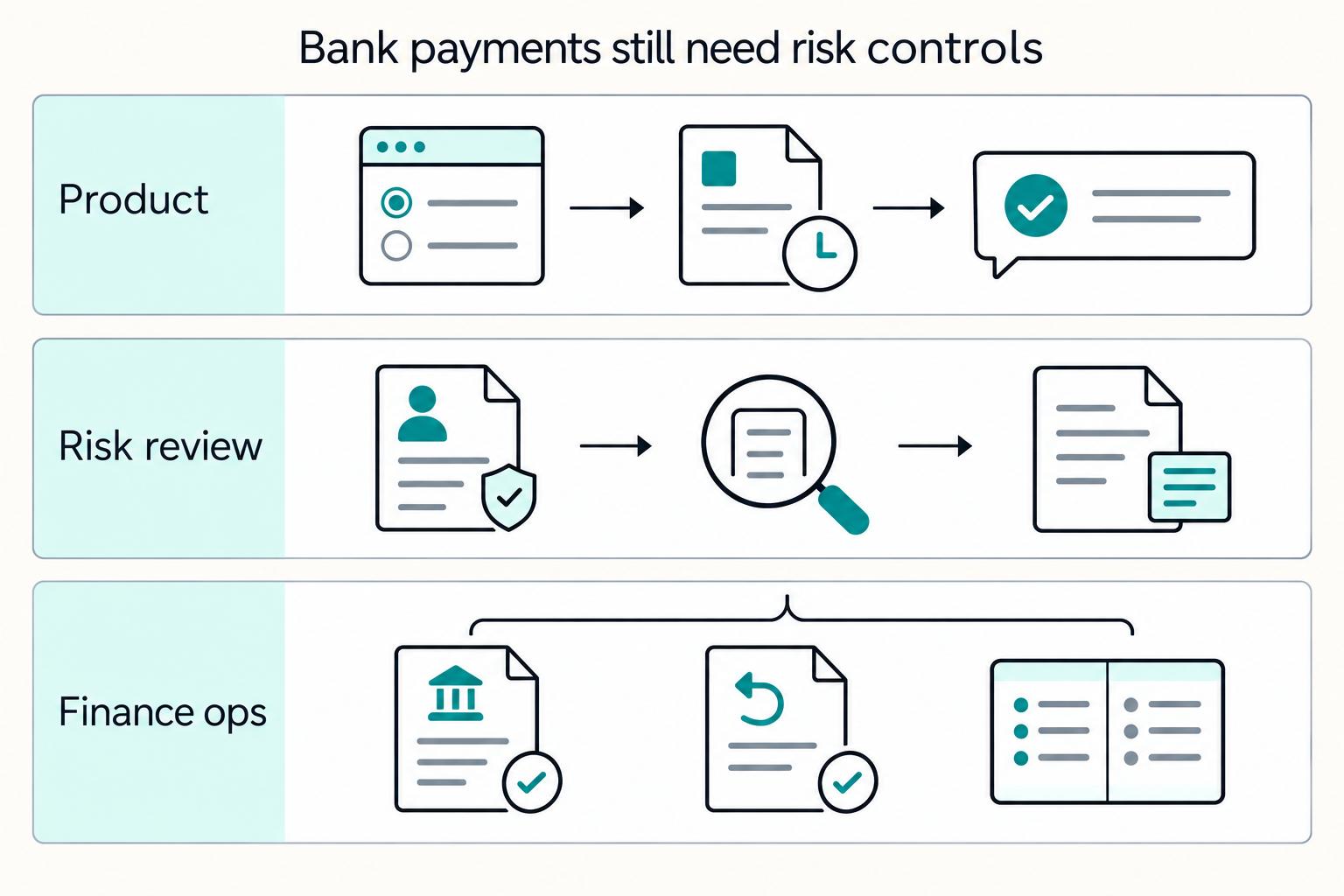
Quick Answer
Pilot Pay by Bank on repeat, higher-value flows first, and keep card checkout where one-click conversion still drives growth. Decide with your own cohort exports: effective cost per successful payment, settlement behavior by rail, and exception volume from retries, refunds, and unmatched records. Require a trace from initiation ID to ledger match before expansion, and delay fallback removal until approvals and finance close-cycle reporting remain stable.
Open Banking and Account-to-Account (A2A) payments can lower payment costs and change dispute exposure#
Open Banking and Account-to-Account (A2A) payments can lower payment costs and change dispute exposure. That only happens if you choose the right rail for each flow and run it with the right controls.
At the rail level, A2A moves money directly between bank accounts without a card-network intermediary. In practice, open-banking-enabled A2A flows still include explicit authentication and authorization stages.
There is credible evidence of cost upside, but not a universal outcome. An Open Banking UK case study presents open banking A2A as a way to remove card-processing costs through direct processing. It reports that Wonderful moved donations exclusively to open banking in 2021 and has processed around £8 million. Treat that as evidence the model can work in practice, not proof your platform will see the same result.
Execution detail is where this decision succeeds or fails. A2A is not one rail. ACH is commonly described as the digitized evolution of checks and can be low cost with settlement in hours or days. RTP can be instant but is typically priced higher than ACH. Before you scale, your team should be able to name the exact rail for each use case, the exact customer approval step, and the exact path from payment event to reconciliation.
This is also where cards can still win. If one-click card conversion is driving growth, cards may stay primary while you phase in A2A where it fits your flows. A2A is already familiar to many consumers through Venmo, Cash App, or Zelle, but you still need evidence on your own traffic and operations.
The goal of this article is simple: help you decide where direct bank payments are worth the operational change, what proof to require before launch, and which controls prevent expensive rework. Need the full breakdown? Read How Platform Operators Accept Payments Through QuickBooks.
Build the mental model before choosing a vendor#
Choose a vendor only after your team can describe one payment attempt end to end in the same operational language. If that explanation breaks across product, engineering, and finance, pause the deal.
Treat terms like Open Banking, Pay by Bank, and A2A as labels, not proof. What matters is whether the provider can show exactly what the user sees, what your systems receive, and what finance can match to settled cash.
Map the path you are actually buying#
Before you compare contracts, have each provider walk a single payment attempt from initiation through final reconciliation output. Ask for the exact event sequence, reference IDs, status changes, and a sample reconciliation export.
Use a simple checkpoint. Can your team point to the ID created at initiation, the status updates that show progress, and the record finance will use to match cash? If not, you are still evaluating messaging, not operations.
Separate availability from adoption#
Availability is not adoption. SEPA Instant has been available between participating banks since 2017, yet one cited source says only 11% of euro transfers are instant.
That matters when you evaluate rollout risk. Another cited source also describes legacy rails such as cards and wires as often slow, expensive, geographically limited, and manual in places, with cross-border transfers that can take days. Ask one hard question early: when the preferred path fails, what does the customer see next, and what lands in your reconciliation queue?
If you want a deeper dive, read this Open Banking for Platforms guide.
See where A2A actually saves money and where it does not#
A2A can reduce payment cost in some cases, but it is not a blanket replacement for cards. Test it first where order values and repeat usage are strong. Keep cards primary where one-click conversion is still the growth engine.
Compare total economics, not just one fee line#
| Payment path | Example published Stripe price | Cost components to model | Typical fit | Common cost risk |
|---|---|---|---|---|
| Card schemes (domestic) | 2.9% + 30¢ per successful transaction | Processor pricing plus card-network and provider fees | First purchase and one-click checkout flows | +1.5% international card fee and +1% currency conversion fee can materially change cost |
| Instant Bank Payments | 2.6% + 30¢ per successful transaction | Bank-payment processing and provider pricing structure | Repeat payer flows | Provider/country pricing differences and fee changes can narrow expected gains |
| ACH Direct Debit | 0.8% with a $5.00 cap | Rail fee structure plus exception handling and settlement workflow | Higher-value or recurring collections | Operational handling costs can reduce the headline fee advantage |
Published pricing is only a starting point. Stripe states costs can change, advises teams to double-check each provider's fee schedule, and offers custom pricing for high-volume or unusual models.
Also check fee layers above the rail. For example, Stripe Managed Payments charges 3.5% per successful transaction in addition to standard Stripe processing fees, which can materially change the business case.
Separate controllable vs non-controllable costs#
Some costs come from execution choices. Routing logic, retry policy, fallback timing, and where you present Pay by Bank in the flow are controllable.
| Cost factor | Control type |
|---|---|
| Routing logic | Controllable |
| Retry policy | Controllable |
| Fallback timing | Controllable |
| Pay by Bank placement in the flow | Controllable |
| Provider pricing model | Non-controllable |
| Country-specific pricing overrides | Non-controllable |
| Contract shape | Non-controllable |
Other costs are structural. Provider pricing model, country-specific pricing overrides, and contract shape are not things you tune away in product. Platform pricing choices matter too. One Stripe Connect model says platforms do not incur additional account, payout volume, tax reporting, or per-payout fees, while another includes $2 per monthly active account and 0.25% + 25¢ per payout sent.
Use this decision rule#
If average order size and repeat usage are high, test Pay by Bank first. If one-click card conversion is the main growth lever, keep cards primary and phase A2A into repeat or invoice-like flows.
Validate with a pilot before rollout#
Do not assume a universal provider ranking. Economics can vary by provider and country, so finance should validate on a pilot cohort before you scale.
Measure effective cost per successful payment and per settled dollar using real exports: successful fees, failed attempts, retries, payout costs, and reconciliation exceptions. Treat that as the minimum evidence needed for a reliable rollout decision.
You might also find this useful: State of Platform Payments: Benchmark Report for B2B Marketplace Operators.
Before you lock in routing rules, run your own order-size and frequency assumptions in this payment fee comparison tool.
Treat chargebacks as changed risk, not zero risk#
Pay by Bank can reduce classic card chargeback exposure, but it does not create a zero-risk lane. In many A2A flows, reversals are handled as refunds rather than card-style chargebacks, while risk still shows up through errors, fraud attempts, misdirected payments, and operational exceptions.
That distinction matters when funds move directly bank to bank through Open Banking APIs. The dispute and exception surface changes, so your controls and operating model need to change with it. Execution risk also varies by region, since real-time bank support and integration rules are not uniform.
Authentication improves confirmation, not risk by itself#
Strong Customer Authentication (SCA) improves payer confirmation because approval typically happens in the customer's own banking app. Biometric authentication can add another confirmation layer.
Even with stronger authentication, faster transfer rails can raise error and fraud-attempt risk. On rails that can move funds in up to 10 seconds, 24/7/365, mistakes are harder to unwind after initiation. Use pre-payment controls before money moves, especially Verification of Payee (VoP) and, where available, IBAN-name plausibility checks.
Assign ownership before Pay by Bank scales#
Do not leave risk ownership implied. Set clear owners across product, risk, and finance so decisions stay consistent as volume grows.
| Team | Assign this decision | Minimum checkpoint |
|---|---|---|
| Product | Placement of Pay by Bank, fallback behavior, and refund/dispute UX | Track drop-off at auth, timeout, and payee-check steps separately |
| Risk/Fraud | When stronger checks are required and whether VoP/IBAN checks are mandatory | Failed or missing payee verification triggers block or review |
| Finance Ops | Refund, exception, and reconciliation workflows post-initiation | Daily reporting splits initiated, settled, refunded, and unmatched payments |
Capture authentication outcomes and payee-check results in an exportable payment record. If your data only shows "payment succeeded," it becomes much harder to resolve customer claims and diagnose exceptions later.
Treat "fewer chargebacks" as one outcome, not the whole decision. The real test is whether your controls are strong enough for the new risk shape.
Related reading: How Platform Operators Triage Late B2B Payments Before Market Entry.
Match use case to rail before promising speed#
Do not promise one speed for all Pay by Bank flows. A2A payments can run on different rails, and ACH and real-time paths can produce different payout timing and operational outcomes.
ACH and real-time rails behave differently where it matters#
Use this operator-level rule. ACH is generally the slower, asynchronous path, while real-time rails are designed for 24/7 seconds-level receipt when the rail, bank, and provider setup are eligible.
| Rail path | Settlement expectation | Reversal/exception reality | Messaging risk |
|---|---|---|---|
| ACH | Slower, asynchronous progression from initiation to settled availability | Exceptions can still require follow-up handling | "Instant" language creates avoidable payout misses |
| RTP / other real-time rails | Funds can arrive in seconds, including outside business hours, when eligible | Operational incidents still require defined response procedures | Overpromising universal instant delivery when eligibility is limited |
Why rail and infrastructure realities change your product copy#
Rail and infrastructure choices affect what customers actually experience. Availability and user experience for instant A2A vary by country and banking infrastructure, so your copy should describe the routed outcome, not a blanket method claim.
Use language like the examples below, and avoid blanket "instant bank payout" claims across mixed-rail flows.
- "Bank payout in seconds for eligible banks."
- "Bank transfer may take longer when instant routing is unavailable."
Use a routing rule, not a marketing slogan#
If contractor payout timing is strict, route eligible cases to faster rails and keep explicit fallback messaging for ACH delays. If timing is flexible, ACH may still fit where coverage or economics make instant routing inconsistent.
Before launch, require finance sign-off on settlement assumptions in public copy based on pilot results, reconciliation output, and exception logs. Include an incident playbook for abnormal rail states, including who pauses timing claims, who updates customer messaging, and what evidence is captured.
Related reading: Making Tax Digital for Income Tax and UK Platform Operators: Confirmed Rules and Open Scope Questions.
Pick the first surface where A2A will win fastest#
Start where A2A removes operational friction immediately, not just card cost. Good first candidates are flows where finance still relies on manual uploads or chasing unmatched records. A strong early surface is one where reconciliation pain is high and outcomes can be measured clearly.
Instrument the pilot end to end through API events, not just a provider dashboard. Capture bank-link start and completion, customer approval, payment initiation, provider reference ID, settlement updates, exceptions or returns, and ledger match status. Your checkpoint is simple: one customer action should be traceable to the finance entry without manual stitching.
Choose cohorts deliberately. Open-banking conditions vary by market, and early rollout drag often comes from awareness gaps, security concerns, or passive institutional support. Monitor bank-link and approval abandonment by market before expanding.
Keep a card fallback in early cohorts. Direct bank-account payments do not follow the same protection model as card networks, so treat fallback removal as a staged decision. Remove card fallback only after production performance is stable for approvals, settlement matching, and exception handling through at least one finance close cycle.
Related: IRS Form 1042-S for Platform Operators: How to Report and Withhold on Foreign Contractor Payments.
Choose integration depth with a provider scorecard#
Integration depth is often the real choice here, not brand recognition. If your team cannot staff ongoing rail operations, choose the simpler integration depth now and defer orchestration complexity.
Run selection as a scorecard: define criteria, owners, and success metrics up front, then evaluate providers against your operating requirements. Use this as diligence, not a market ranking.
| Provider | Bank coverage | Auth UX | Implementation effort | Reporting depth |
|---|---|---|---|---|
| Stripe | Verify with your target banks and markets. | Validate on your real user flow and abandonment points. | Confirm scope across payment initiation, notifications, and reporting. | Require reconciliation outputs tied to reference IDs and settlement states. |
| Dwolla | Collaborations with Plaid and MX are referenced; confirm ranked coverage with the provider. | Test approval flow quality on your target use case. | Confirm build split across your team, Dwolla, and connected partners. | Verify exports and API fields needed for automated reporting and exception handling. |
| Plaid | Mentioned in source context; no provided ranking for coverage. | Prove fit through your own IAV and approval funnel testing. | Confirm whether role is connectivity only or part of a broader stack. | Check whether outputs support finance reconciliation, not only connection status. |
| MX | Mentioned in source context; no provided ranking for coverage. | Test bank-link and approval behavior on your actual bank mix. | Confirm integration boundaries with payment provider and internal systems. | Validate event detail and exception visibility before rollout. |
| Token.io | Confirm supported coverage ranking with the provider before committing. | Verify approval completion and abandonment on your traffic profile. | Confirm exact implementation and operational ownership. | Require evidence of payout or settlement traceability in exports and API responses. |
Single-vendor vs multi-provider architecture#
Choose single-vendor or multi-provider architecture based on concrete operational requirements. Use these criteria to decide:
| Criterion | What to decide |
|---|---|
| Failover options | Define what actually fails over - bank linking, payment initiation, or data access - and how the customer experience changes. |
| Reconciliation exports | Prioritize the setup that gives cleaner, finance-ready outputs for daily matching and exception review. |
| API operational clarity | Prefer the design where one customer action stays traceable across account connection, approval, initiation, settlement updates, and finance match status. |
Set a proof gate before contract signature#
Do not sign on sandbox demos alone. Pilot with real data and edge cases on your own traffic profile. Require evidence for:
| Proof area | What to verify |
|---|---|
| IAV success on your bank mix | Confirm where users drop, whether at search, credentials, approval, or post-link issues, not just completion count. |
| Webhook reliability in your environment | Test duplicate deliveries, ordering issues, delays, and replay handling. |
| Payout and settlement traceability | Verify provider reference IDs map cleanly to internal ledger entries and reconciliation outputs. |
Consumer familiarity with bank transfers can help, but it may not guarantee purchase-flow adoption, so validate adoption and operations on your own users before expanding.
This pairs well with our guide on How Marketplace Operators Choose a Platform Payments Architecture That Lasts.
Ship in sequence to avoid expensive rework#
Once you choose your provider setup, do not scale all at once. Roll out in phases: prove customer checkpoints first, then expand payment initiation and downstream operations.
Start with customer checkpoints you can actually observe#
Treat the front of the flow as checkpoints, not one blended conversion number. Track whether the user selects a bank-pay option at checkout and approves payment in their banking environment with Strong Customer Authentication.
Keep one traceable internal reference for each user action from bank-pay selection to auth outcome to initiation. If you cannot tell where users dropped, pause expansion until you can. Keep settlement messaging precise too. Speed depends on the rail and whether an instant scheme is actually in use.
Make event handling boring before you add volume#
Boring operations are the goal. Before you add volume, make sure your team can distinguish checkout choice, in-bank authorization, and funds arrival, since those checkpoints do not always complete at the same time.
A practical check is simple: during incident review, you can show whether the customer selected bank pay, authorized payment in their banking environment, and when funds were expected to arrive based on the rail in use.
Require finance artifacts before expansion#
Do not widen traffic until finance has what it needs. Set launch gates for clear visibility into settlement status and dispute or return handling.
The risk model changes with A2A push payments. Disputes do not disappear; they shift toward refunds and support handling rather than scheme-driven chargebacks. Finance should be able to answer what settled and which cases need follow-up without engineering digging through raw logs.
Phase launch by cohort and use case#
Roll out by cohort and use case, not by broad user-base percentage. That makes rail-specific failure patterns easier to isolate.
Start with a payment surface that already fits bank-pay behavior, keep fallback coverage while you learn, and expand only when customer checkpoints, settlement behavior, and support handling stay stable together.
Build the evidence pack finance and audit teams will ask for#
Treat your evidence pack as incomplete if finance cannot trace a payment from user intent to settlement and ledger impact without ad hoc engineering log pulls.
Prove one payment end to end#
For new payment rails, keep one connected transaction story, not just a settled amount. Keep stable identifiers and linked event records so finance can follow each step and match it to the final accounting entry.
A practical check is simple: pick a settled payment and trace it both ways, from user intent to settlement and back to ledger posting. If that trace breaks, your controls are still trust-based rather than evidence-based.
Keep policy context attached to each transaction#
Money movement records are not enough on their own. You also need to show why the payment was allowed and which control path applied at the time.
AP2 frames this as authorization, authenticity, and accountability. Use that lens in your own records so reviews can answer not just "did it go through," but "who approved what, under which policy path, and who owns exceptions."
Run recurring control reviews with explicit exceptions and owners#
Run recurring reviews by payment path, with clear exception categories, a current owner, and resolution status. Keep the outputs auditable so support, finance, and engineering are working from the same transaction truth. If teams describe the same payment in conflicting ways, your evidence chain is incomplete. Pause expansion until those views reconcile cleanly.
For a step-by-step walkthrough, see Platform-to-Platform Payments: How to Build B2B Settlement Between Two Marketplace Operators.
Plan for failure modes before they hit production#
You are not production-ready until each common break has a customer message, retry rule, manual-review trigger, and a named owner. In Open Banking and A2A flows, incidents can come from operational gaps, not just edge-case scenarios.
Map the breakpoints before volume arrives#
Before volume arrives, define response rules up front for the five failure modes you expect to manage:
| Failure mode | Customer message | Retry policy | Manual review trigger | Owner |
|---|---|---|---|---|
| Bank-link drop-off | "Your bank connection was not completed. You can try again or pay by card." | Allow one clean restart of bank-link flow; avoid repeated silent retries | Repeated drop-off in the same bank or cohort over a short period | Product + engineering |
| Auth timeout | "We could not confirm the payment in your banking app yet." | Allow one re-initiation after status check | Any ambiguous state between initiated and confirmed | Engineering + payments ops |
| Duplicate webhook delivery | Often no visible customer impact when controls work | No customer retry; process events idempotently | Any case where one payment intent could trigger multiple ledger or payout actions | Engineering |
| Delayed settlement | "Your payment is processing. Payout is released after funds settle." | Do not retry settlement blindly; check rail status first | Settlement timing outside the expected window for that rail | Finance ops |
| Payout release mismatch | "We're reviewing your payout timing for this transaction." | No automated retry; hold release until payment and ledger state match | Any case where payout queues before settled funds are verified | Finance + ops |
In pay-by-bank flows, treat two checkpoints as mandatory in your logs: the customer selecting bank pay at checkout, and confirmation in the banking app. Without both events tied to a stable transaction reference, it is harder to separate true auth timeouts from abandonment.
Set the rollback line before you need it#
Set the rollback checkpoint before launch. If approval or settlement performance degrades from your baseline, consider routing affected cohorts to Card Schemes while you isolate the cause.
Make that checkpoint rail-specific. ACH funds availability is typically 1-5 business days after initiation, so delayed settlement can break payout expectations if you promise faster release. Same Day ACH can reduce timing risk to same business day for eligible flows. Other account-to-account rails can be much faster in some markets, including up to 10 seconds (24/7/365), so one generic rollback rule is usually too coarse.
Ask for evidence, not stories#
After each incident, require a short review pack tied to records. If a review cannot show the event trace and reconciliation outcome, treat root cause as unresolved.
- API event timeline with provider references, internal payment IDs, and webhook delivery history
- Reconciliation result showing whether funds, ledger posting, and payout state matched
- Customer impact by cohort and the decision taken, whether retry, hold, refund, or fallback to cards
Handle country and program variance without overpromising#
A successful pilot in one market is not, on its own, evidence that the same Open Banking or Pay by Bank experience will hold everywhere. The ECB report explicitly notes diverging stakeholder views, so treat country, bank, and program coverage as variables to verify, not assumptions to reuse.
Keep external promises narrower than internal ambition. Even when Account-to-Account (A2A) Payments are part of your plan, implementation details may differ by market and program. If your copy implies one uniform experience, support and rollback risk can rise when local conditions differ.
Separate the universal from the local#
Keep universal operating principles explicit, then qualify everything market-specific. In practice, avoid turning one region's pattern into a global bank-payment claim, and avoid treating one flow as a cross-market default.
A practical review rule: if a sentence makes a broad statement about availability, timing, or customer steps, add a market or program qualifier or narrow the claim.
Use explicit qualification in copy#
Use plain language such as the examples below:
- "Pay by Bank is available where supported."
- "Features appear when enabled for your market or program."
- "Confirm bank coverage by market and program before launch."
Apply that wording in public docs, onboarding, launch notes, and sales enablement. For any conversion-critical claim, keep a matching evidence record for the exact market or program scope.
As a governance checkpoint, note the ECB digital euro stakeholder work that began in the third quarter of 2024 did not reach full consensus. The report says there was disagreement between stakeholder groups, not all comments were included in the main text, and annexed original feedback provides more context. Before publishing broad regional claims, review the annexed original feedback. If support is limited to one country or program, say that directly.
Quick decision tables#
| Use case | Why A2A can win | Where cards may still stay easier |
|---|---|---|
| Invoice-funded payouts | Lower acceptance cost matters when settlement can wait for account-based confirmation. | Cards remain simpler when instant customer familiarity matters more than fee savings. |
| High-volume low-margin flows | A2A helps when card fees wipe out the economics of small transactions. | Cards may still offer broader fallback coverage across markets and customer types. |
| Known counterparties | Bank-account-based setup is easier to sustain when users are already verified. | Cards may still win for one-off users with no bank-linking patience. |
| Control | Implement before launch | Why it matters |
|---|---|---|
| Bank-account verification | Choose whether microdeposits, open-banking confirmation, or instant match is the default. | It prevents failed payouts from being misread as normal cost savings. |
| Refund and reversal handling | Define what happens if the payment succeeds but the downstream payout must be reversed. | A2A economics look cleaner only when exception handling is explicit. |
| Fallback routing | Keep a card or alternative rail for users who cannot complete the A2A path. | The cheapest rail still fails if your conversion rate collapses. |
| Metric | Good launch signal | Escalate when |
|---|---|---|
| Authorization or link-success rate | The majority of targeted users complete the bank-linking flow without manual help. | Support volume spikes during onboarding or verification. |
| Fee per successful transaction | A2A stays meaningfully below the comparable card flow after all fallback costs. | Savings disappear once retries and support work are included. |
| Settlement clarity | Operations can reconcile the account-based flow without adding manual suspense buckets. | Bank-response timing or matching makes close-out slower than the card baseline. |
Primary source checkpoints#
When you compare A2A with cards, keep a live reference set open: the ECB payments strategy update, Plaid's A2A payments guide, and an Open Banking UK platform case study.
Conclusion#
The winning decision is not "A2A or cards." It is deciding where Open Banking and Pay by Bank create a clear unit-economics advantage on specific payment surfaces. Keep cards where coverage, customer experience, or dispute handling are stronger.
The upside is real, but not automatic. A2A can bypass card-network service and interchange fee layers and is often presented as lower-fee with faster settlement than cards. In practice, outcomes vary by market infrastructure and country-level adoption.
Start narrow and prove rail behavior with real operator evidence before scaling. Run a pilot cohort small enough to inspect failures closely, then expand only when controls and outcomes are stable.
Before widening volume, confirm two checkpoints:
- Bank-side payer verification is reliably captured through strong user credentials, for example 2FA, biometrics, or established payment credentials.
- You can identify which rail executed each payment, whether real-time network, ACH, or direct bank connection, so settlement timing and exceptions are explainable.
Keep the commercial case disciplined. Examples like 2.5% card fees on £500,000 annual volume or A2A pricing as low as £0.50 per payment are illustrative, not guarantees. The decision should come from your pilot's effective cost after operational overhead and exceptions.
Treat disputes as a tradeoff, not a universal wipeout. Claims on chargeback outcomes are not fully consistent across providers, so risk should be validated on your own traffic and use case.
Scale A2A when your pilot shows three things on live traffic: lower effective cost, stable settlement, and traceable operations. When you are ready to validate rollout constraints and coverage by market/program, talk to Gruv.
Frequently Asked Questions
How do Account-to-Account (A2A) Payments reduce card fees for platform operators?
A2A payments can reduce card-fee exposure by moving funds directly between bank accounts instead of through card-network intermediaries. One cited example shows a 2.5% card fee, or £12,500 on £500,000 in annual volume, while some A2A examples use fixed pricing such as £0.50 per payment. Treat those figures as illustrative, not universal pricing for every platform or market.
Do A2A payments eliminate chargebacks or just change dispute risk?
Treat this as a risk shift, not a universal risk wipeout. One source says chargeback risk can be eliminated, but that is a source-specific claim and should not be generalized across all rails, countries, or providers. A2A flows can also use controls like two-factor or biometric checks.
What is required to launch Pay by Bank without breaking reconciliation?
Start with a flow you can trace end to end: payer authorization first, then downstream verification and rail processing. Before scaling, confirm your team can reliably connect authorization outcomes to processing and settlement records in your own systems. Test failure scenarios in pilot traffic so exceptions are visible before volume grows.
When should a platform keep Card Schemes alongside Open Banking payments?
Keep cards alongside bank payments when coverage or performance is uneven in your target market or program. Adoption and outcomes vary by country and banking infrastructure, and provider coverage is region-specific. Remove card fallback only after bank-pay approval, settlement visibility, and operational handling are stable in the exact markets you are scaling.
What are the biggest A2A failure points and how do teams mitigate them?
Failure points often show up around payer authorization and in execution environments with legacy systems or fragmented policy coordination. Those constraints can make rollout and operations harder even when the core flow is sound. Mitigate by validating each handoff in the flow and keeping fallback options where bank-pay performance is inconsistent.
How should product, engineering, and finance split ownership for A2A operations?
There is no universal ownership model, so define one explicitly before scaling volume. At minimum, assign clear accountability for authorization, downstream processing reliability, and settlement/exception handling in your own operating model.
Try a related tool
Researched and edited by the Gruv editorial team. Gruv builds cross-border billing, payouts, and finance-operations software for global businesses.
Sources
Includes 1 external source outside the trusted-domain allowlist.
- ecb.europa.eu/pub/pdf/other/ecb.eurosystemcomprehensivepay...trusted
- ecb.europa.eu/paym/target/consolidation/profuse/shared/pdf...trusted
- law.stanford.edu/wp-content/uploads/2017/08/milanesi_wp29.pdftrusted
- occ.gov/static/ots/ceo-memos/ots-ceo-memo-340.pdftrusted
- portal.ct.gov/-/media/DCP/Legal/AGL-Medical-Marijuana-RFA-...trusted
- sec.gov/Archives/edgar/data/1783879/0001628279210002...trusted
- stripe.com/pricingtrusted
- airwallex.com/uk/blog/a2a-payments-explained-what-they-are...external
Educational content only. Not legal, tax, or financial advice.
Related Posts

The Freelance Payment Penalty: A Modeled Audit of Platform Fees, FX Spreads, and Payout Delays
The money rarely disappears through a single, easy-to-spot fee. The real loss is stacked. A marketplace takes its commission, a processor adds a charge for international cards, a bank or payment company converts the currency at a spread, a platform holds the funds before release, and a wire sheds a little to intermediaries on the way in. Each layer looks defensible on its own, but the worker feels the combined result as a smaller deposit and a later payday.

How to Respond to a Subpoena for Business Records
Move fast, but do not produce records on instinct. If you need to **respond to a subpoena for business records**, your immediate job is to control deadlines, preserve records, and make any later production defensible.

A US Expat's Guide to Investing in UCITS ETFs to Avoid PFIC Issues
The real problem is a two-system conflict. U.S. tax treatment can punish the wrong fund choice, while local product-access constraints can block the funds you want to buy in the first place. For **us expat ucits etfs**, the practical question is not "Which product is best?" It is "What can I access, report, and keep doing every year without guessing?" Use this four-part filter before any trade: