
Quick Answer
Platforms can bypass some card fees by routing eligible, repeat-payment lanes through Open Banking account-to-account payments instead of card networks, especially in mature markets like the UK. This works best for repeat B2B invoice pay-ins, known-payer replenishment, and recurring flows with a supported mandate and bank coverage. Keep cards primary where one-click checkout drives conversion, and launch with fallback rails, reconciliation controls, and market-specific coverage checks.
Why A2A Payments Matter for Platforms#
Account-to-account (A2A) payments can reduce card-fee exposure, but only in the right lanes and markets. The real decision is not whether to replace cards. It is which transactions should move off card rails first, and what that change adds in product, support, finance, and control work.
Pay by Bank moves funds directly from a payer bank account to a payee bank account. For merchants and platforms, that can be a cost-efficient alternative to cards. It is not a universal replacement for every checkout or recurring flow.
Fee pressure can be material in card-heavy markets. In the UK, the Payment Systems Regulator reported core card scheme and processing fees rose by at least 25% since 2017, adding at least £170 million per year for businesses, while cards remain the most popular way consumers pay. For platforms with meaningful volume, A2A can be a routing lever, not a blanket switch.
Market maturity varies. Open Banking Limited reports 351 million UK payments in 2025, up 57% year over year, and 16.5 million user connections by December 2025. In the US, the CFPB’s personal financial data rights compliance dates were stayed by a court on October 29, 2025. That data-access rule does not create PSD2-style payment-initiation rights.
Before you start#
This guide is for teams running embedded payments, marketplace workflows, or repeat B2B payment operations that need an execution-ready decision path.
One term to align on early is Payment Initiation Services, or PIS. Under UK Open Banking standards and UK PSRs, a payment initiation service is an online service that initiates a payment order at the user's request with explicit user consent. That consent requirement shapes both your product flow and your operating model. Before launch, use these checkpoints:
- Confirm the lane: identify the transaction types where bank-based behavior is a strong fit.
- Confirm the market: verify local Open Banking maturity and where fallback rails still need to stay in scope.
- Confirm operating controls: make sure reconciliation from provider references to internal transaction records and settlement tracking is reliable.
If those checks are not evidence-based, execution risk rises quickly. The usual result is avoidable payment friction up front and messy financial operations once multiple rails are live.
Decide if A2A is the right move for your platform now#
Use A2A now only where repeat behavior is strong and card-fee pressure is high. If conversion depends on saved cards and one-click remote checkout, keep cards primary and treat A2A as selective routing, not a full replacement.
Cost and behavior do not move together. Cards remain prominent in US remote payments. UK adoption provides a useful benchmark: Open Banking Limited reports 351 million payments in 2025 and 16.5 million user connections by December, which should not be read as a count of unique people.
Step 1. Apply a hard gate to your highest-volume lanes#
Start with one hard gate: does this lane combine high card-fee burden, repeat payer behavior, and low dependence on one-click checkout?
Prioritize repeat B2B invoice pay-ins and known-payer replenishment. Recurring billing can fit only where the provider supports the required recurring mandate, consent limits and banks; a one-off bank approval does not authorize future collections. Preserve cards where saved-card checkout materially supports conversion.
Validate with a defined pilot window using lane-level data. If those three conditions do not show up in the same lane, you probably do not have an A2A-first candidate yet.
Step 2. Compare rails on the attributes that change the decision#
Compare rails before you commit roadmap scope. Lower headline fees are not enough if added friction and support load erase the gain.
| Payment path | Fee pressure | Settlement speed | Dispute profile | Payer friction | Ops complexity |
|---|---|---|---|---|---|
| Open-banking initiation over the selected bank rail | Can be attractive when routing volume off card networks | Varies by bank and provider; validate real pilot performance | Not the same as card chargeback handling; do not assume zero disputes | Can be higher than saved-card checkout; validate in-lane conversion impact | Can be higher early due to fallback and reconciliation across rails |
| Card networks | Often high when interchange and scheme costs are material | Operationally mature for most platforms | Established card dispute structure; in the U.S., Regulation Z billing error notices can be raised within 60 days | Usually lowest friction in remote and one-click contexts | Usually lowest incremental complexity when cards are already default |
| US ACH bank-payment path (within A2A) | Lane-specific; compare ACH pricing directly with card costs | Same Day ACH includes a third window, effective March 19, 2021, with interbank settlement at 6:00 pm ET | Different return and error handling; for consumer EFTs, Regulation E has its own 60-day notice framework | UX varies by implementation; benchmark against card-on-file checkout | Moderate, especially around returns, cutoffs, and asynchronous posting |
Step 3. Calculate net savings after support and integration costs#
Proceed only if the savings from routing eligible volume off cards are still there after you price in support, engineering, and finance-ops work.
Model this lane by lane, not at company average. Compare current card costs with expected A2A costs, then include support load, engineering for connectivity, reconciliation overhead, and fallback volume that still lands on cards or ACH.
Require written estimates with owners: finance for baseline costs, product for expected uptake, and engineering for integration effort. If any input is assumed rather than owned, postpone the decision.
Step 4. Define bypass card fees precisely before you ask for budget#
Define "bypass card fees" narrowly: routing eligible transactions off card networks where the bank-payment option is supported and payer behavior can absorb the extra step. It does not mean removing cards from every flow.
That framing keeps leadership expectations realistic. Open banking A2A can compete with card systems, but adoption barriers still exist, so phased rollout with fallback rails is often the practical path. Use this rule: move first in known, repeat, fee-heavy lanes; keep cards first where checkout speed protects revenue.
For a deeper look at operational tradeoffs, read Open Banking for Platform Operators: How A2A Payments Reduce Card Fees and Chargebacks. If you are weighing a pilot, use the payment fee comparison tool to compare expected savings with implementation effort.
Pick one payment lane before you scale anything#
Once you decide A2A is worth testing, narrow the scope hard. One lane gives you a cleaner read on what is failing and what is still immature.
Launch one lane first so you can isolate problems. If invoice pay-ins, recurring subscriptions, and marketplace settlement all go live together, it gets much harder to separate payer-behavior issues from bank authentication, reconciliation, or fallback design.
Step 1. Choose the cleanest lane, not the loudest one#
Pick a lane with predictable payer behavior and few edge cases, often repeat B2B invoice payments. Recurring flows need an additional gate: confirm that the relevant mandate and bank coverage support the planned repeat collections.
| Lane | Pilot fit | Why |
|---|---|---|
| Invoice pay-ins from repeat business customers | Strong first candidate | Predictable repeat business-customer behavior |
| Recurring payments | Candidate where supported | Recurring mandate, consent limits and bank coverage verified |
| Ad hoc consumer checkout | Later than known B2B or recurring flows | One-off behavior |
Invoice pay-ins from repeat business customers are a strong first candidate. For UK recurring collections, verify the exact Variable Recurring Payments use case and provider coverage. Sweeping transfers between a customer’s own accounts and commercial merchant collections have different coverage; do not infer subscription support from sweeping VRP adoption.
Use a simple verification point before you commit: sample one lane and confirm who pays, how often they pay, whether due dates are known, and how often support intervenes. If those inputs vary widely, the lane is not clean enough for a first pilot.
Step 2. Write the fallback rule before launch#
Write fallback rules before go-live. Offer another supported method after confirmed failure or non-submission. A timeout or missing callback can leave an initiated payment uncertain; check provider status and keep its identity before asking the payer to pay again.
In the U.S., a routine known-payer B2B invoice may tolerate ACH. A time-sensitive remote payment may need card fallback because remote payments are still card-heavy and Pay by Bank is still emerging. Preserve invoice or checkout state so a failed bank step does not force the payer to start over.
Step 3. Sequence by region on real market maturity#
Set region scope explicitly: in many cases, UK first, then Europe, and evaluate the U.S. separately. UK implementation maturity is stronger. The CMA confirmed in September 2024 that the Open Banking Roadmap was completed, and FCA and PSR reporting showed over 11.7 million active users and over 22.1 million monthly open-banking payments in early 2025 reporting.
| Region | Basis | Rollout stance |
|---|---|---|
| UK | Implementation maturity is stronger; CMA confirmed roadmap completion in September 2024; over 11.7 million active users and over 22.1 million monthly open-banking payments were reported in early 2025 reporting | Often first |
| Europe | PSD2 provides the legal foundation for opening payment markets to new entrants | Practical next step |
| U.S. | CFPB personal-financial-data-rights compliance dates stayed October 29, 2025; data access differs from payment initiation | Separate decision path |
PSD2 provides a legal basis for payment initiation in the EU, but bank and provider coverage still need checking. In the US, review available bank-payment contracts separately from the CFPB data-access rule and its stayed compliance dates.
Get prerequisites ready across product, engineering, finance, and compliance#
Do the groundwork before you polish the UI. Early failures on this rail can come from consent gaps, weak webhook handling, unclear reconciliation ownership, or compliance holds that ops cannot see.
Step 1. Define the user journey and fallback states#
Map the exact payer journey for your first market, including failure and fallback branches. In the UK, third-party account access requires explicit user consent, so your flow should clearly show consent capture, redirect, success, and what happens on failed or abandoned authentication.
Write support copy for success, payer cancellation, redirect timeout, unsupported banks and confirmed failure. Keep an uncertain submitted payment separate from a failed authentication attempt; verify status before offering a fresh payment. US coverage needs its own review rather than reliance on the stayed CFPB schedule.
Step 2. Lock the API and webhook contract before UI polish#
Finalize API and event contracts per market before front-end refinement. Required fields vary by country, standard, and institution. Not all banks support all payment types. Lock request schemas, event names, retries, and failure mapping first.
Use each provider’s supported idempotency contract on writes and keep a durable internal business-operation identity. Validate webhook authenticity according to the provider’s scheme before processing, and test batches and incomplete status visibility. Give operations a pending-investigation state.
Step 3. Define reconciliation outputs by rail and assign month-end ownership#
Set reconciliation outputs by underlying rail and provider, such as UK Faster Payments, US ACH and cards. A2A describes a broad bank-to-bank model; ACH is one A2A rail. Separate reporting should reveal each rail’s timing, returns and exceptions without double-counting categories.
Assign a named owner for close before pilot launch. Your readiness check is simple: that owner can trace a sample payment from provider notification to internal cash reporting without engineering log pulls. Keep a visible exception bucket for pending or unmatched items instead of treating silence as completion.
Step 4. Document KYC, KYB, and AML gates and surface them to ops#
Map KYC, KYB, beneficial-owner and AML responsibilities with the regulated provider and compliance owner for the actual jurisdiction and business model. Keep required gates visible in internal operations rather than assume every platform carries the same legal duties.
Give internal operations the review state, permitted reason and responsible owner. Customer-facing text should show an approved next action without exposing restricted investigation details. A compliance hold should not be confused with a failed transfer.
Step 5. Compare vendors at institution level, not brand level#
Run vendor due diligence at institution level, because coverage and behavior vary by bank. Compare rail coverage in your target market, institution-level payment feature support, webhook security, status transparency, and webhook maturity.
For a UK pilot, validate support against the actual banks your customers use and confirm the payment-initiation path fits your regulatory needs. If a provider cannot show institution-by-institution support and failure-state behavior for your lane and region, keep them out of first-launch scope.
Design the money flow and ledger behavior before implementation#
Once the API contract is set, lock your money-state model too. A provider callback, wallet balance, and payout decision should not mean the same thing. They happen at different times, and collapsing them into one state creates reconciliation noise and release risk.
Step 1. Map the path from payer action to payout eligibility#
Model five separate legs, even if your provider UI blends them: payer initiation, provider callback, internal ledger posting, wallet or balance projection, and payout eligibility. This matters because a payment can be initiated, and even marked executed by a provider, before funds are settled into the creditor account.
| State | Meaning |
|---|---|
| Initiated | Payment intent or consent request created |
| Pending | Payer action or provider processing in progress; settlement not confirmed |
| Credited | Receipt and availability confirmed under the provider and account contract; ownership and release conditions satisfied |
| Held | Compliance, investigation, or exception blocks use of funds |
| Returned or Failed | Payment did not complete or was reversed |
Consent approval and payment settlement are distinct. Preserve the selected provider’s intermediate states and documented failure codes rather than collapse an approved consent, accepted API request or completed redirect into paid.
Treat these as your internal labels, not a provider standard.
Define authoritative evidence for each state change#
Define which authenticated provider event, API status or settlement record can advance each state. Feed callback and reconciliation observations through the same replay-safe transition rules so duplicate signals do not create extra postings.
Treat webhooks as signals, not blind posting instructions. Verify webhook authenticity, and design for providers that can send multiple events in one request. Use idempotency controls for safe retries so repeated requests do not execute the same operation twice. Then test the failure paths directly: replay the same valid callback three times and confirm you still have one internal transaction, one ledger journal for that step, and one coherent status history.
Keep this boundary strict: provider "executed" is not the same as settled funds. Releasing payouts on the earlier signal turns status ambiguity into treasury risk.
Step 3. Build a source-of-truth field table and use it everywhere#
Define a minimum internal field set before pilot. Reconciliation is transaction-level matching, and it gets operationally heavy when internal and provider records do not line up.
| Field | What it identifies | Why finance and ops need it |
|---|---|---|
| Provider reference | Provider payment or event identifier | Links callbacks, provider exports, and status retrieval to your records |
| Internal transaction ID | Your platform payment record | Gives support, product, and finance one shared record key |
| Ledger journal ID | Accounting entry for the state change | Shows exactly which event created a posting and helps prevent duplicate journals |
| Settlement date | Provider or bank-reported settlement date, separate from internal release eligibility | Separates processing activity from cash availability and close timing |
| Exception reason | Why payment is held, unmatched, returned, or failed | Keeps investigation work visible instead of buried in generic failures |
A practical pattern is one durable internal key and one durable external key for each movement. Finance should be able to trace a payment from provider reference to internal transaction to ledger journal without engineering log pulls.
Step 4. Write explicit eventual-consistency rules for wallet and payout logic#
Write the lag rules down. Use rules like:
- Post a pending or in-transit ledger entry when provider status shows accepted or in progress.
- Show projected wallet balance only when needed, and label it differently from available balance.
- Allow payout only after internal credited state and no compliance or exception hold.
Give finance a close rule they can apply consistently: wallet balances may lag ledger postings while funds are pending, under review, or awaiting settlement confirmation. Those gaps should stay in an exception queue with a reason. If status is unclear, retrieve provider status before releasing funds.
Choose regional rail strategy and fallback logic#
Set your rail strategy by market first, then by product lane. For many platforms, that means UK Open Banking first, selective EU rollout where Payment Initiation Services support is proven, and a separate U.S. plan built around ACH and bank connectivity instead of a blanket bank-payment launch.
Step 1. Segment markets before you segment features#
Use a market matrix rather than a global toggle. UK Open Banking Limited reported 351 million payments in 2025 and 16.5 million user connections at year end. Provider initiation coverage and settlement reporting still determine whether that market fits your lane.
Treat Europe as selective. PSD2 provides an established legal basis for payment initiation services, but support is not uniform across account providers, and providers do not have to support every payment method. Enable this option only in countries and bank programs your provider can explicitly name, test, and report.
Handle the US as its own rollout. The CFPB reports that its data-access compliance dates were stayed in October 2025. Choose ACH or another supported bank rail from actual coverage, settlement evidence and payer experience; do not treat that rule as a payment-initiation cutover.
Step 2. Match fallback to urgency, not ideology#
Separate inbound payment fallback from outbound payout recovery. For an urgent payout, a supported push-to-card product may be an option after the original transfer is confirmed failed or never submitted. A card checkout charge is not a payout substitute. While the transfer outcome is uncertain, investigate under its original identity rather than send a second payout.
For routine B2B flows, stricter bank-rail handling is usually better. ACH runs at large scale, with 35.2 billion payments in 2025. Same Day ACH supports up to $1 million on the same business day, so retries or next-window processing are often better than forcing card fallback by default.
Treat dispute and return handling as rail-specific operations. Card chargebacks are resource-intensive, while ACH returns follow different rules and timelines, including consumer-account return rights tied to codes such as R11. Do not apply one dispute policy across cards, ACH, and bank-initiated rails.
Step 3. Write strict coverage policy language#
State coverage precisely in policy and UI copy: where the bank-payment option is enabled, disabled, or conditional by market and program. Avoid broad statements that let support, product, and finance interpret coverage differently.
Validate production reality, not sandbox assumptions. Confirm bank-level coverage, supported payment methods, and settlement exports per market before launch. A provider Open Banking label does not guarantee equivalent support across banks or countries.
Step 4. Add a hard go or no-go checkpoint for each market#
Before launch in each market, require three checks:
- Verified provider support at bank and payment-method level
- A rail-specific return or dispute playbook
- Settlement reporting with usable dates and references for finance
If any check is weak, hold launch for that market. Settlement reporting is the key gate: finance should be able to reconcile provider reference, internal transaction ID, and settlement date without engineering intervention.
Build checkout and payment-request UX that improves adoption#
Adoption improves when this method is shown where it fits, not as a blanket card replacement. Make the bank approval step, return confirmation, and fallback path explicit before users start.
Step 1. Present Pay by Bank where the value is obvious#
Use it in flows where paying directly from a bank account is easy to explain, such as payment requests. Keep it as an option rather than forcing it as the default everywhere.
In the U.S., Pay by Bank is still emerging while cards remain the most prominent remote-payment behavior. If your conversion depends on familiar card entry, keep card paths clearly visible and often primary.
Step 2. Set expectations before redirect or approval#
Tell users plainly what will happen: they approve in their bank app or online banking, not by entering card details on your site. For redirection flows, tell users they will leave your site to authenticate and then return with confirmation.
If your provider supports decoupled authentication, explain where approval happens and what a pending state means. Before launch, verify that your pre-approval screen answers three questions:
- Where am I going?
- When will I come back?
- What should I do if approval does not complete?
Step 3. Handle failed authorisation without losing transaction context#
Design the flow so users can retry or switch rails without unnecessary rework after a failed bank-auth attempt. Persist key state before bank authentication so you can restore context on return when authorisation is incomplete or fails.
Open Banking standards explicitly include failure reasons such as U036 Authorisation not completed and U037 Authorisation failed by one (or more) of the authenticators. Map those states to clear next actions in both UI and support replies: retry bank auth, choose another available bank option, or switch to card where your regional policy allows.
Step 4. Use one label consistently across teams and touchpoints#
Pick one customer-facing term and keep it consistent across checkout, payment requests, help content, support macros, and reporting. Industry terms vary, including Pay by Bank, instant bank transfer, A2A, direct bank transfer, and bank transfer via open banking, but your product language should not.
A practical default is to keep Pay by Bank customer-facing and reserve A2A for internal shorthand. Consistent wording helps users understand the same redirect, approval, and return-confirmation flow.
Implement API and webhook controls that prevent money-movement errors#
Once UX is in place, the next real risk is control failure: duplicate writes, delivery failures, and unmatched deposits. For A2A and other bank-based flows, design for retries, late signals, and out-of-order events from day one.
Step 1. Enforce idempotency on every money-moving write#
Make internal money-changing operations replay-safe, including ledger postings, refunds and payouts. Use provider idempotency where the endpoint supports it and preserve durable internal operation identity beyond provider key retention.
Use one idempotency key per business operation and keep it stable across retries. In Stripe-style patterns, keys can be up to 255 characters and may be pruned after 24 hours, so your internal deduplication window may need to outlast provider retention.
Validate this with replay tests: send the same request multiple times, including after a forced timeout, and confirm you still get one internal transaction ID and one ledger journal ID.
Step 2. Verify webhook signatures on raw payloads and make processing deterministic#
Authenticate webhooks using the provider’s documented signing scheme. Where the signature covers raw payload bytes, verify those exact bytes before parsing. Expect duplicate and out-of-order delivery, and keep durable receipt separate from completed processing so a crash between them can resume safely.
Use explicit state transitions and idempotent journal effects. Ignore an already-applied stale event, but record a legitimate later return or reversal as a new linked event rather than suppress it as backward progress. Commit completion with local effects, and track external effects durably so interrupted processing can recover.
Step 3. Reject stale FX quotes in conversion-bound flows#
If execution depends on an FX quote, quote freshness is a hard gate. Bind each payment attempt to a quote ID and expiry, and require a fresh quote when stale.
Use the selected provider’s quote expiry and revocation contract rather than a universal window. Test bank approvals that cross expiry; obtain a fresh quote and any required payer acceptance before execution.
Step 4. Add dead-letter and replay controls that operators can actually use#
Failed events need a dead-letter location and a replay path that operators can use without engineering intervention. Operators should be able to see received, verified, processed, failed, dead-lettered, and replayed states with the latest error and payment reference. Run replay through the same deterministic handler as live traffic. Recovery should restore normal processing, not bypass controls.
Drill this path regularly: force a post-verification processing failure, confirm dead-letter capture, replay after fix, and verify there is still only one ledger impact.
Step 5. Escalate unmatched deposits and late failures before funds move downstream#
For bank-transfer flows, unmatched inbound funds should trigger a hard exception path. If auto-reconciliation fails, route to operator review immediately and block downstream release until resolved.
Track each exception with a clear evidence pack: provider reference, internal transaction ID if present, ledger journal ID, settlement date, payer reference text, and exception reason.
Late failures and returns can arrive after an earlier confirmation. Define the selected rail’s return exposure, available-funds evidence and approved funding or reserve policy before irreversible downstream actions; a generic one-business-day wait is not a finality guarantee.
Set up reconciliation and audit evidence from day one#
Build a daily pack by underlying rail and provider path, linking each movement to journals and settlement evidence. Open-banking initiation can use a bank rail such as Faster Payments; ACH is another A2A rail. Keep categories explicit so finance does not double-count bank-payment totals.
Step 1. Build a daily rail-level reconciliation pack#
Each rail-day should reconcile to posted journals, with drill-down from total to transaction-level evidence.
| Rail | Minimum daily tie-out |
|---|---|
| Open-banking provider path, grouped by underlying rail | Provider payment or order reference, internal transaction ID, ledger journal ID, current payment status, amount, settlement or reporting date |
| ACH | Provider or file reference, internal transaction ID, ledger journal ID, amount, batch or file linkage, return or reversal status when applicable |
| Other rails (including cards) | Provider or acquirer reference, internal transaction ID, ledger journal ID, captured or settled amount, refund or reversal linkage when applicable |
For Open Banking, do not rely only on webhook end states. Status can be retrieved after staging or submission, and status messaging includes lifecycle states and failure reasons, so use it as a second reconciliation source for stuck or incomplete items.
Step 2. Separate exception queues instead of burying them in "failed"#
Use explicit exception classes, not one failed bucket. At minimum, separate unmatched items, duplicate callbacks, partial settlements, and returns so ownership and close impact are visible.
Store rail-specific reason evidence on each exception. For Open Banking, keep the reported status or failure reason. For ACH, keep the return reason code plus original-entry linkage; reversal controls require Company ID, SEC Code, and Amount in the reversal to match the original entry.
If a queue record lacks rail, provider reference, internal transaction ID, ledger journal ID, current status, reason, owner, and last action time, it is not close-ready.
Step 3. Record an audit trail that can reconstruct the full chain#
Your audit trail should let you reconstruct the request, provider outcome, ledger posting, and any manual intervention without guesswork. PCI DSS guidance on automated audit trails and privileged-user actions is the right control model here.
Record the full request-to-posting-to-export chain. That includes the initiating user or service, request timestamp, provider reference, callback or status-retrieval evidence, internal transaction ID, ledger journal ID, export or settlement file reference, and any manual override with actor, reason, and timestamp.
If you are in FCA CASS 10A scope, reconciliations belong in the resolution pack and records must be retrievable within 48 hours.
Step 4. Set close criteria finance can trust#
Close criteria should be evidence-based: no unresolved critical exceptions and no missing ID mappings across internal and provider records. Require this minimum chain for every close item: payment request ID, provider reference, internal transaction ID, ledger journal ID, and export or settlement reference. If any link is missing, keep the item open instead of forcing balance with an unlinked manual journal.
Plan for failures, returns, and operational recovery#
Assume ambiguous payment states will happen, and decide recovery rules before launch. In Open Banking and other A2A flows, one failure mode is treating a missing callback as a hard failure before checking provider status and payout exposure.
Step 1. Classify failure modes before launch#
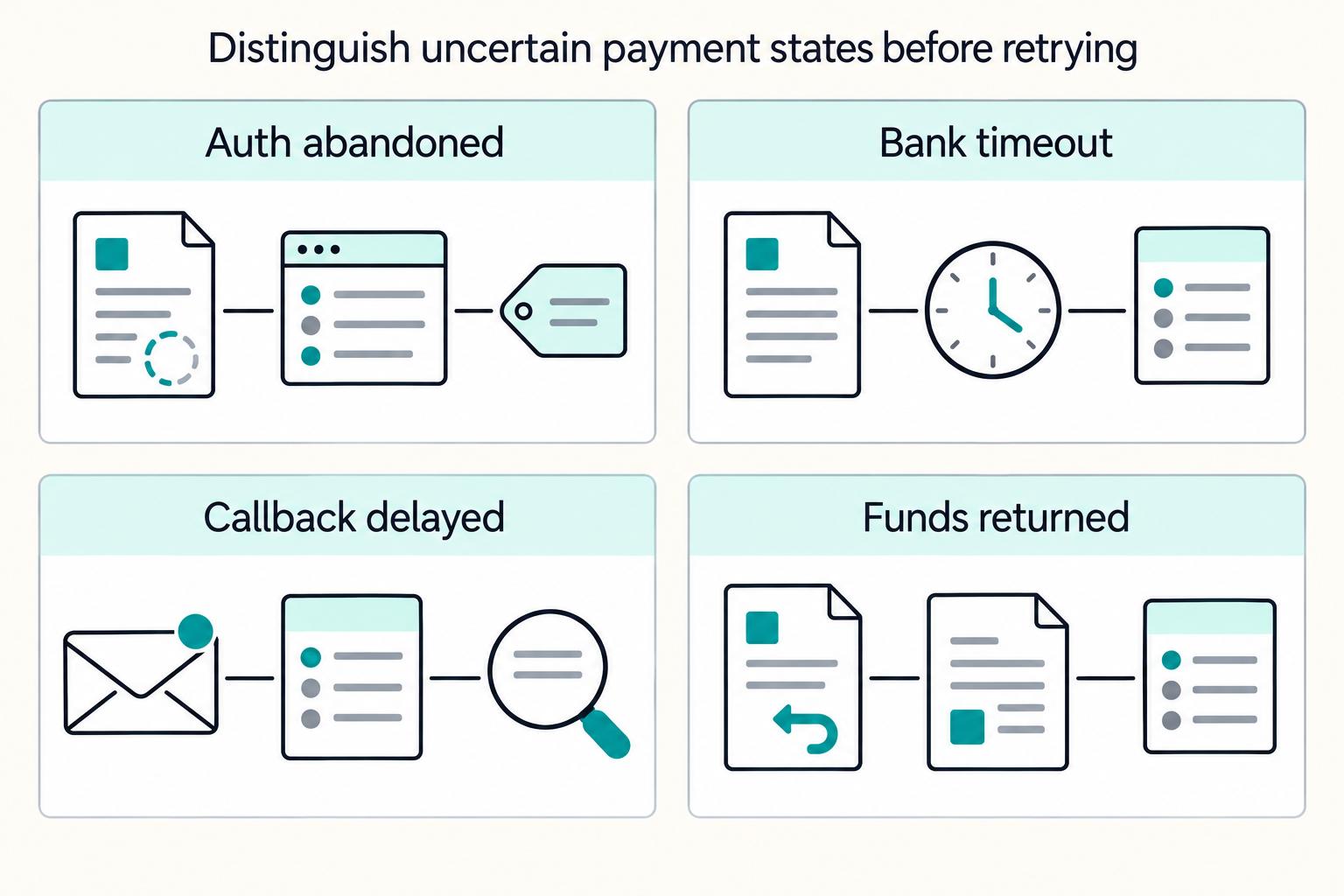
Define four distinct classes in product, ops, and support tooling: payer auth abandonment, bank timeout, delayed provider callback, and returned funds. Do not collapse these into one generic failed state.
For each class, capture the same minimum evidence: provider reference, internal transaction ID, current provider status, last webhook receipt time, last status-poll time, ledger journal ID if posted, and downstream payout hold status. If support cannot identify the class quickly from this record, your status model is too vague.
A practical checkpoint is to sample five recent delayed or failed payments and confirm each can be classified without opening raw logs.
Step 2. Check provider status before telling users to retry#
Use provider-specific recovery timing, not one global callback threshold. Webhook retry behavior differs. Stripe retries failed deliveries in live mode for up to three days, while Adyen retries immediately and can continue from a retry queue for up to 30 days.
When a callback is missing beyond your expected provider window, check provider status first through API or reporting, then decide whether to retry, reopen, or close the attempt. If funds are uncertain, consider keeping downstream payout on hold as an internal control until provider confirmation or clear settlement evidence is available.
Step 3. Separate card disputes from A2A and ACH returns#
Do not apply card dispute logic to bank-based payments. Card rails use chargebacks with merchant evidence, while ACH returns and Faster Payments recovery follow different mechanics.
| Rail | What matters operationally | Recovery posture |
|---|---|---|
| Card networks | Chargebacks require merchant evidence | Preserve order, delivery, and authorization evidence for representment |
| ACH | Returns and reversals have rail-specific timing limits, for example improper reversal handling can have a second-banking-day deadline | Store return reason codes and key entry references; escalate quickly on reversal issues |
| UK Faster Payments-based bank payments | Once sent, payments generally cannot be cancelled; mistaken payments follow the Credit Payment Recovery process | Treat as post-send recovery, not a chargeback-style reversal |
In the U.S., keep ownership split correctly: electronic fund transfer error resolution is under Regulation E, while credit-card billing disputes are under Regulation Z.
Step 4. Write support macros from real statuses, not generic failure text#
Support messaging should match the exact operational state. Maintain separate macros for authentication abandoned, bank confirmation pending, callback delayed with investigation in progress, and funds returned.
Map every macro to a concrete internal status code and next ops action. If callback-driven status is still unconfirmed, do not ask the customer to pay again until status verification is complete.
Roll out in phases with explicit success and stop criteria#
Keep the first launch narrow so issues are visible and fixable. A practical starting scope is one lane, one region, and one provider integration, then expand only when the pilot is operationally stable.
Step 1. Start with one tightly scoped pilot#
Run one bank-payment lane, in one market, through one provider. That keeps the pilot diagnosable and aligns with pilot-first open-banking rollouts and readiness checks before wider volume.
Track three metrics from day one: successful payment initiations, API response times, and exception rate. For a sample week, finance should be able to map every provider reference to an internal transaction ID and ledger journal without raw-log digging or ad hoc engineering support.
Step 2. Expand only after operations stay clean#
Add a second lane only after reconciliation and support load stay within agreed limits. For ACH debit origination, monitor the selected program’s administrative, overall and unauthorized return measures with the provider or ODFI. Nacha’s 3% administrative and 15% overall levels trigger evaluation rather than automatically establish a violation. Confirm the applicable codes, denominator and window; those debit measures are not credit-payout return limits.
Step 3. Set hard pause rules before volume grows#
Define stop criteria before launch. If exception backlog grows faster than your team can clear it, or payer drop-off rises after you change payment presentation, pause expansion and fix instrumentation first.
Set separate objectives for bank-interface availability and provider callbacks. Open Banking’s operational guidance recommends 99.5% quarterly interface availability; its downtime condition includes five consecutive requests unanswered within a total 30-second timeframe. That ASPSP interface metric is not a callback-delivery guarantee. Use the selected provider’s callback expectations and your own recovery objective before expanding scope.
Step 4. Run one weekly operator review#
Run a short weekly review with product, engineering, and finance, and tie each failed checkpoint to a clear owner and due date.
Cover pilot volume, successful initiations, response timing, exception classes, and support load. Watch for false confidence: strong volume can hide weak reconciliation or rising support effort. If the review cannot clearly show both payer outcomes and money-movement evidence, hold the next phase.
Final decision checklist for your team#
Treat this as a go or no-go gate. If you cannot answer yes to each step with evidence, do not scale A2A yet.
Step 1. Confirm lane fit first#
Use the bank-payment option where card-fee pressure is meaningful and payer intent is strong enough for bank-auth steps, then model economics and friction one lane at a time.
If the case relies on universal payer switching or treats ACH and open-banking initiation as one operating path, pause. Preserve a clear card option where your own conversion evidence supports it.
Step 2. Confirm technical readiness for failure, not just success#
Before broader launch, prove idempotency on money-moving requests, webhook signature verification, replay-safe event processing, and fallback handling.
In a pilot, retry the same supported idempotent request, replay callbacks, interrupt processing and delay provider signals. Verify that an uncertain payment stays under investigation and a confirmed failure can enter a supported fallback without duplicate posting or movement. Use the selected provider’s delivery and retention windows.
Step 3. Turn on controls before live volume#
Where your model depends on a covered financial institution or bank partner, map customer identification and beneficial-owner verification clearly, with blocked and pending states visible to operations.
Your operating evidence should include reconciliation by rail and a traceable audit trail from request to posting to export, including manual overrides. Where BSA or FinCEN retention rules apply, required records must be retained for five years.
Step 4. Lock rollout guardrails before launch#
Align product, engineering, and finance on pilot scope, success metrics, owners, and rollback triggers in writing.
Keep scope tight for the first pilot and define decision ownership up front for completion rate, settlement timing, exception backlog, and support load. If ownership for pausing expansion is unclear, the pilot is not ready.
Step 5. Validate market reality by region before scaling#
UK Open Banking is more mature: the CMA confirmed final roadmap completion in September 2024, with 31 million open banking payments and 13.3 million active users in March 2025.
Treat the U.S. as a separate operating decision. This option remains emerging there, and CFPB milestones on October 22, 2024 and August 22, 2025 concern personal financial data rights rather than PSD2-style payment initiation rights. Confirm provider coverage, bank behavior, settlement reporting, and fallback performance in each market before expansion. When your rollout checklist is approved and you need to confirm coverage and integration fit, contact Gruv.
Frequently Asked Questions
What does it actually mean to bypass card fees with Open Banking?
It means routing eligible payments through a bank-payment flow, or A2A, instead of card networks where that rail fits. It does not mean removing cards from every flow. In these flows, the payer approves through their bank app or online banking rather than entering card details.
How are Account-to-Account (A2A) payments different from ACH for platform teams?
A2A is the broad model of bank-account-to-bank-account payment; ACH is one US rail within it. Open-banking initiation can use different underlying rails. Compare the actual rail, consent model, timing and return rules rather than treat A2A and ACH as mutually exclusive options.
When should a platform keep card networks as default instead of Pay by Bank?
Keep cards as default where familiar saved-card behavior materially supports conversion. The Federal Reserve’s July 2025 Pay by Bank note cites the 2023 Survey of Consumer Payment Choice: credit and debit cards accounted for 32% and 30% of retail purchase counts. Treat those dated shares as context and use your own lane’s conversion and cost evidence for routing.
Is Open Banking mature enough in the United States, or only in the United Kingdom and Europe?
UK and EU payment initiation have established regulatory frameworks, but coverage varies by bank and provider. US bank payments need a separate assessment: the CFPB data-access rule’s compliance dates were stayed on October 29, 2025, and the rule does not establish PSD2-style payment-initiation rights.
What are the biggest implementation risks in bank connectivity APIs and webhooks?
The main risks are duplicate processing, unauthenticated callbacks, interrupted handlers and incorrect transitions from asynchronous signals. Use provider-specific webhook authentication, durable operation identity, replay-safe journal posting and recovery that distinguishes receipt from completed processing. Delivery windows vary by provider.
How should we handle reconciliation when we run A2A and card rails in parallel?
Reconcile by underlying rail and provider, including Faster Payments, ACH and cards where used. Map provider references to internal transactions and journals, with separate return and dispute queues. ACH belongs within the broader A2A category, so do not count it again in a separate A2A total.
Researched and edited by the Gruv editorial team. Gruv builds cross-border billing, payouts, and finance-operations software for global businesses.
Sources
- congress.gov/crs-product/IF13117trusted
- consumerfinance.gov/about-us/newsroom/cfpb-finalizes-personal-fi...trusted
- consumerfinance.gov/rules-policy/final-rules/electronic-fund-tra...trusted
- docs.stripe.com/api/idempotent_requeststrusted
- docs.stripe.com/webhookstrusted
- ecfr.gov/current/title-12/chapter-X/part-1026/subpart...trusted
- ecfr.gov/current/title-12/chapter-X/part-1005/subpart...trusted
- federalregister.gov/documents/2024/11/18/2024-25079/required-rul...trusted
Educational content only. Not legal, tax, or financial advice.
Related Posts

The Freelance Payment Penalty: A Modeled Audit of Platform Fees, FX Spreads, and Payout Delays
The money rarely disappears through a single, easy-to-spot fee. The real loss is stacked. A marketplace takes its commission, a processor adds a charge for international cards, a bank or payment company converts the currency at a spread, a platform holds the funds before release, and a wire sheds a little to intermediaries on the way in. Each layer looks defensible on its own, but the worker feels the combined result as a smaller deposit and a later payday.

How to Respond to a Subpoena for Business Records
Move fast, but do not produce records on instinct. If you need to **respond to a subpoena for business records**, your immediate job is to control deadlines, preserve records, and make any later production defensible.
A US Expat's Guide to Investing in UCITS ETFs to Avoid PFIC Issues
The real problem is a two-system conflict. U.S. tax treatment can punish the wrong fund choice, while local product-access constraints can block the funds you want to buy in the first place. For **us expat ucits etfs**, the practical question is not "Which product is best?" It is "What can I access, report, and keep doing every year without guessing?" Use this four-part filter before any trade: