
Quick Answer
Yes, platform operators can use QuickBooks Payments, but it should be scoped to payment acceptance rather than treated as a complete operating model. Pick Online versus Desktop early, validate company mapping and rail behavior in your real account, and confirm settlement expectations before go-live. Release only after one full trace links provider references, internal journal entries, deposit records, and exportable evidence for finance.
Where QuickBooks Fits in Platform Payment Operations#
If you searched for accept payments quickbooks platform operators, you probably landed on SMB setup docs, not platform-architecture guidance. Public QuickBooks material is useful for understanding product capabilities, but much of it is written for onboarding and day-to-day use. Those resources may not cover the cross-functional design choices that matter to engineering, product, and finance.
The practical question is not whether QuickBooks can take payments. It can. QuickBooks Payments is the payment capability inside QuickBooks. QuickBooks Online supports payments online, in person, and over the phone, including PayPal, Venmo, cards, and ACH. QuickBooks Desktop includes a built-in path for invoice payments and in-person sales. The real operator question is where it fits cleanly in your stack and where you need extra controls so reconciliation does not turn into cleanup work later.
This guide takes that operator view. Intuit's developer docs confirm API support to process payments, refund charges, and manage credit cards and bank accounts. But the public material does not, by itself, provide a complete operating model for multi-team delivery. You still need to validate scope, ownership, and accounting impact before implementation.
- Choose the product path first.
Decide on QuickBooks Online or QuickBooks Desktop Payments before you start integration work. Intuit supports connecting a Payments account to either product, but the operating model is different. In Desktop, one account can be used for one company file at a time, so multi-file setups need review early.
- Validate reconciliation assumptions before launch.
Your first checkpoint is not just "payment accepted," but "payment accepted and mapped to the right company and records." Intuit's developer docs warn that misalignment between Payments and QuickBooks company connections can break reconciliation. Confirm company mapping, payment references, and exception ownership before live traffic.
- Launch only when failure paths are explicit.
Treat setup completion as the beginning, not proof of production readiness. Define explicit checkpoints for unmatched payments, retries, and accounting-impact changes. This matters even more if Desktop is your starting point, because Intuit's migration guidance says Online works differently and some features may need adjustment during migration.
The goal is simple: decide where Payments belongs in your acceptance layer, choose the right product path, and surface unknowns early so reconciliation does not become downstream debt.
If revenue-share payouts are part of your model, see IndieHacker Platform Guide: How to Add Revenue Share Payments Without a Finance Team.
Define the real scope before you build#
Treat QuickBooks public docs as a capability boundary, not proof that they fit your full platform model. Start with a shared boundary table so engineering, product, and finance classify scope the same way before anyone estimates delivery.
Step 1. Separate documented capability from platform assumptions#
| Capability area | Explicitly documented in public material | What remains unclear for platform operators |
|---|---|---|
| Acceptance channels | QuickBooks Help says QuickBooks Online can receive and process payments online, in person, or over the phone with QuickBooks Payments. QuickBooks Desktop help frames payments around invoices and in-person sales. | Whether those channels map cleanly to your embedded flow, delegated operator model, or custom customer journey. |
| Payment methods | QuickBooks Help lists PayPal, Venmo, credit card, and ACH bank transfer as customer payment methods in the Online flow. | Whether each listed method has equivalent API depth and control for your integration pattern. |
| API scope | Intuit describes the Payments API as letting apps process payments, refund charges, and manage credit cards and bank accounts. The OAuth scope is com.intuit.quickbooks.payment. | How far the API goes for your full use case if you need more than core payment actions. |
| Merchant operations | Intuit documents the Merchant Service Center as a portal to accept payments, manage statements, get reports, and complete other tasks. | Whether MSC operations and reporting are sufficient for your controls, exception handling, and support model. |
| Region and test support | The Payments API is officially supported in US and CA, with some endpoints US-only. Payments sandboxes are US-only. | Whether your endpoint mix, locale, and test plan still work if you operate in Canada or need non-US sandbox coverage. |
Label each row documented, partially documented, or unverified. If critical rows stay unverified, do not lock delivery dates.
Step 2. Verify the claims that move design, cost, and timeline#
A few caveats change implementation risk enough that you should confirm them before planning goes any further:
- Eligibility and approval gating
QuickBooks Help says Payments accounts are subject to eligibility criteria, credit, and application approval. If activation timing matters, treat that as a launch dependency.
- Region and endpoint coverage in writing
Docs say support exists in US and CA, note some US-only endpoints, and state payments sandboxes are US-only. Validate your target region and test approach before writing test plans.
- Integration depth, not just endpoint presence
Intuit says current QuickBooks Online SDKs do not fully support the QuickBooks Payments API. If you need that scope, plan for direct REST integration.
"Supported" is not the same as "proven for your operating model."
Step 3. Default to hybrid for platform-native merchant and payout needs#
If your model depends on multi-merchant onboarding or payout orchestration, default to a hybrid architecture until fit is validated in writing.
The public material supports scoping QuickBooks to documented capabilities: payment acceptance, refunds, payment instrument management, and merchant reporting. It does not publicly document native multi-merchant onboarding for platform operators or built-in payout splits across sub-merchants.
Use a short evidence pack to close the gap: target merchant entity, countries, rails, required API actions, sandbox needs, and explicit open questions. If answers remain unclear, keep it in the acceptance layer and avoid designing core platform flows around assumptions.
Enforce one boundary early. Intuit warns that if the payments account and QuickBooks company connection do not match, reconciliation can fail. It can also look like one business is transacting through another business's account.
Related: Inward Remittance for Platforms: How to Accept Payments from Overseas Clients.
Gather prerequisites and proof before enabling anything#
Before anyone starts setup, align proof of account ownership, roles, and reporting. A completed form is not the prerequisite. A shared evidence pack is.
Step 1. Build a shared evidence pack#
Build one evidence pack that engineering, product, and finance all use. If teams cannot point to the same account owner and collection account, you are still planning on assumptions. Include at least:
| Evidence item | What to confirm |
|---|---|
| Account ownership | The account owner for the QuickBooks Payments account and the matching QuickBooks company |
| Acceptance channels | Planned QuickBooks Online acceptance channels: invoice, in person, or over the phone |
| Payment methods | In-scope customer payment methods: PayPal, Venmo, credit card, and ACH bank transfer |
| Deposit destination | Expected first deposit destination: QuickBooks Checking or a named external bank account |
| Reconciliation ownership | Monthly reconciliation owner and backup, plus the reports they will use |
Step 2. Turn setup into an implementation plan#
Turn the QuickBooks Help setup flow into your implementation plan, with an owner, rollback condition, and test evidence for each step. Help says signup starts by signing in to QuickBooks Online as an admin and applying for Payments, and that the account auto-connects to the product you sign up from.
If your organization already has a QuickBooks Payments account from another Intuit product, confirm whether you need to link an existing account or create a new one before you configure invoices or support workflows.
Step 3. Confirm settlement choices early#
Settlement choices affect close timing and support operations, so confirm them early. During signup, you can choose QuickBooks Checking or a different bank account for customer payments. If QuickBooks Checking exists, the QuickBooks checking debit card is the default for instant deposits.
| Funding or control | Documented detail |
|---|---|
| First funding | Within five business days after the first payment |
| Later funding | Typically within two business days |
| Manually entered ACH | Can be delayed for extra security checks |
| Instant deposits | Less than 30 minutes; not all payments are eligible; up to 5 times per day; same-day requests must be before 3:00 PM PT |
| Collection account | Only one collection account can be active at a time |
| Deposit bank account | Must be U.S.-based; deposit-account changes are restricted to Full Admin users |
Use those timings in your support copy and close checklist. Lock down the control constraints now. Only one collection account can be active at a time. The deposit bank account must be U.S.-based, and deposit-account changes are restricted to Full Admin users.
Step 4. Set acceptance criteria before build#
Set acceptance criteria before build, then prove them with Merchant Service Center outputs. Help indicates transaction, deposit, and fee reports can be exported as CSV. Monthly statements are available within the first 10 business days of each month, with up to 24 months of downloadable history.
Use a go-live checklist such as:
- operations can retrieve transaction, deposit, and fee records needed for support tickets
- finance can export CSVs and reconcile consistently
- delayed-funding exceptions, including ACH delays, are visible and assigned to a named owner
- a test payment is traceable from acceptance to deposit evidence to monthly statement support
If any of those checks fail, setup may be complete, but launch readiness is not.
Related reading: Building a Virtual Assistant Platform Around Payments Compliance and Payout Design.
Choose acceptance surfaces and payment rails first#
Choose the acceptance surface before you enable payment methods. That keeps support, reconciliation, and device decisions separate instead of turning them into one vague payments launch.
Step 1. Assign one owner to each acceptance surface#
QuickBooks Online documents three acceptance contexts: online, in-person, and over the phone. In practice, it helps to split online into two owned surfaces: invoice and payment links, including pay-enabled invoices, and any separate online checkout flow you operate. Keep in-person capture separate.
For each surface, define one owner, one customer entry point, one test scenario, and one rollback condition. If you plan to accept phone payments, assign ownership explicitly or keep it out of scope.
Step 2. Build a rails matrix before enabling methods#
Only enable rails you can prove in the live payment experience. Online help lists PayPal, Venmo, credit card, and ACH bank transfer. The QuickBooks Payments page also lists debit card and Apple Pay for payable invoices. QuickBooks Desktop guidance for 2018 or later explicitly documents online invoice payment by credit card or ACH bank transfer, plus in-person capture.
| Rail | Possible initial fit | Explicitly documented | Fallback |
|---|---|---|---|
| ACH bank transfer | Invoice-heavy flows | Listed in QuickBooks Online help and Desktop invoice guidance; pay-enabled invoices can reduce processing risk | Keep card available if ACH is delayed |
| Credit card | Broad online invoice coverage | Documented in Online help, marketing page, and Desktop invoice guidance | Re-offer ACH for invoice flows |
| Debit card | Customers preferring card on payable invoices | Listed on the Payments page | Fall back to credit card |
| Apple Pay | Mobile-friendly invoice payment | Listed on the Payments page | Treat as optional and fall back to card entry |
| PayPal | Wallet preference | Listed in Online help and marketing | Fall back to card or ACH |
| Venmo | Mobile wallet preference | Listed in Online help and marketing | Fall back to card or ACH |
Before sign-off, confirm that each promised rail actually appears for your QuickBooks company after eligibility review.
Step 3. Capture in-person device constraints early#
If in-person payments are in scope, treat hardware as a prerequisite. QuickBooks says Android users need a QuickBooks card reader for in-person acceptance.
Do not launch in-person payments until you can show a successful transaction on the exact Android device and reader setup you plan to deploy.
Step 4. Sequence rollout by reconciliation risk#
Rollout order can follow reconciliation risk rather than marketing appeal. For invoice-driven B2B volume, one practical choice is invoice plus ACH first, then wallet and card expansion after reconciliation is stable. That is an operating choice, not a published QuickBooks rule.
That sequence also fits the documented ACH behavior: pay-enabled invoices can reduce processing risk, while manually entered ACH may be delayed for extra security checks.
If you need to embed payments without replacing your existing systems, see How to Embed Payments Into Your Gig Platform Without Rebuilding Your Stack.
Pick QuickBooks Online or Desktop with explicit tradeoffs#
Choose the product path before any integration sprint starts, because QuickBooks Online and QuickBooks Desktop are independent and do not sync. The decision is not just product preference. It changes acceptance channels, access model, reporting habits, and migration work.
Step 1. Compare Online vs Desktop against real operating constraints#
| Option | Supported acceptance channels | Payment method coverage | Setup complexity | Operational visibility |
|---|---|---|---|---|
| QuickBooks Online | Online help documents online, in-person, and over-the-phone acceptance | Help documents PayPal, Venmo, credit card, and ACH bank transfer | Starts by connecting an existing QuickBooks Payments account | Browser-based access; Intuit positions it for work from anywhere/on any device; Online Advanced supports up to 25 users |
| QuickBooks Desktop Payments | Desktop help centers on invoices and in-person sales, and states customers can pay online or in person | Desktop Payments page lists cards, Apple Pay, Google Pay, eChecks, and ACH payments | Starts by connecting a Payments account, with a Desktop version prerequisite (Desktop 2023 or later) | Best fit when operations are already Desktop-centered and payments stay close to that workflow |
| Migration risk | Treat either path as a commitment | Shared payment labels do not remove migration work | Switching later is not a lightweight change | Intuit states Online is independent from Desktop, and move timing varies by company file size |
Verification checkpoint: confirm that the channels and methods you plan to support are documented for the exact product and version you will run.
Step 2. Match the choice to deployment and reporting habits#
Pick Online when engineering, product, and finance need shared browser access across devices and broad app connectivity. Pick Desktop Payments when finance is already anchored to Desktop workflows and the payment scope is mostly invoice and in-person collection.
Before you scope build work, run a live capability check in your actual company setup:
- Online: confirm required methods and the user-access pattern in browser.
- Desktop: confirm QuickBooks Desktop 2023+ and an acceptable machine ownership model.
Step 3. Force one signed decision before build#
Before sprint planning, get architecture, finance ops, and product to sign the same comparison outcome. Record these four items in the sign-off note:
- Chosen path:
QuickBooks OnlineorQuickBooks Desktop Payments - In-scope channels
- Required payment methods that must appear in setup
- Migration stance:
no planned migrationorfuture move expected, validation budget reserved
Design reconciliation as a product requirement#
Once you choose Online or Desktop, treat reconciliation as a launch requirement, not a post-launch repair job. QuickBooks can help record and match activity, but your team still needs internal states and explicit exception handling.
Step 1. Map payment events to your states and close artifacts#
Define your internal payment lifecycle first, then map QuickBooks records to it. At minimum, track accepted, expected to deposit, deposited, fee recorded, exception open, and closed. Tie those states to close artifacts such as deposits in transit, fee totals, unmatched bank activity, and open-exception aging.
In QuickBooks Online, auto-recorded deposits, fees, and automatic matching are useful, but they should map into states you already control. Validate the design with one real card payment and one ACH transfer traced across four records: customer-facing transaction, internal ledger entry, QuickBooks transaction or deposit, and bank transaction.
Step 2. Use QuickBooks automation as an assist, not final authority#
Automation helps only when deposit and fee accounts are mapped correctly. Use it to reduce manual work while keeping clear internal ownership for transaction state and exception handling. When QuickBooks state and product state diverge, your team should resolve the issue from internal transaction and exception context.
Apply the same rule to Desktop Payments. The QuickBooks Reconcile feature can support fee accounting and funding-status visibility, but your team still needs its own record of expected settlement, expected fees, and exception review status.
Step 3. Set deposit checkpoints from documented timing#
Build checkpoints from documented timing windows, not from one assumed settlement clock. Intuit says timing varies by product and payment type, and manually entered ACH may be delayed for security checks.
| Scenario | Documented timing | Checkpoint |
|---|---|---|
| First payment on a new/early account | Within five business days after the first payment | Track in a separate early account funding bucket before escalating |
| Typical post-setup deposits | Typically within two business days | Keep as in transit through day two, then open review |
| Credit card before 3 PM PT | Next business day | If missing next business day, check batch status and bank feed |
| Credit card after 3 PM PT | Within 2 business days | Do not commit to next-day availability |
| Instant Deposit (eligible linked account) | Less than 30 minutes; up to 5 times each day; up to $125,000 per day | Track as a separate funding path when enabled |
Also account for batching. QuickBooks Payments can group daily customer payments into one deposit record, so reconciliation should not assume one bank deposit per customer payment.
Step 4. Create failure buckets before go-live#
Define explicit exception buckets before production traffic starts, for example:
- unmatched payment to deposit batch
- partial amount mismatch across payment, fee posting, and bank deposit
- duplicate-looking events with similar surface details but different references
- delayed ACH review, especially for manually entered ACH
Dry-run each bucket with at least one planned failure. Operators should be able to see payment amount, customer or invoice reference, expected deposit date, QuickBooks deposit or batch reference if present, fee status, and bank-match status without manual reconstruction.
Implement event handling with idempotent retries#
Idempotent event handling comes down to two rules: retries must never create a second accounting effect, and every terminal outcome must be traceable to the provider reference that produced it.
Step 1. Normalize rail statuses before wiring customer messaging#
Define your own rail-specific status map first, then map provider labels to it. QuickBooks Payments supports credit card, debit, ACH bank transfer, PayPal, and Venmo, but customer messaging and fulfillment should follow your internal states, not provider-specific wording alone.
| Rail | Minimum internal states to track | Customer communication rule | Operator red flag |
|---|---|---|---|
| ACH bank transfer | initiated, pending review, confirmed, failed | Send submission receipt, but send settlement confirmation only after confirmed | Manually entered ACH can be delayed for extra security checks |
| credit card | accepted, expected to deposit, deposited, reversed | Send payment success at accepted, but match cash-timing copy to deposit timing | Deposit timing differs before and after the 3 PM PT cutoff |
| PayPal | pending, completed, denied, reversed | Do not fulfill on pending; fulfill on PAYMENT.CAPTURE.COMPLETED | Some flows can take up to seven days to complete |
| Venmo | accepted, expected to deposit, deposited, reversed | Mirror internal confirmation logic, not wallet-surface success alone | Missing provider reference or unclear deposit path |
If you use QuickBooks Online, processed-payment deposit status is visible there. For other QuickBooks products, route status checks through Merchant Service Center and document that path for operators.
Step 2. Enforce idempotency on every write path#
Carry one idempotency key through payment creation and every retried write that can affect records. Use Intuit request-Id for write, modify, and delete operations, and use PayPal-Request-Id on PayPal REST POST calls.
Apply one hard rule: if a retry cannot prove the same idempotency key and the same business intent, do not replay it. Send it to operator review instead of risking duplicate receipts or duplicate journal impact.
Step 3. Separate webhook acknowledgment from business processing#
Acknowledge webhooks immediately, then process them asynchronously with dedupe. Intuit expects HTTP 200 within three seconds. Otherwise, events may be resent, with retry spacing that can extend to a six-hour window.
Queue first, process second, and dedupe on event identity plus payment idempotency key. If you use a dead-letter queue, avoid setting maxReceiveCount too low, for example 1. Move stale or conflicting events to an operator queue with payment ID, provider reference, current status, retry count, and last error.
Step 4. Prove terminal states back to the journal entry#
Your real checkpoint is traceability, not webhook arrival. Each terminal status should be reproducible from provider reference to internal payment record to final journal entry.
For QuickBooks-originated activity, keep request-Id, provider transaction reference, internal payment ID, deposit reference if present, and journal entry ID in one searchable trail. Spot-check by pulling a transaction by ID in Merchant Service Center, matching it to your event history, and confirming one terminal ledger outcome per payment.
Plan for disputes chargebacks and cash timing#
Treat disputes for credit card and debit card payments as a separate operating path with its own ownership, evidence handling, and cash-impact tracking.
Step 1. Define the dispute lifecycle before you add more card volume#
Define internal stages and owners before volume grows: alert received, evidence needed, response submitted, under review, won, lost, and closed. QuickBooks chargeback notices include case number, transaction details, dispute reason, and challenge instructions, so make those required fields in every case record.
Do not plan around one fixed QuickBooks deadline. QuickBooks says reply deadlines are set by banks or payment providers, so your internal handoff windows should be earlier than the external cutoff. Stripe documents typical dispute response windows of 7 to 21 days by card network, and missing the deadline can mean an automatic loss.
Build an evidence pack that is ready to submit as PDFs, since QuickBooks requires an explanation plus PDF supporting documents for rebuttals.
Step 2. Separate pending disputes from confirmed losses in ops and finance views#
Keep active dispute work and realized-loss accounting separate so forecasting is not distorted.
| Internal dispute state | What ops should do | How finance should treat it |
|---|---|---|
| Needs response / evidence needed | Collect documents, assign owner, submit before provider deadline | Track as at-risk cash, not booked loss |
| Under review | Monitor case, retain case ID and submission proof | Keep in pending-dispute bucket |
| Won | Close restrictions tied to the case | Remove reserve, no loss recognized |
| Lost | Apply balance and payout policy | Book confirmed loss and related fee impact |
Cash availability can tighten before a final outcome. PayPal says disputes, claims, and chargebacks place a temporary hold on transaction funds, so your pending-dispute view should reflect short-term cash pressure without booking final loss too early.
Step 3. Map dispute outcomes to balances, payouts, and review rules#
Write these rules down explicitly. Do not assume status changes automatically update balances, payouts, or review queues. Set hard controls:
- block direct refunds on open chargeback cases until review is complete, because QuickBooks warns you can pay twice if you refund and then lose the chargeback
- define lost-dispute handling up front, for example how balances are treated and when recovery is attempted
- define when open or recent dispute losses trigger payout restrictions or manual review
If you use QuickBooks Payments Dispute Protection, document its boundaries precisely. It can auto-cover eligible chargebacks. It does not apply to ACH, PayPal, or Venmo. It has limits of $10,000 per chargeback and $25,000 per year on a rolling 365-day basis, and it covers the chargeback amount plus related fees but not arbitration fees.
Step 4. Use internal SOP sign-off before you expand higher-risk rails#
If chargeback exposure is material, require internal dispute SOP sign-off before you expand card-heavy acceptance paths. Sign-off should confirm owner handoff windows, required evidence documents, pending-versus-loss finance treatment, and rules for balances and payout holds.
Run one mock won case and one mock lost case before launch. If the team cannot show the case file, submission proof, accounting treatment, and customer-account outcome in one place, the process is not ready for higher volume.
If you are formalizing controls around payments, see How to Write a Payments and Compliance Policy for Your Gig Platform.
Add compliance and tax boundaries before scale#
Set the boundary in writing before you scale. QuickBooks Payments supports payment acceptance, and the tax-compliance material here is centered on Form 1099-K reporting, not every jurisdiction-specific filing duty.
Step 1. Draw the boundary in writing#
Create one short policy note shared by product, finance, and legal: QuickBooks Payments helps you accept payments, and in this context the reporting focus is Form 1099-K. Intuit says this reporting is done using Form 1099-K, and for tax year 2025 it shows federal criteria as gross payment card transactions exceeding $20,000 and 200 transactions.
| Form or filing | How the article frames it |
|---|---|
| Form 1099-K | This is the reporting focus here; for tax year 2025, federal criteria are gross payment card transactions exceeding $20,000 and 200 transactions |
| Form 1042-S | This can involve separate rules and owners; the IRS describes it as a withholding-agent information return for certain income paid to foreign addresses |
| FBAR (FinCEN Form 114) | This can involve separate rules and owners; Form 8938 does not replace FBAR |
| Form 8938 | This can involve separate rules and owners; it does not replace FBAR |
| Schedule SE | This can involve separate rules and owners depending on the facts |
List exclusions just as clearly. Forms such as IRS Form 1042-S, FBAR (FinCEN Form 114), FATCA-related Form 8938, and Schedule SE can involve separate rules and owners depending on the facts. For example, the IRS describes Form 1042-S as a withholding-agent information return for certain income paid to foreign addresses, and says Form 8938 does not replace FBAR.
Step 2. Place checks at onboarding and before payout release#
Add a compliance review point during onboarding so risk facts are identified before volume increases. The goal is routing, not making legal conclusions inside the product.
Add a second gate before payout release for accounts with unresolved tax or legal flags. If required ownership, review status, or support records are incomplete, hold release and route the case instead of assuming Payments has covered the obligation.
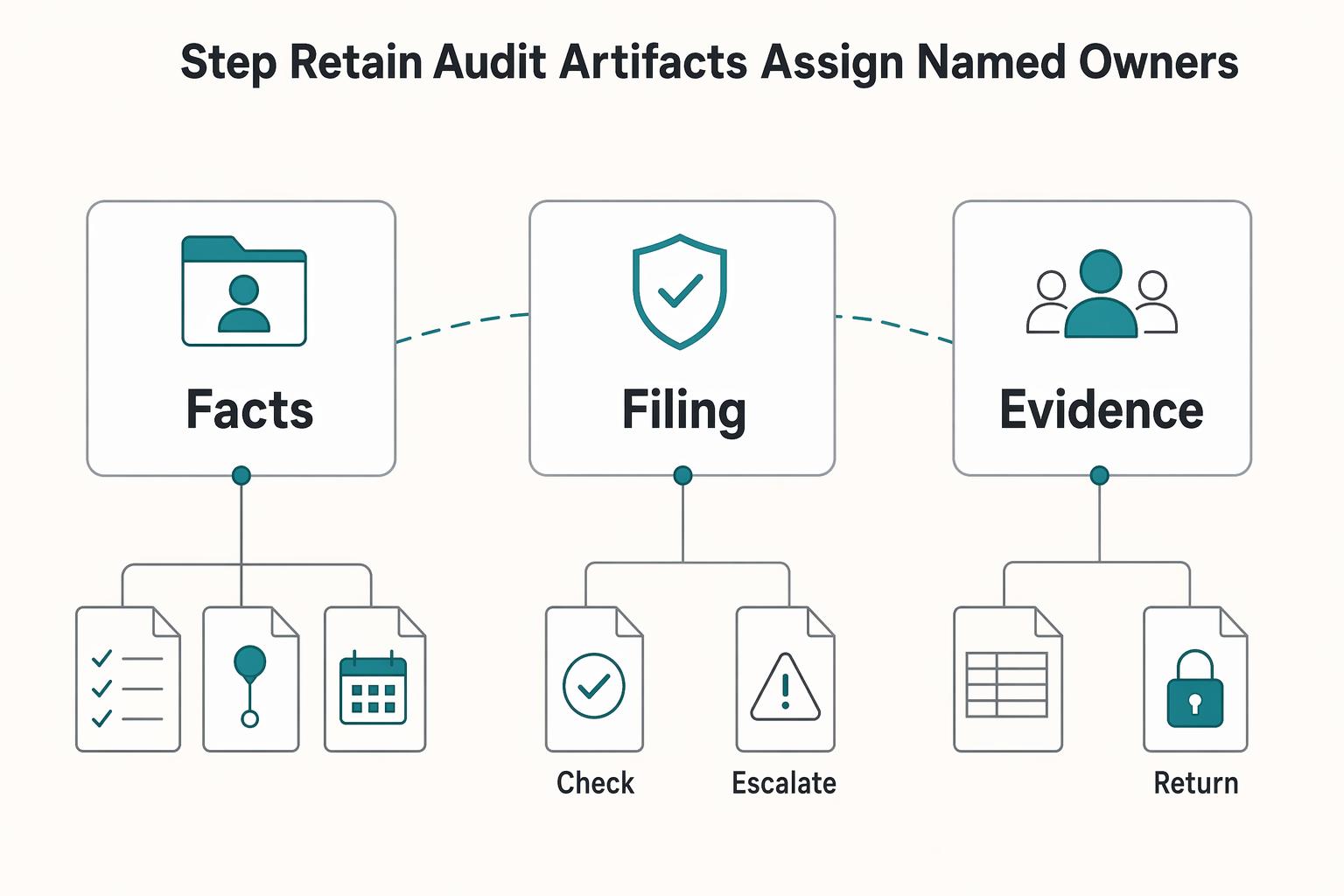
Step 3. Retain audit artifacts and assign named owners#
Keep a lightweight evidence pack for each flagged case: intake responses, reviewer decision, decision date, and the supporting records used. The checkpoint is simple: for any escalated account, you can show who reviewed it, what triggered review, and whether payout was allowed or blocked.
Make ownership explicit in the SOP. State plainly that setup alone does not satisfy every filing duty, and route 1042-S questions to tax counsel or a specialist process. If foreign-payee reporting is part of your model, this guide on IRS Form 1042-S for platform operators is the right companion doc.
For a step-by-step walkthrough, see How to Launch a Legal Compliance Platform for Freelancers and Handle Their Payments.
Avoid common mistakes that create platform debt#
Once the compliance boundary is clear, the next job is avoiding debt. Expand payment rails only as fast as your reconciliation and dispute operations can support them.
Step 1. Freeze new rails until reconciliation is stable#
If exceptions are already noisy, stop adding Apple Pay, PayPal, or Venmo even though QuickBooks lists them alongside credit card and ACH options. More rails mean more edge cases and more cleanup.
Resume expansion only when each enabled rail is traceable end to end. Auto-recording in QuickBooks Online can help, but it is not proof that your internal ledger, settlement view, and support workflow fully match. The practical test is simple: for any transaction, you can trace it from provider reference to internal record and explain unmatched items quickly.
Step 2. Treat QuickBooks Help completion as setup, not go-live approval#
QuickBooks describes setup as fast and step-based, but completing the documented setup flow is not the same as being production ready. Teams can finish setup and still miss replay behavior, export gaps, ownership gaps, or settlement assumptions that fail under volume.
Use a separate internal go-live gate above setup completion. Consider replay tests on high-risk events, finance sign-off on reconciliation dry runs, and a lightweight evidence pack with transaction IDs, status proof, accounting result, approver, and date. If you cannot replay a success path, a failure path, and one exception path with clear downstream impact, do not launch.
Step 3. Pick one primary product path per business unit#
Choose one primary QuickBooks path per business unit. QuickBooks Online and QuickBooks Desktop Payments have separate operating paths, and accounts are linked to the product where they were created unless manually connected elsewhere.
Desktop also carries a company-file constraint: one QuickBooks Payments account connects to one company file at a time, and Desktop Payments has version prerequisites. Mixed-path setups create hidden ownership and migration friction. Define exceptions explicitly, and name owners for setup, reconciliation, support, and cross-product connection approvals.
Step 4. Assign one team to own card disputes#
Assign one accountable team for credit and debit card disputes before volume grows. In QuickBooks Online US, Dispute Protection is card-only, so you cannot run one uniform disputes process across cards, ACH, PayPal, and Venmo.
Set a written internal escalation target and evidence checklist. In QuickBooks' Resolution Center flow, merchants are asked to respond within 2 business days, and once a chargeback notice arrives, do not issue a direct refund. With a stated $25 chargeback fee, dispute volume has a direct operating cost even before loss outcomes.
For benchmarks on how other operators run platform payments, see State of Platform Payments: Benchmark Report for B2B Marketplace Operators.
Ship with a practical go live checklist#
Use this as a launch gate. If any item is unclear, do not route first customer traffic through QuickBooks Payments.
1. Lock product path and rail scope#
Get written signoff on your exact launch stack: QuickBooks Online or QuickBooks Desktop Payments, the QuickBooks Payments account, and the rails you will expose at go live. This is a hard dependency because the account auto-connects to the product used at signup, and Desktop allows one account per company file at a time. If you run Desktop, confirm you are on QuickBooks Desktop 2023 or later.
Define rails explicitly. QuickBooks documentation lists card, debit, ACH bank transfer, PayPal, and Venmo, and Intuit also markets Apple Pay. Validate rail availability in your chosen flow instead of assuming every rail works everywhere.
2. Prove each launch rail with auditable evidence#
Run acceptance tests for ACH bank transfer, credit card, and at least one wallet rail you plan to offer. Capture evidence another operator can verify quickly: provider transaction reference, internal record ID, timestamps, customer-facing status, and accounting outcome.
Include at least one failure-path test, not just a happy path. A practical example is validating known rail limits, such as PayPal or Venmo not supporting recurring invoices.
3. Reconcile one full close cycle before go live#
Run one dry reconciliation cycle from payment event through the close process finance will use. In QuickBooks Online, auto-recorded deposits and fees reduce manual work, but your release proof is still matching QuickBooks transactions to bank or credit card statements.
Include one failure case, such as an unmatched transaction or delayed confirmation. If you use QuickBooks Checking, verify how deposit behavior and instant deposit fees apply before launch.
4. Enable dispute and support readiness#
Confirm ownership before launch: who monitors chargeback notices, where evidence is stored, and which support contact path is used. Chargebacks are deadline-driven, and PayPal or Venmo credit-card-payment chargebacks may require action within 5 calendar days.
Make sure your escalation path is documented and tested before traffic starts. Missed notices can become losses quickly, and chargebacks may also carry a $25 fee.
If your go-live gate includes replay safety, operator visibility, and clean ledger handoff, use this implementation reference to pressure-test your integration plan: Read the Gruv docs
Conclusion#
Treat QuickBooks Payments as a scoped payment-acceptance component, not a complete platform operating model. The practical sequence is to confirm scope, choose QuickBooks Online or QuickBooks Desktop Payments, lock reconciliation and cash timing, and then launch rails with explicit failure handling.
- Confirm scope before internal commitments.
Intuit positions QuickBooks Payments for small businesses, and QuickBooks Help supports online, in-person, and phone payment acceptance. That does not by itself confirm a full platform model for multi-party funds movement or broader compliance ownership. Get written agreement on what your team will and will not rely on, and log unresolved unknowns.
- Choose one product path and sign it off.
Avoid split assumptions where engineering builds for Online while finance plans for Desktop. QuickBooks Online is positioned for anywhere access, while QuickBooks Desktop Payments requires QuickBooks Desktop 2023 or later and fits a dedicated-machine pattern. If ownership, reporting, or access assumptions still differ, stop and get a signed decision from engineering and finance.
- Lock reconciliation and cash timing before expanding rails.
Deposit speeds vary by product and payment type, and initial deposits are stated as within 5 business days. Instant Deposit can be less than 30 minutes where eligible, up to 5 times each day. Validate each enabled rail end to end with evidence of payment status, deposit visibility, and expected accounting outcomes.
- Assign responsibilities that setup does not remove.
Card acceptance still carries PCI DSS obligations. Disputes are an operating path, not cleanup: a chargeback is a bank reversal, and QuickBooks requires you to challenge or accept it; the stated chargeback fee is $25. Coverage differs by rail because Payments Dispute Protection applies to credit or debit card transactions only, not ACH, PayPal, or Venmo. Payment setup also does not replace separate tax or reporting analysis, which may include items like Form 1042-S, FBAR, FATCA, Form 8938, or Schedule SE thresholds depending on entity and jurisdiction, so assign named owners outside the setup flow.
Copy this final checkpoint list into your launch doc and do not mark a line complete without evidence:
- Scope confirmed for
QuickBooks Paymentsand unresolved unknowns logged -
QuickBooks OnlinevsQuickBooks Desktop Paymentsdecision signed by engineering and finance - Rails and dispute operations tested end to end
- Compliance and tax responsibilities assigned beyond payment acceptance setup
If one box is still open, delay expansion instead of improvising after launch. The win is a narrow, auditable path that finance, support, and engineering can explain on day one.
If your roadmap extends from payment acceptance into payout orchestration with audit-ready status tracking, compare your target flow here: Explore Gruv Payouts
Frequently Asked Questions
Can platform operators use QuickBooks Payments, or is it mainly for SMB invoicing?
QuickBooks Payments can work for scoped payment acceptance, refunds, and payment data handling, but Intuit positions it mainly for small businesses. If your model depends on multi-merchant onboarding, seller-level payout orchestration, or platform-style funds movement, do not assume that fit is covered out of the box. Confirm fit in writing before you commit architecture.
What payment methods are actually supported in current QuickBooks payment flows?
QuickBooks Help lists credit card, debit, ACH bank transfer, PayPal, and Venmo. Intuit marketing also mentions Apple Pay, but availability should be treated as flow-dependent until you verify it in your exact product path. Validate each rail with a real transaction and the expected accounting result instead of relying on a feature list.
How is QuickBooks Online different from QuickBooks Desktop Payments for implementation teams?
The operating constraints differ. In QuickBooks Help, the QuickBooks Online sequence starts by connecting an existing QuickBooks Payments account, while getting started with Desktop Payments requires QuickBooks Desktop 2023 or later and allows only one Payments account per company file at a time. That Desktop constraint affects entity design and migration planning early. For developer-side flows, keep Payments and QuickBooks connections on the same companyId to protect transaction and reconciliation integrity.
What are the exact setup steps from QuickBooks Help, and what should engineering validate beyond setup?
QuickBooks Help says to sign in to QuickBooks Online as an admin, then connect an existing Payments account or complete signup through business, owner or proprietor, and payment deposit sections. If you are connecting an existing account, refund open transactions before connecting. After setup, engineering still needs to validate same-companyId mapping and one full end-to-end reconciliation cycle.
What controls should we put in place for disputes and chargebacks?
Set ownership before launch: one owner for QuickBooks dispute emails and one evidence location for retrieval requests and chargebacks. After a chargeback notice, do not issue a direct refund to the customer, and plan for deadline-driven responses. QuickBooks notes review of rebuttal documents can take up to 5 business days before submission to the bank. Include fee and coverage checks in your operating guide, including the stated $25 chargeback fee and Payments Dispute Protection terms, as low as 0.99%, up to $10,000 per chargeback and $25,000 per year for eligible disputed card charges.
Which critical details are still unknown before we commit architecture and timeline?
The first unknown is approval. QuickBooks Payments is subject to eligibility, credit, and application approval, so timeline assumptions stay provisional until approval clears. The second is fit in your exact implementation, including rail availability, same-companyId mapping, and Desktop company-file constraints. If any of these remain unresolved, convert them into explicit validation tasks with owners before making sprint commitments.
Try a related tool
Researched and edited by the Gruv editorial team. Gruv builds cross-border billing, payouts, and finance-operations software for global businesses.
Sources
Includes 4 external sources outside the trusted-domain allowlist.
- irs.gov/businesses/comparison-of-form-8938-and-fbar-...trusted
- irs.gov/forms-pubs/about-form-1042-strusted
- developer.intuit.com/app/developer/qbpayments/docs/learn/explore-...external
- developer.intuit.com/app/developer/qbpayments/docs/workflows/proc...external
- quickbooks.intuit.com/learn-support/en-us/help-article/invoicing/t...external
- quickbooks.intuit.com/paymentsexternal
Educational content only. Not legal, tax, or financial advice.
Related Posts

The Freelance Payment Penalty: A Modeled Audit of Platform Fees, FX Spreads, and Payout Delays
The money rarely disappears through a single, easy-to-spot fee. The real loss is stacked. A marketplace takes its commission, a processor adds a charge for international cards, a bank or payment company converts the currency at a spread, a platform holds the funds before release, and a wire sheds a little to intermediaries on the way in. Each layer looks defensible on its own, but the worker feels the combined result as a smaller deposit and a later payday.

How to Respond to a Subpoena for Business Records
Move fast, but do not produce records on instinct. If you need to **respond to a subpoena for business records**, your immediate job is to control deadlines, preserve records, and make any later production defensible.
A US Expat's Guide to Investing in UCITS ETFs to Avoid PFIC Issues
The real problem is a two-system conflict. U.S. tax treatment can punish the wrong fund choice, while local product-access constraints can block the funds you want to buy in the first place. For **us expat ucits etfs**, the practical question is not "Which product is best?" It is "What can I access, report, and keep doing every year without guessing?" Use this four-part filter before any trade: