
Quick Answer
Name the seller, actual buyer, and party authorized to accept the order before integrating an AI checkout surface. Record the user’s approval or delegated spending mandate and its limits. Confirm merchant-of-record responsibility in the provider configuration and contracts, then design payment-state handling, refunds, disputes, and reconciliation around those roles. The AI interface and the account initially debited for a dispute do not, by themselves, decide who the merchant of record is.
AI commerce is moving faster than role clarity, and that is where teams get into trouble#
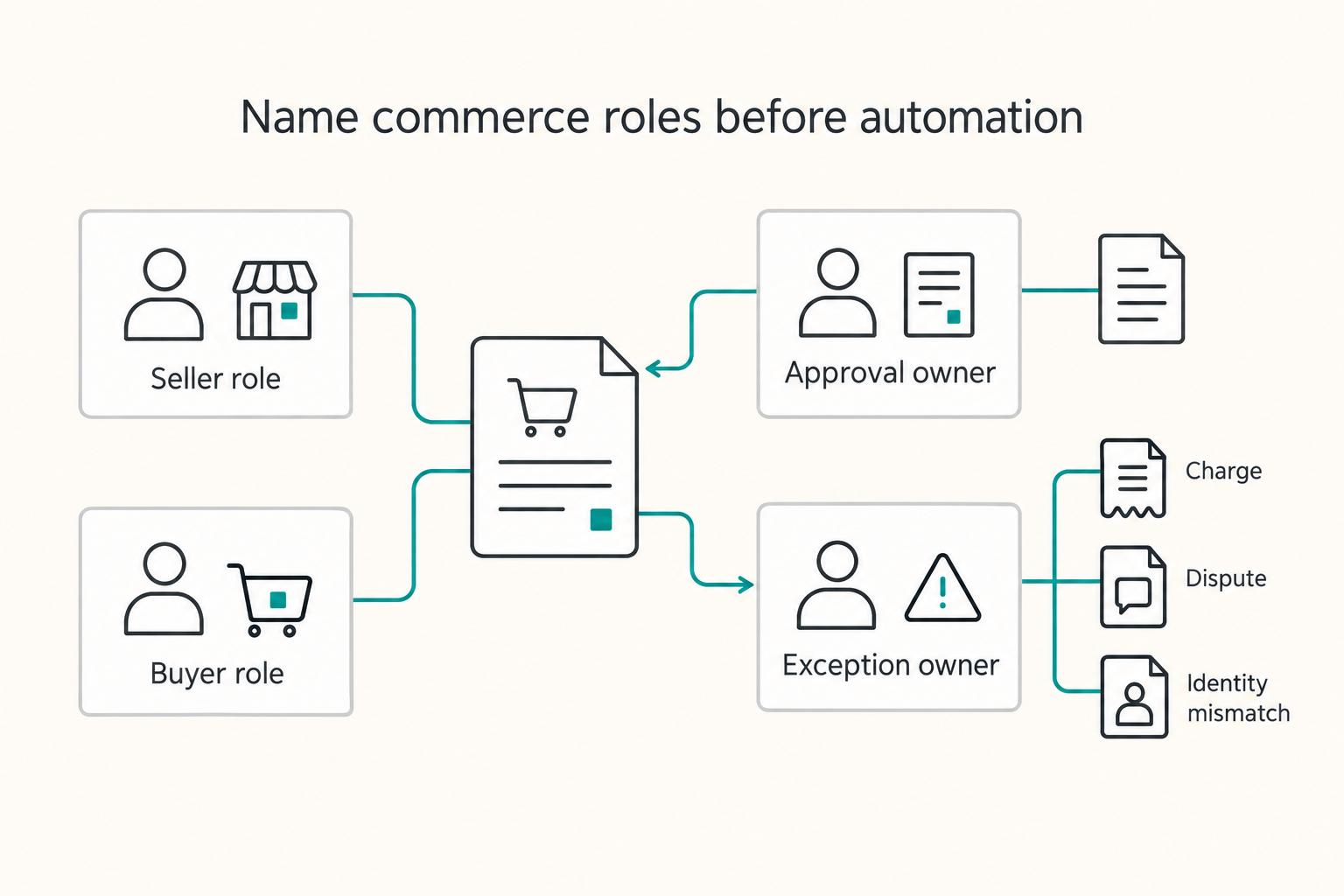
AI commerce is moving faster than role clarity, and that is where teams get into trouble. Before you debate protocols or checkout surfaces, decide who is actually selling, who is the recognized buyer, who captures approval, and who owns the fallout when a charge, dispute, or identity mismatch shows up later.
AI commerce can involve either purchase-by-purchase assistance or delegated buying under a user’s mandate. Mastercard’s framework distinguishes those models. Decide which one you are building and record its permission boundaries; the label agentic does not explain who authorized a particular purchase.
The implementations we can point to reinforce that distinction. OpenAI's commerce guidance says ChatGPT collects buyer, fulfillment, and payment information from the user, and the merchant still accepts or declines the order and returns that state. That keeps the human-linked authorization moment and the merchant's approval decision at the center, even when the purchase flow feels embedded in an assistant. Microsoft made the same point on January 8, 2026 with Copilot Checkout: "you stay the merchant of record." The interface may shift into an AI assistant, but the underlying commercial role can remain with the merchant.
That gap between interface and legal role is where platform teams need discipline. If your product, finance, and engineering leads do not name the Merchant of Record and the buyer identity before launch, you will end up arguing about them during disputes, reconciliation, or provider review, when your options are worse. A good first checkpoint is simple: can your team point to the exact moment where the user provided payment details or approval, the exact party that accepted the order, and the exact record tying that action to a buyer identity? If not, you are not ready to scale AI-assisted checkout.
There is also a real trust problem underneath the excitement. Mastercard warns that without a standardized method to verify agent identity and consumer intent, merchants risk increased fraud. So this article stays grounded in what is workable now: agent-assisted payment flows, explicit authorization, merchant-side decisioning, and role assignments that can survive provider scrutiny.
The goal is practical. By the end, you should have a workable path for choosing MoR and Buyer of Record roles. You should also have a short list of launch checkpoints and a set of validation questions your finance, product, and engineering owners can act on this quarter.
Define the roles before you discuss tools#
Define the legal and operational roles first, then choose tools. If you skip that sequence, teams often confuse interface ownership with payment liability.
Merchant of Record identifies the party legally responsible for the sale and related transaction obligations. A payment processor is not automatically the seller merely because it moves the money. Use Buyer of Record here as an operational label for the actual person or business buying, linked to its consent and fulfillment record; do not assume it is a universal legal category.
For the documented checkout examples discussed here, separate these four actors explicitly:
- the merchant or seller that accepts or declines the order
- the AI platform that mediates the experience
- the payment provider (for example, Stripe)
- the actual person or business buying, with the relevant customer account or agent-session context
This split reflects how current flows actually work: user payment and buyer details are collected from the user, merchants still control accept/decline, and payment providers remain a distinct actor in the transaction path. Use a simple readiness check before launch: can you show who collected payment details, who captured authorization, and who made the final accept/decline decision?
Describe the implemented permission model precisely. In a confirmed-purchase flow, retain the user’s approval for that order. In a delegated flow, retain the mandate, spend and merchant limits, expiry, and revocation state. An agent session ID alone does not establish authority to spend.
If you want a deeper dive, read ASC 606 for Platforms: How to Recognize Revenue When You're the Merchant of Record.
Choose the operating model your risk team can support#
Choose the model your risk, finance, and support teams can defend under dispute pressure, not the one that looks most autonomous in a demo. The core decision is still who is Merchant of Record, who controls authorization, and whose balance takes the hit on refunds and chargebacks.
| Model | Practical setup | Liability surface | Authentication and authorization control | Dispute handling | Unknowns to confirm before launch |
|---|---|---|---|---|---|
| Platform-led MoR | The platform is the seller under the program and contracts; Connect charge configuration must reflect that role | Destination-charge disputes debit the platform balance; that debit pattern alone does not decide the merchant of record | Typically platform-owned approval and payment handoff flow | Usually platform-first | Provider acceptance for agentic flows, country footprint, cross-border payout eligibility, contract carve-outs |
| Merchant-led MoR | The merchant is the seller; direct charges or an indirect charge with on_behalf_of may reflect that assignment | Direct-charge disputes initially debit the connected account; ultimate negative-balance responsibility and fee settings still matter | Merchant controls final checkout/approval step | Usually merchant-first | Whether merchant acquiring/support operations can absorb this channel, statement clarity, connected-account agreement consent capture |
| Hybrid delegation | Platform mediates parts of the flow while merchant retains defined sale/approval obligations | Shared and easier to contest unless contracts are explicit | Shared or sequenced controls across platform and merchant | Can bounce between parties without clear event ownership | Highest uncertainty: provider acceptance, program eligibility, and precise contract language for submit/confirm/reverse actions |
Choose the selling role from the commercial agreement and actual responsibilities before choosing the payment route. A platform that only arranges access to another merchant does not become the seller simply because one integration is easier to scale.
Use a second decision axis for Buyer of Record design:
| Buyer record design | What it means operationally | Consent record implication |
|---|---|---|
| End-user direct buyer | Buyer evidence is tied to the actual user/business making the purchase | Keep records of who approved, when approval happened, which merchant was selected, and session context |
| Platform-instrumented buyer | Platform identity submits or represents the order flow | Keep explicit linkage from platform identity to the real user and delegated permission; session ID alone is weak evidence |
Check selling responsibility separately from money movement. Stripe’s Connect guidance distinguishes direct charges from indirect charges and the on_behalf_of setting. An indirect charge can name the connected account as merchant of record while dispute debits still reach the platform. Align receipts and disclosures with the selling party and document liability allocation separately.
Before launch, confirm connected-account agreement acceptance before payments, and confirm country plus cross-border eligibility up front because coverage is conditional. You might also find this useful: Merchant of Record for Platforms and the Ownership Decisions That Matter.
Decide checkout and authorization mechanics upfront#
Before launch, lock the exact point of user confirmation, where authorization is attempted, and who can still decline the order. If those three moments are not explicit, your checkout design is not ready.
In current agent-assisted flows, the split is straightforward: the agent handles checkout presentation and collects user-provided purchase details, while merchant systems still make the final accept or decline decision and return that status to the agent surface. OpenAI's flow is endpoint-driven, so the agent calls merchant ACP endpoints to create or update checkout sessions before the merchant returns order state.
Map the handoff precisely#
Define the handoff in order:
| Step | Checkpoint |
|---|---|
| 1 | User gives purchase-confirming input in the agent UI |
| 2 | Agent/channel calls your ACP endpoint to create or update the checkout session |
| 3 | Payment layer attempts authorization and exposes the actual payment state |
| 4 | Map the merchant checkout response and processor payment state into explicit user-facing outcomes; use the chosen protocol version’s actual status values |
Model non-happy paths explicitly. For example, Stripe PaymentIntents can move to requires_action for additional authentication or requires_payment_method after a payment failure, so a catch-all "submitted" status is not enough.
Choose one integration path before expanding#
Direct ACP integration gives you explicit endpoint-level control, but you own more day-to-day integration behavior across agents and session flows. If you plan to use OpenAI Instant Checkout, treat partner approval as a launch dependency.
An aggregated path like Agentic Commerce Suite can reduce channel-by-channel work by giving you a single integration path. It does not remove requirements for expiration handling, retry safety, or payment-state management.
If your team cannot safely support multiple ACP variants, start with one path, prove it in production, then expand agent by agent.
Define failure behavior before users find it#
Handle these cases up front:
| Case | Required handling |
|---|---|
| Stale session | Expired checkout sessions cannot be completed; return an explicit expired state and offer restart |
| Failed or interrupted authorization | Route requires_action and requires_payment_method to a user-completed step, not a silent dead end |
| Duplicate submit | Use idempotency keys so retries do not create duplicate operations |
Treat retries as an API and state-model concern, not just a UI concern. The user-facing status should clearly show whether the attempt is pending, failed, or handed off to standard checkout.
For a step-by-step walkthrough, see How to Choose a Merchant of Record Partner for Platform Teams.
Lock liability and fraud controls before scale#
Before you scale agent-assisted checkout, lock ownership for each failure event: who takes the loss, who investigates, and which evidence is retrievable by transaction ID.
After authorization mapping, build a responsibility matrix by event type, not around a generic fraud owner. For the Merchant of Record, be explicit about who runs review, who submits dispute evidence, and who approves refunds or write-offs when the issue is not payment fraud.
| Event type | Dispute or risk category to map | Primary owner questions | Evidence you should already have |
|---|---|---|---|
| Unauthorized purchase | Fraud dispute categories, including card-absent fraud such as Visa 10.4 Other Fraud | Who proves the buyer authorized the purchase? Who responds to the issuer? | Consent proof, authorization timestamp, payment reference ID, user session or actor identity context |
| Fulfillment mismatch | Product not received 13.1 or not-as-described style claims | Who proves delivery or service completion? Who owns remediation? | Fulfillment details, delivery status, communication logs, receipts, policy disclosures |
| Charge dispute | Formal issuer dispute process | Who submits the evidence pack and tracks deadlines? | Provider dispute ID, payment ID, receipts, communications, system logs grouped by type |
| Identity mismatch | Buyer identity or account-context mismatch | Who verifies the actor matched the intended buyer account at purchase time? | Account identifier, session context, consent event, any step-up authentication result |
Structure records the way dispute teams need them: separate receipts, communications, policies, and system logs. For each order, require at least four artifacts from day one: consent proof shown in the agent UI, auth timestamp, actor identity context, and provider reference IDs (such as payment or dispute ID).
Use dispute coding to tighten weak spots#
Classify events against known dispute families early. Fraudulent card-absent claims and fulfillment claims require different evidence, so your matrix should treat them differently. Visa's Compelling Evidence 3.0 update for dispute code 10.4 took effect on 15 April 2023, which is a practical reminder that evidence standards change.
Run a quick audit on recent transactions and confirm you can pull the full pack quickly. If logs, receipts, and communications sit in separate systems without shared reference IDs, dispute handling will slow down under load.
When to tighten authorization#
Review authorization when disputed orders or losses increase. A payment dispute can debit funds and add fees under the provider’s rules, while resolution timing depends on the case. A clearer confirmation step, tighter delegated limits, or user-completed checkout can address different failure patterns; choose the change from the evidence.
Early patterns may not match legacy bot-fraud assumptions. As one marketplace risk leader put it, "One of the first challenges teams are running into is that bot-driven fraud doesn't look the way it used to." Use that as a signal to expand autonomy carefully.
Related: Paddle vs. Stripe: A Comparison for SaaS Founders.
Make finance and accounting decisions explicit#
Once liability is assigned, your finance logic has to match it end to end. If finance cannot explain a transaction from order creation through payout and later adjustments, do not open new agent channels yet.
Tie your model choice to ASC 606, not preference#
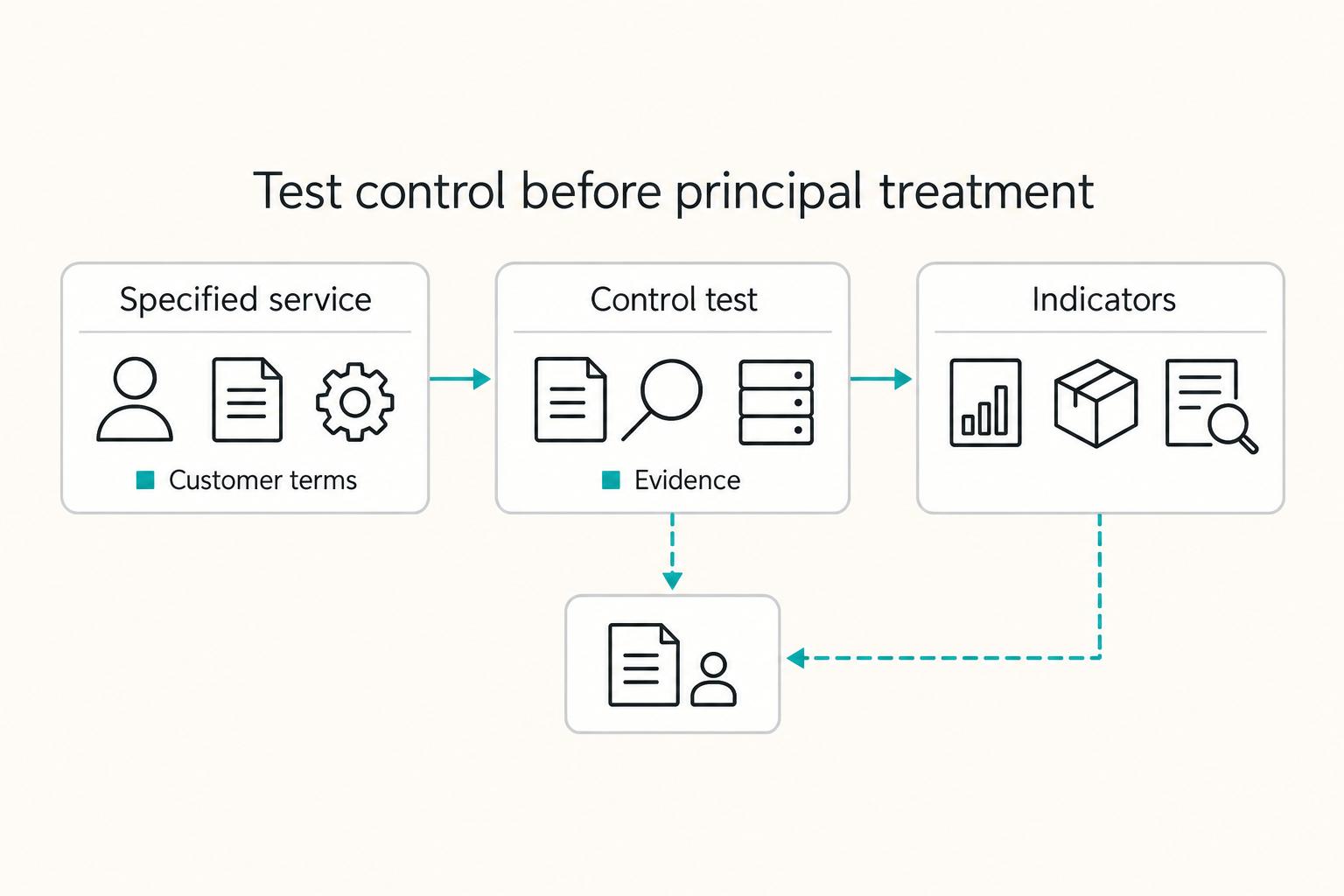
Principal versus agent under ASC 606 is a control assessment, not a presentation election. Start with two questions: what is the specified good or service, and who controls it before transfer? That conclusion drives gross-versus-net reporting.
| Operating model | ASC 606 question to answer | Revenue presentation implication |
|---|---|---|
| Platform-led MoR | Does the platform control the specified good or service before transfer, or is it arranging for another party to provide it? | Could support gross presentation if control exists before transfer; if not, net presentation may be more appropriate |
| Merchant-led MoR | Does the merchant retain control through fulfillment and customer transfer, with the platform only arranging access, demand, or payment flow? | Often points toward the platform presenting net fees if it is acting as an intermediary, but the contract and facts still decide |
| Hybrid delegation | Which party actually controls the specified good or service at the transfer point, especially when checkout, support, or refunds are split? | Most likely to create mixed indicators, so document the control analysis clearly before choosing gross or net reporting |
Use this as a decision prompt, not a shortcut. The memo should follow control analysis, contract terms, and operating facts.
Reconcile the full chain every day#
ASC 606 does not require a daily cadence, but daily reconciliation is a practical control for agent-assisted checkout at scale. Build one chain that connects commercial events, payment events, accounting entries, and exception handling before payout close.
At minimum, reconcile these four layers every day:
- Order events: created, confirmed, cancelled, fulfilled, refunded, partially refunded
- Payment events: authorization, capture, failure, dispute, payout inclusion
- Ledger journals: revenue, fees, reserves, refunds, chargebacks, tax where applicable
- Exception queues: unmatched IDs, timing gaps, duplicate events, negative balances, manual overrides
If you use Stripe, balance transactions are a strong accounting starting point because they provide a ledger-style record of inflows and outflows. The source field gives related object IDs for lineage tracing. Automatic payouts help preserve transaction-to-payout linkage, and reconciliation pulls can be triggered when payout.paid or payout.reconciliation_completed arrives.
Two failure modes to avoid: reconciling only cash movement while ignoring the commercial event trail, and letting teams key records on different IDs so payouts cannot be traced back to the original order and decision path.
Set a minimum audit pack for every payout cycle#
Define a repeatable internal audit pack for each payout or settlement cycle:
- Transaction lineage: order ID, customer or account context, payment ID, balance transaction ID, payout ID, and any dispute or refund IDs
- Policy-gate outcomes: internal approval or rejection results for consent, authentication, authorization, fraud review, or fallback handling
- Adjustment history: refunds, fee corrections, reserve movements, disputes, write-offs, and who approved them
Keep adjustment history as separate records rather than overwriting prior entries. If your team cannot pull one payout pack and show the full chain, including later adjustments, pause rollout until that is fixed.
This pairs well with our guide on What is a Merchant of Record (MoR) and How Does It Work?.
Sequence implementation so engineering and ops stay aligned#
Implement in the same order you decided liability and transaction ownership: role decision sign-off, contract language, integration path, event mapping, reconciliation tests, then controlled rollout. This keeps product, engineering, and ops working from one state model instead of patching conflicts later.
Start with one checkout-state owner#
Pick one object as the commercial source of truth for the flow and align every team to it. In OpenAI commerce specs, the merchant-managed Checkout session carries item, fulfillment, and payment information, so it can anchor both UX and reconciliation.
Before launch work starts, document which event moves a session from created to authorized, paid, fulfilled, refunded, or failed. If that mapping is ambiguous, duplicate charges, premature fulfillment, and hard-to-explain exceptions follow.
Split ownership cleanly#
Use explicit checkpoints by team so gaps are visible early:
| Team | Responsibilities |
|---|---|
| Product | Flow design, confirmation points, and buyer-facing status states |
| Engineering | Request authentication, signature verification, idempotent POST retries, and durable event handling |
| Ops | Exception queues, replay handling, and manual override decisions when automation cannot resolve safely |
Treat retries and duplicate delivery as normal operating conditions. Stripe recommends idempotency keys on POST requests, supports safe retries, and expects fulfillment handlers to tolerate repeated execution for the same Checkout Session ID.
Define source-of-truth events before testing#
For an integration using Stripe Checkout, verify the session’s server-side payment_status before fulfillment; a redirect or success page is not payment proof. For a direct PaymentIntent integration, use the PaymentIntent’s state and corresponding payment events. Map those provider states separately into your merchant order and ACP checkout records.
For Stripe Checkout with a delayed payment method, checkout.session.async_payment_succeeded signals eventual payment success. Direct PaymentIntent integrations use their corresponding PaymentIntent events instead. Handle delayed, duplicate, and out-of-order webhooks using the selected integration’s documented state model.
Before production, run this minimum test set:
- replay a duplicate event
- delay a provider webhook and confirm state remains pending
- replay an unchanged request after a transport timeout; separately test failure recovery without assuming a new key cancels the first attempt
- force a manual override and confirm the adjustment is logged, not overwritten
If any test marks an order paid without a server-verified payment signal, stop rollout and fix that first.
Validate provider and jurisdiction constraints early#
Treat country and program eligibility as a go-live blocker. A merchant-of-record setup that works in one market can fail in another because onboarding requirements, payout eligibility, tax handling, and available payment options vary by jurisdiction. Confirm coverage first, then scope rollout.
On Stripe Connect, verification requirements depend on account location, business type, and requested capabilities. Confirm active capabilities, connected-account availability, settlement currencies, and cross-border program approval for your actual platform and merchant locations. A global currency total does not establish eligibility for a particular account.
Use a written provider confirmation checkpoint for your exact markets and transaction pattern. Confirm:
- where your platform can create connected accounts from its own business location
- which capabilities must be activated
- whether cross-border payouts are approved for your program
- what tax handling is supported for your sales type in each target jurisdiction
If policy is unclear for agent-assisted or autonomous transaction flows, pause rollout and request explicit acceptance criteria in writing.
Keep a short go-live gate list signed by finance, legal, and ops:
- legal terms approved by launch country and program
- compliance map complete for KYC, payout eligibility, tax handling, and reporting ownership
- permitted payment instruments and settlement paths documented by market
- exception-handling ownership accepted by finance and ops
This risk is practical, not theoretical. OpenAI's September 29, 2025 Instant Checkout launch started with a narrow scope: U.S. ChatGPT Plus, Pro, and Free users buying from U.S. Etsy sellers, with single-item purchases first. Plan for that pattern: provider rollout scope may be narrower than your target footprint at launch.
See also: When to Use an Employer of Record for International Hiring.
Conclusion#
The practical win here is not choosing the newest protocol or checkout surface first. It is choosing a Merchant of Record and buyer-accountability model that your legal, finance, product, and engineering owners can all explain the same way when an order fails, a dispute lands, or revenue gets reviewed.
Use the authorization limits of the actual integration. OpenAI’s documented delegated-payment flow ties a payment request to a selected purchase, maximum amount, and expiry. Other designs may use a broader mandate. In each case, assign seller responsibility, consent handling, and accounting ownership explicitly.
If you take one operating recommendation from this piece, let it be this: start from the assumption that your first launch needs explicit user-linked consent, merchant-owned order accountability, and finance-approved revenue treatment. Do not expand to broader agent behavior until you can prove three things in production:
- each transaction has a usable evidence pack, including consent proof, authorization timing, actor identity context, and provider reference IDs
- daily reconciliation ties order events, payment events, and ledger outcomes back to the same transaction chain
- your provider has confirmed in writing how it treats your exact AI-agent flow, including who is considered the seller and what program limits apply
The common failure mode is not technical polish. It is organizational mismatch. Product assumes the platform is orchestrating the sale. Engineering builds around that assumption. Then provider rules or contract language may still treat the merchant as the selling party, while finance realizes principal-versus-agent is a facts-and-circumstances judgment rather than a reporting preference. Once that happens, you are not just cleaning up UX. You are rewriting contracts, receipts, support ownership, and revenue presentation after launch.
So keep the next step small and concrete. Run one internal decision session using your model comparison table and launch gates. Force answers on four points before more roadmap scope gets approved: who sells, who buys, who can accept or decline the order, and who owns dispute and reconciliation outcomes. Any policy question you cannot answer internally should go back to providers in writing, especially where protocol fragmentation means support for multiple approaches may be needed.
If those answers hold up under review, you are ready to scale carefully. If they do not, pause there. In this category, disciplined clarity beats speed.
Frequently Asked Questions
Who is usually the Merchant of Record in AI-agent commerce today?
In the documented OpenAI ACP flow, OpenAI is not the merchant of record: the merchant accepts or declines the order and processes payment on its own systems. Other programs can assign roles differently. Confirm the seller in the contracts and provider configuration rather than inferring it from the AI interface.
Are agentic payments actually live, or are most flows still agent-assisted?
Both assisted and delegated purchase designs exist, and their authorization requirements differ. For your integration, identify whether the user confirms each order or grants a bounded mandate, and retain that permission with the payment record. A single documented checkout flow does not establish what most of the industry is doing.
What is the practical difference between Merchant of Record and Buyer of Record in these transactions?
MoR is the legal entity selling to the customer and carrying the core seller obligations. Buyer of Record is often used as an operational label for the buyer identity in the transaction record, but you should not assume one universal legal definition across jurisdictions. The practical test is simple: if you cannot show who bought, who sold, and who accepted the order, operations and accounting get harder.
Can an AI agent complete checkout independently without user involvement?
An agent can act within permissions granted by a user, but the integration must define those limits and any confirmation required. OpenAI’s documented delegated-payment flow limits a token by the selected purchase, maximum amount, and expiry. That is a bounded payment permission, not unrestricted authority to buy anything.
What should a platform team decide first before integrating AI-agent checkout?
Decide who is the seller in the transaction and who controls order acceptance first. That choice shapes contracts, dispute handling, revenue presentation, and the evidence you must retain. If your team is still debating whether the platform or the merchant is really selling, do not start integration yet.
What must be verified with providers before selecting a MoR approach?
Get written confirmation for your exact AI-agent use case, not a generic marketplace yes. Verify who the provider treats as MoR in that program, whether AI-agent checkout is accepted at all, what buyer and payment data is collected from the user, and who has the final accept or decline decision on the order. One risk is building around platform-led assumptions only to learn the provider or scheme rules assign seller responsibility differently.
How do ASC 606 and principal vs agent decisions change the recommended model?
The accounting assessment asks whether the entity controls the specified good or service before it reaches the customer, or arranges for another party to provide it. That drives gross-versus-net revenue presentation; neither a merchant-of-record label nor a processor debit decides the answer. Document the contract and operational facts, then use the principal-versus-agent guide for the accounting workflow.
Try a related tool
Researched and edited by the Gruv editorial team. Gruv builds cross-border billing, payouts, and finance-operations software for global businesses.
Sources
Includes 2 external sources outside the trusted-domain allowlist.
- docs.stripe.com/connect/how-connect-workstrusted
- docs.stripe.com/connect/chargestrusted
- stripe.com/resources/more/merchant-of-recordtrusted
- stripe.com/blog/developing-an-open-standard-for-agentic...trusted
- support.stripe.com/questions/stripe-feature-availability-by-cou...trusted
- support.stripe.com/topics/disputestrusted
- about.ads.microsoft.com/en/blog/post/january-2026/conversations-that...external
- developers.openai.com/commerce/guides/key-conceptsexternal
Educational content only. Not legal, tax, or financial advice.
Related Posts

ASC 606 Revenue Recognition for Merchant of Record Platforms
If you run a Merchant of Record flow, cash movement is not your revenue policy. Under ASC 606, the hard part is that customer payment, processor settlement, and the point when revenue is actually earned can sit on different dates and in different records.
ASC 606 Principal vs Agent Decisions for Merchant-of-Record Platforms
For merchant-of-record teams, the **ASC 606 principal vs agent merchant of record** call is a high-stakes judgment, not a presentation preference. It can move revenue from gross to net and raise the level of judgment finance, audit, and compliance teams need to defend.

Paddle vs. Stripe: A Comparison for SaaS Founders
For a SaaS founder, this is a three-way choice: Paddle as Merchant of Record, Stripe Payments with Billing under your own merchant responsibility, or eligible Stripe Managed Payments transactions with Stripe as Merchant of Record. Compare those configurations before comparing fees. A standard Stripe account does not automatically make Stripe the legal seller.