
Quick Answer
Real estate agents can claim the home office deduction if they file Schedule C and can prove that a specific area of the home is used exclusively and regularly for business and that the home is their principal place of business. After qualifying, they can choose the simplified or regular method for that tax year and should keep clear photos, logs, measurements, and expense records.
The Home Office Deduction: A Strategic Asset, Not Just a Tax Break#
If you file Schedule C, the key question is not whether this deduction looks aggressive. It is whether you can prove you qualify, choose the right method for that tax year, and support the claim with clean records.
The IRS framework is qualification first, savings second. Your space must meet the core tests, including exclusive and regular use, so mixed personal and business use in the same area does not qualify, and principal place of business. A home office can also qualify through the administrative or management path when you use it for those activities and have no other fixed location for substantial admin work. Even when you qualify, your deduction may still be limited.
Here is how this article is organized:
- Part 1: claim defensibility, so you can confirm whether you qualify under IRS tests.
- Part 2: deduction value, so you can choose simplified versus regular for that year.
- Part 3: audit readiness, so your records, forms, and documentation are easy to defend.
That sequence is intentional: qualify first, then calculate. If you qualify, you can choose either method each taxable year. The simplified option reduces calculation and recordkeeping work, but it does not change the qualification criteria. Once you choose a method on a timely filed original return, you cannot switch methods for that same year. The simplified method is $5 per square foot, up to 300 square feet, and can be claimed directly on Schedule C. If you do not use it, you generally compute the allowable amount on Form 8829 for Schedule C.
Practical default: prove eligibility and business-use facts first, then optimize the deduction amount.
Related reading: Do I Have to Pay State Taxes While Living Abroad as a Digital Nomad?.
Part 1: Prove Qualification Before You Run the Deduction Math#
Qualifying is mostly a proof exercise. You need to show that your home is your principal place of business and that a specific area is used exclusively and regularly for business. If either point is weak, pause here before you run the deduction math.
If part of your income is W-2 employee compensation, note this guardrail first: employees are not eligible to claim the home office deduction for tax years beginning after 2017.
Prove your home is your administrative base#
Working outside your home does not automatically disqualify you. What matters is whether your home is your principal place of business, including through the administrative or management path when those duties happen at home and there is no other location for them.
If you rely on that path, keep the IRS language you are relying on with your records.
Use a simple Work Pattern Log to make this easier to defend. At regular intervals during the year, record the date and rough time block for at-home admin or management work, such as:
- updating CRM records and client notes
- drafting listing or marketing materials
- reviewing transaction paperwork
- tracking commissions and categorizing expenses
- sending follow-ups and scheduling
- managing pipeline, vendors, and calendar
- paying business bills and reviewing bookkeeping items
Desk fee access vs. true administrative base#
Paying a brokerage desk fee is not the issue by itself. What matters is where your admin or management work actually happens and whether another location is available for those duties.
| Checkpoint | Points away from home qualification | Points toward home qualification |
|---|---|---|
| Where admin or management is usually done | Brokerage office most days | Home most days |
| Other location for these duties | Yes, regularly available and used | No other location is available for those duties |
| Why brokerage space is used | Routine admin base | Meetings, training, pickups, occasional use |
Decision rule: if brokerage space is your routine admin base, your home-office position may be weaker. If home is your routine admin base and brokerage use is incidental, your position may be stronger.
Make exclusive and regular use easy to show#
Exclusive use is often where claims get weaker. In practice, it means a clearly defined business area used only for business on an ongoing basis.
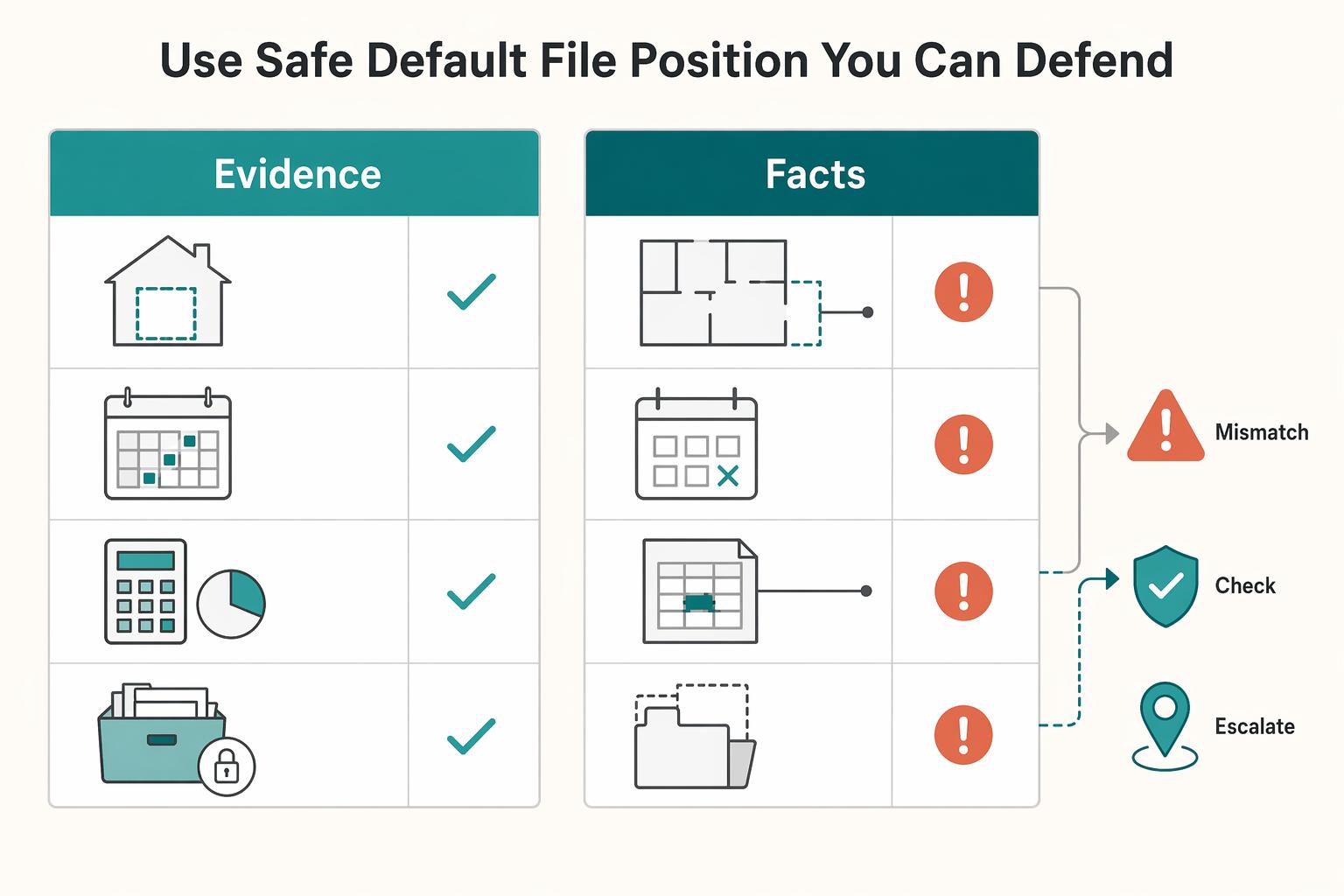
| Record | Keep | Supports |
|---|---|---|
| Photos | Dated photos of the claimed area | Exclusive use |
| Floor plan | A simple floor-plan sketch with measurements | Clearly defined business area |
| Work logs | Periodic Work Pattern Logs | Regular use |
| Calendar history | Calendar or task history showing recurring use | Regular use |
Keep those items together in one folder per tax year, cloud or local, so your support is easy to retrieve. This is an organizational best practice, not a required IRS storage format.
Mixed use can weaken a claim. If the claimed area also functions as a guest zone, dining space, gaming spot, or personal storage, your facts get harder to defend. Detached structures follow the same rule: they qualify only if used exclusively and regularly for business.
Keep method choice separate from eligibility#
Do not blur qualification and calculation. Method choice does not change eligibility.
The simplified option, $5 per square foot up to 300 square feet, simplifies calculation and recordkeeping, but the qualification rules stay the same. The regular method uses actual expenses with records maintained, generally calculated on Form 8829.
You choose a method on a timely filed original federal return, and you cannot switch to the other method for that same year. Prove qualification first, then choose the method.
When to talk to a tax pro#
Bring in a tax pro when your facts are genuinely ambiguous: shared or mixed-use space, or admin duties truly split across multiple locations. In those cases, focus on qualification first, then deduction size.
You might also find this useful: How to Write Off a Home Office as a Renter.
Part 2: Choose the Method That Justifies the Recordkeeping#
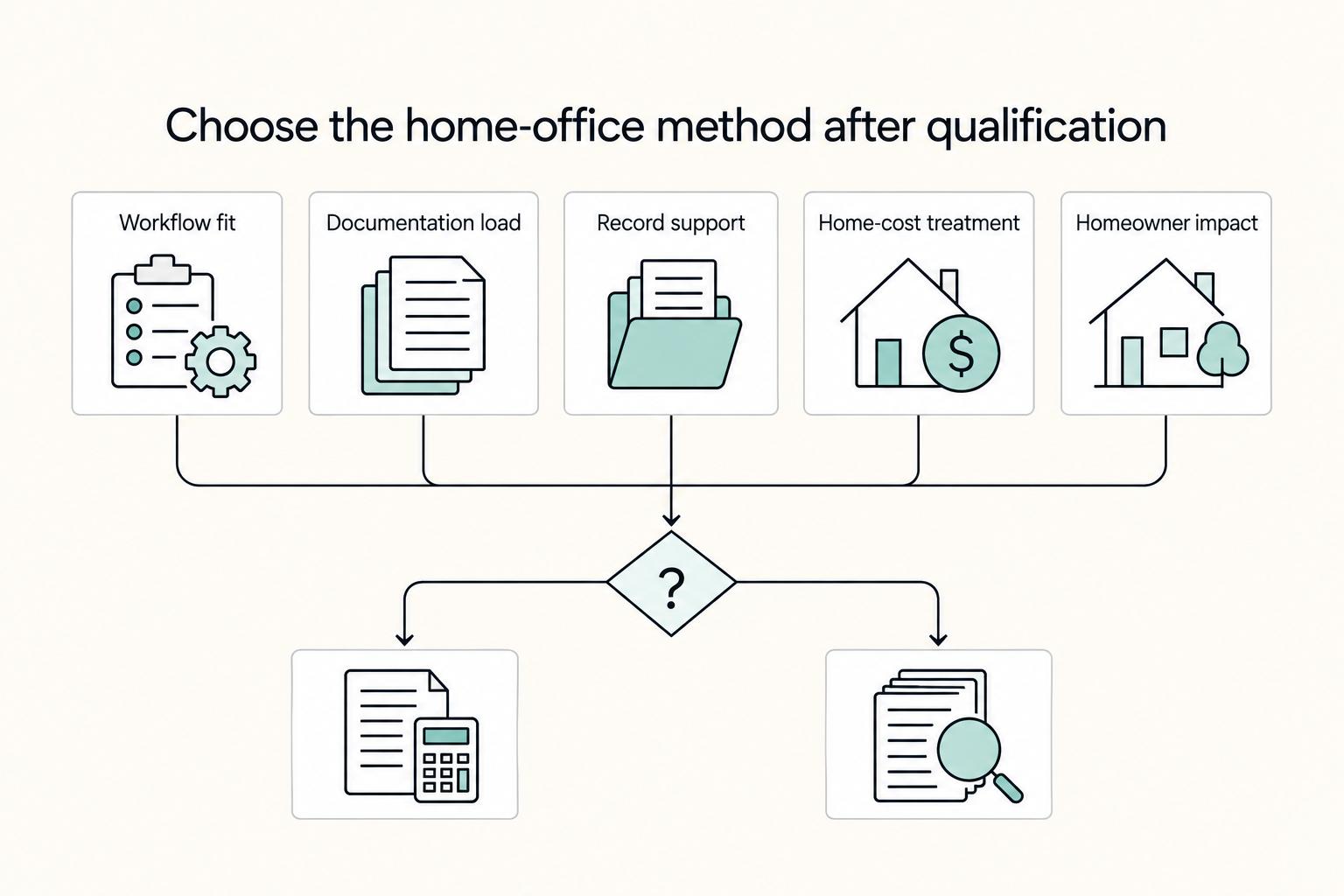
Once you qualify, the next decision is practical: choose the method that gives enough value to justify the recordkeeping. Start with the simplified option if you want lower admin overhead. Run the regular method if you have strong records and expect meaningful upside.
Your eligibility does not change based on method choice. In both methods, the area must still be used exclusively and regularly for business, and your home still needs to meet the principal-place-of-business standard from Part 1.
Choose the method that matches your workflow#
Pick the method that fits how you actually run the business, not the one that sounds better in theory. The simplified option cuts calculation and recordkeeping work. The regular method uses actual expenses and requires fuller documentation.
Before comparing methods, confirm office square footage for both methods and total home square footage for the regular method. Those measurements drive either the capped simplified calculation or the regular-method allocation.
| Decision factor | Simplified option | Regular method |
|---|---|---|
| Who this fits | You want a faster claim with lighter ongoing admin | You can support a more detailed file and want to test for larger deduction potential |
| Documentation load | Lower for calculation support, while still requiring qualification proof | Higher, because actual expenses must be determined and records maintained |
| Record support focus | Fewer allocation inputs, but qualification proof still carries the claim | More moving parts to support: qualification, expense records, and allocation method |
| Treatment of home-related expenses | Standard rate: $5 per square foot, up to 300 square feet; no home-office depreciation deduction for years you use this method | Allocate operating-home costs between personal and business use; homeowners may also account for depreciation |
| Long-term homeowner implications | No later depreciation recapture for years you use the simplified option | Sale can involve depreciation-related tax consequences |
Two rules should stay front and center: method election is annual, and once you choose on a timely original return, you cannot switch methods for that same year. If you used more than one home for business during the year, you can use the simplified method for only one home.
Run a breakeven worksheet before filing#
Do not pick a method on instinct. Run both calculations side by side, then keep that worksheet in your tax file.
| Method | Inputs to gather | Calculation sketch | Where it lands |
|---|---|---|---|
| Simplified | Office square feet, subject to the IRS cap | Office square feet × $5, up to 300 square feet | Home-office deduction amount for the year |
| Regular | Office square feet, total home square feet, eligible annual home expenses | (Office square feet ÷ Total home square feet) × allocable home expenses | Form 8829 computes allowable business-use-of-home expenses for Schedule C |
If you use the regular method, keep the measurement support and the underlying expense documents together. Form 8829 is the core calculation form for Schedule C business-use-of-home expenses, and it is also where carryover mechanics are handled.
Use the homeowner guardrail before chasing a larger deduction#
If you own your home, do not chase a larger deduction without thinking through sale consequences. The regular method can create future sale consequences through depreciation rules.
| Trigger | Relevant rule |
|---|---|
| Office area mixed with personal use | Mixed use can weaken a claim. |
| Moved, bought, sold, or used more than one home during the year | If you used more than one home for business during the year, you can use the simplified method for only one home. |
| Expect a property sale in the near or medium term | The regular method can create future sale consequences through depreciation rules. |
| Using the regular method and unsure how prior depreciation was handled | Basis is reduced by the greater of depreciation allowed or allowable, not only what you entered on a return. |
In plain terms, today's deduction can affect tomorrow's taxable gain, and basis is reduced by the greater of depreciation allowed or allowable, not only what you entered on a return.
That means skipping a depreciation entry does not automatically remove future impact. IRS guidance also ties home-office depreciation to a 39-year recovery period in this context.
Bring in a tax pro when any of these apply:
- your office area is mixed with personal use at any point
- you moved, bought, sold, or used more than one home during the year
- you expect a property sale in the near or medium term
- you are using the regular method and are unsure how prior depreciation was handled
If those triggers are absent, use a simple rule: choose simplified when regular-method upside is small or your documentation is thin. Choose regular only when the added deduction is real, documented, and worth the added maintenance.
Related: How to Handle Taxes for a Side Hustle.
Before you choose simplified or regular, run both scenarios in the home office deduction calculator and save the result with your deduction records.
Part 3: The Audit-Proof Dossier - Your System for Unshakeable Confidence#
After you choose a method, the real protection is your file. For a home-office position, your job is to keep a record set that shows what you claimed, how you calculated it, and which documents support each part of that position.
Create one folder for the tax year in a secure cloud location you already trust, then maintain it on a fixed cadence. Optional tools can help, but consistency matters more than the tool: one account flow, one categorization routine, one document home.
This section is about workflow and traceability, not the underlying eligibility rules or formulas. Keep legal-rule verification as a separate step.
Set up a records workflow you can keep all year#
The best records process is the one you will actually maintain. Start with account separation where possible: route business income and business spending through dedicated business accounts or cards, and flag exceptions immediately when a personal account is used.
| When | Action | Key detail |
|---|---|---|
| At purchase or bill receipt | Save the full document into the current tax-year folder | Do not rely on a partial screenshot |
| Weekly or twice monthly | Categorize transactions | Use home-office related, general business, personal, and needs review |
| Monthly | Reconcile statements to saved records | Clear uncategorized items |
| Year-end | Freeze the folder and export statements | Store the final calculation worksheet used for filing |
Then keep that cadence all year. A placeholder is not evidence. If a file is incomplete or unlabeled, treat it like an administrative marker, not proof. The standard is substance, not just a trace that something once existed.
Documentation map: what each file proves#
A simple document map makes retrieval faster and shows you where support is thin before filing.
| Record type | Keep this | Supports this part of your filed position | Quick check |
|---|---|---|---|
| Workspace photos | Dated images from multiple angles | Context for workspace setup over time | Can another person understand the setup from images alone? |
| Work pattern records | Calendar blocks, task logs, or weekly summaries | Timeline context for how the workspace was used for work | Does usage appear consistent over time? |
| Home-cost documents | Full bills or statements tied to the home and tax year | Source support for costs included in your worksheet | Do name, address, dates, and period match your file? |
| Direct workspace expenses | Receipts or invoices for workspace-specific costs | Source support for direct costs in your worksheet | Can you tie each cost to a saved document without extra reconstruction? |
| Calculation worksheet | Final worksheet used for return prep | How you computed the amount claimed | Can you trace totals back to source records quickly? |
Use a sortable naming pattern and stick to it, for example: YYYY-MM-DD_DocType_Vendor_Amount or YYYY-Q1_WorkspacePhotos. If helpful, add an internal ID, for example 2026-HO-017, to speed retrieval.
Five-minute audit-readiness checklist#
If you want a quick pre-filing check, use this list:
- Core files you relied on are present: photos, work-pattern records, statements, receipts, and final worksheet.
- Filenames are date-first and consistent.
- Monthly reconciliation is complete and uncategorized items are resolved.
- You can produce any requested record in under two minutes.
- The year folder is locked after filing so records are not overwritten.
When to escalate to a tax pro#
Do not wait until after filing if your records are broken. Escalate before filing if you have missing history, heavily mixed personal and business spending, conflicting records, major filing changes, or uncertainty about how tax-rule tests apply to your facts. Early cleanup is easier than defending a file you cannot fully support.
For a step-by-step walkthrough, see Home Office Deduction Rules for Freelancers With Multiple Homes.
Conclusion: Treat This Deduction as an Operating Decision#
Treat this deduction as an operating decision: document your position, choose your approach, and keep evidence in a file you can actually use at filing time.
Your Qualification Blueprint next step: confirm the facts and standards you are relying on, then write down that reasoning now. Your Optimization Engine next step: compare the approaches you are considering with your own numbers and your real recordkeeping capacity, then keep a short note on why you chose your approach. Your Audit-Proof Dossier next step: keep dated records, expense support, and your final calculation together year-round so you are not rebuilding everything at year-end.
Use primary sources in that file, not summaries. The IRS states that the Internal Revenue Bulletin is authoritative, and it also states that bulletin highlight synopses are not authoritative interpretations. So save the original IRS item and a traceable marker, for example the bulletin identifier and decision or page references, instead of relying on secondhand summaries. Apply the same caution to preliminary research papers: OFR working papers describe themselves as works in progress and not necessarily official policy.
Do this next:
- Confirm the facts and standards you are relying on while they are fresh.
- Compare your approach options with your own numbers and documentation burden, then save your rationale.
- Maintain evidence continuously so filing prep stays clean and fast.
Escalate to a tax professional before filing if your facts are ambiguous, your documentation is incomplete, or multiple rules may overlap.
We covered this in detail in Can Digital Nomads Claim the Home Office Deduction?.
If you want a cleaner operating stack for invoicing, getting paid, and keeping tax-ready records where supported, review Gruv for freelancers.
Frequently Asked Questions
Can you claim the deduction if you pay desk fees to a brokerage?
Yes, paying desk fees to a brokerage does not disqualify you by itself. What matters is whether your home meets the IRS tests, including principal place of business and exclusive and regular business use of the claimed area.
Is the simplified or regular method better for you?
Neither method is automatically better. The simplified method uses a flat rate and lighter calculation work, while the regular method uses actual expenses and generally goes through Form 8829 with Schedule C. Once you choose a method on a timely filed original return, you cannot switch for that same year.
What if you rent instead of own?
Renting does not prevent the deduction. You still need to meet the same IRS tests, including exclusive and regular use and principal place of business.
What if you work outside the home a lot?
You may still qualify even if you work outside the home a lot. The key is whether your home is the principal place of business, including for administrative or management work, and whether you have no other fixed location for substantial administrative or management work.
What records should you keep to support the claim?
Keep dated workspace photos, a floor plan with measurements, work logs or calendar history, and the bills, receipts, or statements tied to your method. Save the final calculation worksheet in an organized tax-year folder. If the space is mixed-use, records are blended, or a home sale is in view while using the regular method, consider talking to a tax pro before filing.
What happens if you use the regular method and later sell your home?
The regular method can create future sale consequences through depreciation rules. The simplified method avoids depreciation recapture for years you use simplified. This is why homeowners should weigh current deduction size against future home-sale tax impact.
Try a related tool
Researched and edited by the Gruv editorial team. Gruv builds cross-border billing, payouts, and finance-operations software for global businesses.
Sources
Educational content only. Not legal, tax, or financial advice.
Related Posts

Do I Have to Pay State Taxes While Living Abroad as a Digital Nomad?
Living abroad does not end `state income tax` exposure by itself. The first decision is practical: choose a filing position your facts can support, then build records that support the same story all year.

How to Handle Taxes for a Side Hustle
If you want less stress at filing time, use sequence instead of shortcuts. When one year includes payroll income, contractor income, and time in more than one country, the order of operations matters. This guide gives you a defensible path so you can make each decision once, document it, and avoid rebuilding the return later.
How to Write Off a Home Office as a Renter
A renter can claim the home office deduction when IRS eligibility tests are met and the business use of the home is clear to document. You are the CEO of a business-of-one, so run this like an operating decision: qualify first, document second, then calculate. If you want a low-friction approach, start with compliance, not aggressive tax savings.