
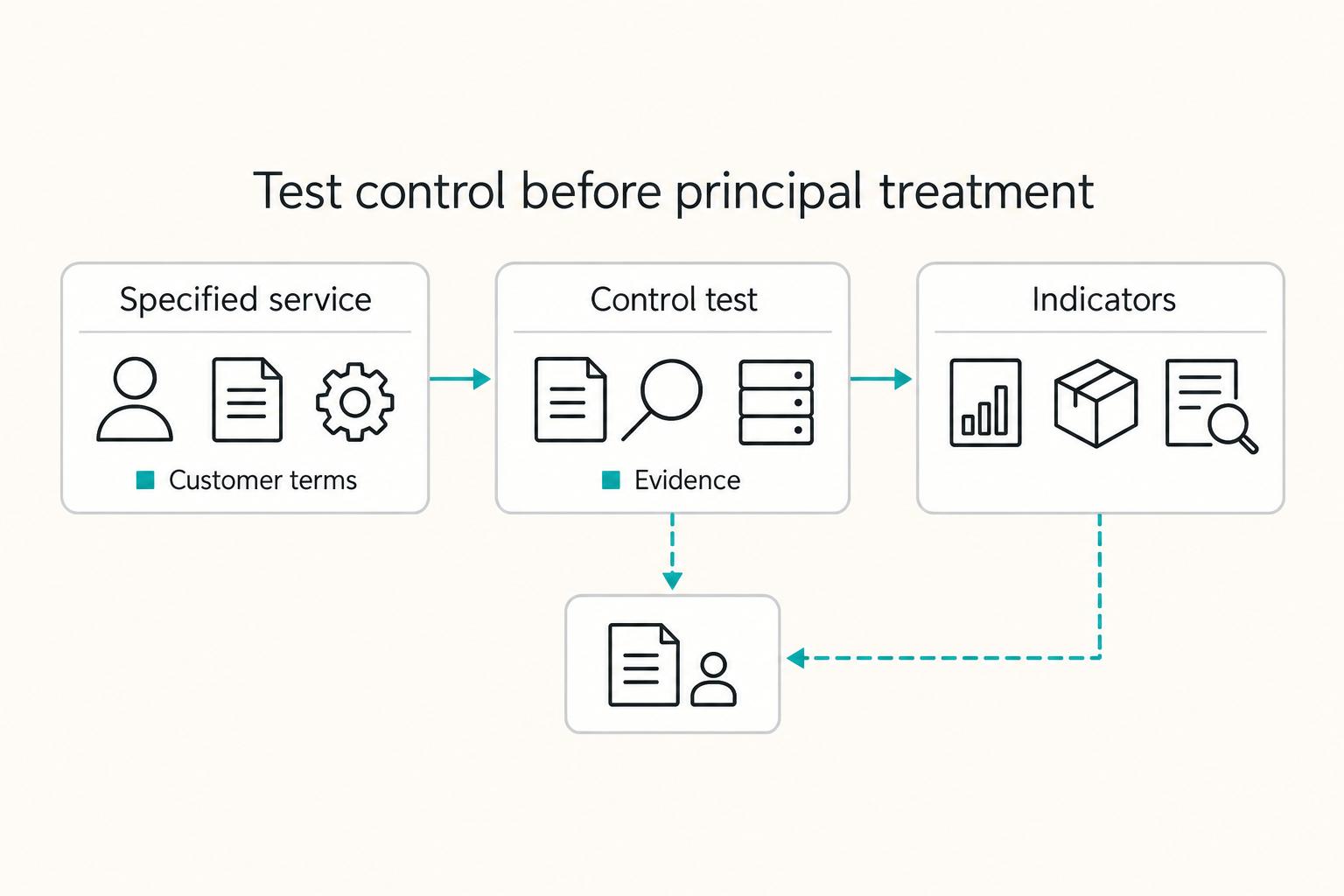
Quick Answer
Yes: under asc 606 principal vs agent merchant of record, your team should conclude principal only when it can show control of the specified good or service before transfer to the end customer under ASC 606-10-55-37. Merchant-of-record labeling, settlement flow, or brief legal title are not enough on their own. If control support is incomplete, keep the position provisional, evaluate relevant indicators, and escalate before reporting lock.
Map control before choosing gross or net revenue#
For merchant-of-record teams, the ASC 606 principal vs agent merchant of record call is a high-stakes judgment, not a presentation preference. It can move revenue from gross to net and raise the level of judgment finance, audit, and compliance teams need to defend.
That is because principal-versus-agent guidance sits inside Revenue from Contracts with Customers, not beside it. The assessment applies to revenue arrangements involving an intermediary, which usually means three or more parties in the chain. If you conclude you are the principal, revenue is generally presented at the gross amount received for the goods or services. If you conclude you are the agent, revenue is generally presented at the net amount. PwC also notes that this judgment often affects more than presentation, with implications for other parts of the five-step model.
The first practical checkpoint is simple: verify that you are looking at the actual multi-party arrangement, not just the payment flow. If your team cannot clearly map the platform, supplier, and end customer roles, you are already at risk of making the wrong call. A common failure mode is letting a commercial label like merchant of record stand in for the accounting conclusion. That label may matter for contracts and operations, but by itself it does not settle whether you are principal or agent under ASC 606.
This guide is narrower, and more useful, than a generic explainer. You should leave with a practical decision sequence, an evidence checklist, and clear points where finance should stop and bring in technical accounting or legal review. In practice, that can mean testing one transaction stream at a time, checking what evidence supports your conclusion, and identifying where your documentation is thin before quarter end rather than during audit review.
This article is an interpretation aid for platform teams, not a substitute for fact-specific advice. Principal-versus-agent conclusions often require significant judgment, and published technical guidance warns that not every fact pattern is covered. Use what follows to structure the analysis, build a reviewable record, and spot escalation issues early. If your facts are mixed or your conclusion depends on a close judgment call, treat that as a specialist review issue, not a drafting exercise.
For adjacent SaaS recognition context, see Revenue Recognition for SaaS Companies Under ASC 606.
Principal vs agent at a glance for MoR teams#
Start with one question: did you control the specified good or service before transfer to the end customer? FASB's principal-versus-agent amendment makes that control test central. If yes, you are closer to principal. If you mainly arranged for another party to provide it, you are closer to agent. If that control case is weak or mixed, do not force a gross-vs-net conclusion.
| Criteria | Principal | Agent | What finance and compliance should verify |
|---|---|---|---|
| Control of the specified good or service | Controls the specified good or service before transfer | Does not control it before transfer; arranges for another party to provide it | Define the specified good or service first, based on what is transferred to the end customer |
| Delivery responsibility | Facts indicate the entity is responsible for the promised transfer | Facts indicate another party provides the promised transfer | Check who is accountable when fulfillment, access, or service delivery breaks |
| Legal title | May support the analysis, but is not decisive alone | Momentary title alone does not establish control | If title is brief, treat it as limited evidence and test control using full arrangement facts |
| Revenue presentation | Generally gross | Generally net | Link presentation to the control conclusion, not billing or settlement flow |
| Three-party complexity | Can still be principal, but requires clear support that you control what the end customer receives | Common when the platform connects supplier and customer without pre-transfer control | Map all parties and test who serves the end customer for the specified good or service |
| Evidence burden under ASC 606-10 | Judgment must be supported by arrangement-specific facts showing control before transfer | Judgment must be supported by facts showing an arranging role | Retain the contract set, customer terms, supplier terms, and a memo that explains the conclusion; if unclear, use ASC 606-10-55-39 indicators |
| Unknowns that trigger escalation | Conflicting facts, mixed obligations, disputed specified good or service, or unresolved indicators | Same | Escalate before close instead of forcing a binary call on incomplete facts |
Sequence matters: identify the specified good or service first, then assess control before transfer. In three-party arrangements, weak scoping in step one usually leads to the wrong principal-versus-agent answer.
Treat labels as labels. Merchant-of-record status, invoicing flow, tax handling, or momentary legal title do not by themselves prove control.
ASC 606-10 does not prescribe one universal file checklist, so your standard is auditability: can a reviewer reconstruct your judgment from retained evidence? If not, escalate.
If you want a deeper dive, read ASC 606 for Platforms: How to Recognize Revenue When You're the Merchant of Record.
Map the transaction before you classify it#
Map the transaction structure and the specified good or service first, then classify principal versus agent. If you cannot clearly identify the platform, supplier, and end customer in each three-party arrangement, the classification is not ready.
Start from the intermediary perspective and confirm the arrangement involves three or more parties. Then define the performance obligation and specified good or service at the unit level, because the core question is whether you promised to provide that good or service yourself or arrange for another party to provide it.
| Mapping step | What to confirm | Common mistake |
|---|---|---|
| Contract chain | Identify platform, supplier, and end customer for each flow | Ignoring one party in the three-party arrangement |
| Unit of account | Define the performance obligation and specified good or service at the end-customer level | Using internal labels instead of the customer promise |
| Commercial labels | Record labels such as merchant of record or buyer of record | Treating labels as the accounting conclusion |
| Mixed flows | Assess each specified good or service separately | Forcing one conclusion across the whole contract |
Do not collapse unlike flows into one answer. Under ASC 606, you can be principal for some specified goods or services and agent for others in the same contract, and significant judgment is often required.
If the facts are mixed after mapping, use ASC 606-10-55-39 indicators with all relevant facts and circumstances to inform the control assessment (ASC 606-10-25-25). Related: Merchant of Record for AI Agents: Who Is the Buyer of Record in Autonomous Transactions?.
Apply the control test in a repeatable sequence#
Apply the principal-versus-agent analysis in a fixed order: identify the specified good or service, decide whether you control it before transfer, then use indicators only to support or challenge that preliminary view. That sequence follows ASC 606-10-55-37, which centers the conclusion on control before transfer, not on payment flow or merchant-of-record labels.
Start at the end-customer level. If the specified good or service is not clear, return to ASC 606-10-25-19 through ASC 606-10-25-22 before classifying principal or agent.
Use a strict sequence, not a pile of indicators#
| Step | What to do | ASC 606 reference |
|---|---|---|
| 1 | Name the specified good or service in customer-facing terms | ASC 606-10-25-19 through ASC 606-10-25-22 |
| 2 | Test control before transfer | ASC 606-10-55-37 |
| 3 | Assess indicators as evidence, not as a shortcut | 606-10-55-39A |
- Name the specified good or service in customer-facing terms.
- Test control before transfer under ASC 606-10-55-37.
- Assess indicators as evidence, not as a shortcut. Under 606-10-55-39A, indicator relevance changes with the nature of the specified good or service and the contract terms.
Use a clear decision rule: if you cannot show control before transfer, do not default to principal treatment because your platform touches funds. Also, another party performing fulfillment does not automatically make you an agent, because a principal may use another party to satisfy the promise.
Run a contradiction check before close#
Before sign-off, test whether any evidence is being overstated. A key example is legal title: if title passes only momentarily, treat it as non-decisive unless it is tied to actual control before transfer. ASC 606 technical guidance states that an entity does not necessarily control a specified good if it obtains legal title only momentarily.
A practical check is to align customer terms, supplier agreement, and a sample transaction record, then identify the transfer point to the customer and what rights your entity had immediately before that point.
| Decision checkpoint | What you are deciding | Required artifacts | ASC 606 anchor | Suggested approval owner |
|---|---|---|---|---|
| Specified good or service | What exactly the customer is promised | Customer-facing terms, product/checkout description, supplier contract excerpt, sample order record | ASC 606-10-25-19 through 25-22 | Revenue accounting owner |
| Pre-transfer control | Whether your entity controls that specified good or service before transfer | Contract memo on rights/obligations, fulfillment flow, operational evidence of who directs provision before transfer | ASC 606-10-55-37 and 55-37A | Technical accounting |
| Indicator assessment | Whether indicators support or contradict the preliminary control view | Indicator analysis tied to contract terms and facts, contradiction log | 606-10-55-39A | Technical accounting plus controllership |
| Contradiction check | Whether legal title or fund flow is being overstated | Title passage clause, settlement flow, delivery timing, exception notes | ASC 606 control principle | Legal or compliance review |
| Final sign-off | Whether the conclusion is documented and reporting-ready | Judgment memo, artifact index, unresolved issues list, approval record | ASC 606 judgment area | Controller with legal/compliance input |
If checkpoint two is not clearly supported, keep the conclusion provisional and escalate before reporting lock. This is a high-judgment area, so the conclusion should rest on a documented control narrative and supporting artifacts.
For a step-by-step walkthrough, see Merchant of Record for Platforms and the Ownership Decisions That Matter.
Scenario calls for common platform setups#
Do not classify contractor, seller, and creator flows by label. Under ASC 606-10-55-37, the answer depends on the specified good or service in each stream and whether your entity controls it before transfer. If you cannot show pre-transfer control, treat the conclusion as provisional and escalate before close.
Using the same lens across platform setups prevents inconsistent treatment. Even when checkout, settlement, or merchant-of-record paperwork looks similar, the principal-versus-agent conclusion can differ by stream. In arrangements with three or more parties, start with what the end customer is actually buying in that line item.
| Flow setup | Specified good or service to test | What could support a principal conclusion | What points to agent or at least provisional treatment | Artifacts to review |
|---|---|---|---|---|
| Contractor payment flow | The end-customer service performed for the customer | Evidence your entity controls that service before transfer, not just cash movement or invoicing | You only arrange for the contractor to perform and cannot show control of the service before the customer receives it | Customer terms, contractor agreement, service acceptance record, sample order timeline |
| Seller payment flow | The product or product bundle transferred to the customer | Evidence your entity controls the product before customer transfer | Your role is limited to arranging the sale; brief legal title alone is weak evidence | Seller agreement, checkout terms, order and delivery record, return or refund clauses |
| Creator payment flow | The content, access right, or other digital service promised to the end consumer | Evidence your entity controls that promised access or service before transfer | You mainly connect customer and creator, while the creator controls what is provided to the customer | Creator agreement, subscriber terms, entitlement logs, fulfillment or access record |
Worked example: a contractor service sold through a platform#
Hypothetical facts. A customer books a $100 home repair through a platform that is merchant of record for checkout. The customer terms identify the independent contractor as the repair provider. The contractor sets the repair scope and price, supplies the labor, and must correct defective work. The platform promises to arrange the booking and collect payment; its supplier agreement gives it no right to direct the contractor to perform the repair on the platform's behalf. The platform collects $100, owes $85 to the contractor, and earns a $15 arrangement fee when the customer accepts the completed repair. Assume no tax, refunds, or other separate promised services in this illustration.
The specified customer service is the repair, transferred when the customer accepts the completed work. On these facts, the platform arranges for the contractor to provide that repair and does not control the repair or a right to direct its provision before transfer. The supported conclusion for this specified service is agent: when the fee is earned, it presents $15 revenue, while the other $85 is due to the contractor. For comparison, if changed facts supported a principal conclusion for the same $100 repair, the illustration would show $100 gross revenue and $85 contractor cost, yielding the same $15 gross profit before other costs. Cash collection and the merchant-of-record label do not choose between those presentations.
Contrary facts still need review: the platform runs checkout, handles payment disputes, and may offer customer refunds. Those facts may affect the indicators, but they do not by themselves establish pre-transfer control of the repair. A conclusion could change if the customer contract instead made the platform responsible for delivering an acceptable repair and the supplier agreement gave it an enforceable right to direct or replace the contractor before service transfer. Reassess the actual rights, fulfillment responsibility, pricing discretion, and other relevant indicators before changing to gross presentation; do not infer control from the label alone.
One company can be principal in one stream and agent in another without contradiction. ASC 606 requires separate assessments when there is more than one specified good or service, and one contract can produce mixed outcomes. For example, a platform may be principal for its own platform access or support service, but agent for third-party creator content sold through the same checkout, because the performance obligation facts differ.
Use a sample-based proof test before close. Pull one completed transaction from each stream, mark when the customer received the promised good or service, then compare customer-facing terms, supplier-side terms, and operational logs to confirm what rights your entity had immediately before that point. A common failure mode is reusing one memo across all payout types because the funds flow is uniform.
What changes the answer enough to trigger reassessment?#
Reassess when the facts supporting the conclusion change, not just when payment flow changes. Common triggers include:
| Trigger | What changed | Focus |
|---|---|---|
| Contract amendments | Who promises the end-customer deliverable or bears the customer-facing obligation | End-customer deliverable |
| Supplier substitutions | Who provides the specified good or service and what rights your entity has before transfer | Rights before transfer |
| Customer-facing obligation changes | Access terms, refund promises, support commitments, or fulfillment responsibility | Customer-facing obligation |
Keep the analysis at the specified-good-or-service level. If control before transfer is not clearly documented for that stream, do not force a principal conclusion for reporting.
Hidden tradeoffs competitors skip#
The core tradeoff is not just gross-versus-net optics. It is whether your ASC 606-10-55-37 conclusion is supportable enough to hold up in review while still reflecting how the business evaluates performance.
| Call you make | What looks attractive at first | What you give up | What to verify before close |
|---|---|---|---|
| Over-call principal | Higher reported revenue because principal generally presents gross consideration | Weak control support can increase challenge risk if the file does not show control of the specified good or service before transfer | Match customer terms, supplier agreement, and operational logs to the exact transfer point |
| Over-call agent | More conservative net presentation and a lower top line | External reporting may drift from internal operating views, pricing analysis, and gross profit percentages | Confirm you are not netting a stream where you actually control the promised good or service before transfer |
| Build a tighter, evidence-backed judgment | More defensible presentation tied to arrangement facts | More monthly review work, more document retention, and potentially slower close when evidence is scattered | Require a memo, sample transactions, and contradiction checks for each material stream |
Over-calling principal can make top-line results look stronger, but classification affects the amount of revenue recognized and can significantly shift top-line revenue and gross profit percentages, even when net income is unlikely to change. If control evidence is thin, the larger number comes with a weaker support file. A study of US public-company filings found that firms with principal-versus-agent exposure had a higher likelihood of revenue-related SEC comment letters and higher audit fees before ASC 606 adoption; those differences declined after adoption. That historical association is context, not a risk estimate for a particular platform today.
Over-calling agent creates a different risk. The presentation may look conservative, but it can reduce comparability with how management prices, forecasts, and evaluates stream economics. Conservative is not automatically correct under this analysis.
A common failure mode is treating merchant of record as the conclusion instead of a label to investigate. Principal-versus-agent is a facts-and-circumstances judgment, and momentary legal title is not decisive control evidence. If the file says "merchant of record, therefore principal" without showing rights immediately before transfer, the conclusion is fragile.
If gross presentation matters, earn it with evidence. For each material stream, keep one completed transaction pack with the customer promise, supplier obligation, and operational record showing when the good or service reached the customer. If those three conflict, escalate instead of forcing a principal conclusion to protect optics.
Stronger controls improve defensibility, but they add close-cycle workload. More sampling, tighter contract review, and documented judgment are often worth it for material streams, while lower-volume lines may support a lighter cadence with clear escalation triggers.
Build the evidence and reporting checklist finance can run monthly#
Treat the principal-versus-agent conclusion as a monthly evidence process, not a one-time memo. Under ASC 606, this analysis applies to arrangements with three or more parties and is made for each promised good or service, so your checklist should test each stream separately.
Run a monthly checklist#
Use a compact checklist that ties control conclusions to evidence before reporting lock. This format is practical, not ASC 606-mandated.
| Control assertion | Required document | Data source | Owner | Review cadence |
|---|---|---|---|---|
| The promised good or service is identified at the right unit of assessment | Customer terms and supplier agreement or statement of work showing the performance obligation | Contract repository, legal tracker | Revenue accounting with legal support | Monthly for new or changed streams |
| The company controls the specified good or service before transfer when asserting principal | Executed contract set plus fulfillment, delivery, or service-completion evidence tied to transfer point | Order records, fulfillment logs, service tickets, platform event logs | Revenue accounting with operations | Monthly sample for material streams |
| If control is unclear, ASC 606-10-55-39 indicators were assessed with full facts and circumstances | Current judgment memo showing indicator analysis, contradictions, and conclusion | Technical accounting files | Technical accounting or controllership | Monthly for open or material judgments |
| Revenue presentation and disclosures reflect the judgment and any changes in judgment | Close memo and disclosure support tied to ASC 606-10-50-1 objective | Close binder, reporting support files | Financial reporting | Each close, with disclosure refresh each reporting period |
| Changes in the three-party arrangement were screened for reassessment | Contract amendment, supplier change notice, product or routing change record | Contract management, product release log, vendor onboarding records | Controllership with product and legal | Monthly exception review and on change |
Before reporting lock#
Run three checks before close. First, resolve contradictions across customer terms, supplier obligations, and operational evidence. Second, close missing evidence gaps. Third, resolve or escalate open ASC 606 judgment memos. If additional evidence is still needed, work through ASC 606-10-55-39 with all relevant facts and circumstances.
What to archive and what to refresh#
Archive a representative transaction pack for each material stream: the contract version in force, current judgment memo, sample transaction evidence, and review sign-off. Keep records of judgment changes because ASC 606 requires disclosure of judgments and changes in judgments that affect revenue.
Refresh the file when facts change, not only at year-end. In a three-party arrangement, reassess when promised goods or services change, supplier responsibilities shift, customer terms are amended, or product changes affect who directs fulfillment.
You might also find this useful: Subscription Revenue Recognition for Bundles and Discounts: ASC 606 Allocation Rules.
Know when to escalate and who signs off#
Treat the classification as open and escalate before close when the specified good or service is disputed, control evidence conflicts, or the customer obligation changes in a way that could affect control before transfer.
A practical minimum is a three-stop review: finance owner to frame the transaction and collect evidence, compliance to test operating reality against the customer-facing promise, and technical accounting or legal to challenge the ASC 606 conclusion. That is not a codified signer order under ASC 606; it is a control for a judgment-heavy area that SEC staff has described as a frequent consultation topic. The checkpoint is simple: reviewers should be able to trace the latest executed customer terms, supplier agreement, and any approved modification to the same conclusion.
| Escalation trigger | What usually changed | Minimum review path | What to attach |
|---|---|---|---|
| Disputed specified good or service | Teams may be classifying the wrong unit of account | Finance owner plus technical accounting/legal | Contract set, obligation mapping, transaction sample |
| Conflicting control evidence | Contract terms and operating evidence point in different directions | Finance owner, compliance, technical accounting/legal | Customer terms, supplier terms, fulfillment evidence, contradiction note |
| Material change in customer obligation | Scope or price changed through an approved modification | Finance owner plus technical accounting/legal | Amendment, pricing change, updated judgment rationale |
| New market, new template, or role shift for merchant of record or buyer of record | Facts and responsibilities may have changed even if labels did not | Finance owner, compliance, legal | New template, local terms, responsibility matrix |
Two red flags need special treatment. First, momentary legal title alone is not determinative evidence of control. Second, if you still need ASC 606-10-55-39 indicators to reach a conclusion, keep the position in escalation until the facts-and-circumstances analysis is complete.
Final rule: no classification is final without documented rationale tied to ASC 606-10-55-37, showing why you do or do not control the specified good or service before transfer.
Conclusion#
The decision rule is narrower, and harder, than the label suggests. Under ASC 606, principal status is not determined by a commercial label alone, by who bills the customer, or by who handles cash. The core test in ASC 606-10 55-37 is whether you control the specified good or service before it is transferred to the customer.
That matters because the classification is not just a presentation footnote. Principal versus agent affects gross versus net revenue, and the conclusion can also affect other parts of the five-step model. In a three-party arrangement, a practical mistake is testing the wrong promise or treating a commercial label as if it answered the accounting question.
Your operating posture should reflect that this is an ongoing judgment area, not a one-time memo. Contracts change, supplier roles change, and new or modified arrangements create fresh pressure to revisit earlier conclusions. Regular evidence reviews and explicit escalation triggers do not remove judgment, but they can help teams test whether the documented story still matches the live transaction before close.
A good verification checkpoint is simple. Can a reviewer start with the executed customer terms, supplier agreement, and any approved contract modification, then trace to fulfillment records or operational logs and reach the same transfer-of-control conclusion without filling gaps by assumption? If not, your file is not ready. A risk is copying a conclusion from an older template after a new market launch, a changed customer obligation, or a supplier substitution. Another is relying on brief legal title or payment handling when the operating facts do not show control before transfer.
The most practical next step is to start with one representative transaction and run it through the full sequence again, then repeat for other material flow or market differences. Identify the specified good or service. Test control before transfer. Then see whether the indicators support or contradict that initial view. Document where the contracts, operational evidence, and reporting treatment line up, and where they do not. Then update the contract language, evidence collection, and review controls before you extend a conclusion to additional flows or markets.
So the verdict is straightforward. If you cannot demonstrate transfer of control over the specified good or service before customer transfer, do not force principal treatment for top-line optics. Treat the position as provisional, escalate the gaps, and reassess whenever the arrangement changes.
Frequently Asked Questions
What is the ASC 606 test for principal vs agent in a platform transaction?
Start with ASC 606-10 55-37: an entity is a principal only if it controls the specified good or service before it is transferred to the customer. If that control conclusion is not clear from the facts, evaluate the indicators in ASC 606-10-55-39 with all relevant facts and circumstances. This is a judgment test, not an accounting policy choice.
Does holding legal title briefly make a merchant-of-record platform a principal?
No. ASC 606 guidance says obtaining legal title only momentarily does not necessarily mean the entity controls the good. Merchant-of-record labeling, brief title transfer, or payment flow by themselves are not determinative of principal status.
Why must teams identify the specified good or service before classifying principal or agent?
Because the analysis is performed for each specified good or service promised to the customer, not for the platform label as a whole. ASC 606-10 55-36A frames the sequence by focusing first on the nature of the promise and then the control assessment for the specified good or service.
When does principal-versus-agent analysis apply in a three-party arrangement?
It is relevant when a revenue arrangement involves three or more parties, which is common in platform structures. The core question is whether the entity provides the good or service itself (principal) or arranges for another party to provide it (agent).
Can one platform be principal for one performance obligation and agent for another?
Yes. A single contract can include different specified goods or services, and the entity can be a principal for some and an agent for others. The conclusion can differ across items in the same contract.
What evidence should finance retain to support transfer-of-control conclusions?
ASC 606 does not provide a universal evidence-retention checklist for all platforms. Keep documentation that supports the control conclusion for each specified good or service and shows how the facts and circumstances were evaluated under ASC 606-10-55-37 and, when needed, ASC 606-10-55-39.
When should compliance teams escalate a principal-versus-agent judgment for specialist review?
Escalate when additional evidence is needed to reach a conclusion and the team must rely on ASC 606-10-55-39 indicators weighed against all relevant facts and circumstances.
Researched and edited by the Gruv editorial team. Gruv builds cross-border billing, payouts, and finance-operations software for global businesses.
Sources
Includes 6 external sources outside the trusted-domain allowlist.
- pure.psu.edu/en/publications/principal-versus-agent-consi...trusted
- sec.gov/newsroom/speeches-statements/griffin-remarks...trusted
- assets.ctfassets.net/rb9cdnjh59cm/4D7ffW50p0GAVsrw5epBrm/322579a1...external
- dart.deloitte.com/USDART/home/codification/revenue/asc606-10/r...external
- dart.deloitte.com/usdart/home/codification/revenue/asc606-10/r...external
- kpmg.com/us/en/frv/reference-library/2025/handbook-re...external
- revenuehub.org/article/principalagent-considerations-gross-...external
- storage.fasb.org/ASU%202016-08.pdfexternal
Educational content only. Not legal, tax, or financial advice.
Related Posts

ASC 606 Revenue Recognition for Merchant of Record Platforms
If you run a Merchant of Record flow, cash movement is not your revenue policy. Under ASC 606, the hard part is that customer payment, processor settlement, and the point when revenue is actually earned can sit on different dates and in different records.
Merchant of Record for AI Agents and Buyer of Record Decisions
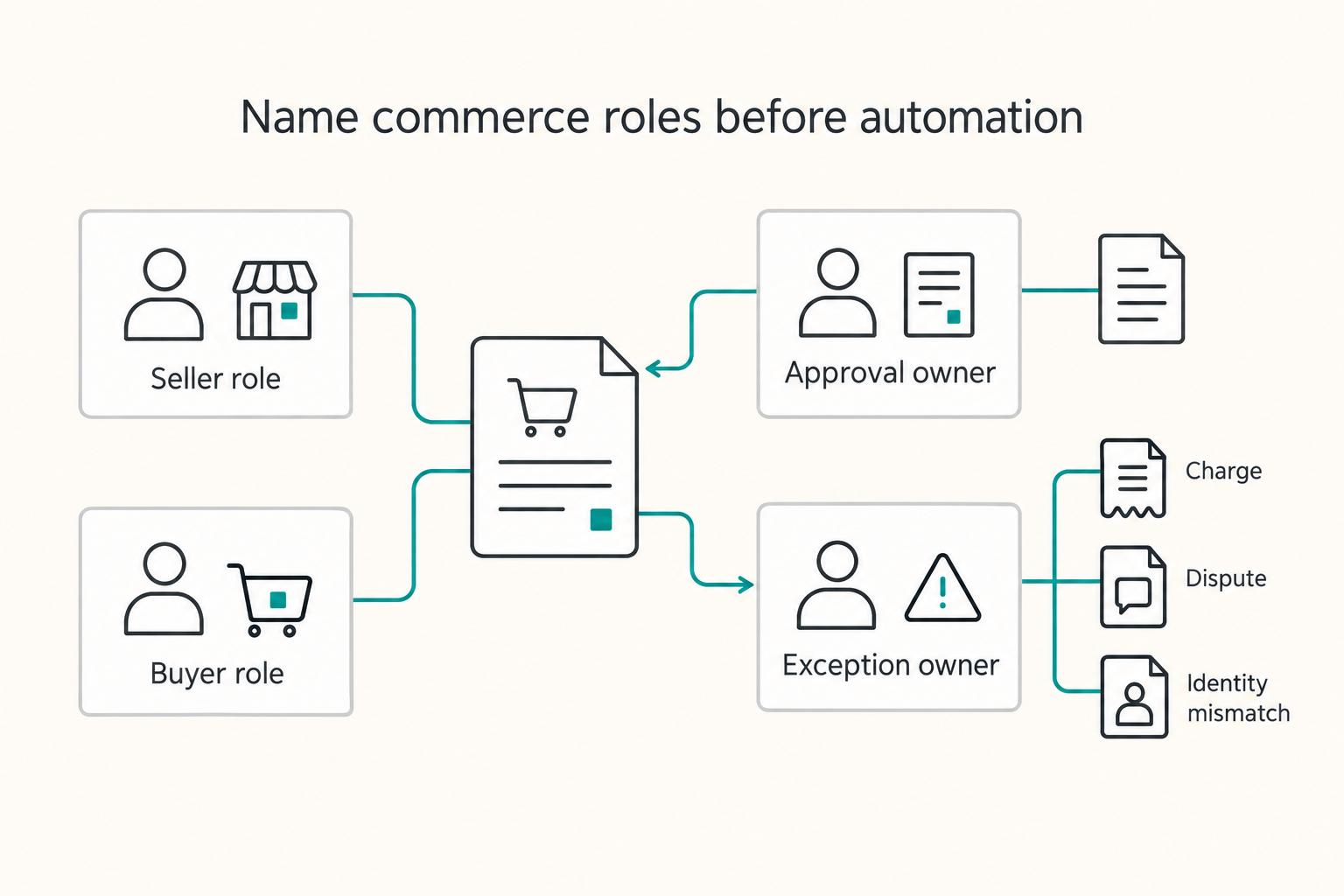
AI commerce is moving faster than role clarity, and that is where teams get into trouble. Before you debate protocols or checkout surfaces, decide who is actually selling, who is the recognized buyer, who captures approval, and who owns the fallout when a charge, dispute, or identity mismatch shows up later.
Subscription Revenue Recognition for Bundle Discounts Under ASC 606
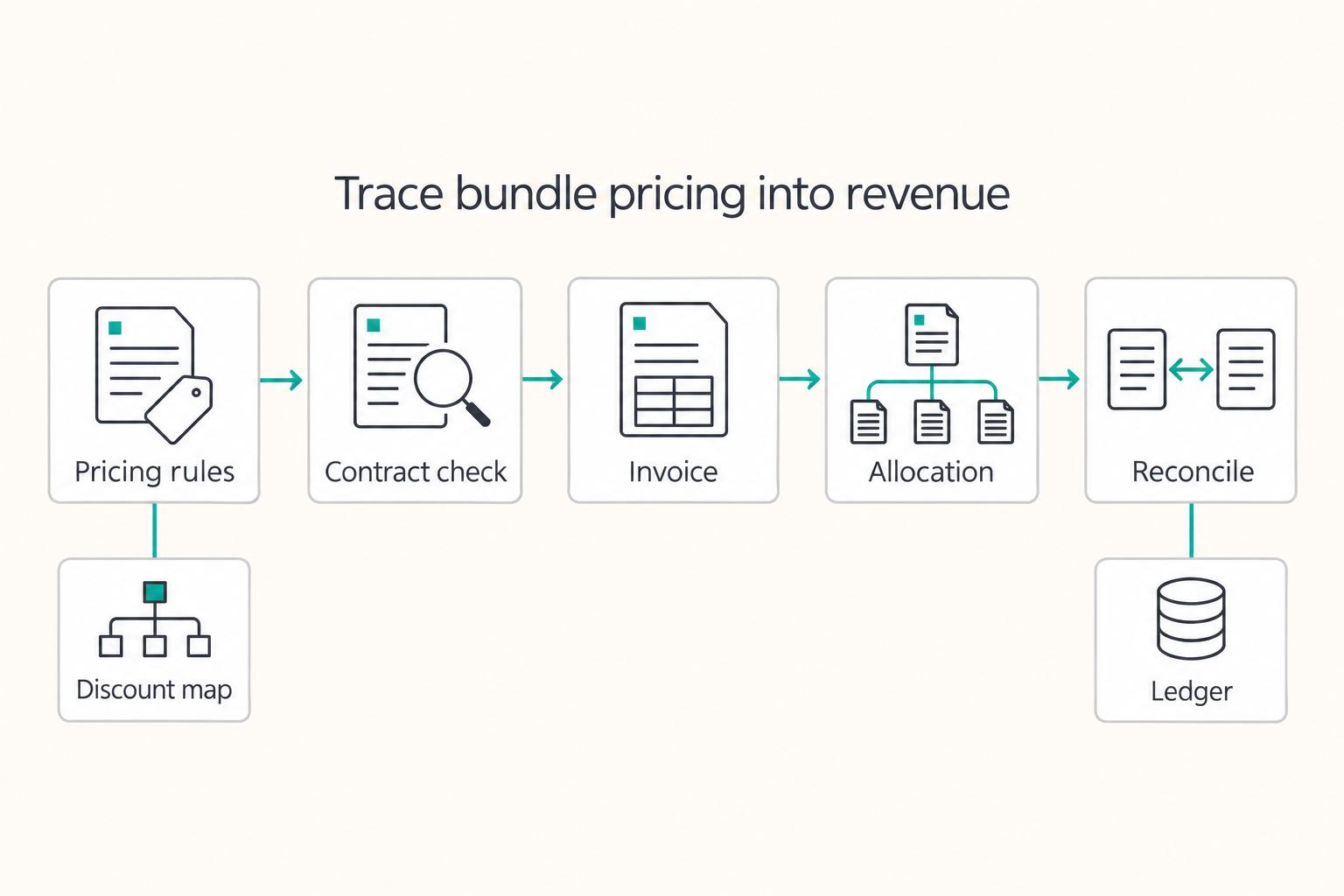
A discounted subscription bundle can put one amount on an invoice while producing several revenue schedules. The invoice total does not tell finance how much belongs to software access, a distinct training service or another promised deliverable. Start with the actual promises and supported stand-alone selling prices, then calculate the allocation and recognize each amount when or as its obligation is satisfied.