
Quick Answer
Under ASC 606, identify the contract and performance obligations, determine and allocate the transaction price, then recognize revenue as each obligation is satisfied. For a qualifying single evenly delivered 12-month service with US$12,000 prepaid, recognize US$1,000 per completed month and retain the unearned balance as a contract liability. Check setup, changes and refund terms separately.
Separate Collections, Contract Balances and Earned Revenue#
Under ASC 606, revenue follows the transfer of promised goods or services rather than the date money arrives. A customer prepayment for future service creates a contract liability, commonly called deferred revenue. Cash, billings, receivables and recognized revenue therefore need separate records.
That rule changes day-to-day decisions. A large annual prepayment can make one month look stronger than it is on an earned basis. That can distort spend, hiring, runway, and pricing decisions.
| Founder decision | Cash-balance decision-making | Earned-revenue decision-making |
|---|---|---|
| Spend | Treats upfront collections as budget you can use now | Separates earned revenue from deferred revenue before committing spend |
| Hiring | Hires after a strong cash month | Hires against cleaner P&L trends and recurring earned revenue |
| Runway | Assumes bank balance reflects operating performance | Separates cash on hand from revenue recognized and services still owed |
| Pricing confidence | Reads a big prepay month as pricing proof | Looks for consistent earned-revenue patterns before changing price or packaging |
For example, a January collection can fund operations while the company still owes service through December. Build the cash forecast from available cash, expected collections, delivery costs, expenses and refund exposure. Deferred revenue is not necessarily restricted cash or an amount repayable on demand; it identifies an obligation that still needs accounting and operational attention.
Second, valuation and diligence readiness. Revenue is a core performance signal in investor review, and ASC 606 and IFRS 15 were built to improve comparability. Proper reporting does not guarantee a higher multiple, but it can make your numbers easier to evaluate. Recurring revenue schedules, contract-balance movement, and a clear split between billed, collected, earned, and still owed all help. Keeping one-time fees separate from subscription revenue can make recurring performance easier to see.
Third, better operating decisions. SaaS revenue requires judgment and estimates, so this is not something you set once and ignore. You need regular visibility into deferred revenue rollforward and the timing of remaining performance obligations. You need to know what is still on the balance sheet and when it should convert to revenue. If month-end close cannot show opening deferred revenue, closing deferred revenue, and revenue recognized from that balance, planning is running on partial data.
The mindset shift is simple: cash received and revenue earned are different signals. The next step is to apply that distinction directly to everyday decisions.
Use the Annual Subscription Example With Clear Assumptions#
The example below assumes a valid ASC 606 contract for a single stand-ready hosted service, available evenly from 1 January through 31 December. It excludes sales taxes, variable usage charges, financing adjustments and separate obligations. Those assumptions make a simple time-based schedule appropriate.
That is the practical point for a SaaS business. Under US GAAP, ASC 606 is the rule for when revenue is earned. In practice, the operating question is: have you already delivered the promised service, or do you still owe delivery?
A US$12,000 annual prepayment in that example is recognized as US$1,000 per completed month. Mid-month starts, daily schedules, service interruptions and different promises can change the pattern; equal monthly amounts are not a rule for every SaaS contract.
Treating unearned prepayments as spendable income raises operating risk. The cash is in your account, but you still owe service over the remaining term. If you spend as if all prepayments are earned, you can overextend operating commitments.
How the two views change founder decisions#
| Founder action | Cash-balance view | Earned-revenue view |
|---|---|---|
| Budgeting | A strong collection month looks like immediate spending capacity | You separate collected cash from earned revenue before increasing spend |
| Hiring | One large annual prepay can feel like payroll coverage | You add recurring headcount only after earned-revenue trends support it |
| Forecasting | Revenue appears lumpy because it follows invoice timing and collections | Revenue appears smoother because it follows delivery across the contract term |
| Fundraising or audit prep | Cash reports can feel sufficient until scrutiny increases | You can share revenue schedules that show how contract cash becomes recognized revenue over time |
After January in this example, cumulative revenue is US$1,000 and deferred revenue US$11,000. After March, cumulative revenue is US$3,000 and deferred revenue US$9,000, assuming no additions, credits or cancellations. The original cash collection stays US$12,000; it does not recur when revenue is released.
Cash still matters, but it answers a liquidity question. Earned revenue answers a performance question. Once that distinction is clear, you can apply it contract by contract through ASC 606's five-step approach.
Apply ASC 606’s Five Steps to the Actual Contract#
The FASB revenue standard establishes a five-step model. Use current Codification guidance for final policy decisions; the original issuance is a reference to the model, not a substitute for later amendments. Document facts and judgment before configuring the accounting schedule.
Work the five questions in order#
1. Identify the customer contract. Confirm approval and commitment, identifiable rights and payment terms, commercial substance and probable collectibility of the consideration expected. Written, oral or customary arrangements can qualify; a missing signature alone does not decide the accounting. Preserve enforceable terms, amendments and relevant side promises.
| Step | Contract-level evidence | Worked-example assumption |
|---|---|---|
| Identify the contract | Approval, rights, payment terms, substance and collectibility | Enforceable 12-month agreement meeting the criteria |
| Identify performance obligations | Actual promises and distinctness analysis | One evenly provided stand-ready hosted service |
| Determine transaction price | Fixed and variable consideration and relevant adjustments | US$12,000 fixed consideration, excluding tax |
| Allocate price | Relative standalone selling prices where multiple obligations exist | One obligation receives the full 12,000 |
| Recognize revenue | Transfer pattern and supportable measure of progress | 1,000 per completed month under stated assumptions |
2. Identify the performance obligations. A promised item must be capable of benefiting the customer on its own or with available resources and separately identifiable within the contract to be distinct. Administrative setup alone is not a transferred service. Hosted access may be a series accounted for as one obligation.
3. Determine the transaction price. Consider fixed fees, variable amounts and their constraint, financing, noncash consideration and payments to customers where relevant. Usage, service credits, concessions and refund terms can matter; the invoice total alone is not the analysis.
4. Allocate the transaction price. Generally allocate to distinct obligations using relative standalone selling prices, subject to the standard’s specific exceptions. An invoice label is not proof of standalone selling price. Document estimates when observable standalone sales are unavailable.
5. Recognize revenue as control transfers. Determine whether an obligation is satisfied over time or at a point in time, then support the recognition pattern. Stand-ready hosted service often uses time; usage-based amounts, licenses and implementation can require different analysis.
Have a preparer document the contract conclusion and a reviewer check the schedule, postings and exceptions. Scale the control to the business: a two-person review is a practical recommendation, not a universal requirement that every private SaaS company undergo an independent audit.
Common SaaS components and the accounting call to escalate#
A contract label is rarely enough on its own. What matters is the actual promise, the available evidence, and where judgment could materially change the outcome.
| Contract component | Accounting question to escalate | What to verify before booking | Where judgment is highest |
|---|---|---|---|
| Subscription access | Assess an over-time stand-ready service or other actual promise | Service term, provisioning evidence, suspension/termination terms | Pauses, free periods, mid-term plan changes |
| One-time onboarding | Determine whether activity transfers a distinct service or only enables access | Scope, completion criteria, sign-off requirements | Onboarding that blends into ongoing service |
| Data migration | Test customer benefit and whether migration is separately identifiable | SOW, acceptance criteria, completion record | Partial migrations and post-go-live remediation |
| Premium support tier | Assess a separate support promise or bundled stand-ready service | SLA/entitlement terms, contract period | Fees that include launch or implementation work |
| Training | Assess distinct sessions and delivery pattern | Agenda, attendance/completion record, delivery dates | Multi-session bundles tied to broader enablement |
Two worked setup cases illustrate why this matters. If a US$3,000 activation fee transfers no separate service and US$12,000 pays for the same 12-month access, total consideration is US$15,000. Assuming one evenly delivered obligation and no renewal material right, recognize US$1,250/month. If the fee creates a renewal benefit that is a material right, the allocation and period need further analysis; it is not automatically limited to year one.
Your handoff into implementation#
Before you move this into accounting software, make sure each contract file includes:
| File item | Included detail |
|---|---|
| Contract evidence | Evidence of enforceable agreed terms, including approval, order forms, amendments and relevant oral or customary promises. |
| Promised items and open questions | Plain-language list of promised items and open accounting questions |
| Value and billing support | Evidence of agreed value and billing terms, with signatures where applicable. |
| Contract-cost note | Evaluate recoverable incremental acquisition costs under Subtopic340-40; distinguish capitalized costs from revenue. |
| Evidence and unresolved items | Evidence for each judgment and unresolved items flagged for accountant review |
| Non-standard terms and approvals | Notes on non-standard terms and approver decisions |
Record the Annual Contract Without Counting Revenue Twice#
Keep the recognition conclusion separate from the software workflow. For the US$12,000 single-service example, the ledger must show receipt, obligation release and cash settlement correctly whether you use journals or an automated schedule.
1. Set up your deferred revenue workflow first#
Set up a contract-liability account and the appropriate subscription-revenue account. If an unconditional US$12,000 invoice is due before service starts, debit accounts receivable US$12,000 and credit deferred revenue US$12,000. A contract liability can arise before cash collection when payment is due.
2. Post the upfront payment to liability, not revenue#
When that invoice is paid, debit cash and credit accounts receivable US$12,000; do not credit deferred revenue a second time. If payment is received directly before performance without that prior receivable entry, debit cash and credit deferred revenue US$12,000. In either route, each month’s recognition is debit deferred revenue US$1,000 and credit subscription revenue US$1,000.
3. Automate recognition to match service delivery#
For eligible QuickBooks Online Advanced or Intuit Enterprise Suite accounts, Intuit’s current workflow uses Accounting → Revenue recognition → Manage settings → Manage templates. Assign a suitable template to the service item and select the liability account, then use that item on invoices. Enable the feature first and verify the schedule’s dates and accounts. The Revenue Recognition Report shows billed and recognized amounts; feature access can depend on edition and region.
What changes on each statement#
| Event | Cash | Deferred revenue | Recognized revenue |
|---|---|---|---|
| Direct prepayment without prior receivable | Increases | Increases | No change |
| Receipt clearing a pre-service receivable | Increases; receivable decreases | No further increase; already recorded when due | No change |
| Each recognition cycle during service term | No change | Decreases | Increases |
| Final recognition cycle completed | No change | Reduced to zero for that contract | Fully recognized for the delivered service period |
4. Run quality-control checks before relying on automation#
Test the ledger effect before relying on automation. Confirm invoices, receipts and recognition journals do not duplicate income or liabilities. A controlled spreadsheet can support or generate approved journal entries; it is not automatically unsuitable for a small business. Keep version history, review and reconciliation.
| Check | What to confirm |
|---|---|
| Reconcile deferred revenue regularly | Tie the liability balance to open service obligations, not just ledger totals |
| Review recognition settings after setup changes | Confirm timing still matches the service period |
| Route non-standard contract changes for accounting review | Check the accounting treatment before posting |
| Monthly rollforward | Opening liability + newly deferred amounts − recognized releases − applicable refunds/credits ± other supported changes = closing liability. |
| Separate balances | Reconcile receivables and contract assets separately; an unconditional payment right is a receivable, while further performance conditions can create a contract asset. |
The Three Most Common (and Costly) Revenue Recognition Mistakes#
Problems usually start with contract classification, not posting speed. These three mistakes break the logic of recognition and show up as distorted recurring metrics, weaker planning decisions, and poor audit readiness.
| Mistake | What it distorts | Correct treatment | Metric affected |
|---|---|---|---|
| You book an annual prepayment as current-month revenue | Revenue timing and period trends | Record upfront cash as a contract liability, then recognize as service is delivered | Monthly revenue trend, deferred revenue balance |
| Setup recognition confused with recurring metrics | Timing and normalized recurring performance | Assess obligations for recognition; apply a separate documented MRR/ARR definition | Recognized revenue, MRR and ARR reconciliations |
| You delete original entries after refunds or cancellations | Audit trail and period reliability | Use credit memos or reversing entries, then update recognized and deferred revenue | Net revenue, close accuracy |
You booked the full annual prepayment in month one#
If you receive cash before performance, that amount is not fully earned yet. Record a contract liability first and recognize revenue as you satisfy the service obligation.
For the annual example, opening deferred revenue after receipt is US$12,000. After three US$1,000 releases, the closing balance is US$9,000. A new US$6,000 prepayment before the next close adds a separate schedule; it is not all current-month revenue and should not overwrite the first contract.
If you skip this, one cash-heavy month can look like a performance jump and lead to bad planning calls. Reconcile deferred revenue to contract terms before you rely on monthly results.
Separate Setup Recognition From Recurring Metrics#
A separate invoice line does not decide recognition. Performance obligations do. You need to assess whether setup or implementation and subscription access are distinct before you choose the timing.
If a contract contains distinct training as well as access, price allocation can differ from billed lines. Illustrative standalone selling prices are US$12,000 for annual access and US$3,000 for training. A US$12,000 package allocates US$9,600 to access and US$2,400 to training on that relative basis, assuming no specific allocation exception. Recognize US$800/month for evenly supplied access and the training allocation when the assumed one-session obligation is satisfied.
MRR and ARR are management metrics with documented definitions, not the ASC 606 journal. A one-time activation fee does not become recurring commercial revenue because its accounting recognition is spread over months. Conversely, a distinct setup service can be recognized over time if its transfer pattern warrants it. Reconcile the metric policy to revenue without forcing the totals to be identical.
You fixed refunds and cancellations by deleting the original entry#
Preserve the original entries and record the actual cancellation, credit or refund. In the simple example, cancellation after three completed months with an agreed refund of all remaining service means US$3,000 remains earned and US$9,000 is refunded: debit deferred revenue US$9,000 and credit cash US$9,000 when paid. A separate refund-payable entry may precede cash payment. Do not reverse the earned US$3,000 merely because future service is cancelled.
This example assumes no penalty, additional concession, disputed prior delivery or continuing obligation. Expected refunds and price concessions require appropriate liability and transaction-price analysis. In QuickBooks, adjust or stop the recognition schedule before issuing the relevant credit or refund. Review the generated postings; software credit workflows should not accidentally reverse earned amounts or leave future releases running.
For a step-by-step walkthrough, see What is 'Deferred Revenue' and How to Account for It.
Close the Contract Schedule, Ledger and Metrics Together#
Once your entries follow the contract, use that same logic to run the business. Revenue recognition is not just a compliance exercise. It is a control that keeps planning, risk checks, and reporting consistent from close through forecast.
In the annual example after January, US$1,000 has been recognized and US$11,000 remains deferred. Verify that remaining access is still owed and that any credits or cancellation changes were included. The schedule should reconcile to the ledger rather than serve as an unreviewed parallel revenue total.
Report recognized revenue, billings, collections and defined MRR/ARR separately. Document differences from allocated setup fees, discounts, partial periods, service credits and usage. Recurring metrics should reflect their stated definitions, not change opportunistically to match a stronger accounting or cash figure.
Track contract costs separately. Recoverable incremental costs of obtaining a contract, such as qualifying sales commissions, can be capitalized and amortized; the permitted practical expedient allows immediate expense when the otherwise applicable amortization period is one year or less. Renewal expectations can affect that period. A “multi-period” label alone does not decide capitalization, and these costs are not deferred revenue.
At close, review contract changes, reconcile opening and closing liabilities, inspect receivables and contract assets, and compare recognition to service evidence. Resolve unexplained variances before issuing final reports. Budgeting should still use a cash forecast alongside these accounting views.
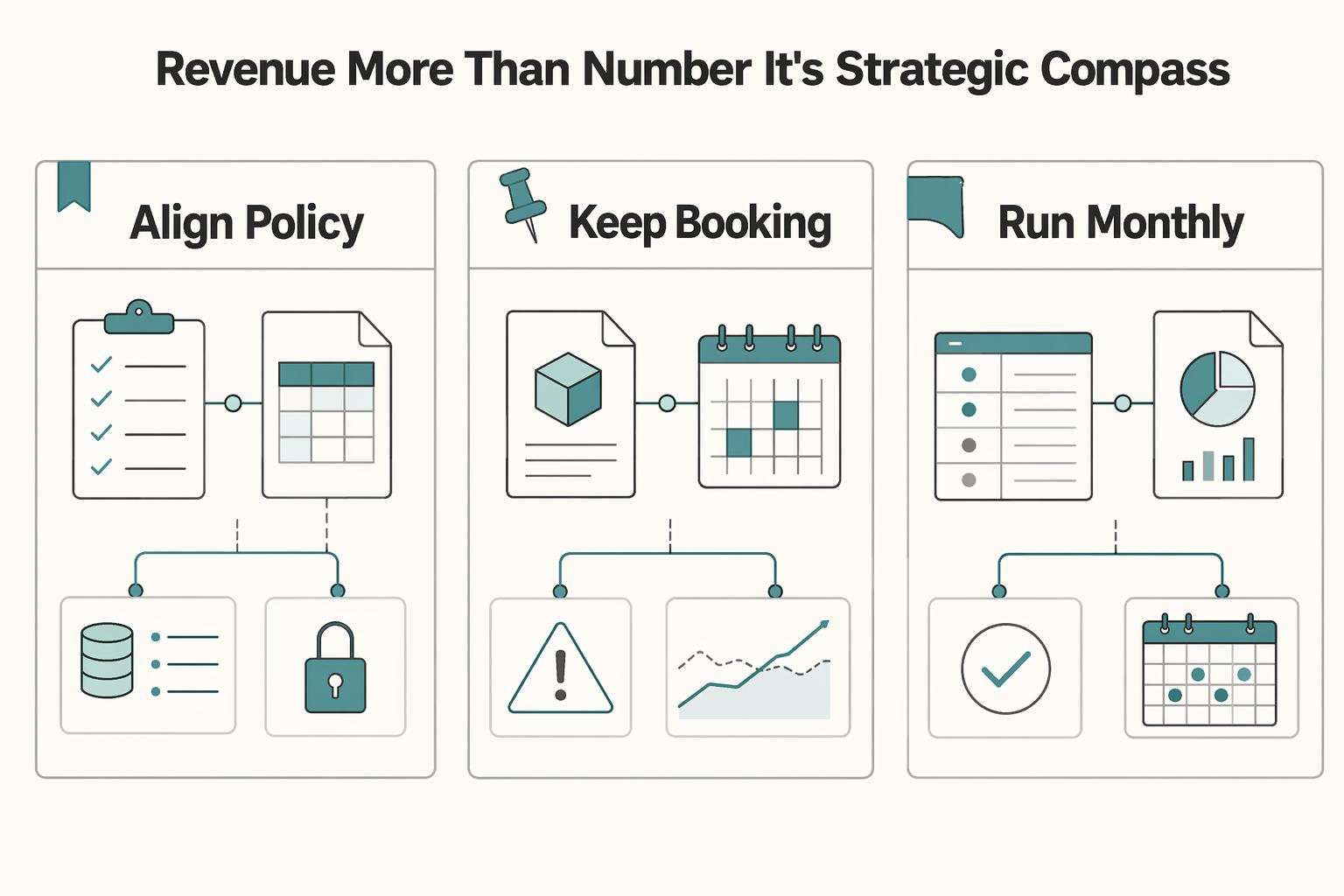
- Align policy to performance obligations, not payment timing.
- Keep booking discipline so prepaid cash stays in deferred revenue until earned.
- Run a monthly full review cadence, and add a checkpoint before major spend or forecast changes.
Frequently Asked Questions
How do I record an annual SaaS subscription in my books?
For a qualifying single, evenly delivered 12-month hosted service with US$12,000 prepaid, defer the unearned amount and recognize US$1,000 per completed month. If a receivable was already posted to deferred revenue, the receipt clears receivables rather than creating another liability. Verify the contract’s actual term and transfer pattern.
How do I account for a one-time SaaS setup fee?
Determine whether setup transfers a distinct service. Administrative activation that transfers none is an advance for future service, even if nonrefundable. A distinct service receives its allocated consideration and follows its own transfer pattern. Renewal material rights can extend the recognition analysis beyond the first term. Separate invoice labels do not decide treatment.
What is the difference between revenue and cash flow for a SaaS business?
Treat them as different signals. Cash flow tells you when money moved, while revenue tells you when you satisfied the customer obligation. On a $12,000 annual contract, collecting the full amount upfront does not mean you earned $12,000 immediately. If delivery is monthly, the earned amount follows that delivery pattern, such as $1,000 per month in that basic example.
What is ASC 606 in simple terms?
Use ASC 606 as your contract-based decision framework. Topic 606, Revenue from Contracts with Customers, applies a five-step model to determine what you promised, how much consideration is in scope, and when revenue is earned. The practical goal is consistency across contracts, including contract-term decisions, distinctness, and variable fees. A contract-level memo helps keep close and audit support aligned.
Does this still apply if I report outside the US?
ASC 606 is US GAAP. IFRS reporters generally apply IFRS15, which shares the core five-step model but is not identical in every detail. Local GAAP and tax reporting can differ. Establish the applicable reporting framework before adopting the schedule or disclosures.
Try a related tool
Researched and edited by the Gruv editorial team. Gruv builds cross-border billing, payouts, and finance-operations software for global businesses.
Sources
Includes 5 external sources outside the trusted-domain allowlist.
- ifrs.org/issued-standards/list-of-standards/ifrs-15-r...external
- quickbooks.intuit.com/learn-support/en-us/help-article/accounting-...external
- quickbooks.intuit.com/learn-support/en-us/help-article/customer-re...external
- storage.fasb.org/ASU%202014-09_Section%20A.pdfexternal
- storage.fasb.org/Rev_Rec_Implementation_QAs.pdfexternal
Educational content only. Not legal, tax, or financial advice.
Related Posts

Hiring a Subcontractor for the First Time Without Costly Surprises
Hiring your first subcontractor works best when you can describe the job, review the result and afford the coordination time. Agree on scope, authority and payment terms before handing over client work, then pay according to those terms.

Freelance Bookkeeping: Invoices, Receipts, and Month-End Close
Freelance bookkeeping connects what you earned, what a client owes, what a provider received, and what reached your bank. It also records expenses and the evidence behind them. Clear records help you identify missing payments and resolve mismatches; they cannot guarantee faster payment or prevent every dispute.

How to Write a Book as a Freelancer Without Scope Drift
The book needs a defined job and a defined boundary before you draft. In this cycle, give it one job: either support your client book services, or strengthen your own authority book so your niche, offer, and sales conversations become clearer.