
Quick Answer
Allocate a fixed bundle price by relative SSP unless all three ASC 606-10-32-37 conditions support assigning the entire discount to a subset. Assess variable amounts under their own two-part allocation test and recognize each allocation when or as its promise is satisfied.
Allocate the contract price before recognizing revenue#
A discounted subscription bundle can put one amount on an invoice while producing several revenue schedules. The invoice total does not tell finance how much belongs to software access, a distinct training service or another promised deliverable. Start with the actual promises and supported stand-alone selling prices, then calculate the allocation and recognize each amount when or as its obligation is satisfied.
Under ASC 606, the usual allocation uses relative stand-alone selling prices (SSPs). A fixed discount can be assigned entirely to selected obligations only when the specific discount-exception criteria are met. Lower margins, sales intent or a “free add-on” label do not replace those criteria. Where the criteria are met, targeted allocation is required rather than an optional way to improve reported margins.
This guide uses hypothetical subscription examples and separates fixed discounts, variable consideration and principal-versus-agent conclusions. It assumes the arrangements qualify as customer contracts within ASC 606. Contract identification, collectibility, tax, financing and other transaction-price issues still need their own assessment.
Identify the promises and capture SSP at inception#
Do not allocate by catalogue code automatically. A setup task that only enables your own service may not transfer a distinct service to the customer. Conversely, a separately useful training course may be a distinct promise. Document the benefit to the customer and whether promises are separately identifiable in the contract before deciding how many obligations exist.
Determine SSP at contract inception. Actual separate sales in comparable circumstances are the strongest starting point. A list price is not automatically SSP. If SSP is not directly observable, use a supported estimate, such as a market assessment or expected cost plus margin; the residual approach has eligibility limits. Keep the customer class, geography, period and evidence supporting the estimate. Deloitte’s SSP guidance reproduces the relevant Codification provisions.
Freeze that inception evidence with the contract version. A later catalogue price increase changes the input for new contracts where appropriate; it does not, by itself, reallocate the price of an existing contract. A contract amendment or a change in consideration needs its applicable accounting analysis, not a silent refresh of every existing revenue schedule.
Calculate the default relative-SSP allocation#
Assume a contract contains three distinct obligations: one year of access with SSP $1,200, a separate training course with SSP $300, and a separate data migration service with SSP $500. Total SSP is $2,000. Fixed transaction price is $1,600, so the bundle discount is $400. No targeted-discount exception is supported in this example.
| Obligation | SSP | Relative share | Allocated price | Allocated discount |
|---|---|---|---|---|
| Access | $1,200 | 60% | $960 | $240 |
| Training | $300 | 15% | $240 | $60 |
| Migration | $500 | 25% | $400 | $100 |
| Total | $2,000 | 100% | $1,600 | $400 |
For each obligation, allocated price = $1,600 × obligation SSP ÷ $2,000. The discount follows the same proportions. Check both totals: allocated price must equal the transaction price, and allocated discounts must equal $400. Define how cents are rounded and assign any rounding difference consistently rather than leaving an unexplained balance.
Allocation is not recognition. If access begins immediately and is provided evenly over 12 months, the simplified access schedule is $960 ÷ 12 = $80 per month. Recognize the $240 training allocation when or as the training obligation is satisfied, and the $400 migration allocation under its own transfer pattern. Those conclusions depend on the promises and performance facts; signing the contract or issuing the invoice does not satisfy every obligation.
Test all three fixed-discount exception criteria#
ASC 606-10-32-37 requires all three conditions, not a general statement that the discount “belongs” to one item. The FASB-issued amendments set out the test; the current Deloitte discount chapter reproduces it alongside examples.
- You regularly sell each distinct good or service, or each relevant distinct bundle, separately.
- You also regularly sell a subset bundle separately at a discount to its components’ SSPs.
- That subset-bundle discount is substantially the same as the contract discount, and analysis provides observable evidence identifying the obligations to which the entire discount belongs.
Keep representative separate and subset-bundle sales, their prices and terms, and the comparison to the contract discount. An approval email saying “discount the training” is not enough. Different margins or customer cohorts can prompt review, but do not independently meet the test. If the evidence does not establish the exception, use the normal relative-SSP allocation.
If supported, allocate the entire fixed discount to the identified subset, then allocate within that subset on the appropriate relative-SSP basis. Do not allocate an arbitrary portion to a favored product and spread the rest elsewhere. Apply a qualifying targeted discount before using a residual approach to estimate another item’s SSP, as required by paragraph 32-38.
Compare a qualifying subset bundle with the default#
For a separate hypothetical contract, SSPs are $600 for annual access, $300 for training and $300 for migration. The business regularly sells each separately, and regularly sells training plus migration as a $450 bundle. It sells all three in this contract for $1,050. The $150 contract discount equals the documented $150 training-and-migration bundle discount, and analysis establishes that the entire discount relates to those two services. Assume all three criteria are supported.
| Obligation | Default if exception unsupported | Allocation with supported exception |
|---|---|---|
| Access | $525 | $600 |
| Training | $262.50 | $225 |
| Migration | $262.50 | $225 |
| Total | $1,050 | $1,050 |
The default is $1,050 × each SSP ÷ $1,200. With the qualifying exception, access retains $600 and the discounted subset receives $450. Because training and migration have equal SSPs, each receives $225. The discount is $75 on each subset service, zero on access. This is a different contract from the first example; do not mix its SSPs or totals into that schedule.
If the entity merely advertises a one-off $450 training-and-migration offer without evidence of regular standalone subset-bundle sales, the assumed facts supporting this example disappear. Document the missing condition and use the default unless another applicable allocation requirement changes the conclusion. Commercial naming cannot fill the gap.
Analyze variable consideration with its own two-part test#
A contingent service bonus, usage charge or rebate is not automatically a fixed bundle discount. Estimate and constrain variable consideration under the applicable requirements before determining the amount included in the transaction price. A commercially possible bonus is not necessarily an amount that can already be recognized.
Under paragraph 32-40, allocating a variable amount entirely to a specific obligation or a distinct service within a qualifying series requires both: the payment terms relate specifically to efforts or an outcome for that obligation or service; and allocating it there satisfies the allocation objective when considering all promises and payment terms. The variable-consideration chapter reproduces paragraphs 32-39 through 32-41.
For the first $1,600 contract, suppose a $100 bonus depends specifically on a migration outcome. Assume finance concludes that the full $100 belongs in the transaction price and that both allocation criteria are met. Base allocations remain $960 access, $240 training and $400 migration; the bonus adds $100 to migration, bringing total allocated consideration to $1,700. That conclusion still does not recognize the migration amount before its performance obligation is satisfied.
If the criteria are not met, do not park the bonus on migration merely because sales used that label. Analyze the remaining consideration under the general allocation and discount requirements. Where fixed discounts and variable amounts coexist, apply the variable-allocation guidance first, then analyze the remaining amount under the applicable discount guidance. Keep the estimates, constraint and allocation conclusion as separate decisions.
Resolve principal versus agent before using customer gross receipts#
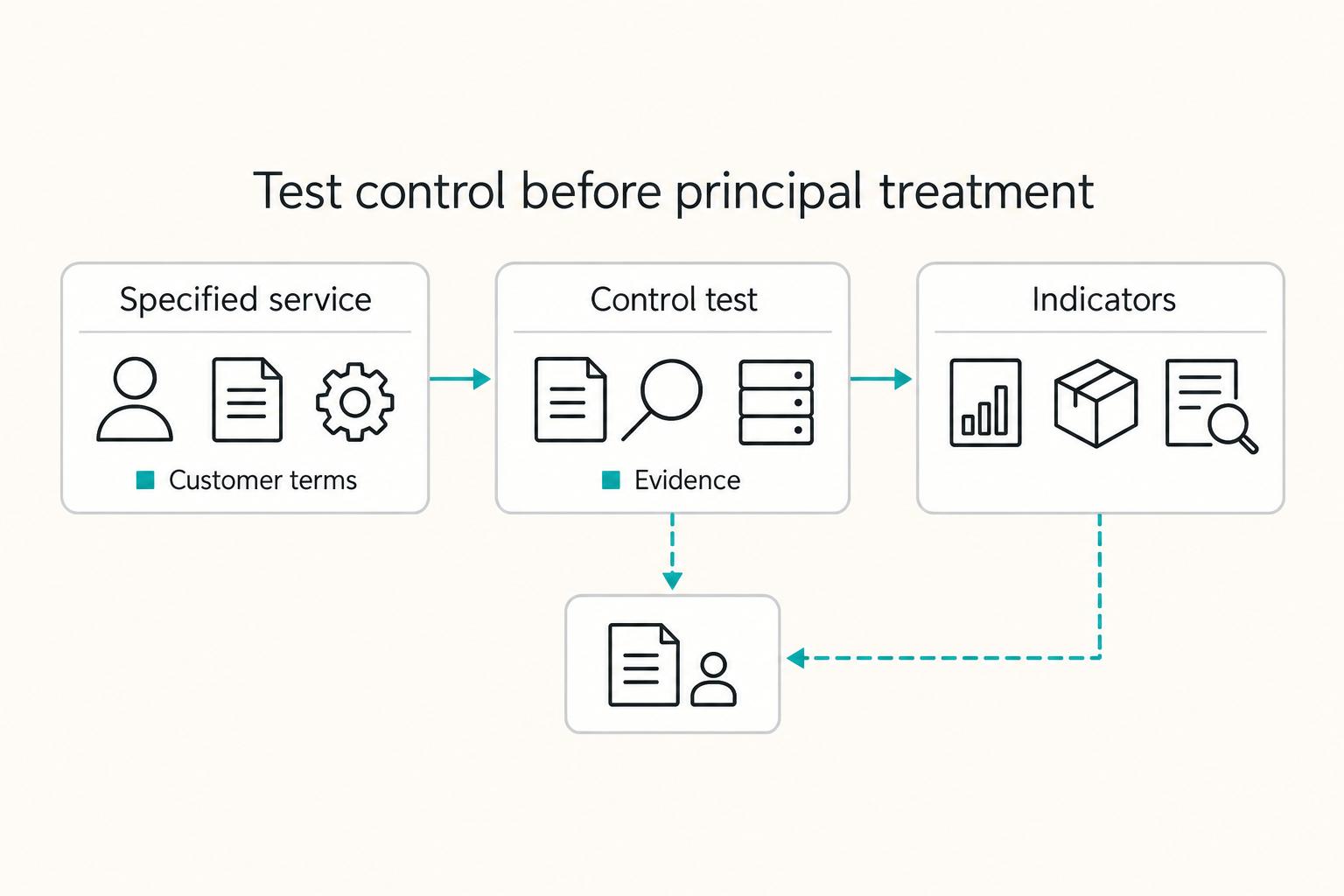
Merchant of Record status, collecting cash and setting an invoice label do not settle which service you promise. The FASB’s principal-versus-agent amendments require identifying each specified good or service and assessing control before transfer. A principal promises to provide the specified service; an agent promises to arrange its provision. One contract can contain different conclusions for different services.
For illustration, a platform collects $1,000 for a third-party course and retains $100. If its promise is only to arrange that course and it is an agent, its arrangement fee is $100; the $900 remitted to the supplier is not platform revenue. If the platform controls and provides the specified service as principal, gross presentation may apply. The same bank receipt cannot be used blindly as the allocation base in both cases.
Map the platform’s own promises and consideration after that analysis. It may have an access promise of its own as well as an arrangement service, with separate evidence and timing. Removing a supplier remittance from gross revenue can therefore change the promised-service and transaction-price analysis, not merely the final display of a previously identical allocation. For more detail, see principal-versus-agent revenue recognition.
Keep billing, allocation and recognition traceable#
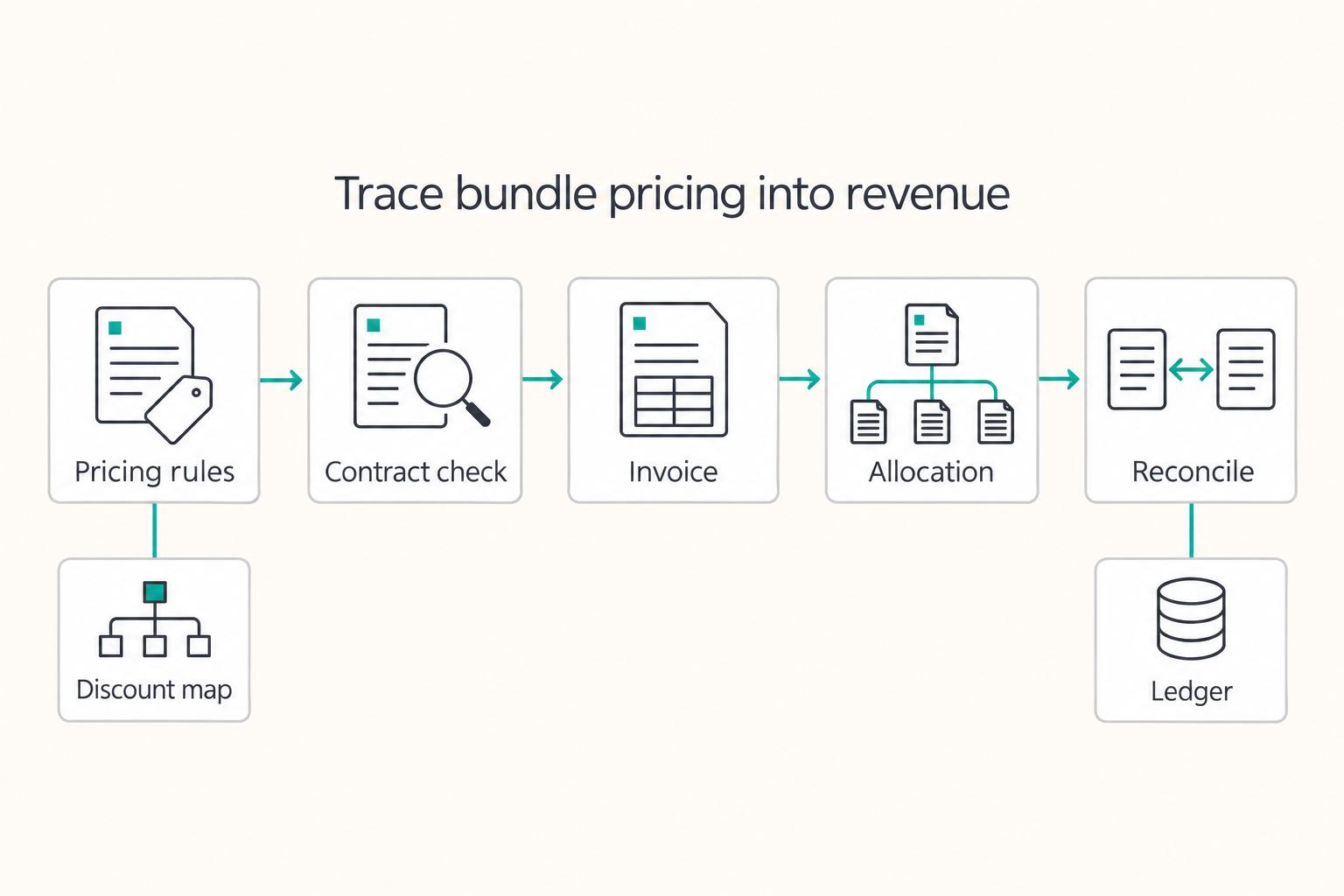
The diagram is an operational trace, not a mandatory accounting sequence or a requirement to wait for invoicing before recognition. Record the signed contract, identified obligations, inception SSPs, transaction-price inputs, exception decision and allocation version. Link invoices and revenue schedules to that record so a commercial invoice discount does not overwrite the accounting allocation.
| Control | What to verify |
|---|---|
| Inception inputs | Contract version, SSP support date, distinct-promise analysis and transaction price |
| Exception decision | Each discount criterion or each variable-allocation criterion addressed explicitly |
| Schedule | Allocated amounts total the transaction price; each recognition pattern matches its obligation |
| Close | Recognized revenue plus remaining allocated schedule reconciles to the current allocated amount, with documented adjustments |
| Cash and billing | Invoices, receivables, contract assets/liabilities and cash reconciled under their actual accounting treatment |
An upfront $1,600 invoice can create a different billing pattern from the first example’s access, training and migration revenue. Keep billing and revenue schedules separate. If the whole price is collected before services are provided, analyze the resulting contract liability; do not treat collected cash as immediate revenue or assume every uninvoiced schedule amount is a receivable.
For integrations, persist the contract version, obligation, accounting period, amount, currency and posting reference before dispatch. Enforce a business-level posting identity so retries cannot create a second journal. After a timeout, locate and reconcile the original posting before sending a new one. Provider key limits and retention vary; a key by itself is not a substitute for a durable posting record.
Review new bundle designs, amendments and changed consideration before posting. Freeze prior SSPs for continuing contracts unless the applicable modification accounting requires another basis. Preserve corrections with approval and links to the original entry. Local enforceability can affect contract analysis; unrelated payment onboarding checks do not determine a fixed-discount allocation.
Frequently Asked Questions
How do we calculate the default allocation?
Multiply the transaction price by each obligation’s SSP divided by total SSP. In the $1,600 example, the $1,200 access SSP is 60% of $2,000 total SSP, so access receives $960. Recognition follows its own performance pattern.
When can the entire discount go to a subset?
All three paragraph 32-37 conditions must be met: regular separate sales, regular discounted subset-bundle sales, and a substantially matching discount with observable evidence identifying where the whole discount belongs. Sales intent alone is insufficient.
Can later catalogue prices change an existing allocation?
A later SSP change alone does not reallocate the existing transaction price. Use inception support and analyze amendments or changes in consideration under their applicable requirements.
What must support a targeted variable amount?
The terms must relate specifically to the obligation or qualifying distinct service, and the resulting allocation must satisfy the allocation objective considering the whole contract. Estimation and the constraint remain separate requirements.
Does Merchant of Record status establish gross revenue?
No. Identify each specified service and assess control before transfer. An arrangement promise can produce an agent fee rather than gross supplier receipts, changing the consideration and promises used in the revenue analysis.
What should finance retain for close?
Retain executed terms, obligation conclusions, inception SSP evidence, transaction-price estimates, criterion-by-criterion exception analysis, approvals, allocations, recognition schedules and links to billing, cash and ledger entries.
Researched and edited by the Gruv editorial team. Gruv builds cross-border billing, payouts, and finance-operations software for global businesses.
Sources
Includes 4 external sources outside the trusted-domain allowlist.
Educational content only. Not legal, tax, or financial advice.
Related Posts
ASC 606 Principal vs Agent Decisions for Merchant-of-Record Platforms
For merchant-of-record teams, the **ASC 606 principal vs agent merchant of record** call is a high-stakes judgment, not a presentation preference. It can move revenue from gross to net and raise the level of judgment finance, audit, and compliance teams need to defend.

The Freelance Payment Penalty: A Modeled Audit of Platform Fees, FX Spreads, and Payout Delays
The money rarely disappears through a single, easy-to-spot fee. The real loss is stacked. A marketplace takes its commission, a processor adds a charge for international cards, a bank or payment company converts the currency at a spread, a platform holds the funds before release, and a wire sheds a little to intermediaries on the way in. Each layer looks defensible on its own, but the worker feels the combined result as a smaller deposit and a later payday.

How to Respond to a Subpoena for Business Records
Move fast, but do not produce records on instinct. If you need to **respond to a subpoena for business records**, your immediate job is to control deadlines, preserve records, and make any later production defensible.