
Quick Answer
Yes. An Employer of Record is the legal employer in-country, so you can hire without setting up your own local entity first. It usually manages the employment contract, global payroll, payroll taxes, and statutory benefits, while your team directs daily work. The model is strongest for ongoing roles where control looks employee-like, not project-only contractor work. Before launch, confirm who signs contracts, who issues payslips, and who executes termination steps in that jurisdiction.
Why international hiring fails at the handoff between speed and ownership#
An Employer of Record lets you hire in another country through a third party, without setting up your own local entity first. The provider handles key compliance mechanics, but it does not hand off every employment risk.
The hard part in international hiring is usually not just finding talent. It is getting the employment mechanics right without creating compliance issues you will need to clean up later. A single misclassification or paperwork error can lead to fines, legal disputes, or lost talent, and that risk can grow once you cross borders.
If you came here searching what is employer of record eor, keep the practical question in view: should you use this model for your next hire? If so, how do you do it with less ambiguity around contracts, payroll tax registration, onboarding, or termination steps? International hiring can open access to talent in new markets, but the upside disappears quickly when your offer terms, payroll setup, or worker classification do not match where the person will actually work.
This guide is built for that decision point. It gives you a practical way to decide between an EOR and nearby options, a clear responsibility split between you and the provider, and working checklists for pre-hire setup, onboarding, payroll, and offboarding. The goal is not to present the model as universally right. It is to help you avoid the common pattern where a business moves fast, assumes compliance has been fully outsourced, and finds out too late that key ownership was never defined.
Treat this as an execution-focused explainer, not a vendor pitch. We are not assuming every provider handles every country the same way, and we are not treating marketing language as a legal guarantee. As you read, keep an operator's eye on the basics that matter most: who is the legal employer, who signs the employment contract, who issues payslips, who handles payroll tax registration, and who keeps the local documentation if something is questioned later.
By the end, you should be able to make a cleaner call on international hiring. You should know whether an employer of record fits the role, what evidence to collect before onboarding, and where the real risk still sits even when a third party is helping.
For a step-by-step walkthrough, see How EOR Platforms Use FX Spreads to Make Money.
What an Employer of Record is and is not#
An Employer of Record (EOR) is a third party that is the legal employer for your hire in a target country, while you still run that person's day-to-day work. The EOR typically handles employment administration such as payroll and compliance, and your team keeps managerial control over assignments, priorities, and performance.
An EOR is not the same as setting up your own local legal entity. It can help you hire in a country without opening your own local entity first, but it does not remove your responsibility to define roles, manage conduct, approve compensation, and run operations well.
You may also see provider labels like global employment organization. Treat that as commercial wording, and focus on the contract reality: who is named as the legal employer in-country, and who is responsible for local employment compliance.
The boundary is straightforward: an EOR supports compliant employment mechanics, not business judgment. It is not a substitute for role clarity, performance management, onboarding discipline, or budget control.
The responsibility split that prevents compliance surprises#
Map ownership before the offer goes out. The EOR handles employment administration, and your team owns the work itself. When those lines are unclear, risk and day-to-day friction usually follow.
What the EOR owns and what you still own#
An EOR is typically the party that signs the employment contract, runs global payroll, withholds payroll taxes, and administers statutory employee benefits. Your team still controls role scope, assignments, priorities, and performance decisions.
| Function | Usually owned by EOR | Usually owned by your team |
|---|---|---|
| Employment setup | Employment contract and employment paperwork | Role scope, reporting line, compensation decisions |
| Ongoing administration | Global payroll, payroll taxes, statutory benefits | Work direction, priorities, feedback, performance management |
| Employment changes | Employment administration updates and local process support | Promotion decisions, compensation changes, manager approvals |
Before launch, verify the handoff points: who signs contracts, who issues payslips, who executes contract termination steps, and who holds local employment documentation.
Liability is reduced, not erased#
EOR support with local employment administration can reduce exposure, but it does not fully outsource liability in every dispute. Shared-employer exposure can still exist when your company has authority over essential terms and conditions of employment, even when the EOR is the legal employer on paper.
Use the provider for compliance mechanics, but rely on clear contracts and disciplined internal operations for risk control. Termination is a common place where assumptions break: if your manager initiates an exit but ownership of process, approvals, and documentation is unclear, disputes become more likely.
Build a country-by-country evidence pack#
Create one evidence pack per hiring country and keep it accessible to HR, finance, and hiring managers. At minimum, include:
| Evidence item | Details to keep |
|---|---|
| Employment contract template | Current employment contract template |
| Payroll timing | Payroll calendar and cutoff dates |
| Tax filing split | Written split of tax filing responsibilities |
| Termination process | Who initiates, who executes, who documents |
| Escalation contacts | Contacts by country for payroll, legal, and urgent employee issues |
Run one live walkthrough before the first hire starts: offer flow, first payroll, and termination handling.
EOR or contractor model for your next international hire#
Use this rule first: if the role is core, ongoing, and tightly managed by your team, start from an EOR review. If the work is project-based and truly independent in execution, a contractor model may fit.
| Decision factor | Independent contractor usually fits when | EOR usually fits when | Risk signal |
|---|---|---|---|
| Control over work | You define outcomes, not day-to-day methods | You direct what is done and how it is done | Higher behavioral control points toward employee status |
| Expected tenure | Time-bounded or clearly finite | Open-ended or long-running | Longer, integrated engagements can drift toward employment patterns |
| Role placement | External specialist support | Core role inside your operating team | Core, closely managed roles increase misclassification exposure |
| Relationship pattern | Independent business relationship | Employment-like management cadence | The more it looks like employment, the weaker the contractor position |
Labels alone do not decide status. U.S. guidance evaluates the facts through behavioral control, financial control, and the relationship of the parties. If you retain the right to direct and control both what is done and how it is done, your contractor case weakens even if the contract says "independent contractor."
The local law check is not optional#
There is no single universal test across countries or across U.S. states. Confirm classification under the relevant country and state rules before onboarding.
California's ABC framework starts from employee status unless all three conditions are satisfied. The UK provides a Check Employment Status for Tax (CEST) tool for employed vs self-employed tax treatment. Same role, different jurisdiction, different analysis.
Before the start date, keep a short classification file with:
- proposed scope and expected duration
- who controls method, schedule, and deliverables
- the local check used (for example, a UK CEST result or state-level review)
- a re-review trigger if scope expands, duration extends, or control increases
Where teams get into trouble#
A common failure mode is speed-first contractor onboarding followed by employee-like management. When the person becomes tightly directed in an ongoing role, you can end up doing retroactive compliance cleanup.
Misclassification is treated as a serious issue, and it occurs when someone who is legally an employee is treated as an independent contractor. If the facts are shifting toward employment, reassess early, document the decision, and move to an EOR path before the pattern hardens.
EOR, PEO, and staffing agency compared in plain terms#
If your main need is compliant direct employment in a new country, start by evaluating an Employer of Record (EOR). PEOs and staffing agencies can both help, but they solve different problems and are not interchangeable with an EOR.
| Model | Legal-employer position (plain terms) | Entity implication | Typical fit |
|---|---|---|---|
| Employer of Record (EOR) | The EOR serves as the legal employer of the worker | Often used when you do not want to set up a local entity first | Compliant international hiring in a new country |
| Professional Employer Organization (PEO) | Different model and purpose from an EOR | Commonly discussed for domestic growth contexts | Growth support at a different expansion stage |
| Staffing agency | Arrangement-focused model, not the same as long-term employment infrastructure | Contract and setup vary by arrangement | Temporary or project-based talent needs |
The tradeoff is practical: staffing can solve short-term sourcing speed, but it is not the same thing as long-term compliant employment infrastructure. EOR and PEO can both reduce administrative complexity, but they are usually better suited to different expansion stages.
Use a simple decision rule. If you need compliant direct employment in a country where you do not yet have local setup, evaluate EOR first. If you mainly need short-term project talent, staffing may fit, but confirm the employer setup in writing.
Country launch checklist before you hire the first employee#
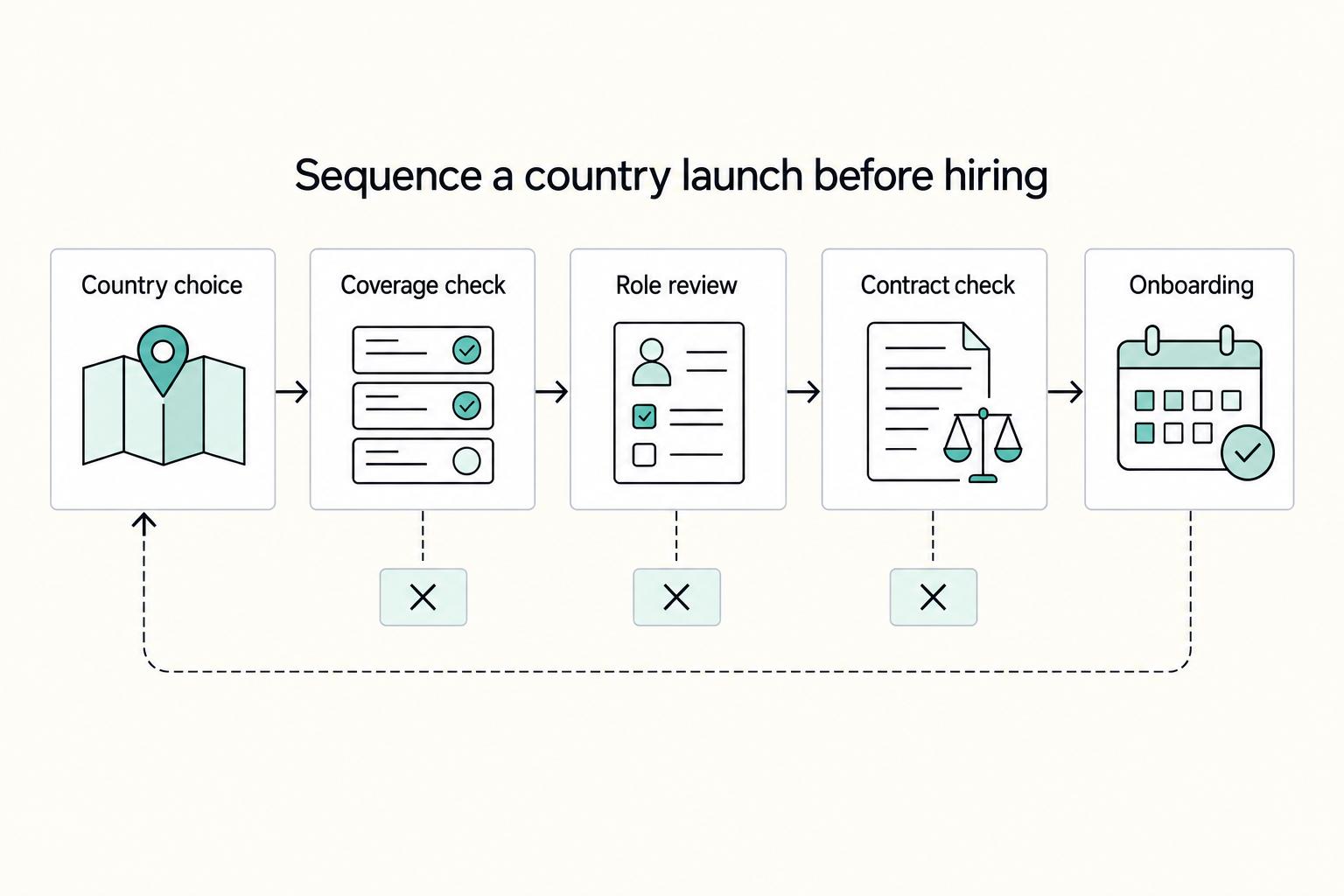
Set the start date last. For a first hire in a new country, use this order: country decision, provider coverage check, role classification review, contract validation, then onboarding.
If you are using an Employer of Record, keep the scope clear. An EOR can help you hire in another country without opening a formal entity there, but you still need to verify legal compliance, tax obligations, and country-specific regulations before you issue an offer.
Sequence matters more than teams expect#
Use this pre-hire checklist to force decisions early:
| Order | Check | What to confirm |
|---|---|---|
| 1 | Confirm the country and hiring model | Where the person will work and whether the role is employee or contractor |
| 2 | Check provider coverage before drafting anything | The provider can support that market and role type, and what they handle versus what your team owns |
| 3 | Review role classification before approvals | Classification is resolved before compensation and onboarding planning |
| 4 | Validate the employment contract and compliance path | Contract ownership, review flow, legal validation, and clear labor law compliance and payroll tax registration responsibilities before offer issuance |
| 5 | Start onboarding only after these checks are complete | Onboarding and payroll steps are locked only after the compliance and documentation path is confirmed |
Set clear owners for onboarding documents, final contract approval, and exception handling when required data is incomplete. If key documents or details are missing, pause the start date instead of improvising.
Coverage varies by provider and market, so validate assumptions against current local employment laws before the offer goes out.
Employment lifecycle controls after onboarding#
After onboarding, keep control through four checkpoints: onboarding, monthly payroll and payroll taxes, compensation or benefits changes, and offboarding.
| Checkpoint | What to verify | What to retain |
|---|---|---|
| Onboarding | Signed employment contract matches the approved offer, required employee data is complete, and payroll setup is confirmed before the first pay cycle | Signed contract, onboarding document pack, benefits enrollment confirmation |
| Monthly payroll and taxes | Salary, variable pay, and approved changes are submitted before payroll cutoff and reflected correctly on the payslip | Payslips, payroll change approvals, tax confirmations, wage and hour records where relevant |
| Compensation or benefits changes | Any pay or benefits update is documented before it takes effect | Contract amendments, written approvals, updated benefits records |
| Offboarding | Notice, final pay, severance, and termination steps are checked against country employment laws before notice is issued | Termination documentation, final pay record, severance record if applicable |
The monthly control with the biggest operational risk is payroll cutoff. It is the last monthly deadline for approved changes to make the current pay cycle, and late submissions or approvals can move to the following month's salary. If a change is urgent, get written confirmation from the provider before you communicate timing to the employee.
Benefits issues are often process issues: enrollment is assumed, selected incorrectly, or not fully documented. Treat enrollment confirmation as a required artifact and verify that payroll or employer contribution records match what was approved.
Your audit file should be complete and routine: payslips, contract amendments, tax confirmations, and core wage/hour records. In the U.S., payroll records are generally kept for three years under EEOC-linked recordkeeping guidance. Retention rules vary by country, so confirm the applicable rule per jurisdiction and store that rule with the country file.
Offboarding is where local labor-law differences matter most. Notice, final pay, severance, and termination procedure requirements can vary by country, so do not issue notice in a new market until the EOR or counsel provides country-specific steps in writing.
As an operating control, run a quarterly compliance review for active workers and recent exits in each country. Check active workers against current contracts, latest payslips, benefits status, and tax confirmations, then verify complete termination and final-pay documentation for recent exits. This is not a universal legal requirement, but it is a practical way to catch drift early. Related reading: What is the 'Withdrawal Penalty' on EOR Platforms?.
How to choose an EOR provider without getting locked into the wrong one#
Pick the provider you can verify before signing, not the one with the best demo. If key parts of employment, payroll, offboarding, and escalation are unclear before signature, treat that as lock-in risk.
| Provider diligence item | What to request |
|---|---|
| Sample local agreements | Redacted sample local employment agreements for two target countries |
| Support SLA terms | How SLAs are enforced and who carries liability when failures happen |
| Escalation contacts | Named escalation contacts for payroll errors, onboarding delays, and termination issues |
| Exit-readiness details | How employee records, contract history, and payroll data are exported, in what format, and what transition support is provided for offboarding or entity migration |
Use a simple scorecard across five areas: coverage depth, contract clarity, payroll reliability, termination support, and escalation responsiveness. For each country you plan to hire in, require entity-model disclosure (owned entity, partner entity, or mixed model), because it changes operational consistency and liability handling.
Keep comparisons neutral. Whether you evaluate Deel, Remote, Oyster HR, Papaya Global, Pebl, or another employer of record, request the same evidence from each provider:
- redacted sample local employment agreements for two target countries
- support SLA terms, including how SLAs are enforced and who carries liability when failures happen
- named escalation contacts for payroll errors, onboarding delays, and termination issues
The common failure pattern is comparing brands instead of contract and operating detail, then finding vague terms, slow support, or an unexpected partner-entity setup after signing.
Run an exit-readiness check before procurement closes. If you later open a local legal entity, confirm how employee records, contract history, and payroll data are exported, and in what format. For GDPR-covered data, use Article 20 as a benchmark: data should be provided in a structured, commonly used, machine-readable format and be transferable to another controller without hindrance. Also confirm transition support for offboarding or entity migration, and get those commitments in writing before signature. Related: Deel vs. Remote: A Comparison from the Freelancer's Perspective.
Conclusion#
An Employer of Record works well when you use it for speed but govern it like a real employment operation. The provider can legally employ the worker on your behalf and, depending on provider and jurisdiction, manage payroll, taxes, benefits, and compliant employment contracts, while you still retain managerial control over the person's work and development.
That split is where most good decisions and most preventable mistakes sit. If you remember one rule from this guide, make it this: do not treat an EOR as a permission slip to skip ownership. Before you launch an offer in any jurisdiction, confirm the local setup, who signs the employment contract, who issues payslips, who holds the employee record, and who executes contract termination paperwork if things change later. If those answers are vague, you are not ready to hire yet.
For your next international hire, run the decision table first. If the role is ongoing, core to the business, and tightly directed by your team, the employee route can be cleaner. Then complete the pre-hire checks and the post-onboarding controls before the start date is locked. That means validating country coverage, local contract terms, payroll cutoffs, statutory benefits handling, and the document trail you will need later if compensation changes, onboarding stalls, or the employment ends.
One failure mode to watch for is assuming the provider owns every compliance outcome once the worker is live. Weak points can show up in handoffs: missing onboarding documents, payroll data submitted after cutoff, untracked contract amendments, or a termination decision made by the client without enough local process discipline. Keep a simple evidence pack for each worker with the signed contract, amendments, payslips, tax confirmations, benefits enrollment records, and named escalation contacts. That is what makes problems fixable and audits less painful.
If you came here asking what an employer of record is, the useful answer is not just a definition. It is a decision rule. Use the model when you need to hire in a country without opening your own local legal entity, but pair that speed with explicit ownership, country-by-country checks, and lifecycle controls from onboarding through offboarding.
If you also need audit-ready payout and reconciliation control around global hiring flows, evaluate the supporting finance and payment infrastructure separately. Do that only where coverage is enabled and appropriate for the market, and make sure it matches the employment records your EOR will produce.
Frequently Asked Questions
What is an employer of record and who is the legal employer?
An Employer of Record is a third-party provider that is legally responsible for another organization's employees. In that arrangement, the EOR is the legal employer and may sign the employment contract. Your company still keeps day-to-day managerial control over the person's work and assignments.
Does an EOR remove all compliance risk for international hiring?
No. An EOR can handle payroll and regulatory compliance administration, but it does not remove all compliance risk. Treat it as risk reduction, and confirm how responsibilities are allocated in your contract.
Can an EOR hire in a country where I do not have a local legal entity?
An EOR can be located in the same country as your business or in another country with different employment laws. Verify country coverage and the provider's legal-employer setup before you move to offer stage.
What does an EOR handle versus what do I still need to manage?
The provider typically handles employment administration such as payroll and regulatory compliance, and in one FAQ model the EOR signs the employment contract. You still keep day-to-day managerial control over work assignments. A useful checkpoint is to confirm who is the legal employer and who manages daily work in each country.
How is an EOR different from a PEO and a staffing agency?
A PEO is commonly described as a shared-employer arrangement, while an EOR fully becomes the legal employer. Because this can vary by provider and jurisdiction, confirm the legal allocation in the contract instead of relying on labels.
When should I use an EOR instead of hiring an independent contractor?
A practical starting point is whether you need a legal employer to handle employment administration. If you are choosing a contractor path, review your compliance approach carefully or see How to Manage and Pay a Global Team of Contractors Compliantly before onboarding.
What should I verify before signing with an EOR provider?
Evaluate providers against your global needs, industry fit, services offered, and reputation. Also request country-specific pricing in writing, since one FAQ source notes fees can vary by country, employee count, and service scope.
Try a related tool
Researched and edited by the Gruv editorial team. Gruv builds cross-border billing, payouts, and finance-operations software for global businesses.
Sources
- congress.gov/crs_external_products/R/PDF/R47943/R47943.3.pdftrusted
- dmas.virginia.gov/media/3868/employer-of-record-manual-august-...trusted
- dol.gov/agencies/whd/flsa/misclassificationtrusted
- dol.gov/general/topic/wages/wagesrecordkeepingtrusted
- eeoc.gov/employers/recordkeeping-requirementstrusted
- en.wikipedia.org/wiki/Employer_of_Recordtrusted
- federalregister.gov/documents/2024/01/10/2024-00067/employee-or-...trusted
- ftc.gov/system/files/documents/reports/report-presid...trusted
Educational content only. Not legal, tax, or financial advice.
Related Posts

What to Do If You've Been Misclassified as an Independent Contractor
Treat this as a protection problem first, not a label debate. If your work was treated as an independent contractor arrangement even though the relationship functioned differently, your first goal is to protect pay, rights, and records while you choose the least risky escalation path. You can do that without making accusations on day one, which often keeps communication open while you document what happened.
How to Pay International Contractors With Fewer Delays and Disputes
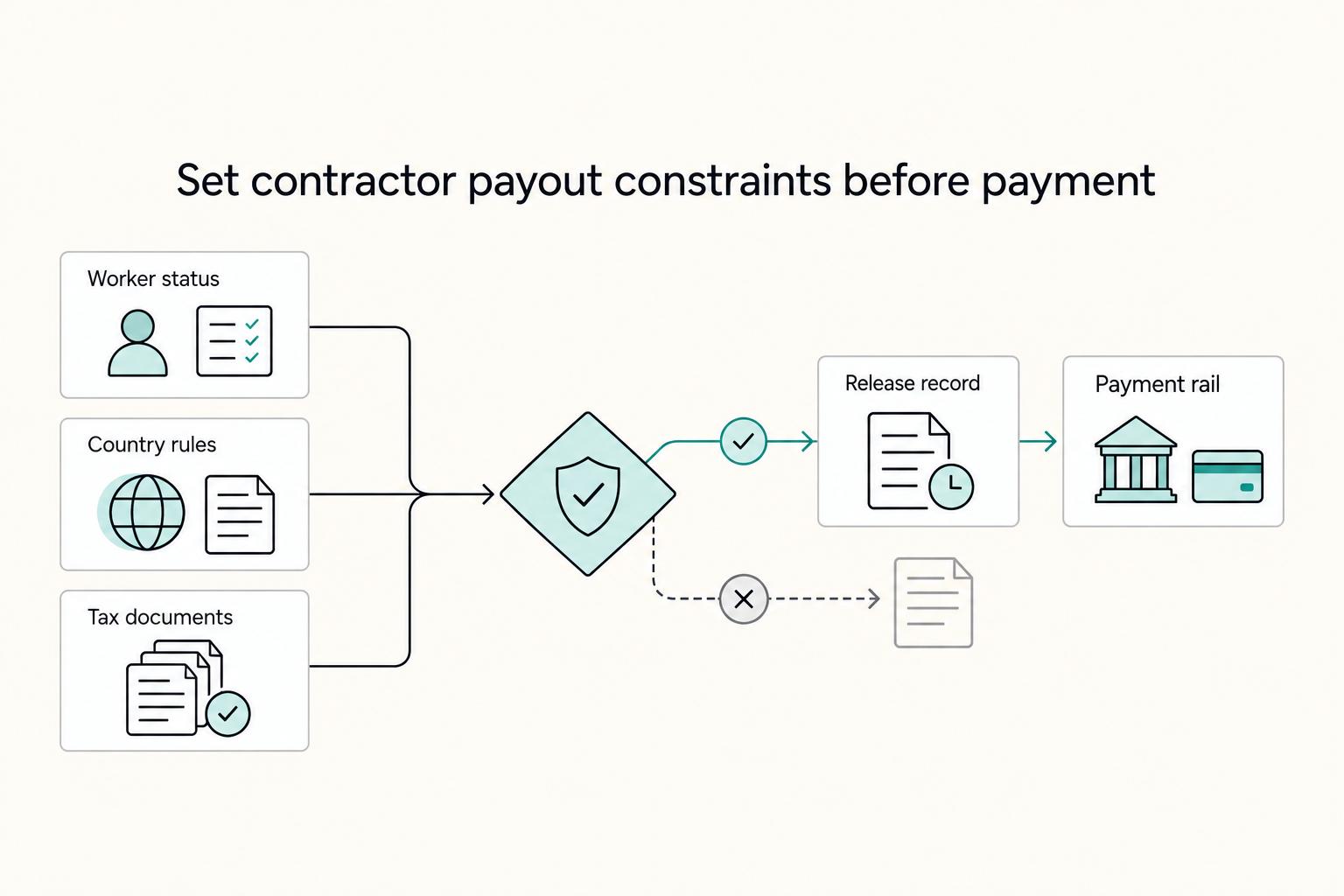
Paying international contractors reliably starts with compliance setup before the first invoice. Missed registration or filing steps turn routine payouts into delays and penalties.
Deel vs Remote for Freelancers Who Need a Clear First-Payout Decision
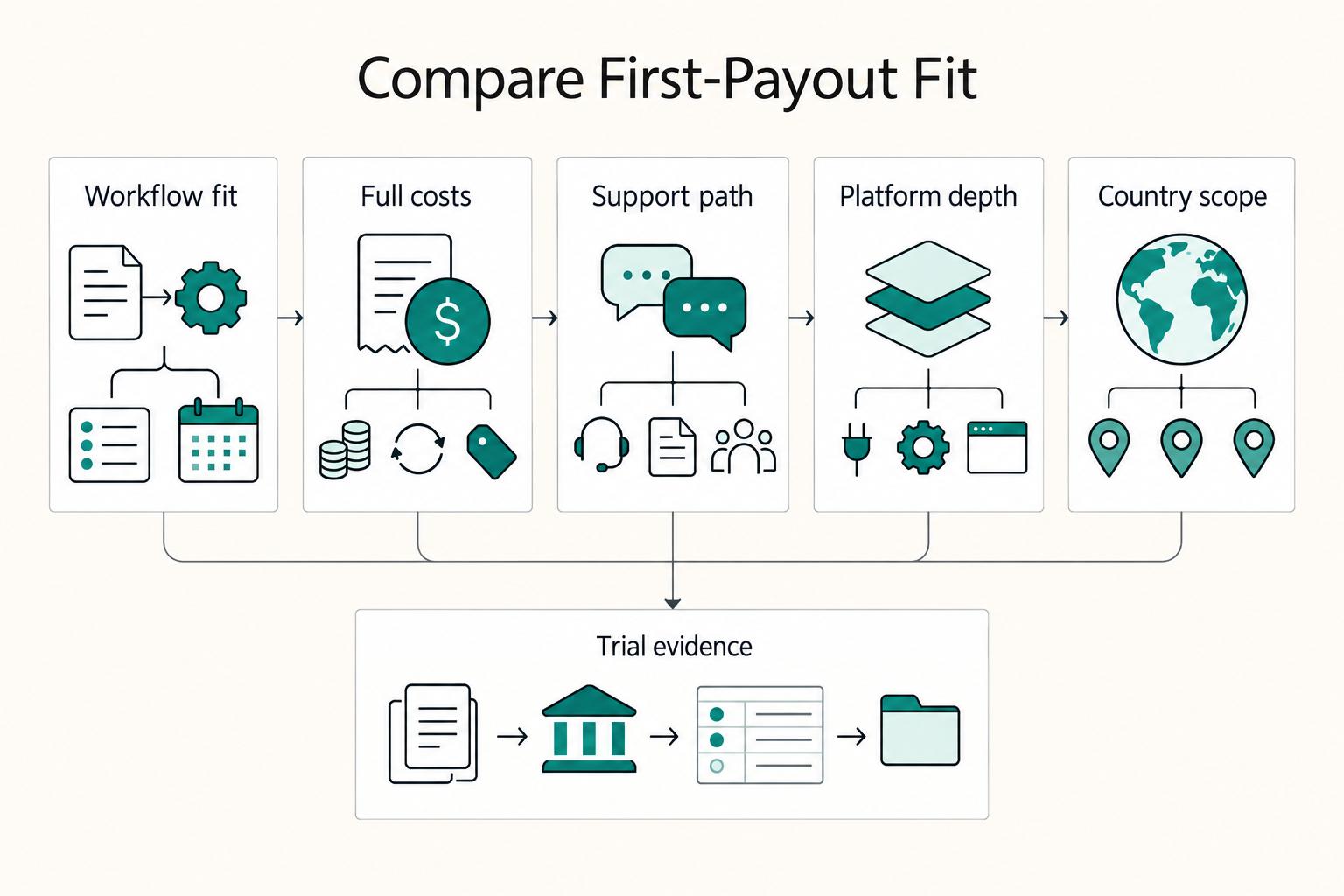
Choose the platform that makes your first payout cycle predictable and your contracts easier to defend. This is an operating decision, not a brand contest.