
How to think about payment fraud signals#
Fraud ML is useful only when it leads to decisions your compliance, legal, finance, and risk leads can defend. This article stays on action paths, ownership, and evidence, not model taxonomy or abstract accuracy claims.
The scope is payment-platform payouts. In practice, decision paths can include releasing funds, pausing suspicious activity before completion where your stack supports it, or routing flagged entities to human review. The key question stays the same: what signal triggered what action, and can you show why.
That standard matters because fraud does not stay in one bucket. Marketplace risk can include payment fraud, account takeover, collusion, promotion abuse, and GPS spoofing. Fixed rules can miss novel fraud, and supervised-only methods get harder to run as fraud classes expand. Where appropriate and permissible, teams can also analyze unlabeled data to surface risky entities, then send those flags to people before final handling.
Here is the practical promise of this article: a working structure to organize payment, identity, and behavior inputs, escalation logic that connects those inputs to actions, and an evidence checklist you can use in committee review, audit, or post-incident analysis. The structure is an organizing frame, not a list every platform should copy.
Keep one operating rule in view. If a signal cannot be explained, owned, and tied to a specific intervention, it should not drive production decisions by itself. The real checkpoint is the handoff from detection to action. That includes linking suspicious activity to live transaction flow before completion, where your stack supports it, and routing ambiguous situations to agent review.
This article also keeps the main tradeoff visible. Missed fraud is often costlier than false alarms, but alert volume still has to stay manageable. The goal is to help you build a defensible feature-engineering program by prioritizing inputs that survive scrutiny, connect to real interventions, and leave a reconstructable decision trail. Related reading: How to Build a Deterministic Ledger for a Payment Platform.
What feature engineering means in payment fraud decisions#
Feature engineering in payment fraud is the disciplined work of turning raw transaction, identity, device, and behavior data into explainable signals you can use for inline decisions.
A model score is an input, not a decision. It still has to map to a clear action path such as allowing a transaction, blocking it, or routing it to review. Teams also need a clear record of what happened.
In practice, these inputs are often multimodal because fraud data is heterogeneous and imbalanced. Published examples include cyclic spatiotemporal encodings for timing patterns, regex-based device fingerprint parsing, and graph-based risk profiling. None of those features should decide outcomes on their own. Their job is to structure evidence so teams can separate normal behavior from events that need intervention. For deeper examples, see Thoughtworks on graph neural networks in fraud prevention and this recent fraud-feature engineering paper.
The baseline is timing and explainability together. Systems need inference speed that supports online decisions. Stakeholders outside ML still need plain-language clarity on what each input represents. A practical check is whether you can trace a decision from source event to transformed feature to decision log.
- Freshness: how current a signal must be to stay reliable at decision time.
- Ownership: the team accountable for definition, monitoring, and change control.
- Escalation path: what happens next when a signal indicates elevated risk.
- Evidence artifact: the record of what fired, when it fired, and what action followed.
If you apply one rule, use this: a feature should be understandable to non-ML reviewers and tied to a real intervention, not valued only for offline model lift. That matters most in fast payment flows.
If you want a deeper dive, read Fraud Detection for Payment Platforms: Machine Learning and Rule-Based Approaches.
Why APP scams bypass legacy controls#
APP risk can slip past legacy controls when those controls are built around rules-first, batch-era review steps instead of payment-context decisions close to execution.
As real-time payments expand, fraud typologies expand with them. Older rules-based stacks were built around static thresholds, velocity checks, and manual review queues. They also assumed transactions could be paused and investigated before settlement. In fast payment flows, that assumption can fail. Static rules and siloed monitoring can react too slowly to coordinated, adaptive behavior, and rule-only systems can miss new patterns while also creating false positives.
| Control point | What it answers well | What it can miss |
|---|---|---|
| Legacy rules-first checks | "Is this transaction outside known thresholds?" | Fast, adaptive, cross-channel patterns that do not match older rules |
| Payment-context checks near execution + clear review triggers | "Does this payment context justify friction or review now?" | Over-reliance on stale pre-payment signals |
The operational shift is simple: evaluate payment-time inputs near execution and route edge cases to review with an auditable record. Without that shift, teams can clear legacy rule checks while missing the narrow intervention window in real-time payments.
For a step-by-step walkthrough, see Top 10 Payment Fraud Patterns Hitting Freelancer and Platform Payouts.
The 50-signal map risk owners can actually govern#
If you want a large signal inventory to survive governance review, organize it by payment-process checkpoint and named ownership, not by model convenience. A process-first structure is easier to defend because fraud is discussed by payment-relevant process, including separate checkpoints for onboarding and provisioning, payment execution, and card-scheme fraud. Use the table below as a governance template, not as proof that every input in each domain is equally predictive.
| Domain | Example signal families | What it can help surface | Primary control owner (set explicitly) | Review-workflow sign-off (set explicitly) |
|---|---|---|---|---|
| Identity and onboarding | Identity consistency checks, onboarding exceptions, provisioning anomalies | Early account abuse indicators and mule setup indicators | Set in your program | Policy exceptions and case outcomes should both have named approvers |
| Payment execution and behavior | First-payment anomalies, beneficiary changes, amount or timing shifts, payout-sequence breaks | Payment-time abuse patterns and mule movement patterns | Set in your program | Require sign-off when holds, releases, or settlement timing are affected |
| Session and channel context | Session continuity, channel changes, access-pattern shifts | Session abuse indicators and context conflicts at payment time | Set in your program | Escalate sign-off when customer treatment or friction logic changes |
| External context | Linked-entity context and external risk indicators | Networked behavior and red flags not visible in internal events alone | Shared ownership set in your program | Document what is decision-driving vs supporting context |
Why this grouping works#
This grouping follows the payment-process checkpoints used in fraud reporting. Onboarding and provisioning help answer whether an account should exist. Payment execution helps answer whether a payment makes sense now. Card-scheme patterns may need separate handling. It also addresses a common failure mode where attackers operate in networks while defenses stay siloed. The European Payments Council fraud trends report is useful for checking those lifecycle groupings against current threat patterns.
Ownership matters more than volume#
Governance gaps can block otherwise useful detection ideas. For each live input, define the owner, freshness expectation, missing-data behavior, allowed action, and sign-off path in the review workflow. If an input cannot be explained from the decision log, it is not ready to drive production decisions.
Where additional regulatory controls are in scope, document approval boundaries the same way. A smaller, fully governed set is usually more reliable than a larger opaque list.
Which signals to ship first when resources are tight#
Ship the inputs that can change a payment decision now. If an input cannot trigger a clear action in real-time payments or human review, defer it.
Start with a short, explainable signal set before broad enrichment you cannot defend. That matters even more when fraud is rare relative to legitimate activity, because models can bias toward the majority class and miss minority fraud patterns while incorrect alerts still rise.
Start with action-linked signals, then expand#
Roll out in tiers based on operational actionability, not novelty.
| Launch tier | Signal focus | Why it ships earlier | Only ship if you can answer |
|---|---|---|---|
| Tier 1 | Transaction-level signals with immediate decision value, for example amount, timing, geography, and prior fraud history | Directly supports hold, release, or route decisions | What happens when data is missing, stale, or inconsistent? |
| Tier 2 | Behavioral-profile and context-shift signals across historical activity | Adds payment-time context that single fields miss | Which patterns trigger review, step-up checks, or release? |
| Tier 3 | Additional enrichment signals with clear decision impact | Can broaden coverage, but may add operational and explainability complexity | Can you trace input, rationale, and action in the decision log? |
Add coverage with an explicit friction budget#
Broader coverage only helps if you can control customer friction. Pair each new input with a defined tolerance for added reviews, delays, and step-up checks, then compare that cost with missed-fraud reduction versus incorrect alerts. If you cannot state that tradeoff clearly, the input is not ready for production use.
Use phased cycles as a planning tool, not a promise#
If you plan in fixed cycles, phase it. First, harden core action-linked controls. Then add one behavior layer and one context layer. Then decide whether internal data is enough or whether deeper enrichment is warranted. Escalate when the same blind spots keep appearing in review and your current data cannot support timely, defensible decisions.
Signal quality rules that prevent false confidence#
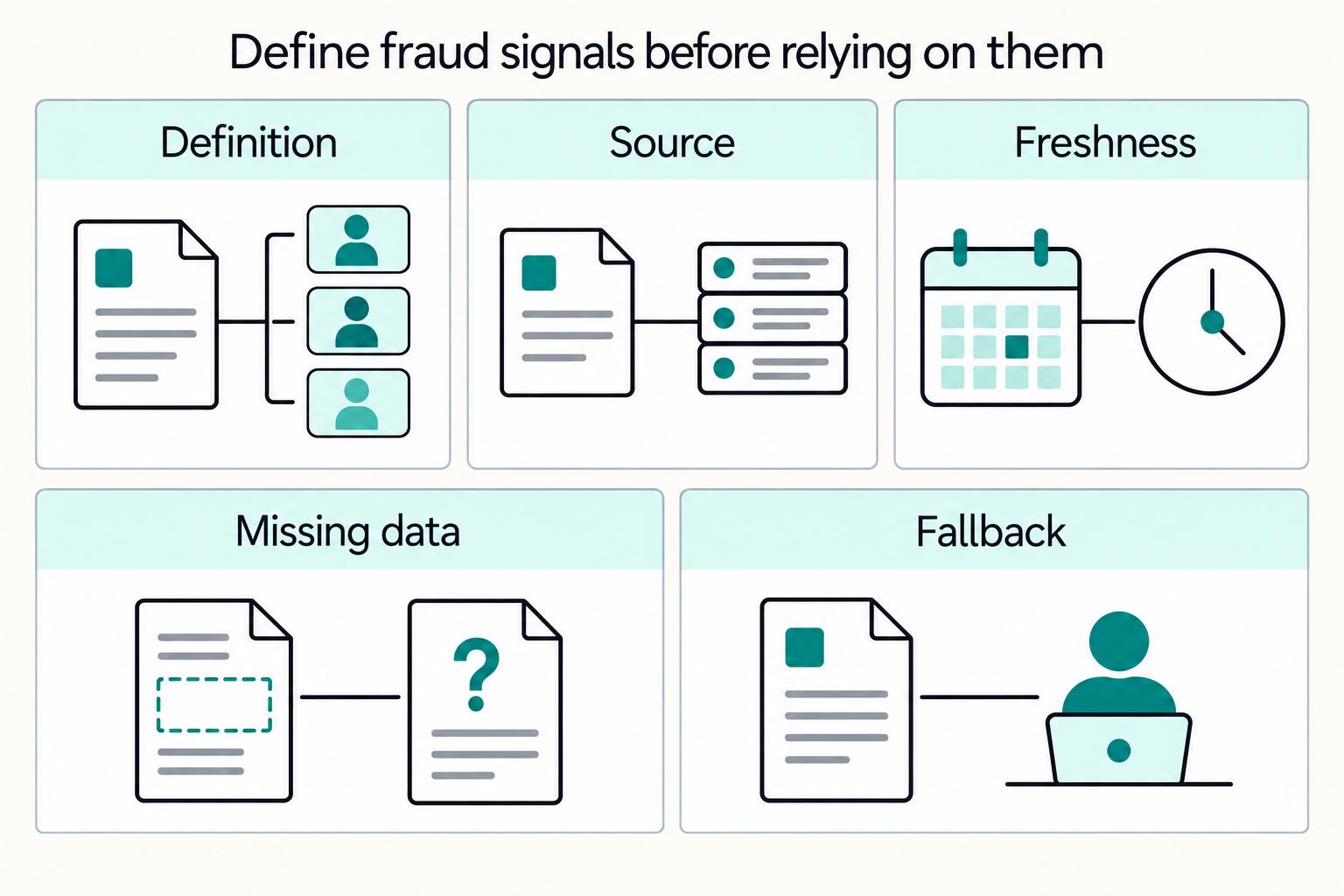
An input is safer for production decisions when it is defined, traceable, and reliable under failure. If you cannot explain what it means, where it comes from, how fresh it should be, and what happens when it is missing, treat it as higher-risk for live decisions.
Give each signal a clear data contract#
Before launch, give every input a short, explicit contract.
| Check | What to document | Why it matters at decision time |
|---|---|---|
| Definition | Plain-language meaning of the signal and what it is not | Prevents the same field being interpreted differently across teams |
| Source system | Exact event, service, or table that produced it | Enables lineage checks and faster debugging |
| Freshness expectation | How current the value should be to remain credible | Reduces decisions based on outdated context |
| Missing-data behavior | Whether null means unknown, unavailable, or not applicable | Prevents silent defaults from being treated as low risk |
| Fallback action | What the flow does when the signal is absent or invalid | Keeps decisions consistent during partial failure |
Verify the full chain, not just model output#
Do not stop at the score. Validate signal quality across the full path: Data Consolidation, Feature Engineering and Signal Extraction, model input, and Decision Orchestration. That end-to-end check is what makes deployment more stable in practice.
Checks to run include:
- Event capture completeness between source ingestion and downstream feature records.
- Transformation accuracy between raw inputs and engineered features.
- Input integrity at inference time, including null rates, default-value rates, and unexpected category shifts.
- Decision logging quality so reviewers can see the input values, model version, and action together.
Test ordinary failures before launch#
False confidence can come from routine data or pipeline breakage, not only new fraud patterns. Run failure tests that simulate missing or degraded inputs and confirm that each case has a defined operational outcome.
Use a clear production gate#
If your team uses a gate for live decisioning, define it explicitly: gaps in ownership, monitoring, or failure handling should trigger a hold until fixed. A one-page spec can capture ownership, freshness expectations, missing-data behavior, monitoring, and fallback action.
Need the full breakdown? Read What Payment Platforms Must Know About Synthetic Identity Fraud.
Escalation rules from model score to human action#
A fraud score should trigger an action path, not act as the final decision on its own. In payment flows that often run inside a 100-200 ms window, keep automated actions simple, such as approve, flag, or block. For cases your policy treats as ambiguous or conflicting, use a human-review path.
Use action bands, not raw scores#
Set your own score cutoffs, but keep each band's purpose stable so operators know what each outcome means. Immediate outcomes of approve, flag, or block are supported, but universal threshold values are not established.
| Action band | Immediate intent | Default outcome | When to escalate |
|---|---|---|---|
| Low-risk band | Keep low-risk payments moving | approve | If later signals materially change risk |
| Review band | Resolve uncertainty without forcing a decline | flag | According to internal policy |
| High-risk band | Stop likely fraud quickly | block | According to internal policy |
Treat conflicting signals as human-review cases#
When core inputs disagree, treat that as uncertainty and follow your manual review policy instead of forcing a fully automated decision.
Define service expectations and required evidence#
Required service-level targets or mandatory evidence packet fields for escalation handling are not specified here. If you document case context internally, include the transaction details used at scoring time, the location and device context, the unusual behavior signal, and the action taken (approve, flag, or block).
Roll out escalation logic in stages#
Start small, test in shadow mode, and expand only after outcomes are stable. That helps you reduce false positives without shifting unnecessary friction into manual queues.
When you finalize action bands, map them to implementation states early using Gruv docs so escalations, holds, and releases stay traceable in operations.
What evidence must be retained for audits and regulator questions#
Once decisions can be approved, held, or escalated in multiple ways, you need to be able to replay why. Your evidence is audit-ready only if someone can reconstruct why a payment was approved, held, or rejected using what was known at that time. Treat a point-in-time decision file as your baseline for material outcomes, not only cases that reached human review.
Keep a decision file that can be replayed#
Use a consistent decision file format so score-to-action reasoning is reviewable. Exact fields depend on your program and jurisdiction, but common entries include:
- signal snapshot used at decision time
- model version used for scoring
- policy rule version used for actioning
- operator action, if a human touched the case
- final disposition, for example release, reject, refund, or continued hold
Fraud decisions are often multimodal, so the retained record should show which evidence types were actually used, such as transaction features, behavior, alert narrative, entity relationships, authentication telemetry, or external threat signals. Storing only the latest profile state is usually not enough to show what your team knew when the decision was made.
Link fraud evidence to compliance records#
Fraud evidence should be linked to governance records, not isolated from them. Where these controls exist in your program, link the relevant due-diligence status (for example KYC/KYB), sanctions screening outcomes, AML monitoring notes or alerts tied to the payment, and the review timeline for escalations.
Focus on linkage, not duplication. If records live across systems, keep stable locators, timestamps, and analyst-note references so reviewers can retrieve the full trail later.
Produce committee-level outputs, not just case logs#
Risk committee oversight needs operating signals, not isolated case anecdotes. Provide regular trend summaries, exception counts, and an unresolved-escalation inventory so risk, compliance, legal, and finance are reviewing the same picture.
Explainable governance dashboards can help, but the output still needs to stay in plain language. Show where decisions are concentrating, how many exceptions or overrides occurred, and which escalations remain open beyond normal review windows.
Set boundaries with counsel#
Do not treat this evidence pack as a universal legal schema. Retention duties, disclosure obligations, privacy limits, and documentation expectations vary by country and program, especially in cross-border operations. Confirm legal requirements with counsel and document the choices for your operating jurisdictions.
This pairs well with our guide on Device Fingerprinting Fraud Detection Platforms for Payment Risk Teams.
How to evaluate vendors without buying a black box#
Use your audit-evidence standard as the vendor filter. If a platform cannot map its outputs to auditable actions, treat it as supplemental intelligence, not your primary decision engine.
Many tools sound similar because risk scoring is a common claim. The practical test is whether you can inspect what drove a score, route outputs into your review workflow and compliance workflows, and replay decisions later for audit or legal review.
| Vendor | Explainability evidence in supplied materials | Integration and control surface evidence | Signal transparency evidence | Control ownership support evidence |
|---|---|---|---|---|
| Vyntra | No verified detail in supplied materials | No verified detail in supplied materials | No verified detail in supplied materials | No verified detail in supplied materials |
| SEON | No verified detail in supplied materials | No verified detail in supplied materials; external roundup lists pricing from $599/month | No verified detail in supplied materials | No verified detail in supplied materials |
| Sardine | No verified explainability detail evidenced | Fraud and compliance modules surfaced for KYC/KYB, sanctions screening, AML Transaction Monitoring, and Case Management | No verified detail that feature definitions or lineage are exposed | Evidenced control adjacency because compliance modules are explicitly surfaced |
| BioCatch | No verified detail in supplied materials | No verified detail in supplied materials | No verified detail in supplied materials | No verified detail in supplied materials |
| Feedzai | No verified explainability detail evidenced | External roundup presents risk scoring, Case Management, and AML capabilities for large financial institutions | No verified detail that feature definitions or lineage are exposed | Some support indicated through Case Management and AML capability listing |
This table is intentionally strict. It does not say unsupported vendors lack these capabilities. It says you should not assume them without proof. The roundup used for shortlisting was last updated March 11, 2026, so use it to shape diligence questions, not to approve control design.
Ask for proof, not category labels#
Use direct questions that can be retained in your procurement record:
- Can you expose feature definitions used in scoring, not only high-level labels?
- Can you show lineage from raw event or enrichment to final decision output?
- Can you provide action-level logs with timestamps for approve, flag, block, and analyst override events?
- How does output flow into our review queue and our internal KYC/KYB and AML Transaction Monitoring steps?
- What regional deployment options support our data residency compliance obligations?
- What is your proven latency under real-time conditions, given payment decision windows can be around 100-200 milliseconds?
A practical checkpoint is a live walkthrough of one approved payment and one flagged payment using your sample data. If a vendor can show only aggregate dashboards or generic score explanations, you still do not have audit-ready evidence.
Evaluate fit to your operating model#
Real-time payments raise the diligence bar. A tool can look strong analytically and still fail operationally if it cannot return results inside your decision window, hand off cleanly to your review queue, or coexist with existing KYC, KYB, sanctions, and AML steps.
Sardine has evidenced adjacency here because its surfaced modules include KYC/KYB, sanctions screening, AML Transaction Monitoring, and Case Management. Feedzai is also evidenced as covering risk scoring, Case Management, and AML. That does not settle the decision, but it does show where to probe integration depth first.
A documented failure mode in rules-only systems is high false positives, slower reaction times, and easier circumvention by adaptive criminals. Use diligence to confirm scoring output can support operational decisions, not just sit beside existing controls.
Make rollout part of diligence#
Do not move from demo straight to enforcement. Require shadow mode first so you can compare vendor output against current decisions before broader use. This lets you test false-positive behavior and whether logs are complete enough for the decision file you need to retain. Related: How to Implement Intelligent Payment Retries: Timing Signals and ML-Based Approaches.
Common mistakes that create regulatory surprises#
A common surprise is not a single bad score, but weak control governance across the payment lifecycle. A recurring pattern is teams focus on model output, then discover too late that stage coverage or control-mapping evidence was not clear enough to defend.
- Treating a low false-positive rate as enough. In low-prevalence fraud settings, false-positive volume can still surge and create alert fatigue, investigation waste, customer friction, and trust damage.
- Framing false positives as only a model-quality issue. Many false-positive failures come from other pipeline stages, and decisions can become harder to defend when the unit of analysis is not explicit, such as
eventvsuservscase. - Reviewing controls without clear stage coverage. If your design and review do not map controls across payment initiation/authentication and payment execution, gaps are easier to miss until later review.
- Operating without a durable threats-versus-controls-and-mitigations artifact. If you cannot show that mapping clearly, it becomes harder to explain why a control existed, how it was applied, and what mitigation was expected.
Conclusion#
The core takeaway is simple: better fraud outcomes can come from auditable inputs with clear ownership and action paths, not just from collecting more signals. If an input cannot be traced from source to decision, it can add risk even when model output looks strong.
Before you expand integrations, define three operating artifacts: a prioritized signal list, an escalation matrix, and an evidence-pack standard. That keeps feature engineering tied to real decisions and makes review paths explicit when inputs conflict.
Use traceability as your main checkpoint from data capture to decision log. In practice, prioritize controls that keep features reliable in production, such as real-time serving APIs, quality-monitoring dashboards, feature validation, and automated pipeline tests. Apply that across batch, streaming, on-demand, and backfilling workflows.
Keep the final guardrail practical: tune for risk reduction and traceability, then iterate in measured changes. ML can help surface suspicious patterns in large transaction datasets, but pipeline operations are often the hardest production step. Early research signals, especially preprints that are not peer-reviewed, should be treated with caution until your evidence trail and operations are stable. If you need a practical reference for lineage and feature operations, Databricks' feature platform overview is a solid starting point.
If you need to pressure-test this framework against your payout flow and market constraints, contact Gruv for a scope review focused on controls, coverage, and auditability.
Frequently Asked Questions
What is feature engineering for payment fraud ML in plain language?
Feature engineering is the step where raw payment and account activity is turned into usable risk inputs before model inference and decision orchestration. In this context, those inputs can come from transactions, customer accounts, devices, networks, and OSINT. A practical standard is that a reviewer can explain what influenced the decision without guessing.
Why are rules-only systems weak against Authorized Push Payment scams?
The main issue is that fraud tactics evolve faster than outdated, rules-only defenses. That broader weakness holds, but APP-specific loss rates or fixed-rule performance benchmarks aren't established. Treat context mismatches as escalation cues, not as proof that the ruleset is sufficient.
Which signal families should a payment platform implement first?
There is no universal "first 50" sequence for every platform. Start with the families you can collect and act on reliably: transaction behavior, customer account data, device data, network data, and relevant OSINT. Then map them to live controls such as Bank Account Validation and AML Transaction Monitoring so each input has a clear operational purpose.
How should compliance and finance teams prioritize signals when staffing is limited?
Prioritize by actionability and governance, not by technical complexity. Keep the inputs that have an owner, data-freshness expectations, missing-data handling, and a clear path to a documented decision action or human investigation. If your team cannot review the volume or defend the trail in audit, defer that input.
What should trigger escalation from automated decisioning to human Case Management?
Escalate when inputs conflict, when model output is not explainable enough to defend, or when a separate detection process flags an entity for review. A grounded operating pattern is to have flagged entities reviewed individually by human agents. Also escalate when checks between feature engineering, model inference, and decision orchestration fail, because a broken flow can make automated outcomes unreliable.
What records should we keep to answer regulator or auditor questions confidently?
Keep a decision-time snapshot of inputs, the model output, the orchestration decision, review notes, and final disposition in the feedback loop. Retain related control outcomes, including Bank Account Validation and AML Transaction Monitoring, when they were part of the decision path. Decisions are hardest to defend when teams keep the score but lose the input context or reviewer trail.
Researched and edited by the Gruv editorial team. Gruv builds cross-border billing, payouts, and finance-operations software for global businesses.
Sources
Includes 8 external sources outside the trusted-domain allowlist.
- arxiv.org/html/2601.07276v2external
- databricks.com/blog/what-is-a-feature-platformexternal
- dl.acm.org/doi/10.1145/3766918.3766955external
- europeanpaymentscouncil.eu/sites/default/files/kb/file/2025-12/EPC162-2...external
- oscilar.com/blog/riskdecisioningexternal
- preprints.org/manuscript/202601.1954external
- sardine.ai/blog/fraud-compliance-feature-storeexternal
- thoughtworks.com/en-us/insights/articles/graph-neural-network...external
Educational content only. Not legal, tax, or financial advice.
Related Posts

The Freelance Payment Penalty: A Modeled Audit of Platform Fees, FX Spreads, and Payout Delays
The money rarely disappears through a single, easy-to-spot fee. The real loss is stacked. A marketplace takes its commission, a processor adds a charge for international cards, a bank or payment company converts the currency at a spread, a platform holds the funds before release, and a wire sheds a little to intermediaries on the way in. Each layer looks defensible on its own, but the worker feels the combined result as a smaller deposit and a later payday.

How to Respond to a Subpoena for Business Records
Move fast, but do not produce records on instinct. If you need to **respond to a subpoena for business records**, your immediate job is to control deadlines, preserve records, and make any later production defensible.

A US Expat's Guide to Investing in UCITS ETFs to Avoid PFIC Issues
The real problem is a two-system conflict. U.S. tax treatment can punish the wrong fund choice, while local product-access constraints can block the funds you want to buy in the first place. For **us expat ucits etfs**, the practical question is not "Which product is best?" It is "What can I access, report, and keep doing every year without guessing?" Use this four-part filter before any trade: