
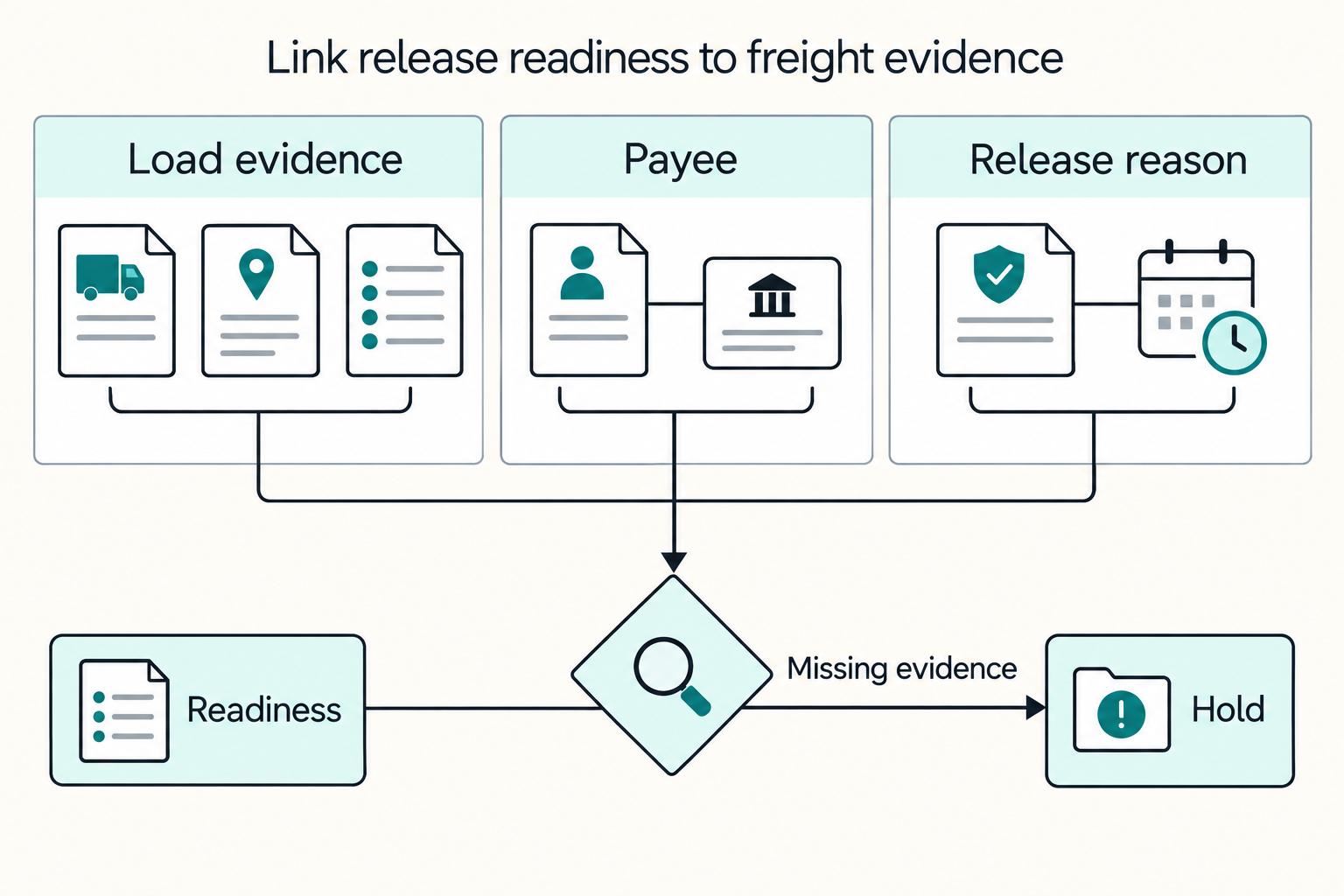
Quick Answer
Define the carrier obligation and due date independently of shipper collection. Confirm the entitled payee, including any factoring assignment, and evidence for the specific advance or settlement. Reconcile prior payments and fees to the remaining load balance, then resolve uncertain attempts before retrying.
Choose the freight marketplace money model before scale#
The first decision is not just how a freight broker pays a carrier. It is which money movement model your digital freight marketplace will run, before scale makes exceptions expensive. Make that choice late, and you can end up with a platform that books loads but cannot settle them cleanly.
In a broker-led flow, the carrier invoices the broker and the broker invoices the shipper. Track those as separate obligations with separate due dates. Carrier payment follows the applicable carrier agreement and legal requirements; do not infer a pay-when-paid condition from the shipper’s collection status. QuickPay changes the agreed timing or cost, while factoring can change who owns the receivable and should receive payment.
This guide helps you make that choice in the right order. The goal is practical: leave with a sequence for deciding ownership, payout release points, and rollout limits before you expand lanes or markets. Digital matching can simplify booking, but it does not remove payment complexity.
A useful rule is to avoid choosing rails first. First assign ownership of each funds-impacting state change:
- who validates load details
- who can approve payout
- who handles disputed charges
- who reconciles booked versus paid outcomes
Before settlement, make sure shipment records contain the operational basics needed to execute the move, such as pickup and delivery locations, freight dimensions, and weight. If that data is weak upstream, payment exceptions can multiply downstream.
This guide focuses on an operating policy for brokered freight, with U.S. regulatory examples labeled below. Check the applicable contract and local requirements for each lane; it does not provide a country-by-country payment-law comparison.
Carriers may need cash for fuel and other operating costs before the shipper pays the broker. Plan the funding for that timing gap separately from the bank rail used to execute payment.
Related: State of Platform Payments: Benchmark Report for B2B Marketplace Operators.
Map who owns money movement in your marketplace#
Do not let "the platform" own this by implication. Write your intended money path in one sentence: who invoices the customer, who receives funds, who approves payout, and where margin is recorded in your model. Marketplaces often split booking, payment, and communication across tools, and that is where ownership gaps turn into payment exceptions.
Step 1. Write the intended funds path#
Start with your commercial model, not the rail. If you are running a broker-led model, state the payer, payee, and payout trigger explicitly, then tie that choice to your contracts and operating rules. Treat this as a documented operating decision, not a team assumption.
Step 2. Build an owner matrix for each funds-changing step#
Use one compact matrix and assign a named team or role to every row.
| Step | Operational owner | Contract or document to check | Release question |
|---|---|---|---|
| Booking | Marketplace ops or broker ops | Booking record, accepted terms | Was the load accepted on valid terms? |
| Invoicing | Finance or broker back office | Customer invoice terms | Who bills whom, and when? |
| Payout approval | Carrier payables or finance approver | Delivery documents, agreed terms | What evidence makes this payout ready? |
| Settlement | Payments or finance | Payment record, remittance detail | Was money sent to the intended party? |
| Dispute | Ops plus finance | Exception notes, contract terms | Who can place or release a hold? |
| Reconciliation | Finance or reconciliation owner | Ledger, shipment record, payout record | Does one paid load tie to one approved shipment? |
Step 3. Separate ops ownership from legal responsibility#
The person moving a load forward is not automatically the party carrying contractual responsibility. Keep contract review, payout rules, and exception handling in a separate column from day-to-day task ownership. Otherwise, "ops approved it" becomes a weak answer when a charge is disputed or a payout is released early.
For U.S. partner identity checks, FMCSA’s fraud guidance recommends confirming broker and carrier phone numbers against SAFER and calling the listed number when details conflict. Verify payment-destination changes through a trusted existing contact as well; a valid USDOT number alone does not validate new bank instructions.
Step 4. Add a no-owner, no-launch checkpoint#
Set this as a hard internal rule for every funds-impacting state change: if no role owns the hold, release, or correction path, that state should not launch.
Test that rule on two hard cases before go-live: one load with missing documents and one with a post-booking exception. If ownership or the evidence trail is unclear in either case, pause payout automation.
Gather prerequisites before you build payout logic#
Define payout evidence and ownership rules before you automate, or you will hard-code exceptions into the normal path. Documentation, payee instructions, and validation ownership should be launch prerequisites, not cleanup work.
| Prerequisite | What to define | Release impact |
|---|---|---|
| Lane-specific evidence pack | Rate Confirmation, shipment records, and the contract terms tied to payout release; mark each item as required, optional, or not applicable by corridor and model | Match the records required for this payment stage: an agreed fuel advance can precede delivery, while final settlement uses the agreed delivery/invoice evidence |
| Payee assignment instructions | Collect assignment-related instructions at onboarding or booking and track whether they apply for that carrier and load | If the current payee assignment is unclear, hold payout until the assignment trail is complete and visible to ops and finance |
| Corridor-level customs checks | For cross-border or intermodal lanes, decide whether customs-related records are part of payout readiness review for that corridor | Define who validates it and at which shipment stage that validation affects payout release; keep this lane-specific |
payout ready state | For this advance, partial settlement or final balance, confirm the approved amount, entitled payee, agreed timing and evidence required for that stage; account for prior payments | Track matching delay and discrepancy rate; tighten matching before you expand payout automation if review is consistently delayed or discrepancy volume stays high |
Step 1. Assemble a lane-specific evidence pack for each payable load#
Specify evidence by payment stage. Booking and a fuel advance may require accepted rates, identity and pickup evidence; final settlement may require invoice, delivery confirmation and supported accessorials. Mark each item required, optional or not applicable under the agreement and applicable rules.
Match the amount and evidence for the payment stage across the relevant records. An advance may not yet have a final invoice or delivery confirmation. Final settlement should reconcile the agreed rate, required invoice and delivery evidence, supported adjustments and prior payments under the same load reference.
Step 2. Capture payee assignment instructions before delivery#
Capture factoring or other receivable-assignment instructions early, including their effective scope and date. Preserve the notice and verify changes with known contacts. A new carrier bank account is not enough to override an existing assignment; obtain the evidence needed to establish that the carrier may receive the payment.
Route conflicting assignment instructions to a named finance owner and resolve the entitled recipient before sending money. Track the contractual due date while investigating; an internal review should not become an indefinite payment deferral.
Step 3. Define corridor-level customs checks before enabling the lane#
For cross-border or intermodal lanes, decide whether customs-related records are part of payout readiness review for that corridor. The key control is ownership: who validates it, and at which shipment stage that validation affects payout release.
Step 4. Define "payout ready" as an operations state, not a UI status#
Define readiness for the specific payment: advance, partial settlement or final balance. Require its approved amount, entitled payee, agreed timing and applicable evidence. Record advances and prior payments so readiness never resets the full load amount as newly payable.
Choose between broker-led, embedded, and hybrid settlement#
Once payout ready is defined, choose the settlement model your team can enforce every day. If launch speed and current broker habits matter most, start broker-led. If you need tighter in-product controls, lean embedded. Use hybrid only when you have a clear segmentation reason and explicit ownership.
These are operating models, not just product labels. In practice, broker-led often runs through a broker payment hub, with status pushed back to your app. Embedded keeps more payout logic and status control in your product. Hybrid runs both paths at once.
| Model | Speed to launch | Visibility | Failure handling | Integration effort | Reconciliation burden |
|---|---|---|---|---|---|
| Broker-led portal-first | Often fastest, especially where broker-first workflows are already in place | Partial unless statuses, payee data, and artifacts are pulled back reliably | Split between portal queues and your ops team | Lower upfront | Moderate to high if key events stay outside core records |
| Embedded orchestration | Typically slower upfront | Higher potential when your app is the source of truth | More centralized when your product owns holds, retries, and release rules | Higher upfront and ongoing | Can be lower if documents, approvals, and payout references stay aligned |
| Hybrid | Can look medium at first, then slow as edge cases grow | Uneven by partner, lane, or provider | Hardest because exceptions cross two ownership models | Medium to high | Can be highest unless status and evidence gates are enforced the same way everywhere |
Step 1. Choose broker-led when adoption speed matters more than centralization#
Choose broker-led when adoption speed matters more than centralization. Many freight broker teams are working through fragmented stacks, legacy cost pressure, and changing connectivity, so broker-grade tools with prebuilt integrations and clearer pricing can be the fastest path operationally.
Step 2. Choose embedded when your product needs to enforce payout rules#
Choose embedded when you need your product to enforce payout rules across partners and lanes. That can improve control, but it can also raise total cost of ownership through implementation and ongoing operating overhead.
Before launch, produce a consistent decision record for each advance or settlement, linked to evidence, amount, current payee and approval. Retain a durable payment attempt and provider reference; ambiguous outcomes require investigation before another attempt.
Step 3. Use hybrid for bounded transition periods and specific corridors#
Use hybrid for bounded cases such as transition periods, specific corridors, or partner classes that need a different path. If your team cannot enforce the same status definitions and document gates across providers, hybrid can become expensive in exception handling and reconciliation.
Run hybrid like a migration program, not a loose feature toggle. Use named cohorts, readiness trackers, and explicit cutover ownership for each group so partners do not drift between models without a recorded decision.
Design payout rails and carrier terms that match your risk tolerance#
Separate commercial terms from execution rails. Standard terms and QuickPay define when and on what fee basis payment is due; ACH, wire and check are methods of sending it. Funding, agreement and assignment determine the obligation, while bank availability and cutoff affect execution.
Step 1. Build an internal rail matrix and treat it as operating policy#
| Choice | Meaning | Confirm |
|---|---|---|
| Standard terms | Contractual due-date rule | Trigger, due date and requirements for the invoice |
| QuickPay | Optional earlier payment under agreed terms | Fee base, who pays, election and promised arrival estimate |
| Factoring | Receivable financing that may assign the payee | Assignment scope, current entitled payee and release/change evidence |
| ACH or wire | Payment execution route | Provider cutoff, currency, destination validation, status and return handling |
| Fuel advance | Earlier payment credited against the load balance | Eligibility, approved amount, recipient and later deduction |
Illustrative load L100: the agreed carrier amount is USD 2,000. A verified USD 300 fuel advance has already been paid. If the carrier elects a separately agreed USD 40 QuickPay fee for final settlement, the final transfer is USD 1,660. Advance plus final cash is USD 1,960, with the USD 40 fee explaining the difference from USD 2,000. Preserve both payment references. This assumes no factoring assignment or other adjustment; a shipper invoice remains a separate receivable and does not reset the carrier’s balance.
Step 2. Treat expedited payout as an exception path#
Offer QuickPay only on clear, agreed terms and fund it consistently. A carrier choosing ordinary terms must still be paid on those terms. Use the actual provider estimate for arrival rather than promising a universal number of hours.
Step 3. Add a review state when factoring is in play#
Before paying a factored invoice, confirm the assignment scope and the current recipient. A factor may have already advanced funds to the carrier; the broker’s remaining obligation can then be payment to the factor, not a second payment to the carrier. Resolve conflicting notices and retain the supporting instruction trail.
Step 4. Define corridor-specific handling as internal policy and test one shipment#
For each corridor, define the evidence and approvals applicable to that payment stage. Separate customs obligations from payment conditions; do not turn every transport document into a blanket hold on an otherwise due amount.
Build a document and compliance gate before payout release#
Before sending an advance or settlement, link the applicable evidence, entitled recipient and agreed amount. Scope holds to the affected payment and record their lawful or contractual basis, owner and clearing condition.
| Control | Requirement | If not met or noted |
|---|---|---|
| Minimum evidence pack | Use the evidence required for the payment stage under the agreement and applicable requirements | Investigate the affected amount with a named owner and due date; handle undisputed amounts under the applicable terms |
| Compliance hold | Use policy-based compliance gates with explicit hold reasons where contracts, market rules, or provider setup call for identity or compliance review | Label the hold clearly so ops and finance can act on it |
| Manual override | Allow an authorized exception only where the underlying requirement permits it | Require approver identity, reason code, and linked artifacts explaining why normal gates were bypassed |
| Escalation lanes | Route document gaps, amount conflicts, and payee-entitlement conflicts to named owners before scheduling | A held load without a named owner can become a delayed payout and then a dispute |
Step 1. Define a minimum evidence pack in your own policy#
Use the agreed evidence pack for the particular payment stage. Delivery documents support final settlement where required; they cannot be prerequisites for a fuel advance intended to fund the journey. Internal policy must respect payment terms and applicable requirements.
If evidence is missing or amounts conflict, identify the affected obligation and investigate promptly. Record the due date, owner, reason and next action. Release an undisputed amount where the agreement and applicable requirements allow it, and keep the remaining balance open.
Step 2. Use policy-based compliance gates with explicit hold reasons#
Use policy-based compliance gates with explicit hold reasons. Where contracts, market rules, or provider setup call for identity or compliance review, label the hold clearly so ops and finance can act on it.
For U.S. property brokerage covered by 49 CFR 371.3, brokers must keep transaction records that include the freight bill or bill-of-lading number, compensation, freight charges collected and carrier-payment date. These records support a clear freight-to-payment trail; they do not prescribe a universal payout document gate for all countries or contracts.
Step 3. Allow manual override only with a complete audit trail#
Document every authorized exception with the approver, reason and linked evidence. An audit trail cannot waive a mandatory legal or provider restriction. Escalate requirements that cannot be overridden rather than treating admin access as permission.
Step 4. Define escalation lanes for missing or conflicting documents#
Define escalation lanes for missing or conflicting documents before they become silent delays. Route document gaps, amount conflicts, and payee-entitlement conflicts to named owners before scheduling.
Implement status tracking and reconciliation from day one#
Once the document gate is in place, make status tracking and reconciliation explicit so ops and finance can follow the same payout path from shipment evidence to settlement outcome.
Step 1. Define one internal status chain and clear transition rules#
Define one internal status chain and clear transition rules. Keep status names operational and require the same interpretation across brokerage, carrier ops, and finance.
Track the carrier payable, advance, payment attempts and any adjustments separately from shipment status. Close the payable only when its full balance is paid or validly adjusted. A confirmed partial payment reduces the balance but does not close the load’s payment obligation.
Step 2. Attach each status change to shipment evidence and stable references#
Attach each status change to its evidence and stable references. Use pickup or advance-eligibility evidence for an advance and the agreed delivery/invoice evidence for final settlement. Link load, approval, payment attempt and remaining-balance records so each financial effect is traceable.
Step 3. Define the exception path before volume grows#
For incomplete delivery evidence or an amount dispute, follow the applicable agreement and requirements. Keep a named investigation owner and due date; distinguish a contested amount from an undisputed amount eligible for payment.
Step 4. Run a checkpoint that traces each paid load to settlement#
Run a regular checkpoint that traces each paid load to a clear evidence set and settlement result. For each completed payout, confirm that the linked load and invoice references, evidence, approvals, and remittance details all point to the same outcome.
If your team is locking status ownership and release rules now, use Gruv Payouts to evaluate a control-first payout layer before corridor expansion.
Plan exception handling before scale creates noise#
Define exception logic early, or volume will hide risk inside one generic queue. Separate proof problems from money problems, then decide which cases block payout and which can move through a controlled partial-settlement path.
Step 1: Define failure modes before they arrive#
Start with exception types in your workflow, such as missing Proof of Delivery, banking-detail mismatches, factoring conflicts, and disputed Detention or Demurrage charges. Treat them as different risks, not one backlog:
- Missing POD is an evidence problem.
- Banking mismatch is a payee-control problem.
- Factoring conflict is a payee-ownership problem.
- Disputed accessorials can be amount disputes, even when service may be complete.
A signed delivery document establishes evidence of service, not the same due date for every contract. Track the agreed trigger and deadline separately from any review state, so missing information and payments simply not yet due are visible as different cases.
| Exception type | Initial action | Clear when | Primary owner |
|---|---|---|---|
| Missing Proof of Delivery | Investigate required evidence for the affected payment stage | Required delivery evidence is linked to the load record per policy | Carrier ops or broker ops |
| Banking detail mismatch | Hold payout and revalidate payee instructions | Payee details are verified and approved per policy | Finance |
| Factoring conflict | Hold payout until payee is confirmed | One valid payee instruction is on file and assignment conflict is resolved | Finance |
| Detention or Demurrage dispute | Separate amount review from service confirmation | Approved charge amount and supporting notes are agreed | Ops plus finance |
Step 2: Write plain "if X, do Y" rules#
As volume grows, routing cannot depend on judgment alone. Write short internal rules that make the next action explicit.
- If required evidence is incomplete, request the missing artifact under the same load reference, record the due date and investigate the affected amount under the applicable terms.
- If service is confirmed but the dispute is monetary, consider routing only the undisputed amount to partial settlement when contracts and approval rules allow it.
- If banking details do not match the approved payee record, stop release and revalidate before any payout request is sent.
- If a factoring company raises an assignment conflict, freeze payee release until finance confirms who should be paid.
Do not use QuickPay to bypass an unresolved payee conflict or an unsupported amount. It changes the agreed timing and fee, not who is entitled to the payment or what the load balance is.
Step 3: Assign owners and SLA bands that expose risk#
You do not need external benchmarks to run this well, but you do need internal resolution targets by exception type and a visible owner. Otherwise, items sit in pending review, and risk disappears from view.
- Document gaps: carrier or broker ops.
- Payee and factoring conflicts: finance.
- Detention or Demurrage disputes: ops plus finance.
Use aging bands, for example new, aging, and overdue, with clear escalation rules tied to your own thresholds. The key is clarity: every hold should show owner, current status, and the exact clearing condition.
Step 4: Prepare for outages and delayed broker-system updates#
If provider statuses arrive late or not at all, exception handling becomes your recovery path. Keep your internal record authoritative: intended payee, approved amount, evidence pack, and last confirmed settlement state.
When outage or delay risk appears:
- Pause auto-release and auto-complete actions that require fresh provider confirmation.
- Keep outbound attempts in durable pending states with stable business IDs. Resolve any submitted attempt’s status before replay or fallback; do not pay again merely because a callback is late.
- Reconcile provider responses to internal requests before retries, especially where stale updates can misstate completion.
After recovery, reconcile each payment attempt and the remaining load balance. Deduplicate event deliveries separately from financial effects; resume unfinished processing after a crash instead of skipping it solely because an event was recorded as seen.
Roll out by market and corridor without overcommitting#
Start with corridors you can operate reliably, not just corridors with the most demand. In practice, an initial cohort is usually safer where document handling is predictable and your payout and dispute workflows are already clear internally.
Step 1. Segment launch cohorts by operating friction first#
Segment launch cohorts by operating friction first: corridor, document complexity, and your current confidence in payout operations.
Use a simple rule set:
| Cohort type | Launch posture | Why it belongs there | Verification before go-live |
|---|---|---|---|
| Domestic corridor with repeat partners and stable proof flow | Launch first | Fewer moving parts and easier exception review | Confirm one approved evidence pack, one payout path, and named dispute owners |
| Domestic corridor with port or facility access constraints | Launch selectively | Local regulation or access limits can change corridor viability | Verify who handles access delays, facility issues, and payout holds |
| Cross-border corridor with customs-clearance dependence | Stage later unless document ops are already stable | Customs inefficiency can delay shipments and increase import costs | Confirm customs-document validation, escalation ownership, and any known payout blockers |
Step 2. Use a market go-live checklist as a release gate#
Use a market go-live checklist as a release gate, not a planning note.
At minimum, define:
- required documents for that market or corridor
- payout methods you will support there
- payout assumptions and known unknowns (for example, fee or timing benchmarks by market that you have not validated yet)
- expected dispute patterns, for example amount disputes versus proof disputes
- owner for each hold and release decision
Step 3. Stage customs-dependent lanes after simpler lanes#
Stage customs-dependent lanes after simpler lanes unless your document operations are already stable. This is a sequencing choice, not a permanent no-go.
Step 4. Track unknowns as explicit launch inputs before expansion#
For each pilot lane, record:
- assumptions
- pilot thresholds that trigger review or pause
- explicit unknowns (including unvalidated payout fee/timing benchmarks by market)
- review dates
- sign-off owner before expansion
Common mistakes that break payout scale and how to recover#
Many costly payout failures at scale are operational: unclear ownership, overused QuickPay, weak document gates, and unresolved factoring instructions. Fixing those four areas early makes growth easier to control.
| Mistake | Recovery | Key control |
|---|---|---|
| Treating broker payout portals as the operating model | Keep your own control layer above the portal | For each load, keep one internal record with approver, payout state, provider reference, and settlement outcome |
| Enabling QuickPay too broadly | Limit QuickPay to lanes and partners that can absorb the fee | Use it selectively based on lane margin after fee, partner reliability, and dispute history |
| Releasing funds before document checks are complete | Enforce the evidence requirements for each payment stage | Investigate the affected amount under the agreement; retain any permitted exception and its approval |
| Ignoring factoring edge cases until payout day | Resolve payee instructions before scheduling payout | When carrier and factoring instructions conflict, freeze scheduling and resolve the payee in writing first |
Mistake 1: Treating broker payout portals as the operating model#
49 CFR 371.3 gives parties to covered U.S. brokered transactions the right to review the required transaction record. Preserve the underlying data outside transient portal views, and treat proposals to change the rule separately from requirements already in force.
Mistake 2: Enabling QuickPay too broadly#
Use the elected QuickPay terms and actual provider timing estimate. For a U.S. bank route, Nacha describes Same Day ACH as processing on the same business day; bank cutoffs, availability and eligibility still need to be checked. A faster rail does not finance the broker’s working-capital gap.
Mistake 3: Releasing funds before document checks are complete#
Recovery: apply the agreed evidence requirements for the payment stage.
Match final-settlement evidence to the contract, and handle advance payments under their own eligibility rules. Verify documents and payee instructions rather than treating an uploaded file as sufficient proof.
Keep missing-evidence investigations owned and time-bound. Record any permitted exception, the approved amount and the remaining balance; do not use an internal checklist to invent new terms after the load is completed.
Mistake 4: Ignoring factoring edge cases until payout day#
Factoring can assign the receivable to a factor that has financed the carrier. Confirm the entitled payee and assignment scope before scheduling payment; the precise rights and recourse depend on the documents and applicable law.
When carrier and factoring instructions conflict, freeze scheduling and resolve the payee in writing first. The control objective is simple: one load, one current payee of record, one clear instruction trail.
If you want a deeper dive, read How Logistics and Freight Platforms Pay Carriers and Owner-Operators at Scale.
Conclusion#
The durable advantage here is not any single payment method. It is a clear operating model: explicit ownership, disciplined documentation checkpoints, and reliable reconciliation when exceptions happen.
Step 1. Define an owner for every money-moving step#
Define an owner for every money-moving step across the Shipper, Freight broker, and Carrier. If no one owns a state change, dispute path, or key decision, do not scale that flow yet.
Step 2. Lock your documentation and booking checkpoints before you automate#
Lock your documentation and booking checkpoints before you automate. Teams should be able to make the same decision from the same records, and booking inputs should be captured consistently, for example origin, destination, and cargo type.
Step 3. Choose your payout approach and write the rules down#
Specify standard and optional expedited terms, approved rails and advance rules. Resolve submitted payments with unknown outcomes before using a fallback, and preserve prior payments in the load balance.
Step 4. Standardize status handling and reconciliation before expansion#
Standardize status handling and reconciliation before expansion. If teams cannot trace what happened, in order, for a paid load, scale will multiply operational noise.
Turn your launch checklist into an implementation plan with idempotent events, approval gates, and audit-ready reconciliation using the Gruv docs.
Frequently Asked Questions
Who pays the freight broker, and when should the carrier expect payout?
In a broker-led flow, the broker invoices the shipper and pays the carrier under its separate carrier agreement and applicable requirements. Track each due date independently; shipper nonpayment does not by itself establish permission to delay a carrier payment. QuickPay can change agreed timing and factoring can change the entitled payee.
How should a marketplace choose between QuickPay and standard payment terms?
Compare the carrier’s agreed standard terms with an optional QuickPay offer, including the fee base and arrival estimate. Keep funding separate from payment execution, and do not make QuickPay a requirement for receiving an otherwise due payment.
What is the minimum payment stack required before scaling broker-carrier payouts?
Keep accepted rate terms, the carrier payable and due date, current payee instructions, stage-specific evidence, payment attempts and a reconciled remaining balance. An advance and final settlement have different evidence needs. Track shipper invoicing and collection separately rather than making them universal carrier-release prerequisites.
When should we rely on broker payment hubs like TriumphPay versus building embedded orchestration?
Choose a hub or embedded orchestration by testing the required records, payee controls, stage-specific evidence and exception handling. Keep carrier terms independent of shipper invoicing. QuickPay can change agreed timing or fees; a factoring assignment can change entitlement and must be reflected in the payment recipient.
Which documents must be present before a carrier payout is released?
Use the documents required by the agreement and applicable rules for that payment stage. Final settlement may need delivery and invoice evidence; a pre-delivery fuel advance needs its own eligibility evidence. Required documents, investigation deadlines and any permitted exceptions should be clear before the load is accepted.
How do we reduce payout failures when factoring companies are involved?
Keep assignment notices, effective scope, verified changes and any release evidence with the carrier and load record. Resolve conflicting carrier and factor instructions before sending funds, preserve the due date during investigation and reconcile the payment to the remaining obligation.
Researched and edited by the Gruv editorial team. Gruv builds cross-border billing, payouts, and finance-operations software for global businesses.
Sources
Includes 1 external source outside the trusted-domain allowlist.
Educational content only. Not legal, tax, or financial advice.
Related Posts

The Freelance Payment Penalty: A Modeled Audit of Platform Fees, FX Spreads, and Payout Delays
The money rarely disappears through a single, easy-to-spot fee. The real loss is stacked. A marketplace takes its commission, a processor adds a charge for international cards, a bank or payment company converts the currency at a spread, a platform holds the funds before release, and a wire sheds a little to intermediaries on the way in. Each layer looks defensible on its own, but the worker feels the combined result as a smaller deposit and a later payday.

How to Respond to a Subpoena for Business Records
Move fast, but do not produce records on instinct. If you need to **respond to a subpoena for business records**, your immediate job is to control deadlines, preserve records, and make any later production defensible.
A US Expat's Guide to Investing in UCITS ETFs to Avoid PFIC Issues
The real problem is a two-system conflict. U.S. tax treatment can punish the wrong fund choice, while local product-access constraints can block the funds you want to buy in the first place. For **us expat ucits etfs**, the practical question is not "Which product is best?" It is "What can I access, report, and keep doing every year without guessing?" Use this four-part filter before any trade: