
Quick Answer
To pay solar installers and energy auditors at scale, anchor every payout to the signed contract, financing structure, and local billing rules before you automate disbursements. Separate installer and auditor logic when their approval evidence differs, block payouts until identity, tax, and policy checks are complete, and launch in one jurisdiction first with traceable records, batch review, and reconciliation.
Why paying solar installers and energy auditors gets complicated#
Clean energy payouts break when contract structure, financing assumptions, and local billing rules are misread. Before you optimize disbursement speed or onboarding, confirm what earns a payout, who owns the asset or cash flow, and which program terms can change payment value.
Before you start#
Use this as an operator decision path, not a generic payments overview. The evidence here is mostly U.S. contract and financing context, plus one California billing-program example, so validate jurisdiction by jurisdiction instead of assuming one global model.
Start with a small evidence pack: a sample customer contract, the relevant lease or off-take agreement, and the utility or program billing terms that govern credits or cashout. If you cannot point to the document that defines ownership, payment timing, or reset conditions, you are still guessing.
Step 1 Anchor payout logic to the contract form#
Let the contract form set payout logic. In an operating lease, the lessor owns the equipment and the customer pays fixed monthly rent. In a capital lease, the customer is treated as the equipment owner for most legal and accounting purposes during the term.
That distinction drives operations. EPA guidance notes that operating-lease qualification depends on Financial Accounting Standards Board tests, so accounting treatment is a design constraint. If your team cannot clearly state ownership and whether the structure is intended to qualify as an operating lease, do not lock payout triggers.
In practice, review ownership clauses first. Build payout triggers from the lease or long-term off-take agreement terms rather than project activity alone.
Step 2 Test financing assumptions before expanding the model#
If projects depend on project finance, payout design needs to align with financing logic. Project finance is tied to project-specific risks and future cash flows, often with limited recourse, and it works best when long-term off-take agreements are in place with quality-credit counterparties, including PPAs.
Use that as a working rule in your model. When contracted revenue and long-term performance drive the deal, disbursement logic should follow contract states, not just field completion. Small structural differences can reduce financing availability or leverage even when projects look similar.
Your key checkpoint is the off-take or equivalent revenue agreement. If counterparty quality is weak or long-term revenue commitment is vague, treat expansion as higher risk instead of assuming operations can fix it later.
Step 3 Verify jurisdiction-specific billing mechanics#
Local program mechanics can materially change payout outcomes. In Silicon Valley Clean Energy's Solar Billing Plan, exported electricity is credited based on its value to the grid, and credit value varies by time of day, day of week, and season.
| Rule area | Condition | Outcome |
|---|---|---|
| Export credits | Exported electricity | Credited based on its value to the grid |
| Credit variability | Time of day, day of week, and season | Credit value varies |
| Enrollment | Customers approved after April 14, 2023 | Enrolled in the new plan |
| Billing start | Approvals between April 15, 2023 and April 15, 2024 | Billing began on the customer's first true-up date |
| Cashout | Under $100 | Bill credit |
| Cashout | $100 or more up to $5,000 | Check |
| Cashout cycle | End of the cashout cycle | Balances reset |
Do not model exported power as a flat monthly payment. In this program, customers approved after April 14, 2023 were enrolled in the new plan; for approvals between April 15, 2023 and April 15, 2024, billing began on the customer's first true-up date. Cashout thresholds also matter: under $100 is bill credit, $100 or more up to $5,000 is check, and balances reset at the end of the cashout cycle.
In practice, verify credit timing, cashout thresholds, and reset rules in program terms before you map payout states. A wrong assumption here can leave the ledger looking correct while the economics are wrong.
This pairs well with our guide on How Marketplace Operators Choose a Platform Payments Architecture That Lasts.
Define scope before you touch payout rails#
Start with a launch scope you can document end to end. If you broaden scope before the documents are clear, you bake assumptions into payout logic.
Step 1 Pick a narrow launch lane you can verify with real paperwork#
Choose a lane where you already have signed or near-live documents, not just demand signals. Before product work starts, confirm you can trace the transaction path from agreement to payout and identify the dispute path if it breaks.
The verification point is simple: operations can walk through one repeatable transaction shape using current documents. The red flag is just as clear: teams call multiple lanes "similar" but cannot show the paperwork side by side.
Step 2 Map contract artifacts before payout rules#
Inventory the contract artifacts your launch lane actually uses and record who signs, stores, and reviews each one in a dispute. If contract naming and document ownership are inconsistent across teams, payout design is still speculative.
Step 3 Build an evidence pack and mark what is still unverified#
Create a small, reviewable evidence folder from current operating documents. If a required artifact exists only as a forward-looking statement or a deck promise, treat it as unverified until you have the underlying document.
Step 4 Track known unknowns with owners and deadlines#
Keep a visible known-unknown register for jurisdiction-specific checks that could affect launch readiness. Run it like a submission checklist: each unknown needs an owner, a validation source, and a clear deadline so late validation does not delay launch or review.
Related: Airline Delay Compensation Payments: How Aviation Platforms Disburse Refunds at Scale.
Match payout design to contract and financing structure#
Choose the payout anchor from the contract and financing evidence you can prove, not from workflow preference. If long-term obligations dominate, you can anchor disbursements to contract states. If short-cycle work dominates, milestone-based evidence may be the better anchor.
Step 1 Choose the payout anchor before payout speed#
Start with one question: what document state makes this payment valid? Then design payout timing around that evidence.
| Starting model | Anchor payout to | Best fit when | Internal control check | Financing compatibility check |
|---|---|---|---|---|
Contract-linked (PPA / CfD or similar long-term contracts) | Signed contract states, amendments, and documented exception states | Obligations are long-duration and release logic depends on contract state | Confirm release, exception, and reversal owners are explicitly named | Check that payment triggers are traceable to signed contract artifacts |
| Milestone service payouts | Verified completion milestones and acceptance evidence | Work is short-cycle and acceptance-driven | Confirm acceptance evidence is complete before release | Better fit when review is tied to completed, evidenced work |
For one sample deal per lane, operations should be able to show the exact artifact that changes payment status. A red flag is when payment status is driven by internal updates without signed agreement or acceptance evidence.
Step 2 Treat accounting and ownership as launch gates#
Do not defer accounting and ownership questions. Before you automate anything, set a clear internal decision on how release, exception, and reversal handling will work.
For each payout design, require a short approval record that names the release state, the exception approver, and the reversal owner if obligations change. If that record is missing, keep manual review in place.
Step 3 Check financing fit against real contract artifacts#
Use financing compatibility as an evidence test, not a theory check. NREL published a dedicated report on renewable energy project finance costs across technologies, and the November 2024 CPUC RPS report tracks checkpoints such as contracted renewable capacity, procurement costs, and "Progress in Long-Term Contracting" (p. 40).
Operationally, use a simple standard:
- Contract-linked: a reviewer should be able to follow release logic from the signed long-term agreement.
- Milestone: completion evidence should stand on its own for an external reviewer.
- Across models: hold release when counterparty identity, signed documentation, or amendment/exception paths are unclear.
The January 2026 EU Parliament PPA/CfD study is useful here as a practical signal: uptake is shaped by real barriers and the tools used to address them, so structure choices should account for implementation risk, not only commercial intent.
Step 4 Build failure handling into the model#
Define hold states before launch for amendments, delays, and disputes. The CPUC report's discussion of transmission project delay is a useful reminder that deployment timing can slip outside your payout calendar.
Keep one release rule consistent across models: if the underlying contract state is uncertain, hold payment status until the evidence is complete.
You might also find this useful: How to Scale Global Payout Infrastructure: Lessons from Growing 100 to 10000 Payments Per Month.
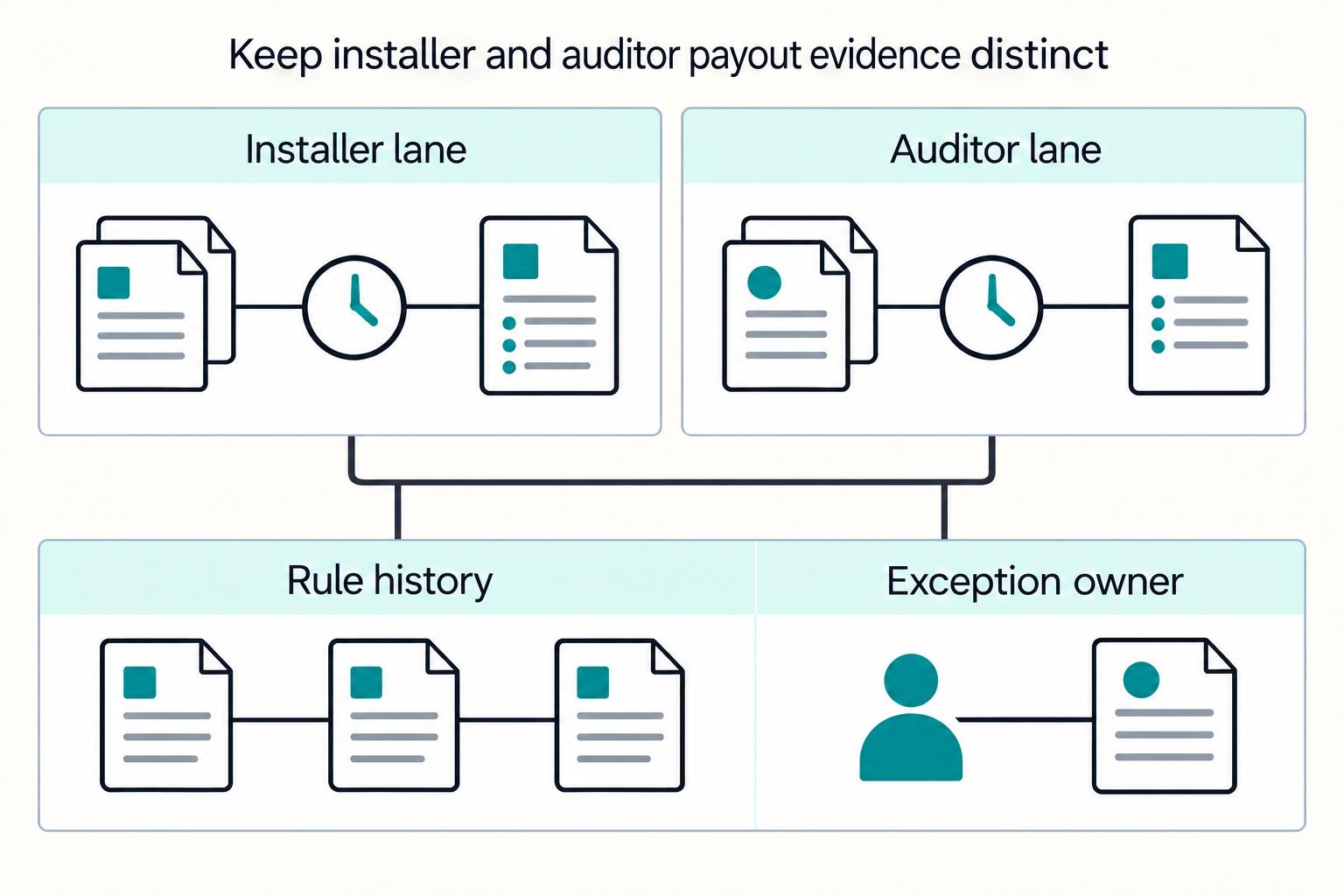
Separate installer and auditor payout logic from day one#
If installer and auditor payments rely on different approval evidence, split the payout logic from the start. Only governance structure is established here, not specific installer-versus-auditor payout timing norms, so keep operational assumptions explicit.
Step 1 Use separate status paths when triggers differ#
When triggers differ, define lane-specific states tied to each lane's own release evidence, and require operations to show the artifact that moved a payment from held to releasable.
Step 2 Keep dispute handling lane-specific#
Use distinct hold and dispute states per lane, with a named owner, required evidence, and a release rule. Avoid a single catch-all disputed status that hides whether the blocker is missing documentation, a commercial disagreement, or complaint review.
Step 3 Treat rule governance as part of payout design#
Maintain a dated revision log for payout rules and state definitions, with what changed and where it changed. This matches the governance pattern reflected in the NYSERDA material (Revision Date | Description of Changes | Revision on Page(s)) and supports clear reconstruction later.
Keep an explicit current list of who can approve exceptions, consistent with the CPUC document's use of an appendix for participant appearances.
Put compliance and tax gates before disbursement#
Once installer and auditor lanes are separate, keep one release rule in front of both: no disbursement until required gate states are complete. Treat this as both a product control and an operations control, not a manual exception path.
Step 1 Define blocking states before you enable payouts#
Set explicit blocking states for identity, business, and policy-risk reviews that match your market and program requirements. The key design choice is whether these states are advisory or blocking at release time. If you want predictable controls, make them blocking.
The FBAR materials here do not define specific KYC, KYB, or AML control standards, so treat those checks as program-policy definitions. Keep the model auditable: identity cleared, tax profile ready, and policy review cleared should be independent checks. If any check is incomplete, the payee can continue onboarding or service delivery, but should stay out of withdrawal and payout batches.
Step 2 Map tax readiness by payee type before first withdrawal#
Define tax-profile readiness states before your first payout run, and map them by payee type and country. Specific W-8, W-9, or Form 1099 requirements vary by program and jurisdiction, and this FBAR material does not establish a universal requirement. If your program uses forms such as W-8, W-9, or later 1099 handling, capture those as structured status fields rather than ad hoc ops notes.
Keep the payee record explicit: payee type, country, tax-form status, date received, and any approved override. Paying first and collecting tax records later usually creates avoidable cleanup work.
Step 3 Define when FBAR context belongs in your documentation#
If you support cross-border account structures, decide early when FBAR context should appear in user-facing docs and support playbooks for U.S. users. FBAR is the Report of Foreign Bank and Financial Accounts, filed as FinCEN Form 114.
| FBAR item | Detail |
|---|---|
| Filing trigger | An FBAR must be filed when the single-account maximum or aggregate maximum exceeds $10,000 |
| Account valuation | Each account is valued separately |
| Maximum account value | A reasonable approximation of the greatest value during the calendar year |
| Currency and rounding | Recorded in U.S. dollars and rounded up to the next whole dollar |
| Rounding example | $15,265.25 becomes $15,266 |
| Exchange rate source | Another verifiable exchange rate source may be used when a Treasury Financial Management Service rate is unavailable |
| Standard timing | April 15 with an automatic extension to October 15 |
| Relief notices | FinCEN also publishes event-specific relief notices |
Use the threshold and calculation details as written for those U.S. filers: an FBAR must be filed when the single-account maximum or aggregate maximum exceeds $10,000, and each account is valued separately. FinCEN describes maximum account value as a reasonable approximation of the greatest value during the calendar year, recorded in U.S. dollars and rounded up to the next whole dollar, for example, $15,265.25 becomes $15,266, and allows another verifiable exchange rate source when a Treasury Financial Management Service rate is unavailable.
Do not hardcode one unconditional deadline into product copy. FinCEN instructions state April 15 with an automatic extension to October 15, and FinCEN also publishes event-specific relief notices.
Step 4 Enforce the release checkpoint in product and operations#
Enforce the same release checkpoint in both API logic and payout operations workflows: no release while required identity, tax-profile, or policy states are incomplete. That prevents manual batch paths from bypassing controls.
If you expose or export FBAR-related data, structure and correction paths matter. FinCEN materials note that missing required XML elements can trigger submission rejection, and errors in a previously filed FBAR require an amended report. Use that as a design cue to keep records structured, corrections explicit, and exceptions logged by payee, reason, and approver.
Build traceable money movement architecture#
Build one traceable money trail first, then scale it. In markets shaped by capital intensity, long payback horizons, and uncertainty, weak traceability can increase financing risk.
Step 1 Define one canonical record trail#
Pick one authoritative record path across collection, settlement, and disbursement records for each transaction type, and make teams use it consistently. Avoid parallel truths across tickets, spreadsheets, and exports.
Step 2 Put update checkpoints into the operating model#
Set formal checkpoints where recorded values are reconciled to actuals before reporting decisions are made. This follows the same governance logic used in structured update processes such as annual plan and performance checkpoints.
Step 3 Keep reported balances tied to recorded facts#
Treat recorded state changes as the source, and make reported balances and outcomes derived views. Keep budget, benefit, and output/outcome artifacts organized so another operator can reconstruct decisions without guesswork.
Step 4 Design against fragmentation risk#
Assume data gaps and policy fragmentation can undermine consistency if left unmanaged. Standardize key fields and handoffs early so your money-movement records stay decision-ready for reporting and bankability discussions.
Roll out in one country with a strict launch sequence#
Once your money trail is traceable, keep scope tight: launch in one jurisdiction and one customer segment first. A common failure mode in this phase is mixing contract norms, escalation paths, and onboarding flows before the team has one repeatable operating path.
Step 1 Choose one jurisdiction and one segment#
Pick one country and one lane, for example residential installers or energy auditors, then define the contract form you expect to handle most often, such as a PPA or an operating lease. The goal is not to resolve every legal edge case. It is to align payout states, holds, and dispute evidence to one dominant contract pattern.
Use a public jurisdiction artifact as a checkpoint, not a substitute for counsel. A useful example is California's 2024 RPS annual report (November 2024), which explicitly includes sections on Compliance and Enforcement, Project Location and Mapping, and Progress in Long-Term Contracting, and also flags risk from delayed transmission timelines. Whether or not you launch in California, use the same standard: choose a market where contracting and enforcement signals are inspectable.
Your end-of-step check is simple: you can name the segment, the dominant contract form, and your formal escalation path for payout disputes in a one-page launch memo.
Step 2 Configure onboarding gates before partner recruitment#
Set onboarding gates before partner recruitment starts. If your operating model uses compliance gates, define KYC, KYB, and AML states, plus any document collection your program requires, including W-8 or W-9 forms where applicable to your workflow.
Operationally, treat payouts as gated until identity, business profile, and required documents in your workflow are complete. Keep the launch document pack narrow: signed contract, verification outcome, payout method details, and any tax-profile status your program tracks. If an operator who did not onboard the partner cannot determine payout eligibility from the record, the gate is not ready.
Step 3 Pilot with limited counterparties and batch payouts#
Run a small pilot to test operations, not demand. Use payout batches during the pilot so you can review exceptions as a set and produce reconciliation exports after each cycle.
After each batch, keep one packet with released, held, and failed payouts, exception reasons, reconciliation output, and the document references needed to clear holds. Do not expand until finance and operations can independently reproduce the same batch outcome from exported records.
Step 4 Run a go or no go review before the next market#
Run a formal go or no go review before expanding to another market. Base it on three operational signals you define upfront: dispute rate, payout failure rate, and unresolved hold time.
If recurring disputes tie back to contract ambiguity, or holds remain unresolved because documents or reviews lag, expansion multiplies the problem. Fix the root cause in the current country first, then expand. Write the decision memo so an external reviewer could follow it later: jurisdiction, dominant contract form, onboarding gates in place, and latest reconciliation outcome.
Before entering market two, use a concrete implementation checklist for batches, retries, and reconciliation in Gruv Payouts.
Reduce legal exposure from sales and payment promises#
Treat sales language as a payment control, not just marketing. When promises about savings, fees, financing terms, or cancellation rights are not supported by the signed documents, complaints can quickly become payout holds, reversals, and pressure to cancel the agreement.
Step 1 Audit every installer offer against the signed contract#
Start with the higher-risk channels: financed residential installs, in-home sales, and rep-led offers. Regulators and consumer agencies have repeatedly flagged the same pattern: misleading statements about loan terms, costs, and expected bill outcomes, including financing markups that can raise principal by 30% or more above cash price.
Use one rule across offers: if it is said in the sales process, it must be clearly reflected in the contract and fee disclosures. If claims like "no electric bill," "low-interest financing," or "no fees" are not supported in the file, stop related partner payout until the offer is corrected and reapproved.
Run a recurring sample review per active installer and compare the approved script version, proposal or quote, financing summary, and signed contract. Check for mismatches on fees, savings claims, term length, and cancellation language.
Step 2 Enforce promise boundaries in your sales-agent agreement#
Set hard boundaries on what reps can promise, and require approved language for price, financing, expected savings, and project timing. Any nonstandard claim should require internal approval before it is presented to the customer.
This matters most in fast-close channels. FTC consumer guidance flags rushed e-sign behavior as a scam indicator. For covered door-to-door transactions, confirm whether Cooling-Off Rule requirements apply and capture required cancellation-right disclosures in the file. Where covered, the cancellation window is three business days, but do not treat that as a universal right for all solar contracts.
Minimum evidence for each rep-originated sale should include:
- approved script or offer-template version used
- final contract and financing disclosure shown to the customer
- e-sign timestamps and channel or device record
- cancellation-right notice for covered transactions
- rep attestation or call or chat record for nonstandard discussions
Step 3 Build a complaint path that can freeze payouts and reconstruct the sale#
Complaints tied to consumer protection laws need named owners and a defined payout consequence. State enforcement actions describe recurring issues: misleading low-interest claims with large undisclosed fees, big-savings pitches tied to large down payments and non-completion, and false promises that led consumers into high-cost contracts. In New York, requested relief included canceling consumer agreements.
| Owner | Action | Recorded detail |
|---|---|---|
| Support | Logs the complaint | Contract ID, channel, and allegation details |
| Compliance or legal | Reviews the sale file | Script, contract, fee disclosure, and any cancellation notice |
| Finance | Holds, releases, or reverses payout | Decision reason |
Use one escalation path with three owners. Support logs the complaint with contract ID, channel, and allegation details. Compliance or legal reviews the script, contract, fee disclosure, and any cancellation notice. Finance then holds, releases, or reverses payout and records the decision reason.
Include Better Business Bureau complaints in intake as a signal, not proof. Your internal standard should be reconstructability: an independent reviewer can determine what was promised, what was signed, and whether the rep stayed within approved language.
For a step-by-step walkthrough, see Gaming Platform Payments: How to Pay Game Developers Studios and Tournament Players at Scale.
Check financeability before you expand geography#
Do not expand because a market looks active. Expand only when program ownership, approval status, and governance signals are clear enough to support consistent execution.
Step 1 Build one expansion scorecard for every market#
Use the same scorecard each time so decisions are comparable and evidence-based.
| Dimension | What to verify | Red flag |
|---|---|---|
| Program ownership clarity | Who funds incentives, who administers the program, and who carries obligations | Unclear ownership or split responsibilities with no clear accountability |
| Approval status | Whether initiatives are approved or still being refined | Material initiatives pending approval |
| Scope and budget stability | Whether revision history shows scope or budget changes | Reduced focus or budget cuts that change delivery assumptions |
| Governance traceability | Date-stamped revision logs and current program chapter/fund review | No current, dated record of program changes |
For policy context, keep date-stamped governance artifacts in your file, such as revision logs and the latest program chapter or fund review.
Step 2 Test whether your expansion narrative is evidence-backed#
Use policy-program change logs as a risk check. NYSERDA updates budget and benefit values through the Annual Investment Plan & Performance Report (IPPR), and its revision history includes initiative removals when approvals were not yet in place, including an entry dated June 6, 2019.
Step 3 Treat policy signals as secondary inputs#
Broader policy goals can improve market attractiveness, but they should not override unresolved approval or governance risk.
Prioritize administrative clarity. In Delaware, the Green Energy Fund is funded by Delmarva Power and Light ratepayers and administered by DNREC, with the program review reporting more than $30 million funded since 1999. If policy scope is narrowing or approvals are pending, delay expansion and tighten controls first.
Plan failure handling before scale amplifies it#
Plan failure handling before scale amplifies it. Define retry logic, escalation paths, and notification thresholds in your payout operations before volume grows.
Step 1 Define what is explicitly supported#
From the excerpt, the supported facts are:
- Form F-1/A, Amendment No. 2, under the Securities Act of 1933
- Filing date October 2, 2024
- Registration number 333-280955
- Rule 415 delayed/continuous offering checkbox marked
- Emerging growth company status marked
Step 2 Separate filing checkpoints from operational playbooks#
Use the filing evidence for what it can prove, and avoid inferring payout-incident procedures that are not in the text.
| Field | What is established |
|---|---|
| Filing status | Form F-1/A, Amendment No. 2; Registration No. 333-280955; filed October 2, 2024 |
| Rule 415 | Delayed/continuous offering box is checked |
| Issuer status | Emerging growth company is checked |
| Accounting standards election | Election not to use the extended transition period for new or revised standards |
Step 3 Mark payout recovery details as unknown#
Failure classes, owner/SLA matrices, customer status language, release/reversal evidence rules, and deterministic retry/replay design are not established.
Related reading: How Streaming Gaming Platforms Scale with Monetization and Payout Infrastructure.
Track the operating metrics that actually change decisions#
Once failure handling is deterministic, track only the metrics that map to a control checkpoint and a clear go or no go decision. If a metric cannot be tied to a defined review record, it should not drive expansion.
Step 1 Separate the signal by control domain#
Do not rely on one blended operations view. Keep distinct reporting lanes for:
- procurement costs
- compliance and enforcement items
- timeline-risk items, including transmission-related delay risk
This keeps cost, compliance, and timeline risk visible as separate decision inputs instead of averaging them into a single number.
Step 2 Add explicit reporting-control checkpoints#
Pair operational metrics with auditable reporting checks:
- whether required reports were filed during the preceding 12 months
- whether required Interactive Data Files were submitted during the preceding 12 months
- whether internal control over financial reporting has a documented assessment and attestation checkpoint under Section 404(b)
Use the same discipline as formal reporting: each dashboard value should reconcile to an underlying record, owner, and timestamp.
Step 3 Gate expansion on sustained control stability#
Before expanding to a new market or partner cohort, confirm that cost, compliance, and timeline-risk reporting remain stable across repeated review periods. If reporting checks are complete but transmission-related timeline risk continues to increase, treat that as an intervention signal and fix the control point before rollout.
Conclusion#
A durable operating model does not start with the fastest payout rail. It starts with contract-fit payout design, explicit control gates before funds move, and market-by-market expansion only after the first launch is traceable under diligence and financing scrutiny.
If your model may intersect with Project Finance, this discipline matters even more: lenders underwrite project risks and future cash flows, often with limited recourse to the sponsor. Long-term off-take agreements with quality-credit counterparties can support financeability, but the operating standard is simple: each release event should map to a real contract state and clear completion evidence.
- Confirm the contract model before building payout states.
Classify each flow (for example, long-term off-take and other contract structures) and make sure each release condition maps to the governing document.
- Define control gates before enabling withdrawals.
Define any onboarding, identity and business checks, and tax-document handling by jurisdiction, payee type, and program. Where applicable, include W-8 Form, W-9 Form, and reporting inputs for Form 1099.
- Split handling paths when contract evidence or timing differs.
If different counterparties or contract states require different completion evidence, avoid forcing everything into one rule set.
- Make payout operations auditable and reconcilable.
Release decisions and payment history should stay traceable for finance review and diligence.
- Use a pilot and make expansion earn approval.
Cleantech financing paths are not linear, and in tight credit markets even small deal-structure differences can reduce financing availability or leverage. Treat each new market as both an operations and financing decision.
Short version: prioritize contract fit, control clarity, and evidence-based expansion sequencing.
When your pilot metrics hold across initial cycles, use this expansion checkpoint to confirm market and compliance fit with Gruv.
Frequently Asked Questions
What payment model should a cleantech marketplace start with for installers and auditors?
Start with the model that matches the signed contract structure. Use contract-linked payouts for PPA or lease-based obligations, and milestone-based payouts for short, acceptance-driven work. If you cannot map each release event to contract language or acceptance evidence, simplify before launch.
How do `PPA` and `VPPA` structures change payout timing and risk ownership?
The article supports only that PPA is a distinct contract category with meaningful design and adoption differences, not a generic service contract. It does not provide specific VPPA timing or risk-allocation rules. Those details need to come from the negotiated agreement and counsel.
When should we use lease-linked payouts instead of milestone payouts?
Use lease-linked payouts when the commercial reality is equipment use over time instead of a one-time delivery outcome. The article notes leases can spread large clean-energy payments over several years. Confirm the lease type first because operating, capital, and tax-exempt lease-purchase forms have different ownership, classification, and end-of-term implications.
What makes a cleantech payment flow financeable for `Project Finance` participants?
Financeable payout flows are traceable to contract state, obligation owner, and evidence of completion. The article says project finance is tied to project-specific risks and future cash flows, often with limited recourse, and works best when long-term off-take agreements are in place with quality-credit counterparties. If those elements are unclear, treat expansion as higher risk rather than assuming operations can fix it later.
How do payout terms create legal risk under consumer protection enforcement?
Legal risk rises when sales claims about savings, fees, financing terms, timing, or cancellation rights are not supported by the signed documents. The operating guardrail is simple: if it is said in the sales process, it must be reflected in the contract and fee disclosures. When promise and contract diverge, route the matter to review and hold related partner payouts until it is corrected.
What is the minimum compliance stack before first disbursement (`KYC`, `KYB`, `AML`, tax forms)?
This article does not set one universal minimum stack across markets. Instead, define identity, business, policy-risk, and tax-document requirements by jurisdiction, payee type, and contract model, and make them blocking release states. Keep first disbursement blocked until the required checks and records are complete.
How should energy auditor compensation differ from solar installer compensation at scale?
Separate their payout logic whenever contract terms, release evidence, dispute handling, or risk ownership differ. Use lane-specific states, hold rules, and named owners rather than one shared workflow. Combining both groups under one rule can hide contract-specific risk instead of reducing complexity.
Researched and edited by the Gruv editorial team. Gruv builds cross-border billing, payouts, and finance-operations software for global businesses.
Sources
- ag.ny.gov/press-release/2026/attorney-general-james-su...trusted
- bsaefiling.fincen.gov/docs/XMLUserGuide_FinCENFBAR.pdftrusted
- cpuc.ca.gov/-/media/cpuc-website/divisions/office-of-gov...trusted
- cpuc.ca.gov/-/media/cpuc-website/divisions/office-of-gov...trusted
- docs.cpuc.ca.gov/PUBLISHED/AGENDA_DECISION/114750.htmtrusted
- docs.nrel.gov/docs/fy20osti/76881.pdftrusted
- documents.dnrec.delaware.gov/energy/services/GreenEnergy/Documents/DNREC%...trusted
- eere-exchange.energy.gov/FAQ.aspxtrusted
Educational content only. Not legal, tax, or financial advice.
Related Posts

The Freelance Payment Penalty: A Modeled Audit of Platform Fees, FX Spreads, and Payout Delays
The money rarely disappears through a single, easy-to-spot fee. The real loss is stacked. A marketplace takes its commission, a processor adds a charge for international cards, a bank or payment company converts the currency at a spread, a platform holds the funds before release, and a wire sheds a little to intermediaries on the way in. Each layer looks defensible on its own, but the worker feels the combined result as a smaller deposit and a later payday.

How to Respond to a Subpoena for Business Records
Move fast, but do not produce records on instinct. If you need to **respond to a subpoena for business records**, your immediate job is to control deadlines, preserve records, and make any later production defensible.

A US Expat's Guide to Investing in UCITS ETFs to Avoid PFIC Issues
The real problem is a two-system conflict. U.S. tax treatment can punish the wrong fund choice, while local product-access constraints can block the funds you want to buy in the first place. For **us expat ucits etfs**, the practical question is not "Which product is best?" It is "What can I access, report, and keep doing every year without guessing?" Use this four-part filter before any trade: