
Quick Answer
Payoneer can be a practical payout layer for marketplace-heavy inflows, but you should approve it only after testing your exact channels. Validate fit, map the full money path from receipt to withdrawal with a live cycle, and confirm exports, exception handling, and reconciliation work for close before committing volume to Payoneer marketplace payments.
What to test first in Payoneer Marketplace Payments#
Payoneer can be the right payout layer when marketplaces drive most of your inflow. It can also create avoidable cleanup work if you treat broad coverage statements as route-level proof. The practical move is simple: test your exact channels first, then decide.
| Check | What to confirm |
|---|---|
| Fit check | Confirm your top channels are usable for your account profile, not just named in marketing or third-party lists |
| Money-path check | Map receipt, conversion, and withdrawal steps for each channel with one live test cycle |
| Control check | Verify records, exports, and exception handling are usable for routine close and escalation |
Public Payoneer materials give useful scope context. Payoneer says it connects with more than 2,000 marketplaces, platforms, and networks, and that payments happen every day in 190+ countries and territories in 70 currencies. Its account materials also describe use cases that include getting paid by clients and marketplaces, adding funds from a bank account, and paying suppliers or business expenses. That range matters if you want fewer disconnected tools for incoming and outgoing money.
The problem starts when scope is mistaken for certainty. A coverage page can tell you where Payoneer may be active. It does not, by itself, confirm your entity setup, country combination, payout methods, fee path, or month-end control needs. Those details only become clear after live checks in your own account context.
Before setup, run three checks in order and do not skip steps:
- Fit check: confirm your top channels are usable for your account profile, not just named in marketing or third-party lists.
- Money-path check: map receipt, conversion, and withdrawal steps for each channel with one live test cycle.
- Control check: verify records, exports, and exception handling are usable for routine close and escalation.
Use the Marketplace & Platforms Hub and the How to Use Payoneer Hub as setup references. Then keep your own evidence pack with channel name, connection state, required account checks, expected payout route, and escalation path. This pack should be decision material, not an afterthought. If a route fails later, your team should be able to answer three questions quickly: what changed, when it changed, and who owns the next action.
Define the key terms before you compare tools#
Payout evaluations can stall before testing begins when key terms get mixed together. Separate them early so each claim gets tested at the right depth.
| Term | What it means | Key limitation |
|---|---|---|
| Marketplace payouts | Platform-to-seller disbursements | Treat this as a send/receive flow concept until reporting quality, exception visibility, and reconciliation behavior are also confirmed |
| Store aggregation | Consolidated earnings and payment history across channels | Verify Store Manager field depth, export detail, and exception visibility in-app |
| Marketplace connectivity | Coverage framing | Not operating certainty |
| SWIFT payments | A messaging layer for payment instructions | Not direct fund movement by itself |
| Integration API | An automation option to evaluate for marketplace or SaaS use cases | Not automatic eligibility or cost fit |
- Marketplace payouts: platform-to-seller disbursements. Treat this as a send/receive flow concept until reporting quality, exception visibility, and reconciliation behavior are also confirmed.
- Store aggregation: consolidated earnings and payment history across channels. Verify Store Manager field depth, export detail, and exception visibility in-app.
- Marketplace connectivity: coverage framing, not operating certainty. The General Payments Hub and B2B pages frame this as broad send/receive guidance and as definitions, methods, and solutions.
- SWIFT payments: a messaging layer for payment instructions, not direct fund movement by itself.
- Integration API: an automation option to evaluate for marketplace or SaaS use cases, not automatic eligibility or cost fit.
These definitions help prevent two common errors. First, buyers see a named feature and assume controls are included. Second, teams test only the first receipt and skip close-readiness checks. Both issues show up later as manual cleanup and delayed decisions. To keep decisions consistent, use one standing rule across the article:
- If you only need reliable send-and-receive flow behavior, start with account-level route validation.
- If you need audit-grade control, require proof for exports, exception handling, and reconciliation before committing volume.
A second rule helps with internal alignment: do not approve a route based on single-source language alone. Pair each claim with one observed event in your own account. Use a simple structure: claim, test step, observed result, owner, next action. That keeps decisions tied to evidence instead of assumptions.
What Payoneer is clearly strong at from the current results#
From the current results, the clearest usable value is not route-level product proof for every channel. It is the EU VAT planning map you can use while product checks are still in progress.
The VAT anchors are concrete and decision-ready, so tax sequencing can move forward while channel testing continues:
- OSS expanded from MOSS on 1 July 2021.
- The cross-border SME scheme references a EUR 100,000 turnover cap.
- The same SME path notes a process target that should not exceed 35 working days.
| Decision area | What is clearly supported now | What to verify before relying on it |
|---|---|---|
| Marketplace strength claims | Confirm with Payoneer directly | Marketplace depth or partner strength for eBay, Walmart, Airbnb, Fiverr |
| Store aggregation claims | Verify Store Manager detail in-app | Coverage or control depth for Amazon EU or Amazon CA |
| Cross-border tax planning | OSS scope, SME scheme thresholds, CBR advance-ruling path | Product-specific fee, FX, or payout-speed claims |
That split is useful because it shows where you can move now and where you should wait. Regulatory planning can advance using OSS, SME, and CBR criteria. Product confidence for headline capability claims still needs direct route validation. Before you call Payoneer a strong fit, run one checkpoint that combines commercial and VAT impact:
- Map each transaction type to OSS relevance.
- Check the EUR 10,000 EU-wide threshold for certain cross-border B2C treatment.
- Check SME eligibility against the EUR 100,000 cap.
- Mark whether a VAT Cross-border Ruling is needed for treatment that remains unclear.
This helps you avoid a common sequencing mistake: scaling payout activity first, then discovering the tax path needs rework. If VAT classification can alter how you post, report, or escalate exceptions, lock that logic before volume grows.
Where buyers confuse product paths and make bad decisions#
Bad decisions usually start with one assumption: if Payoneer is mentioned, every route is effectively proven. Keep claim types separate so your decisions stay grounded.
Logo references are not route proof. Brand names can appear in third-party comparisons or anecdotal content, but that does not verify your entity profile, country constraints, method availability, or escalation quality. Treat logo visibility as an investigation prompt, not approval evidence.
Label ambiguity compounds the issue. Similar names may describe different product paths, and authoritative path documentation should be verified before drawing conclusions. Until path definitions are verified, treat label-level claims as test items.
Conflicting coverage figures are another clear warning. One source may state more than 150 currencies across over 200 countries, while another cites over 50 currencies. When counts disagree, mark them unresolved and continue only with first-party confirmation for your exact route.
Before you commit, use this claim filter so conflicting statements do not slip into approvals:
- Classify each statement as official documentation, third-party comparison, or anecdotal content.
- Record publication dates so stale claims are visible.
- Mark contradictions as unresolved until you verify route-level behavior.
- Reject shortcuts such as offers for "verified Payoneer accounts" when source material warns of termination, financial loss, and legal consequences.
Add one internal rule for procurement and finance reviews: no route moves from candidate to approved without a dated connection capture, one successful payout event, and one documented escalation path. That rule is strict enough to prevent false confidence but light enough to run quickly.
Use this decision rule for next actions:
- If your goal is connect-and-receive, validate connection and withdrawal friction first.
- If your goal is control and reconciliation, require direct reporting and exception evidence before choosing a path.
How the payout flow works end to end in real operations#
Treat rollout as two parallel tracks from day one: route behavior and VAT readiness. Provider-specific steps for setup, conversion, or withdrawal stay unconfirmed until you test them in your own account.
Use this baseline sequence to plan your first live cycle:
- Set payout details in each channel account.
- Receive the first live payout in your payout provider account.
- Confirm which withdrawal, spending, or currency options are actually available.
Keep that sequence as a working model, not a guarantee. Your first live cycle should confirm which screens appear, which options are visible, and which constraints surface only after funds land.
Apply the same discipline to consolidation claims. If you depend on a consolidation dashboard for multi-market visibility, make it a live validation item with real records. Do not approve centralization claims from wording alone.
Before you scale, define what "connected" means for each channel:
- Connection proof: exact account status, date, and screenshot reference.
- Money-path proof: first successful receipt and the immediate next step taken.
- Constraint proof: country, entity, or tax conditions required to keep the route active.
- Escalation proof: internal owner, required document, support channel, and expected response window.
These definitions turn vague status updates into clear go/no-go evidence. A route is not truly "working" if funds arrive but exceptions cannot be resolved in a predictable way.
Put VAT checks on the same rollout calendar because tax path choices can change launch timing:
- OSS allows registration in one Member State of identification for covered cross-border obligations from 1 July 2021.
- EU materials reference a EUR 10,000 threshold for certain cross-border B2C treatment.
- The cross-border SME route includes a EUR 100,000 Union turnover cap and a process target up to 35 working days.
For complex cross-border treatment, use the CBR advance-ruling path under national VAT ruling conditions. Where multiple companies are involved, assign one company to submit the request on behalf of others.
Keep one route card per channel and update it after each test cycle:
- Current route state (
ready,blocked,pending) - Latest payout event date
- Latest exception and owner
- Next decision date
This keeps status updates concise and ties leadership decisions to current facts. Use this decision rule as volume increases:
- If your goal is connect-and-receive, run a small live pilot per channel before scaling.
- If your goal is multi-country control and reconciliation, lock VAT path decisions first, then expand payout routes.
Related: How to Get a SIREN/SIRET Number as a Freelancer in France.
Marketplace fit check by channel before you sign up#
Do not let brand familiarity stand in for channel evidence. Your sign-up decision should come from tested connection and withdrawal behavior on the channels that matter most to your revenue.
Start with Payoneer Resources Hub content, including the Marketplaces category. Treat Checkout claims such as 120+ currencies, multiple payment methods, T+2 settlement, and no monthly or setup fees as prompts to verify. They are not route approval on their own and do not confirm marketplace payout support.
Use this channel list as a verification checklist, not as confirmation of official support.
| Channel to verify | What to verify before sign-up | Evidence to retain |
|---|---|---|
| Upwork | Exact connection path, account prerequisites, payout options after linking | Dated connected-status capture and first test receipt ID |
| Fiverr | Eligibility conditions, available payout method, withdrawal route | Method options capture and withdrawal test notes |
| eBay | Connection requirements, entity or geography limits, escalation path | Approval proof, support ticket ID, internal owner |
| Walmart | Setup steps, payout path visibility, exception path | Step log, first payout confirmation, escalation contact |
| Lazada | Program coverage by market, channel-specific success criteria | Region-specific approval evidence with timestamp |
| Wish | Current connection rules, method availability, fallback option | Connected-state capture, payout method capture, fallback decision |
| Amazon entities | Separate verification for each entity plus first payout test per entity | Entity-by-entity checklist and first-cycle reconciliation note |
Use this minimum checkpoint set before approval:
- Connection status confirmed, dated, and captured.
- Payout method options visible after connection.
- Withdrawal path tested from receipt to intended destination.
- Escalation route documented with support channel, ticket ID, internal owner, and expected response window.
- Commercial check completed against official fee materials for the routes you will use.
Prioritize channels by impact, not convenience. If one channel drives most of your volume, test that route first even if setup takes longer. Fast success on low-volume channels does not reduce risk on the route that matters most.
Use this sequencing pattern to contain risk while still moving quickly:
- Highest-volume channel first.
- One secondary channel with different payout characteristics.
- Remaining channels after you confirm repeatability on the first two.
This gives you early signal on core volume and variation handling without expanding scope too quickly. Decision rule: if your top revenue channels pass these checks with low friction, Payoneer may be a practical fast start. If your highest-volume channel remains unclear after one escalation cycle, pause onboarding and verify alternatives.
Cost and FX questions you must answer before committing#
Do not commit volume until you can estimate net proceeds on real routes with repeatable confidence. Channel fit alone is not enough if the cost math stays unclear.
Treat reduced-fee language as directional until the corridor, method, and account state are confirmed for the routes you plan to run.
| Channel test | Receipt check | Conversion check | Withdrawal check | Evidence to save |
|---|---|---|---|---|
| Amazon entity | Receive one live payout in source currency | Determine whether conversion is required, optional, or avoidable | Confirm available method after receipt | Dated options capture, transaction record, support reply for unclear fields |
| Upwork | Receive one representative payout | Record visible rate and timing of rate display | Record charge shown at withdrawal confirmation | Timestamped rate capture, landed bank amount, variance note |
| Fiverr | Receive one representative payout | Compare method-by-method conversion outcome | Check whether timing changes landed value | Method test log, settlement timestamp, net proceeds sheet |
Use one template across channels and do not change it between tests:
net proceeds = received amount - conversion impact - withdrawal charge - timing impact
Keep a shared evidence pack with date, corridor, channel, captures, and support case IDs for any number you cannot reconcile on first pass.
To strengthen confidence, run at least two comparable tests on each priority route. If the second result cannot be explained with available details, treat that as unresolved variance, not noise.
Pause commitment if any of these is true:
- You cannot reproduce the same net result twice for the same channel and method.
- Conversion details appear only after a step you cannot preview before funds arrive.
- Support confirms eligibility but cannot confirm route-level pricing mechanics.
- Your highest-volume channel still shows unresolved variance after one full test cycle.
Decision rule: move forward only when net proceeds can be estimated with repeatable confidence across priority channels. If repeatability fails, hold volume and close pricing unknowns before expansion. If you also need adjacent compliance context, read GDPR for Freelancers: A Step-by-Step Compliance Checklist for EU Clients.
Compliance and account readiness checks that prevent payout delays#
Compliance readiness is a gate, not something to clean up later. Scale only when your account state and payout paths are documented for each priority route.
Official Payoneer resources provide useful context, including the General Payments Hub and marketplace-fraud materials. There are no route-level approval thresholds, guaranteed limits, or withdrawal SLAs you can rely on for every setup without verifying them directly.
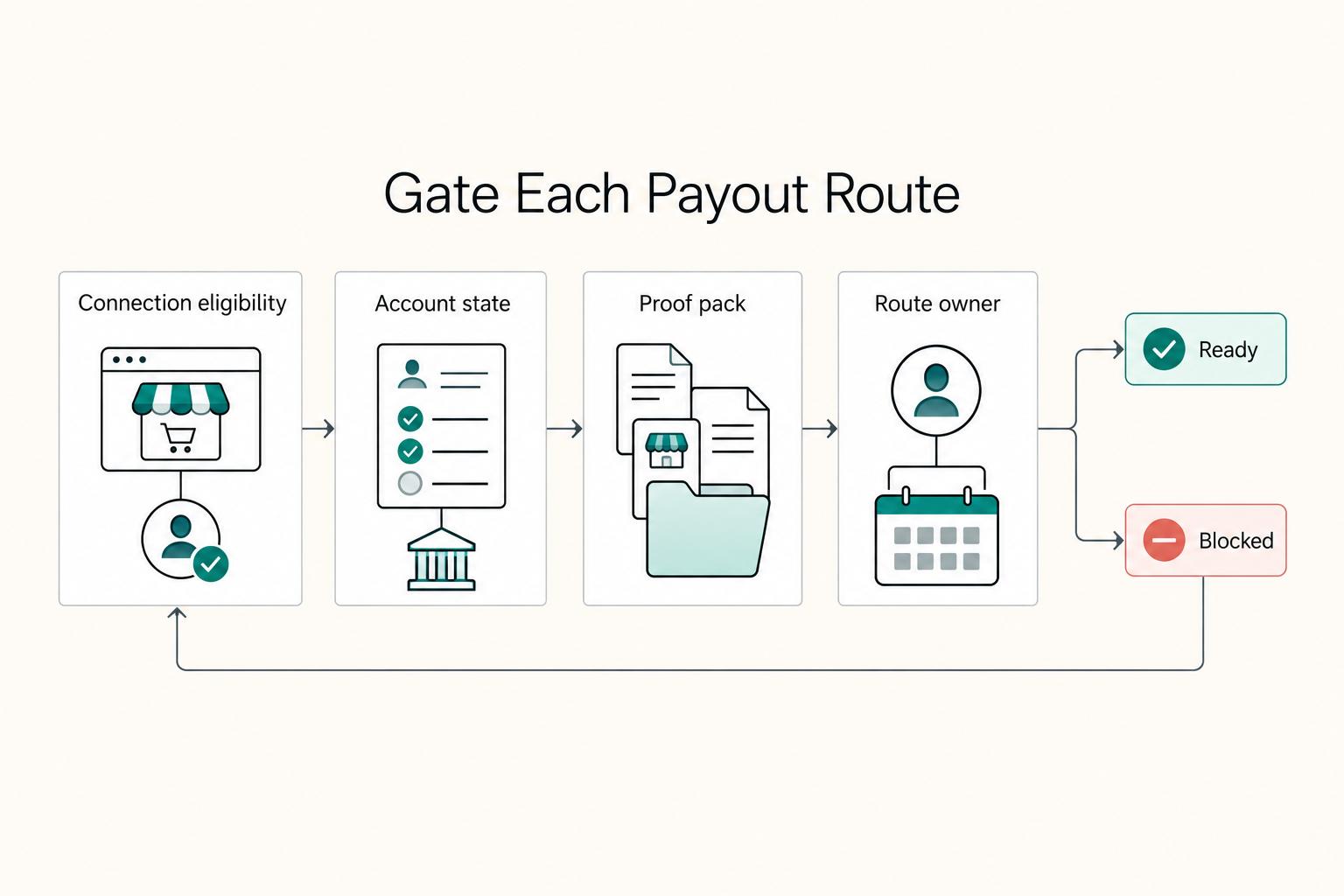
Keep two checks separate on every route so you can isolate failures faster:
- Marketplace connection eligibility.
- Account-state conditions that may still affect movement after connection.
If either side is unclear, ask support for explicit confirmation and store the response with date and owner. Then maintain this proof pack for each route:
- Approved account status with date.
- Marketplace connection evidence.
- Documented support responses for unresolved rules or exceptions.
- Route state marked as
ready,blocked, orpending.
A simple readiness board helps teams avoid mixed messages. Each route should show only one current state, one owner, and one next action. If ownership is unclear, treat the route as not ready regardless of technical status.
Do not treat user-generated verification offers as policy evidence. Decision rule: if the proof pack is incomplete for a priority route, keep rollout constrained until the gap is closed.
The operations and reconciliation test finance-minded buyers should run#
Run a month-end close test before scaling. The test should answer three things under real conditions: payouts can be traced end to end, VAT treatment is applied consistently, and exceptions can be resolved without guesswork.
Any "centralized payout" message is a hypothesis until close evidence proves otherwise. Build the test around your actual channel mix and posting logic. Pass criteria are straightforward: no hidden gaps at close, clear exception ownership, and a clear re-check trail for each adjustment.
| Close test | What to check | Pass condition | Failure signal | Evidence to retain |
|---|---|---|---|---|
| Export completeness | All expected payout lines appear once across channels | No unexplained gaps or duplicates at close | Missing line items discovered after reporting cutoff | Export snapshot, line-count check, reconciliation summary |
| Exception visibility | Missing payout can be isolated quickly by channel and date | One owner and one ticket path per exception | Team relies on ad hoc spreadsheet merges to find root cause | Exception log with owner, timestamp, and status |
| VAT classification consistency | Same transaction type gets the same VAT treatment each time | Reviewer 1 and reviewer 2 reach the same classification | Repeated reclassification between close cycles | Classification rules sheet and reviewer sign-off |
| Threshold monitoring | Relevant EU VAT thresholds and scheme limits are checked during close | Flags raised before filing deadlines | Threshold issue discovered after return prep | Threshold check record and reviewer approval |
| Re-check trail | Corrections can be traced from original to final entry | Every adjustment has reason, approver, and date | Final figures differ with no clear audit path | Versioned close file and change log |
Anchor VAT checks to confirmed levers so close reviews stay consistent:
- MOSS was extended into OSS from 1 July 2021.
- Online sellers can register in one EU Member State for VAT declaration and payment under OSS.
- EUR 10,000 EU-wide threshold replacing prior distance-sales thresholds.
- EUR 100,000 Union turnover cap for cross-border SME scheme eligibility.
When cross-border treatment remains unclear, use VAT Cross-border Rulings instead of assumptions. A CBR request is introduced in the participating EU country where the applicant is VAT-registered. If multiple companies are involved, one files on behalf of the others. For cross-border SME registration, plan around a process target that should not exceed 35 working days.
Define your review rhythm in advance so close execution stays predictable:
- Pre-close: confirm channel exports are available and owners are assigned.
- Close day: run line checks, exception tagging, and threshold checks.
- Post-close: log adjustments, unresolved risks, and next-cycle actions.
This rhythm keeps exceptions visible and reduces late surprises. Keep one proof pack per close cycle:
- Channel-level reconciliation output with matched and unmatched lines.
- VAT decision log with threshold checks and reviewer sign-off.
- Exception register with owner, deadline, and disposition.
- CBR or support correspondence IDs linked to open tax-treatment questions.
- Final close memo listing unresolved risks and next-cycle actions.
Decision rule: if you cannot pass this test for two consecutive closes, keep volumes constrained and fix controls first.
When Payoneer is enough and when you should move to deeper infrastructure#
Payoneer may be enough when payout routes stay narrow and close processes remain consistent. If your team can resolve exceptions without repeated rework, keeping the stack simple can be reasonable.
Consider deeper infrastructure when failures repeat, not just when activity rises. Common trigger points include recurring close friction, slower exception isolation, or corrections that are hard to trace.
| Decision signal | Stay with Payoneer | Move to deeper infrastructure |
|---|---|---|
| Process complexity | Limited routes and predictable exception patterns | Multi-route activity with frequent status differences and handoffs |
| Close performance | Consistent closes with clear traceability | Repeated unmatched lines or late corrections |
| Control requirement | Current checks match current risk | More formal policy controls and change tracking are required |
| Operating priority | Fast execution with narrow requirements | Control durability before further scaling |
Use company scale as context, not proof of fit. Payoneer reported nearly 2 million customers. Its February 26, 2026 release for the year ended December 31, 2025 highlighted 14% revenue ex-interest growth and 28% B2B revenue growth. It also defines Take Rate as revenue as a percentage of volume.
Treat product direction the same way. On February 17, 2026, Payoneer announced plans for embedded stablecoin capabilities with Bridge, including receiving, holding, and sending stablecoins, with funds able to be withdrawn to local bank accounts. Start with Payoneer when your needs are narrow and speed matters, then add deeper infrastructure if repeated control gaps start consuming operating capacity.
First 30 days checklist for a safe rollout#
Treat the first 30 days as a controlled pilot with explicit stop conditions. Scale only when the record shows clean performance under real conditions.
| Week | Focus | Pass gate |
|---|---|---|
| Week 1 | Validate fit for each priority payout channel with documented checks | Each priority channel has a dated connection result and a documented next step |
| Week 2 | Test connection and a first payout cycle using your documented operating steps, then log every status and exception | At least one live payout path is traced from receipt to destination for each tested route |
| Week 3 | Run reconciliation drills using payout records or exports and assign clear exception ownership | Exception ownership is explicit and close checks can be repeated without ad hoc fixes |
| Week 4 | Hold a go/no-go review against cost, compliance, and reporting criteria; escalate unresolved unknowns before scale | Unresolved items are limited, owned, and time-bound |
- Week 1: Validate fit for each priority payout channel with documented checks.
- Week 2: Test connection and a first payout cycle using your documented operating steps, then log every status and exception.
- Week 3: Run reconciliation drills using payout records or exports and assign clear exception ownership.
- Week 4: Hold a go/no-go review against cost, compliance, and reporting criteria; escalate unresolved unknowns before scale.
Use clear pass gates each week so the pilot stays disciplined:
- Week 1 passes when each priority channel has a dated connection result and a documented next step.
- Week 2 passes when at least one live payout path is traced from receipt to destination for each tested route.
- Week 3 passes when exception ownership is explicit and close checks can be repeated without ad hoc fixes.
- Week 4 passes when unresolved items are limited, owned, and time-bound.
Two guardrails keep the pilot honest. First, treat third-party comparison claims, including rigid workflows, unclear fees, or broad country and currency coverage, as prompts to verify, not proof. Second, enforce incident timing discipline. Legal commentary indicates reimbursement rights can be affected if unauthorized transactions are not reported without undue delay, including notices made outside a 13-month limit, so you should timestamp detection, escalation, and notification actions in your incident log.
If AdSense or YouTube Partner Program payouts matter in your setup, test that route during the pilot and record timing and exception behavior before adding more channels.
Use this end-of-pilot decision rule:
- Proceed if route evidence is repeatable and close checks stay clean.
- Hold if core assumptions are still unresolved after one full cycle.
- Escalate control depth if exceptions are recurring or hard to trace.
Conclusion#
Choose Payoneer based on tested route behavior, not brand visibility. It is a credible option for marketplace-connected payouts when your channel mix is still narrow and your controls can keep pace.
Current evidence supports relevance at scale, not automatic fit. Payoneer reports over 2 million direct customers across 190 countries, supporting transactions in 150 currencies, nearly 100 banking and payment partners, and fiscal 2024 figures of $80.06 billion in processed payments with $977.7 million in revenue. Treat those numbers as context while route decisions stay tied to your own validation.
Core unknowns remain route-specific. A documented path may include local bank withdrawal, Payoneer card spend, and transfers to other Payoneer users. Some guidance is clearly path-specific, such as a Checkout page for Ukrainian entrepreneurs dated February 16, 2026. One review also claims an approximate 0.5% to 2% FX markup versus mid-market rates, which you should treat as directional until your tests confirm outcomes.
Use fit checks and a pilot phase as hard gates:
- Proceed when tested routes run consistently and close cycles reconcile without repeated surprises.
- Hold volume when core assumptions remain untested or exceptions require ongoing manual repair.
- Escalate to deeper controls when growth outpaces your ability to trace and resolve payout issues.
Expand only when your records stay clean, repeatable, and easy to defend at close. If you need route-specific help for your country or program, Talk to Gruv.
Frequently Asked Questions
How does Payoneer marketplace payment flow work from connection to withdrawal?
Use a baseline sequence of setting payout details in the channel, receiving the first live payout, and then confirming which withdrawal, spending, or currency options are actually available. But the article does not confirm a full Payoneer click-by-click flow, so treat the path as unconfirmed until you run a live test in your own account. Approve the route only if results repeat across back-to-back cycles.
Is Payoneer Marketplace built for marketplaces, freelancers, or both?
This guide does not clearly define whether Payoneer Marketplace is built for marketplaces, freelancers, or both. Use your own use case as the decision anchor and validate eligibility and payout behavior in your account context. If scope remains unclear after testing, keep rollout limited.
Can Payoneer Store Manager really centralize payments across Amazon EU and Amazon CA?
No. The current material does not confirm Store Manager behavior for Amazon EU or Amazon CA, and it does not confirm export depth, exception tracking, or control coverage for those entities. Treat centralization as a live test objective with real records before you rely on it.
Which marketplaces are explicitly named, and does that guarantee full support?
A complete support matrix is not documented here, so named marketplaces do not guarantee support for your entity, geography, or payout route. Treat every channel as a separate pre-launch check. Keep connection proof, payout proof, and escalation proof for each one.
What should I verify first in the Payoneer Support FAQ before relying on payouts?
Verify onboarding prerequisites, account-state conditions that may affect movement, and the escalation path if something blocks. Do not assume the same steps apply across channels. Save dated notes or captures as you verify each item.
What cost and FX details are still unknown before live testing?
Exact fee schedules, FX spread mechanics, and route-level net outcomes are still unknown in the current excerpts. You cannot estimate dependable net proceeds from this material alone. Use real transactions on priority channels to record receipt amount, conversion outcome, withdrawal charge, and landed amount before scaling.
When should I keep using Payoneer versus move to a more control-heavy setup?
Keep using Payoneer when records stay clean and compliance checks are repeatable across closes. Move to a more control-heavy setup when cross-border VAT handling, exception isolation, or reconciliations create repeated rework. Lock VAT path decisions before scaling if those issues persist.
Watch
Payoneer for Marketplace Payouts: What to Know
Try a related tool
Researched and edited by the Gruv editorial team. Gruv builds cross-border billing, payouts, and finance-operations software for global businesses.
Sources
- federalregister.gov/documents/2021/01/07/2020-29274/independent-...trusted
- sme-vat-rules.ec.europa.eu/sme-scheme/cross-border-sme-scheme_entrusted
- taxation-customs.ec.europa.eu/archives/taxable-persons/vat-cross-border-ru...trusted
- vat-one-stop-shop.ec.europa.eu/one-stop-shop_entrusted
- vat-one-stop-shop.ec.europa.eu/index_entrusted
Educational content only. Not legal, tax, or financial advice.
Related Posts

GDPR Compliance Checklist for Freelancers Working With EU Clients
Start by separating the decisions you are actually making. For a workable **GDPR setup**, run three distinct tracks and record each one in writing before the first invoice goes out: VAT treatment, GDPR scope and role, and daily privacy operations.
How to Get a SIREN/SIRET Number as a Freelancer in France
If your goal is to get a SIREN and SIRET in France as a freelancer, treat this as an execution sequence, not a theory piece. The finish line is simple: submit clean data, receive the identifiers that apply to your case, and verify the public record before you use them in business documents.

Building a Portfolio Career With Multiple Freelance Income Streams
A portfolio career is deliberate: multiple income streams chosen to work together, not random jobs accepted whenever they appear. It is also different from gig economy work you pick up only as needed.