
Quick Answer
Use shared intake, contract review and close controls under IFRS 15 and ASC 606, with documented framework-specific exceptions such as collectibility and contract-cost impairment reversals. Assess each specified service for principal-versus-agent control, and select the modification treatment before updating allocation. Escalate material judgment changes before close and keep terms, amendments, approvals and posting support together.
IFRS 15 and ASC 606 in Practice#
Many global subscription platforms can start from one operating assumption: IFRS 15 and ASC 606 are aligned enough that you may be able to standardize much of your revenue recognition governance. They are not so aligned that every judgment call can be treated as interchangeable. The goal is practical: cut duplicate policy work without letting a real accounting difference or contract nuance slip into close week.
That matters beyond controllership. Revenue outcomes are often shaped long before the journal entry. Customer contracts, billing design, refund terms, upgrade paths, reseller or merchant of record arrangements, and entity reporting lines can affect how revenue is assessed and defended. Both standards were developed jointly to create common guidance for contracts with customers, with the shared objective of reporting useful information about the nature, amount, timing, and uncertainty of revenue.
Use this guide to separate what you can standardize across IFRS 15 and Topic 606 from what your team still needs to handle through explicit judgment, written decision rules, and cross-functional escalation. In practice, the shared baseline can often cover contract intake, policy mapping, posting logic, and close review checkpoints. One simple verification point works well: before quarter close, confirm that the contract terms feeding billing, revenue schedules, and legal approvals still match the policy conclusion on file. If they do not, the issue is not only technical accounting. It is governance.
The main risk is not that the standards are unrelated. It is that teams overread the convergence and stop documenting the points where judgment still drives reported timing or amount. IFRS 15 itself emphasizes that: paragraph 110(b) requires disclosure of significant judgments and changes in judgments that affect revenue outcomes. For a subscription platform, unsupported local practice, undocumented exceptions, or silent contract changes can create audit friction even when the headline policy looks aligned.
Run one shared policy baseline unless you can point to a documented divergence. Escalate early when a judgment could change presentation, timing, or materiality. If your U.S. GAAP entity and IFRS entity reach different answers from the same customer contract, treat that as a required review item, not close cleanup. The minimum evidence pack should include the executed contract terms, the policy conclusion, and the approval trail showing who signed off and when.
This is an operational decision guide for revenue recognition governance, not a substitute for formal technical accounting or legal advice. Use it to decide what can be centralized, what needs stronger controls, and when an issue is serious enough to route to specialists before it turns into rework.
IFRS 15 and ASC 606 at a glance for global subscription platforms#
Most global subscription platforms should run IFRS 15 and ASC 606 through one shared control framework with a documented exception list, not two separate revenue engines. The core model is aligned; execution pressure usually comes from fact-specific judgments, contract changes, and disclosure-ready documentation before close.
| Criterion | IFRS 15 | ASC 606 | Needs specialist judgment before close |
|---|---|---|---|
| Scope | Revenue from contracts with customers. | Common U.S. GAAP guidance for revenue from contracts with customers. | Unclear contract boundaries or unusual terms that do not fit standard contract analysis. |
| Core revenue recognition model | Five-step model; performance obligations are distinct promised goods or services. | Same core model and objective. | Performance-obligation identification, transaction price judgments, and principal vs agent conclusions. |
| Disclosure burden | Requires disclosures that give users complete contract-revenue information. | Core model is aligned; differences can still affect how disclosures are prepared and reviewed. | Judgments that change timing, amount, or presentation and require clear documentation. |
| Transition and maintenance effort | Effective for annual periods beginning on or after 1 January 2018; ongoing effort is in judgment, documentation, and contract-change handling. | Issued as ASU 2014-09 in May 2014; ongoing effort is consistent policy application and evidence quality. | Proposed policy divergence for similar contracts across entities. |
| Recurring billing reality | Billing cadence alone does not determine revenue. Contract terms and promised services drive recognition. | Same. | Usage charges, credits, cancellations, and mixed fixed/variable pricing. |
| Contract changes (upgrades/downgrades) | Frequent modifications create operational pressure because conclusions may need reassessment. | Same operational pressure. | Modification analysis, revised allocation, and alignment between billing changes and accounting conclusions. |
| Governance across global markets | Usually supports one shared baseline with documented exceptions. | Same model, different execution pressure. | Same commercial pattern producing different entity conclusions without a documented rationale. |
Same model, different execution pressure#
The key risk is not recurring billing by itself. It is moving fact patterns: upgrades, downgrades, add-ons, cancellations, and other contract changes that force reassessment under a judgment-intensive model. Teams often overbuild by treating this as a standards split rather than a controls-and-escalation problem.
A practical pre-close check is to confirm the executed contract terms, billing setup, and accounting memo still point to the same performance-obligation and modification conclusions. If they do not align, treat it as a governance issue, not a routine close cleanup item.
What to escalate early#
Escalate performance-obligation and principal-vs-agent questions early. These are common specialist-judgment areas and can look settled operationally but fail accounting review once contracts are live.
Use a simple threshold: if a contract change or presentation decision could affect revenue timing, amount, or gross-versus-net presentation, route it before quarter close. Keep an evidence pack with executed terms, relevant amendments, the policy memo, and documented approval.
If you want a deeper dive, read ASC 606 for Platforms: How to Recognize Revenue When You're the Merchant of Record.
What can be standardized across both standards#
Standardize the core controls first, then document exceptions only when a real divergence changes the accounting conclusion. IFRS 15 and ASC 606 were designed to reach the same core conclusions for revenue from customer contracts, so most subscription platforms can use one baseline for recurring customer contracts.
| Control area | Shared baseline under IFRS 15 and ASC 606 | Minimum audit trail |
|---|---|---|
| Intake | Review every new or changed contract through the same five-step model: contract, performance obligations, transaction price, allocation, and recognition. | Executed customer contract, amendments, product or SKU mapping, and the reviewer's conclusion. |
| Contract review | Apply one review template for similar contracts in similar circumstances. | Policy reference, judgment memo, and approval from the accountable reviewer. |
| Posting logic | Tie revenue postings to the approved contract classification, not only billing cadence or invoice timing. | Posting rule or system configuration, plus evidence it matches the approved accounting treatment. |
| Close checks | Confirm contract terms, billing outputs, and recognized revenue still align at period end. | Reconciliation support, documentation of any changed judgment, and support for contract-cost assets when recognized. |
Use one shared policy set for recurring arrangements, with an exception log instead of separate IFRS and U.S. GAAP policy stacks. If the same commercial pattern starts producing different entity-level conclusions, escalate before that hardens into local practice.
Your evidence pack should let finance and risk management reproduce the conclusion without re-interviewing the original reviewer. Under ASC 606, keep the significant judgments, changes in those judgments, and support for any asset recognized from costs to obtain or fulfill a contract. If the memo cannot be traced to the amendment and posting rule actually used, the control is not reliably standardized.
Where divergence creates real operational risk#
The close-critical risk is not a large gap between IFRS 15 and ASC 606, but residual differences and judgment calls that can still change revenue timing, comparability, and consolidation outcomes across global markets.
Use a focused map of actual standards differences and shared judgment risks rather than a second full policy stack. The FASB comparison identifies collectibility and contract-cost impairment reversals as differences. Principal-versus-agent analysis is a converged control assessment that still needs consistent application.
| Difference or shared judgment risk | What reporting needs to explain | Where interpretation friction shows up | Consolidation impact |
|---|---|---|---|
| Collectibility threshold and contract existence | Why revenue started when it did, and what evidence supported contract existence | Both require probable collection, but probable has different meanings under IFRS and U.S. GAAP; assess the applicable framework | Entities can recognize earlier or later than group expectations, reducing comparability and increasing close adjustments |
| Principal versus agent (shared judgment) | Identify each specified good or service and explain whether the entity controls it before transfer | This remains a live application issue, especially in platform models | Mixed conclusions across entities can distort consolidated presentation and KPI comparisons |
| Contract-cost asset impairment reversal | Whether a previous impairment should be reversed after conditions improve | IFRS 15 requires qualifying reversals; U.S. GAAP Topic 340 prohibits them | Keep framework-specific cost-asset schedules and consolidation adjustments |
Set one explicit escalation rule: if a policy choice can change reported timing, reported amount, or potential materiality, require pre-close exception escalation and written decision-rule sign-off. Do not let local practice or billing-system defaults settle the issue. The sign-off pack should include the executed contract, amendments, judgment memo, relevant collectibility support, and the posting or consolidation mapping to be used.
If you enforce one checkpoint, make it collectibility. The threshold is an explicit contract criterion, so it is not a soft preference call. Where payment history is weaker, terms are unusual, or invoicing is treated as the default recognition trigger, escalate before close.
Parallel policy tracks can reduce local friction, but they also increase reconciliation and governance burden. More exception memos, more consolidation mappings, and more opportunities for local conclusions to miss group reporting logic are the usual tradeoff. You do not need separate IFRS 15 and ASC 606 manuals for every entity, but any local deviation needs a clear owner, a written decision rule, and recurring reconciliation checks.
Merchant of record decisions and principal vs agent exposure#
Treat merchant of record design as a revenue presentation decision from the start, not just a checkout setup. If you are redesigning your flow, test the facts you need for gross versus net reporting before go-live. The MoR label alone does not determine the outcome, but it changes which facts you need to test for gross versus net reporting before go-live.
Under both frameworks, the core test is whether your entity controls the specified good or service before transfer to the customer. Topic 606 ties this directly to principal-versus-agent and gross-versus-net reporting (including ASC 606-10-55-36 through 55-40), and IFRS 15 requires a contract with enforceable rights and obligations, where enforceability is a matter of law. Review this jointly across product, legal, and finance.
| Decision area | Facts that point to early principal-vs-agent testing | Facts that may support agent presentation | Evidence to retain |
|---|---|---|---|
| Pricing and customer promise | Your platform sets or tightly controls customer pricing and owns the customer-facing promise | Another party sets the substantive price and your role is arranging access or sale | Executed customer terms, pricing approval records, product pages |
| Fulfillment and refunds | Your platform is responsible for delivery quality, remediation, or refund outcomes | Another party remains responsible for fulfillment and bears refund responsibility | Support terms, refund clauses, service commitments, complaint handling rules |
| Settlement and counterparty terms | Customer pays your platform and contracts give your entity primary rights and obligations | Contracts show you collect on behalf of another party and remit under defined settlement terms | Settlement schedules, remittance terms, invoice footer, payout agreements |
For every arrangement involving another supplier, identify each specified good or service, then assess whether your entity controls it before transfer. Pricing discretion, fulfillment responsibility and inventory risk can support that assessment, but no indicator alone decides it. Missing pricing discretion or refund exposure does not establish agent status. Document the conclusion before billing starts and confirm operations match it; one contract can contain both principal and agent roles.
Contract language should drive the accounting outcome. In customer contracts, check who promises the service, who can enforce payment, who handles returns or cancellations, and who owes the customer if the underlying provider fails. Rights, obligations, refunds, and settlement terms are core evidence, not boilerplate.
Use one consistent checkpoint: route any new MoR setup, or any material change to customer terms, through your internal principal-versus-agent guidance and MoR revenue recognition review before release. For a deeper internal reference, use ASC 606 for Merchant-of-Record Platforms: Principal vs Agent Revenue Recognition. Related: ASC 606 Revenue Recognition Decisions for Subscription Pricing.
Contract changes, bundles, and discounts without close-week surprises#
When a subscription changes, first confirm an approved modification, then choose the separate-contract, prospective or cumulative catch-up treatment before updating allocation and revenue schedules.
The order that keeps you out of rework#
An approved scope or price change follows IFRS 15 paragraphs 18–21 and ASC 606-10-25-10 through 25-13. Additions are a separate contract when they are distinct and priced at appropriately adjusted stand-alone selling prices. Otherwise, distinct remaining services generally receive prospective treatment; changes to a partially satisfied, non-distinct obligation require a cumulative catch-up. Mixed changes combine those treatments. Assess that branch before allocating discounts.
| Decision point | IFRS 15 anchor | ASC 606 anchor | What you should verify |
|---|---|---|---|
| Approved change? | 18–19 | 606-10-25-10 through 25-11 | Evidence of approval and enforceable changed rights; approval can be written, oral or implied by customary practice |
| Separate contract? | 20 | 606-10-25-12 | Distinct additions and an increase reflecting their appropriately adjusted stand-alone selling prices |
| Otherwise, what remains? | 21(a)–(c) | 606-10-25-13 | Distinct remaining services: prospective allocation of unrecognized original consideration plus modification consideration. Non-distinct partially satisfied obligation: cumulative catch-up. Mixed changes: both as appropriate. |
For bundles and discounts, the risk is usually execution, not the framework itself. Typical breakdowns include inconsistent SKU mapping between billing and revenue tables, manual override drift, and contract amendments that are not routed into accounting review. Treat these as control failures to catch early, not close-week cleanup.
The monthly checks worth doing#
A monthly cadence is a practical control choice, even though IFRS 15 and ASC 606 do not prescribe a monthly schedule.
| Review area | What to review | Required step |
|---|---|---|
| New, changed, and canceled contracts | Approved amendments, bundle structure, and discount terms | Review a sample |
| Billing outputs to recognized revenue | Offer type, especially upgrades, downgrades, coupons, and bundled plans | Reconcile |
| Stand-alone selling price inputs used in allocation | Current pricing support | Retain the memo or pricing file behind the conclusion |
| Manual journal or billing override tied to subscription revenue | Approval and whether it was reflected in revenue logic | Investigate |
IFRS 15 paragraph 126(c) also requires disclosure of the methods, inputs, and assumptions used to allocate transaction price. Keep the pricing basis, allocation rationale, and contract review notes with the accounting outcome.
If bundled offers are a recurring pain point, go deeper on Subscription Revenue Recognition for Bundles and Discounts: ASC 606 Allocation Rules. Pair this with Subscription Billing Platforms for Plans, Add-Ons, Coupons, and Dunning when the operational bottleneck is the billing-to-revenue handoff.
The control framework and reporting checklist global teams can run now#
Use one shared control framework across IFRS 15 and ASC 606, with clear ownership, defined evidence, and an escalation path when judgments change. Both standards focus reporting on the nature, amount, timing, and uncertainty of revenue, and ASC 606 also requires disclosure of significant judgments and changes in those judgments. Your controls should therefore prove not only the final number, but also who decided, based on which contract facts, and how the conclusion can be reproduced.
One matrix, different owners#
| Function | Primary owner | Practical cadence | Evidence to retain | Escalation path |
|---|---|---|---|---|
| Compliance | Compliance lead or controllership compliance owner | Pre-close and quarterly review | Policy memo version, control checklist, open policy exceptions | Controller, Head of Compliance, then audit oversight if unresolved |
| Finance | Revenue accounting manager | Each close, plus post-close review | Judgment log, close-pack reconciliations, variance analysis, journal support, contract linkage | Controller or CAO; technical accounting if conclusions change |
| Legal | Commercial or product counsel | Contract template changes, non-standard deals, pre-launch review | Executed contracts, amendment approvals, redline history, legal conclusion notes | General Counsel and finance leadership if terms affect revenue treatment |
| Operations | Billing or deal desk owner | Ongoing intake controls, close support | Order records, SKU mapping, approval records, exception tickets, billing-to-revenue tie-out | Revenue accounting manager, then controller for unresolved breaks |
Minimum reporting checklist#
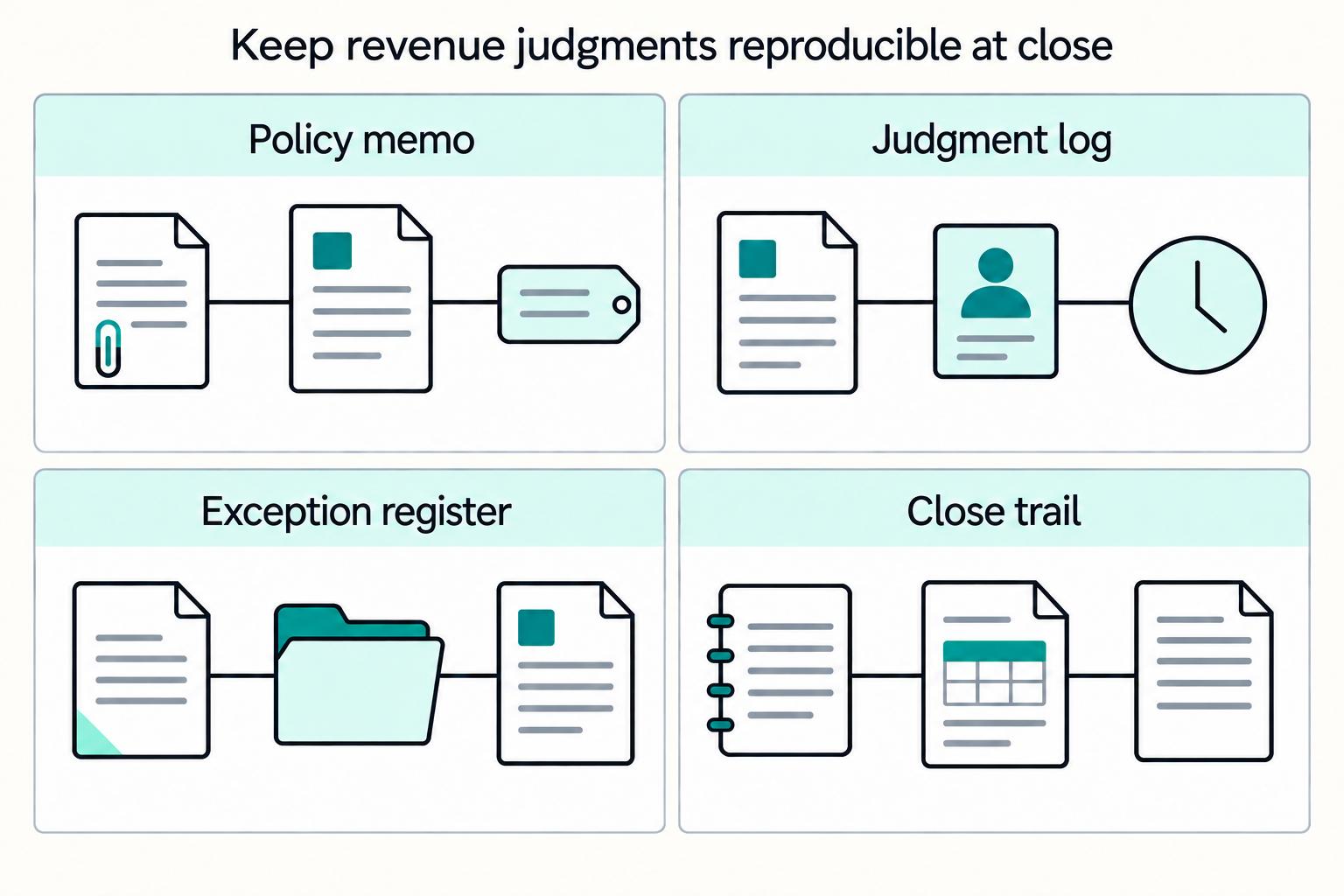
| Item | What it covers | Key contents |
|---|---|---|
| Policy memo | Current position for recurring revenue streams | Contract facts and accounting conclusions under IFRS 15 or ASC 606 |
| Judgment log | Significant judgments and changes in judgments | Owner, date, affected population, and impact |
| Exception register | Non-standard contracts and unresolved issues | Manual overrides, unresolved variances, and policy deviations |
| Close-pack audit trail | Close support and traceability | Reconciliations, journal support, source-report references, approvals, and links to underlying customer contracts |
Good evidence is traceable and reproducible: executed contract, approval record, decision rule, affected population, and the report or query used to produce the accounting result. Weak evidence is a document set that cannot reliably connect contract terms to the booked revenue outcome.
Checkpoints that catch drift#
Set three review checkpoints and document decisions consistently:
- Pre-close policy freeze: Confirm active policy memo version, approved decision rules, and open exceptions before close begins.
- Post-close variance review: Focus on judgment-heavy areas and require contract reference, applied rule, and judgment-log updates where needed.
- Quarterly control effectiveness review: Test whether controls identified issues early across different revenue streams, and document the risk rationale.
If repeated failures indicate a control deficiency that needs oversight attention, escalate early. In a PCAOB financial-statement audit, AS 1305 requires the auditor to communicate identified significant deficiencies and material weaknesses in writing to management and the audit committee before issuing the audit report. An ordinary policy exception is not automatically a control deficiency.
Standardize the control structure, not just the accounting policy. If your evidence cannot take an auditor from contract terms to revenue output and back, your process risk remains high even if close is fast.
Need the full breakdown? Read What Is a Subscription Lifecycle? How Platforms Manage Trial Active Paused and Churned States.
Escalation points that prevent expensive rework#
Escalate judgment calls before launch, not during close. If a contract leaves principal vs agent unclear, send it to technical accounting and pause rollout until the conclusion is documented.
| Trigger | Required response | Support |
|---|---|---|
| Principal vs agent unclear | Send it to technical accounting and pause rollout until the conclusion is documented | Short decision memo that names the promised good or service, cites the contract clauses used, and explains why control does or does not exist before transfer |
| Local entity practice conflicts with group policy | Move it through cross-functional governance | Local practice, group policy memo, sample contracts, and a written decision with an accountable owner and effective date |
| Unresolved policy exceptions in close week | Require documented exception escalation and a named owner before finalizing numbers | Named owner, exception memo and remediation plan; auditor communication requirements apply if the issue is a significant deficiency or material weakness |
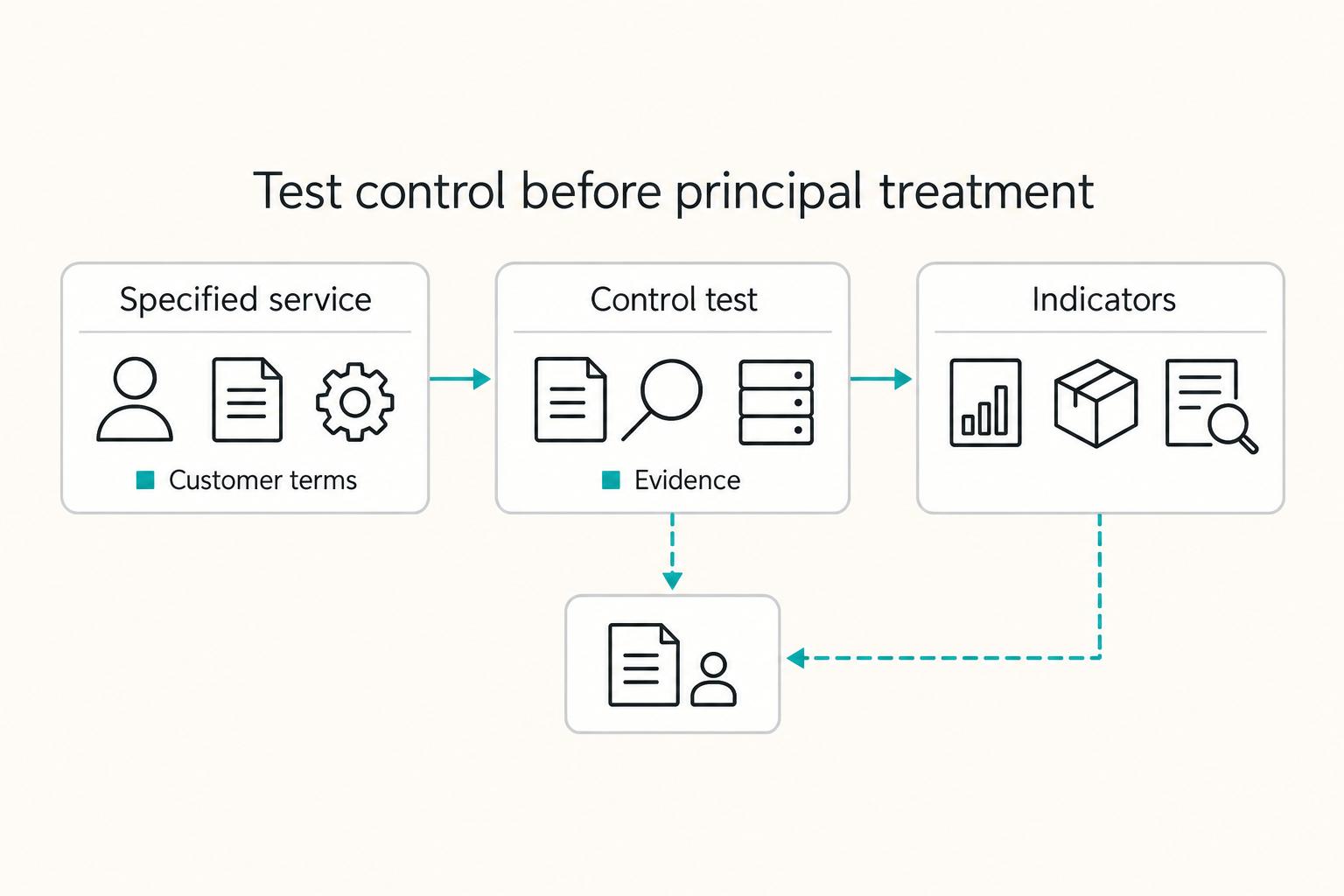
Both IFRS 15 and ASC 606 hinge on the same test: identify the specified good or service, then assess whether you control it before transfer. Use a short decision memo that names the promised good or service, cites the contract clauses used, and explains why control does or does not exist before transfer.
Do not treat labels or momentary legal title as enough by themselves. Under ASC 606, momentary legal title does not necessarily mean control, so reliance on invoice form or reseller wording alone is an escalation trigger. If you need a deeper treatment, see ASC 606 for Merchant-of-Record Platforms: Principal vs Agent Revenue Recognition.
Escalate again when local entity practice conflicts with group policy for similar subscription transactions under IFRS 15 or ASC 606. IAS 8 requires consistent accounting policies for similar transactions unless IFRS permits otherwise, so unresolved local variation should move through cross-functional governance. The evidence pack should include the local practice, group policy memo, sample contracts, and a written decision with an accountable owner and effective date.
Set a no-go rule for close week: unresolved policy exceptions cannot be parked or rolled forward informally. Require documented escalation and a named owner before finalizing numbers. If the issue indicates a significant deficiency or material weakness, involve audit leadership early so the auditor can meet applicable written-communication requirements before report issuance.
Related reading: 7 Revenue Leak Points in Subscription Platforms You Can Verify in 30 Days.
Conclusion#
Start from one shared baseline across IFRS 15 and ASC 606, then separate out only the places where a documented difference actually changes the accounting result. That is the right practical stance for global subscription platforms because the standards were built to reach the same core conclusions on revenue from contracts with customers, even though minor differences remain.
A common risk is inconsistent execution. Teams can skip parts of the five-step model, apply local habits to principal versus agent judgments, or treat bundles and discounts as post-close cleanup instead of allocating transaction price based on relative stand-alone selling prices. If your group policy produces different answers for the same contract pattern, the first thing to inspect is not the standard. It is your decision discipline.
What holds up in practice is simple and strict: decision rules people can follow, escalation points that trigger before close decisions are locked, and an audit trail that lets someone else reproduce the conclusion. Principal versus agent is the clearest test case. Under Topic 606, including the March 2016 ASU 2016-08 update, the judgment turns on whether you control the good or service before it is transferred to the customer, with indicators used to support that evaluation. If a contract change, refund right, or settlement term makes that answer unclear, escalate it before close. Do not let the close team reverse engineer the conclusion from invoice wording.
Your evidence pack should be strong enough that an auditor can follow your revenue story from contract terms to booked numbers and understand the nature, amount, timing, and uncertainty of revenue and cash flows. We recommend a file that includes the executed customer contract, amendments, the written accounting conclusion, and approval records. One failure mode is having billing exports and screenshots but not the contract language or amendment history that explains why revenue timing or gross versus net presentation changed.
The next step is not to redesign everything. Run your reporting checklist against the current close and fix the highest-risk gaps first:
- Confirm that each material revenue judgment follows the same five-step sequence under both standards.
- Pull one recent exception, such as a contract modification or principal versus agent call, and verify who escalated it, when, and what evidence was retained.
- Check whether a reviewer outside the deal team could reproduce the answer from the file alone.
That is the working conclusion for this comparison: standardize where IFRS 15 and ASC 606 are substantially aligned, isolate residual divergence risk with evidence, and make documentation strong enough that ad hoc judgment never has the final say.
Frequently Asked Questions
Are IFRS 15 and ASC 606 effectively the same for subscription platforms?
The five-step model and principal-versus-agent control assessment are substantially aligned. Actual differences, including collectibility criteria and contract-cost impairment reversals, can still change results. Use shared controls with framework-specific exceptions documented before close.
When does a global platform need separate policies instead of one shared approach?
Use separate treatment only when you can point to a documented difference that changes the accounting outcome, such as the collectibility threshold. If you cannot name the exact difference and show why it matters, keep one shared policy. A practical checkpoint is a short exception memo documenting the standard difference and affected contract types.
What are the first signs that principal vs agent judgment is being handled inconsistently?
The biggest red flag is hearing that gross versus net is a policy choice or local preference. It is not an accounting policy election, and the assessment is a required two-step process built around whether you control the specified good or service before transfer to the customer. Another early warning sign is teams relying on labels or presentation instead of contract facts and control analysis.
Which controls should be standardized globally, and which should be localized by market?
Standardize intake, evidence templates and the shared revenue model and principal-versus-agent assessment. Localize market-specific contract facts and enforceability analysis, while retaining framework-specific criteria wherever IFRS and U.S. GAAP differ. Route changes to the method through group technical accounting.
What evidence should finance keep to defend revenue judgments during audit?
Keep documentation that ties each judgment and disclosure back to contract facts, including the underlying terms and the rationale for the accounting conclusion. Because IFRS 15 and ASC 606 require judgment and extensive disclosures, your file should let an auditor trace the conclusion to those facts.
How should teams handle bundles and discounts without breaking allocation consistency?
For new contracts, allocate price using the applicable stand-alone selling-price rules. For upgrades or amendments, first determine the modification treatment: distinct additions at appropriately adjusted stand-alone prices may form a separate contract; otherwise apply prospective, cumulative catch-up or combined treatment as appropriate. Then update allocation and system mappings before close.
When should compliance or legal intervene instead of leaving decisions to finance alone?
There is no single universal trigger. As a practical control, involve compliance or legal when the accounting conclusion depends on contract wording that is still being negotiated or remains unclear, especially around rights and obligations. Finance can assess revenue treatment, but it should not fill in missing contract facts. If key terms are unsettled, pause exception approval until the contract terms are finalized.
Try a related tool
Researched and edited by the Gruv editorial team. Gruv builds cross-border billing, payouts, and finance-operations software for global businesses.
Sources
Includes 7 external sources outside the trusted-domain allowlist.
- assets.publishing.service.gov.uk/media/5a756eb140f0b6397f35e624/IFRS_15_Appli...trusted
- fasb.org/page/PageContentexternal
- ifrs.org/issued-standards/list-of-standards/ifrs-15-r...external
- ifrs.org/content/dam/ifrs/supporting-implementation/a...external
- pcaobus.org/oversight/standards/auditing-standards/detai...external
- pcaobus.org/oversight/standards/auditing-standards/detai...external
- storage.fasb.org/Comparison%20of%20Topic%20606%20and%20IFRS%2...external
- storage.fasb.org/ASU%202016-08.pdfexternal
Educational content only. Not legal, tax, or financial advice.
Related Posts
Subscription Revenue Recognition for Bundle Discounts Under ASC 606
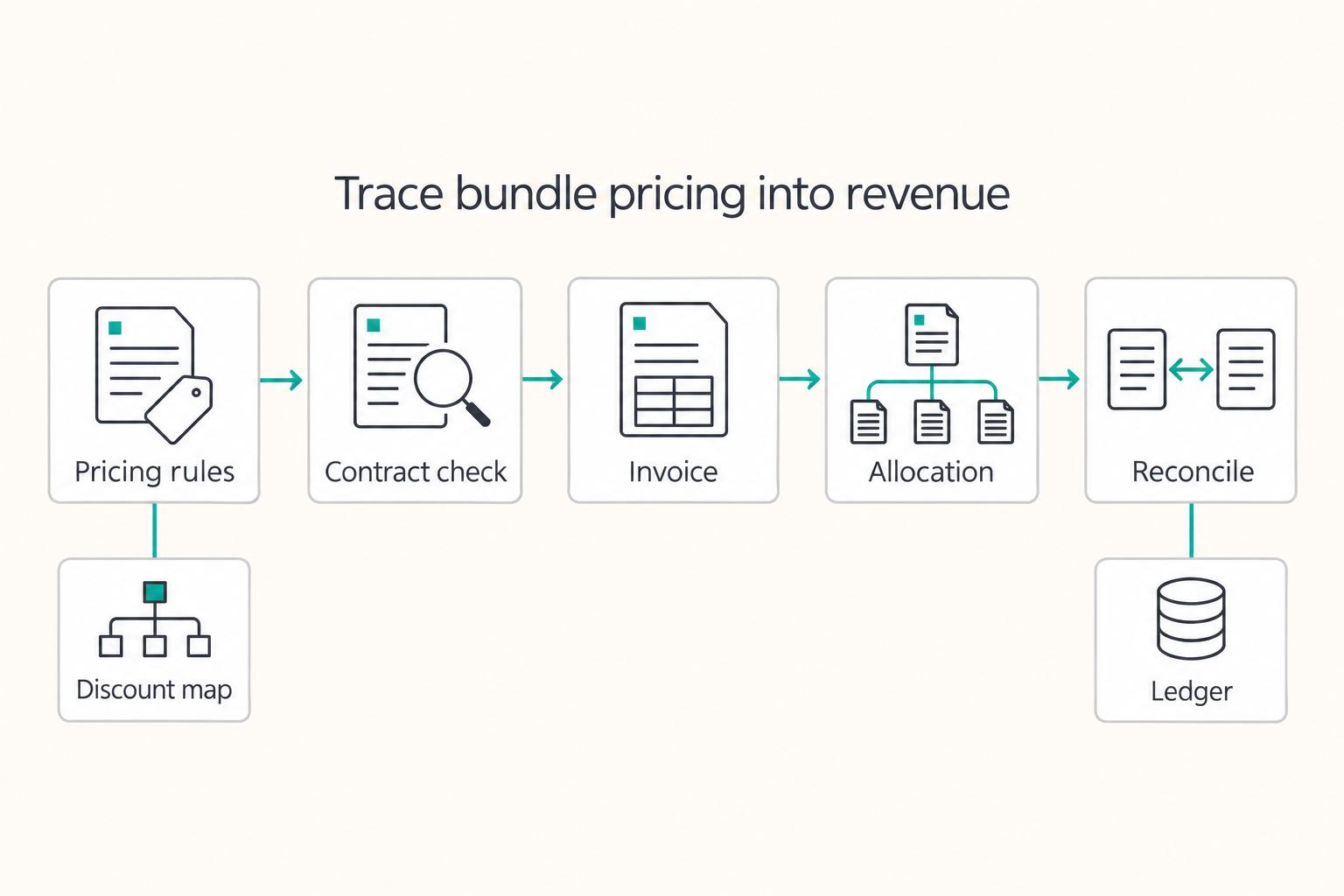
A discounted subscription bundle can put one amount on an invoice while producing several revenue schedules. The invoice total does not tell finance how much belongs to software access, a distinct training service or another promised deliverable. Start with the actual promises and supported stand-alone selling prices, then calculate the allocation and recognize each amount when or as its obligation is satisfied.

ASC 606 Revenue Recognition for Merchant of Record Platforms
If you run a Merchant of Record flow, cash movement is not your revenue policy. Under ASC 606, the hard part is that customer payment, processor settlement, and the point when revenue is actually earned can sit on different dates and in different records.
ASC 606 Principal vs Agent Decisions for Merchant-of-Record Platforms
For merchant-of-record teams, the **ASC 606 principal vs agent merchant of record** call is a high-stakes judgment, not a presentation preference. It can move revenue from gross to net and raise the level of judgment finance, audit, and compliance teams need to defend.