
Quick Answer
Calculate gross margin as (recognized marketplace revenue − cost of sales) / recognized revenue. Keep GMV and take rate separate, count platform-borne costs once, include known unmapped fees, and reconcile FX and provider movements to accounting. Track reserves, seller payables, and bank receipt in a separate cash bridge.
What to Include in a Marketplace Gross Margin Model#
Build a weekly model that connects marketplace revenue to the costs the platform actually bears. Keep GMV, recognized revenue, gross profit, contribution after operating costs, and cash availability separate. A settlement delay can reduce available cash without changing gross profit; a refund or platform-borne fee can change both.
Headline commission alone is not usable margin. In cross-border flows, payments can be hard to trace and slow to settle, and teams often miss the full FX cost across the payment path. Model those costs as separate components, not one blended fee line, or you may hide where margin is leaking.
Treat timing as an exposure question, not a fixed industry percentage. A quote today and a conversion next week can use different market rates. Record the currency and amount of the obligation, when its price becomes fixed, and when conversion occurs. Test hypothetical adverse moves against your own margin rather than assuming all corridors or escrow products have the same holding period.
Compare rates using the same currency direction, timestamp, source, and bid/ask or midpoint convention. Different feeds can legitimately return different rates. The ECB reference rates are daily information rates; the ECB discourages using them for transactions. They are not proof of the executable price available at a particular second.
The finished model should let another operator reproduce revenue, costs, and unresolved estimates from source records. Use it alongside payout commitments, permitted uses of funds, and approved treasury limits when evaluating conversion or routing changes.
What to prepare before you build the model#
Start with the data contract, not the spreadsheet. Before you calculate margin, confirm that each payment event can be traced across the systems in your payment flow.
Pull matching raw extracts#
Pull one consistent raw extract from each system for the same time window. Many teams start with a recent window so they capture normal settlement activity plus late events. Use raw rows, not summary reports.
Keep any provider reference or transaction ID that persists across the flow. Your first checkpoint is simple: can the same payment be matched across systems without loose joins?
Set the model grain at transaction-event level#
Use a transaction-event grain before you build formulas. If your systems expose them, keep separate rows for events such as authorization, capture, split payouts, refunds, and disputes.
A common failure mode is defaulting to flat corridor pricing, ignoring FX spread, or treating payments as a cost center. That risk is higher when conversion and settlement mechanics sit outside your platform.
Lock cadence and owners#
Lock one reporting cadence and assign owners before the first reconciliation cycle. One practical split is finance for calculations, ops for exception queues, and product for event instrumentation and missing fields. Make ownership explicit for late webhooks or blank fields so unresolved items do not stall the model.
Build the evidence folder early#
Create dated evidence folders for provider statements, contracts, FX execution logs, invoices, allocation rules, reconciliation notes, and assumption versions. Keep original extracts immutable and record corrections separately. When margin moves, this support pack should explain the amount, source, period, and owner.
For a broader view of where payment infrastructure is moving, read Digital Platform Trends 2026: What Payment Infrastructure Shifts Mean for Marketplace Operators.
Set your margin definitions before you touch formulas#
Do not start formulas until finance, ops, and product agree on written definitions. Classification drift can distort margin even when the math is right.
Separate commission, take rate, and gross margin#
Headline commission is the commercial rate. Take rate is marketplace revenue divided by the defined GMV denominator; state whether that denominator is before or after refunds. Gross profit is recognized revenue minus cost of sales, and gross margin is gross profit divided by recognized revenue. A payment-cost-adjusted yield divided by GMV is a separate operating metric, not the same percentage as gross margin.
First settle gross versus net revenue presentation with finance. Under the IFRS 15 principal–agent framework, control of the specified good or service determines whether revenue is presented gross as principal or as the fee or commission as agent. An agent's seller remittance is generally a payable settlement, not an extra expense against its commission. Do not infer accounting treatment from who temporarily holds the cash.
Set recognition rules for each event#
Separate operational states from financial movements. Authorization, webhook delivery, capture, fee assessment, conversion, refund, reserve movement, and bank payout do not all create revenue or expense. Write the accounting outcome for each movement, including no posting where appropriate. Deduplicate by the provider's underlying financial movement and account, rather than counting repeated webhook deliveries as new transactions.
Late refunds and disputes can change a prior transaction cohort after the reporting close. Show the original cohort view alongside the current-period accounting adjustment, and record seller recovery, commission reversal, provider fees, and any unrecovered platform loss separately. A disputed buyer payment is not automatically a platform expense equal to its full GMV. Use the actual provider deadlines and finance-approved recognition policy.
Write cohort-level inclusion rules#
Write inclusion rules by GMV cohort, not only at platform level. Payment costs can vary with basket structure, payout pattern, currency path, and risk, so cohort rules should reflect those differences.
For each cohort, document which costs the platform bears: processing, gateway, payout, conversion, dispute fees and unrecovered losses, direct infrastructure, and identity checks. Costs charged to a buyer or seller belong in platform expense only when the platform actually absorbs them. Have finance classify cost of sales versus operating expense before comparing gross margins.
Route unknowns to unmapped leakage#
Include known unclassified charges in the cost total under an unmapped bucket, with an owner and deadline. Lack of a category does not make a fee zero. If the amount itself is unknown, show an estimate or range and mark the affected metric provisional; explain how much the unresolved item could change it.
For a broader view of marketplace unit economics, read Platform Economics 101: How to Model Commission Fees Payout Costs and Gross Margin.
Map the settlement flow to ledger events and controls#
Map each payment lifecycle to its operational record, financial movements, accounting treatment, and control. Some states have no journal; some movements, such as fees without an order reference, still need one. The map should explain both.
Document the lifecycle by payment type#
Document the lifecycle you actually run for each payment type, starting with transaction and settlement flow and adding any additional stages your institution uses. Do not force all payment types into one generic process. Then assign, for each step, an operational owner and a system of record.
Name the authoritative record for each step. For example, Stripe balance transactions expose amount, fee, net, currency, status, and availability timing. These fields help reconcile provider balances; a provider's available balance still needs a separate bank-receipt check.
Standardize the required field set#
Define one required field set across lifecycle steps so events can be traced consistently, even when some fields are populated later.
For example:
- Provider and account; stable financial movement ID; webhook event ID kept separately
- Order, capture, refund, dispute, conversion, and payout references where applicable; order may be absent for account-level fees
- Signed amount, fee, net, currency, and smallest-unit convention
- Created, executed, available, payout, and bank-posted timestamps with timezone and source
- Operational status, accounting treatment, journal reference where applicable, and counterparty
- Quote ID, currency direction, source and destination amounts, benchmark convention, allocation rule, and policy version
Normalize naming across source exports, bank files, payout systems, and ledger data so the same event key means the same thing everywhere.
Add control points and lag expectations#
Add control points at each lifecycle step, including expected lag, likely failure mode, and reconciliation check. Define expected lag from your own observed processing behavior by payment type and source system.
| lifecycle step | source system | journal event | expected lag | failure mode | reconciliation check |
|---|---|---|---|---|---|
| Authorization | Processor authorization record | Usually no revenue or cash posting; document any actual fee separately | Observed authorization expiry | Expired authorization mistaken for a sale | Match capture to authorization without counting both as revenue |
| Capture and processing fee | Provider movement and order record | Revenue/payable and fee treatment under the approved policy | Provider-specific pending-to-available timing | Missing capture, duplicated fee, or wrong currency | Reconcile signed amount, fee, and net; deduplicate movement IDs |
| Refund or dispute | Adjustment and original transaction records | Commission reversal, seller recovery, fee, and platform loss separately | Provider case and adjustment timelines | Full GMV counted as platform expense | Trace recovery and reversal to the original cohort |
| Reserve and payout | Provider reserve/payout report; bank statement | Reserve reclassification or clearing-to-cash movement, not automatic expense | Contractual release and observed bank posting | Reserve treated as cost or payout as bank receipt | Reconcile all batch movements, then verify bank amount and currency |
| FX and shared infrastructure | Executed conversion record; supplier invoices and usage records | Conversion and allocated cost treatment; keep benchmark diagnostics separate | Execution timestamp and invoice service period | Duplicate spread, stale quote, or arbitrary allocation | Match conversion amounts and fees; reproduce allocation driver |
Define explicit exception handling#
Run exceptions through explicit rules, because payment operations require failure-mode handling. Route conflicting statuses, missing references, and stale sync records to review instead of forcing automated matches.
Allow system-of-record ownership to vary by lifecycle step when your operation crosses multiple settlement systems. The goal is a control map that survives reconciliation and supports decision-making with event-level evidence.
Related reading: Inventory Management for Marketplace Platforms: How to Sync Stock Levels with Payment Triggers.
Build the cost taxonomy and formula map you will run weekly#
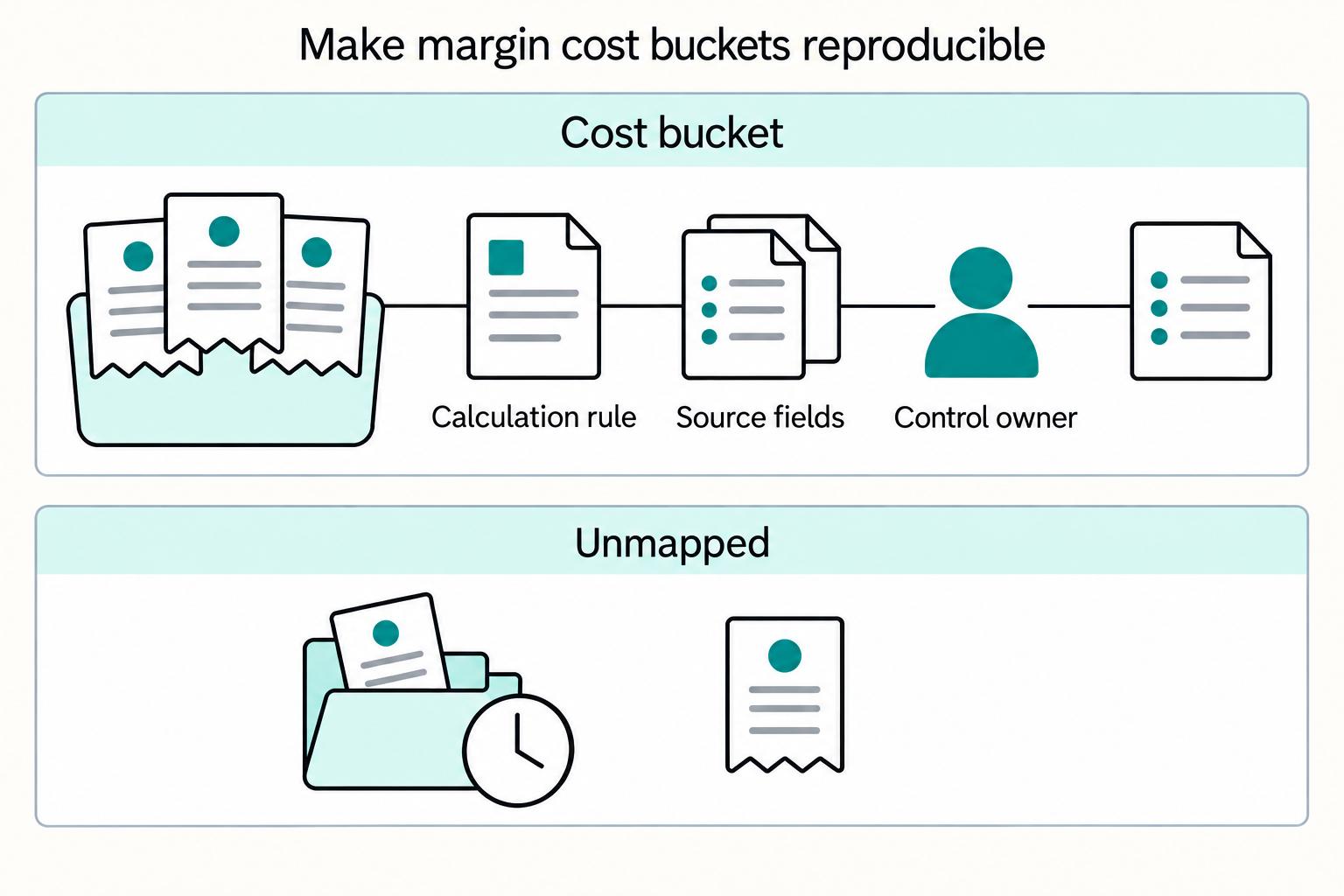
Freeze bucket definitions and source mappings, then apply explicit formulas. The classification of cost of sales needs finance approval, but known charges must remain in the total while their category is investigated. Unknown amounts require disclosed estimates and uncertainty, not exclusion from reported margin.
Freeze the bucket set#
Use a stable taxonomy for platform-borne payment processing, payouts, conversion, disputes and unrecovered losses, direct infrastructure, and identity checks. Keep unclassified known costs visible. Record shared fixed costs and their allocation basis separately so a change in allocation cannot masquerade as better payment economics.
Do not use a catch-all miscellaneous line in reporting. Route unclassified charges to an explicit unmapped leakage bucket with an owner and due date, then clear it on a deadline.
Checkpoint: sample fee lines from exports or invoices and have a second operator classify them using only the written rules. If results differ, tighten the bucket definitions.
Map every bucket to a reproducible formula#
Map every bucket to a formula, denominator, source fields, update cadence, and control owner. Keep the denominator policy stable across reporting periods, and document any exception in writing. Use one operating table like this:
| bucket | formula | numerator / denominator | source fields | update frequency | control owner |
|---|---|---|---|---|---|
| Processing | Sum actual platform-borne processing and gateway charges, net of fee refunds | Cost amount; optionally cost / captured volume | Movement fee details; contract and periodic invoices | Weekly, with invoice true-up | Payments finance |
| Payout | Sum transfer and intermediary charges actually borne | Cost amount; cost / completed payouts as a separate diagnostic | Payout references, bank deductions, invoices | Weekly | Payout operations |
| FX | Sum booked conversion charges and finance-approved FX cost treatment once | Cost amount; benchmark shortfall shown separately | Executed rate, currency pair, amounts, fee currency, journal | Weekly | Treasury / finance |
| Disputes and losses | Case fees + platform loss − recorded recoveries under the policy | Cost amount; retain original cohort and current period | Case IDs, seller recovery, adjustment records | Weekly, with late-event rollforward | Risk finance |
| Infrastructure and identity | Direct costs + documented allocation of shared service cost | Allocated cost; driver units stated | Supplier invoice, service period, usage or verification counts | Weekly estimate; invoice true-up | Engineering / finance |
| Unmapped known costs | Sum known charges awaiting classification | Cost amount included in total, not zero | Source row, amount, owner, resolution date | Weekly | Named exception owner |
| Gross margin | (Recognized revenue − cost of sales) / recognized revenue | Gross profit / revenue; undefined when revenue is zero | Revenue bridge and finance-approved cost categories | Weekly | Finance |
Checkpoint: a different operator should be able to rebuild your selected margin metric from exports, invoices, and the assumptions register without your personal working file.
Build a revenue-to-gross-profit bridge#
Use a worked bridge with explicit assumptions. The following hypothetical agent marketplace earns a 10% commission, has no tax in the example, and uses net-of-refund GMV. Finance has classified the listed direct costs as cost of sales for this illustration; a different classification changes gross margin and must be disclosed. These amounts are not provider prices.
| Bridge item | Hypothetical amount and calculation |
|---|---|
| Buyer GMV before refunds | $10,000 |
| Buyer refunds | $1,000; net GMV $9,000 |
| Recognized marketplace revenue | $1,000 commission − $100 commission reversal = $900 |
| Seller payable | $8,100; pass-through obligation, not agent cost of sales |
| Platform cost of sales | Processing $250 + payouts $40 + booked FX cost $50 + unrecovered losses $60 + infrastructure $80 + identity checks $40 + unmapped known charges $20 = $540 |
| Gross profit and gross margin | $900 − $540 = $360; $360 / $900 = 40% |
| Take rate | $900 / $9,000 = 10% |
| Contribution after additional operating overhead | $360 − $100 overhead = $260; $260 / $9,000 = 2.89% of net GMV |
A $500 provider reserve in this example reduces immediately available cash; moving money into that reserve does not by itself add $500 to expense. Likewise, $8,100 remitted to sellers clears the payable. Keep a separate cash bridge for reserve releases, provider balances, payout batches, and bank receipt rather than expecting cash to equal gross profit.
State timing policy explicitly. If current-period and original-transaction views differ, show both rather than blending them silently.
Parameterize the inputs that change#
Parameterize changing inputs instead of hardcoding them. Keep corridor mix, contract terms, dispute incidence, and similar assumptions in one register with effective date, version, owner, and evidence note.
Separate provisional estimates and scenario assumptions from actuals. Avoid hidden overrides so margin changes can be traced to pricing, routing, mix, or operations.
Related reading: Accounting for a Payment Infrastructure Business: How to Structure Finance Ops.
Add the FX layer most teams under-model#
Treat FX as its own evidence-backed layer, not a blended fee inside processing or payout. If you do not capture the rate used at execution time, margin attribution drifts and you end up fixing the wrong part of the stack.
Capture FX data at execution#
Capture the quoted rate and the actual executed rate, quote ID and expiry, source amount and currency, destination gross and net amounts, explicit fees and their currency, execution timestamp, and provider reference. State the direction, such as EUR per USD. Normalize smallest units before applying rates; cents and whole currency units are not interchangeable.
Settlement-date views alone are weak for FX control. If provider data is blended or missing execution timing, flag it as limited evidence in your assumptions register and keep it visible in the FX bucket.
Keep execution, availability, payout, and bank-posted timestamps separately. They answer different questions. Preserve the raw provider fields and any limits in their precision; a settlement date without an execution time cannot support a precise intraday spread attribution.
Separate markup from transfer and foreign transaction fees#
Separate explicit transfer or conversion fees from a benchmark rate variance. The latter is an economic comparison, not automatically an additional ledger expense. Do not subtract an embedded spread again if its effect is already included in your revenue, converted balance, or booked FX result. Document how the operating model reconciles to accounting.
For a hypothetical $1,000 conversion, a matched benchmark of €0.900 per dollar implies €900. An executed rate of €0.891 produces €891 before a separate €5 fee, or €886 net. The €14 benchmark shortfall comprises €9 rate variance and €5 explicit fee, about 1.56% of benchmark proceeds. It is not a further €14 charge to add on top of those same components. Keep known charges included even when their category is unresolved.
Your weekly standard is traceability: another operator should be able to point to the exact record supporting each FX-related cost line.
Distinguish network-driven and merchant-driven FX costs#
Tag conversion costs by the documented cause and the party that bears them. A buyer's card-issuer FX charge may affect checkout experience but is not a platform expense unless the platform reimburses or subsidizes it. Avoid inventing network, wallet, or provider attribution from a currency mismatch alone.
| Cause tag | Use when |
|---|---|
| provider conversion | Sampled records show provider conversion |
| card-rail conversion | Sampled records show card-rail conversion |
| wallet or local-scheme path | Sampled records show a wallet or local-scheme path |
| unattributed FX-related cost | Source data cannot support attribution |
You need this split because the corrective actions are different. Use simple cause tags on sampled records, such as provider conversion, card-rail conversion, wallet or local-scheme path, or unattributed FX-related cost when source data cannot support attribution.
Benchmark sampled records at the execution timestamp#
Use a consistent independent benchmark with its own timestamp, direction, and rate convention. Compare execution to a contemporaneous benchmark where available; compare an earlier quote separately to distinguish intervening market movement. A daily reference supports a coarser diagnostic, not an exact executable-spread claim.
Retain the conversion artifact and benchmark evidence for each sampled record. Missing timestamps, stale quotes, and unmatched rate conventions remain exceptions. Do not smooth unexplained variance into take rate or describe all quote-to-settlement movement as provider markup.
Decide when to hold convert or settle#
Start with contractual payout deadlines, currency obligations, permitted uses of balances, and treasury risk limits. Within those constraints, compare total platform-borne cost and exposure. Holding a source currency while owing a fixed foreign-currency amount can increase risk; traceability alone does not make automatic conversion or delay safer.
Start with a corridor and payout-horizon grid#
Use a corridor-by-corridor grid with payout currency, payout horizon, and whether inflows already cover same-currency outflows.
| Exposure window example | First check | Starting posture |
|---|---|---|
| Near-term payout | Are usable funds already in the obligation currency and available before cutoff? | Avoid unnecessary conversion only when ownership, availability, and deadlines permit |
| Longer review or reserve hold | Is the obligation fixed in a different currency while funds remain unavailable? | Measure the mismatch and use approved conversion or hedging policy; do not assume delaying conversion reduces risk |
| Long-dated quote | Is pricing indicative, expired, or firm for the required execution date? | Refresh indicative pricing; preserve contractual commitments and approval limits |
These are exposure categories, not standard provider holding periods. Test your observed delays and contractual release terms against a stated adverse FX scenario. Keep market risk, funding cost, and delayed cash availability distinct.
Use natural hedging where it fits#
Match same-currency inflows and outflows only when timing, ownership, and legal permission to use the funds align. Seller funds or ring-fenced balances cannot be treated as freely usable platform cash. Convert only the eligible residual under the approved policy.
Track this by corridor and payout horizon: inflow, outflow, matched volume, and residual. Do not call it a hedge if the match exists only in aggregate while actual payout timing is misaligned.
Refresh quotes when timing risk rises#
When timing risk is high, use fresh firm quotes and flag stale conversions for review. Indicative pricing is not enough once execution timing slips.
For each conversion, keep a traceable record: quote reference, quoted time, execution time, currency pair, provider reference, and approval trail. Treat weak quote-to-execution linkage as an exception, especially in workflows with tight cutoffs.
Compare paths on landed margin#
Compare feasible collection and payout paths on platform-borne processing, conversion, transfer charges, losses, and operational effort. Show financing costs and cash availability separately from gross margin unless finance's accounting policy includes them in cost of sales. A larger reserve is not itself a larger expense.
Do not assume one path always wins by corridor. Set one explicit rule: optimize total landed margin, not the lowest single fee line.
Reconcile weekly with an audit-ready evidence pack#
Reconcile the economic model to provider movements, journals, and balances, then reconcile payout batches to bank receipt separately. Missing bank cash does not automatically prevent recognition of supported revenue or accruals. Disclose estimates and pause publication of a definitive metric when unresolved errors exceed the agreed materiality tolerance.
Your payment flow can span distinct operational perimeters and connected ledgers, so one end balance is not enough evidence. Treat transaction flow, settlement flow, internal controls, management reporting, and audit readiness as separate checks inside one weekly pack.
Reconcile events before balances#
Start from event-level records, then move to balances and reporting:
- Payment events to ledger journals
- Ledger journals to account balances
- Balance and exception outputs to management reporting
Each financial movement should map to its accounting outcome, including documented no-posting events. Each journal should trace to a movement, allocation, accrual, or approved manual adjustment. Do not require every operational notification to create a journal.
Check replay behavior#
If your systems allow retries or replay, include a standing control to detect duplicate financial impact.
Include a checkpoint for retried events and verify that later passes did not create unintended journal activity. If that evidence is incomplete, treat the week's margin output as provisional for external reporting.
Store a weekly evidence pack#
Store a weekly evidence pack that another reviewer can follow without rebuilding context. At minimum, keep:
- variance report
- exception list
- closed-loop fixes with what changed and why
- unresolved items with owner and due date
The pack should connect each break to root cause, correction, and current status so reported margin remains defensible later.
Gate publication with a pass or fail check#
Add a pass or fail gate before external margin publication. Define tolerance in policy, define who can override, and pause reporting when unresolved breaks exceed that line.
If open reconciliation items could still change revenue, payment cost, FX cost, or payout liability, mark results as provisional or hold publication. In a weekly finance process, credibility should win over speed.
When evaluating an implementation, use Gruv's developer documentation to check the available references, status events, replay behavior, and reconciliation exports against your required controls.
Stress test failure modes before scale exposes them#
Your margin model is only reliable if it still holds when settlement timing breaks. If post-close adjustments can move results after close, treat reported margin as scenario-dependent, not final by default.
Build scenarios on a fixed transaction cohort#
Build at least three scenarios, then add a severe downside. Use a clear set such as base, upside, and downside, then vary assumptions across timing and status changes so you can see combined-shock behavior.
Keep the transaction cohort fixed while you change assumptions. That isolates whether movement comes from timing, reclassification, or true economic loss.
Stress timing, not just volume#
Stress timing directly, not just event volume. Run one pass with first-observed timing, then additional passes that move adjustments into later closes.
Show which rows change the original cohort and which change the current accounting period. Keep follow-up controls for late refunds, disputes, and returns even after payout settles. Use supported accruals and estimates under the accounting policy; settlement confirmation alone does not make all costs final or determine revenue recognition.
Simulate asynchronous returns and state handling#
Simulate asynchronous returns and define internal state handling before scale makes ambiguity expensive. If you use internal return states, document one rule for how each state affects reporting.
Require reference continuity across state transitions so returned items can be traced to the original event. Without that chain, reconciliation risk can rise and margin explanations get weak.
Test payout holds for cash-timing impact#
Where policy-gated payout holds are used, stress-test their cash-timing impact against risk reduction. The goal is not a universal threshold. It is to measure whether your policy reduces exposure in size or duration.
Model a reserve hold as restricted availability or the relevant balance classification, not an automatic loss. Add separately any actual borrowing cost, conversion exposure, or unrecovered loss caused by the delay. Record assumptions and reconcile them to later actuals.
Related: How to Scale a Marketplace from 100 to 100000 Users: Payment Infrastructure Roadmap.
Compare providers with margin impact not marketing claims#
Choose providers on all-in margin impact, not headline fees. Compare the option with the lowest total cost for your actual corridors and payment sizes after processing, payout behavior, FX treatment, disputes, and reconciliation effort are included.
Price the full cost stack by corridor and payment size#
Build one comparison sheet for Stripe, PayPal, and at least one relevant alternative, such as a local acquirer, bank-transfer path, or non-bank money transmitter. Use harmonized all-in cost measures by corridor and payment value, since costs vary by rail, country pair, and ticket size.
For PayPal, use the price terms for the merchant market, account, product, and currency being modeled. Its balance report distinguishes immediately charged net-billed fees from gross-billed fees invoiced periodically. Do not subtract an informational fee on a transaction and then count the same invoice again.
Save the applicable contract or fee schedule with its effective date and the account's actual statements. Record volume tiers, minimums, refund treatment, and negotiated exceptions. Reconcile estimated charges to invoices instead of relying on public headline rates.
Split domestic and international flows before comparing#
Use each provider's contractual definitions of domestic and international pricing. Store the merchant market, payer or card market where relevant, collection currency, settlement currency, payment method, and account terms. A different country pair need not mean a currency conversion, and conversion can occur without an international buyer.
Where detailed payment-method data is available, avoid one blended card assumption. If a quote cannot be mapped to GMV by corridor and payment method, treat it as directional rather than decision-grade for finance.
Record buyer-paid or seller-paid charges separately from platform costs. Include a deduction in marketplace margin only if the platform bears it under the agreement or records a subsidy; show other charges as a customer-experience or seller-proceeds diagnostic.
Use benchmarks as context, not substitute pricing#
Use external benchmarks as directional context, not contract pricing. They are useful for spotting corridors that look structurally expensive or unusually cheap, but they should not populate your provider model directly.
Normalize comparisons to the same corridor, payment size, currency obligation, refund and dispute assumptions, payout frequency, and service level. Include any known intermediary deductions borne by the platform. Retail remittance averages or unrelated regulatory capital measures cannot substitute for a marketplace's account pricing and actual reports.
Score operational quality that affects finance effort#
When pricing is close, operational quality can decide margin confidence. Score each option on reconciliation quality, reference consistency across auth, capture, payout, refund, and dispute events, plus incident investigation responsiveness.
Ask for sample exports, sample statements, and one traced transaction from initiation through payout and any dispute state. If references break in that chain, costs can reappear as manual research, provisional closes, and weaker dispute recovery. If stable IDs and audit-ready reporting are weak before launch, treat that as a margin risk, not just an ops inconvenience.
If cross-border payouts are affecting margin, see Digital Nomad Payment Infrastructure for Platform Teams: How to Build Traceable Cross-Border Payouts.
Execute the first 30 days without overbuilding#
In the first 30 days, aim for a weekly decision loop you can trust, not a fully polished system.
| Week | Focus | Checkpoint |
|---|---|---|
| Week 1 | Finalize definitions and the settlement map | Trace one transaction end to end and resolve any reference, status, or timestamp mismatch immediately |
| Week 2 | Stand up the weekly model | Rerun the prior week and confirm that results are reproducible except for documented corrections |
| Week 3 | Review one FX-related sample | Examine quote context, execution timing, settlement outcome, and ledger posting together |
| Week 4 | Review outcomes and lock the next quarter | Convert the gaps that most affected reporting confidence into next-quarter instrumentation and control priorities |
In Week 1, finalize definitions and the settlement map#
Start by locking definitions, data contracts, and settlement-to-ledger mapping in writing before formulas or dashboards expand. Keep terms, event states, and field mappings explicit so finance, ops, and product are working from the same interpretation.
Trace one transaction through its financial movements, journals, provider balance, and bank payout. Record who owns unresolved differences and date-stamp policy assumptions. Ask finance to approve accounting classifications before publishing gross margin.
In Week 2, stand up the weekly model#
Build the weekly model first, even if parts are manual. Produce one weekly output, one week-over-week variance view, and one exception queue with owner, cause, and due date.
Checkpoint: rerun the prior week and confirm that results are reproducible except for documented corrections. If reproducibility fails, fix mapping and controls before adding more reporting layers.
In Week 3, review one FX-related sample#
If FX is in scope, run one focused sample review and examine quote context, execution timing, settlement outcome, and ledger posting together. Use the sample to test whether the current flow is introducing unexplained variance or timing noise.
Change a conversion or routing policy only when the sample supplies enough evidence and finance and operations approve it. If the result is inconclusive, retain the policy and improve the missing data.
In Week 4, review outcomes and lock the next quarter#
Hold one short cross-functional review and decide which gaps most affected reporting confidence. Convert those gaps into next-quarter instrumentation and control priorities. End with a short, owned action list with dates and evidence so next week's reporting is measurably more reliable.
For a step-by-step walkthrough, see Building Payment Infrastructure In-House: Engineering, Compliance, and Maintenance Costs.
Put this model on a weekly operating cadence#
Treat the weekly margin output as a controlled release. Publish only after definitions, reconciliation, and FX timing checks pass.
- Confirm definitions are unchanged for the gross margin model and recognition timing. If anything changed, version it and treat week-over-week comparisons as non-like-for-like.
- Run a repeatable workflow: flag notable breaks first, then interpret what those breaks signal at the aggregate level.
- Recalculate costs from actuals and disclosed accruals. Keep execution-rate variance, explicit fees, and booked FX effects distinct. An illustrative Day 1 quote, Day 3 approval, Day 5 conversion, Day 7 settlement timeline is a scenario, not a standard provider schedule.
- Review exceptions with owners and deadlines, and publish margin only after control gates pass. If an open break could change the result, mark the output provisional.
- Include weekly KPIs with the margin result: exception count, aging, unresolved breaks, and open FX timing gaps. Then verify whether prior fixes improved outcomes, not just process completion.
- Record policy or routing changes when evidence supports them, with owner, date, and expected effect. Measure the next comparable cohort using the same definitions; do not force a change or claim improvement every week.
Use the model to document what a provider must supply before changing infrastructure. Explore Gruv's payouts and Merchant of Record offerings against those requirements, including who owns the sale, fees, seller liabilities, and reconciliation evidence.
Frequently Asked Questions
What is the practical difference between headline commission and effective take rate in a marketplace model?
Headline commission is the commercial rate. Take rate is marketplace revenue divided by the stated GMV denominator. Gross margin divides revenue minus cost of sales by revenue. A yield after payment costs divided by GMV is a separately labeled operating metric; keep its costs and denominator explicit.
Which cost buckets are mandatory in a gross margin model for payments and FX?
Include the platform-borne processing, payout, booked conversion, dispute fees and unrecovered losses, direct infrastructure, and identity costs that apply to your flow. Include known unmapped charges in the total. Finance must decide which costs belong in cost of sales and which are operating expense; disclose allocations and avoid counting agent seller remittances as platform expense.
How do embedded FX markups differ from transfer fees in provider statements?
An embedded markup affects the executed rate relative to a matched benchmark. A transfer fee is a separate charge. Compare destination amounts before and after explicit fees, and avoid adding a benchmark shortfall again when its underlying components already affect your model.
How do we audit FX markup using timestamped conversion data without building a treasury team?
Store quote and execution details, normalize currency units and direction, and compare execution with a benchmark at matching timing and convention. Reconcile destination gross, explicit fees, and net proceeds. Compare earlier quotes separately so market movement is not mislabeled as provider markup.
When should we hold balances versus auto-convert before payout?
Use the currency of the obligation, payout deadline, availability and permitted use of funds, and approved FX exposure limits. Matching eligible same-currency flows can avoid conversion; holding a different currency against a fixed payable can increase risk. Neither slow settlement nor poor traceability by itself proves that auto-conversion is safer.
What controls reduce FX leakage without adding major operational complexity?
Start with controls that improve transparency and repeatability: store conversion timestamps and rates, and reconcile estimated versus actual cost on a fixed cadence. Keep FX components visible in reporting so spread and non-spread charges are not blended into one opaque line. When data is incomplete, mark outputs as provisional until the missing evidence is resolved.
Where Gruv fits
Researched and edited by the Gruv editorial team. Gruv builds cross-border billing, payouts, and finance-operations software for global businesses.
Sources
Includes 1 external source outside the trusted-domain allowlist.
- developer.paypal.com/reports/balancetrusted
- docs.stripe.com/api/balance_transactions/objecttrusted
- docs.stripe.com/reports/balance-transaction-typestrusted
- ecb.europa.eu/stats/policy_and_exchange_rates/euro_referen...trusted
- stripe.com/en-ch/resources/more/14-key-marketplace-metricstrusted
- ifrs.org/content/dam/ifrs/project/pir-ifrs-15/rfi-ias...external
Educational content only. Not legal, tax, or financial advice.
Related Posts

The Freelance Payment Penalty: A Modeled Audit of Platform Fees, FX Spreads, and Payout Delays
The money rarely disappears through a single, easy-to-spot fee. The real loss is stacked. A marketplace takes its commission, a processor adds a charge for international cards, a bank or payment company converts the currency at a spread, a platform holds the funds before release, and a wire sheds a little to intermediaries on the way in. Each layer looks defensible on its own, but the worker feels the combined result as a smaller deposit and a later payday.

How to Respond to a Subpoena for Business Records
Move fast, but do not produce records on instinct. If you need to **respond to a subpoena for business records**, your immediate job is to control deadlines, preserve records, and make any later production defensible.
A US Expat's Guide to Investing in UCITS ETFs to Avoid PFIC Issues
The real problem is a two-system conflict. U.S. tax treatment can punish the wrong fund choice, while local product-access constraints can block the funds you want to buy in the first place. For **us expat ucits etfs**, the practical question is not "Which product is best?" It is "What can I access, report, and keep doing every year without guessing?" Use this four-part filter before any trade: