
Quick Answer
Build a global contractor payout speed index by country around confirmed time-to-funds, not API success timestamps. Start with corridor scoring, separate payout speed from payout coverage and withdrawal access, and assign confidence labels only when evidence is complete. A practical minimum is end-to-end proof from initiation through provider status progression to contractor receipt. If that chain is missing, treat the market as unverified even when a provider lists it as supported.
Measure time to funds, not coverage claims#
A global contractor payout speed index by country should tell you one thing first: how reliably contractors in each corridor receive funds when you expect them to. Coverage maps are not the same as reliable time to funds. If you are deciding where to launch first, the useful question is not "can we pay there at all?" but "how often do contractors in that market get paid when we expect them to?"
Justworks lists support for international individual contractors in 60+ countries. Its country list is a useful inventory input, but it does not measure the time between your payout request and usable funds in a contractor’s account.
A market can look attractive on paper, then create support load if payout timing is inconsistent. Evaluate the actual funding currency, destination currency, provider, payout method and receiving-bank path as one corridor instead of treating international payments as a uniform capability.
The focus here is real time-to-funds for cross-border payments, because that shapes contractor experience, operational effort, and launch risk. If a provider says a country is supported, that should be your starting point, not your approval to scale.
A simple rule up front: do not commit product and GTM resources to a new payout country based on coverage alone. First verify the evidence that will matter later in production, such as provider processing timestamps, observable status changes, and contractor-side confirmation that funds were actually received. If you cannot get that proof in a target corridor, treat the market as unverified no matter how broad the provider's country list looks.
Keep one model distinction straight early. Justworks explicitly notes that International Contractors is not equivalent to International Employer of Record, and that its contractor product is intended for international individuals, not vendors. That kind of product boundary matters because payout expectations, compliance steps, and rollout assumptions can change depending on who is being paid and under what arrangement.
So the goal here is decision quality, not a glossy ranking. By the end, you should have a practical way to sort countries into launch now, launch carefully, or delay until you have better proof of actual payout behavior.
For accounting sync context, see Xero + Global Payouts: How to Sync International Contractor Payments into Your Accounting System.
What the Global Contractor Payout Speed Index should measure#
Measure one thing first: actual time-to-funds. Do not treat API acknowledgment, a provider "processed" status, or country availability as payout speed, because those signals are not the same as confirmed receipt.
| Term | What it measures |
|---|---|
| Payout speed | How long until the contractor can reasonably expect funds |
| Payout coverage | Whether a provider can initiate payment in that country |
| Withdrawal options | How the contractor can access money after it arrives in the destination environment |
Keep those terms separate from the start.
Use a hard model boundary between real-time rails and batch-processed rails so you do not hide different payout behaviors inside one country score. For each corridor, validate speed with the same core evidence: initiation time, provider status progression, and contractor-side receipt confirmation.
Treat discovery tools, including Contractor Payout Explorer, as a way to prioritize what to evaluate next, not as proof of payout performance. The same standard applies to broad positioning claims such as Remote's "Hire, manage, and pay from one platform": useful inventory signal, but not verified time-to-funds evidence.
If you want a deeper dive, read Global Contractor Payout Benchmarks by Country.
Build a scoring model founders can audit#
Build the index so another operator can retrace every score. The practical rule is to score major currency corridors first, then roll those results up into a country view with confidence labels.
A country view is useful for presentation, but it is too broad as the primary scoring unit. The same country can perform differently by corridor, so a single country score can hide where delay risk actually sits.
Score corridors before countries#
Use three dimensions for each corridor:
- Rail availability: record which payout paths are available for that corridor, but treat availability as capability, not proof of speed.
- Observed settlement behavior: weight receipt-confirmed outcomes most heavily, and keep them separate from provider status signals.
- Corridor consistency: check whether outcomes stay stable across normal operating conditions; if the trace is incomplete, keep the score conservative.
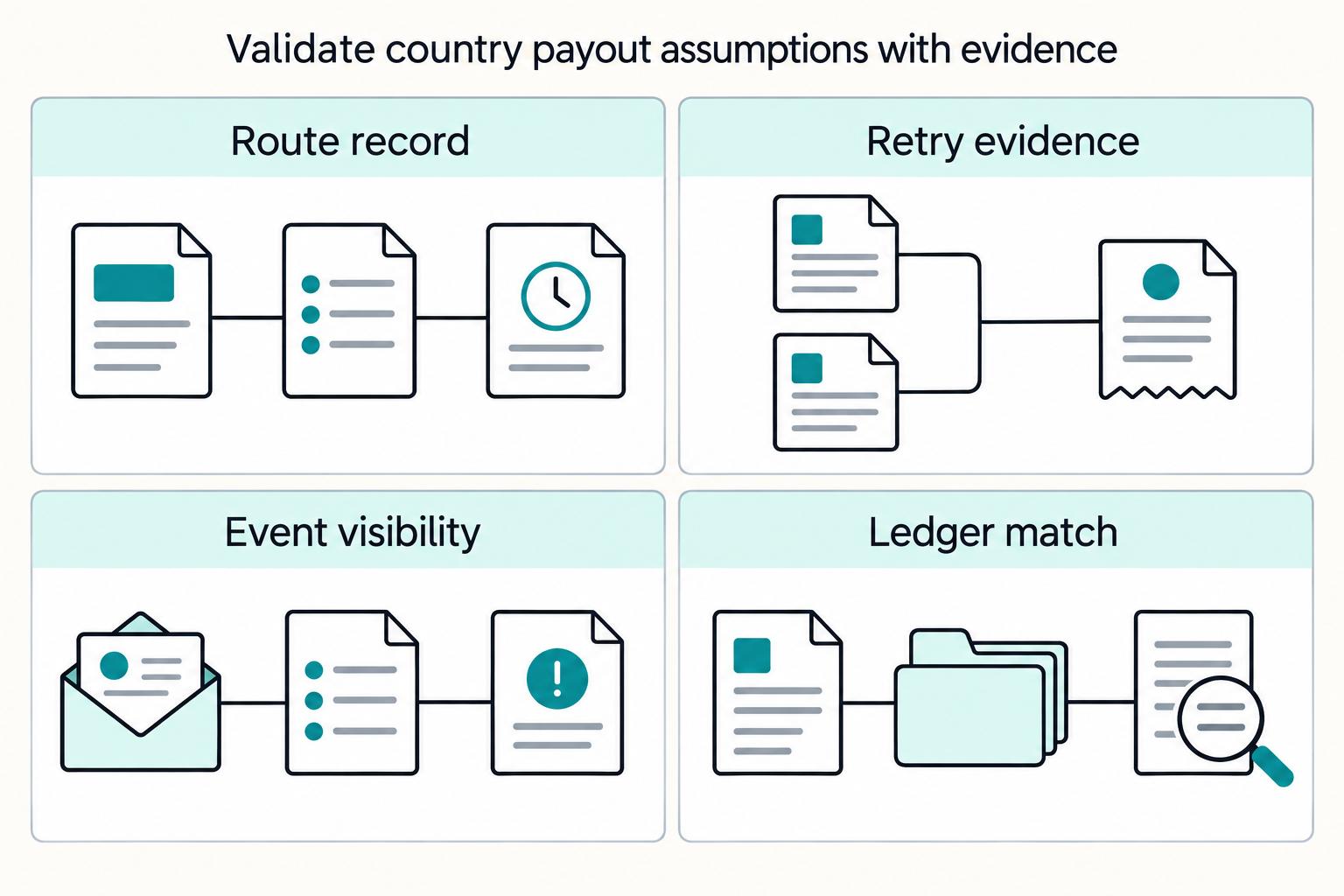
For auditability, keep a simple evidence pack per corridor: initiation record, status trail, internal posting point, and receipt confirmation. If key evidence is missing, track the corridor but do not mark it fully verified.
Record the observation window and a worked example#
For each corridor, record the provider and receiving-bank mix, payout amounts, funding and destination currencies, rail used, sample count and observation dates. Measure elapsed time from your approved release request to recipient-confirmed usable funds; also record funding-ready-to-receipt time if prefunding changes the comparison. Store UTC timestamps and the recipient’s local time. Report the median and a tail percentile only when the sample supports them, together with counts of pending, failed and returned payments. Excluding unfinished payments can make a slow route look fast.
Hypothetical example: ten released payouts are observed for seven days. Eight have confirmed usable-funds times of 2, 3, 3, 4, 4, 5, 6 and 8 hours; one remains pending and one is returned. The completed-payment median is 4 hours, but receipt-confirmed completion is only 8/10 (80%). Publish both figures and the seven-day observation window; do not present the 4-hour median as a guarantee or quietly omit the two exceptions. A ten-payment pilot supports a narrow confidence label, not a reliable country-wide tail estimate.
Make weak evidence visible#
Use confidence labels directly in the ranking:
- Verified: receipt-confirmed evidence is sufficient to explain time-to-funds end to end.
- Partially verified: some real evidence exists, but it is incomplete or narrow.
- Unknown: corridor existence may be known, but payout-speed evidence is not sufficient.
This keeps planning honest. Country-by-country views and routine cross-border hiring context are useful, but they do not replace an auditable financial model with visible assumptions.
Use a compact comparison table#
| Corridor pattern | Rail mix | Expected settlement window type | Evidence completeness | Confidence level |
|---|---|---|---|---|
| Receipt-confirmed corridor with clear trace | Documented and observed | Observed and repeatable | End-to-end receipt and status evidence | Verified |
| Corridor with partial trace coverage | Documented, partly observed | Variable or incomplete evidence | Partial receipt or status evidence | Partially verified |
| Corridor listed but not receipt-confirmed | Claimed only | Unknown | No receipt-confirmed timing evidence | Unknown |
Need the full breakdown? Read Bank Code vs. Routing Number vs. Sort Code: A Global Platform Payout Reference Guide.
Compare rail behavior that changes speed outcomes#
If contractor trust depends on rapid cash access, prioritize corridors where you can prove a local instant path was used and the contractor actually received usable funds. The core distinction is not marketing speed, but whether payouts run through an instant-capable path or through bank-mediated, batch-style steps that add delay.
An instant domestic rail describes only one part of a cross-border flow. Funding, FX conversion, compliance checks and recipient-bank posting can add time before or after that rail. Record those stages separately so a fast domestic transfer does not conceal a slow end-to-end payout.
Nacha’s ACH fact sheet distinguishes same-day, next-day and two-day ACH credit settlement. A provider’s collection or payout workflow may take longer than the underlying rail. Use the selected service’s cutoff and recipient availability rules, then measure your own end-to-end result.
| Rail type pattern | What "processed" can mean | Delay pattern to test | Evidence that clears the risk |
|---|---|---|---|
| Batch or bank-mediated path | Instruction accepted or message handed off | Cutoff-related delay, intermediary lag, reconciliation lag | End-to-end timestamps plus contractor receipt confirmation |
| Local instant-capable path | Instant route initiated | Fallback to a slower path, or posting mismatch after initiation | Trace that the instant path was used plus confirmed receipt time |
For scoring, weight markets with receipt-confirmed instant outcomes above corridors that only show fast initiation signals.
We covered this in detail in Choosing Global Contractor Payment Rails in 2026 Without False Precision.
Separate payout speed from payout coverage and access#
Do not treat a broad country list as proof of fast contractor cash access. Run three separate go/no-go checks for each corridor: payout coverage, payout speed, and withdrawal access.
A coverage map answers only whether a provider says it can reach a market. It does not prove same-day time-to-funds, and it does not prove the contractor can use funds when your dashboard shows "processed." A corridor can be reachable and still be a weak choice for trust-sensitive payouts.
| Check | What it actually tells you | Evidence needed before launch | Common mistake |
|---|---|---|---|
| Payout coverage | Whether the provider claims footprint in the market | Supported country list, supported currency/corridor, onboarding eligibility | Treating coverage-map presence as proof of same-day performance |
| Payout speed | Time from instruction to usable funds | Live test timestamps, rail used, status events, contractor receipt confirmation | Using API acceptance time as the speed metric |
| Withdrawal access | How the contractor gets money out, and where timing risk sits | Available payout/withdrawal route in the tested corridor, user-side receipt and availability check | Ignoring post-provider delays on bank-dependent access paths |
Withdrawal design can change user outcomes even when coverage looks identical. If a corridor is effectively bank-transfer-only, experience depends on bank posting behavior, cutoffs, and receiving-side account access. If payees can choose instant versus standard paths, timing can differ materially even within the same provider.
Use Remote and Contractor Payout Explorer-style inputs as baseline inventory, not launch proof. They help identify where support is advertised and which rails or methods might exist; your launch decision still needs internal validation. At minimum, confirm multi-rail support and webhook coverage for real-time status updates, then run low-volume live tests that capture provider initiation time, webhook timestamps, downstream reference, and contractor-confirmed receipt in local time.
The common failure pattern is straightforward: ops sees "available in country X," product hears "fast enough," and support absorbs the gap. If coverage exists but withdrawal paths are constrained, launch with explicit SLA language and staged contractor cohorts. State only what you can defend, then expand after your evidence shows consistent time-to-funds.
Related: Contractor Payout Speed Calculator by Rail and Country.
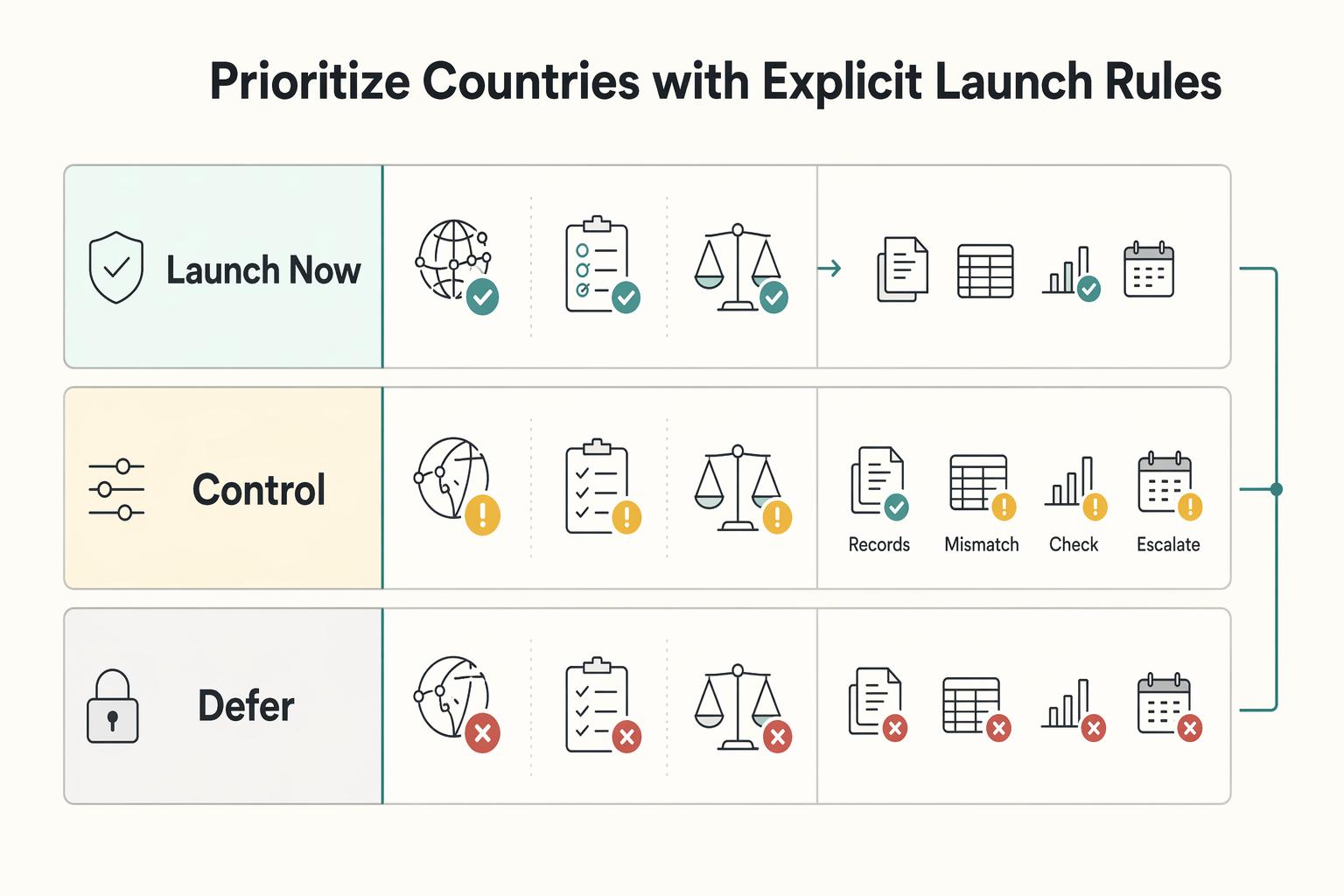
Prioritize countries with explicit launch rules#
Put each country into a clear launch lane: launch now, launch with controls, or defer. Use this as an operating rule for decision discipline, not as proof of payout performance on its own.
The decision inputs should include corridor evidence, verification confidence, and country-specific operating complexity. A route can look fast in testing and still be a poor early launch if tax, worker classification, currency conversion, or local labor-law handling is not ready.
| Launch lane | What should be true | What to do |
|---|---|---|
| Launch now | Strong corridor evidence, repeatable receipt confirmation, clear status handling, and manageable country-specific operations | Open broader access and use timing language you can defend |
| Launch with controls | Usable corridor, but verification gaps or country-operation uncertainty remain | Limit volume, narrow cohorts, set explicit expectations, and track exceptions closely |
| Defer | Weak evidence or unresolved country-operation/compliance work | Do not promise speed yet; finish validation and operating documentation first |
Keep the evidence bar explicit#
Do not move a country up a lane on coverage claims alone. Require your own corridor-level evidence pack with initiation timing, status progression, and contractor-confirmed usable funds in local time. If any part is missing, keep confidence lower and rollout tighter.
Red flags that should lower launch priority#
- Country-level availability exists, but proof is weak for your actual corridor.
- Unclear ownership for exceptions, returns, or pending states.
- Unresolved country-specific requirements across tax, classification, FX, or local labor-law handling.
- Operational burden is likely to outpace team capacity even if payouts can be initiated.
Match lane strictness to your payout model#
If your product relies on frequent contractor payouts, use stricter lane criteria because timing reliability is part of trust. If your model is more AP-heavy and cycle-based, you may tolerate more latency, but only when outcomes are predictable and exception handling is clear.
Related reading: Bank-Rejected Contractor Payout Recovery for Platform Teams.
Verify time-to-funds before full rollout#
Do not move a country from pilot to general availability until you have verifiable evidence of actual time-to-funds on the live corridor. Use a strict sequence: sandbox checks, low-volume live tests, reconciliation checks, then production scaling.
Use a staged verification sequence#
| Stage | What you are proving | Evidence to keep per corridor |
|---|---|---|
| Sandbox checks | Integration mechanics work as expected | request/response records and status mapping checks |
| Low-volume live tests | Live behavior matches what you expect from pilot assumptions | provider timestamps, status/webhook timeline, contractor-received confirmation |
| Reconciliation checks | Operational records match money movement outcomes | ledger posting trail, payout reference continuity, exception ownership |
| Production scaling | Pilot performance holds under broader usage | repeated pass results and stable exception handling |
If a corridor fails one stage, stop there and fix it before moving forward. Do not treat strong sandbox results as a substitute for weak live evidence.
Make evidence packs mandatory#
Keep one auditable evidence pack per corridor that traces each payout from initiation to contractor-received confirmation. The goal is simple: an operator outside payments should be able to follow the timeline without guesswork.
This is where settlement risk needs explicit attention. A status can look complete in-system while usability of funds still lags in the real path, so your rollout decision should depend on end-to-end proof, not status labels alone.
Track failure modes before promotion#
Before moving a country from pilot to broader release, require clean handling for:
- delayed provider callbacks
- return flows
- unmatched deposits
- stale FX conversion timing
If any of these remain unresolved, keep the country in pilot and tighten the evidence pack first.
For a step-by-step walkthrough, see Platform Economy Payment Index for Contractor Payments.
Connect payout speed decisions to operational controls#
A country is launch-ready only when your controls hold under real conditions, not when a pilot settles quickly once. Tie expansion decisions to infrastructure that can absorb duplicate requests, incomplete status updates, and manual exceptions without breaking your audit trail.
| Control | What it does | Risk addressed |
|---|---|---|
| Idempotent retries | Prevent duplicate payouts after network drops | Duplicate payouts after network drops |
| End-to-end status visibility | Tracks the full lifecycle instead of stopping at initial acknowledgment | False confidence from initial acknowledgment only |
| Exception queues with clear ownership | Keep "stuck," "returned," and "awaiting update" as distinct states | One vague failure bucket |
Before you trust outcomes in this index, verify those three controls. They keep duplicate requests, incomplete status updates, and vague exception handling from distorting your speed view.
Make traceability work both directions#
Traceability should work forward and backward. You should be able to trace one payout from internal request ID to provider reference, then to the ledger record and finance export used for reconciliation. Finance should also be able to start from an exported line item and trace back to provider events without engineering log interpretation.
Use this checkpoint: can someone outside payments explain why a payout is marked complete using the request record, provider reference, webhook history, ledger posting, and finance export? If not, the process is still dependent on tribal knowledge, and that risk grows with volume.
Watch the places where APIs create false confidence#
For integration teams, observability is most critical around asynchronous events. A 200 OK confirms endpoint acceptance, not final settlement or usable funds.
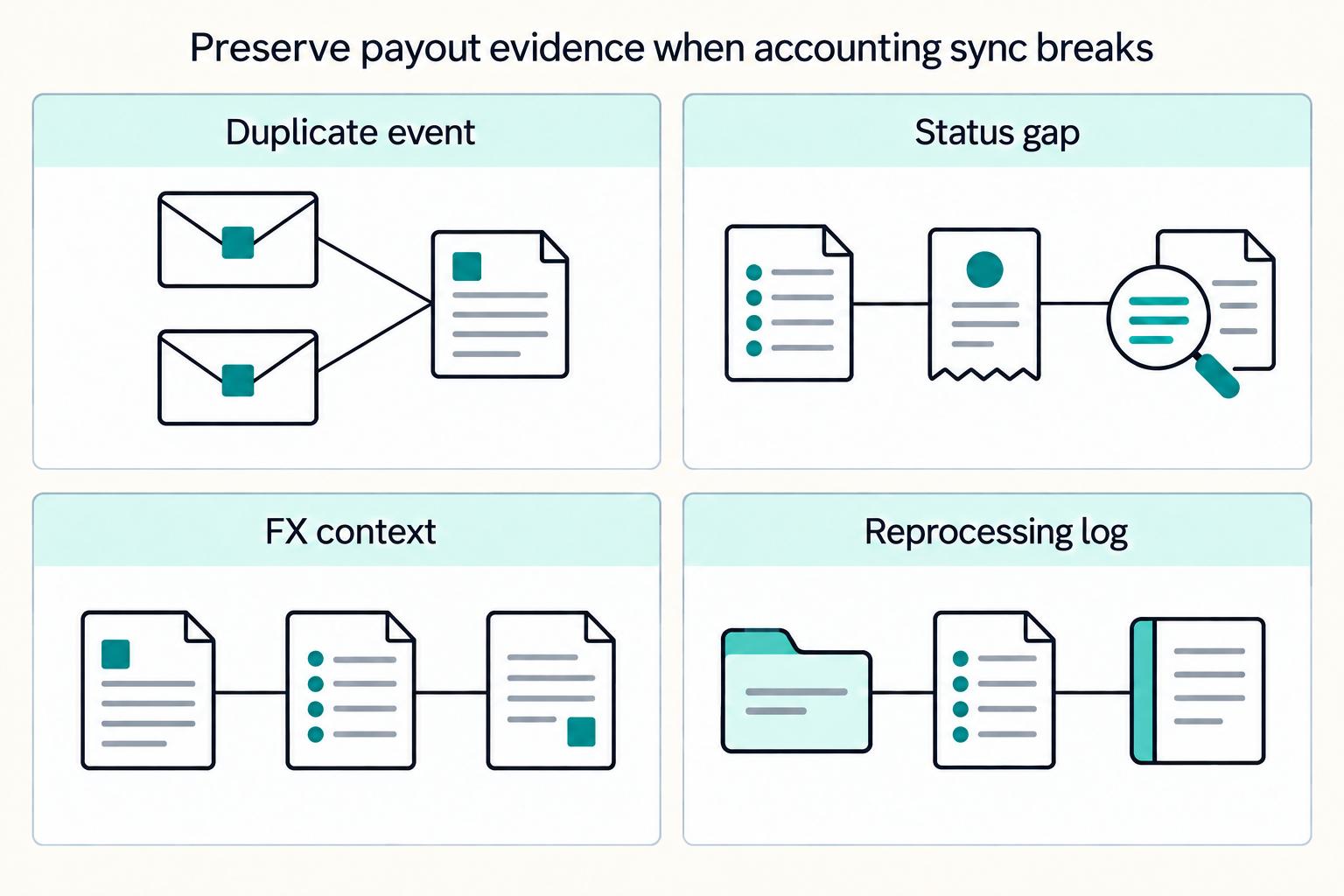
Capture a minimum event trail: request accepted time, provider acknowledgment time, each callback in order, internal status-change timestamps, ledger posting time, and the point finance can reconcile. A common failure mode is labeling a payout "paid" when the real state is still "instruction accepted" or "processing." Compare provider timestamps with your receipt times so late callbacks do not distort your speed view.
Use a cross-team handoff before country expansion#
Keep expansion auditable by requiring signoff across payments ops, finance, and product before moving a country out of pilot.
| Owner | Signoff areas |
|---|---|
| Payments ops | exception queues, escalation paths, and operational status taxonomy |
| Finance | ledger mapping, export fields, reconciliation checks, and returned-payment handling |
| Product | user-facing status language, SLA wording, and recorded launch decision |
If any owner cannot demonstrate their part of the chain, keep the market in pilot. This keeps speed claims aligned with operational truth.
This pairs well with our guide on Contractor NPS and Payout Reliability: What Moves Loyalty.
Conclusion#
The strongest move is usually narrower than your product map suggests. Sequence countries by verified payout evidence first, then expand coverage. That is what turns payout expansion from a sales claim into an operating decision you can defend.
A transparent index makes the evidence behind each confidence label visible. Product, finance and operations can then use the same observations to decide whether a market is ready, rather than relying on a coverage map or one unusually fast payment.
The practical checkpoint is simple: do not rank a country high unless you can trace at least one live corridor end to end. In practice, that means you can connect the internal request ID to the provider reference, follow status history, see the ledger posting, and verify final payout status. If finance cannot follow that chain without engineering stepping in, your confidence label should stay low no matter how broad your provider's coverage looks.
The main failure mode is expanding on surface availability. A provider may list a country while your intended payees, funding method or withdrawal route remain unsupported. Keep payment readiness and worker classification as separate launch checks: a fast payment does not establish the correct contractual relationship.
If you are making the first pass this week, keep it tight:
- Rank target countries by corridor, not country name alone.
- Add confidence labels such as verified, partially verified, and unknown.
- Run low-volume live tests on the top corridors before making public coverage claims.
- Scale only after your evidence pack and reconciliation path hold up under real payouts.
That is the real value of a country-by-country payout verification index. It gives you a disciplined way to decide where to launch now, where to launch with controls, and where to wait. Start with the countries you can prove, not the ones that look biggest on a map.
Frequently Asked Questions
Is there a true global contractor payout speed index by country available today?
Not as a settled industry standard you can treat as authoritative. Tools such as Remote's Contractor Payout Explorer help with discovery, but they focus on currencies, withdrawal options, and approximate payout times rather than audited time-to-funds.
What is the difference between payout speed and payout coverage?
Payout speed is the actual time until funds are visible and usable for the contractor. Payout coverage is broader availability data, including pay-in currencies, withdrawal options, and approximate payout times. A country can have solid coverage and still be a poor choice for fast or predictable payouts.
Why is API success time different from actual time-to-funds?
Because a successful API response usually means your request was accepted, not that the contractor's bank account already reflects the funds. That gap can appear when a payout is marked "successful" before funds are visible to the recipient. If you score countries using API timestamps alone, you will likely overstate speed.
Do real-time rails guarantee instant contractor access to funds?
No. A faster underlying rail can improve the path, but it does not by itself prove instant recipient access. You still need evidence showing when funds became visible to the contractor, not just when your provider or API returned success.
How do banking-hours cutoffs affect cross-border payout timelines?
Batch rails have processing windows and banking-day calendars. ACH supports same-day, next-day and two-day credit settlement; a cross-border provider may add funding, conversion or review time. SWIFT messaging does not establish one universal arrival window. Record the provider estimate, applicable cutoff and actual usable-funds timestamp for the selected route.
Should we prioritize countries with instant rails even if coverage is narrower?
Potentially, but only when your target users can actually use the available withdrawal path. Broad coverage with slow, opaque payout behavior can still create a poor payee experience, which is linked to lower engagement and higher support costs. If coverage is narrower, validate the faster route with a limited live cohort before wider rollout.
What minimum evidence should we collect before launching a new payout country?
Collect corridor-level live evidence, not only provider documentation. At minimum, verify the available payout coverage (currencies, withdrawal options, and approximate payout times), record when the API reported success, and confirm when funds were actually visible to the contractor. For ACH batch processing, use the applicable banking-day windows. For bank-mediated cross-border routes, record the provider’s estimate and actual recipient access rather than inferring arrival from a SWIFT message.
Try a related tool
Researched and edited by the Gruv editorial team. Gruv builds cross-border billing, payouts, and finance-operations software for global businesses.
Sources
Includes 4 external sources outside the trusted-domain allowlist.
Educational content only. Not legal, tax, or financial advice.
Related Posts
Global Contractor Payout Benchmarks by Country
Treat most country ranking pages as inputs, not answers. If you are evaluating **country-level contractor payout inputs**, the first mistake is assuming every page measures the same thing. Many do not.

Contractor Payout Speed Calculator by Rail and Country
If you treat payout speed like a front-end widget, you can overpromise. The real job is narrower and more useful: set realistic timing expectations, then turn them into product rules, contractor messaging, and internal controls that support, finance, and engineering can actually use.
Xero + Global Payouts: How to Sync International Contractor Payments into Your Accounting System
Treat this as a disbursement-sync problem, not a receivables setup task. Xero has clear ways to help customers pay invoices and, in some cases, to pay certain supplier bills. That is not the same as running outbound contractor payouts across countries, currencies, and payout methods end to end.