
Quick Answer
Cross-border payment compliance combines GDPR transfer duties, separate CCPA privacy and recipient duties, and KYC/AML controls for onboarding, holds, releases, and escalation. Map data flows and legal scope, confirm the applicable transfer safeguards or recipient terms, name hold and release owners, and retain appropriate evidence for each payout lifecycle step.
What Cross-Border Payment Compliance Covers#
Cross-border payment compliance is two linked jobs, not one checklist: privacy-transfer compliance and payment-control compliance. In the same payout flow, you may need to manage cross-border personal data transfer obligations under GDPR and separate privacy obligations under CCPA. You may also need to run KYC and AML controls that can affect onboarding, payment release, holds, and escalation.
First determine GDPR scope and whether the disclosure is a Chapter V transfer. The EDPB’s transfer guidance distinguishes an exporter subject to GDPR, disclosure to a separate controller or processor, and an importer in a third country or international organization. Geography alone is not the entire test. If Chapter V applies, use a covered adequacy route or an applicable safeguard or other lawful path; ordinary processing duties still apply.
CCPA has its own scope and disclosure rules; it is not an international-transfer permission system. Check whether the business and information are covered, the recipient’s actual role, and any applicable exemption. For a service provider or contractor relationship, use the required purpose and use restrictions. The current CPPA regulations include changes effective January 1, 2026; old 2020/2021 dates are not a complete current rule set.
On the payments side, AML and KYC stand on their own. FATF frames its Recommendations as an international standard that countries implement through local measures, so one market's control set may not be enough in another. In the U.S. banking context, 31 CFR 1020.220 requires a written, risk-based CIP as part of the AML compliance program. Do not assume that exact rule automatically applies to every non-bank payment platform without checking your actual regulatory setup. Before first live payout, confirm three basics:
- Where personal data leaves the EEA.
- What transfer basis supports that movement.
- Who owns KYC/AML hold and release decisions when payments are blocked.
Keep evidence early, not after an incident. Retain transfer-basis documentation and traceable records for identity checks, payout holds, releases, and escalation decisions.
This article stays at the operator layer: what to implement now, what evidence to keep, and what should trigger legal or compliance review. Because jurisdictions implement privacy and AML rules differently, use this as an operating framework and confirm market-specific requirements with counsel before launch.
For a broader operational view of cross-border rails, costs, compliance, and settlement speed, see Cross-Border Payments Guide for Platform Operators: Rails Costs Compliance and Speed Compared.
Start with a shared compliance vocabulary#
Shared terms are a control, not housekeeping. They determine what gets approved, documented, and escalated.
Under GDPR guidance, a transfer mechanism is the legal route used for transfers of personal data to a third country or an international organization. In practice, that is typically an adequacy decision or appropriate safeguards such as Standard Contractual Clauses (SCCs). It is not the same as saying a vendor is reputable or data is encrypted, and transfer conditions still sit alongside other GDPR obligations.
Separate localization from transfer safeguards. RBI’s payment-data storage direction and FAQ apply to authorized or approved payment-system providers and relevant payment-system data, not automatically every business record. The FAQ addresses overseas processing and a specific cross-border component exception; map the actual regulated provider, dataset and processing path before choosing storage controls.
Apply the same precision under CCPA. A service provider arrangement should map to a written contract with the business, and the business purpose should be specific rather than generic contract-wide language. If you cannot pull the written contract terms and the stated business purpose for a payout-related vendor, treat that arrangement as unverified.
Do not treat CCPA service-provider language as a GDPR transfer mechanism. Keep those terms separate, and your controls are easier to test.
For broader context, see A Guide to GDPR Compliance for SaaS Businesses.
Separate privacy-transfer risk from payment-flow risk#
Treat privacy-transfer legality and payment-flow controls as parallel reviews with shared escalation points. If you collapse them into one approval form, gaps on one side become harder to spot on the other.
| Track | Core decision | What to verify | Typical evidence |
|---|---|---|---|
| Privacy-transfer | Is the cross-border personal-data transfer lawful and correctly contracted? | Whether an adequacy decision applies, or appropriate safeguards such as Standard Contractual Clauses (SCCs) are in place; whether a CCPA service provider or contractor agreement exists when required | Executed SCCs, adequacy assessment record, signed service provider/contractor terms |
| Payment-operations | Should this party be onboarded, monitored, held, or paid? | Customer due diligence status, AML alert handling, monitoring coverage, and payout hold/release criteria under applicable jurisdiction and program rules | KYC file, CDD outcome, alert disposition records, payout decision logs |
| Shared escalation | Does one event change both legal and operational risk? | Whether the same case changes data access, transfer scope, and payout handling | Escalation log linked to the payout case |
On the privacy-transfer track, start with the GDPR route for non-EEA transfers: adequacy decision or appropriate safeguards such as SCCs. For SCC-based transfers, verify the applicable European Commission SCC documentation, including the modernised clauses issued on 4 June 2021. For CCPA-covered disclosures to service providers or contractors, verify the signed agreement for that disclosure. If you cannot name sender, receiver, destination country, and governing transfer document, treat the transfer path as unverified.
FATF Recommendations are standards implemented through local measures. Determine which regulated entity and national rules govern the flow, including required identity and payment information. FATF’s June 2025 Recommendation 16 revisions have an expected implementation horizon by the end of 2030; do not treat a revised global standard or threshold as already enforceable in every corridor.
Use shared escalation when either track changes the other. This matters most when:
- a new destination country, processor location, or access pattern changes transfer route or CCPA contract posture
- repeated AML alerts or holds, manual overrides, or unusual payout patterns appear in a corridor or counterparty segment
- an investigation needs broader data access than the original payout purpose
Signed transfer paperwork does not replace onboarding and monitoring controls, and a passed KYC check does not establish transfer-law compliance. Keep both tracks distinct, then bring them together at escalation.
Related: Cross-Border Payment Compliance Annual Update 2026: FATCA CRS DAC7 OECD Pillar Two.
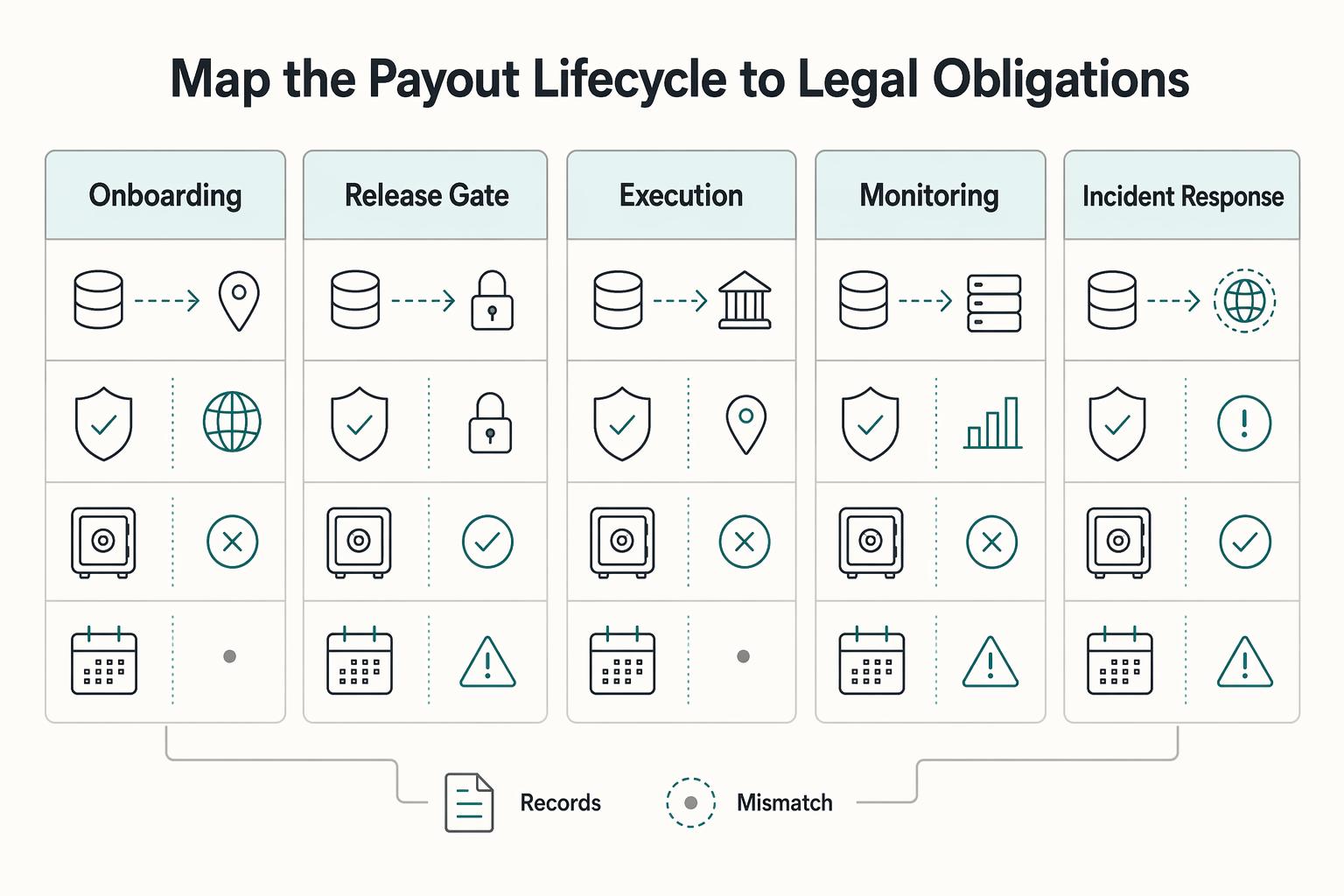
Map the payout lifecycle to legal obligations#
Once the two tracks are separate, map them to the same payout lifecycle. Each step should answer four questions: what data moved, which legal gate applied, whether funds were held, and when ops had to escalate to legal.
| Lifecycle step | GDPR and transfer control | CCPA control | KYC and AML control | Data path and escalation checkpoint |
|---|---|---|---|---|
| Onboarding | Determine whether a GDPR-subject exporter makes personal data available to a separate recipient in a third country or international organization. For an in-scope Chapter V transfer, confirm adequacy or appropriate safeguards and their effectiveness. | Determine CCPA scope and recipient role; execute required recipient terms where applicable. | Complete CDD/KYC before activation, including screening record, reviewed materials, risk outcome, and approver. | Record sender, receiver, destination country, processor location, and support-access location. If any field is unknown, onboarding is incomplete. If China-linked processing or access is in scope, escalate for PIPL Article 40 localization review before go-live, since localization constraints may apply. |
| Approval | Confirm effective transfer safeguards, correct SCC modules and any required assessment and supplementary measures. | Confirm the contracted party can support consumer-request handling in practice, not only in contract text. | Approve or reject based on CDD outcome and program risk rules. | Require legal review if a new country, processor, or access pattern appears between application and approval. |
| Execution | Limit transfers to data needed to create and settle the payout. If execution sends data outside the EU, log the exact transfer path. | Keep covered disclosures within the correct recipient role and permitted purposes. | Run execution-stage screening and release controls under your AML program. | Add a pre-release checkpoint: if processing shifts to a new region or a manual override follows an alert, hold payout, log reason, and escalate as required. |
| Monitoring | Recheck whether ongoing access, storage, or support changed the transfer route. | Maintain processes to receive and process California consumer requests tied to payout-flow data. | Perform ongoing due diligence and transaction scrutiny; escalate suspicious patterns for reporting analysis. | Repeated holds by corridor, counterparty type, or processor trigger joint transfer-scope and AML-control review. |
| Incident response | Start breach triage immediately; supervisory notification may be due within 72 hours of awareness, with a separate high-risk data-subject notification branch. | Route incidents so California request-handling duties remain operational during containment. | Preserve alert, account, and transaction history needed for suspicious-activity analysis and internal investigation. | Escalate from ops to legal immediately if the incident expands data access, introduces a new transfer route, or requires emergency cross-region sharing. For China-linked incidents, include localization and outbound-transfer analysis where applicable. |
Treat data movement as a release condition#
Do not rely on assumed geography at any payout stage. Treat transfer-path mapping as a release control: exporter, importer, destination country, processor, and support-access locations should be explicit in the case file. If you cannot name that path, transfer analysis is incomplete.
Use three hard checkpoints#
In practice, three checkpoints do most of the work here.
- When data leaves a region
Log a new processor, storage region, support-access location or destination. Determine whether it changes a Chapter V transfer, ordinary GDPR processing risk, CCPA recipient role or a local storage requirement. A separate overseas processor may introduce a transfer even if production storage stays in-region; employee access and other patterns require their own analysis.
- When a payout is held
A hold can change data access and review footprint, not just payout timing. Capture hold reason, reviewer, review region, and release or rejection decision.
- When ops must escalate to legal
Escalate for new-country exposure, new personal-data sharing patterns, breach events, or China-linked processing that raises PIPL Article 40 localization concerns. Also escalate when repeated overrides or suspicious-activity reviews require broader access than the original payout purpose.
Keep evidence attached to the lifecycle step#
Cross-border controls are harder to operate when transfer records, contracts, and AML evidence live in separate systems. Keep evidence at the decision step. Store transfer mechanism and contract records at onboarding and approval, the CDD file at onboarding, hold and release logs at execution, alert dispositions at monitoring, and the breach timeline at incident response. If one held payout case cannot answer where data started, where it moved, what covered that move, and who approved the outcome, the map is not operational.
Choose the transfer path before covered personal data moves#
Do not wait for volume to force the decision. For EEA personal data, confirm early whether an adequacy decision applies or whether you need SCCs or another GDPR safeguard for a third-country transfer.
| Transfer path | Use it when | Verify before the covered transfer |
|---|---|---|
| Adequacy decision | Personal data moves from the EEA to a destination covered by an EU adequacy decision | Confirm the destination and recipient match the adequacy path, and record exporter, importer, country, and processing/support-access locations in the case file. |
| SCCs | No adequacy decision applies and you are using contractual safeguards for an EEA-to-third-country transfer | Applicable signed module and annexes, destination-law/practice assessment and effective supplementary measures |
| Hold and escalate | You cannot confirm adequacy, safeguards, or the actual transfer path | Pause rollout, keep that corridor or vendor out of production, and escalate to counsel before routing more personal data through that route. |
GDPR Chapter V (Articles 44 to 50) governs international transfers, so an approval packet that says only "EU data may be processed abroad" may still be a placeholder rather than a transfer decision.
Match the legal path to the contract set#
Map each entity’s actual role and select the appropriate contractual modules and documents. With SCCs, assess relevant destination-country law and practice and whether supplementary measures can make the safeguards effective; signatures and completed annexes alone are not the full assessment. If protection cannot be ensured, do not proceed on that route. Adequacy also has defined destination and recipient scope.
For CCPA exposure, service provider and contractor terms are operational controls too, with separate obligations and contract limits on reuse or disclosure outside the direct business relationship. Those terms do not replace GDPR transfer documentation. In many flows, you may need both.
Open one vendor file and compare each named exporter, importer, processor and subprocessor with its actual role. These may be different legal entities; the documents must correctly identify their respective roles and onward transfers, rather than merely repeat one entity name across every agreement.
Pause expansion when paperwork lags volume#
Incomplete required transfer documentation is a blocker before that transfer starts, not just a reason to pause growth. Stop new use of the affected route and assess existing processing with privacy counsel, while preserving the records needed for remediation. Escalate when any of these are true:
- The destination country or transfer mechanism is unclear.
- The vendor file has CCPA service-provider language but no valid GDPR transfer basis for the same flow.
- The operating model changes data access, review, or retention beyond current contract terms.
- The jurisdiction raises local restrictions or localization questions that adequacy or SCCs alone do not resolve.
Adequacy decisions and SCCs are transfer tools, not blanket approval for every market or operating model. If country setup, processor structure, or review model is unusual, get legal review before adding more volume to that route.
Design for data localization without breaking payouts#
A valid transfer mechanism is not enough on its own. You can satisfy GDPR transfer requirements and still run into local storage or access limits in some jurisdictions. Before adding volume, test your actual payout architecture against data localization requirements.
Start with a concrete map: where payout data is stored, where it is processed, and who can access it from outside the market. That map matters because localization measures can still impede transborder data flows even when your Chapter V transfer path is documented.
Map the real data footprint#
Do not rely on high-level vendor claims like "hosted globally" or "processed regionally." For one live payout flow, record the actual path for onboarding data, payout instructions, fraud review notes, support tickets, logs, and backups.
| Element | What to document | Verification check |
|---|---|---|
| Storage | Primary region, backup region, and any market-specific storage location for payout records and logs | Compare contract terms, product settings, and admin-console region configuration |
| Processing | Where sanctions review, fraud screening, reconciliation, and support handling occur in practice | Confirm whether batch jobs, analytics, or support tools move personal data outside the intended region |
| Access | Which teams, subprocessors, and support staff can view or retrieve records from another country | Test one real access path, including emergency support access |
Watch for side channels. Even if production records are in-region, logs, alerts, or manual review queues may still replicate abroad and create similar compliance risk.
Minimize what leaves the market#
Use data minimization as a default control. GDPR requires data to be limited to what is necessary, and CCPA regulations apply a reasonably necessary and proportionate standard to collection, use, retention, and sharing.
For payout events and logs, keep only the fields needed for settlement, reconciliation, fraud review, or legal retention. Prefer tokenized identifiers, masked account data, and short reason codes, with full-record retrieval reserved for narrower investigation paths.
A practical check is to sample recent event payloads and log entries and challenge each personal-data field. If the only justification is "might be useful later," remove it or gate it behind tighter access.
When localization blocks the preferred vendor flow#
Treat GDPR transfer documentation and CCPA service-provider or contractor terms as related but different controls. CCPA does not directly govern international transfer mechanisms, and those contracts do not resolve jurisdictions that require local storage or local handling.
PIPL Article 40 applies domestic storage duties to critical information infrastructure operators and handlers meeting prescribed volume criteria for personal information collected and generated in China. China-linked processing therefore requires a scoped review of handler status, data and applicable outbound-transfer rules; the country connection alone does not establish that every record must be localized.
If localization blocks the preferred stack, practical options often include:
- Split processing by region for affected markets.
- Roll out market by market where architecture and contracts are already supportable.
When localization constraints are unresolved, a narrower staged model may be easier to implement and govern than forcing one global stack.
Set the minimum control set before entering a new market#
Before live release, identify applicable privacy, transfer, localization and payment requirements and retain the evidence that each is satisfied. Require a transfer mechanism when Chapter V applies, the correct recipient contracts where required, and actual onboarding and release controls under your regulated entity or partner program. Avoid imposing SCCs or CCPA service-provider terms on every flow regardless of scope.
This gate should stay narrow. Teams usually get into trouble when they treat market entry as a contract-filing exercise or overbuild controls that do not reduce first-month risk. The practical test is whether one real payout flow is lawful, reviewed, and controllable.
The launch gate should fit on one page#
Keep the launch gate short and evidence-based. If one item is missing, hold launch.
| Control area | What must be true before go live | What to verify |
|---|---|---|
| Transfer mechanism | For an in-scope Chapter V transfer, conditions are identified and matched to the actual exporter, separate recipient, and destination | Confirm whether the path relies on adequacy decisions under GDPR Article 45 or appropriate safeguards under Article 46, such as Standard Contractual Clauses (SCCs) |
| Service provider arrangements | For covered CCPA disclosures, recipient role is identified and contracts contain the terms required for that role | Read operative clauses and confirm retention, use, and disclosure are limited to allowed purposes |
| KYC/AML policy gates | Policy defines when payouts are held or released based on onboarding and screening outcomes | Use controlled test cases before live release, then monitor approved production behavior. |
| Operational traceability | Alerts, exceptions, and approvals are attributable to named owners and can be reconstructed later | Pull one completed case and verify timestamps, reviewer identity, reason for decision, and final disposition |
The transfer basis is the key lever. GDPR requires Chapter V conditions before transfer, so you should be able to point to the selected path for each EU export: adequacy where available, or Article 46 safeguards where it is not.
Contracts and privacy terms are necessary, but not enough#
Signed paperwork alone does not close the risk. CCPA service provider arrangements must be specific about business purposes and must restrict retaining, using, or disclosing personal information outside allowed scope. Those terms are necessary, but they do not replace GDPR transfer documentation.
Use one concrete verification step for a vendor in onboarding, fraud review, support, or payout processing. Confirm that the contract entity matches the operating entity, the relevant data types are covered, and the contract posture aligns with your transfer path.
Require evidence that operational gates are real#
Do not accept "we monitor alerts" without proof. Before first live payout, verify that alerts are handled, exceptions have owners, and approval history is traceable. You should be able to retrieve a case showing what triggered review, who reviewed it, whether payout was held or released, and why.
In an MSB context, the baseline is an effective written AML program with policies, procedures, and internal controls. That does not require one approval-chain design, but it does require that KYC/AML gates exist beyond tribal knowledge or ticket comments.
Test representative approved, held and failure cases before expansion. Before the first live payment, use controlled test evidence to verify required controls, rather than requiring a previous live payout to establish readiness. Where SAR reporting applies, the responsible regulated entity retains protected records under its rule; these do not belong in a general support export.
Be explicit about what is not in scope yet#
List controls you are intentionally deferring so their absence is not mistaken for oversight. Common examples include:
- market-wide automation for low-volume manual-review categories
- expansion to additional seller types with different risk profiles
- extra analytics fields or support-tool integrations that increase data movement without changing launch risk
- Optional country-specific features only after required legal and release controls are already satisfied.
Launch when you can show, for one live cohort, a lawful transfer path, contract terms that match data use, and working KYC/AML gates with named owners and traceable decisions. If any artifact is missing, stop before first payout.
Before launch, align your control checklist to an implementation surface your ops and engineering teams can verify in one place: Review Gruv docs.
Assign owners and escalation triggers across teams#
Ownership needs to follow the risk type, and escalation triggers need to be defined before the first exception. That is what gives each payout case a clear, traceable decision trail across legal, compliance, and operations.
A workable split is this: legal and privacy interpret GDPR and CCPA duties, compliance and risk run day-to-day AML controls and monitoring, and finance and payments ops close reconciliation and incident outcomes. This is an operating model, not a universal legal requirement, but it matches what each function should be able to evidence.
| Team | Owner scope | What they should be able to produce |
|---|---|---|
| Legal and privacy | Transfer-rule interpretation, consumer-rights handling, regulator-facing position | Transfer basis for each flow (Article 45 adequacy or Article 46 safeguards such as SCCs), and rationale for exceptions |
| Compliance and risk | Day-to-day AML coordination, monitoring, and escalation | Screening outcomes, alert dispositions, hold/release decisions, and named ownership for ongoing monitoring |
| Finance and payments ops | Reconciliation, payout status control, incident closure | Ledger impact, release/reversal status, closure notes, and proof the operational outcome matches the approved decision |
Keep controller accountability explicit and record applicable request deadlines by request type. Under the current CCPA regulations, specified requests such as deletion, correction and access/know requests generally require acknowledgement within 10 business days and response within 45 calendar days, with a permitted extension under stated conditions. Opt-out requests use a different deadline; do not apply the 45-day clock to every request.
Define the triggers before the first real exception#
Write escalation triggers before launch and make them visible to ops. Typical triggers include:
- transfer documentation is missing, inconsistent, or no longer matches the live entity or vendor flow
- repeated AML monitoring alerts or payout holds on the same corridor, seller type, or rule set without operational resolution
- a data access, deletion, or correction request cannot be fulfilled from current records
- regulator-facing, law-enforcement, or formal complaint requests arrive
- a suspected personal-data breach affects payout records or support tooling
When a transfer path is approved, verify that the contracting entity, operating entity, and actual data recipient match in practice.
Keep one escalation log per payout case#
Use one case-linked escalation log even if execution spans Jira, ticketing, and monitoring systems. This is an operational control choice, but it is usually the cleanest way to preserve traceability when multiple teams touch one event.
Capture case ID, payout ID, jurisdiction, owner, trigger, applicable transfer basis, permitted hold or release status, timestamps and disposition. Maintain breach assessment and notification decisions in the restricted incident record. Keep SARs and information revealing their existence in the regulated entity’s protected reporting workflow; a general support or finance case should contain only the operational information its users may lawfully access.
Centralized first, then local where complexity warrants it#
For small launches, centralized approvals can improve consistency and help early control fixes. As jurisdiction-specific differences become material, market-level approvals can become more defensible, with central oversight to keep standards aligned.
Use the structure that matches your risk complexity. Centralization can improve efficiency and cross-jurisdiction coverage, but it can also bottleneck local nuance if one queue owns everything.
For a step-by-step walkthrough, see Cross-Border Freelancer Risk Mitigation Through Structure and Compliance.
Build an audit evidence pack that survives review#
Build one standard evidence pack per payout program, corridor, or escalated case so a reviewer can quickly verify the transfer basis, the payout decision path, and the final money movement.
If a reviewer has to infer which entity signed what, or whether a held payout was released or reversed, the pack can fail review even when the underlying decision was reasonable.
Start with the transfer basis and contract posture#
Retain the actual transfer path: applicable adequacy scope, SCC module and completed annexes plus assessment and supplementary measures, or another supported Chapter V route. Record the parties and onward transfers. Keep the underlying processing basis and processor contract duties separate from the transfer mechanism.
Then include the executed CCPA service provider or contractor agreement where relevant. Treat this as a separate requirement. A CCPA contract does not replace GDPR transfer documentation.
| Evidence lane | What to include | What to verify |
|---|---|---|
| Privacy transfer basis | Applicable mechanism, entities, assessment and supplementary measures | Entity names match the live processor, country path matches the actual flow, contract version is final |
| Payment operations | KYC/CIP identity-verification outcome, beneficial-owner checks where relevant, AML alert disposition, payout hold/release history | Case IDs and payout IDs align across systems, and recorded decisions match the documented payout outcome |
| Other reporting obligations | Applicable separate tax/account-reporting file; restricted financial-crime reports kept separately | Do not include SAR existence or contents in general audit/support exports |
Add the artifacts that explain the payout decision#
Include evidence showing how the payment decision was reached, not just the final status. Keep identity-verification evidence for KYC/CIP, and beneficial-owner identification and verification records where those rules apply.
Keep alert review and payment disposition attributable, but separate general operating evidence from protected reporting records. For banks subject to 31 CFR 1020.320, SAR filing generally follows a 30-calendar-day detection window, with up to 30 additional days if no suspect is identified; SAR copies and supporting records are retained for five years from filing. Apply the rule for the actual regulated entity. SARs and information revealing their existence are confidential and shared only as authorized.
Keep U.S. tax reporting separate from privacy evidence#
For U.S.-linked programs, keep FBAR, FinCEN, FATCA, and Form 8938 materials in a separate tax-reporting lane from SCCs and service-provider agreements.
Assess foreign-account and asset reporting separately for the actual person or entity. FBAR is filed with FinCEN; Form 8938 does not replace it. The FBAR test generally includes a US person’s financial interest or signature authority and aggregate covered foreign accounts exceeding USD 10,000 at any time in the year; the due date is April 15 with automatic extension to October 15. These are account-reporting tests, not requirements triggered simply by sending a cross-border payout.
Check the pack before each quarterly review#
Before each quarterly compliance review, run a short evidence QA check. This is an operating control, not a stated legal requirement. Check three items every cycle:
- Completeness: transfer basis is present, service-provider arrangement is executed where relevant, payout decision log is attached, and the case links to KYC/CIP and AML records.
- Retention: records are stored under the correct policy, and SAR-related documentation follows the applicable retention rule.
- Retrieval speed: a reviewer can retrieve the full file within a reasonable time.
Pressure-test retrieval with one approved payout, one held payout, and one escalated case. If legal basis, disposition, and money-movement proof are hard to retrieve, fix indexing before scale increases.
Related reading: How Graphic Designers Protect Cross-Border Payments and Cash Flow.
Avoid the failure patterns that create regulatory surprises#
Regulatory surprises can come from mixing separate obligations or launching before controls are stable. These are the failure modes worth guarding against early.
Do not swap CCPA contract language for GDPR transfer coverage#
CCPA service-provider or contractor terms do not replace GDPR transfer requirements. For EU personal data sent to a third country, your transfer basis must still hold under GDPR Chapter V (Articles 44-50), including an adequacy decision where available or appropriate safeguards such as SCCs.
Before launch, verify that signed entity names, recipient, and country path in your adequacy or SCC record match the processor actually handling payout data. If those records point to the wrong entity or route, you can still have a transfer-compliance gap even when the commercial contract is complete.
Do not launch payouts on untuned monitoring#
KYC and AML controls are ongoing, not a one-time onboarding step. The baseline expectation is customer due diligence, ongoing monitoring, and investigation or reporting of unusual or suspicious transactions. In U.S. banking supervision, SAR filing is a formal required control.
Run a pilot cohort before full rollout and check whether alert handling and reviewer dispositions align with actual money movement, including holds, releases, and reversals. Repeated manual overrides without clear documented disposition can signal that monitoring is not yet stable.
Treat data localization requirements as an architecture input#
Treat applicable localization as a design input rather than relying on a global measure count. Identify the covered provider and data, storage and deletion requirements, and permitted cross-border exceptions before configuring backups or support access.
Map where payout data is stored, processed, and accessed, including vendor support access. If localization requirements conflict with your current setup, scope a regional processing design or delay entry until controls are workable. Late discovery can increase compliance burden and fragment operations.
Clear ownership helps reduce surprises: legal for GDPR, CCPA, and localization interpretation, compliance for KYC/AML execution, and operations and finance for reconciliation and closure. If a high-risk exception has no named owner or escalation deadline, treat it as unresolved risk.
Roll out in phases and verify before each expansion step#
A phased rollout can help keep controls stable while you scale. Lock the transfer path first, expand only when control evidence is repeatable, and revalidate each cohort before go-live.
Phase 1 starts with one corridor and one documented transfer decision#
Choose one corridor and document applicable requirements before the first covered transfer or live payment. Confirm the actual entities and recipient roles; use a sandbox or synthetic data while required approvals or transfer conditions are unresolved.
Verify that required safeguards and contracts are effective before the affected data flow begins. Expansion review then checks new processors, support locations, recipient types and required controls instead of treating the initial approval as permission for every later route.
Phase 2 is an internal gate, not a victory lap#
Treat Phase 2 as an internal governance gate, not a legal entitlement to launch. This gate is not a statutory requirement under GDPR, CCPA, or FATF, but it helps confirm the pilot can be repeated without control drift.
Review more than document presence. GDPR calls for regularly testing, assessing, and evaluating technical and organizational security measures, so use this phase to check control effectiveness and close or formally track unresolved escalations against your pre-agreed criteria.
Phase 3 expands in cohorts and revalidates assumptions each time#
Expand in small cohorts and revalidate privacy and monitoring assumptions each time. FATF's risk-based approach and ongoing implementation assessment support recurring checks as corridor risk and transaction patterns change.
For California exposure, keep governance checkpoints current with regulatory updates. CPPA lists completed regulation packages, including a package in September 2025, and states specified regulations became effective on January 1, 2026.
Keep a standing change log or your controls will age out#
Maintain a standing change log for regulatory updates, contract amendments, vendor-routing changes, and transfer-mechanism revisions. The log should show what changed, who reviewed it, and whether reapproval was required.
Use one trigger consistently: if a new market changes the data route, legal basis, or AML risk profile, treat it as a revalidation event rather than a copy-paste launch.
Conclusion#
The most defensible approach is operational: run transfer-law controls and payment controls as separate tracks, then connect them through clear senior ownership, escalation, and retrievable evidence.
That separation reflects different duties. GDPR Chapter V requires transfer conditions to be met for third-country transfers. AML/CFT controls follow a separate FATF risk-based approach focused on identifying and prioritizing financial-crime risk. CCPA adds contract discipline for service-provider processing on behalf of a business under a written contract. When teams merge these into one generic checklist, gaps get easier to miss.
Before scaling, run a concrete check on one corridor, one receiving-entity type, and one live or pilot payout path. Confirm you can show the transfer map, the documented transfer basis, the CCPA contract posture when California data is in scope, and payment-side records showing key control decisions and escalations. If any artifact is missing, incomplete, or ownerless, treat that as a control gap.
Accountability requires more than policy text: you must be able to demonstrate compliance. For CCPA-linked operations, consumer-request records and response handling must be retained for at least 24 months, so your review should confirm those records are retrievable.
Use this as the immediate next step:
- Map actual transfers first using the EDPB "know your transfers" sequence.
- Verify transfer mechanism and contract terms against the real payout path.
- Test one end-to-end evidence file, including decision history and alert disposition.
- Log missing artifacts, unclear ownership, and route-change triggers before increasing volume.
This structure can reduce surprises without overbuilding controls your team cannot maintain. If you need to validate market-by-market payout controls and escalation coverage before expansion, talk with Gruv.
Frequently Asked Questions
What does cross-border payment compliance mean under GDPR and CCPA in practical terms?
For an in-scope flow, analyze ordinary privacy duties, international-transfer conditions and payment controls separately. GDPR Chapter V applies when its transfer criteria are met; CCPA recipient obligations depend on covered information and actual role. A service-provider contract does not substitute for an applicable GDPR transfer mechanism.
Do SCCs and CCPA service-provider terms both apply to the same payout flow?
They can apply together when both laws and recipient roles are in scope, but neither document is automatically required for every payout. SCCs are one GDPR safeguard; CCPA service-provider or contractor terms restrict the recipient’s use of covered information. Record the scope and reason for each requirement.
What is the minimum control set before launching payouts in a new market?
Identify the legal and regulated entities, required provider approval, applicable privacy and transfer scope, recipient contracts, localization, onboarding and release checks, and recoverable payout states. Test a representative control path before live release. Required safeguards cannot wait for a higher-volume pilot.
How should legal, compliance, finance, and payments ops split responsibilities?
No regulation in this set mandates one fixed org chart. One workable split is legal on GDPR Chapter V and CCPA contract posture, compliance on AML/CIP execution, finance on reconciliation, and payments ops on daily case handling. Keep clear handoff records showing who escalated and what changed.
What events should trigger immediate escalation to legal counsel?
A practical immediate-escalation set includes route changes, missing or inconsistent transfer documentation, signs that vendor use may exceed agreed contractual purposes, or suspected personal-data breaches. For GDPR-scoped incidents, notification timing can be as short as 72 hours after awareness where notification is required. Escalate suspicious activity cases through the regulated entity or banking partner as well, since filing timelines can be strict, for example, 30 calendar days for FDIC-supervised institutions from initial detection.
What evidence should we retain for an audit-ready cross-border payout program?
Retain the applicable transfer mechanism and assessment, recipient and processor contracts, release decisions, status history and change approvals under a defined retention and access policy. Keep restricted reporting records such as SARs in their authorized workflow; ordinary audit retrieval does not permit unrestricted disclosure of them.
How do data localization requirements change architecture and vendor choices?
Map covered data, regulated provider, storage, processing, backups and support access. RBI’s direction is a payment-system rule with scope and FAQ qualifications, not a universal India-business-data mandate. Use the applicable storage and outbound-transfer rules to choose vendors and architecture before the affected flow begins.
Try a related tool
Researched and edited by the Gruv editorial team. Gruv builds cross-border billing, payouts, and finance-operations software for global businesses.
Sources
- commission.europa.eu/law/law-topic/data-protection/international-...trusted
- cppa.ca.gov/regulations/pdf/ccpa_statute_eff_20260101.pdftrusted
- cppa.ca.gov/faqtrusted
- ecfr.gov/current/title-31/subtitle-B/chapter-X/part-1...trusted
- ecfr.gov/current/title-31/subtitle-B/chapter-X/part-1...trusted
- edpb.europa.eu/documents/guideline/guidelines-052021-on-the...trusted
- edpb.europa.eu/documents/recommendation/recommendations-012...trusted
- en.npc.gov.cn.cdurl.cn/2021-12/29/c_694559_2.htmtrusted
Educational content only. Not legal, tax, or financial advice.
Related Posts

The Freelance Payment Penalty: A Modeled Audit of Platform Fees, FX Spreads, and Payout Delays
The money rarely disappears through a single, easy-to-spot fee. The real loss is stacked. A marketplace takes its commission, a processor adds a charge for international cards, a bank or payment company converts the currency at a spread, a platform holds the funds before release, and a wire sheds a little to intermediaries on the way in. Each layer looks defensible on its own, but the worker feels the combined result as a smaller deposit and a later payday.

How to Respond to a Subpoena for Business Records
Move fast, but do not produce records on instinct. If you need to **respond to a subpoena for business records**, your immediate job is to control deadlines, preserve records, and make any later production defensible.

A US Expat's Guide to Investing in UCITS ETFs to Avoid PFIC Issues
The real problem is a two-system conflict. U.S. tax treatment can punish the wrong fund choice, while local product-access constraints can block the funds you want to buy in the first place. For **us expat ucits etfs**, the practical question is not "Which product is best?" It is "What can I access, report, and keep doing every year without guessing?" Use this four-part filter before any trade: