
Quick Answer
Cross-border freelancers reduce risk by building around three layers: a maintainable legal entity, a compliant invoicing and payment process, and a personal tax and residency tracker. Start by separating business and personal funds, verifying where the entity must register and how it is taxed, and keeping invoices, VAT checks, contracts, payment records, travel days, and foreign-account details organized and current.
Treat your entity choice as a risk decision#
Treat your entity choice as a risk decision, not admin cleanup. It affects personal liability exposure, tax and filing posture, day-to-day operations, and how cleanly you can run payment operations.
Use this lens throughout the article: liability separation, tax and compliance fit, and operational practicality across the jurisdictions that matter to you. When your setup is off, problems usually show up under pressure, such as debt exposure, filing friction, or payment flow issues.
Two early red flags are easy to spot. First, if you operate as a sole proprietorship, there is no separate legal entity between you and the business, so business debts and obligations can attach to you personally. Second, if business money is still mixing with personal money, fix it now by using a business bank account once you start accepting or spending business funds.
This blueprint has three layers. Foundation is your entity choice. Operations Engine is your invoicing and payment compliance. Personal Shield is your residency and cross-border tax exposure that can still follow you personally.
Before you compare entity types, run this quick self-check. If you cannot answer these clearly, pause before choosing or changing structure.
- Where do you actually live and work most of the year?
- Where are your clients established?
- For cross-border services, where relevant, have you mapped how client location affects VAT treatment in your cases?
- Is business income and spend flowing through a business bank account?
- If you are a U.S. citizen or resident alien, are you planning around worldwide income reporting obligations?
- Are you near local residency thresholds that can change tax treatment, for example 183 days or more in the UK tax year?
- If you are considering an LLC, have you checked the specific state rules and election timing constraints, including the 75 days prior and 12 months after filing window?
- Will your growth plans change your filing burden, funding needs, or structure requirements?
Related: A freelance IT consultant's guide to 'Business Interruption' insurance.
The Foundation: Your Legal Entity#
Choose the entity you can actually maintain correctly. Structure sets your liability boundary, tax treatment path, and compliance workload.
What the corporate veil actually does for you#
A separate entity is meant to separate company obligations from your personal assets. But that boundary is not automatic or universal. In practice, outcomes depend on the facts, the jurisdiction, and whether you followed required entity formalities, including registration where required.
Why sole proprietorship is often the weaker starting point#
A sole proprietorship does not create the same liability separation an LLC is designed to provide. That can stop being theoretical fast when disputes, unpaid obligations, or compliance problems show up.
A weaker starting structure can also create legal and financial drag early, especially as operations grow.
Decision table#
| Option | Best-fit use case | Reader outcome | Operational friction | Common setup mistake to avoid |
|---|---|---|---|---|
| Sole proprietorship | Solo activity where you are not using an LLC or LLP structure | No LLC/LLP liability structure in place | Varies by jurisdiction | Assuming this setup provides LLC-style liability separation |
| Single-member LLC | Solo business that wants a separate legal structure | LLC can have one member, and members have limited liability for company obligations | Varies by jurisdiction | Assuming liability structure automatically answers tax treatment in every jurisdiction |
| Multi-member LLC | Two or more owners using an LLC structure | Same LLC liability design with shared ownership | Varies by jurisdiction | Not confirming jurisdiction-specific compliance and governance requirements |
| LLP | Professional services where LLP use is authorized | Registered partnership form for authorized professional services | Varies by jurisdiction and profession | Using an LLP without confirming authorization for your profession and location |
Choose your base in this order#
Start with the liability and ownership model you need. Then confirm where the entity must register and how that jurisdiction classifies it for tax purposes. Finally, verify the compliance and governance requirements you will need to maintain as the business grows.
Once you have a likely home base, verify the local rules before you act. For example, in New York, domestic LLCs and LLPs must register with the Department of State, and foreign LLCs and LLPs must also register to conduct business there. New York tax treatment conforms to federal entity classification.
If a single-member LLC is disregarded federally, New York also treats it as disregarded. When the owner is an individual, New York treats it as a sole proprietorship for state tax purposes.
Verification checklist#
Before you finalize your setup, verify each point in writing:
- Confirm where the entity must register before operating.
- Confirm how that jurisdiction classifies your entity for tax purposes.
- Confirm jurisdiction-specific compliance and governance requirements before taking action.
- If you are considering an LLP, confirm authorization rules for your profession and location.
- Record the applicable local requirements in writing before you file or operate.
If you cannot verify these items, stop and resolve them first. A workable structure that you can support on paper is better than a more ambitious one you cannot maintain.
If you want a deeper dive, read How to Choose the Right Business Structure for Your Freelance Business.
The Operations Engine: Getting Paid Compliantly Across Borders#
Once your entity is in place, your payment process has to support it in practice. If your invoice identity, receiving account, and records drift apart, you can create avoidable payment delays, bookkeeping problems, and a weaker separation story.
Run a before-send invoice check#
For cross-border B2B work, invoicing is a compliance control, not just billing. In the EU context, Article 226 includes the customer VAT identification number as a required invoice detail. Reverse-charge treatment can also depend on both customer status and invoice wording.
| Check | What to confirm | Support |
|---|---|---|
| Customer identity | Match legal name, address, and VAT identification number to the contract or purchase order | Contract or purchase order |
| VIES validation | VIES returns a valid or invalid result; if invalid appears, pause and request confirmation or registry evidence | VIES result or registry evidence |
| Customer VAT ID | Include the customer VAT ID on the invoice when treatment depends on customer VAT status | Invoice |
| Reverse-charge wording | Confirm the exact wording against local tax guidance or source records before using it | Current reverse-charge wording pending local tax/source-record verification |
| Tax line and total | Confirm they match the verified rule being applied | Invoice tax line and total |
| Support file | Store the invoice, VAT check result, contract or SOW, and payment record in electronic form | Electronic support file |
Use this check before sending an invoice that may rely on reverse charge:
- Confirm customer identity. Match legal name, address, and VAT identification number to the contract or purchase order.
- Validate VAT number in VIES. VIES returns a valid or invalid result, but updates can lag national databases. If invalid appears, pause and request confirmation or registry evidence.
- Include the customer VAT ID on the invoice. Do not omit it when treatment depends on customer VAT status.
- Reverse-charge wording requires local verification. Wording is context-sensitive and not universal. Confirm the exact invoice wording from local tax guidance or source records before use.
- Recheck tax line and invoice total. Confirm they match the verified rule being applied.
- Save the support file together. Store the invoice, VAT check result, contract or SOW, and payment record in electronic form.
If AP asks you to send now and fix VAT later, slow down. In contexts like UK domestic reverse charge for construction, status checks can also depend on VAT registration, CIS status, and end-user determination. Local rule checks come first.
Choose the stack that matches your evidence needs#
The right payment stack is usually the simplest one that keeps business identity and money flow consistent.
| Stack layer | Best use | Compliance fit | Operational friction | Audit trail strength |
|---|---|---|---|---|
| Dedicated business bank account | Main operating account in your entity's legal name | Strong for keeping business and personal funds separate | Moderate at setup, lower once live | Strong when all client receipts and business payments run through it |
| Multi-currency business account | Receive and hold client currencies before conversion or transfer | Good when opened and operated in entity name | Moderate, provider and currency features vary | Good when statements show incoming currency, conversion, and outbound transfer |
| Invoicing or payment tool | Invoicing, card acceptance, payout handling | Useful when profile, invoice identity, and payout account all match entity identity | Varies by provider rules, fees, and payout timing | Strong when invoice record, payment event, fees, and expected deposit date are visible |
Use a simple rule. If a tool cannot clearly operate in your entity's name and pay out to an entity-name account, treat it as unfit until you verify it.
Separate funds like you expect to defend it#
Commingling can weaken an otherwise decent setup fast. IRS guidance says to keep business and personal accounts separate, and U.S. small-business guidance ties that separation to limited personal liability protection. Separation is not an automatic shield, but mixing funds makes your position harder to defend.
Run a monthly separation protocol:
- Use only accounts opened in the entity's exact legal name for client receipts.
- Route processor payouts to an entity-name account only.
- Pay yourself through one consistent owner-pay method your books can classify correctly.
- Pull together records monthly: issued invoices, payout reports, bank statements, FX conversions, and any refunds or adjustments.
Keep records in electronic form if they are preserved properly. IRS guidance expects supporting documents such as invoices, receipts, deposit slips, and canceled checks. For retention, apply the strictest rule that covers your case. IRS baseline is 3 years in standard situations, and HMRC guidance says VAT invoices should be preserved for 6 years from issue.
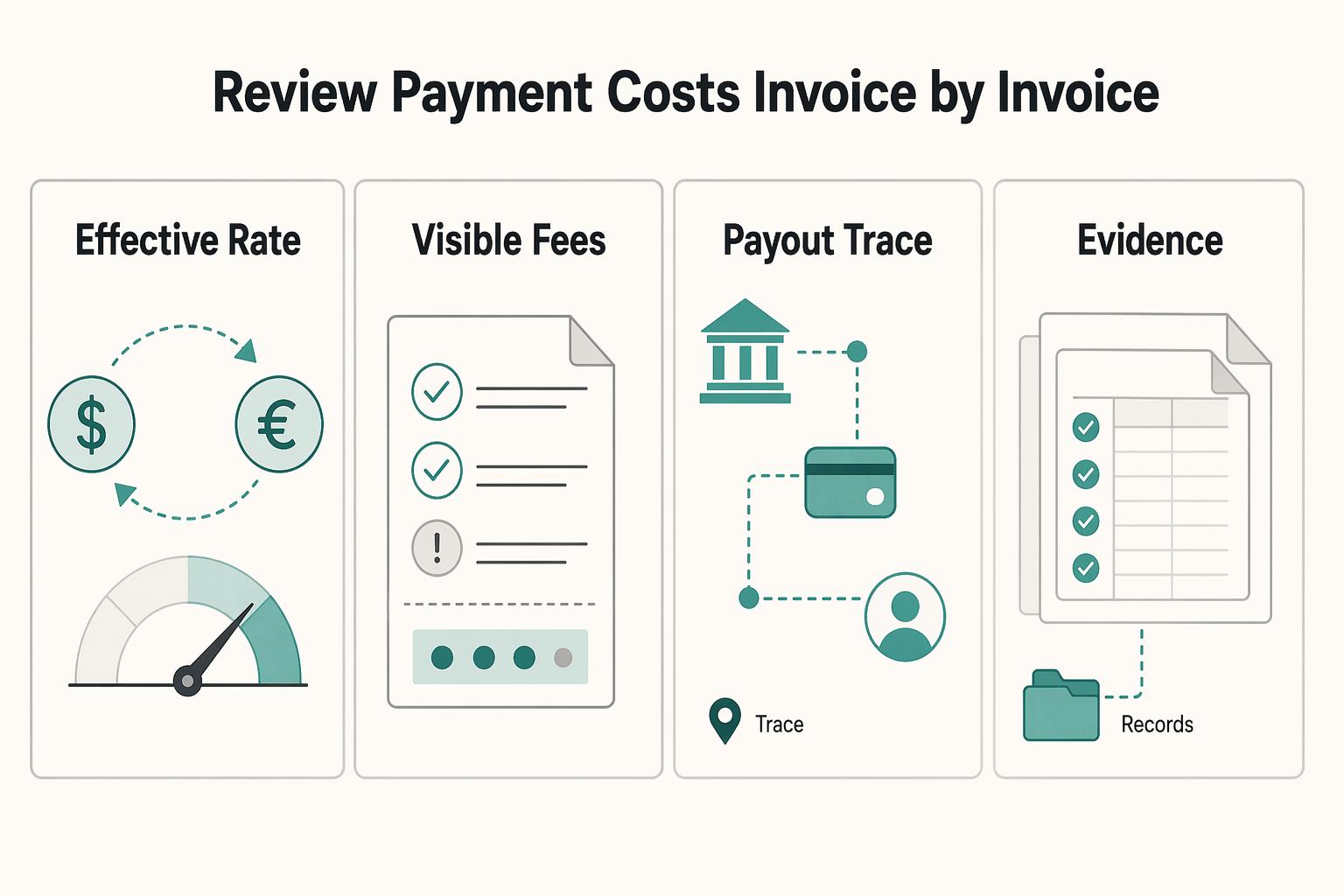
Review payment costs invoice by invoice#
Published pricing is not enough. Cross-border cost control works best when you review each invoice for fees, FX margin, and settlement timing.
| Review area | How to check | Grounded detail |
|---|---|---|
| Effective FX rate | Divide the home-currency amount received by the invoice currency amount, then compare it against a reference market rate at the same time point | Compare invoice-level receipt against a reference market rate at the same time point |
| Visible fees | Log transfer, receiving, processing, and international surcharges | PayPal's U.S. merchant fee page states international commercial transactions add an extra 1.50% on top of domestic receiving fees |
| Settlement timing | Track invoice paid date, processor receipt date, and bank deposit date | Stripe says initial payout is typically scheduled in 7-14 days after first live payment, then follows your account payout schedule; confirm current provider payout rules from provider source records before relying on the schedule |
| Conversion path | Record whether you converted at receipt, held currency, or transferred before conversion | Wise shows business conversion pricing starting from 0.57%, varying by currency; confirm current provider FX pricing from provider source records before relying on the comparison |
Use this routine until your stack shows stable results:
- Effective FX rate: Divide the home-currency amount received by the invoice currency amount, then compare it against a reference market rate at the same time point.
- Visible fees: Log transfer, receiving, processing, and international surcharges. PayPal's U.S. merchant fee page states international commercial transactions add an extra 1.50% on top of domestic receiving fees.
- Settlement timing: Track invoice paid date, processor receipt date, and bank deposit date. Stripe says initial payout is typically scheduled in 7-14 days after first live payment, then follows your account payout schedule. Confirm current provider payout rules from provider source records before relying on the schedule.
- Conversion path: Record whether you converted at receipt, held currency, or transferred before conversion. Wise shows business conversion pricing starting from 0.57%, varying by currency. Confirm current provider FX pricing from provider source records before relying on the comparison.
If one provider looks cheaper on posted fees but loses on FX margin or settlement timing, it is not cheaper in practice. Standardize only after invoice-level comparisons.
You might also find this useful: A Freelancer's Guide to Business Process Automation (BPA).
The Personal Shield: Navigating Catastrophic "Unknown Unknowns"#
Even with a clean entity and payment process, some risk still sits with you personally. The practical defense is not more complexity. It is keeping current facts, records, and independence signals in order before they are tested.
Keep a forward-looking residency tracker#
Year-end reconstruction is where avoidable mistakes start. Keep a live log you can review before you confirm trips.
| Tracker element | What to record | Article note |
|---|---|---|
| Travel facts | Each country, entry date, exit date, purpose of stay, visa or permit basis if relevant, where work was performed, and whether you used client premises | Keep a live log you can review before you confirm trips |
| Context notes | Longer stays, local housing, or other ties | Context notes that may matter later |
| Running day count | A running day count by jurisdiction | Current residency trigger pending official tax/source-record verification |
| Pre-booking review | Review upcoming travel patterns before plans are fixed | Upcoming travel patterns get checked before plans are fixed |
| Escalation file | Day log, travel records, accommodation records, work-location history, and upcoming itinerary | Have evidence ready when facts are unclear or changing |
Country-by-country residency tests or day-count triggers are not established, so treat this as planning hygiene and verify local rules before making filing decisions.
Your tracker should capture:
- Each country, entry date, exit date, purpose of stay, visa or permit basis if relevant, where work was performed, and whether you used client premises.
- Context notes that may matter later, for example longer stays, local housing, or other ties.
- A running day count by jurisdiction, with the applicable residency trigger verified from official tax guidance or local advisor records before use.
- A pre-booking review step so upcoming travel patterns get checked before plans are fixed.
- An escalation point when facts are unclear or changing, with evidence ready: day log, travel records, accommodation records, work-location history, and upcoming itinerary.
The point is not to predict every outcome. It is to avoid guessing later when a bank, client, or tax question lands.
If you are a U.S. person, sort out which foreign-account filing may apply#
Handle this as an annual determination. Form 8938 and FBAR can both matter, and Form 8938 does not replace FBAR.
Use this orientation flow:
- Are you required to file a U.S. income tax return?
If no, IRS guidance says Form 8938 is not required for that tax year.
- Do you have an interest in specified foreign financial assets?
If yes, compare aggregate value to the applicable Form 8938 threshold for your filing category.
- Check which threshold set applies.
A baseline IRS trigger cited for certain taxpayers is aggregate value exceeding $50,000. IRS also says higher thresholds may apply for joint filers and taxpayers residing abroad. For specified domestic entities, the instructions cite $50,000 on the last day of the tax year or $75,000 at any time during the tax year. This section is an orientation and does not list every filing-status threshold.
- If Form 8938 may apply, attach it to your annual return.
It follows the return due date, including extensions.
- Check FBAR separately.
Form 8938 filing does not remove a separate FBAR requirement. Verify the current FBAR threshold and filing deadline from FinCEN or IRS source records before using the filing calendar.
One recordkeeping point matters here. Form 8938 asks whether foreign assets were acquired or sold during the tax year. Track lifecycle events, including openings, closures, acquisitions, disposals, and transfers, not just year-end balances.
Flag PE questions early and document independence signals#
PE legal tests, treaty outcomes, or clause-level safe harbors are not established. Use this as a fact-pattern checklist for advisor review, not a legal conclusion.
| Do | Avoid |
|---|---|
| Use your own business identity in contracts, invoices, and signatures when that reflects reality | Presenting a client office as your business base |
| Describe your role as an independent contractor or service provider when accurate | Using titles that present you as client staff or management |
| Work from your own locations unless there is a clear short-term reason otherwise | Operating from client premises as your default workplace |
| Keep authority limited to your deliverables | Signing, negotiating, or committing terms in the client's name |
Add one more control layer so your paperwork and behavior stay aligned:
- Keep independent-contractor wording explicit where accurate.
- State signature-authority limits clearly.
- Set client communication boundaries so you are not presented as local management or a legal representative.
Run this on a fixed cadence#
Use a routine that fits your facts so you catch issues early. Example cadence:
- Monthly: clean travel logs and foreign-asset records.
- Pre-travel: review projected day counts and work-location pattern changes.
- Periodic advisor review: especially before year-end or after major fact changes.
When your location pattern, foreign-account footprint, or client-facing authority changes, review immediately instead of waiting for filing season.
For a step-by-step walkthrough, see The Best Business Travel Insurance for Digital Nomads and Executives.
Before you book your next move, centralize travel-day planning so you can catch residency and reporting conflicts early: Use the Tax Residency Tracker.
How the three layers reinforce each other week to week#
These three layers only work when they reinforce each other. Foundation sets the plan. Operations Engine turns that plan into weekly execution. Shield keeps risk signals visible so you can adjust early instead of reacting late.
| Layer | Primary purpose | Your weekly practice | If skipped |
|---|---|---|---|
| Foundation | Keep one clear plan that drives decisions | Review this week's top priorities and confirm they still match your goals | Work becomes reactive and priorities drift |
| Operations Engine | Keep execution and cash routines predictable | Reconcile issued invoices, received payments, and open follow-ups | Payment follow-up and cleanup become time-consuming |
| Shield | Keep exposure and risk signals visible | Update a short risk log with material changes and decisions to revisit | You spot issues late, under pressure |
Foundation#
Treat this layer as non-negotiable. The goal is clarity you can maintain, not a perfect answer on paper, so you can lead decisions instead of reacting to noise.
Do this now: write your top three priorities for the next seven days and one thing you will defer.
Operations Engine#
This is where your structure meets weekly reality. When your rhythm stays consistent, delivery and cash cycles usually stay smoother. Most breakdowns here come from gradual drift, not one dramatic failure.
Do this now: reconcile your last three invoices against payment receipts, then list any unmatched item that still needs an explanation.
Shield#
This is your early-warning layer. Keep a live risk log so new information can reshape your decisions before pressure builds. A weekly update is more useful than reconstruction later.
Do this now: add the most important change you noticed this week and note which decision it may affect.
Autonomy comes from repeatable habits: one clear plan, one clean execution rhythm, and one current risk log. In disruptive periods, this helps you use change as fuel instead of being swept up in it.
For deeper context on financial mechanics, see A Guide to 'Amortization' of Intangible Assets for a Freelance Business.
Once your operating cadence is in place, tighten client terms to reduce downstream risk: Generate a freelance contract.
Frequently Asked Questions
Do you need an LLC, or can you stay a Sole Proprietorship?
You can stay a sole proprietorship if that matches your facts, but decide based on liability, tax treatment, and how you actually operate. Compare the identity on your contracts, invoices, bank records, and tax filings, then choose the structure that fits your real footprint. If jurisdictions overlap, take it to a local advisor.
Should a U.S. citizen living abroad use a foreign entity?
Sometimes, but not by default. The article does not say a foreign entity is automatically better in cross-border cases. Choose structure with legal and tax considerations in mind, and use a local advisor when jurisdictions overlap.
How do you reduce PE risk for clients?
Reduce PE risk by keeping your business identity, agreements, invoices, and authority limits clear and consistent. Use independent-contractor wording where accurate, avoid presenting client premises as your business base, and do not sign or negotiate in the client's name unless that reflects reality. Review local rules with an advisor before relying on a position.
What is FBAR, and what should you track now?
FBAR may apply if you are a U.S. person and the aggregate value of qualifying foreign financial accounts exceeds $10,000 at any time during the calendar year. Track each account's institution, account number, country, owner or signatory status, and year-high value in one log. FBAR is due April 15 with an automatic extension to October 15.
How do you calculate the maximum account value for FBAR?
Use a reasonable approximation of the greatest value during the calendar year. Periodic account statements can be used, and the amount is rounded up to the next whole U.S. dollar. Keep statements and a brief calculation note for each account.
What is the simplest way to handle tax-residency tracking?
Keep one live travel-day log and update it before each trip instead of reconstructing it at year end. Record arrival date, departure date, city, work purpose, and service location in one place. Then verify current residency tests in each relevant country with a local advisor.
What if the foreign account is joint with your spouse?
Do not assume one filing automatically covers both spouses. The article notes a joint-account exception tied to a timely signed FBAR and FinCEN Form 114a, so filing details matter. Confirm the filer, ownership or signatory roles, and whether Form 114a is required before filing.
Try a related tool
Researched and edited by the Gruv editorial team. Gruv builds cross-border billing, payouts, and finance-operations software for global businesses.
Sources
- bsaefiling.fincen.gov/docs/XMLUserGuide_FinCENFBAR.pdftrusted
- dodcio.defense.gov/Portals/0/Documents/CMMC/AssessmentGuideL2.pdftrusted
- fincen.gov/reporting-maximum-account-valuetrusted
- fincen.gov/report-foreign-bank-and-financial-accountstrusted
- ftc.gov/business-guidance/resources/health-products-...trusted
- irs.gov/businesses/corporations/do-i-need-to-file-fo...trusted
- irs.gov/businesses/small-businesses-self-employed/bu...trusted
- sba.gov/business-guide/launch-your-business/choose-b...trusted
Educational content only. Not legal, tax, or financial advice.
Related Posts

The Freelance Payment Penalty: A Modeled Audit of Platform Fees, FX Spreads, and Payout Delays
The money rarely disappears through a single, easy-to-spot fee. The real loss is stacked. A marketplace takes its commission, a processor adds a charge for international cards, a bank or payment company converts the currency at a spread, a platform holds the funds before release, and a wire sheds a little to intermediaries on the way in. Each layer looks defensible on its own, but the worker feels the combined result as a smaller deposit and a later payday.

How to Respond to a Subpoena for Business Records
Move fast, but do not produce records on instinct. If you need to **respond to a subpoena for business records**, your immediate job is to control deadlines, preserve records, and make any later production defensible.

A US Expat's Guide to Investing in UCITS ETFs to Avoid PFIC Issues
The real problem is a two-system conflict. U.S. tax treatment can punish the wrong fund choice, while local product-access constraints can block the funds you want to buy in the first place. For **us expat ucits etfs**, the practical question is not "Which product is best?" It is "What can I access, report, and keep doing every year without guessing?" Use this four-part filter before any trade: