
Quick Answer
GDPR for SaaS businesses is ongoing operating work. If you offer services to people in the EU or monitor their behavior there, treat scope as likely active, map controller-processor roles per workflow, align your DPA and core contract clauses, and keep written evidence of decisions, controls, and updates so onboarding stays defensible.
Set safe GDPR defaults and keep evidence before onboarding#
Use GDPR for SaaS businesses as an operating playbook that protects trust and gives you defensible legal decisions before onboarding.
As the CEO of a business-of-one, you need a playbook you can run without a compliance department.
You are not trying to become a privacy lawyer overnight. You are setting safe defaults your team can run, then escalating jurisdiction-specific issues for legal confirmation.
If your SaaS offers goods or services to people in the EU, or monitors their behavior, GDPR can apply even when your company is outside the European Union. This guide prioritizes decision quality over policy theater. Weak decisions create real downside, including temporary or definitive processing bans and penalties up to €20 million or 4% of annual worldwide turnover.
Run this as your first working session#
Use this sequence to establish a practical baseline for accountability, legal clarity, and durable data privacy operations.
| Decision area | Safe default you can apply now | Evidence to keep |
|---|---|---|
| Scope | Treat EU-facing activity as in scope until you verify otherwise | Intake answers on whether you offer goods/services to people in the EU or monitor their behavior |
| Accountability | Make compliance demonstrable, not assumed | Written records of your data protection practices and choices |
| Evidence retention | Keep proof of the steps you take to comply, not just policy text | Logs of decisions, updates, training, and incident handling |
| Operating model | Use a privacy management framework to embed accountability | Framework owner, review cadence, and change history |
Picture a non-EU SaaS team rushing a new enterprise onboarding. They skip documentation and activate monitoring by default. Procurement pauses the deal because the team cannot show how data protection decisions were made, what practices are in place, or where accountability records live.
Use this script before every cross-border deal. Ask:
- "Are we targeting or monitoring people in the EU?"
- "What data protection practices and choices have we documented?"
- "What evidence can we present today?"
If any answer is unclear, pause onboarding, assign one owner, and close the gap before revenue depends on guesswork. If you want a deeper dive, read Taxes in Germany for Freelancers and Expats.
Build the mental model before you touch your contracts#
Treat GDPR for SaaS businesses as a role and proof system: classify each data activity, confirm a legal basis, and align your contracts to those decisions.
The fastest way to lose time in legal review is letting sales, ops, and legal work from different assumptions. Lock the shared model first, then negotiate.
For SaaS teams, the General Data Protection Regulation (GDPR) sets rules for how you process personal data of data subjects who are in the Union. It also reaches certain non-EU operating contexts. Your job is straightforward: name the role for each workflow, document why processing is lawful, and retain evidence that you did both.
Use these definitions to avoid contract mistakes#
| Term | Working definition for operators | Why it matters in contracts |
|---|---|---|
| GDPR | European regulation setting rules for personal data processing | It sets the legal frame your DPA and privacy terms must follow |
| Data Controller | Party deciding why and how data is processed | This party carries core accountability duties and decision ownership |
| Data Processor | Party processing data on the controller's behalf | This party needs clear written instructions and duty boundaries |
| Legal basis for processing | At least one lawful ground must support each processing purpose (Article 6(1)) | You cannot justify processing with vague business intent |
| Accountability | You must comply and prove compliance (Article 5(2)) | You need records, not just policy statements |
| Data Processing Agreement (DPA) | Written controller-processor contract or equivalent legal act | You must put one in place when a controller uses a processor |
Run this mapping script before you redline#
- List each data flow that touches data subjects in the Union.
- Mark who decides purpose and means for each flow.
- Mark who processes only on behalf of that decision maker.
- Assign the legal basis for processing to each purpose.
- Record what proof you will retain for accountability.
- Confirm your DPA mirrors these role and responsibility decisions.
Here's a common failure mode: product says "we just host," while success teams define campaign targeting rules for a client. In that moment, your role can shift by activity. Map the shift explicitly, then reflect it in your DPA. This is how GDPR stays defensible without slowing down real deals.
Does GDPR apply to your non EU SaaS operation right now?#
If your non-EU SaaS offers goods or services to people in the EU/EEA, or monitors their behavior there, treat GDPR scope as likely active and validate it before onboarding.
Before you debate clauses, make the scope call. This is the go or no-go gate that keeps onboarding from drifting into improvisation.
Start with location and activity facts, not assumptions about citizenship. In practice, scope depends on where people are and what your product is doing. Expand your map to the European Economic Area (EEA), because GDPR applies across the EEA, not only EU member states. For cross-border delivery, expect separate EU and UK compliance questions and confirm the legal split early.
Run a repeatable scope test#
| Scope question | Why it matters | Operational action |
|---|---|---|
| Do we offer goods or services to people in the EU or EEA? | This can trigger GDPR for a non-EU SaaS | Mark as likely in scope and continue GDPR compliance workflow |
| Do we monitor behavior of people in the EU or EEA? | Monitoring can also trigger scope | Escalate for legal review and tighten tracking controls |
| Do users, teams, or systems span UK and EU markets? | EU and UK obligations can diverge by scenario | Track both regimes separately and assign an owner |
| Are facts incomplete at onboarding? | Unclear inputs increase legal risk | Use conservative controls as an internal default, then narrow after legal review |
Use this intake script on every new account:
- Where is the client entity located?
- Where are end users located, including EU, EEA, and UK?
- Will our service monitor user behavior in those regions?
- Which systems process the data, and in which regions?
- Who signs off on the scope call and the follow-up legal check?
Example: your SaaS team onboards a UK client while product analytics captures user behavior in Norway and Germany. If the team labels the deal as UK only, they can miss EEA and EU scope triggers. Use a conservative internal default: classify as likely in scope, document your reasoning, and operate with stronger controls until counsel confirms a narrower path.
Are you the controller, the processor, or both in this deal?#
Map each workflow to a role before you negotiate terms, because the same SaaS company can act as a Data Controller in one activity and a Data Processor in another.
Roles tell you what you owe, what you can promise, and what your contract must say.
A Data Controller decides the purpose and means of processing. A Data Processor handles personal data on behalf of the controller. In delivery, you can be both across different workflows. Treat role labels as activity-specific, not company-wide.
Then tie each processing purpose to a Legal basis for processing, since processing is lawful only when at least one Article 6 basis applies.
Classify each workflow with one matrix#
| Workflow step | Who decides purpose and means | Likely role in that step | What to document |
|---|---|---|---|
| Product usage analytics for your own roadmap | Your team | Data Controller | Processing purpose, legal basis, internal owner/system, retention horizon |
| Campaign execution in Slack under client instructions | Client decides, you execute | Data Processor | Client instructions, processing purpose, contract coverage, retention horizon |
| Internal file operations in Google Drive for your business operations | Your team | Data Controller | Purpose, legal basis, internal access owner, retention horizon |
| Client file handling in shared workspace under client direction | Client decides, you execute | Data Processor | Scope of instructions, security controls, deletion timing |
Convert role labels into legal and operating controls#
| Item | What to do |
|---|---|
| Processor activity | Make sure your processor contract governs subject matter, duration, nature, and purpose of processing |
| Controller activity | Record the purpose and legal basis for processing before launch |
| Recurring tools such as Slack and Google Drive | Keep one role matrix, then update it when the workflow changes |
| Internal operating fields | Capture owner, system, and retention horizon |
- For each processor activity, make sure your processor contract governs subject matter, duration, nature, and purpose of processing.
- For each controller activity, record the purpose and legal basis for processing before launch.
- Keep one role matrix for recurring tools such as Slack and Google Drive, then update it when the workflow changes.
- Capture owner, system, and retention horizon as internal operating fields so teams can execute without reopening legal debates.
Example: your client sets targeting rules and asks you to run execution inside Slack, so you act as Data Processor there. In the same engagement, you analyze your own product performance data for internal roadmap decisions, so you act as Data Controller there. One deal, two roles, clear controls.
Want a quick next step for "gdpr for saas businesses"? You can try the SOW generator.
Lock your contract stack before onboarding starts#
Set a baseline Data Processing Agreement (DPA) first, then align liability and dispute terms so your GDPR obligations hold up in real conflict, not just in procurement review.
Role mapping is only useful if your contracts match it. Lock the stack before onboarding so delivery does not inherit legal ambiguity.
For GDPR in SaaS, processor work must sit under a binding contract or legal act before onboarding. Treat that as a gate, not a cleanup task. Your DPA should include the mandatory Article 28 terms and state clear duties operations can follow on day one.
It should also require the processor to provide information needed to demonstrate compliance and set a concrete termination path for returning or deleting personal data.
| Clause area | What to lock before onboarding | Why it matters in disputes |
|---|---|---|
| DPA core terms | Scope, processing purpose, instructions, security duties, audit support | Converts GDPR role mapping into enforceable obligations |
| Termination | Controller choice to return or delete personal data at end of services | Prevents messy exits and unresolved data exposure |
| Limitation of Liability | Damage exclusions and caps, plus explicit carve-outs | Controls downside while preserving practical remedies |
| Indemnification | Privacy and security trigger language that matches your risk model | Prevents indemnity promises from conflicting with liability limits |
| Governing Law, Jurisdiction, Dispute Resolution | Clear forum mechanics for cross-border SaaS deals | Reduces delay and uncertainty when enforcement starts |
Use this redline checklist before signature#
- Confirm your DPA clauses match the controller-processor split from your role matrix.
- Verify the processing purposes in your contract exhibits align with your documented processing map.
- Redline Limitation of Liability and Indemnification together, not in separate passes.
- Remove vague dispute language and pick clear governing law, jurisdiction, and dispute resolution terms.
- Attach an accountability evidence list, including approvals, DPA versions, and change logs.
Example: sales accepts a broad indemnity, legal applies a tight liability cap, and the DPA leaves termination data handling unclear. One incident triggers a contract fight before anyone addresses the operational fix. Lock the stack early so revenue is protected and the controls are enforceable.
Turn GDPR principles into operating controls your team can actually run#
Build a control map that assigns each GDPR principle to an owner, a routine, and an evidence artifact your team can produce on demand.
Contracts are the promise. Controls are what make the promise true under real workload.
Start by translating principle text into tasks your SaaS team can run consistently. Lawfulness, fairness, and transparency means you publish clear notices and keep them aligned with product behavior. Purpose limitation means you use personal data only for documented purposes. Data minimisation means forms ask only what each workflow needs.
| GDPR principle | Team control you run | Evidence you store | SOC 2 overlap |
|---|---|---|---|
| Lawfulness, fairness, and transparency | Review user notices when product or onboarding fields change | Notice approval log and change history | Privacy, confidentiality |
| Purpose limitation | Restrict internal data use by workflow and role | Policy decision record and access rule approvals | Processing integrity, privacy |
| Data minimisation | Remove nonessential fields from forms and imports | Field rationale and form revision log | Privacy, confidentiality |
| Storage limitation | Set deletion routines per data category and enforce them | Retention plan and deletion run records | Confidentiality, privacy |
| Integrity and confidentiality | Apply risk-appropriate access controls and test safeguards regularly | Access reviews, security test logs, incident response records | Security, availability, confidentiality |
Treat Accountability as an output requirement. Keep records of processing activity current, including purpose, retention planning, and security measures. Store policy decisions and incident response records in one legal and data privacy evidence pack.
Use SOC 2 mapping for efficiency, but keep GDPR obligations explicit because SOC 2 does not replace GDPR obligations. If you need a practical companion, use A Guide to SOC 2 Compliance for SaaS Companies.
Run this compliance ops checklist#
| Operational check | What to verify |
|---|---|
| Notices and purposes | Confirm new features match published notices and approved purposes |
| Access controls | Review access-control changes and remove excess permissions |
| Deletion routines | Verify deletion routines ran and log exceptions for follow-up |
| Processing records | Update processing records for new tools, vendors, or workflows |
| Decision and incident files | File policy decisions and incident notes in one folder |
Example: support requests broad export access to solve one issue. This checklist lets you approve a narrow, purpose-limited path, capture the decision, and keep your legal posture clean. If you want another operations-focused guide, see Working Remotely in Latin America: A Visa Guide.
When do you need an EU representative or DPO support and how should you decide?#
Decide EU representative and DPO support by testing your actual processing pattern against Article 27 and Article 37 triggers, then logging the rationale in writing.
Handle this like every other part of the playbook: make a call, assign an owner, and keep the proof.
For GDPR compliance, start with Article 27 logic. If your activity falls under Article 3(2), designate an EU representative in writing. Place that representative in a Member State where affected data subjects are located. Do not treat this as liability transfer. Your company still carries its own data privacy and legal exposure.
Use this decision grid#
| Decision area | Trigger to test | Action | Evidence to keep |
|---|---|---|---|
| Article 27 Representative | Your processing falls under Article 3(2) | Appoint an EU representative in writing | Signed appointment, scope note, DPA contact update |
| Article 27 Exemption | Processing is occasional, avoids large-scale special-category processing, and your context fits exemption limits | Record why you did not appoint now | Legal rationale memo, review date, owner |
| DPO requirement | Core activities involve large-scale regular and systematic monitoring, or large-scale special-category processing | Designate a Data Protection Officer (DPO) | Role charter, reporting line, involvement workflow |
| DPO support without strict trigger | Your current processing does not trigger Article 37, but risk grows across jurisdictions or processing patterns change often | Buy specialist support or assign a trained internal lead | Decision memo, cadence notes, escalation path |
Treat Supervisory Authority guidance as an operational input. When guidance shifts your interpretation, update controls, notices, and accountability records promptly. Supervisory authorities monitor and enforce this regulation, so your decisions should stay current and provable.
Write the memo before final rollout#
| Memo item | What to record |
|---|---|
| Article 27 applicability | State whether Article 27 applies and why |
| DPO requirement | State whether a DPO is required now and what could change that call |
| Threshold uncertainty | Note uncertainty where thresholds vary by jurisdiction, then confirm with qualified counsel |
| Owner and review cadence | Assign an owner and a review cadence so the decision stays live |
Example: your SaaS expands into new EU resident segments and adds behavior tracking across core workflows. Your memo should trigger a fresh Article 27 and DPO review before launch, not after a complaint.
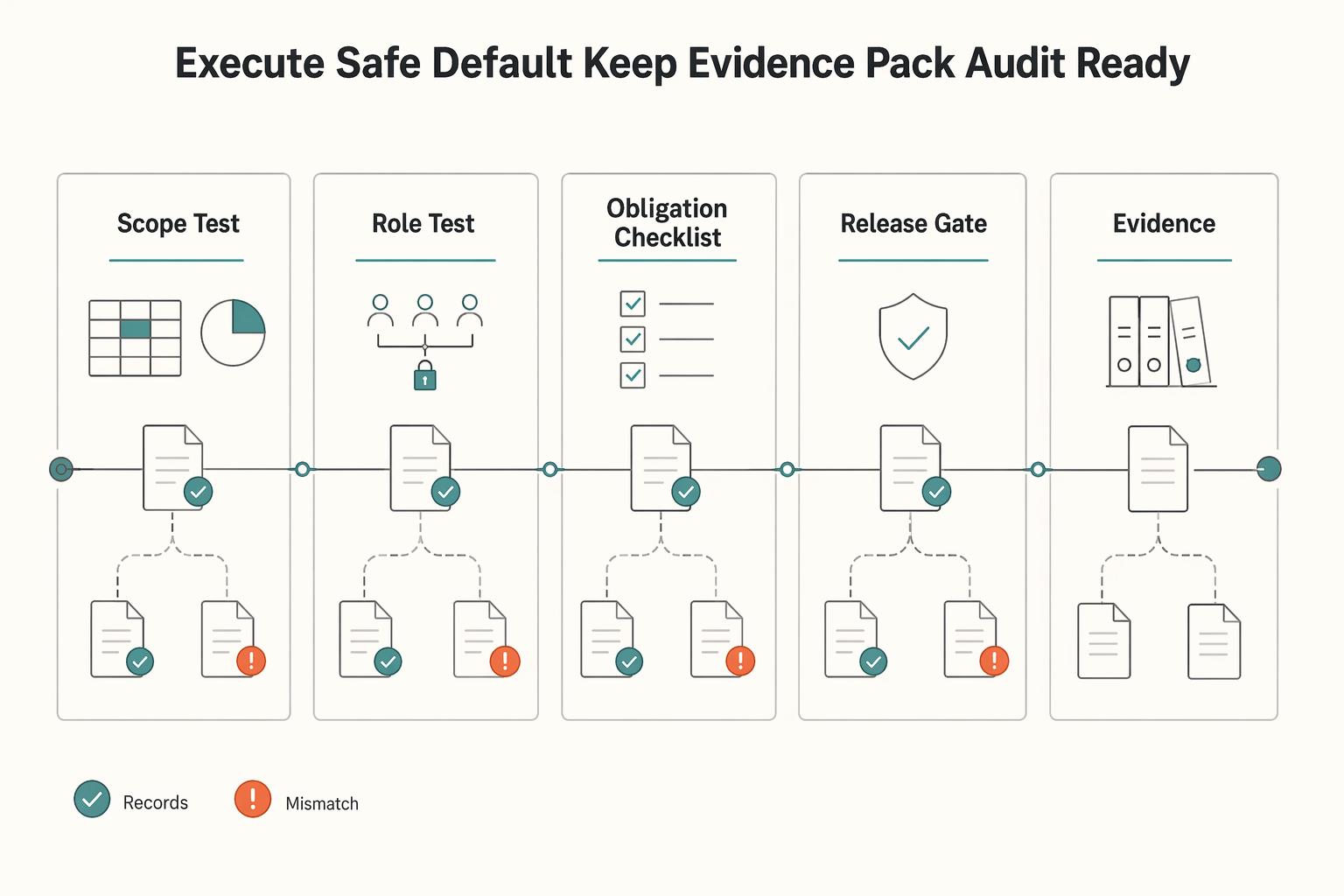
Execute the safe default and keep your evidence pack audit ready#
Use the same five-part compliance cycle on a set cadence, and treat each pass as an evidence update, not a policy rewrite.
The point is not perfect paperwork. The point is staying consistent as products, clients, and jurisdictions change.
| Cadence step | What your team does | Evidence artifact |
|---|---|---|
| Scope test | Recheck whether your SaaS serves people in the EU/EEA or tracks behavior tied to that region, such as IPs or clicks | Updated scope memo with assumptions and open legal questions |
| Role test | Reconfirm each major workflow's documented role as Data Controller or Data Processor | Role matrix update with owner sign-off |
| Obligation checklist | Confirm your valid reason for processing, consent and logging standards where consent is used, and rights handling for access, deletion, and transfer requests | Checklist with pass or fail status and remediation tickets |
| Cross-border gates | Review transfer paths and contract terms, and escalate jurisdiction-specific gaps for legal confirmation | DPA version log, transfer decision log, escalation notes |
| Evidence refresh | Consolidate approvals, policy changes, incident records, and consent or processing logs | Current audit folder index with timestamps |
Traceability matters more than volume. Keep one decision log that links each operational change to the matching contract clause, policy update, and control owner. That single thread helps your legal and delivery teams answer client diligence requests without guesswork or conflicting statements.
Keep the rhythm compliance first#
- Run a short weekly or biweekly review for changes that cannot wait for the main cycle.
- Escalate jurisdiction-specific questions early when local rules diverge.
- Mark uncertainty clearly in writing, then confirm interpretation with qualified counsel before rollout.
Example: you add a new analytics feature for a cross-border client. Pause launch, run the five checks, update the evidence pack, and reopen only when owners approve the legal and data privacy impacts. As a practical next step, pull the required inputs, confirm scope coverage, then validate final legal positions with counsel.
Frequently Asked Questions
Does GDPR apply to a SaaS business outside the EU?
Yes, it can. GDPR covers some non-EU SaaS operations when processing relates to offering goods or services to data subjects in the European Union, or when you monitor behavior in the Union. Your company address does not decide this on its own, so run the scope test on the actual service and data flows.
If all my customers are outside the EU, can I ignore GDPR?
No. You can still trigger GDPR where processing relates to offering goods or services to data subjects in the Union, or monitoring behavior in the Union. Narrow scope only after you check where end users are and what your systems do with their data.
How do I decide whether I am a Data Controller or Data Processor in one client engagement?
Use a purpose-and-means test for each processing activity. If you decide why and how personal data gets processed, you act as a Data Controller for that activity. If you process data only on a client’s instructions, you act as a Data Processor. One engagement can contain both roles, so document roles by workflow.
What GDPR principles should I operationalize first in a small SaaS team?
Start with principles that drive daily decisions: lawfulness, fairness and transparency, purpose limitation, and data minimisation. Convert each into one control you can run consistently, then keep evidence of how those controls are applied.
When is an Article 27 Representative required for non-EU businesses?
If Article 3(2) applies to your processing, you must appoint an Article 27 Representative in writing in the Union. Article 27 includes limited exemptions, including certain occasional processing contexts and public authorities or bodies.
When should a SaaS company appoint or outsource Data Protection Officer support?
You must designate a Data Protection Officer (DPO) when your core activities include large-scale regular and systematic monitoring, or large-scale processing of special-category data. You can appoint a staff DPO or contract the role through a service provider. If strict triggers do not apply yet, consider support as legal and operational complexity rises.
How long does baseline GDPR compliance usually take for a SaaS business?
No single legal timeline fits every SaaS business. Scope, processing patterns, contracts, and evidence maturity drive the pace. The practical move is to run the baseline sequence immediately, then keep it current through regular review and documented updates.
Try a related tool
Researched and edited by the Gruv editorial team. Gruv builds cross-border billing, payouts, and finance-operations software for global businesses.
Sources
Educational content only. Not legal, tax, or financial advice.
Related Posts
Taxes in Germany for Freelancers and Expats
Low-stress compliance in Germany comes from decision order, not tax tricks. Use this sequence: confirm core facts, apply conservative temporary assumptions, verify the few points that can break invoices or filings, and keep one evidence file that explains each decision.
Working Remotely in Latin America Without Visa Guesswork
Treat this move as a verification project, not a booking sprint. If you are planning a remote-work move in Latin America, the first practical step is to separate what is clearly supported now from what still needs direct government confirmation before you spend money or lock dates.
A Guide to SOC 2 Compliance for SaaS Companies
**Build your SOC 2 playbook before sales pressure hits, so you control scope, evidence, and audit timing instead of reacting under stress.** If you're pursuing **[soc 2 compliance for saas](https://www.cobalt.io/learning-center/soc-2-compliance-for-saas)**, treat this guide as a system, not a policy exercise. As the CEO of a business-of-one, you need a SOC 2 plan that protects your calendar as much as your customers. Use it to decide what to implement first, keep the right proof, and connect the work to clearer security controls, cleaner buyer conversations, and fewer fire drills.