Start by refusing to publish until one start event and one stop event are mapped to system timestamps and owned by named teams. A contractor payout SLA payment speed guarantee is credible only when eligibility, exclusions, and remedy triggers can be reproduced from the same monthly extract used for customer reporting. Keep invoicing language separate from execution timing, and lock breach logic to evidence that Finance Ops, Engineering, Product, and Legal can independently verify.
A payout speed guarantee is only real when the clock is explicit and measurable. If timing boundaries are unclear and misses have no defined remedy, you do not have an SLA you can run under load.
| Item | Article says | Use in payout promise |
|---|---|---|
| Workable SLA | Defines the service level, the metric used to measure it, and the remedy or penalty when performance misses | Use it for the measured speed guarantee |
| General contract language and payment terms | Are not the same as a speed SLA | Do not use them as the speed guarantee |
| Advance Payment Guarantee (APG) | Protects recovery of an advance if performance fails | Keep it separate from payout speed measurement |
For platform owners, this is an execution problem, not just a contract drafting exercise. You are balancing SLA commitments against internal operations, supplier variability, and existing vendor terms. A workable SLA defines the service level, the metric used to measure it, and the remedy or penalty when performance misses.
General contract language and payment terms are not the same as a speed SLA. The speed guarantee should define how fast your platform executes an eligible payout once it enters the measured part of your process.
Keep this separate from an Advance Payment Guarantee (APG) as well. An APG protects recovery of an advance if performance fails. It does not measure service speed, and it is not a substitute for a payout SLA.
Vague promises and borrowed boilerplate create room for misinterpretation. Significant contracts without a working SLA are easy to misread, and standard supplier SLAs often favor the supplier. Use one governing document set so Product, Finance Ops, and Legal are checking the same promise before you publish it.
Be explicit about tradeoffs. Tighter service levels can affect supplier pricing and may change whether suppliers are willing to respond, and commercial terms vary by market and offering. Precision matters, but so does limiting scope to something you can actually sustain.
This guide walks through a measurable SLA design, an operating sequence for the clock, and executable miss-handling rules. The through line is simple: define the clock, prove the data, and only then promise speed. For a step-by-step walkthrough, see Contractor Payout Speed Calculator by Rail and Country.
Set the boundary before you promise speed. Your Payment speed guarantee should cover service execution timing, not billing terms or contract administration.
1. Separate the SLA from invoicing and admin terms.
Start by separating the Service-Level Agreement (SLA) from invoicing, payment terms, and administrative documents. The Texas MSA shows this split clearly: performance standards include 5.2 Service Level Reimbursement, while 11. Invoicing and Payment is separate, with 11.3 Disputed Charges as its own exception path.
Keep invoice disputes and similar commercial terms outside the speed promise unless you deliberately include them. Treat broader contract-administration documents as adjacent terms, not hidden definitions for the SLA clock. A useful check is to tag every clause as execution timing, billing or payment, or contract administration.
2. Define one start event and one stop event.
Define one explicit start event and one explicit stop event for the Payment speed guarantee, in one sentence that Finance and Legal will read the same way. If that sentence needs footnotes to work, the clock is still too vague.
Do not publish until each event has one owner, one timestamp source, and one document home. Use a concrete control artifact, such as a Statement of Work: the Michigan contract ties Contract Activities to work described there, which gives you a clear place to record what the service covers. A common failure mode is letting website language, vendor terms, and ops reporting each use a different clock.
3. State scope limits before launch.
State scope limits in plain language before launch, and make exceptions explicit in published terms.
Apply the same discipline when scope changes over time: document changes instead of assuming them. The Michigan contract's use of a Contract Change Notice for renewal is a practical model for that control. Use this checkpoint before release: if you cannot explain clock start, clock stop, and the main exclusions in one sentence to Finance and Legal, the SLA is not ready.
You might also find this useful: Payment Transparency for Contractors: How to Build a Payout Tracker Your Recipients Trust.
Do not publish tax-readiness language until your evidence pack and legal/tax inputs are documented. This pack supports FEIE-related tax evidence; treat payout-operations assumptions in this section as unverified.
1. Build a minimum evidence pack first.
Build a minimum evidence pack, then assign clear ownership for each artifact:
For each artifact, record one owner, one extract path, and one timestamp source.
2. Review the governing documents that may limit the promise.
Review the IRS materials you are relying on, and separate binding rules from non-binding guidance.
At this stage, you are looking for conflicts and gaps, not drafting final legal text. Track document name, version date, owner, and section reference. Treat IRS LB&I practice units as non-binding guidance, not authoritative law.
3. Map what this pack does and does not establish.
Map tax-test failure conditions and exceptions explicitly, and mark unrelated payout-ops controls as unknown in this section.
This grounding pack does not establish KYC, KYB, AML, VAT-validation, vendor-remedy, or penalty-clause rules for payout SLAs. Keep those items out of FEIE eligibility logic unless validated from separate approved sources.
4. Keep tax-document readiness separate from payout execution.
Keep tax-document readiness separate from payout execution, and keep tax treatment evidence-based rather than generic. If your program touches FEIE-related cases, capture only what can actually be verified.
| FEIE evidence point | What to log |
|---|---|
| Eligibility frame | FEIE applies only to a qualifying individual with foreign earned income. |
| Filing artifact | Claimed on Form 2555 or Form 2555-EZ. |
| Return requirement | Claiming FEIE still requires filing a U.S. tax return that reports the income. |
| Physical presence test | 330 full days in any 12 consecutive months; a full day is 24 hours from midnight to midnight. |
| Failure/exception handling | Missing the day count fails the test regardless of illness, family issues, vacation, or employer orders; days in a foreign country in violation of U.S. law do not count; the minimum time requirement can be waived for war, civil unrest, or similar adverse conditions. |
| Authority level note | IRS LB&I practice units are non-binding guidance and should not be treated as authoritative law. |
Once these prerequisites are named, owned, and reproducible from records, you can draft tax-readiness terms without guessing. For broader payout-operations context, read Contractor NPS and Payout Reliability: What Moves Loyalty.
You can hit the timing metric on paper and still have outcomes break down when data silos, fragmented systems, and misaligned KPIs prevent clear verification and prevention.
1. Define one canonical event chain.
Define one canonical event chain from your own evidence pack, and give each event one operational meaning. Keep UI labels separate from clock logic so reporting and operations use the same definitions.
| Event type | Lock the meaning to a verifiable condition | Required metadata |
|---|---|---|
| Start event | The exact condition that begins SLA timing | timestamp source, owner team, report extract path |
| In-flight checkpoints | Named transitions that show progress through the lifecycle | timestamp source, owner team, report extract path |
| Stop event | The exact condition that ends SLA timing | timestamp source, owner team, report extract path |
| Exception event | A condition that changes treatment | timestamp source, owner team, report extract path |
Use a hard verification point here: if any event lacks an owner, timestamp source, or extract path, the clock is not locked. Keep these definitions in an SLA methodology appendix so teams cannot reinterpret them later.
2. Document exception handling rules clearly.
Document exception handling rules before you publish anything. Do not collapse different exception classes into one bucket when they change metric treatment.
Use evidence-based rules only. If an exception cannot be verified consistently, keep it unresolved until the rule is documented and reproducible.
3. Validate edge cases before launch.
Before go-live, test at least one edge-case scenario and confirm reporting remains traceable and reproducible. This helps you avoid the kind of failed experiments and pilots that can clutter improvement efforts.
4. Document path variants explicitly.
Document path variants explicitly, even if the external promise is simple. Keep one canonical chain, then add branch notes where ownership, evidence, or clock boundaries differ. That approach keeps the SLA consistent across teams and reduces failures caused by muddy definitions.
If you want a deeper dive, read How to Build a Payout SLA: Setting Expectations for Contractor Payment Timing.
Tiered guarantees are most defensible when scope, eligibility, and governance are explicit enough to reproduce from records. A single global promise across uneven payout paths can create avoidable misses and disputes.
1. Split tiers where scope or review conditions actually change.
Split tiers where scope, review conditions, or risk handling materially differ across segments. If one segment appears less reliable or is not clearly governed yet, publish a looser tier for that segment or keep it out of scope until it stabilizes.
Before publishing, run an evidence check: each tier should map to documented contract terms and repeatable records.
2. Write eligibility as testable conditions.
Write eligibility as explicit, testable conditions in the SLA terms, not as operating assumptions. If eligibility cannot be reconstructed from records, do not include that population in a published guarantee. This keeps your denominator defensible and prevents retrospective reclassification.
3. Choose a tier posture based on enforceability.
Choose your posture based on enforceability, not just commercial pressure.
| Tier posture | Benefit | Cost |
|---|---|---|
| Narrow and strict | Strong signal for controlled segments | Higher remediation exposure |
| Balanced | Broader coverage with guardrails | More edge-case governance |
| Broad and loose | Fewer formal misses | Lower commercial value |
4. Define reporting scope up front.
For payout batches, define reporting scope in the governing terms up front. A single view can hide material exceptions. Treat this as part of tier design, not as a reporting clean-up task for later.
5. Put the final tier matrix in the governing SLA artifact.
Put the final tier matrix in the governing SLA artifact, for example a named SLA exhibit, and align it with contract order-of-precedence rules so conflicts resolve predictably. If rollout needs control, phase intake and review instead of forcing one undifferentiated launch.
Do not treat the guarantee as binding until the governing terms are fully signed and dated by authorized approvers.
This pairs well with our guide on Mobile Contractor Payout UX: Design Rules and Launch Checks.
A payout speed guarantee belongs in contract text only when Legal can enforce it and Operations can prove it from records. If either side fails, the clause starts to read like marketing language instead of an enforceable SLA.
| Part | Define | Check |
|---|---|---|
| Service scope | The covered service | Can be proven or disproven from documented records and reporting outputs |
| Metric definition | Clock start and stop events and the included population | Use measurable events rather than words like "prompt" or "timely" |
| Exclusions | Any pause or exclusion conditions | Use event-based, reportable triggers |
| Breach treatment | What counts as a miss, who validates it, what remedy applies, and when the decision is made | Finance Ops can run the breach test from the agreed extract used for customer reporting |
1. Translate the operating model into contract-ready parts.
Translate your operating model into four contract-ready parts: service scope, metric definition, exclusions, and breach treatment. Because an SLA is a contract between provider and customer, the clause should state the service standard, how it is measured, and what applies when it is missed.
Keep the wording testable. Replace "processed quickly" with the covered service, clock start and stop events, included population, and any pause or exclusion conditions. For each sentence, confirm that it can be proven or disproven from documented records and reporting outputs.
Avoid terms like "prompt," "timely," or "commercially reasonable" unless you anchor them to measurable events.
2. Keep statutory or procurement timing duties separate.
Keep statutory or procurement timing duties separate from your internal guarantee model. If a deal touches local payment or procurement rules, treat those as jurisdiction-specific legal references for counsel review. Do not treat them as default SLA metric definitions.
Legal obligations and your execution guarantee are not automatically the same. One reflects law or procurement requirements in a particular context. The other defines what your platform promises and measures. Do not merge them unless counsel confirms they align.
Include a caveat that local contracting practices and laws may require jurisdiction-specific terms. If you use one jurisdiction's examples in negotiation, label them as local examples, not global defaults.
3. Define breach handling in executable terms.
Define breach handling in the Remedies clause and Penalty clause with triggers Operations can actually execute. State what counts as a miss, who validates it, what remedy applies, and when the decision is made.
Use event-based, reportable triggers. For example, define breach against missed service levels for an eligible population in agreed SLA reporting, with stated pause and exclusion rules. Avoid "appropriate compensation" unless the contract also names the decision authority and calculation method.
Verify that Finance Ops can run the breach test from the same agreed extract used for customer reporting. If remedy decisions depend on ad hoc manual reconstruction, execution is more likely to fail under pressure.
4. Review inherited supplier language carefully.
Require legal review for inherited supplier language, especially in a technology vendor contract. Standard supplier SLAs may favor the supplier, and significant contracts without legal-reviewed SLAs are easy to misread.
Also decide whether you need an SLA or an SLC. An SLA is contractual between provider and customer. An SLC is broader and more one-directional. If remedies, responsibilities, and expectations are binding, use SLA-grade structure and align final redlines to the operating model from the prior section.
If a clause changes pricing, liability, or response obligations, route it through Legal, Finance Ops, and the business owner together. Misaligned targets create both legal risk and delivery risk.
We covered this in detail in QuickBooks Online + Payout Platform Integration: How to Automate Contractor Payment Reconciliation.
After signature, the SLA stands or falls on evidence quality, not wording. Build the monthly payout-speed report so a reviewer can trace results back to source events, ledger journals, and reconciliation outputs.
1. Lock identifiers and timestamp definitions before dashboard work starts.
Lock identifiers and timestamp definitions before you build dashboards. If API requests, provider callbacks, ledger journals, and reconciliation records cannot be linked to the same payout attempt, the report becomes a matching argument instead of a performance record.
Define one durable event key per payout attempt, explicit clock start and stop event names, and one declared timestamp source for each event. Write and version those rules, and treat any change as a formal definition change.
Keep contract labels separate from measurement logic. A contract summary can show PAYMENT TERMS | DELIVERY TIMEFRAME while the excerpt still shows no populated timing values. Your report needs to define those fields in operational terms.
2. Publish a monthly scorecard that separates performance from exclusions.
Publish a monthly scorecard that separates measured performance from exclusions and impact. A single headline percentage hides definition drift and slows root-cause work.
| Scorecard field | Define in writing | Why it matters |
|---|---|---|
| Eligible volume | Which payouts are in scope for the month | Prevents silent scope shrinkage |
| Paused volume | Which payouts are paused and pause start event | Keeps valid holds out of miss counts |
| True misses | What counts as a miss after pause/exclusion rules | Creates one breach count for review |
| Top miss reasons | Controlled reason codes for major delay causes | Focuses fixes on real failure drivers |
| Remedy cost | How remedies are calculated and booked | Connects misses to financial impact |
| Trend direction | Improved, worsened, or flat vs prior period | Keeps governance on movement, not anecdotes |
Write numerator and denominator rules next to this table, since these excerpts do not define a standard SLA formula. Store the rule version used each month as well, so trend lines remain comparable when logic changes, similar to how a Contract Change Notice records formal contract modifications.
3. Require two controls before each monthly report goes out.
Require two controls before publishing each month's report. First, raw-event reproducibility: for any reported miss, a reviewer should be able to recreate the classification from the event trail. Second, ledger-to-report tie-out: reported payout counts and remedy totals should reconcile to posted journals and reconciliation outputs.
Keep procurement and contract timing fields in their own lane. A Procurement Timetable or contract coverage period can set context, but it does not, by itself, prove SLA measurement evidence.
4. Set escalation ownership before the first disputed cycle.
Set escalation ownership before the first disputed reporting cycle. Assign clear owners across Product, Finance Ops, and Engineering for metric definitions, reconciliation integrity, and event reliability or defect correction.
Run one dry run on the same coverage window you plan to report externally. Do not publish until metrics are reproducible, ledger tie-out is clean, and defect routing is unambiguous.
Related: Invisible Payouts: How to Remove Payment Friction for Contractors Without Sacrificing Compliance. If you want a concrete reference for webhook states, idempotent retries, and audit-traceable payout flows, review the Gruv docs.
Opaque compliance and tax holds can break SLA trust unless you treat them as explicit, evidence-backed states in the same reporting system as payout speed.
| Field | Minimum record | Reason |
|---|---|---|
| Hold-open timestamp | Store on every paused or excluded record | Shows when the hold started |
| Release or cancel timestamp | Store on every paused or excluded record | Shows when the hold ended |
| Hold category | Store on every paused or excluded record | Keeps the pause classified |
| Action owner | Store on every paused or excluded record | Keeps ownership clear |
| Case identifier | Store on every paused or excluded record | Links the record to the case |
| Path to underlying logs | Store on every paused or excluded record | Makes the pause traceable to logs and case evidence |
1. Classify paused payouts by hold family and action owner.
Classify paused payouts by hold family and action owner so exclusions are reviewable, not discretionary. Use one consistent taxonomy across operations and reporting, and keep action ownership clear. For example, distinguish customer-practical from platform-practical so different delay types do not get blended into one generic "compliance review" bucket.
2. Surface readiness states before a payout enters scope.
Surface readiness states before a payout is treated as in-scope for speed measurement. If a required compliance or tax prerequisite is incomplete, show that state early in product and support workflows. Handle it as a precondition, not as an unexplained delay after the clock starts.
3. Set a clear coverage rule for segments blocked by policy gates.
Set a clear coverage rule for segments that can be blocked by policy gates. When pre-release gates are likely, position that segment as conditional coverage rather than guaranteed speed. Keep those segment labels aligned across contract language, product messaging, and monthly SLA reporting.
4. Attach hold-resolution evidence to every paused or excluded record.
Attach hold-resolution evidence directly to every paused or excluded record. At minimum, store hold-open and release or cancel timestamps, hold category, action owner, case identifier, and a traceable path to the underlying logs.
Where Federal Tax Information is in scope, use Publication 1075 standards to shape evidence handling and control rigor. Publication 1075 frames confidentiality as a core objective for IRS information provided to federal, state, and local agencies. It also addresses risk of loss, breach, or misuse of Federal Tax Information, updates expectations for electronic and non-electronic logs, and names Sections 2.7.1 and 2.7.2 as on-site and computer-security review checkpoints. If a pause cannot be proven from logs and case evidence, do not count it as a valid SLA exclusion.
Recovery is most reliable when ownership and handoffs are documented in the same contract artifacts that define delivery, not only in ad hoc incident playbooks. If recovery lives outside governing documents, teams may improvise when pressure is highest.
1. Put miss and recovery rules in the governing work documents.
The contract excerpts anchor execution in the Statement of Work (Michigan Schedule A; California Exhibit A and related technical exhibits). Recovery ownership can be written there as part of service delivery expectations. If your payout operation uses specific miss categories, define them explicitly in those artifacts with clear owner transitions and required evidence.
2. Bind recovery obligations to term and change-control events.
The Michigan language sets a term from 10/1/2025 to 9/30/2028, allows up to 2 additional 1-year periods, requires renewal exercise through Contract Change Notice, and includes an early-end condition ("unless terminated").
Treat each renewal or termination path as a handoff checkpoint so incident responsibilities do not become ambiguous when terms change.
3. Document partial-failure recovery rules before misses happen.
These excerpts do not prescribe payout replay, retry, or idempotency procedures, so do not assume them. Define your partial-failure decision path, ownership changes, and record-trace requirements in the SOW or technical attachments so teams can execute consistently under pressure.
4. Use documentary checkpoints to close the loop after each miss.
Contracts require performance and operational standards, so closure should be evidenced, not implied. At minimum, require a documented resolution record tied back to the governing artifact. Use recurring miss patterns to decide whether SOW language, technical requirements, or ownership boundaries should be updated.
Use each governance review to make one documented decision that changes outcomes, not just to report status. If the review cannot change SLA language, SOW terms, or policy scope, it is an update meeting, not governance.
1. Review outcomes first, then explanations.
Review outcomes first, then explanations, on one shared scorecard. For each task or deliverable in the SOW, including Schedule A where applicable, keep at least one performance indicator and standard tied to acceptable quality.
Before debating performance, confirm that the same period produces the same counts across teams. If definitions produce conflicting miss counts, fix the definitions first and only then review results.
2. Use formal contract checkpoints while evidence is current.
Use formal contract checkpoints to fix weak terms while the evidence is still current. Renewal discussions are one such checkpoint, and in environments that use formal renewal records, renewal-option exercises are documented through a Contract Change Notice. If your process also includes RFP or vendor reviews, use those moments the same way.
Bring versioned evidence, not general frustration. Keep historical definitions and exclusions so trend lines remain comparable when terms or scope change.
3. Make one deliberate policy call each review cycle.
Make one deliberate policy call each cycle so the impact is measurable. Choose a single move: tighten eligibility, expand corridor coverage, or revise remedy terms in the SLA or SOW.
Base that call on recurring miss evidence and documented standards. If you change multiple major variables at once, you will not know what actually improved outcomes.
4. Keep dated versions of the rules with the contract artifacts.
Keep dated versions of definitions, exclusions, denominator rules, and remedy logic with the governing contract artifacts. Tie each scorecard definition set to the SOW version in force for that period, and to any related renewal or change record. This preserves period-to-period comparability. Without version history, apparent improvement can come from scope changes rather than execution improvement.
Do not publish a payout speed promise until Operations, Finance, Engineering, and Legal can reproduce the same monthly result from the same records and apply the same remedy without debate. That is the real test of whether the promise is operational, not just well written.
1. Define one clock start and one clock stop.
Define one clock start and one clock stop, and map both to system timestamps. Do not rely on labels or status text if the event cannot be pulled from the records used for SLA reporting.
Your launch test is reproducibility: a second analyst should be able to rebuild the report from raw events and reach the same breach count.
2. Write eligibility, exclusions, and scope limits into the SLA text.
Write eligibility, exclusions, and scope limits directly into the SLA text. Keep them explicit in the requirement language, not buried in footnotes or side documents.
Exclusions should be stated plainly in the guarantee language, and scope limits should be clearly named when a standard applies only in a specific program context. This prevents after-the-fact interpretation.
3. Align remedy language with an operational breach trigger.
Align contract remedy language with an operational breach trigger before launch. The condition in your Remedies or Penalty clause should be something operations can detect and report consistently.
Use requirement-and-remedy pairs that are mechanically executable. If you use liquidated damages, define the formula clearly.
4. Set reporting, recovery ownership, and governance before go-live.
Set reporting, recovery ownership, and governance before go-live. Assign owners for reporting integrity, event reliability, and approval of definition changes.
Use a fixed monthly reporting deadline (for example, by the 7th day of the month), a defined distribution path, and change logging so results stay comparable month to month. If customer interactions are expected to be logged, confirm logging is active before launch and tie it to resolution-time targets.
Copy and paste this into your launch review:
Remedies clause, Penalty clause) with operational breach triggers.Related reading: Contractor Payout Preferences: Build a Multi-Method UI.
When you're ready to turn these SLA definitions into an executable payout operation, see how Gruv Payouts supports compliance-gated routing, batch handling, and status visibility.
A contractor payout SLA payment speed guarantee is an execution commitment: the expected service level, how it is measured, and what remedy applies if performance misses target. Payment terms typically cover commercial due dates, while the SLA defines service performance and miss handling. Keeping those commitments separate helps reduce dispute risk.
Before publishing, the SLA should clearly state the expected service, metrics, responsibilities, expectations, and remedies or penalties for misses. To limit misinterpretation, define scope, exclusions, and reporting approach in the contract language. If your RFP or contract language is looser than the public promise, align the documents first.
Use one documented measurement method and apply it consistently. For holds, retries, and partial failures, define in advance how each case is counted or excluded so results are reproducible and not open to interpretation. If teams cannot reproduce the same result from the same rules, the metric is not ready for an SLA promise.
Common friction points in cross-border contractor payouts include invoicing delays, bank fees, tax complexity, and foreign-exchange friction. In some cases, international wires can take five to ten business days to clear, which can pressure tighter promises. Which misses are preventable versus corridor- or rail-driven depends on your process design and payment routes.
Remedies should be explicit enough to run directly from the agreed metric and reporting logic. The SLA should state the miss condition and the consequence without relying on after-the-fact interpretation. If people have to debate the rule each time, the remedy is too ambiguous to enforce well.
Usually not as a single uniform promise. Service commitments are often tiered by service level and pricing, and payout performance can differ across rails and corridors. A tiered model is often more credible than one headline guarantee for every route.
Avery writes for operators who care about clean books: reconciliation habits, payout workflows, and the systems that prevent month-end chaos when money crosses borders.
Priya specializes in international contract law for independent contractors. She ensures that the legal advice provided is accurate, actionable, and up-to-date with current regulations.
Educational content only. Not legal, tax, or financial advice.

Start by defining terms. The available reference material is useful, but it is not complete. The [New York State procurement acronym page](https://ogs.ny.gov/procurement/acronyms-used-procurement) says its definitions are "for reference only" and "not inclusive of every acronym, word, or phrase," so treat outside glossaries as inputs, not as the controlling source for your payout document.

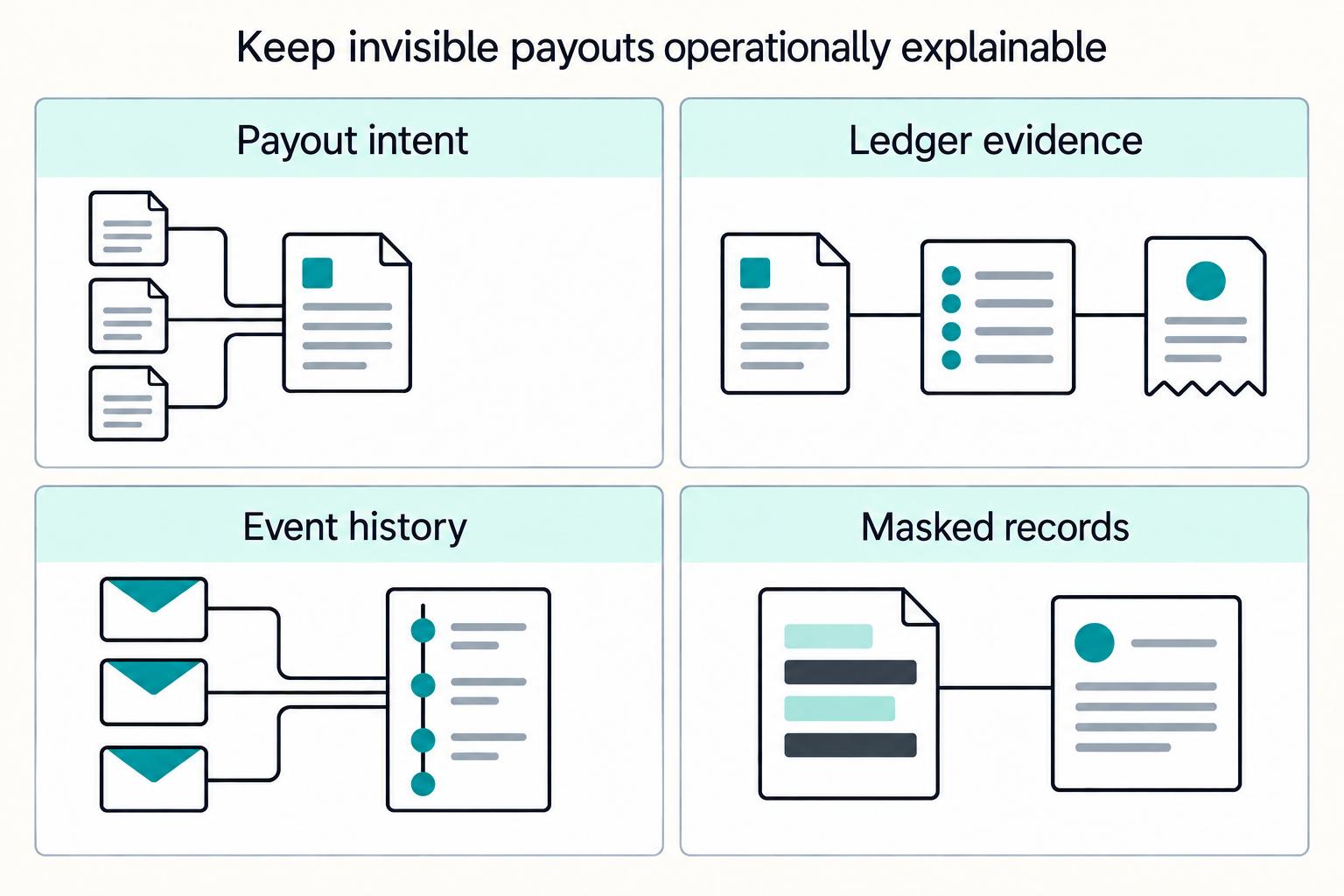
Invisible payouts should make life easier for contractors without hiding the controls your team needs. Contractors should get a predictable, low-friction flow, while internal teams can still enforce and document payout decisions when needed. If you run contractor payouts at scale, you need both outcomes at once. We recommend treating every easy payout as a controlled release path your team can replay later.
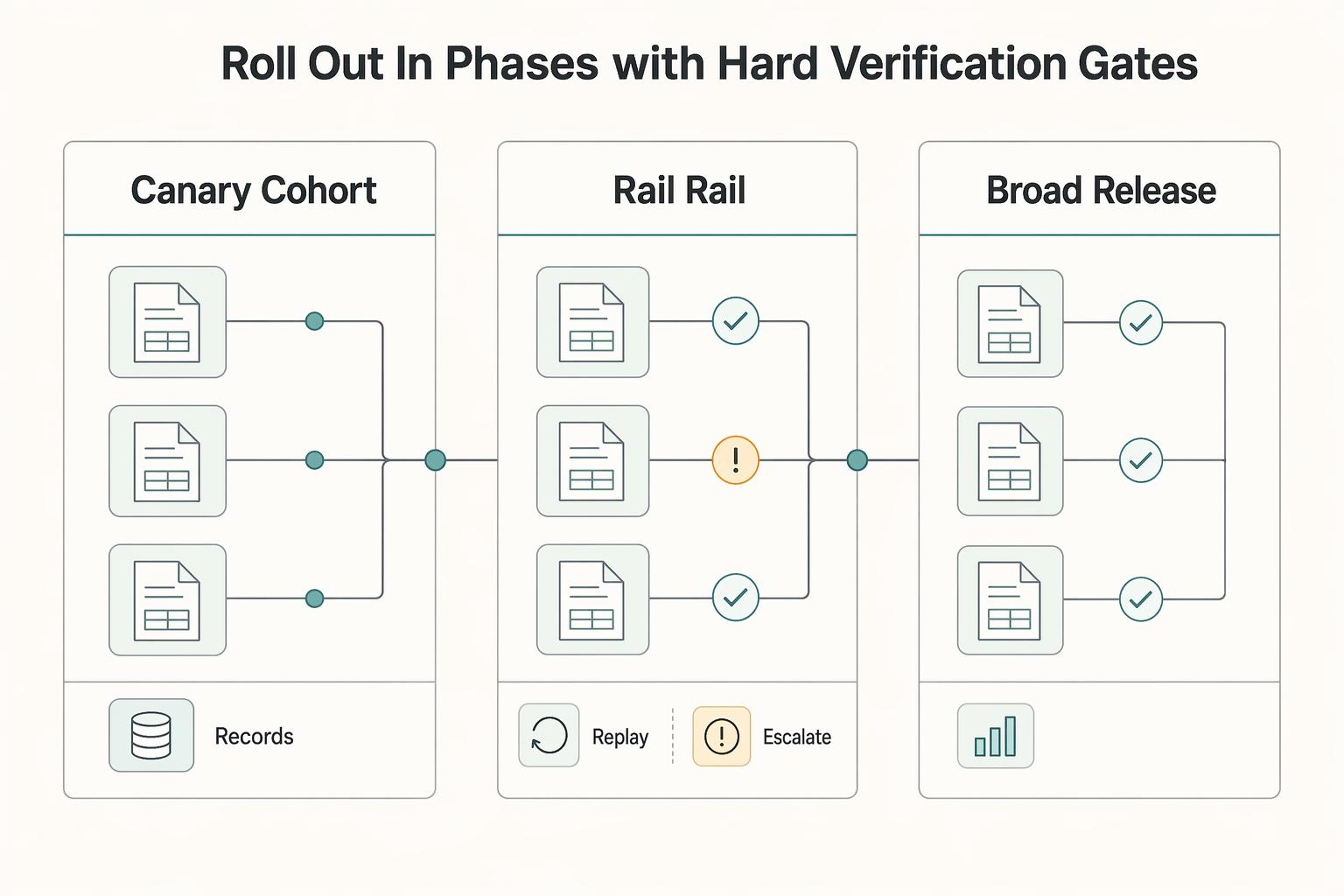
A payout tracker can help build trust when recipients can see what is happening, what happens next, and whether they need to act, without opening a support ticket. When payout status is vague, routine questions can turn into tickets, calls, and escalations. When status is clear, timestamped, and action-oriented, recipients can self-serve and support teams may spend less time chasing updates.