
Quick Answer
Record who acted, on which authority, what changed, why and the verified outcome. Capture decisions reliably, protect access and retention, and compare unique source events with stored records. Integrity checks do not prove completeness; exports need defined scope, cutoff, provenance and visible gaps.
Build a record that can explain a challenged decision#
A compliance audit log should let an authorized reviewer establish who changed a payout, what changed, why it was permitted or blocked, and what happened afterward. The final amount or a successful API response does not answer those questions. A useful log links the decision to its authority, evidence, external outcome and any later correction.
This guide uses payout operations as a worked example and gives six implementation steps. The aim is retrievable, protected and explainable evidence within a defined scope. No log design guarantees regulatory acceptance, legal admissibility or certification; those depend on the applicable requirements and how the controls actually operated.
Step 1: Define the review scope and evidence obligations#
Inventory the decisions and records needed for the applicable law, contract and control program. Assign owners for requirements, capture, retention, access, incident handling and evidence delivery. Specify the covered systems, legal entities, event families and periods rather than claiming one logging standard covers every payment platform.
Include paths that can change a beneficiary, amount, release approval, compliance hold, journal entry or evidence-access permission. Inventory admin consoles, scripts, API services, delegated service accounts and third-party review tools, not only the customer interface. Unauthorized attempts and failed actions can be relevant even when no payment state changed.
NIST SP 800-53 Rev. 5 provides a customizable control catalog, including audit and accountability, rather than a universal private-platform event schema. NIST’s publication page notes Release 5.2.0 from August 2025. Use the applicable selected controls and current implementation context; a framework reference does not establish that an unrelated government contract or criminal-justice policy applies to your business.
Write a short requirements matrix: control/obligation, required event and evidence, responsible system, owner, retention trigger, retrieval target and response to capture failure. Distinguish an internal escalation target from a legal reporting deadline. Where notification duties apply, the responsible team must determine the actual trigger and deadline; an internal suspicion timestamp does not redefine a statutory awareness test.
Step 2: Specify events that explain authority and outcome#
Define a common envelope plus event-specific fields for high-risk decisions. Capture the authenticated actor and any delegation, affected tenant/legal entity and object, action and result, event and recording times, material before/after values, reason, applicable policy/version and protected evidence references. Define when fields are required or explicitly inapplicable.
| Contract item | Question it answers | Important distinction |
|---|---|---|
| Event/source identity and schema version | Which recorded occurrence and interpretation is this? | A repeat delivery is not a new decision |
| Tenant/legal entity and object reference | Which business context was affected? | Validate context; do not trust an arbitrary supplied tenant ID |
| Actor, actor type and delegation | Who or which service acted, and on whose authority? | A service account is not the same as the human who initiated its job |
| Action, result and before/after values | What was requested and what actually changed? | Rejected actions can lack a new state; record the rejection rather than invent one |
| Occurrence and recording time | When did it happen and when was it captured? | Clock skew and late ingestion can affect chronology |
| Reason and policy/rule version | Why was the decision taken under that rule? | A generic approved status is not a reason |
| Case, evidence and operation references | Where can the decision and external result be checked? | A ticket link must remain retrievable and access-controlled |
Use exact monetary units and currency where amounts are involved, and reference the appropriate beneficiary record version. For automated decisions, preserve the rule/model/version and inputs needed to explain the outcome within the approved data policy. A confidence score is optional supporting information where meaningful; it does not by itself justify a decision or prove that an operator reviewed it.
Reason codes need definitions and an escalation route for unknown values. Record errors and refused permission checks as their own results when in scope. An audit log is allowed to record that capture or evidence retrieval failed; it must not manufacture a complete-looking approval trail to hide that failure.
Worked example: a payout amount changes after approval#
Assume a hypothetical $1,000 contractor payout was approved. An operator requests a correction to $1,100 before submission. The platform’s example policy invalidates the earlier approval when the amount changes and requires a different authorized approver. The audit record should preserve the $1,000 approval, the $100 increase, its reason and supporting invoice, the invalidation, the new approval and the later provider operation.
| Recorded occurrence | Example evidence | What it does not prove |
|---|---|---|
| Original approval | $1,000, approver A, policy version and timestamp | Authorization for a later $1,100 amount |
| Change requested and applied | $1,000 → $1,100, operator B, invoice correction reference | That operator B may approve their own change |
| Previous approval invalidated | Affected approval ID and rule reference | That the payout has been canceled externally |
| New approval | $1,100, authorized approver C and evidence | That the recipient has received funds |
| Provider submission and verified outcome | Operation reference, submitted amount and outcome evidence | That every later return or adjustment is impossible |
If the provider already accepted the $1,000 transfer before the correction request, do not rewrite its amount or call it a $1,100 payment. Investigate the original outcome, then authorize any legitimate additional $100 operation under the policy. Link each operation and its financial effect to the obligation. The log should expose the difference between correcting an unsubmitted request and paying a residual amount after execution.
Step 3: Capture lineage reliably across system boundaries#
Link the business obligation, logical operation, execution attempts, provider references and audit events without merging their identities. Make the business change and durable local audit-capture intent atomic where appropriate, then deliver records reliably to the evidence store. Monitor the gaps that remain across external services.
A local transaction can prevent a committed amount change from losing its corresponding local audit intent. An outbox or another supported durable capture mechanism can then relay that record. The relay may retry; preserve a stable occurrence identity while recording delivery attempts separately. A log service unavailable after the change must not silently turn a capture failure into a clean history.
An external payout is outside that local transaction. Record what was requested, the known response and later verified outcome. A timeout is an uncertain result requiring investigation of the original operation. Replaying a historical audit event must not reexecute a payment. Retain legitimate later corrections, partial payments and returns rather than suppressing everything with the same payout ID.
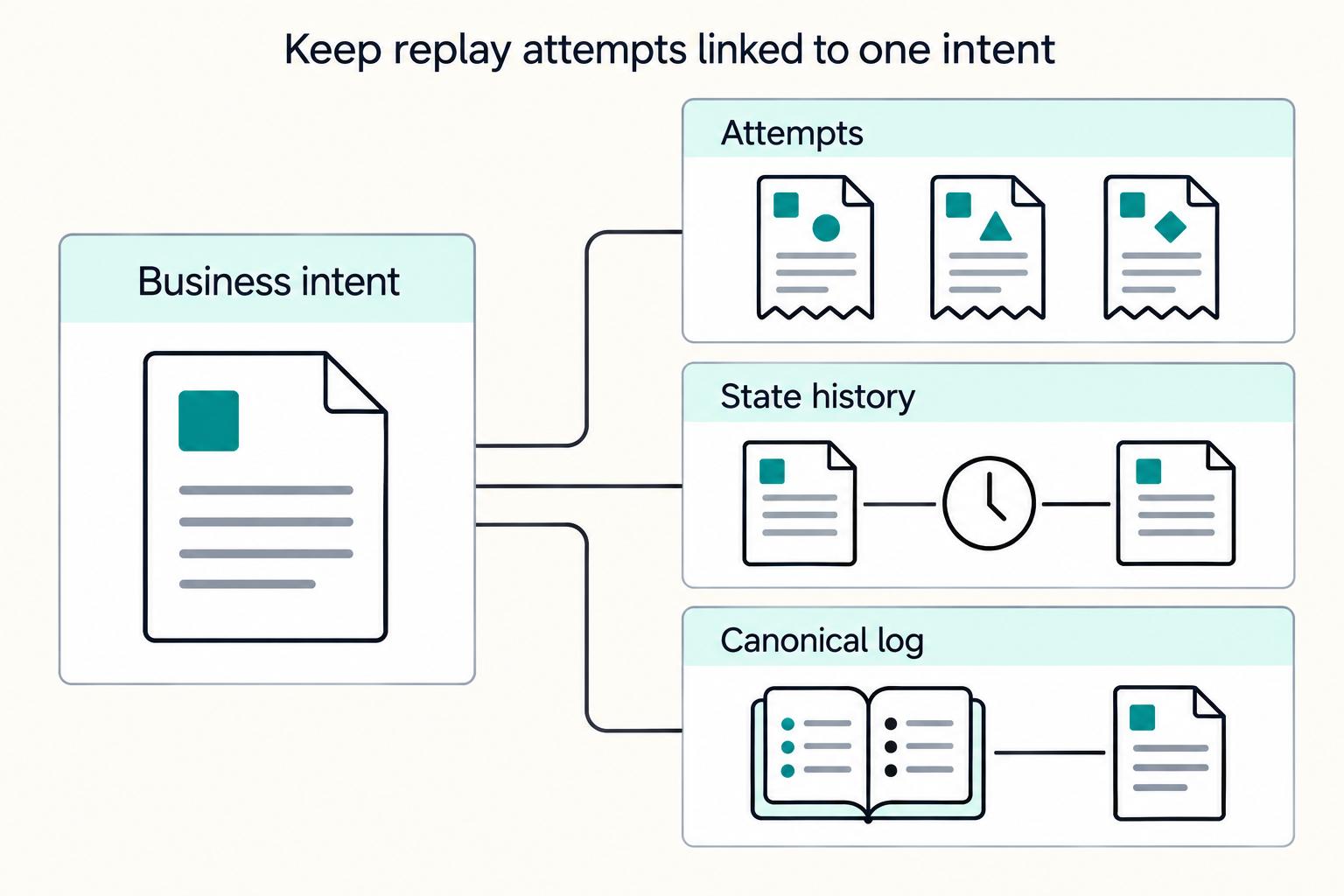
The diagram keeps one business intent linked to attempts, state history and the reconstruction log. Within that intent, use distinct operation and event identities for legitimate later actions. A repeated delivery can be a duplicate occurrence, while a later authorized adjustment is a new occurrence. Record source sequence/revision only where its authority and scope are defined; timestamps alone cannot establish a reliable total order.
Define the evidence used for each claim. Your internal record can establish who approved a change; a provider response can establish acceptance; bank or delivery evidence can establish the relevant external outcome. When records disagree, retain the discrepancy and its resolution. Choosing a reconstruction store is not permission to overrule external evidence without investigation.
Step 4: Protect records, access and retention#
Separate routine log writing from authority to alter retention, administer storage or export evidence. Protect transmission and storage, record evidence access and privileged actions, and use appropriate tamper-detection or write-protection controls. Define retention, deletion and preservation holds for the actual record categories and obligations.
OWASP’s Logging Cheat Sheet covers application-event context, excluded sensitive data, log injection and protection. Validate and encode untrusted event fields so a newline or delimiter cannot forge another record. Keep passwords, access tokens and unnecessary bank/tax identifiers out of general logs. Store necessary sensitive evidence with restricted access and reference it from the decision record.
“Append-only” at the application layer does not prevent a storage administrator from deleting files or a producer from omitting events. Document which threat each control addresses. Hashes can detect changes against a trusted comparison value; a hash stored beside a file by the same uncontrolled administrator offers limited assurance. Hash chains or signatures need protected keys/checkpoints and verification procedures, and neither proves that every required event was captured.
Amazon S3 Object Lock illustrates why configuration matters: governance-mode retention permits authorized bypass, while compliance mode protects a specific object version from overwrite/deletion during its retention period under the documented restrictions. A legal hold and time-based retention serve different functions. Choosing a mode does not certify the whole evidence system or establish that the record is accurate or complete.
Where GDPR applies, the regulation includes data minimization, storage limitation, security and qualified erasure rights, with exceptions such as applicable legal obligations and legal claims. Resolve these requirements alongside preservation duties. Do not keep all personal data forever because the log is immutable, and do not delete subject-linked evidence automatically without checking the applicable basis and hold.
Specify retention by record category, starting trigger, jurisdiction and preservation needs, including backups and replicas. Record authorized retention changes, exports and disposal. Masking reduces exposure but may still leave personal data; pseudonymous identifiers need their own controls. A broad evidence export must not let an operator read another tenant’s documents through a referenced link.
Step 5: Measure coverage and produce a reproducible evidence pack#
Compare required source occurrences and durable capture records with ingested audit records over a defined scope and cutoff. Check unique identities, event families, missing fields, unresolved gaps, late arrivals and capture lag. Export the approved evidence with its selection rules, versions, provenance and integrity verification information.
A stored archive is not a completeness test. Suppose the source records 100 in-scope unique decisions. The collector has 100 rows, but five are duplicate deliveries and five source decisions are absent. The collector contains only 95 matched unique decisions; equal row counts conceal the gap. Compare identities and required fields as well as counts, with a documented treatment of late records and authorized exclusions.
Define the capture lag acceptable for each control and a cutoff for the export. Record both occurrence and ingestion windows so a late-arriving event is visible. A filtered report can be useful, but it must state its coverage and limitations instead of being described as the complete history. Validate that referenced documents, policy versions and approvals are retrievable by an authorized reviewer.
| Pack component | Purpose | Limit to state |
|---|---|---|
| Scope and manifest | Period/time zone, entities, event types, cutoff and selection rules | What is outside the request or unavailable |
| Decision timeline | Actors, changes, reasons, authority and linked outcomes | Clock uncertainty, late arrivals or inferred ordering |
| Supporting evidence | Approved document/policy versions and provider references | Redactions, restricted references and missing artifacts |
| Coverage reconciliation | Unique source matches, gaps, duplicates and dispositions | Coverage is limited to the defined source inventory |
| Integrity and custody record | Export identity, digest, verifier, access and handoffs | An unchanged export can still omit source events |
Record who produced, verified and received the bundle, when, and under which query/tool/schema versions. Preserve the original approved evidence as required while making separately identified redacted copies for an authorized purpose. Legal-discovery handling may require additional preservation and privilege review; a routine operational export should not decide those questions by itself.
Reproducing an export from mutable sources months later may produce different data. Preserve a documented snapshot or source/version references and the cutoff needed for the promised reproduction. A matching digest establishes equality with that captured bundle, not authenticity of its original inputs or completeness of the underlying system.
Step 6: Test failures and make gaps visible during recovery#
Exercise unauthorized changes, self-approval attempts, repeated deliveries, out-of-order outcomes, collector outages, privileged deletion attempts and evidence retrieval. Define the release behavior when required capture fails, escalation ownership and recovery steps. Validate critical decisions and exports with an independent authorized reviewer before broader rollout.
Choose failure handling by the affected control. If a required durable decision record cannot be captured, the policy may block that high-risk action. A temporary delay between durable capture and a search index can have a different response. Avoid both silently proceeding without required evidence and claiming every telemetry failure legally requires stopping all payments.
Contain the affected path, preserve available records and identify the missing interval and event families. Recover from controlled source records and label recovered entries with the actual reconstruction time, original occurrence time where known, sources and uncertainties. Do not backdate a recovered approval to make it appear contemporaneous, or invent a reviewer decision that was never recorded.
For manual overrides and emergency access, record the requestor, approver where required, exact scope, reason, authority, duration and subsequent actions. Approval exceptions cannot legalize a prohibited transfer or bypass a mandatory legal restriction. Define authorized automation and human-review boundaries under the actual policy rather than claiming every consequential decision must always be manual.
Resolve each gap with a responsible owner and verify capture, access and retrieval afterward. Repeat a representative evidence request and check that another reviewer can reach the supported conclusion while seeing remaining uncertainty. The payment event-modeling guide adds detail on reliable publication and replay boundaries.
Frequently Asked Questions
What makes an audit log defensible in a regulatory review?
It supplies retrievable evidence of actors, authority, material changes, reasons and outcomes for a defined scope, with protected records and documented gaps. Completeness, integrity and custody need separate checks. No logging design by itself guarantees a regulator’s acceptance or legal admissibility.
What minimum fields should every compliance audit log event contain?
Use event/source identity, schema version, tenant/legal-entity and object references, actor and delegation, action/result, occurrence and recording times, relevant before/after values, reason, policy/version and protected evidence references. Define applicability by event type rather than inventing values for a rejected action or a field that does not apply.
How is an audit log different from screenshots and periodic evidence exports?
An audit log records occurrences and decisions over time; screenshots and exports can support an evidence pack but have their own scope and cutoff. Neither a screenshot nor a live log alone proves complete coverage. Compare required source events, preserve provenance and state the limitations of each artifact.
Why can native platform logs fail legal discovery or regulator requests?
They may omit material decision context, privileged actions, retention coverage, linked evidence or reliable export provenance. Native logs can be suitable when configured and verified for the actual requirements. Test the defined coverage and retrieval rather than assuming every native log is inadequate.
What should we log for manual overrides and emergency access?
Record the requestor and acting identity, delegated authority, approver where required, reason, exact affected scope, policy exception, start/expiry, before/after values and resulting actions. Monitor privileged evidence access too. An override cannot authorize conduct prohibited by applicable law.
When should a compliance event trigger escalation instead of routine monitoring?
Escalate when the applicable control, incident policy or legal requirement calls for it, including missing critical evidence, unauthorized changes and material unresolved outcomes. Assign owners and distinguish internal response targets from statutory triggers and deadlines. Not every routine logging delay requires the same response.
How can we prove data is complete and current rather than merely archived?
Reconcile unique source occurrences and required fields with ingested records for a defined scope/cutoff, including duplicates, gaps and late arrivals. Measure capture lag and evidence retrievability. Digests or protected storage support integrity; they do not prove that omitted events were captured or that input facts were accurate.
Researched and edited by the Gruv editorial team. Gruv builds cross-border billing, payouts, and finance-operations software for global businesses.
Sources
Includes 2 external sources outside the trusted-domain allowlist.
Educational content only. Not legal, tax, or financial advice.
Related Posts

The Freelance Payment Penalty: A Modeled Audit of Platform Fees, FX Spreads, and Payout Delays
The money rarely disappears through a single, easy-to-spot fee. The real loss is stacked. A marketplace takes its commission, a processor adds a charge for international cards, a bank or payment company converts the currency at a spread, a platform holds the funds before release, and a wire sheds a little to intermediaries on the way in. Each layer looks defensible on its own, but the worker feels the combined result as a smaller deposit and a later payday.

How to Respond to a Subpoena for Business Records
Move fast, but do not produce records on instinct. If you need to **respond to a subpoena for business records**, your immediate job is to control deadlines, preserve records, and make any later production defensible.

A US Expat's Guide to Investing in UCITS ETFs to Avoid PFIC Issues
The real problem is a two-system conflict. U.S. tax treatment can punish the wrong fund choice, while local product-access constraints can block the funds you want to buy in the first place. For **us expat ucits etfs**, the practical question is not "Which product is best?" It is "What can I access, report, and keep doing every year without guessing?" Use this four-part filter before any trade: