
Quick Answer
Research organizations can pay study participants globally by defining payment terms early, classifying each payout as reimbursement, compensation, or both, and validating each country before launch. They should set minimum data, approval, privacy, and reconciliation controls up front, choose centralized, local, or hybrid routing based on country risk, and pause expansion when repeated classification, reconciliation, or privacy issues appear.
Why global participant payouts break even strong trial operations#
Global participant payouts can break when compliance and privacy are treated as late legal reviews after the payment flow is already built. If you need to scale, payout design should start as a product requirement, with clear ownership across product, finance, ops, and engineering.
That is the core challenge with clinical trial participant payments at global scale. The problem is not just moving funds. IQVIA frames regulatory compliance and data privacy as core challenges, and industry commentary describes global patient payments as operating at the intersection of clinical trial regulations, data privacy regulations, and banking regulations. Once a study spans multiple countries, teams may need to handle different legal processes, data-handling expectations, and operational risks inside one program.
Why strong teams still get stuck#
Even strong trial teams can stall on payouts when ownership is split. Legal focuses on permissibility, finance on controls and execution, ops on participant experience and exceptions, and engineering on data fields, integrations, and status logic. When those decisions happen in sequence instead of together, teams create rework and inconsistent country handling.
Privacy is often where the risk becomes obvious. Under GDPR, data concerning health is special-category data, with processing restricted except in limited Article 9 circumstances. That does not mean every payout record is health data. It does mean payment operations tied to trial participation cannot assume standard consumer-payments handling is enough.
Where public guidance usually stops#
Public guidance is useful, but much of it stops at the problem statement. IQVIA helps define the challenge. The SCRS Payment Initiative highlights pressure points such as holdbacks, delayed payment frequencies, and tax on participant reimbursements. What operators still need is the missing middle: sequencing, controls, approval points, and ownership.
Search results also pull in adjacent content that does not solve payout operations. CRO directory content answers who the organizations are, not how to run participant payouts across jurisdictions. Global-perspective commentary can sharpen the debate, but it may not tell you exactly what to build or who should approve country go-live decisions.
What an executable model looks like#
A workable model starts with a few non-negotiables before you choose tools or vendors. Decide:
- What is being paid in each country: participation payment, expense reimbursement, or both?
- What participant data is required to execute payouts, and what data must stay out?
- Who approves new countries, exceptions, and payout-handling changes?
- What record shows payment request, approval, execution, and reconciliation?
Traceability matters. Good Clinical Practice (ICH E6) is about how trials are designed, conducted, recorded, and reported, so payout operations that cannot be clearly recorded can become a review risk.
This article stays intentionally narrow: how to build participant payout operations that work across countries. It is not CRO ranking content or generic thought leadership. The practical path is to define payment terms early, choose an operating model, and build country, data, and control requirements into the product before scale exposes the gaps.
Related: How to Price a Clinical Trial Data Analysis Project.
Define payment terms before you choose tools#
Define payment terms before vendor selection, or your tooling can lock in the wrong legal, tax, and data assumptions. Before build work starts, decide what you are paying for, where you are paying it, and what records you must retain.
Start with reimbursement versus compensation#
Treat these as separate payment types from day one. Participant reimbursement repays participant expenses, while participant compensation acknowledges time and effort. They are not interchangeable, and ethics or tax treatment can differ by jurisdiction. U.S. guidance also frames travel reimbursement differently from payment for participation.
Use one category per payout purpose before implementation. If a study pays both, keep separate purposes, approvals, and records instead of bundling them into one amount. In the U.S., UCSF HRPP notes that total participant payments of $600 or more in a calendar year are reportable as taxable income to the IRS.
Define what global actually means#
"Global" should mean multi-jurisdiction execution, not just multicurrency payout. In practice, that means jurisdiction-specific compliance and privacy obligations, with regulatory compliance and data privacy handled as operating requirements, not late legal cleanup. Under GDPR, research processing of special-category data must be based on Union or Member State law.
Set data scope before any demo or integration work. For each country, define which participant fields are required to execute payment, which are optional, and which must stay out of the payout tool.
Make audit-ready a control objective#
Set "audit-ready" as a control objective before tooling decisions. You should be able to trace each payout across your workflow, including request, approval, execution, and reconciliation, with records that support review. GCP essential documents are meant to allow evaluation of study conduct and data quality. ICH E6(R3) states that source-record changes should remain traceable, preserve the original entry, and be explained through an audit trail.
Ask every tool and process owner for the same evidence pack: request source, approval record, execution reference, edit history, and reconciliation output. If a system only shows payment status without clear change and approval traceability, it can create review risk as programs scale. For a deeper dive, see Mass Payments for Research Panels: How to Pay Survey Participants and Clinical Trial Subjects at Scale.
Compare centralized, local, and hybrid payout models#
Pick the model based on where the real risk sits. A common starting point is centralized for repeatable multi-country volume, local where country requirements are unclear, and hybrid when you need both scale and local judgment. For many teams, that means a standard global lane plus defined local escalation lanes, not one pattern everywhere.
Global rollout gets harder at the country edge. Cross-border participant payouts face country-by-country differences in regulations, banking infrastructure, and data privacy laws, and payment methods can fail when they are not locally tailored. As one operator source puts it, sponsors need "region-specific payment solutions" that handle local laws and banking systems.
| Model | Jurisdiction coverage | Payout method fit | Exception handling speed | Reconciliation effort | Dependency on local legal interpretation |
|---|---|---|---|---|---|
| Centralized global payment platforms | Broad starting reach across many countries (for example, a provider claim of payments in over 180 countries). | Strong for standard, repeatable programs; may miss local participant method preferences in some markets. | Often quicker for routine exceptions in one queue; issues tied to local banking or legal context may still slow handling. | Can be lower when approvals, execution, and reporting stay in one connected system. | Still material; country-specific questions can surface at launch or first exception. |
| Local country vendors | Narrower by design, usually country or region specific. | Strong local fit for methods, documentation, and market practice. | Can be quicker on local issues; cross-country coordination can add delay. | Higher effort as methods, files, and guidance fragment across vendors. | High and explicit; local interpretation is core to execution. |
| Hybrid routing | Broad overall coverage with local routing only where needed. | Better balance: keep standard methods centrally and add local options in difficult markets. | Depends on routing design: routine cases centralized, ambiguous cases escalated locally. | Medium: one core process plus controls for split routing and handoffs. | Targeted use of local interpretation where risk is highest. |
The practical decision rule#
If country count is high and payout volume is recurring, centralized routing is often the first model to validate, then add exceptions where the evidence says you need them. This can improve consistency and reconciliation visibility when one connected system is used.
Do not treat broad country coverage as proof of launch readiness. A coverage claim helps you shortlist vendors, but you still need country-level validation for your exact payment purpose, required participant data fields, and payout methods.
If legal ambiguity is high in target markets, consider hybrid early and define local escalation before launch. That is often safer when the hard issue is local legal interpretation or payment-method acceptance, not basic money movement.
Where each model breaks#
Centralization improves standardization and can reduce reconciliation friction at scale when payment activity stays connected to core clinical and finance workflows. It still breaks at the edge when a technically supported country does not support participant-preferred methods or requires local handling your standard flow cannot absorb.
Local vendors can reduce launch risk where requirements or payment preferences are unclear. The tradeoff is operating drag: decentralized administration is associated with inconsistent reconciliation enforcement, and fragmented payment methods and guidance increase complexity.
Hybrid can work best when ambiguity is concentrated in specific markets. Keep stable markets on the global rail, and route unsettled markets to local expertise, especially when reimbursement and compensation both exist and require different handling.
What to verify before locking the model#
Before you commit, require the same proof set for each vendor or route:
- Country support for your exact payment purpose and participant payment category
- Supported payout methods by country
- Exception owner and escalation path
- Reconciliation output format
- Sample evidence for failed payout, returned payout, and manual adjustment, including approval trace
This prevents a common failure mode: a country is "covered," but real execution fails on participant method fit, local banking behavior, or unresolved local interpretation. A practical rule is simple: centralize where evidence supports standard handling, and localize where evidence shows local constraints.
For a step-by-step walkthrough, see What is a Virtual IBAN and How Do Platforms Use It to Collect Payments Globally?.
Build a country readiness gate before launch#
Set a hard go or no-go gate for each country before launch. If you cannot show the payout purpose, the minimum data needed to execute it, and the named owner for exceptions, that country is not ready.
Broad platform coverage is only a starting signal. Country readiness should be evidenced by signed artifacts that tie payment purpose, privacy handling, and operational ownership to real execution.
What the gate should require#
Use one internal checklist with five required confirmations before any country goes live:
| Area | Confirm before launch | Sign-off artifact | No-go trigger |
|---|---|---|---|
| Payment classification | Whether the payout is participant reimbursement, participant compensation, or both | Country payment-purpose memo or approval sheet | Reimbursement vs compensation is unresolved or treated as interchangeable |
| Documentation | What the participant, site, and study team must retain or submit | Required-documents list tied to each payout type | Required records are undefined |
| Tax treatment review | Whether tax assumptions were checked for the current jurisdiction and program | Country tax review note with decision date | Team is relying on stale assumptions |
| Privacy controls | Which participant fields are needed for payout and who can access them | Field-level data map and access approval | Sensitive data is passed without documented need |
| Exception ownership | Who handles failed payouts, returns, and legal-interpretation questions | Named escalation owner and handoff path | No accountable owner for country-specific issues |
Classification is the first real checkpoint. FDA distinguishes reimbursement for travel expenses to and from the clinical trial site from participation payment and describes participation payment as tied to factors like time, inconvenience, or discomfort. SACHRP also recommends evaluating payment offers by purpose category, including reimbursement and compensation. Operationally, use that as a launch rule: each payout reason in each country must be explicitly classified before funds move.
Make privacy part of launch, not a later review#
Keep privacy controls inside the launch gate, not in a separate queue. Industry guidance already flags regulatory compliance and data privacy as core participant-payment challenges.
For EU/EEA processing, GDPR Article 9 treats health data as special-category data, so the country file should state why any health-related field is in the payout flow. In U.S. covered-entity contexts, HIPAA minimum necessary requires limiting PHI access and disclosure to what is needed for the payout purpose. ICH GCP also requires protecting records that could identify subjects. In practice, send only the minimum participant data needed to deliver payment.
The go or no-go rule#
Do not launch a country if participant reimbursement and participant compensation are not clearly classified. Before approval, require a three-way match between study payment language, the documented disbursement approach, and the payout configuration. In FDA-regulated contexts, the IRB should review payment amount and the proposed method and timing of disbursement. If those records do not align, pause launch. If a country needs both reimbursement and compensation, split them into separate payout reasons with separate evidence trails.
Revalidate policy assumptions#
Run a dated policy-status check as part of every country launch. Congress.gov shows the Clinical Trial Modernization Act (H.R. 3521) at introduced status on 05/20/2025, with a summary that includes a proposed tax exemption of up to $2,000 in clinical trial remuneration. A separate 119th Congress bill was introduced on 06/26/2025. A House press release for the Harley Jacobsen Clinical Trial Participant Income Exemption Act says it aims to exempt all participant payments from gross income.
Treat those as policy-shift signals, not enacted-law shortcuts. Revalidate assumptions at launch so tax and classification treatment does not drift out of date.
Related: How to Embed Payments Into Your Gig Platform Without Rebuilding Your Stack.
Use this go/no-go checklist to design payout flows with policy gates, traceable statuses, and exception handling in Gruv Payouts.
Design payout rails and participant UX by scenario#
Choose one payout rail per scenario, not every available rail by default. Match the path to participant context, the IRB-reviewed disbursement method and timing, and country and program constraints. Then make that path easy to understand and easy to support when something goes wrong.
| Participant context | Payout path | When it fits | Constraints to confirm |
|---|---|---|---|
| Participant has a usable bank account, stable account details, and the program allows account-based payout | Bank transfer | When payout timing and recipient details can be collected reliably | Method must be allowed for that country/program; collect only minimum recipient data; method and timing must match the IRB-reviewed approach |
| Participant cannot or will not use a bank account, or setup friction is likely to block completion | Prepaid method | When a simpler setup experience is needed for recurring payments | Availability varies by country/program; participant terms should clearly state use, limits, and payment purpose |
| Market has higher banking friction, local documentation requirements, or unresolved interpretation questions | Local partner route | When local execution or interpretation support is needed | Confirm country-specific arrangements before launch; keep central status visibility, audit records, and named exception ownership |
Sequence the flow in one fixed order#
Run the flow in a fixed order so teams do not improvise around exceptions later.
- Run identity and policy checks first.
Confirm eligibility for the payout reason in that study and country, and classify the payment purpose (reimbursement, compensation, or both).
- Create payout instructions only after checks pass.
Tie instructions to a visit, milestone, or approved expense item. FDA's January 2018 guidance states IRB review should cover amount plus disbursement method and timing, so pause if configuration does not match reviewed terms.
- Expose participant-visible status.
Show clear states such as details needed, processing, sent, or action required.
- Retry by failure class.
Retry transient settlement delays where appropriate. Route incomplete recipient details and returned payouts to a named owner for correction and decision.
- Notify on meaningful state changes.
Notify participants at setup completion, payout sent, and action required. Alert owners when exceptions age.
Separate failure modes so teams can act fast#
Do not collapse returned payouts, incomplete recipient details, and delayed settlement into one generic exception state. Keep separate statuses so teams can tell whether the issue is participant data, payout rail execution, or a market-specific constraint.
For each failed payout, require three fields in the case record: current status, next action, and owner. Keep return traces and retry or escalation decisions visible. Do not assume exceptions can always be auto-resolved.
In the EU, centralized authorization does not make payout handling uniform. The Clinical Trials Regulation entered into application on 31 January 2022. Sponsors must submit all new applications via CTIS from 31 January 2023. EU compensation documentation still notes that national arrangements may differ.
Use participant copy as an operational control#
Participant-facing language is part of the control model, not just a communications task. Make payment purpose explicit. If payment is for travel or other out-of-pocket costs, state what is covered and what is not. If payment is for time or burden, label it as compensation rather than collapsing categories into a vague payment line.
That supports ethics and trust. FDA distinguishes reimbursement from payment for participation in its undue-influence lens, and published analysis shows payment-purpose labeling is often ambiguous. If a participant withdraws early, align payout behavior with accrual over study progress rather than full completion.
If payout setup drop-off is high, simplify onboarding before adding reminders: remove nonessential fields, explain why each field is needed, and defer optional profile collection. If failure rates spike in one market, route execution through local expertise rather than treating it as a generic processing issue. Make trust signals visible through predictable timelines, clear compensation status, and clear status updates.
Related: How Platform Operators Pay Creators Globally Across YouTube, Twitch, and Substack.
Make audit and reconciliation non-negotiable from day one#
Treat audit evidence and reconciliation as core product requirements from the start. If you cannot trace a participant payout from request through approval and execution, including any return and final ledger match, the model is not audit-ready.
Set a minimum evidence pack for every payout#
Regulators do not provide one universal payout checklist, so define and enforce a minimum pack for each payout. One operational baseline is linked records for request source, approval, execution, any reversal or return, and reconciliation output.
Anchor that pack to one stable payout ID. An operator should be able to open a case and see who initiated it, what visit or expense it maps to, who approved it, when it was sent, and whether it later failed or reversed.
Design records for traceability, not just storage#
Build for end-to-end review, not just storage. ICH E6(R3) frames essential records as evidence for trial-conduct evaluation, oversight, audits, and inspections. It also expects identification, version history, search, and retrieval across records.
For CROs, this is a direct accountability issue. Under 21 CFR 312.52, when a CRO assumes sponsor obligations, it carries sponsor-level accountability for those obligations, so records cannot stop at "payment sent."
For electronic records, 21 CFR Part 11 expects secure, time-stamped audit trails, preserved prior entries, and access limited to authorized individuals. In practice, keep edit history for recipient and payout changes instead of overwriting prior values.
Keep sensitive fields on a need-to-know basis#
Audit-ready does not mean collecting or exposing everything. GDPR Article 5(1)(c) sets a data minimization standard: keep personal data adequate, relevant, and limited to what is necessary for the processing purpose.
Use that standard operationally. Mask sensitive payment details in routine views, restrict full-data access, and separate troubleshooting access from approval authority.
Review on a fixed cadence#
Use a documented control cadence even where law does not prescribe exact frequencies. For example, recurring exception review, reconciliation sign-off, and periodic control testing can help with payout accuracy, duplicate prevention, and access-control effectiveness.
Each review should produce evidence you can retrieve later. Also align retention with trial-record policy. Under 21 CFR 312.57 and 21 CFR 312.62, sponsor and investigator records use a 2-year retention trigger, so payout evidence tied to those records should not expire earlier.
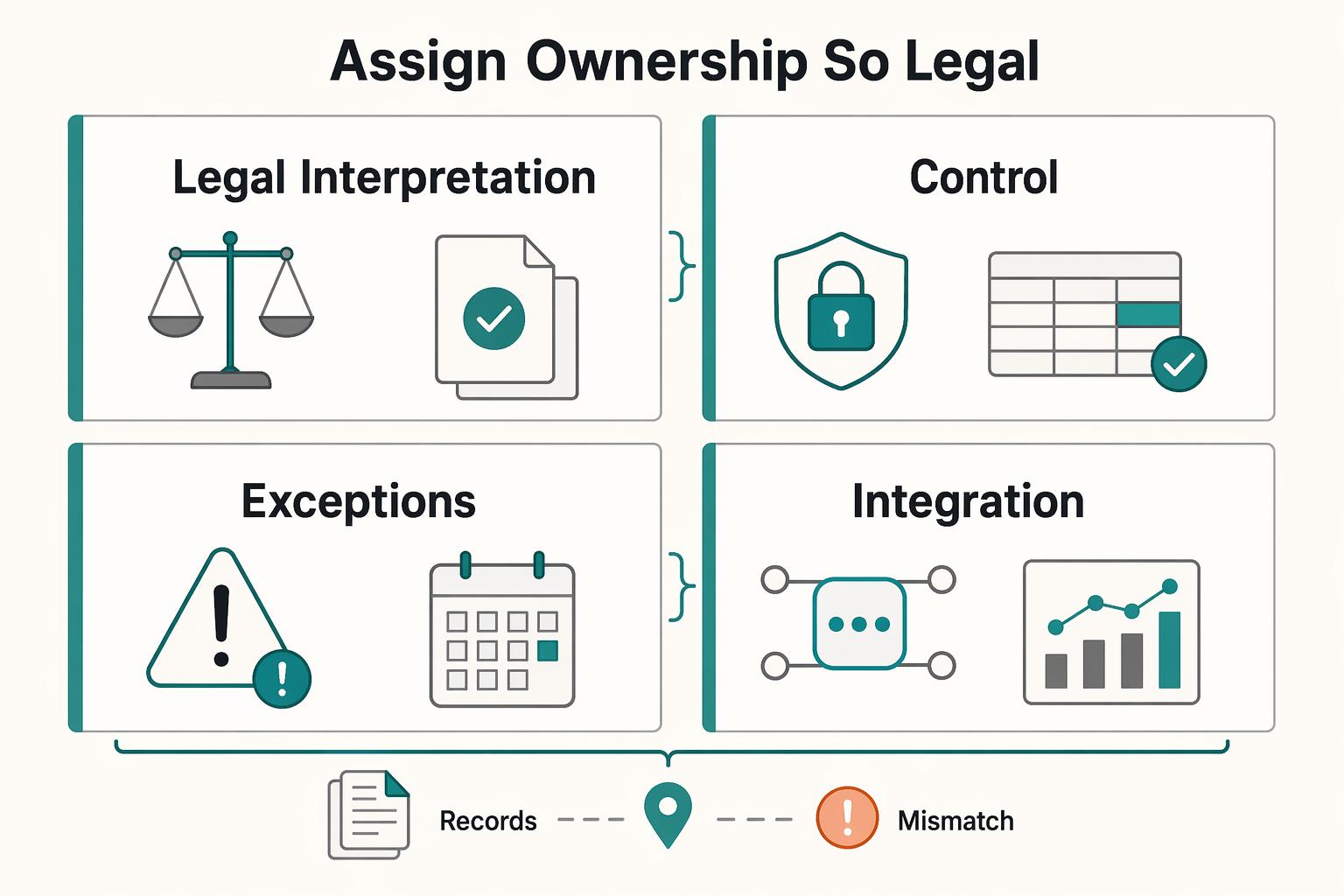
Assign ownership so legal, finance, ops, and engineering do not drift#
Lock ownership by decision type before launch to reduce payment-governance drift. A practical pattern is to keep legal interpretation, finance controls, ops exceptions, and engineering changes in separate decision lanes with named owners.
Start from sponsor responsibilities, including monitoring and risk communication, then document only what is explicitly delegated. Under 21 CFR 312.52, delegation to a CRO must be in writing, and anything not written remains with the sponsor. When a CRO assumes sponsor duties, sponsor-level obligations apply to that CRO for those duties. In the EU, delegation also does not remove sponsor responsibility, so outsourcing execution is not outsourcing accountability.
| Decision type | Primary owner | What they own in practice | Verification detail |
|---|---|---|---|
| Legal interpretation | Sponsor legal/compliance or delegated CRO legal lead | Payment classification (reimbursement vs participation payment), local ethics/authority consultation needs, and IRB-facing payment language | Keep written delegation, country-level legal analysis, and the IRB payment amount/schedule record together |
| Finance controls | Finance/controller | Approval controls, ledger treatment, reconciliation sign-off, returns, and duplicate prevention | Link approver record, payout ID, and settlement/reconciliation evidence |
| Ops exceptions | Payments or trial operations | Failed payouts, missing recipient data, participant follow-up, and manual holds | Require a case owner and timestamped case history |
| Engineering integration | Product/engineering with compliance review | Required data fields, access controls, status events, and payout-system integrations | Confirm changes route privacy incidents to the controller path |
A simple accountability matrix per study and country can help, even if it is one page. The real test is whether each row names a person helped to decide, not just a function.
For unresolved country questions, use a formal escalation path tied to regulatory-compliance risk. If payment classification, IRB expectations, or local ethics requirements are unclear, pause that country until legal resolves the issue or local authorities or research ethics committees are consulted. With over 1,000 human-subjects standards across 131 countries, assumption-based rollout is not credible. Keep a separate privacy escalation owner as well, because GDPR breach notification runs on a 72-hour clock. Related reading: How to Write a Payments and Compliance Policy for Your Gig Platform.
Anticipate the failure modes competitors usually skip#
Treat isolated payout errors as operational noise. Treat repeated control failures as a pause signal. The main risk is not one returned transfer. It is letting misclassification, missing artifacts, duplicate retries, and privacy errors accumulate until you cannot explain payouts country by country.
Participant payments are often difficult because compliance, banking, fraud, tax, and data-privacy risks show up at the same time. In practice, breakdowns can be cross-functional: legal interpretation, approval controls, and execution drift together.
Misclassification breaks more than tax handling#
Do not treat reimbursement and participation payment as interchangeable labels. FDA guidance distinguishes reasonable travel and lodging reimbursement from other participation payments, and expects IRBs to review payment amount, method, and timing so payments are not coercive.
If country files, IRB language, and product labels do not align, pause that market and re-verify payment purpose before additional disbursements. If internal policy and local ethics guidance conflict, stop expansion in that country until the conflict is resolved.
Missing artifacts destroy defensibility fast#
If you cannot produce the approval trail quickly, you do not have a defensible control environment. ICH E6(R3) (finalized 06 January 2025) emphasizes record integrity, traceability, and personal-information protection, so each payout should be traceable from request through approval, execution, and any return or reversal.
Run a recurring sample across successful, failed, and reversed payouts. If approvals live in separate tickets, or IRB-approved schedules are disconnected from live disbursement logic, treat that as a control gap, not admin cleanup.
Retries and returns are where money can go missing twice#
Ambiguous statuses plus manual resend paths can create duplicate payouts. Design retries so they reference the original payout instruction rather than creating a new payable by default, and pause automated retries if reconciliation cannot prove that linkage.
Returns need the same discipline: a named owner, reason code, and next-action date. Delayed payment handling has been linked to strained operations and weaker study performance, so do not let returned funds sit in open-ended investigation queues.
Red flags that should force an immediate pause#
Some signals should stop expansion immediately. Pause new-country rollout or scale-up when you see:
- unexplained reconciliation gaps between approved payouts, executed payouts, and returned funds
- country-level policy conflicts on reimbursement vs participation payment treatment
- repeated privacy-handling errors, especially collection or exposure of data not necessary for exception handling
Data minimisation still applies during exceptions. If teams repeatedly request extra participant data that is not needed to resolve payout issues, fix the workflow before resuming volume.
Contain first, then diagnose#
When red flags appear, isolate the affected markets instead of freezing everything globally. Switch those markets to manual approval gating, suspend auto-retries, and require finance sign-off for resends and reversals.
Then run a targeted root-cause review across three records: country policy, approval artifact, and execution or reconciliation trail. Resume scale only after the failure is explained, the records are complete, and fresh test payouts do not reproduce the issue.
Decide when local expertise is mandatory#
Use local expertise whenever local tax treatment or legal classification of participant payments is unclear, or when local rules are actively changing. In those cases, a centralized team should not make the final call alone before starting or restarting research activities. Escalate to local counsel, a local regulatory partner, or an in-country operating partner first.
This rule matters because participant payments sit at the intersection of clinical-trial, privacy, and banking rules. DIA Global Forum separates reimbursement, compensation, and incentives, and notes that guidance is often inconsistent. If your team cannot clearly confirm how a payout is treated locally, treat it as an interpretation risk, not only a routing issue.
Where centralized execution works#
Centralized payment platforms are most defensible in stable, repeatable markets where payment purpose, payout methods, and required participant data are already clear. If you are paying similar participant categories repeatedly in countries with settled internal guidance, centralization can be easier to govern consistently.
Broad coverage claims are still not enough on their own. A vendor can support many countries and currencies and still leave your specific compensation model unresolved in a given jurisdiction. "Country supported" may mean the payment rail exists, not that local tax, ethics, and documentation expectations are fully cleared for your study model.
Where local-led execution is the safer choice#
Use local-led execution when ambiguity is the main risk. Common triggers are unresolved reimbursement-versus-compensation treatment, recent regulatory updates, or local ethics uncertainty.
This is also where broad guidance stops being enough. IQVIA and DIA Global Forum are useful starting points, but treat that guidance as provisional until local reviewers confirm your interpretation. OHRP is explicit that international compilations are not exhaustive and advises checking with local authorities or research ethics committees before research starts.
ClinRegs is useful for planning because it tracks country-specific regulatory information and updates. Country profiles, for example, showed updates on Mar 19, 2026 (South Africa) and Mar 27, 2026 (Sierra Leone). If your internal country memo is older than the current profile or local guidance cycle, revalidate before paying.
Add a procurement checkpoint before you sign#
Procurement should verify country-specific capability, not just global marketing. Before signing a CRO, PSP, or platform, ask for evidence for the exact countries in your launch cohort:
- named local escalation paths for tax, ethics, and payout-operation questions
- country-by-country handling of reimbursement, compensation, and incentives
- sample artifacts for approval, execution, returns, and participant communications
- written responsibility allocation when sponsor duties are transferred to a CRO, since those transfers must be documented in writing
One risk is buying centralization for interpretation risk it cannot solve. If a vendor can only show coverage maps, currencies, and payout methods, assume local expertise is still required before go-live.
Related: Bug Bounty Platforms: How Security Research Platforms Pay Ethical Hackers Globally.
Execute a 90-day rollout with hard checkpoints#
Use the first 90 days as a gated launch: define payment structure and ownership first, implement controls second, and pilot only where both gates are cleared. The standard is not just payout capability, but whether each payout is defined, approved, and defensible. End every phase with a formal decision: proceed, remediate, or stop.
Phase 1. Lock definitions and ownership before building payout logic#
Lock definitions and ownership before building payout logic. Keep reimbursement and participation payment explicitly separated in your operating model, and make sure payment amount and schedule are ready for IRB review at initial review.
Keep the country shortlist narrow enough to verify. With over 1,000 human-research laws, regulations, and guidelines across more than 130 countries, phase one should assign named owners for legal interpretation, finance controls, operations exceptions, and engineering changes in each launch country. Minimum phase-one evidence pack:
- payment category definitions by study use case, including reimbursement versus participation payment
- a country risk register with open interpretation issues, unresolved tax questions, and local escalation contacts
- an ownership model showing who approves policy, who executes payouts, and who signs off exceptions
Checkpoint before build: confirm whether the proposed payment structure could raise undue-influence concerns in each launch country. If unclear, do not move that country forward.
Phase 2. Treat compliance and data privacy as release gates#
Treat regulatory compliance and data privacy as release gates, not cleanup tasks. Build a formal monitoring approach with defined plan content and clear monitoring-result communication, and align operations to sponsor monitoring duties.
Implementation is not complete unless records are traceable end to end. Require controls so trial information is recorded, handled, and stored adequately, with approval, execution, and reconciliation evidence available for audit. Keep payout operations aligned with GCP expectations for design, conduct, recording, and reporting.
For privacy controls, at minimum enforce purpose limitation, data minimisation, limited storage periods, and data protection by design and by default. Validate that by testing whether support and reconciliation teams can resolve failed payouts without unnecessary participant data exposure.
Phase 3. Pilot only in countries with no unresolved red flags#
Pilot only in countries that passed phase one and phase two without unresolved red flags. Judge the pilot by failure-class evidence, not just success rate: returned payouts, incomplete recipient details, approval gaps, unresolved classification issues, reconciliation mismatches, and privacy-handling exceptions.
For each failure class, document root cause, owner, and time to resolution. If a market shows repeated interpretation risk, hold expansion there and route through local expertise. Do not treat one smooth pilot country as sufficient evidence for global expansion.
Use a final steering checkpoint:
| Checkpoint outcome | Decision rule |
|---|---|
| Proceed | Controls held and failure classes are within managed thresholds |
| Remediate | Gaps are fixable with clear owners and bounded timelines |
| Stop | Legal treatment or documentation remains unstable |
Before expanding, revalidate country assumptions if internal memos are older than current country-tracking updates, including profiles updated on Mar 19, 2026.
Related: How to Recruit for User Research Without Wasting Study Time.
Track the right metrics before scaling#
Scale only when your control metrics stay stable across multiple countries and your participant trust signals are not drifting. Keep the post-launch view narrow and consistent: payout success rate, exception aging, reconciliation close time, and participant-facing status latency. Use internal baselines and trend stability for these metrics rather than universal benchmark thresholds. If those worsen as volume rises, treat that as a control risk, not normal launch noise.
Use one short metric set and keep it auditable:
- Operator metrics: payout success rate by attempt, aging buckets for unresolved exceptions, time to reconciliation close, and time for status updates to appear in participant support views.
- Trust metrics: trend in complaint volume tied to participant reimbursement delays, complaint themes tied to participant compensation timing or wording, and repeat contacts on the same payout issue.
Keep participant reimbursement and payment for participation separate in reporting. FDA treats travel-expense reimbursement differently from payment for time, inconvenience, or discomfort, and FDA also expects IRB review of payment amount and proposed disbursement timing and method. If you blend categories, you can lose the signal you need to see where participant trust is breaking.
Require each metric to trace to the same evidence chain: request source, approval record, execution reference, return or reversal trace, and reconciliation output. If support cases cannot be matched to payout events without inbox reconstruction, the metrics are not reliable enough for expansion.
Use a simple scale rule: expand only after this same metric set holds across more than one country. That matches the operating reality that regulatory, banking, and privacy challenges vary by country, and delayed payment frequencies are a known industry issue.
What teams should do next#
Start with definitions and ownership, then choose the operating model. If you start with vendor selection, unresolved legal, ethics, finance, and privacy decisions can surface later, when changes are harder.
For each program and country, create a short decision record before money moves:
- how the payment is being treated in that jurisdiction (reimbursement, payment for participation, or both)
- who approves that classification
- what evidence must exist before payout
Keep FDA's January 2018 guidance as a baseline: IRBs should review payment amount, method, and timing, and payment credit should accrue as the study progresses rather than depend on full-study completion.
Put country gates in front of tooling#
Treat tooling as downstream of country readiness. Use a minimum gate that confirms:
- payment classification for the jurisdiction and study design
- required participant fields are justified under data minimisation
- named owners across legal, finance, ops, and engineering
- payout method works in that market
- exception and return handling has clear ownership
If a provider requires participant data your team cannot justify as necessary for payout operations, resolve that before integration.
Build the evidence pack before volume arrives#
Build payout execution and audit evidence together, not in separate phases. At minimum, each payout record should connect:
- request source
- approval record
- execution reference
- any return or reversal trace
- reconciliation outcome
Without that chain, retries and duplicates can become harder to defend under pressure.
Expand in phases and keep stop/go checkpoints visible#
Use phased expansion because market conditions and legal treatment vary by jurisdiction. The EU framework itself notes harmonization is only partly achieved, which can make one trial harder to run across multiple Member States, and national implementation still matters.
A practical sequence is:
- Align terms, ownership, and controls.
- Pilot a small country set.
- Expand only where controls remain stable.
Keep regulatory-drift checks explicit in each phase. Revised ICH E6(R3) entered into force in the EU on 23 July 2025. UK clinical-trials amendment regulations come into force on 28 April 2026. Revalidate assumptions around those windows.
Use centralized tooling with local expertise where needed, not a one-model-fits-all assumption. If classification, approvals, or payout operations are still ambiguous in a market, pause expansion there until those gaps are closed.
When your team is ready to turn this plan into implementation details, start with the integration and operations references in Gruv Docs.
Frequently Asked Questions
How can research organizations pay clinical trial participants globally without violating local rules?
Research organizations should classify each payout first, then build the payout flow around that classification and the local rules for each country. Keep reimbursement and compensation distinct, align amount, method, and timing with what the IRB reviewed, and use local expertise where regulatory, banking, or privacy requirements are unclear.
What is the operational difference between participant reimbursement and participant compensation?
Participant reimbursement repays out-of-pocket study expenses such as parking or transportation. Participant compensation recognizes the participant's time and effort. Keep them separate in approvals, participant communications, and reporting so issues can be traced to the right payment purpose.
When should we choose one global platform versus a hybrid model with local partners?
A single global platform fits best when country-level rules, payout methods, and operations are already clear and repeatable. A hybrid model is safer when local interpretation, payment-method fit, or operational handling is still uncertain. In either case, validate country-level methods, exception handling, and reconciliation before launch instead of relying on broad coverage claims.
What controls are required to make participant payouts audit-ready?
Participant payouts are audit-ready when records stay traceable from request and approval through execution, returns or reversals, and reconciliation. Payment amount, method, and timing should align with the reviewed study terms, and records should preserve integrity, traceability, and protection of personal information. Edit history, approval evidence, and reconciliation output should be retrievable for review.
How should we handle data privacy when payout operations need participant-level detail?
Start by defining and documenting the lawful basis for processing before payout operations begin. Then apply data minimisation by collecting and sharing only data that is adequate, relevant, and necessary for the payout purpose. Teams should be able to show those controls in the live workflow, not just in policy.
What should be validated before launching a new country payout lane?
Before go-live, validate the payment classification, minimum participant data needed, approval path, payout execution flow, and exception or reversal handling. Confirm the country-specific operational handling instead of assuming one configuration works everywhere. If ownership, data scope, or payment purpose is unresolved, the country is not ready.
Which signals mean we should pause expansion and fix operations first?
Pause expansion when payout delays keep recurring across countries and issues are not being resolved. Also stop when similar studies are handled with inconsistent payment treatment, or when repeated reconciliation gaps or privacy-handling errors appear. Fix the operating model and retest before adding more countries.
Researched and edited by the Gruv editorial team. Gruv builds cross-border billing, payouts, and finance-operations software for global businesses.
Sources
- aspe.hhs.gov/reports/compensation-clinical-researchtrusted
- cancer.gov/research/participate/clinical-trials/payingtrusted
- clinregs.niaid.nih.govtrusted
- congress.gov/bill/119th-congress/house-bill/3521trusted
- congress.gov/bill/119th-congress/house-bill/4184trusted
- ecfr.gov/current/title-21/chapter-I/subchapter-D/part...trusted
- ecfr.gov/current/title-21/chapter-I/subchapter-D/part...trusted
- fda.gov/regulatory-information/search-fda-guidance-d...trusted
Educational content only. Not legal, tax, or financial advice.
Related Posts

The Freelance Payment Penalty: A Modeled Audit of Platform Fees, FX Spreads, and Payout Delays
The money rarely disappears through a single, easy-to-spot fee. The real loss is stacked. A marketplace takes its commission, a processor adds a charge for international cards, a bank or payment company converts the currency at a spread, a platform holds the funds before release, and a wire sheds a little to intermediaries on the way in. Each layer looks defensible on its own, but the worker feels the combined result as a smaller deposit and a later payday.

How to Respond to a Subpoena for Business Records
Move fast, but do not produce records on instinct. If you need to **respond to a subpoena for business records**, your immediate job is to control deadlines, preserve records, and make any later production defensible.

A US Expat's Guide to Investing in UCITS ETFs to Avoid PFIC Issues
The real problem is a two-system conflict. U.S. tax treatment can punish the wrong fund choice, while local product-access constraints can block the funds you want to buy in the first place. For **us expat ucits etfs**, the practical question is not "Which product is best?" It is "What can I access, report, and keep doing every year without guessing?" Use this four-part filter before any trade: