
Quick Answer
Use beneficiary account validation as a pre-release control, not a screening label. Set internal pass/review/stop actions, require sample responses and audit fields, and pilot in sequence: shadow checks, controlled batches, then go/no-go. Treat LexisNexis output claims as useful but still verify corridor behavior and delivery mechanics. Keep Cashfree, Nium Verify, and FinanceKey in diligence until they show lane-level evidence, and confirm warnings can be held, corrected, and re-cleared before payout.
Beneficiary account validation is an operating decision not a feature checkbox#
Treat beneficiary account validation as an operating-control decision, not a vendor checkbox. The goal is to put a dependable pre-payout decision point into production so your team can reduce avoidable delays and downstream cleanup when payment data is wrong or incomplete.
1. Buy for release control, not a generic "verification" label#
What matters is the control before payout release: can your system confidently release, hold, or route for review? If a platform only returns information your team still has to interpret manually under time pressure, it is not giving you a strong operating control.
This guide is for teams that own payout operations, product logic, and exception handling. It is not a vendor roundup or a compliance shortcut. The standard here is operational evidence that stands up in finance, ops, and engineering review.
Swift's Payment Pre-validation framing is a useful anchor. It describes a real-time API flow to check beneficiary account information with receiving banks and Swift before payment. The stated benefit is fixing inaccurate or missing information before execution, which reduces delays and costs.
2. Evaluate implementation proof as hard as feature claims#
A claim like "we validate bank details" is not enough unless you can verify the path to a dependable control. In the source material, Swift's test-to-live sequence is explicit: enable Test service, connect test systems, and move to Live only after successful testing. Ask every provider for the same kind of proof path, and use a short operator checklist during procurement:
- What exact pre-release response do we receive, and what evidence is retained for audit and review?
- Can we test the full pre-payout flow before go-live, including incomplete or failed beneficiary data cases?
- Which items stay unknown until pilot, such as corridor depth, bank participation, or escalation handling?
If you cannot show how a warning becomes a hold, and how corrected data clears for release, you have information, not control.
3. Treat unknowns as procurement items, not assumptions#
Do not fill gaps with optimistic assumptions. Keep the review grounded in what is evidenced and what is still unknown. Focus especially on coverage breadth, participation depth, SLAs, benchmark accuracy, and whether beneficiary validation alone satisfies wider KYC, KYB, AML, or network-rule obligations.
That discipline matters in high-volume, low-margin payment operations, where efficient controls are necessary to keep risk and cost under control. OCC guidance also warns these activities can create contingent liabilities that may result in losses, and that control design should reflect each institution's specific risk profile.
Run vendor review with two buckets: what is evidenced now, and what must be proven before contract or pilot. For the second bucket, ask for evidence packs, not marketing language: test access, sample validation outputs, retention and auditability details, and failure-handling examples.
We covered this in detail in When Virtual Account Numbers Protect Freelancer Bank Details.
Who this shortlist is for and how to choose#
This shortlist is for teams where payout exceptions are an operating issue, not a clerical one. If finance ops, payments ops, and product or engineering all influence payout release, you likely need a stronger pre-payout control. If you only run occasional domestic checks and do not need API handoff or structured pre-release controls, this is probably more tool than you need.
1. Best fit#
You are a strong fit when you need to reduce payment-detail risk without slowing operations down. Cross-border freelancer payouts are one concrete example in the source material.
The practical differentiator is integration depth: open API access plus monitoring visibility after submission, not just a one-time check.
2. Poor fit#
This shortlist is a weak fit if manual verification is still workable for your payout volume and exception load. A simpler, portal-led process can be enough for one-off domestic payments when you do not need structured pre-release controls.
Also avoid tools that are strong on identity or access control but do not verify payment-detail changes. That still leaves a payment-control gap, even if account-access risk is reduced.
3. Choose with four early filters#
Apply these filters before you get into pricing:
- Use-case fit
Start with your critical payout use cases and remove vendors that cannot show support for those workflows.
- Integration proof
Ask for the workflow you will actually run in production. A grounded checkpoint model is early payer-detail collection (Step 1) and a later transaction status update (Step 5).
- Practical outputs
Confirm outputs are usable in your release workflow for bank-account verification and payment-change control, rather than just informational.
- Evidence and implementation burden
Request monitoring views and audit-oriented reporting examples. In practice, buyer concerns center on payment-control gaps, integration depth, monitoring visibility, and implementation burden.
Non-negotiable rule: if a provider cannot support your required pre-release controls and integrations, remove it before pricing talks.
Related: Wire Fraud Prevention for Platforms: How to Spot Spoofed Bank Details Before You Pay.
Quick comparison of the leading platforms#
Based on what's covered here, LexisNexis Bankers Almanac Validate and Trustpair are the only listed providers with stated decision outputs here, though key implementation fields still remain unknown. For the other three, key fields remain unknown and should be treated as diligence gaps.
| Provider | Best for | Coverage signal | Validation outputs | Delivery mode (API/portal/file) | Known unknowns |
|---|---|---|---|---|---|
| Cashfree | not disclosed in provided excerpts | not disclosed in provided excerpts | not disclosed in provided excerpts | not disclosed in provided excerpts | Product capabilities, corridor coverage, validation outputs, and delivery mode are not disclosed in provided excerpts. |
| Nium Verify | not disclosed in provided excerpts | not disclosed in provided excerpts | not disclosed in provided excerpts | not disclosed in provided excerpts | Product capabilities, corridor coverage, validation outputs, and delivery mode are not disclosed in provided excerpts. |
| LexisNexis Bankers Almanac Validate | Teams that want explicit pre-payout decision outputs | States a database of over 65,000 financial institutions across 200 clearing systems; also states 24-hour data collected by over 100 professionals from over 300 data points | pass, caution, fail; positioned to reduce failures from mistyping and formatting errors | not disclosed in provided excerpts | Corridor-level coverage by lane, and delivery or automation behavior, including webhooks, retries, and idempotency keys, are not disclosed in provided excerpts. |
| Trustpair | Vendor payment fraud controls, especially supplier onboarding and vendor master changes | G2 lists 190 countries and 500+ companies; treat these as vendor claims until verified | favorable, unfavorable, pending, with comments returned in the validation result | not disclosed in provided excerpts | Your exact payment rail or file-release flow, and compliance claims beyond audit-ready reporting and traceability, are not disclosed in provided excerpts. |
| FinanceKey | not disclosed in provided excerpts | not disclosed in provided excerpts | not disclosed in provided excerpts | not disclosed in provided excerpts | Product capabilities, corridor coverage, validation outputs, and delivery mode are not disclosed in provided excerpts. |
| Operator decision rule | Payout operators | If corridor depth matters most, prioritize validation coverage evidence over headline speed claims. | Require outputs that can support release decisions, not only informational checks | n/a | Request lane-specific proof and sample responses before pricing. |
| Engineering decision rule | High-scale payout engineering teams | Coverage proof first; then implementation behavior | If payout scale is high, ask for webhook, retry, and idempotency behavior details before prioritizing UI convenience. | Prefer clearly documented machine-consumable delivery behavior | If this behavior is unclear, integration and recovery risk stays high. |
LexisNexis also states a speed claim of half a second, but speed should come after you confirm coverage and output usability for your payout flow.
Where Europe is relevant, a useful interpretation model is VOP outcomes: Match for aligned names, Close Match for a minor discrepancy that needs review, and No Match for a potential name and account alignment issue.
If you want a deeper dive, read Payee Verification at Scale: How Platforms Validate Bank Accounts Before Sending Mass Payouts.
Cashfree fit for India-linked payout operations#
Cashfree is a conditional fit for India-linked payout operations. What's documented here supports its understanding of local fraud pressure, but it does not show the beneficiary bank-detail validation controls needed for payout-release decisions.
What the evidence supports#
The cited material is explicitly about fraud and error types that threaten disbursal operations, not generic fraud commentary. It also frames the scale context. More than 500 million active users rely on UPI, and the cited April 2024 to January 2025 period reports more than INR 4,245 crore in digital payment fraud losses for Indian enterprises.
Two relevant failure patterns are clearly described:
- Identity masking via multiple UPI handles
The excerpt describes one user creating multiple handles tied to the same mobile number or bank accounts, for example 9348101196@axisbank, 9348101196@sbi, nishant4218@sbi, which makes misuse harder to detect.
- Fake payment screenshot scams
The excerpt describes screenshots that can look complete and authentic, with transaction ID, timestamp, and amount, even when funds never arrive. Operationally, screenshot evidence alone is weak for payment confirmation before payout actions.
What remains a diligence gap#
There's no evidence here of IFSC validation, account-holder name matching, Excel upload verification workflows, specific verification API behavior, beneficiary-creation plus pre-batch revalidation controls, independent accuracy benchmarks, SLA detail, or a documented error taxonomy.
That means Cashfree may be relevant for India-linked risk discussions, but you still need proof of the control surface before treating it as a production payout-release control.
What to request before a pilot#
Ask for a short evidence pack focused on execution, not marketing:
- sample validation responses for India domestic beneficiaries
- exact fields checked and decision outputs returned
- batch handling behavior and exception handling at payout scale
- mismatch, unavailable, and retry outcome categories
- auditable artifacts you can store at beneficiary creation and before payout release
If that evidence is thin, treat Cashfree as a candidate to investigate, not a confirmed pre-payout validation control.
For a step-by-step walkthrough, see Virtual IBANs for Platforms: How to Give Every Seller Their Own Dedicated Bank Account Number.
Nium Verify fit for cross-border payout corridors#
Treat Nium Verify as a vendor that still needs proof for this use case, not a confirmed payout-release control.
Keep context separate from product behavior. Background material on remittance corridors — such as a World Bank Working Paper on "The UK-Nigeria Remittance Corridor" first printed in April 2007, which itself notes that the Bank does not guarantee data accuracy and that some cited sources may be informal or hard to access — helps frame challenges in formal transfer systems, but it does not validate current beneficiary account validation performance. A dated Federal Register listing such as Vol. 41, No. 76 similarly provides no beneficiary-validation product evidence.
What this means for vendor fit#
Keep Nium on your shortlist only as a diligence candidate for this use case. You cannot confirm corridor coverage, validation speed, decision consistency, API flow, exception handling, or pre-payout control behavior without direct vendor verification.
What to request before a pilot#
Ask for current, corridor-specific operating evidence tied to release decisions:
- supported versus unsupported beneficiary-check corridors
- sample validation responses for your payout countries
- exact decision states, including unavailable, mismatch, retry, and manual review
- handling for false positives, false negatives, and post-onboarding beneficiary-data changes
- audit artifacts captured at beneficiary creation and again before payout release
The DOI: 10.1596/978-0-8213-7023-0 is useful for source traceability in your notes, but it is not a substitute for current Nium technical and operational proof.
LexisNexis fit when your ops team needs explicit decision outputs#
Treat LexisNexis Bankers Almanac Validate as a candidate that still requires procurement validation, not a confirmed pre-payout control. Product positioning is available, including stated pass, caution, and fail outputs, but how those outputs behave in your implementation, including webhooks, retries, or other automation behavior, is not confirmed.
What is actually verified#
In the contract material here, what is verified is legal structure, not operational behavior:
- Supplemental Terms govern use of LexisNexis Risk Solutions services and materials.
- Those terms are incorporated into the customer Agreement.
- If there is a direct conflict, the applicable Supplemental Terms control.
- The posted ATTOM terms include a restriction against disclosing or reproducing materials in bulk format.
For ops design, that means you should confirm usage rights before building bulk exports, shared reviewer queues, or broad internal redistribution of materials.
What to validate before you treat it as fit#
If your approval flow depends on explicit decision states and controlled manual review, ask procurement for product proof, not positioning:
- sample responses for clear, ambiguous, and failed cases, including any status and reason fields
- confirmed delivery and update pattern for your workflow, including webhook or event behavior if required
- evidence that your team can preserve an audit trail for review and override decisions tied to payout approval
If your process has multiple checkpoints, for example onboarding and pre-payout, test both. If response shape or record-linking breaks between those points, your decision workflow will not hold.
The tradeoff#
If the missing pieces validate, LexisNexis may support structured review decisions instead of a blunt approve-or-block path. If they do not, you risk process rework late in implementation. Keep it on the shortlist only if contract terms and live product evidence both match your approval design.
Trustpair fit for vendor payment fraud controls#
Trustpair is a stronger fit when you control risk at supplier onboarding and vendor master changes, not only when a payout file is about to be released. The material supports it as an AP and procurement control where supplier legitimacy, bank account ownership, and approval gating are connected before vendor activation.
Best fit#
Use this when vendor setup is treated as a payment-risk event. The Coupa integration is positioned to help avoid fraud early by activating Trustpair's evaluation engine before supplier approval is completed.
This points to pre-approval validation during onboarding. The G2 listing also mentions deep P2P integrations with SAP, Oracle, Coupa, and Kyriba, but treat that as a diligence signal, not proof that your exact payment rail or file-release flow is covered.
What the control actually checks#
The excerpts describe validation on concrete supplier and bank signals. They describe using supplier identifiers, such as tax registration, local ID, TVA number, or DUNS, plus bank account details. The goal is to assess whether the company is active, the account is valid, and the account belongs to the company.
For decisioning, the documented Coupa outcomes are favorable, unfavorable, or pending, with comments returned in the validation result. That pending state gives your team a hold-and-review path instead of forcing an immediate approve or block.
Before rollout, confirm your supplier records contain the required identifiers and legal-entity detail.
Where evidence is strong vs. thin#
The evidence is strong enough to support supplier payment governance with account-ownership validation and onboarding controls. It is not enough to claim AML, FATF, PSD2, or NACHA WEB Debit Account Validation Rule compliance. The compliance-linked language is limited to a G2 reference to audit-ready reporting and traceability for Nacha and SOX.
Coverage and impact claims also need validation in your environment. G2 lists 190 countries, 500+ companies, 90% manual workload reduction, and up to 1 million liability. Treat those as vendor claims until you verify fit for your countries, entity types, and file formats.
Concrete recommendation for supplier payout governance#
If you release high-risk supplier payout files, require proof of the full control chain from onboarding through hold and review to payout release. Ask for:
- sample favorable, unfavorable, and pending outcomes with comments
- evidence that bank-detail changes are re-evaluated during ongoing updates
- audit reporting evidence for internal review, especially where Nacha or SOX traceability matters
The key failure mode is not only fraud. Supplier-data inconsistencies can spread across ERP, procurement, and finance systems when validation is weak. The second failure mode is over-automation, so when results are pending or ownership cannot be matched cleanly, hold the vendor or payout for document-backed human review.
FinanceKey where signal is limited and diligence must be stricter#
Keep FinanceKey in a provisional shortlist slot, not as your first production pilot, until technical and operational evidence is stronger. The current signal is mostly a general payment-flow pattern using beneficiary account identifiers, with returns when data is invalid, and there is not enough detail to rely on it for critical corridors.
What the material supports is limited. One payment-flow excerpt describes a system routing number plus a beneficiary-linked payment identification code, or PIC, and states that invalid PICs are returned to the originator-side institution instead of crediting the beneficiary account. That is relevant context for pre-payout controls, but it does not prove FinanceKey's live bank-account verification coverage, matching logic, or operational output quality.
What to verify before any pilot#
If FinanceKey stays in evaluation, require evidence on these unknowns first:
- coverage by corridor and bank type, beyond generic payment-flow claims
- exact validation outputs, including what your team receives for incomplete or unmatched data
- API behavior for errors, timeouts, duplicate submissions, and response persistence
- manual-review evidence packs with raw response fields and an audit trail tied to payout decisions
If the only failure behavior you can confirm is effectively "instruction returned when invalid," your team still cannot separate typo, stale account, unsupported bank, or ownership mismatch in a controlled way.
Documentation standard to hold them to#
Use documentation quality as a hard gate. RFP 30-2025-009-DHB is an explicit example: it required a specific page to be completed and returned, and warned that false certification is a Class I felony. That does not validate FinanceKey's product, but it is a practical diligence benchmark. If their submission materials, sample responses, and implementation answers are weaker than that, treat FinanceKey as a fallback candidate, not the primary provider for high-risk payout lanes.
Build pre-payout decision rules your team can actually run#
Treat pre-validation as a release control, not a checkbox. Define who can release, who must review, and what evidence is required before money moves. Write this matrix before the provider pilot so your team can execute it consistently.
A beneficiary setup that passed earlier can still become unreliable over time, and issues found late in cross-border flows are costly to unwind. That is why pre-payout validation should run as close to release as your process allows.
Start with three outcomes you control#
Do not assume providers return the same labels. Normalize their outputs into a small set of internal actions your finance ops and product teams can run without case-by-case debate.
| Outcome | Typical trigger you define | Action in pre-payout controls | Owner to assign | SLA to set internally | Release authority |
|---|---|---|---|---|---|
| Pass | Recent successful validation for the payout method, accepted beneficiary details, no internal risk flags | Auto-release or include in the next approved payout batch | Named ops or product owner for automated rules | Policy-defined release window | Automated release under approved policy |
| Review | Ambiguous or mismatched details, stale prior validation, new beneficiary, incomplete data, or policy-defined higher-risk lane | Hold payout, route to manual review, rerun validation or request corrected details | Designated payments ops or risk reviewer | Policy-defined review window | Human reviewer listed in policy |
| Stop | Validation indicates details should not be used, or required data is missing | Block release until details are corrected and revalidated | Payments ops plus business owner for remediation | No release until corrected and rechecked | Escalated approval only if override policy allows |
The operating rule is simple: clean validation plus clean internal risk signals can move. Uncertainty moves to a deliberate hold state.
Hold rules should be explicit#
Set narrow, testable hold triggers in policy. For example, route ambiguous detail matches to review and require fresh validation in any policy-defined higher-risk lane before release.
Also define validation freshness for each payout method. A universal time threshold is not provided here, so set one based on your payout cadence and risk posture, then enforce it consistently. No manual override should clear without a case record your team can reconstruct later. Require, at minimum:
- raw validation response with timestamp, provider, beneficiary ID, and payout method
- any additional compliance status your reviewer relied on
- short risk note explaining the release or rejection decision
- internal record reference linking the validation event, reviewer action, and payout approval
Do not rely on screenshots or chat logs as the decision record. Anchor override decisions in backend records so finance, audit, and engineering can trace the same history.
If you are mapping pass/review/stop into real release controls, review how Gruv Payouts supports compliance-gated flows, idempotent retries, and operational status tracking.
Integrate without duplicate payouts or blind spots#
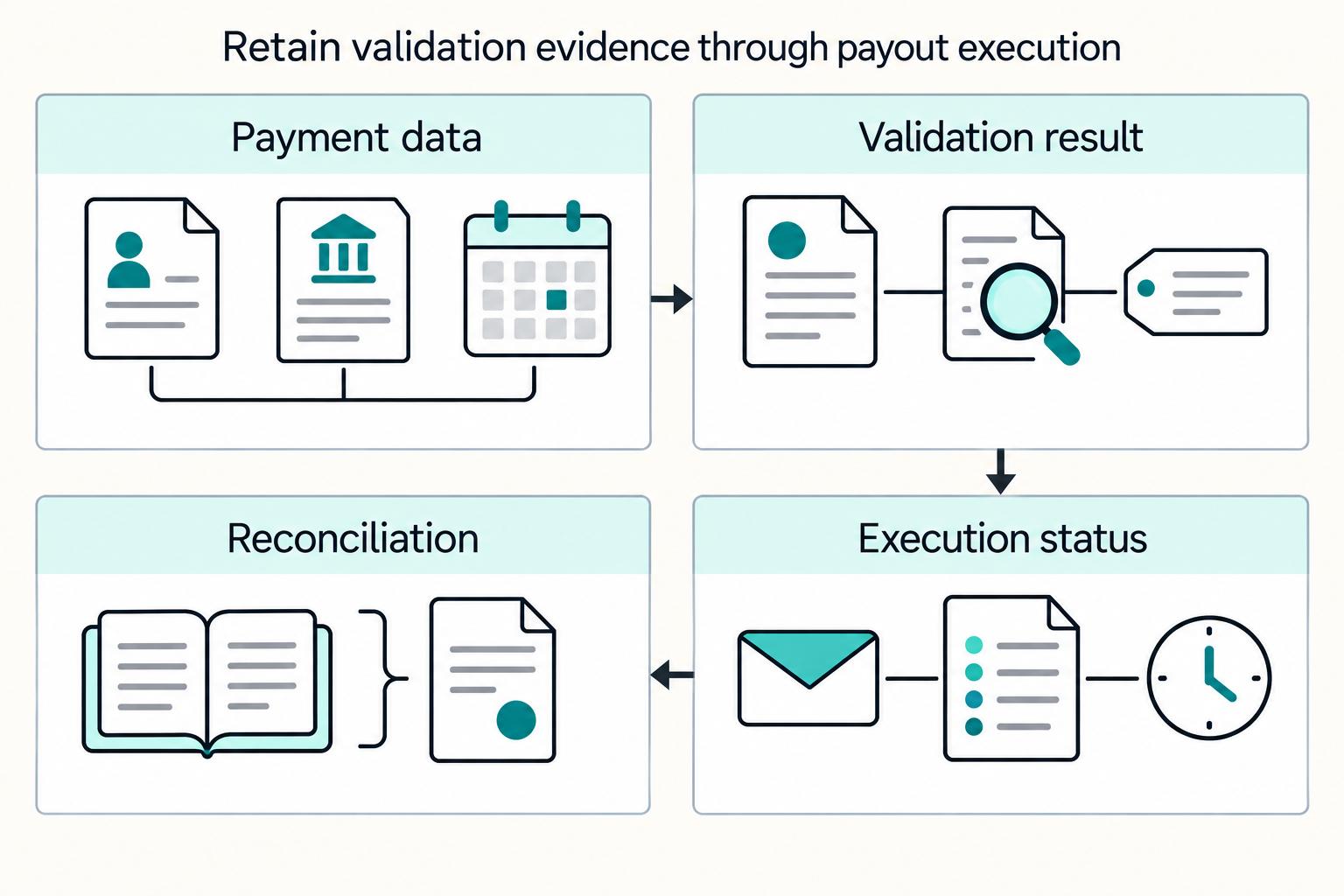
Many control gaps appear at the handoff into execution, so connect validation and payout execution as one traceable flow rather than two disconnected steps.
| Area | What to verify | Grounded detail |
|---|---|---|
| Data to release | Start with structured payment data, run beneficiary account validation, store the exact result used for the decision, and only then move to payout execution. | Before file generation or bank submission, run consistency checks on account numbers, currency codes, beneficiary details, and file-format compliance; examples include pain.001, MT101, and MT103 |
| Retries | Keep a stable internal payout reference across retries and make replay behavior explicit in integration and pilot tests. | Specific mechanisms, for example idempotency keys, are not confirmed. |
| Status visibility | Track execution from submission through bank confirmation with clear internal statuses. | pending approval, pending execution, in progress, complete, or failed; webhooks are an implementation choice to verify with your provider |
| Reconciliation | Match bank confirmations to the original payment record or file and to GL entries. | Run this check on a defined cadence so mismatches are routed before the next release window |
| Operating model | Pick the setup that lets your team see validation outcomes, execution state, and reconciliation evidence in one audit trail. | Reassess as exception queues and payout batches grow; no fixed cutoff is established here for when portal-first stops working or API orchestration becomes mandatory. |
- Keep one ordered path from data to release
Start with structured payment data, including beneficiary, amount, currency, due date, and bank details. Run beneficiary account validation, store the exact result used for the decision, and only then move to payout execution. Before file generation or bank submission, run consistency checks on account numbers, currency codes, beneficiary details, and file-format compliance. This matters most when you generate bank-facing outputs like pain.001, MT101, or MT103, where bad input can lead to rejected files and rework.
- Treat retries as an execution-risk control, not a validation control
A passed validation does not, by itself, establish duplicate-execution behavior during retries. Keep a stable internal payout reference across retries and make replay behavior explicit in integration and pilot tests. Specific mechanisms, for example Idempotency keys, aren't confirmed here, so require your provider to document how duplicate create attempts are handled before go-live.
- Require post-submission status visibility
Validation tells you whether details looked usable before release. It does not tell you where the payment is now. Track execution from submission through bank confirmation with clear internal statuses such as pending approval, pending execution, in progress, complete, or failed. If you use Webhooks, treat them as an implementation choice to verify with your provider, not an assumed capability.
- Close the loop with reconciliation
Blind spots shrink when bank confirmations are matched to the original payment record or file and to GL entries. Run this check on a defined cadence so mismatches are routed before the next release window. For a deeper operating model, see this guide on automating the match between payouts and GL entries.
- Choose operating model by exception pressure and traceability needs
Pick the setup that lets your team see validation outcomes, execution state, and reconciliation evidence in one audit trail. Reassess as exception queues and payout batches grow, and avoid manual handoffs that require rekeying or stitching records together later. There's no fixed cutoff here where portal-first stops working or API orchestration becomes mandatory.
This pairs well with our guide on Account Takeover in Payout Platforms and How to Stop Payee Hijacks.
Compliance and evidence package for go-live approval#
For go-live approval, treat beneficiary account validation as one control in the stack, not a full compliance verdict. It confirms bank details are valid for payout, but it does not replace KYC, KYB, or broader compliance controls.
- Write down what each control covers
Define scope in plain language: bank-detail validation checks account usability, while KYC and KYB cover onboarding identity checks. Keep these outcomes distinct in your signoff pack so reviewers can see whether a payout was blocked for invalid bank details, pending onboarding checks, or an open compliance request like an RFI. A common failure mode is treating a passed bank check as approval to pay while onboarding compliance is still incomplete.
- Name rail and jurisdiction constraints in the approval memo
Do not rely on generic "global coverage" language. In ACH contexts, explicitly label ACH and document the transaction-flow and product-risk review your team completed. For cross-border corridors, note that complexity and risk increase as regulatory environments and financial systems differ. If a corridor is not fully reviewed, mark it out of scope for day one.
- Store evidence internal audit can test
Keep records tied to each payout that show validation outcomes, compliance or onboarding status, and any override approvals. For overrides, retain the decision result, timestamp, approver identity, and approval reason. Before launch, run a test-batch reconstruction: confirm you can show who approved release, what evidence they reviewed, and whether any unresolved compliance document request existed at that time. Set retention windows with legal and compliance owners.
Related reading: Account Updater Services: How to Automatically Refresh Expired Card Data Before Payments Fail.
Launch with a four-week pilot and hard success checkpoints#
If you choose a four-week pilot, use it to test this control before it blocks money in production. The goal is to see whether failed transactions and reporting gaps decrease without creating a heavier manual queue.
| Week | Focus | Key checks |
|---|---|---|
| Week 1 | Baseline current operations and lock scope | Measure current failure rates, exception counts, and manual handling time; confirm the exact corridors and highest-risk payout lanes in scope; map ownership and release authority for each lane |
| Week 2 | Integrate one provider via API in shadow mode | Run validation on live-like traffic without auto-blocking payouts; compare outputs with existing payout decisions; require logs, response capture, event timestamps, and an audit trail tied to each tested batch |
| Week 3 | Activate decision rules for a controlled subset of payout batches | Let clear-pass cases proceed and route caution or fail outcomes to review, with same-day override reasons recorded; review outcomes daily and tag root causes |
| Week 4 | Make a go/no-go decision from evidence, then scale corridor by corridor | Compare controlled-release outcomes against the week 1 baseline; define rollback criteria and owners for engineering, operations, and compliance; do not scale if you cannot show what was validated, what was overridden, who approved release, and where the audit trail lives |
-
Week 1: baseline current operations and lock scope. Measure current failure rates, exception counts, and manual handling time for a period that matches your payout cadence. Confirm the exact corridors and highest-risk payout lanes in scope, and map ownership and release authority for each lane. If your baseline cannot clearly separate bank-detail issues from other review reasons, tighten that first so pilot results are usable.
-
Week 2: integrate one provider via
APIin shadow mode. Run validation on live-like traffic without auto-blocking payouts and compare outputs with existing payout decisions. Require logs, response capture, event timestamps, and an audit trail tied to each tested batch so one sample can be reconstructed end to end. If decisions still depend on spreadsheets, manual uploads, or disconnected systems, fix that before moving forward. -
Week 3: activate decision rules for a controlled subset of payout batches. Start with a subset that matters operationally but is safe to roll back quickly. Let clear-pass cases proceed and route caution or fail outcomes to review, with same-day override reasons recorded. Review outcomes daily and tag root causes so overly strict rules or missing evidence do not quietly increase manual work.
-
Week 4: make a go/no-go decision from evidence, then scale corridor by corridor. Compare controlled-release outcomes against the week 1 baseline and decide whether to expand. Define rollback criteria and owners for engineering, operations, and compliance before each expansion step. If you cannot show what was validated, what was overridden, who approved release, and where the audit trail lives, do not scale yet.
Choose the provider that fits your operating model not just your demo#
Choose the provider that holds up in real operations, not the one with the cleanest demo. Final selection should come down to execution fit: beneficiary validation for your payout routes, action-ready decision outputs, integration behavior you can verify, and evidence your finance and ops teams can audit.
- Start with route and beneficiary fit
Your first filter is practical: can the provider validate the bank details required for your real payout routes before payout creation, and can it revalidate when details change? The provider documentation includes a backend example where the platform requests validation and receives the result, and it notes that required payout fields can change over time. Revalidation for older beneficiary records should therefore be part of your pre-payout controls.
- Prefer outputs that map directly to ops actions
Pick a provider whose results can be routed immediately to release, review, or hold. LexisNexis explicitly describes pass, caution, and fail outcomes for domestic and international payment processes, which is easier to operationalize than a generic "verified" response. It also states a speed claim of "half a second" and ties that to avoiding failed payment fees from mistyped or misformatted details.
- Match delivery mode to your volume and approval workflow
Provider shape should match how your team actually runs payouts. If verification is available individually or in bulk, through API or file-based handling, and supports maker-checker style review, that can matter when finance teams operate file-driven processes and need tighter approval controls.
- Require proof before moving from pilot to rollout
Treat vendor claims as a starting point, then validate with a phased test and measurable checkpoints. At minimum, review request and response records, beneficiary or account references, timestamps, and review outcomes so exceptions are explainable. If a provider cannot show clear handling for failed or caution results, do not expand beyond pilot.
Before rollout, align on route fit, policy gates, and evidence expectations with your stakeholders.
Frequently Asked Questions
What is beneficiary account validation before payout?
It is a pre-payout check to confirm an account exists and that ownership details match. In practice, it is a confidence check that helps confirm you are paying the intended party. That helps reduce fraud, payment errors, and avoidable operational cleanup.
Which fields should a platform verify before releasing funds?
This guide does not define a single global field list that works for every payout rail or corridor. At minimum, confirm account existence and ownership details match before payout. Ask providers to state clearly what their validation covers in each market.
Should validation run only at onboarding or before every payout?
Use validation as an ongoing control, not a one-time event. The guidance reflected here supports running checks at onboarding, before payments, and during long-term payment cycles. That aligns better with ongoing payout risk control.
What should operations do with pass, caution, and fail outcomes?
Do not assume one universal taxonomy. If your provider uses labels such as pass, caution, and fail, set internal release, review, and hold actions before launch. Keep decisions and overrides documented so operations can explain why funds were released or stopped.
How is bank-detail validation different from `KYC` and `KYB`?
Bank-detail validation focuses on whether payment account details and ownership signals align. KYC and KYB cover broader verification controls. Account validation can support compliance work, but it does not replace full KYC, KYB, or broader monitoring programs.
How do cross-border checks differ from domestic checks in practice?
Cross-border validation is often presented in market-coverage terms, such as instant beneficiary validation in over 50 markets. Vendor positioning in this area often emphasizes instant validation and no beneficiary intervention, while traditional methods are described as slower and more opaque. In those traditional flows, one step can take 1-2 days, followed by 2-3 days for beneficiary receipt.
What additional controls reduce payout failures besides account validation?
Treat account validation as one control in a wider risk stack. Pair it with compliance controls, especially KYC, and post-verification monitoring for suspicious activity. The ACH guidance also points to monitoring after verification, which reinforces that a successful check is not the end of risk control.
Try a related tool
Researched and edited by the Gruv editorial team. Gruv builds cross-border billing, payouts, and finance-operations software for global businesses.
Sources
- 2021-2025.state.gov/report/custom/752c5119c5trusted
- cms.gov/files/document/mcp-pymt-att-methodologies.pdftrusted
- congress.gov/bill/114th-congress/house-bill/2029trusted
- evp.nc.gov/_entity/annotation/c78a586a-f31e-f011-998a-0...trusted
- federalregister.gov/documents/2024/09/04/2024-19260/financial-cr...trusted
- federalreserve.gov/boarddocs/supmanual/cbem/200904/0904cbem.pdftrusted
- fincen.gov/boi-faqstrusted
- govinfo.gov/content/pkg/FR-1976-04-19/pdf/FR-1976-04-19.pdftrusted
Educational content only. Not legal, tax, or financial advice.
Related Posts

The Freelance Payment Penalty: A Modeled Audit of Platform Fees, FX Spreads, and Payout Delays
The money rarely disappears through a single, easy-to-spot fee. The real loss is stacked. A marketplace takes its commission, a processor adds a charge for international cards, a bank or payment company converts the currency at a spread, a platform holds the funds before release, and a wire sheds a little to intermediaries on the way in. Each layer looks defensible on its own, but the worker feels the combined result as a smaller deposit and a later payday.

How to Respond to a Subpoena for Business Records
Move fast, but do not produce records on instinct. If you need to **respond to a subpoena for business records**, your immediate job is to control deadlines, preserve records, and make any later production defensible.

A US Expat's Guide to Investing in UCITS ETFs to Avoid PFIC Issues
The real problem is a two-system conflict. U.S. tax treatment can punish the wrong fund choice, while local product-access constraints can block the funds you want to buy in the first place. For **us expat ucits etfs**, the practical question is not "Which product is best?" It is "What can I access, report, and keep doing every year without guessing?" Use this four-part filter before any trade: