
Quick Answer
Give each seller a dedicated receiving number by issuing a virtual IBAN or similar identifier that routes incoming funds to a master collection account. This works when every identifier maps to one seller, one ledger path, and one audit trail, with compliance gates, unmatched-payment handling, and replay-safe webhook processing in place before launch.
Why platforms give each seller a dedicated bank account number#
If you want to give each seller their own receiving bank details without opening a separate traditional account per seller, start by treating this as an account-mapping and controls decision, not just a UI feature. In common setups, a virtual IBAN looks like a standard IBAN but points to an underlying master payment account rather than a standalone account.
Step 1 Frame the product correctly#
Start by naming the thing you are actually issuing. An IBAN is an account-number format defined by ISO 13616, and regular IBAN usage typically has a one-to-one match with a real bank account. A vIBAN can work differently. In common implementations, the seller gets a dedicated receiving identifier, while inbound funds route into a platform-managed account structure for attribution and reconciliation.
That is the operational benefit: cleaner inbound attribution per seller, often without opening a full account for every user. But do not assume one universal model. In May 2024, the European Banking Authority noted that there is no single formal definition of virtual IBANs. Interpretation can vary, including whether an IBAN must always map one-to-one to a payment account.
Step 2 Align product, treasury, and cross-border operations#
A dedicated seller number is not just a seller-experience choice. It changes how you identify incoming transfers, post balances, investigate missing funds, and close finance workflows.
Cross-border operations expose weak design quickly. The Financial Stability Board continues to highlight four persistent frictions: high costs, low speed, limited access, and insufficient transparency. If your flows span markets, design your receiving process and support handling around those constraints from day one. Coverage also varies by provider, so treat examples like EUR or GBP support as provider-specific, not universal.
A simple pre-launch check helps here: can you trace a test inbound transfer from the seller's receiving identifier to provider records, then to the seller record and ledger posting? If not, treat the product as not ready.
Step 3 Focus on implementation choices, failure handling, and proof#
Definitions do not get you to production. You need clear decisions on ownership and account structure, when receiving details are issued, how attribution is verified, and how unmatched inbound payments are handled.
This guide focuses on those operating choices and the controls around them, because that is where risk is created or reduced. The standard throughout is simple: every credited, held, or returned transfer should resolve to one seller state, one ledger outcome, and one audit trail.
Define the product object before you design the flow#
Define the product object first: in many vIBAN programs, a vIBAN is a receiving identifier, not a standalone seller bank account. If your team blurs that line, your product promise, controls, and support handling will drift.
Step 1 Name the object precisely#
Treat a Virtual IBAN (vIBAN) as a seller-facing receiving identifier tied to a collection account. It uses standard IBAN format and functionality, but maps to an underlying master account that has its own IBAN.
Use one sentence across product, ops, and support: "A seller-facing collection identifier that maps inbound bank transfers to an underlying account structure." Then check your PRD, API model, ledger mapping notes, and support scripts for the same wording. If any document describes this as a standalone seller bank account, fix it before build starts.
Step 2 Separate the terms your team will otherwise blur together#
| Term | What it identifies | What to remember |
|---|---|---|
| IBAN | An individual account at a specific institution in a country context | Account identifier, not institution identifier |
| vIBAN | Seller-facing receiving identifier mapped to an underlying account structure | Can look like a standard IBAN to counterparties |
| Virtual account number / virtual bank account | Software-generated routing or reconciliation identifier linked to a central account | Usually for attribution and tracking, not standalone value holding |
| BIC / SWIFT code | Financial institution identifier | Not interchangeable with IBAN; often auto-derived in SEPA, still needed in practice for non-SEPA flows |
For a quick refresher, see What is an IBAN and How is it Different from a SWIFT Code?.
Step 3 Write down what is provider and market dependent#
Document uncertainty early. Coverage, payout rails, onboarding rules, and regulatory interpretation can vary by provider, program, and market. The current vIBAN market does not have one settled definition, and interpretations differ across jurisdictions, including whether IBAN usage must map one-to-one to a payment account. Capture those assumptions in your decision log up front, including country-code coverage and where BIC is required.
Clarify why each seller gets a dedicated number#
If inbound transfer attribution is still manual or error-prone, fix that before you add new payout features. Dedicated receiving details usually solve an operations problem before they solve a product one.
Step 1 Assign one inbound identifier to one seller account#
The main gain is cleaner Payment reconciliation. A dedicated vIBAN or virtual account number gives each Seller account a unique inbound route, which can reduce reliance on payer names or remittance text for attribution. Banking Circle states this directly: assigning a unique virtual account per seller improves collection reconciliation.
Use a simple readiness check: send two same-amount test deposits on the same day to two different seller numbers. If both cannot be resolved to the correct seller record, wallet, and audit trail without manual interpretation, the setup is not ready.
Step 2 Attach that number to the wallet flow sellers actually use#
This matters in wallet flows where bank transfers are part of funding. In Mangopay's wallet model, a dedicated virtual IBAN can be attached to a wallet, and funds sent to that dedicated account are automatically credited to the associated wallet. That simplifies reconciliation and improves the user experience.
Do not stop at "number issued." The receiving details shown in the seller UI should match what is stored on the wallet object and in support workflows. If those drift apart, the risk of unmatched-transfer investigations goes up.
Step 3 Use seller-level attribution to tighten treasury handling#
Seller-specific receiving details can also make Stored balances easier to trace in month-end Treasury workflows. Finance can follow an inbound transfer to one seller balance instead of reconstructing attribution from a pooled account and a vague reference.
Keep expectations tight: dedicated receiving details improve attribution, but they do not remove all unmatched transfers. Stripe also notes that when automatic matching fails, reconciliation becomes manual work. If manual inbound investigations are common, prioritize dedicated receiving details now and defer new payout features until attribution checks pass consistently.
Set prerequisites and go or no-go criteria#
Do not start build until ownership, compliance gates, and traceability are explicit. Because a vIBAN is linked to a master payment account, unclear launch controls can turn into shared-account risk.
Step 1 Confirm cross-functional ownership before you scope features#
Name owners for product, payments ops, engineering, and finance ops before feature scoping. This work spans seller-facing receiving details, provider integration, reconciliation, and compliance, so ownership gaps usually surface during incidents and month-end close.
Your minimum ownership map should answer three questions. Who decides the first seller cohorts? Who investigates unmatched inbound transfers? Who signs off that finance can trace cross-border payments without engineering log pulls? If those owners are not named, you are not ready.
Set one shared incident path now. For a failed or suspicious inbound transfer, define the first team involved and the evidence each handoff must include.
Step 2 Define the smallest launch scope that can actually be verified#
Start with a corridor-and-cohort scope you can verify end to end. For example, limit launch to specific seller types and countries, and to settlement currencies your provider supports there, such as EUR and GBP where supported.
Write a strict done definition for the first cohort: for each Seller account, finance can see the receiving identifier, provider reference, ledger journals, and balance impact without manual interpretation. If those fields are not agreed now, reconciliation stays ambiguous.
Run a pilot deposit drill. Passing is not just "funds arrived." Passing is a supportable chain from seller and currency to provider trace and ledger posting.
Step 3 Set compliance and permissions gates before issuing access#
Gate receiving and payout behavior on verification and permissions status before access is issued. Required information and capabilities vary by country, business type, and requested permissions, and for covered financial institutions, legal-entity customer flows require written beneficial-owner identification and verification procedures.
Define allowed Seller account states clearly: receive enabled, payout enabled, and restricted pending review. Where end-user visibility to providers or banking partners is limited, strengthen internal records and review notes rather than loosening controls.
Your evidence pack should include onboarding decisions, collected verification data, capability or permission state, payout restrictions, and an audit log of state changes. If these records are split across tools without a common seller ID, expect avoidable compliance and support issues.
Step 4 Enforce one internal go or no-go traceability test#
Use one hard internal rule: if you cannot trace request to provider reference to ledger posting for a test deposit, delay launch. This is an observability bar, not a regulatory phrase.
In practice, keep the API request identifier, such as a provider Request-Id, the provider event or webhook reference, and the resulting ledger entry linked in one chain. Engineering should be able to retrieve the request trail, and finance ops should be able to confirm journal output, without multi-tool log hunts.
If that chain breaks, stop and fix instrumentation first. Seller-level receiving only reduces operational friction when you can prove what happened.
Choose your account architecture and ownership model#
Choose this architecture for control and reconciliation, not API convenience. For teams launching fast, a common starting point is one pooled Collection account plus a per-seller Virtual IBAN or equivalent receiving identifier. Add more separation when risk, volume, or partner constraints justify it.
Step 1 Compare practical models before you commit#
A vIBAN is not a standalone account. It is an IBAN-formatted identifier linked to a master account. That means seller-facing details can look segmented while funds still land in a central structure.
| Model | Onboarding friction | Payment reconciliation complexity | Failure blast radius | Support load for unmatched inbound transfers |
|---|---|---|---|---|
| Shared Pool Account with one shared IBAN plus payer reference | Lower at setup | Higher, because matching can depend heavily on reference text or amount | Higher concentration | Higher when reference-based matching fails |
| Pooled Collection account with per-seller Virtual IBAN mapping | Moderate | Lower than shared reference-only matching, because the inbound identifier helps map to seller | Still concentrated at master-account level | Lower than a shared pool when mapping rules and logs are strict |
| Segmented real client accounts (separate account per seller or segment) | Higher | Mixed: attribution is simpler, but cross-account reconciliation can increase | Lower concentration per seller or segment | Mixed |
Pooled models can reduce setup friction, but the complexity moves into your ledger, investigation flow, and controls.
Step 2 Use pooled mapping first when launch speed is the priority#
If you need seller-level receiving details quickly, pooled plus strict mapping can be a strong first move. It gives each seller dedicated details without opening a separate account per seller in the underlying structure.
Your real checkpoint is deterministic traceability: each issued receiving identifier maps to one seller, one master account, and one ledger posting path. For any test deposit, finance should be able to trace the seller identifier, provider reference, receiving master account, and resulting journal entries.
Keep a complete identifier record per seller: identifier, issuance timestamp, status, underlying collection or provider account ID, and restriction state. Without that history, handling inbound transfers to restricted or closed sellers can become slow and error-prone.
Step 3 Segment only when separation solves a named problem#
Add separation only when you can state the reason clearly. Common reasons are partner requirement, higher-risk cohort, volume that justifies isolation overhead, or safeguarding and control expectations that are easier to evidence with a segmented design.
Safeguarding still applies regardless of model. Under Regulation 21 of the Electronic Money Regulations 2011, relevant client funds must be segregated from other funds. That does not force one universal structure, but it does require ownership and account design that stand up to control review. In August 2025, FCA PS25/12 also flagged that some firms lacked sufficiently strong safeguarding practices.
Also take jurisdictional and partner interpretation seriously. The EBA's 2023/2024 fact-finding noted non-uniform views on whether an IBAN must map 1:1 to a payment account. If a bank, EMI, or jurisdiction is not comfortable with virtual mapping, segment the structure or narrow the launch scope.
Step 4 Apply one decision rule and one stop rule#
Use this decision rule:
- If you need fast rollout and can prove deterministic identifier-to-ledger mapping, start with pooled collection plus per-seller dedicated receiving details.
- If you are still relying on shared references in one shared pool, avoid scaling until reconciliation is fast and reliable.
- If partner, jurisdiction, risk tier, or safeguarding review requires clearer separation, segment by seller or at least by entity, corridor, or risk bucket.
Use this stop rule: if you cannot trace an inbound transfer from seller identifier to master-account receipt to ledger posting without manual guesswork, pause launch. Keep the goal practical: fast, automated reconciliation of accounts receivable (AR).
We covered this in detail in FFC Account Number Meaning for Wire Transfers and Further Credit Instructions.
Design compliance gates and seller onboarding order#
Set onboarding so compliance gates come before money movement. Create the Seller account, complete identity and due-diligence checks for the requested capabilities, then issue the Dedicated bank account number according to your inbound-receipt policy. Enable payouts only after payout capability is verified and allowed.
Step 1 Create the seller record before you create any receiving identifier#
Start with a durable seller object in your ledger and ops tools. That record should exist before you request or display a Virtual IBAN so every later event has a deterministic home: verification status, provider references, restriction state, and audit history.
Keep this checkpoint strict: one seller record, one internal seller ID, one expected wallet state, and one provider account reference path. You should be able to answer "which seller owns this receiving identifier?" from one query.
Step 2 Run identity checks before enabling money movement#
Treat capability approval as the gate, not account creation. Customer due diligence is part of establishing the business relationship, using reliable and independent documents, data, or information. In capability-driven models, a capability can be requested while still not allowed.
Requesting additional capabilities can also trigger additional KYC checks, so sequence requests carefully. A practical order is:
- Create the Seller account and request only the minimum onboarding capability set.
- Collect and verify identity or business information for that scope.
- Issue receiving details only when policy allows inbound collection for that seller state.
- Enable payouts only after payout capability is verified and allowed.
Step 3 Tie policy gates to wallet lifecycle states#
Use explicit Platform wallets states so product, compliance, and support all work from the same status model: pending verification, receive-only, payout-enabled, and restricted.
pending verification means the seller exists but capabilities are not yet approved. receive-only can be the bridge state when inbound details are issued, where provider policy permits, but outbound movement is still blocked. This matters in vIBAN flows, where funds route to the master account, so payout control still depends on wallet and capability state. payout-enabled should require a positive capability verification result, and restricted should be your remediation state for risk flags or unresolved verification issues.
Step 4 Log the evidence you will need later#
Store an evidence pack that supports account-level reviews and audits:
- onboarding decision log with timestamp, reviewer or ruleset, and outcome
- risk flags and screening results
- capability and account-holder status history: requested, allowed, disallowed, and suspension events
- approval metadata for receiving details and payout activation
- document retention markers plus expiry or refresh dates
If you operate under the EU AML framework, retain CDD records for 5 years after the end of the business relationship.
Step 5 Freeze outbound movement if verification breaks after issuance#
If a seller already has receiving details and verification later fails or stays unresolved, move the wallet to restricted or suspended. Block outbound payouts, maintain inbound traceability, and route the case to compliance review.
Do not break identifier history during remediation. Keep the mapping from issued identifier to seller, master account, and ledger history intact so any incoming funds can still be investigated and controlled.
Build the ledger mapping and reconciliation controls first#
Make attribution deterministic before you scale receiving details. A seller-facing identifier only works when every inbound transfer can be mapped, posted once, and explained later without manual guesswork.
This matters even more in a vIBAN model. In many vIBAN setups, the identifier maps to a master account where funds settle, so the real product is your mapping and controls, not the IBAN string itself.
Step 1 Document one canonical mapping path#
Define one chain and make every team use it:
inbound provider reference or bank statement line item -> Virtual IBAN -> Seller account -> ledger journals -> Stored balances projection
Do not let support, finance, and engineering use different mapping logic. Your canonical record should include provider event or booking ID, provider account reference, receiving identifier, internal seller ID, ledger journal IDs, wallet state at posting time, and final balance-impact flag.
Use one checkpoint: from either provider reference or receiving IBAN, you should return the same seller, journal entries, and stored-balance movement through one query path. If this still requires spreadsheet or log stitching, the mapping is not production-ready. If your provider exposes a dedicated virtual-identifier field in webhooks, such as receiver_iban_virtual, treat it as a primary reconciliation key.
Step 2 Post every transfer state to one seller and one audit event#
Define your internal transfer lifecycle, then enforce one seller resolution and one audit-trail event for each state change. If you use states like credited and returned, plus any internal hold state, each must map to one seller state and one clear ledger explanation.
Keep transfer status separate from balance status. A transfer can be seller-attributed without being payout-available, and returned flows may require reversal or no-credit outcomes depending on timing.
Keep verification rules strict:
- Event resolves to one seller record.
- Event resolves to one internal transfer state.
- Event creates or links to one audit-trail entry.
- Ledger effect is deterministic and reproducible.
If any check fails, route the item to investigation rather than letting it disappear into silent suspense handling.
Step 3 Create an unmatched-deposit queue with an owner and closure rule#
Treat unmatched inflows as explicit reconciliation exceptions, not background noise. Build an investigation queue with a named owner, aging visibility, and an escalation path.
Each item should capture:
- raw provider or bank reference
- receiving identifier, if present
- amount, currency, and timestamp
- current seller or wallet state, if partially matched
- exception reason, such as missing mapping, closed seller, duplicate reference, or return conflict
You do not need a universal SLA number, but you do need a firm closure rule: unresolved exceptions do not quietly pass as reconciled.
Step 4 Make webhook processing idempotent before you trust automation#
Assume duplicate webhook deliveries and design for them. Deduplicate on a durable key, such as provider event ID or booking ID, before ledger posting, and make every retry check that key before creating journals or balance effects.
Expected behavior on duplicates is simple: acknowledge success, create no second journal, and create no second balance movement. Automate this test:
- Replay the same
creditedevent three times: one transfer record, one balance effect, one audit chain showing retries ignored. - Repeat for your internal hold or pending state.
- Repeat for
returned.
If those tests fail, do not ship this flow yet. Duplicate-safe posting plus explicit exception handling is what makes reconciliation operationally reliable.
Implement event lifecycle and failure handling#
Once mapping is deterministic, event handling becomes the next common failure point. Define one internal lifecycle for each Collection address as your operating model, then map provider-specific events into it.
Step 1 Define one internal lifecycle per Collection address#
Use a documented internal state set, for example initiated, credited, held, returned, and investigation-required, then document the exact rule for entering each state. Providers will not emit identical statuses.
One may send a BOOKING webhook when funds arrive on a Virtual IBAN and include receiver_iban_virtual; another may emit created, tentatively matched, completed, and reconciled transitions. Normalize those into your seller-facing lifecycle, and use receiver_iban_virtual as a primary attribution key when available.
Before launch, add one gating check: confirm the receiving account can actually accept funds. In some documented virtual-IBAN flows, funds are returned unless account status is ACTIVE.
Step 2 Keep the webhook contract strict and predictable#
Process every webhook the same way: verify authenticity, persist first, deduplicate, then acknowledge quickly. If HMAC is used, validate it before trusting payload fields.
Do not rely on a single real-time processing chain. Some providers mark deliveries as failing if they do not get a response within 10 seconds, then retry, including immediate retries and queued retries, and retries can continue for days. Build replay-safe idempotency as a core requirement, not an enhancement.
For each event, persist a durable evidence record: provider event or booking ID, signature-check result, received timestamp, payload hash, receiver_iban_virtual if present, internal transfer ID, and processing outcome.
Step 3 Alert on reconciliation risk, not just endpoint uptime#
Alert first on Payment reconciliation exposure: unmatched transfers, delayed state transitions, and repeated return reasons. If items sit in pre-credit states, for example initiated or held, without resolving to credited or returned, you accumulate unexplained open items.
Track return reasons where available: SEPA SCT R-transaction reason codes cover rejects, returns, recalls, and related exceptions, and some return flows surface a return code in SWIFT reference data.
Step 4 Recover with ledger-first replay, not manual balance edits#
Assume event ordering may vary by provider, and payload data can be stale at processing time. Reconcile against ledger and transfer records as the source of truth, fetch the latest provider resource state when available, then replay stored events through the same idempotent processor.
Do not patch wallet balances manually to hide the symptoms. Recovery is complete only when replay reproduces the same journals, seller attribution, and balance projection without operator edits.
Need the full breakdown? Read How Platforms Use Virtual Accounts to Reconcile Incoming Payments Per Client.
Plan currency handling and payout flow from day one#
Treat currency and payout design as a day-one product decision. If you leave it for later, you can create avoidable conversions, payout delays, and reconciliation problems.
Step 1 Choose whether each receiving address is currency-specific or multi-currency#
Decide what one seller-facing receiving address means in your program before launch. Some setups are single-currency, with one Virtual Account linked to one Master Account, while others are multi-currency, with one Virtual Account linked to multiple Master Accounts and routing by transaction currency.
Make the launch behavior explicit for the currencies you plan to support, such as EUR and GBP. In programs that require wallet currency to match receiving-account currency, a EUR wallet cannot simply reuse GBP receiving details. In some multi-currency designs, unlinked currencies are converted to a default Master Account currency, which changes reconciliation and FX exposure.
Keep a corridor matrix for each seller cohort: receiving identifier, linked master account, wallet currency, and how unmatched currencies are handled, for example conversion to a default currency. Also confirm your exact provider variant before promising currency coverage.
Step 2 Separate inbound collection from payout routing#
Receiving design and payout design are separate decisions. A vIBAN can route inbound funds and even auto-credit a wallet, but that does not mean it can send outbound payments.
Define payout rails independently, because rail availability is contract-dependent and timing varies by rail. For example, SWIFT can arrive same day, is often next day, and can also take several days. Plan exceptions early as well: for some virtual-IBAN pay-ins, refunds are handled through payout flows rather than a refund endpoint. For each corridor, document the inbound method, outbound rail, expected timing band, and exception path.
Step 3 Add FX checkpoints before payout release#
If inflow and payout currencies differ, set hard FX checkpoints before release. At minimum, cover quote freshness, conversion timing, and balance sufficiency in the payout currency.
When using time-bound quotes, keep provider lock durations in the design, such as 5 minutes, 1 hour, or 24 hours. Treat quote locks as risk reduction, not unconditional execution commitments. Also account for cutoff behavior. Missing cutoff can push settlement to the next business day, and some providers publish post-cutoff funding windows, such as 40 minutes for major currencies and 60 minutes for others.
Before payout execution, verify that the converted funds are available in the target currency balance. If the balance is short, fail early and retry after funding.
Step 4 Model the overhead before adding new currency corridors#
If sellers regularly collect in one currency and get paid in another, expect higher operational overhead. You often add at least one conversion event, one more reconciliation link, and another timing dependency around quote and settlement handling.
Expand corridors only after you can trace, without manual interpretation, the full chain: inbound currency, conversion event, and payout currency. A seller-dedicated virtual account improves attribution, but it does not remove FX and payout-routing work.
Roll out in phases with concrete verification gates#
Keep the first rollout deliberately small, then expand only when your evidence is stable. Seller-level virtual IBAN attribution can improve, but launch risk still sits in webhook handling, exception triage, and payment reconciliation.
Step 1 Start with a narrow cohort and small blast radius#
Launch with a seller cohort you can support and verify closely, then evaluate before widening access. Treat this as a canary release: expose the flow to a small subset first and watch both technical and business signals. If your provider can issue many seller-specific receiving identifiers from a pooled structure, that is capacity, not a reason to launch for everyone at once.
Define exception handling up front. For SEPA credit transfer exceptions, record SCT R-transaction reason codes in case records so operations and finance can classify issues consistently.
Step 2 Gate rollout on observable checks#
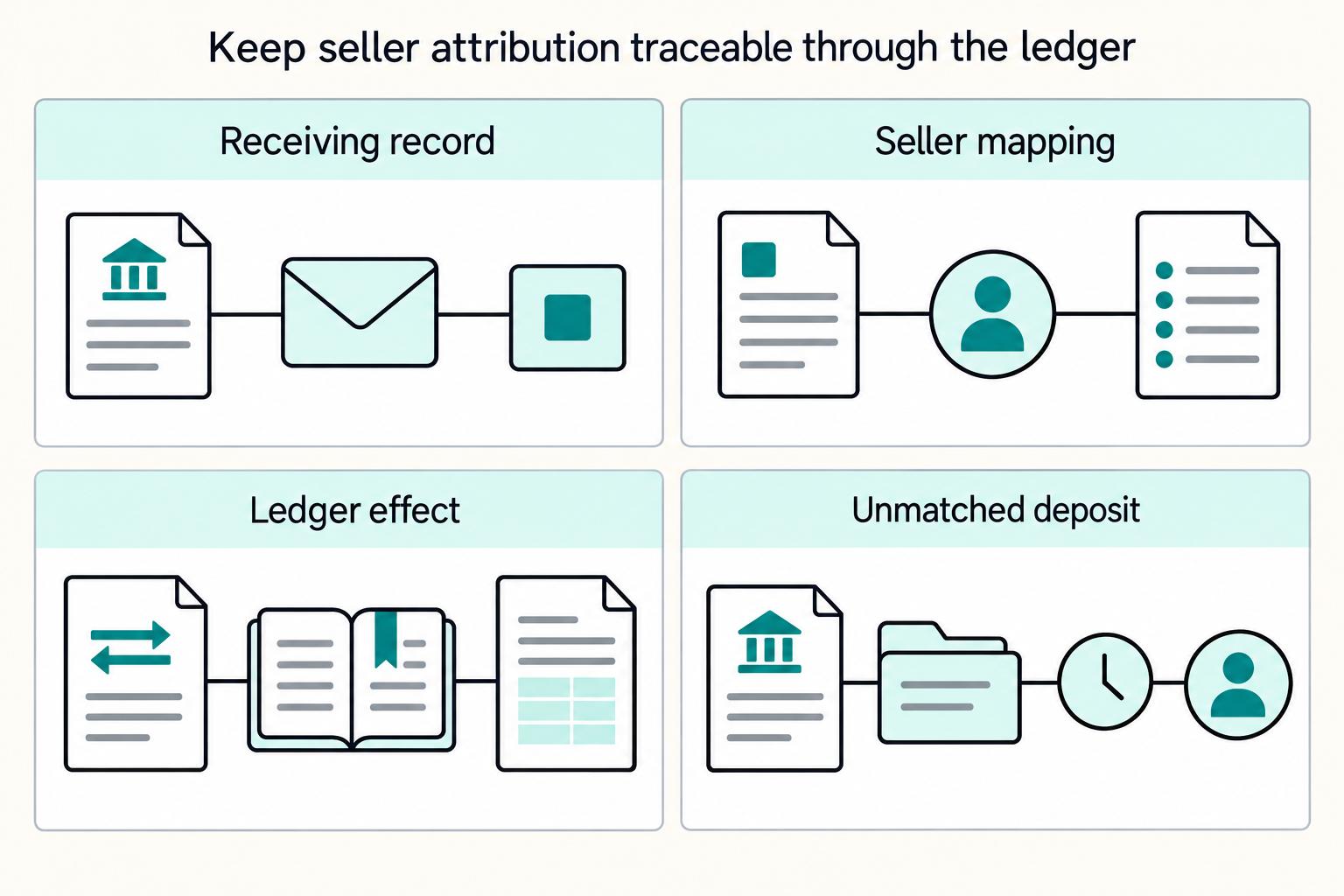
Expand only when the flow is measurable end to end: inbound transfer, seller mapping, ledger outcome, and investigation path when something fails.
| Gate | What to verify | Red flag |
|---|---|---|
| Attribution accuracy | Each inbound payment maps to one seller and one ledger outcome | Funds require manual guesswork or land in suspense |
| Webhook reliability | Events are acknowledged quickly and processed idempotently | Retries create duplicate postings or status gaps |
| Investigation load | Discrepancies are queued with owner and timestamp | Cases age without ownership or next action |
| Reconciliation close time | Finance can close without seller-level exception buildup | Close depends on manual stitching across tools |
For webhook behavior, quick acknowledgment and retry-safe processing are critical. Some providers expect acknowledgment within 10 seconds and may retry failed deliveries for up to 30 days, so replayed events should not repost balances.
Step 3 Review failure evidence on a regular cadence#
Run a product-finance review from event-level evidence, not just dashboard totals. Include failed transfers, return reasons, unresolved investigations, and time-to-resolution trends.
Use that review to decide whether to pause a segment, tighten controls, or proceed. If reconciliation still depends on manual interpretation, treat that as a stop signal for expansion.
Step 4 Expand only after clean close evidence#
Set and enforce an internal expansion rule tied to close-cycle outcomes. Expand to a new market or seller segment only after your predefined close-cycle evidence shows stable reconciliation and no recurring exception class that still needs manual rescue.
The exact threshold is your governance choice. The non-negotiable is sequencing: expand after evidence, not before it.
Common mistakes that break seller-level receiving and how to recover#
A common way to break seller-level receiving is to treat it as a UI feature instead of a controlled funds-mapping change. If mapping, policy state, routing guidance, or operations ownership is unclear, pause expansion and fix that control point first.
Step 1 Treat the receiving identifier as a mapping object, not a marketing label#
A Virtual IBAN should be handled as a receiving identifier linked to your underlying account structure, not as a cosmetic seller-facing label. vIBANs have standard-IBAN format and functionality and are linked to an underlying master account, so your launch gate is mapping integrity from receiving identifier to Seller account to ledger outcome.
Recovery: stop rollout until mapping tests are clean. "Payment arrived" is not enough. If funds can fall into suspense or teams interpret one identifier differently, the setup is not ready.
Step 2 Issue receiving details only when the seller record is policy-ready#
As an internal control practice, issue receiving details only after the seller record clears your policy gates. The EBA highlights risk when vIBAN end users are unknown to PSPs, so weak onboarding visibility is a control risk, not a paperwork detail.
Recovery: if your operating model supports it, keep the account in an internal receive-only state until checks are complete. Preserve a full decision trail, including status, reviewer, risk flags, and timestamp, so compliance and finance can explain why funds were accepted and why release was blocked.
Step 3 Separate IBAN guidance from SWIFT code guidance#
Treat IBAN and SWIFT or BIC as different identifiers in your product and support language. IBAN identifies the account; BIC, often called SWIFT code, identifies the payment service provider.
Recovery: rewrite routing instructions with concrete examples of what to enter and when. Remove any copy or macros that imply the two can be substituted.
Step 4 Consider freezing corridor growth when operations loses SLA control#
If exception queues are aging without clear ownership, adding new corridors can increase unresolved money-movement risk.
Recovery: pause new market onboarding, narrow scope, and restore owner-based SLA control before reopening growth. Resume only when each exception queue has a clear owner, aging visibility, and a defined recovery path.
Next step and copy-paste launch checklist#
Follow this order: define terms, lock architecture and compliance gates, prove ledger mapping, harden event handling, then launch in phases. Skipping that sequence usually turns seller receiving into a reconciliation and support problem.
Step 1 Define the object in writing#
Define the object in writing before engineering builds. State clearly that, in common vIBAN implementations, a Virtual IBAN uses standard IBAN format and functionality but links to an underlying master account rather than creating a separate traditional account identifier.
Also note that there is no single common definition of vIBANs across the EU market, so your program definition should be explicit in product and support docs. Keep IBAN and SWIFT/BIC responsibilities separate. IBAN is the account identifier defined by ISO 13616. The account-holding BIC identifies the PSP where that IBAN-domiciled account sits.
Step 2 Set architecture and compliance gates first#
Choose the account architecture and compliance gates before assigning receiving details. Each Seller account should have explicit lifecycle states and clear reasons for approval or restriction, so issuance is controlled and reviewable.
Do not assume IBAN-to-payment-account mapping is interpreted the same way in every supervisory context, including 1:1 expectations.
Your checkpoint: for a test seller, you can show the current state, decision reason, and the exact timestamp when receiving details were issued.
Step 3 Prove ledger mapping before broad launch#
Build deterministic ledger mapping before broad launch. The chain should be unambiguous: receiving identifier -> Seller account -> ledger journals -> Stored balances.
Test with both a credited transfer and a returned transfer for the same seller. Both should resolve cleanly in Payment reconciliation without manual seller-level guesswork.
Step 4 Harden webhook handling for retries and replay#
Assume retries and replay will happen, and design for that from day one. Webhook handling should verify signatures, prevent replay, post idempotently, and expose clear status outcomes: credited, held, returned, and investigation.
If duplicate delivery can create duplicate ledger postings, the system is not launch-ready.
Step 5 Launch in phases with explicit expansion rules#
Launch in phases, and define expansion rules before first go-live. Start with a narrow cohort, assign ownership for unmatched transfer investigations, and document SLA and escalation paths.
Copy and paste this into your launch tracker:
- We defined Virtual IBAN behavior and SWIFT code boundaries in product and support docs.
- Each Seller account has deterministic mapping from receiving identifier to ledger journals and Stored balances.
- Webhook processing is idempotent, replay-safe, and observable for credited, held, and returned events.
- Unmatched transfer investigations have owners, SLAs, and escalation paths.
- Finance can close Payment reconciliation without manual seller-level guesswork.
- Expansion criteria for new currencies and markets are documented and enforced.
If any box depends on memory instead of product state, ledger rules, or event logs, treat it as not done.
If your rollout checklist is complete and you need to confirm market coverage and compliance gating for launch, contact Gruv.
Frequently Asked Questions
What is a virtual IBAN for a platform seller?
A virtual IBAN is a seller-facing receiving identifier in standard IBAN format that routes incoming funds to an underlying master account. It works for payment addressing, but it is linked to the underlying account rather than being that account. Its practical value is seller-level attribution for inbound transfers.
Is a virtual IBAN the same as opening a separate bank account?
No. A virtual IBAN is linked to a master account that has its own IBAN, rather than a separately opened traditional account for each seller. Keep that distinction explicit across product, finance, and support workflows.
Why give every seller a dedicated bank account number instead of sharing one?
Shared receiving details usually push identification work onto operations teams. Seller-specific virtual IBANs let payments route to one main account while preserving transaction details for tracking and reconciliation. That makes them an operations decision, not just a UX preference.
When should we use an IBAN flow versus a SWIFT code flow?
Use an IBAN flow when the rail or corridor requires an IBAN account identifier. For SEPA payments, IBAN is required, and the SEPA region was 41 countries as of 22 May 2025. Treat SWIFT or BIC separately because it identifies the destination bank, and some Europe-related international payments require both.
Can one collection account support many seller virtual IBANs safely?
Technically, yes. One underlying real account can support many virtual IBANs, but safety is not automatic. The article notes there is no single common market definition and highlights key risks and challenges around virtual IBAN use.
What is the minimum reconciliation setup before going live?
At minimum, each receiving identifier should map cleanly to the correct seller and ledger outcome. Preserve transaction details so inbound transfers can be tracked and reconciled with less manual intervention. If mapping cannot be resolved cleanly, treat it as an operations control gap before launch.
How should we handle unmatched or returned inbound transfers?
Treat unmatched inbound transfers as investigation cases, not as available seller balance. For returned SEPA credit transfers, use SCT R-transaction reason codes because rejects, returns, and recalls are standardized exception flows. That supports automated exception handling and clearer case resolution.
Where Gruv fits
Researched and edited by the Gruv editorial team. Gruv builds cross-border billing, payouts, and finance-operations software for global businesses.
Sources
Includes 3 external sources outside the trusted-domain allowlist.
- consumerfinance.gov/compliance/supervisory-guidance/interagency-...trusted
- eba.europa.eu/sites/default/files/2024-05/612f03de-965a-41...trusted
- ecfr.gov/current/title-31/subtitle-B/chapter-X/part-1...trusted
- fdic.gov/sites/default/files/2024-03/fil16035.pdftrusted
- occ.gov/topics/supervision-and-examination/bsa/bsa-r...trusted
- betaalvereniging.nl/en/knowledge-base/iban-and-bic/bic-codeexternal
- clear.bank/learn/insights/what-are-virtual-ibans-vibans...external
- committee.iso.org/sites/tc68/home/articles/content-left-area/a...external
Educational content only. Not legal, tax, or financial advice.
Related Posts

The Freelance Payment Penalty: A Modeled Audit of Platform Fees, FX Spreads, and Payout Delays
The money rarely disappears through a single, easy-to-spot fee. The real loss is stacked. A marketplace takes its commission, a processor adds a charge for international cards, a bank or payment company converts the currency at a spread, a platform holds the funds before release, and a wire sheds a little to intermediaries on the way in. Each layer looks defensible on its own, but the worker feels the combined result as a smaller deposit and a later payday.

How to Respond to a Subpoena for Business Records
Move fast, but do not produce records on instinct. If you need to **respond to a subpoena for business records**, your immediate job is to control deadlines, preserve records, and make any later production defensible.

A US Expat's Guide to Investing in UCITS ETFs to Avoid PFIC Issues
The real problem is a two-system conflict. U.S. tax treatment can punish the wrong fund choice, while local product-access constraints can block the funds you want to buy in the first place. For **us expat ucits etfs**, the practical question is not "Which product is best?" It is "What can I access, report, and keep doing every year without guessing?" Use this four-part filter before any trade: