
Quick Answer
Choose by eligibility and the company’s actual cash and payment needs. J.P. Morgan is a relationship-banking candidate, Rho combines company banking/AP/accounting, and Brex combines spend controls with separate checking, treasury and vault products. Compare the current fee schedule and plan, verify payroll-ready funds and bank placement, and preserve pending instructions during cutover.
Choose the account for your company’s cash and payments#
A startup’s operating account must receive funding, pay bills and payroll, and produce records its bookkeeper can reconcile. The right choice depends first on entity eligibility, where funds are held and how quickly they can be used. A sophisticated spend platform can help a growing team, but a small company does not need a three-month engineering project just to open an operating account.
This comparison covers J.P. Morgan Startup Banking, Rho and Brex for US-oriented startup operations, using official material checked on October 3, 2026. It is a selected comparison rather than an exhaustive ranking or hands-on reliability test. The provider descriptions below support conditional recommendations; your actual approval, account agreement and service package determine availability.
Three options with different starting points#
| Option | Consider it when | Documented starting point | Decision that remains account-specific |
|---|---|---|---|
| J.P. Morgan Startup Banking | A bank relationship and broader treasury support are central | Startup specialists, operating accounts, liquidity, cards and merchant-processing offerings | Exact account/package fees, required balances and service access |
| Rho | Banking, cards, bill pay and accounting in one interface are useful | Fintech interface; current checking/card bank disclosure names Webster Bank, a division of Santander Bank, N.A. | Approved products, limits and international costs |
| Brex | Spend governance and a checking/treasury/vault mix fit the team | Checking at Column N.A.; treasury/vault through Brex Treasury LLC, a Capital One company | Eligibility, chosen cash product, liquidity and upgraded role requirements |
If you want a primary bank contact and a broader banking relationship, start the discussion with J.P. Morgan. If your main issue is paying company vendors and connecting records to accounting, evaluate Rho. If employee spend policies and custom access are central, evaluate Brex with the required plan. These are inferences from documented product scope, not evidence that one provider is safer, faster or better supported than the others.
These operating products are not automatically approved for holding customer money, marketplace settlement or embedded banking. A platform can use one for its own expenses while arranging regulated customer-money services separately. Explain the proposed third-party flow to the provider before treating a company account as a customer-funds account.
Start with eligibility and the actual business entity#
Keep the company’s legal name, formation records, tax identifier, ownership/control information and physical operations/address evidence ready. Apply for the actual entity that owns the cash and incurs the bills. A foreign founder, a foreign-incorporated company and a US-incorporated company with foreign shareholders are different cases; do not assume the same onboarding answer for all three.
Brex’s requirements include a US EIN, valid US incorporation, US operations and a US physical address, plus industry and other eligibility review. Meeting the listed criteria does not guarantee approval. Its card daily/monthly payment requirements are additional product decisions; the $50,000 cash criterion discussed for certain funded-startup monthly cards is not a universal minimum deposit for every Brex account.
Rho’s application guide requests company-structure documents, incorporation information and an EIN and says virtual addresses from Regus or other providers are not permitted. If the business has an unusual structure or founders abroad, obtain the specific account eligibility answer. Do not confuse an advertised quick application with a guaranteed opening or credit approval.
For J.P. Morgan, request the startup account package appropriate to the entity and service needs rather than treating every Chase or commercial-banking product as the same offer. Ask what documentation and balances it requires and which services need separate approval. An introductory banker meeting or fundraising network is not a commitment to lend.
J.P. Morgan: a relationship-banking starting point#
The Startup Banking hub describes support from early stage onward, including operating accounts, liquidity management, cards and merchant processing. Its commercial-banking disclosure identifies the relevant institutional and product boundaries. For a US deposit account, confirm JPMorgan Chase Bank, N.A. and the actual account terms; non-deposit services and deposits in non-US branches have different protection arrangements.
A team expecting to discuss cash management, investor funding and a broader treasury relationship can reasonably include this option. Request a fee schedule for the proposed operating account, ACH/wires, balance requirements and any analysis charges or offsets. This guide does not assign an unverified universal startup fee or assume Chase Connect, Cashflow360 or financing are included in every package.
Ask the banker to demonstrate the permissions, payment approvals and export path you will actually use. A named contact can help coordinate a problem, but the relationship itself does not prove a faster incident response or guarantee continuity. Check the support process, business-day cutoffs and backup contact instead of inferring reliability from brand size or fundraising-market commentary.
Rho: company payments and accounting in one interface#
Rho’s current disclosures identify it as a fintech, not a bank. Checking and card services are provided by Webster Bank, a division of Santander Bank, N.A., Member FDIC; savings involves American Deposit Management Co. and partner banks. Investment services are a distinct arrangement through RBB Treasury LLC, doing business as Rho Treasury. Use the current agreement and institution identity rather than an older standalone Webster Bank name.
Rho’s pricing page lists $0 subscription and per-user fees and its listed ACH/wire/check and in-platform features, with exceptions. It lists 1% foreign currency conversion, an optional $15 SWIFT fee and a $30 international wire recall fee; recipient/intermediary charges can also apply. Treasury investment management has separate fees. “No subscription fee” is not a promise that every transaction or investment costs nothing.
The accounting guide lists native NetSuite, QuickBooks Online, Sage Intacct and Puzzle integrations and bank feeds for Xero and QuickBooks Online. A native integration and a bank feed do not necessarily carry the same fields or accounting objects. Verify your connection’s mapping and sync method, particularly for bills, fees, corrections and duplicate imports.
Rho also advertises a banking/payments API. Evaluate its documented eligibility, endpoints, limits and controls if automation matters; do not infer that the product lacks APIs merely because a finance-led account comparison emphasizes AP. An API offer still does not establish approval to hold or disburse customer funds in your platform’s particular model.
Brex: separate checking, investment and sweep services#
Brex’s business-account documentation distinguishes checking at Column N.A., Member FDIC, from treasury and vault provided by Brex Treasury LLC, a Capital One company. Treasury invests in a government money market fund; vault sweeps funds to program banks. The current advertised vault maximum is up to $6 million in eligible FDIC coverage, subject to program conditions. Treasury investments are not FDIC-insured deposits.
The same guide says treasury/vault cannot send or receive external transfers directly: move funds to checking to pay externally. Vault-to-checking movement is described as taking one to two business days; treasury movement can be as quick as one hour in the stated business-day window. Do not promise immediate payroll liquidity from the combined dashboard balance. Confirm cutoffs and the current schedule for the account you use.
Brex pricing lists Essentials at $0/user/month, Premium at $12/user/month and Enterprise at custom pricing. Custom roles are documented for Premium and Enterprise. Compare the paid plan when precise permissions are required, rather than presenting all custom controls as part of a free banking account. Product and transaction fees should be reviewed separately.
Checking subaccounts can help label reserves or departments, but they do not by themselves create separate legal entities or additional insurance at the same bank. Keep the entity owner, cash product and bank placement visible. A treasury/vault/checking split organizes product use; it is not automatically legal segregation of different businesses’ money.
FDIC coverage, investments and access are different questions#
The FDIC explains third-party apps: eligible coverage requires funds to be deposited at an insured bank and relevant conditions, including ownership records. It protects against the insured bank’s failure, not the fintech’s insolvency or an app outage. A platform’s support process and your access continuity therefore still matter even when deposits qualify for insurance.
FDIC deposit guidance combines a corporation’s deposits at the same bank up to $250,000. Different account purposes do not create fresh coverage. Sweep programs can place money across banks, but other deposits you already hold at those banks may count toward the same limit. Review placement, exclusions, transit and recordkeeping conditions rather than treating the headline program maximum as an unconditional guarantee.
Money market funds and Treasury securities are investments rather than ordinary FDIC-insured deposits. Evaluate liquidity and investment risk separately from deposit coverage. SIPC membership is not an equivalent guarantee against a fund losing value. Avoid comparing a variable investment yield to a deposit rate without considering the product, fees, access and risks.
Worked example: the balance is not all payroll-ready#
Assume a startup has $600,000 in total cash-management balances: $100,000 in operating checking, $300,000 in a sweep deposit program and $200,000 in a money market investment. Payroll of $120,000 and vendor bills of $40,000 are due on the same day. The immediate checking requirement is $160,000, leaving a $60,000 funding gap before fees or a chosen buffer.
| Balance or obligation | Amount | Operational meaning |
|---|---|---|
| Operating checking | $100,000 | Available starting point, subject to actual account restrictions |
| Sweep deposits | $300,000 | Confirm bank placement and transfer timing |
| Money market investment | $200,000 | Investment liquidity and protection differ from deposits |
| Payroll plus vendors | $160,000 | Requires checking funding in time for execution |
| Minimum gap | $60,000 | Must arrive before the applicable deadline |
The example does not recommend this allocation or assume any provider’s exact setup. If the selected sweep takes one to two business days to transfer, fund checking early enough for the actual payroll cutoff. A forecast or pending internal transfer is not settled available cash. Reserve a buffer chosen from the company’s obligations and volatility rather than maximizing yield on funds needed immediately.
In a separate coverage example, the same corporation’s $100,000 operating account and $200,000 reserve account at one insured bank total $300,000. The standard corporate coverage at that bank is $250,000, so $50,000 exceeds that limit, assuming no other relevant holdings or special treatment. Renaming one account “payroll” does not change the result. Check actual sweep placements and direct balances together.
Compare cost with the transactions you actually make#
List expected users, domestic and foreign payments, currencies, cash/check handling and treasury services. Apply each provider’s fee schedule to that activity. An account with no monthly fee can still cost more for your FX volume; a paid plan can be worthwhile if its actual controls replace work you need. Include intermediary charges where applicable rather than comparing only the provider’s headline transfer fee.
For example, Brex Premium’s posted $12/user/month would produce $240 monthly for twenty billed users before other costs. Under a hypothetical $10,000 equivalent foreign currency transfer charged at Rho’s posted 1%, the conversion fee would be $100 before other applicable charges. These are separate illustrations, not a total-cost winner comparison: the products, eligibility and transactions are not identical.
For a quoted bank package, include its actual monthly and transaction charges and any agreed balance-based offset. Do not insert a generic Chase retail fee into a J.P. Morgan startup package. Avoid comparing variable yields or sign-up rewards as though they were guaranteed recurring savings. Keep the dated fee schedule alongside the decision so later changes are visible.
Test approval and reconciliation with one payable#
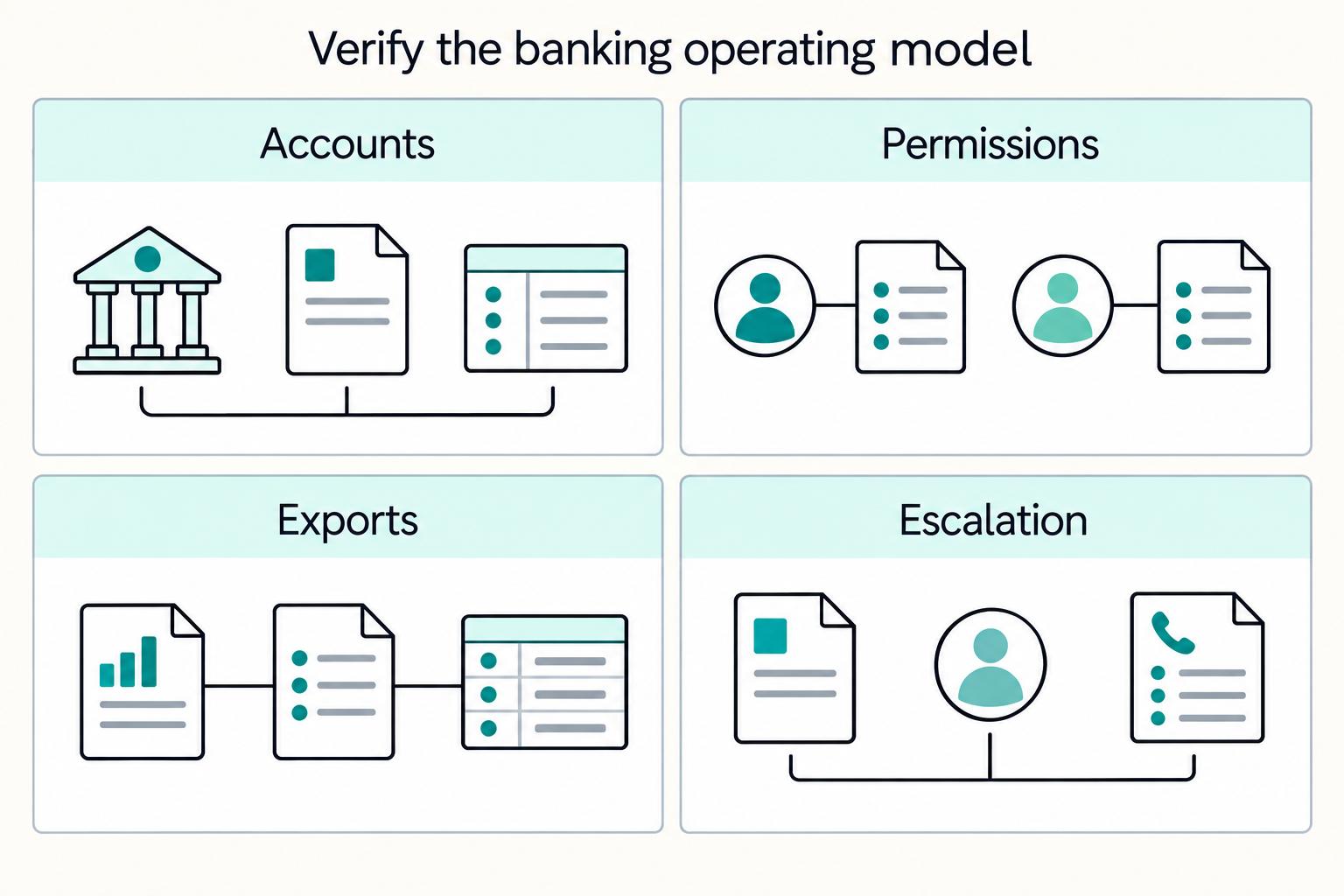
The operating-model diagram highlights accounts, permissions, exports and escalation. For a practical pilot, have an authorized person draft a real company payable, route the required approval and verify who can release it. Use a supported test environment or controlled examples for failures; do not deliberately send an erroneous or unauthorized live payment to test customer support.
Take the confirmed outcome into accounting with the original payable and bank/provider reference. If a $1,000 vendor payment carries a $5 fee, retain the $1,000 liability settlement and $5 cost separately. An internal $60,000 reserve-to-checking transfer should not be imported as revenue or an operating expense. Reimporting the same statement should not create a second payment entry.
Check what happens if the interface times out, an approver is unavailable, a user leaves or a bank detail changes. Confirm the original payment’s outcome before retrying. Keep independent approval for sensitive changes where required by your company’s policy, and remove access promptly when it is no longer authorized. Roles and payment approval chains are related but distinct controls; verify both.
Cut over without losing pending payments#
A 30/60/90 plan can help a complex migration, but a small startup can use a shorter sequence that fits its needs. First open and verify the selected accounts and product permissions. Then fund a controlled company flow, confirm results and reconcile. Expand after relevant gaps are resolved, rather than waiting a prescribed number of days or requiring engineering involvement for every ordinary account.
Before closing the old account, identify outstanding checks, pending ACH/wires, cards, payroll funding, subscriptions, customer receipts and unresolved disputes. Preserve statements and the old account’s final reconciliation. Move standing instructions deliberately and communicate new details through a trusted process. Do not assume opening the new account automatically cancels the old instructions or reroutes inbound funds.
Plan continuity around actual access risks. An appropriately funded backup account may help if the primary service is unavailable, but confirm the providers’ underlying bank arrangements and the cost of maintaining it. Two fintech brands can share a bank or other dependency. More accounts also mean more reconciliations and access controls; choose the arrangement for the company’s needs.
Frequently Asked Questions
What is the difference between a banking startup and a startup banking platform?
A banking startup can mean a young company offering financial services; startup banking means services used by a startup. This guide compares operating-account and finance-platform choices for US-oriented companies. Identify the actual account provider, product and eligibility instead of relying on either label.
How is a fintech platform different from a bank partner model in practice?
A fintech can supply the interface while a regulated bank holds deposits and executes bank services. Other products may be supplied by a broker or payment provider. Read the entity and product disclosures: bank deposit protection, investment protection and the fintech’s own continuity are different questions.
What features matter most for startup finance and platform operations?
Begin with entity eligibility, available operating funds, payment limits/timing, fees and bookkeeping records. Add approval chains, custom access, card/spend policies and integrations as the team needs them. Verify the selected plan and distinguish own-company payments from customer-funds services.
When should an early-stage startup switch banking providers?
Plan a change when the current account no longer supports required geography, payments, controls or record access, or persistent issues remain unresolved. Preserve pending payments and historical statements at cutover. A small startup does not need an automatic 90-day migration timetable, and closing the old account too early can cause missed receipts or payments.
Which controls are non-negotiable before scaling money movement?
Know who owns and holds each balance, which product can pay externally, who can authorize movement and how activity reconciles. Verify payment outcomes before retries and establish an escalation path. Custom roles can require an upgraded plan; adding subaccounts does not create separate legal ownership or insurance coverage.
How should teams evaluate FDIC claims when services are offered through partner banks?
Identify the insured bank and confirm funds have arrived there with the required ownership records. Coverage protects eligible deposits against bank failure, not fintech insolvency or investment loss. Combine relevant holdings at each bank, including direct deposits and sweep placements, rather than assuming each app or subaccount supplies a fresh limit.
Can one stack cover banking, spend control, and reconciliation, or should teams split providers?
An integrated interface can simplify company spend and bookkeeping, while a bank relationship or separate payment service may cover other needs. Compare eligibility, cash access, costs and actual controls. Do not assume an ordinary business account authorizes marketplace customer-money flows or that a second provider removes every shared dependency.
Researched and edited by the Gruv editorial team. Gruv builds cross-border billing, payouts, and finance-operations software for global businesses.
Sources
Includes 6 external sources outside the trusted-domain allowlist.
- fdic.gov/consumer-resource-center/2024-06/banking-thi...trusted
- fdic.gov/system/files/2024-07/your-insured-deposits-e...trusted
- brex.com/support/brex-account-requirementsexternal
- brex.com/support/the-brex-business-accountexternal
- jpmorgan.com/commercial-banking/startupsexternal
- jpmorgan.com/commercial-banking/legal-disclaimerexternal
- rho.coexternal
- rho.co/pricingexternal
Educational content only. Not legal, tax, or financial advice.
Related Posts

The Freelance Payment Penalty: A Modeled Audit of Platform Fees, FX Spreads, and Payout Delays
The money rarely disappears through a single, easy-to-spot fee. The real loss is stacked. A marketplace takes its commission, a processor adds a charge for international cards, a bank or payment company converts the currency at a spread, a platform holds the funds before release, and a wire sheds a little to intermediaries on the way in. Each layer looks defensible on its own, but the worker feels the combined result as a smaller deposit and a later payday.

How to Respond to a Subpoena for Business Records
Move fast, but do not produce records on instinct. If you need to **respond to a subpoena for business records**, your immediate job is to control deadlines, preserve records, and make any later production defensible.
A US Expat's Guide to Investing in UCITS ETFs to Avoid PFIC Issues
The real problem is a two-system conflict. U.S. tax treatment can punish the wrong fund choice, while local product-access constraints can block the funds you want to buy in the first place. For **us expat ucits etfs**, the practical question is not "Which product is best?" It is "What can I access, report, and keep doing every year without guessing?" Use this four-part filter before any trade: