

Quick Answer
Shortlist Mercury for free ACH and domestic wires, Relay for multiple cash-purpose accounts, Bluevine Standard for no monthly fee and standard ACH, and Chase for branch and cash-deposit needs. Choose using your actual payment volume and approval requirements; fund and test a separate backup when an outage would block critical payments.
Choose the account around the payments you actually make#
A startup that receives customer wires and pays ten contractors has different banking needs from a shop that deposits cash every evening. Start with your next month of collections, payroll, supplier payments and reserves. Then choose an account whose fees, approval tools and receiving methods fit that activity.
For a digital business, Mercury is worth comparing for free ACH and domestic wires. Relay offers multiple checking accounts for separating operating cash, payroll and taxes. Bluevine Standard combines no monthly fee with free standard ACH. Chase Business Complete Checking adds a branch-based option with cash-deposit allowances. These are different operating fits, rather than a ranking of which provider is most reliable.
The comparison below uses US business-account disclosures checked on 3 October 2026. Published prices establish the starting cost; the account you are approved for determines your limits and available services. An advertised account-opening time is not a promise that funds will be available for your first payroll.
Four accounts to put on a practical shortlist#
| Account | Published starting cost | Useful difference | Cost or operating constraint |
|---|---|---|---|
| Mercury business banking | $0 monthly base; ACH and domestic wires free to send and receive | Banking, invoicing, bill pay and accounting tools in one interface | Advanced workflows have paid plans; API mass payments, currency exchange and other services can add fees. Mercury is a fintech, with banking through Choice Financial Group and Column N.A. |
| Relay Starter | $0/month | Up to 20 checking accounts per business; useful for separate cash purposes | Higher tiers add features such as multi-step approvals and free same-day ACH. Banking is through Thread Bank; separate Relay accounts are not separate insured banks. |
| Bluevine Standard | No monthly fee; free standard ACH | Sub-accounts, payment tools and accountant/team access | Outgoing wires and international payments can have charges. Paid Plus and Premier plans have different fees and waiver conditions. Banking is through Coastal Community Bank and program banks. |
| Chase Business Complete Checking | $15 monthly service fee, with qualifying waivers | Branch access; $5,000 of in-branch cash deposits included per statement cycle | Up to 20 specified checks and banker-assisted transactions are included; overages and other service fees may apply. One waiver route is a $2,000 minimum daily ending balance. |
Use the providers’ own pages to compare the exact plan: Mercury pricing, Relay pricing, Bluevine Business Checking, and Chase Business Complete Checking. Chase’s balance waiver has statement-period conditions; eligible payment deposits, card spending and other qualifying relationships offer alternative waiver routes. Ordinary customer transfers are not automatically qualifying Chase Payment Solutions deposits.
Choose Mercury for further evaluation when ACH and domestic-wire volume dominate your cost calculation. Put Relay beside it when separating cash into accounts and assigning payment approvals are more valuable than a minimal subscription bill. Compare Bluevine when standard ACH and sub-account organization suit the business. Include Chase when branch service, cash deposits or a direct bank relationship are practical requirements. A business can use one of these as its operating account and a different institution as its continuity account.
Cash-management products need a separate decision. Mercury Treasury is an investment service, not an FDIC-insured deposit account, and can lose value. Do not treat access to Treasury or an advertised yield as equivalent to insured cash that is immediately available for payroll. Keep the deposit, investment and payment-service terms separate when comparing providers.
Work out the cost for your month, not an average startup#
Suppose a bootstrapped software company receives twelve customer ACH payments, sends ten contractor ACH payments, sends two domestic wires and makes no cash deposits each month. Under Mercury’s published base banking terms, those ACH payments and domestic wires carry no transfer fee and the base account has no monthly fee. That does not make every Mercury service free: collecting a card payment, using paid invoicing workflows or making API mass payments can introduce separate charges.
Chase’s monthly service fee alone would be $15 if this company does not meet a waiver. Keeping a qualifying $2,000 minimum daily ending balance can remove that service fee, but does not remove wire charges or other transaction fees. A $2,000 receipt once during the month is different from maintaining the required balance. If the founder needs local cash services, the branch may still be worth the cost.
Use the same volume sheet for Relay and Bluevine, adding the selected plan’s outgoing-wire and expedited-transfer fees. If a paid plan costs $30 more and saves $5 on each transfer you actually make, six such transfers recover the subscription difference. Those two figures are an illustrative break-even calculation, not a quoted provider tariff. Add approval or bookkeeping time saved separately instead of pretending it is a bank fee.
Keep bank fees and payment-processing fees in different ledger accounts. A $1,000 customer invoice, the processor’s fee and the net bank deposit are three distinct records. Reconcile the gross customer receivable and processing fee to the net settlement; do not explain the shortfall as an unidentified banking charge.
Check eligibility before moving payment instructions#
The legal entity opening the account must match the entity receiving customer funds and paying suppliers. Prepare formation or registration records where applicable, tax identification, the business address and ownership/control information requested by the provider. A US-incorporated company with an overseas founder may face different checks from a sole proprietor living in the US.
Bluevine’s application guidance distinguishes business details from owner verification and describes a supported-country path for some overseas applicants. Chase permits online applications for specified structures, including sole proprietorships and certain single-member or single-manager LLCs; other structures can require a branch application. Read the application requirements for your actual entity instead of inferring eligibility from a product comparison.
Confirm permitted industries, country restrictions and the approved entity’s transfer limits before telling customers to use the account. If you handle money owed to marketplace sellers or other customers, an ordinary operating account is not automatically an approved customer-funds arrangement. Resolve that custody and account-purpose question with the bank or provider before collection begins.
FDIC insurance follows deposits and ownership, not the app logo#
The FDIC’s standard limit is $250,000 per depositor, per insured bank, for each account ownership category. Deposits in the same category at the same bank are added together. Opening a second account or using a second app does not by itself create another $250,000 of protection.
For example, assume one startup has $180,000 directly at an insured bank and $100,000 placed at that same bank through a fintech program, all in the same ownership category. The combined $280,000 exceeds the standard limit by $30,000. This simplified example assumes those deposits otherwise qualify for coverage and no additional category changes the result.
Sweep programs can distribute deposits among program banks and extend potential coverage, subject to the program terms and pass-through requirements. Relay identifies Thread Bank and a deposit sweep program; Bluevine identifies Coastal Community Bank and program banks. Ask where your balance is placed, compare that list with deposits you already hold, and follow the program’s exclusion process where needed. Twenty sub-accounts at one provider do not mean twenty independent insurance limits.
Deposit insurance protects against the failure of an insured bank. It does not guarantee uninterrupted access to a fintech interface or protect against the bankruptcy of a non-insured fintech company. Maintain payment continuity separately from insurance coverage: a well-insured balance can still be inconvenient to access during an operational incident.
Prove the receipt, payout and accounting paths#
Keep a short test cycle before changing the account on every invoice. Send a low-value receipt through the method your customers use, then make a permitted ACH payment and a domestic wire representative of your normal outflows. Record submission time, provider confirmation and the receiving account’s posted time. Run a test near the cutoff you normally face, so an early-morning result is not mistaken for an afternoon guarantee.
- Confirm the approved account name, routing instructions, authorized users and payment approvers. Store customer-facing instructions in one controlled place.
- Trace a customer receipt to its invoice and bank transaction. When a processor batches several payments, retain the payout or settlement reference and its component transactions.
- Trace a supplier payment from the approved obligation to the provider reference, bank debit and final outcome. Distinguish submitted from completed or returned.
- Connect the accounting feed or export and reconcile one statement period, including fees and transfers between your own accounts. Investigate missing or duplicate entries before expanding volume.
Account-to-account transfers are not revenue or contractor expenses. Record the debit and credit as a transfer and allow for money in transit when posting dates differ. Give each reconciliation discrepancy an owner and a resolution note; a bank-feed connection alone does not establish that the books close correctly.
If you automate these handoffs, keep the payment instruction separate from the bookkeeping action. The Stripe, QuickBooks and Wise automation guide is a companion for mapping those connections. Replaying an accounting import should not send a second payment.
Fund a backup path before a disruption#
A second account is useful when an outage at the operating provider would stop payroll, customer collections or supplier payments. Choose a different institution or sufficiently independent service path, check underlying bank overlap, and keep enough accessible funds there for the critical payments you intend it to cover. A zero-balance backup account does little when your primary balance is temporarily inaccessible.
Prepare alternative instructions for future receipts and tell customers which invoices they apply to. If a customer has already sent money, trace that transfer before asking them to pay again. For outflows, distinguish a confirmed failure from an unknown result: a timeout or delayed status does not establish that nothing moved.
Hold an unresolved payment for investigation using its original reference. Switch providers for a new, unsent obligation or after the first attempt has conclusively failed and is no longer capable of completing. Keep one execution owner for each obligation across both accounts. This lets the backup improve continuity without creating duplicate contractor payments.
Where cross-border collections and payouts outgrow the banking interface, evaluate a payment-operations layer against the specific corridors, statuses and reconciliation exports you need. Keep the bank accounts that already work; add another service only when it removes a concrete handoff or reporting problem.
Make the account choice from a real payment cycle#
Shortlist the account that suits the business you run today, calculate its cost from your own payment volume, and prove the first receipt-to-close cycle. Add a funded backup where interruption would hurt. That gives the founder a clear account choice and finance a traceable payment history, without treating a ranking or an insurance headline as proof of day-to-day access.
Frequently Asked Questions
Which account is best for a startup with mostly ACH and domestic wires?
Mercury is worth shortlisting because its published base banking terms include free ACH and domestic wires to send and receive. Compare approval tools, eligibility, account-specific limits and paid workflow costs before choosing it. Relay, Bluevine and Chase suit different account-organization or branch requirements; the fee comparison is not a reliability ranking.
Is a no-monthly-fee business account completely free?
No. A base account can have no monthly fee while charging for outgoing wires, expedited transfers, international payments or optional workflows. Compare the selected plan against your actual transaction volume, and keep payment-processing charges separate from account fees.
Does using two fintech accounts double FDIC coverage?
Not necessarily. The standard limit is $250,000 per depositor, per insured bank, for each ownership category. Deposits held directly and through fintech programs at the same bank can share that limit. Check program-bank placement and overlap rather than counting app names or sub-accounts.
When should a startup add a backup business account?
Add and test a backup when a single-provider disruption would block critical collections or payments. Keep accessible continuity funds and verified receiving instructions there. Do not send a replacement for an unresolved transfer until you have established the first attempt cannot still complete.
What should finance verify before changing the operating account?
Verify entity and account identity, permitted use, payment limits and approvers, customer instructions, representative receipt and payout tests, and one reconciled statement period. Track fees, processor settlements and transfers between your own accounts separately so the new bank feed does not hide a posting error.
Try a related tool
Researched and edited by the Gruv editorial team. Gruv builds cross-border billing, payouts, and finance-operations software for global businesses.
Sources
Includes 4 external sources outside the trusted-domain allowlist.
Educational content only. Not legal, tax, or financial advice.
Related Posts
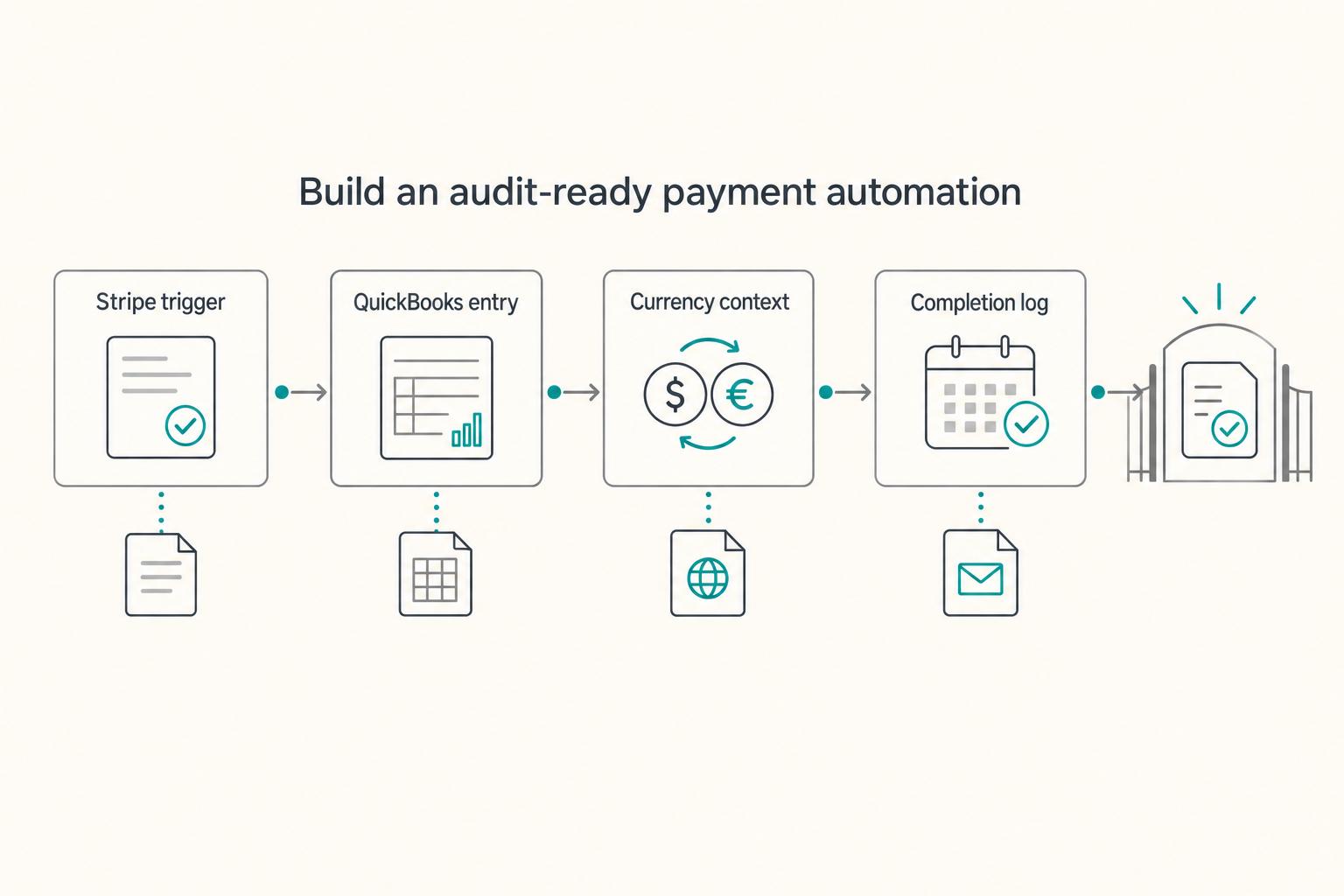
Automating Your Freelance Finances: A Zapier Workflow for Connecting Stripe, QuickBooks, and Wise
Start with one payment flow you understand, then automate its accounting record without losing the source reference. Stripe captures payments, QuickBooks holds the books, Zapier connects the selected steps, and Wise records any separate cross-border balance or conversion activity.

The Freelance Payment Penalty: A Modeled Audit of Platform Fees, FX Spreads, and Payout Delays
The money rarely disappears through a single, easy-to-spot fee. The real loss is stacked. A marketplace takes its commission, a processor adds a charge for international cards, a bank or payment company converts the currency at a spread, a platform holds the funds before release, and a wire sheds a little to intermediaries on the way in. Each layer looks defensible on its own, but the worker feels the combined result as a smaller deposit and a later payday.

How to Respond to a Subpoena for Business Records
Move fast, but do not produce records on instinct. If you need to **respond to a subpoena for business records**, your immediate job is to control deadlines, preserve records, and make any later production defensible.