
Quick Answer
Yes, integrated payables platforms consolidate pay runs when they let your team submit one batch across ACH transfers, wire transfers, checks, and virtual cards while keeping approvals and records aligned. The practical test is control: one place to approve, one place to track execution, and one record set that matches your ERP and internal ledger. If those checkpoints are missing, you have partial automation rather than true consolidation.
Integrated payables for platform teams who need control, not just automation#
Integrated payables starts to matter when you can run one pay run across multiple rails from one operating layer. It is not just a nicer screen on top of fragmented tools. In practice, you submit one batch, route ACH transfers, wire transfers, checks, and virtual cards from the same place, and keep approvals and records coordinated.
- One pay run, multiple rails
At its core, integrated payables centralizes outbound payments in one system instead of forcing your team to bounce between separate tools for each rail. The pattern is batch-based: you submit a batch of payments, and the platform dispatches each item in the right format, such as ACH for one payee and a virtual card for another. Payments do not need to look identical. What matters is coordinating execution even when the rails differ.
- Built for scaling accounts payable and payout batches
This is not an AP 101 setup for a low-volume team paying a handful of bills each month. It starts to matter when accounts payable begins to look more like platform operations: recurring payout batches, mixed payment types, and handoffs between finance, operations, and engineering. The useful test is whether finance still has one interface to process and log everything, or whether the real record now lives across bank portals, manual exports, and side spreadsheets. If it is scattered, you are already paying a control tax.
- Control is the real outcome
The main benefit is not automation by itself. It is coordinated pay runs, tighter approval coordination, and payment records your team can actually review later. A unified setup can coordinate approvals and scheduling while aggregating each transaction into one dashboard or record view. That gives you a better starting point for an audit trail, though the trail still depends on your controls and evidence handling.
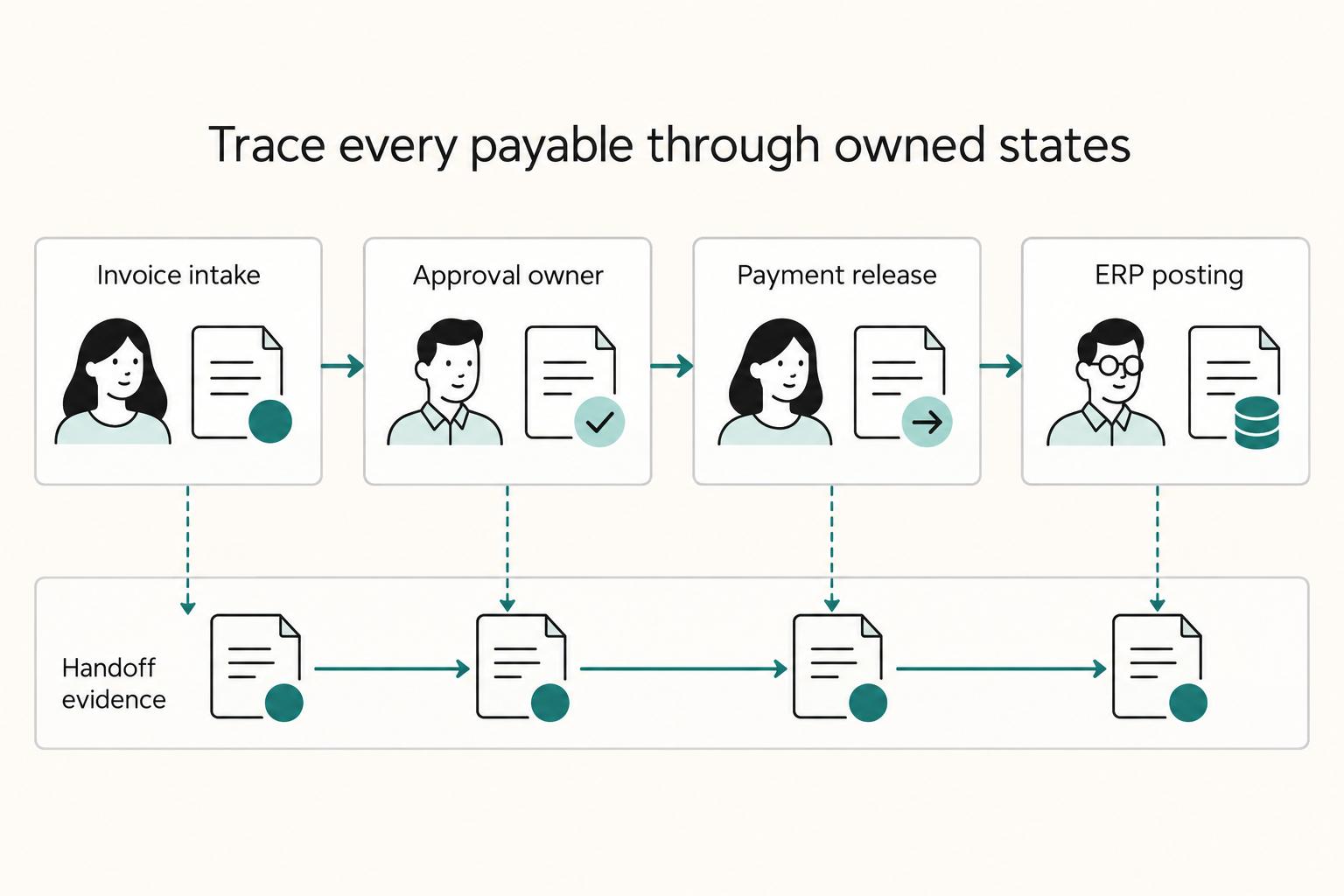
Use a simple operator check: for any submitted batch, you should be able to trace each payment from the payable line item to the dispatched rail and then to the logged transaction record in the same interface or record view. If you cannot, a common failure mode is false consolidation. Execution looks centralized, but approvals still happen in email, one rail still runs outside the platform, and month-end breaks because the records do not line up. At that point, the tool did not really consolidate the pay run. It just moved the mess.
If you are evaluating whether this model will actually reduce operational drag, start with one blunt question: does it give your team one submitted batch, one place to review approvals, and one record set to match against? If not, you are buying partial automation, not control.
Related: Accounts Payable Automation ROI: How Platforms Calculate the Business Case for Payables Technology. If you want a quick next step, try the free invoice generator.
Decide if your platform should consolidate pay runs now#
Consolidate now when exception pressure and ERP reconciliation burden are rising faster than payout volume. If they are not, standardize controls first.
| Signal | What to review | Indicator |
|---|---|---|
| Payee volume growth | Review the last three runs and confirm whether one submitted batch is still reviewed in one place or whether side spreadsheets now run the process | Increasing payouts create repeated batch friction because approvals and payout intake are not getting cleaner |
| Number of payment rails | Check whether ACH transfers, wire transfers, and checks are split across different portals or spreadsheets | Execution is fragmented and you cannot send one consolidated file your existing systems can use |
| Current exception rate | Tag one month of exceptions by root cause; the cited benchmark for top-performing AP organizations is 9% | You are well above 9% or trending upward as volume grows |
| Month-end reconciliation burden in ERP | See whether finance must manually stitch bank portals, provider exports, and spreadsheets before Reconcile Payables Activity for the Period and Create Accounting and Transfer to General Ledger | A single pay run cannot be tied cleanly to ERP activity |
This section is for platforms running repeat pay runs with finance and engineering both involved. It is not for low-volume teams on one rail with clean closes and no recurring operational pain.
- Payee volume growth
Volume is a consolidation signal only when it creates repeated batch friction. If monthly contractor, creator, or marketplace payouts are increasing but approvals and payout intake are not getting cleaner, every run slows down. Review your last three runs and confirm whether one submitted batch is still reviewed in one place, or whether side spreadsheets now run the process.
- Number of payment rails
More rails become a problem when they fragment execution. If you are juggling ACH transfers, wire transfers, and checks across different portals or spreadsheets, your operating record is already split. The practical test is whether you can send one consolidated file your existing systems can use, instead of rebuilding the same pay run across separate rail workflows.
- Current exception rate
Exception rate is a direct timing signal because it captures the share of payments needing manual intervention from errors, missing data, or approval bottlenecks. A cited benchmark for top-performing AP organizations is 9%. If you are well above that or trending upward as volume grows, treat it as a strong consolidation signal. Before selecting a vendor, tag one month of exceptions by root cause so you separate rail and approval breakdowns from payee data quality issues.
- Month-end reconciliation burden in ERP
Month-end close shows whether your process is actually consolidated. If finance must manually stitch bank portals, provider exports, and spreadsheets before steps like Reconcile Payables Activity for the Period and Create Accounting and Transfer to General Ledger, the burden is already material. If a single pay run cannot be tied cleanly to ERP activity, consolidation is still incomplete.
If exceptions are rising faster than payout volume, prioritize consolidation soon. If not, tighten onboarding, approvals, and master-data controls first, then re-check.
Compare your consolidation options before you pick a vendor#
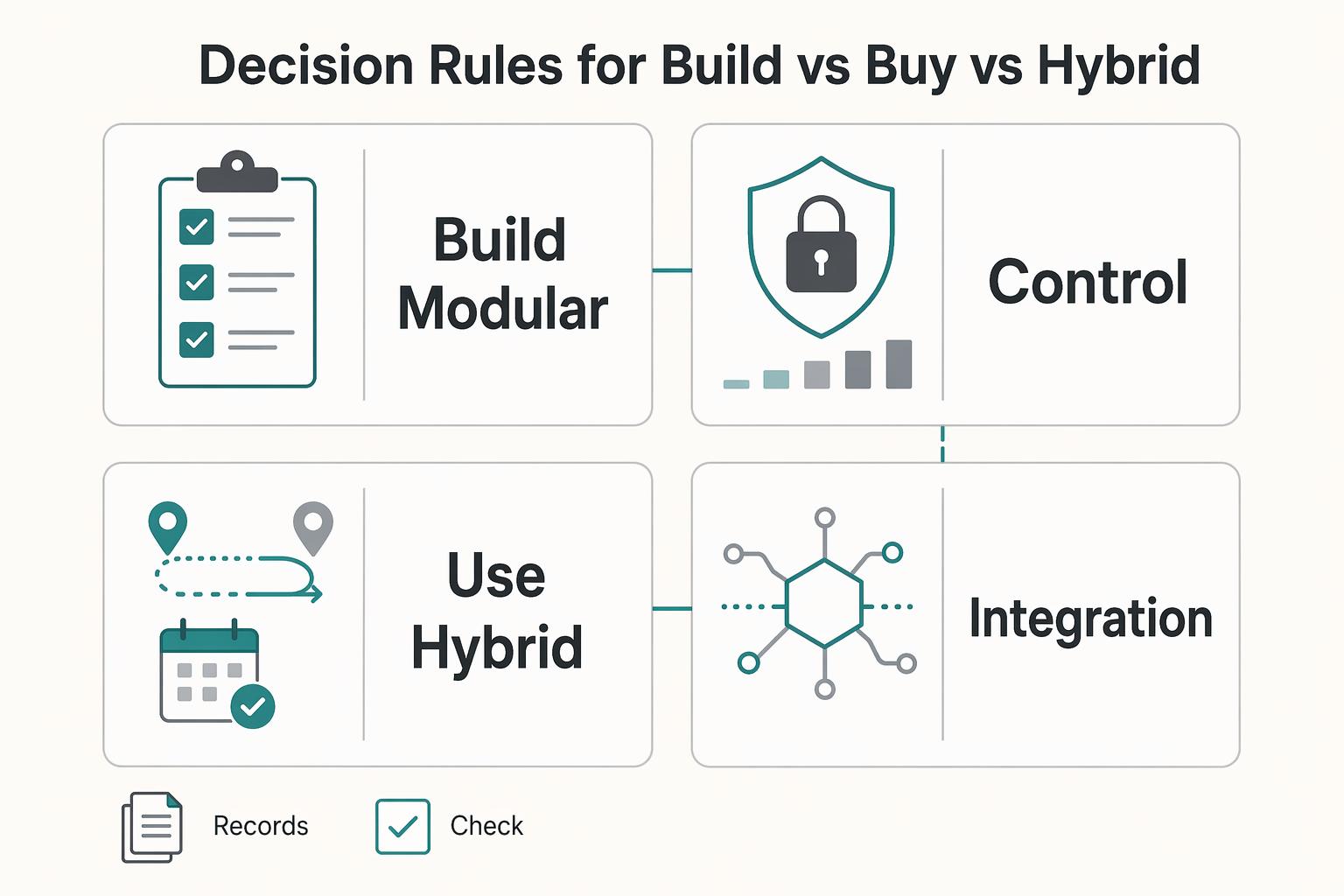
Pick the operating model before you pick the vendor: single-provider stacks usually reduce integration lift, while modular stacks can improve rail flexibility and reconciliation depth if your team can own the complexity.
| Option | Best for | Control | Speed to launch | Implementation effort | Key pros | Key cons | Concrete pay run / payout batch use case |
|---|---|---|---|---|---|---|---|
| Manual AP stack (bank portals + spreadsheets + exports) | Low-volume teams with one main rail and stable pay runs | Low to medium (process-dependent) | Low | Low at first, high over time | No new implementation, familiar process | Operational overhead grows as rails and files split across tools | Finance runs one weekly ACH pay run, then handles urgent wire exceptions outside the main payout batch and reconciles manually at month-end |
| Single integrated payables provider | Teams that want faster rollout with fewer moving parts | Medium to high | High | Medium | One system for outbound payments; one approved batch can be dispatched in different formats by payee; can reduce multi-file complexity | Less flexibility to mix providers or heavily customize internal mapping | Finance approves one creator payout batch, submits once, and the provider handles rail-specific formatting and execution |
| Modular API-led stack | Platforms with engineering ownership and multiple payout batches | High (if mappings and event handling are strong) | Medium | High | More rail choice; API/host-to-host patterns can support deeper internal matching and control | More failure modes and integration ownership | Marketplace routes domestic and cross-border payout batches through different providers, normalizes status events, then posts back into ERP |
Use these criteria to score options before shortlisting vendors:
- ERP compatibility: confirm whether movement is by flat file, point-to-point, API, or host-to-host, and who maps payment status back to ERP records.
- API quality: check whether batch and status data map cleanly to your internal payable records.
- Webhook reliability: verify retry behavior and recovery for missed events; for example, Stripe publicly states automatic retries for undelivered webhook events for up to three days.
- Native audit trail evidence: confirm the system records who did what and when, not only final payment results.
If your priority is speed with less integration drag, start with a single integrated provider. If your priority is mixed rails and deeper in-house reconciliation control, a modular API-led stack can be the better fit.
Set pay run cadence and batching rules that match your risk profile#
Set cadence by urgency and failure tolerance, not habit. The goal is to avoid trapped cash from funding too early and to keep urgent exceptions from getting buried in broad batches.
| Cadence | Best fit | Cash timing impact | Failure handling | Team workload |
|---|---|---|---|---|
| Weekly | Predictable, lower-volume payouts with few exceptions | More float between approval and payment, less flexibility for late changes | One bad file or missed cutoff can affect a large share of the run | Lowest day-to-day effort, higher peak pressure on run day |
| Daily | Steady volume with regular new payables and moderate urgency | Tighter alignment between approved payables and cash movement | Smaller failures are easier to isolate and rerun | Higher review and reconciliation frequency |
| On-demand | Time-critical exceptions or premium-speed payouts | Fastest release for urgent items, least batching efficiency | Isolates urgent failures, but can create control drift if overused | Highest interruption cost and approval load |
Weekly works when exceptions are rare and one concentrated review cycle is acceptable. Daily is often the middle ground because smaller batches make misses easier to contain. Keep on-demand narrow; if everything is urgent, prioritization has broken down.
Cadence sets when you run; rail rules set what belongs together.
- ACH transfers
Use ACH for repeatable, lower-urgency payouts that benefit from standardized batching. If you rely on Same Day ACH, cutoff discipline is non-negotiable: FedACH transmission deadlines are 10:30 a.m. ET, 2:45 p.m. ET, 4:45 p.m. ET, and 2:15 a.m. ET, and files must be completely received by deadline.
- Wire transfers
Use wires for urgent or high-value items. Fedwire transfers are immediate, final, and irrevocable once processed, so urgent wires should be separated from broad ACH-style batches; the current third-party initiation deadline is 6:45 p.m. ET each business day.
- Virtual cards
Use virtual cards where acceptance exists and you want tighter issuance and usage controls. They are digital instruments and can support cleaner compliance and auditing in exception-heavy workflows.
- Checks
Keep checks as a separate exception rail, not an urgent rail. In the cited guidance, the first $275 is generally available by the next business day, while the rest of the deposit should generally be available on the second business day.
If urgency is high and exceptions are frequent, split high-risk rails into separate payout batches. In practice: routine ACH in one batch, urgent wire exceptions in another, and paper-dependent items in their own queue so a hold on one rail does not freeze the full run.
Add explicit checkpoints: a lock window before provider or bank cutoff, final approval gates before release, and a dual-approval control pattern where appropriate. Then set a post-run reconciliation deadline before the next run starts so batch IDs, confirmations, approved totals, and ERP posting totals are aligned.
For a step-by-step walkthrough, see What is a Virtual IBAN and How Do Platforms Use It to Collect Payments Globally?.
Put controls in place before you scale volume#
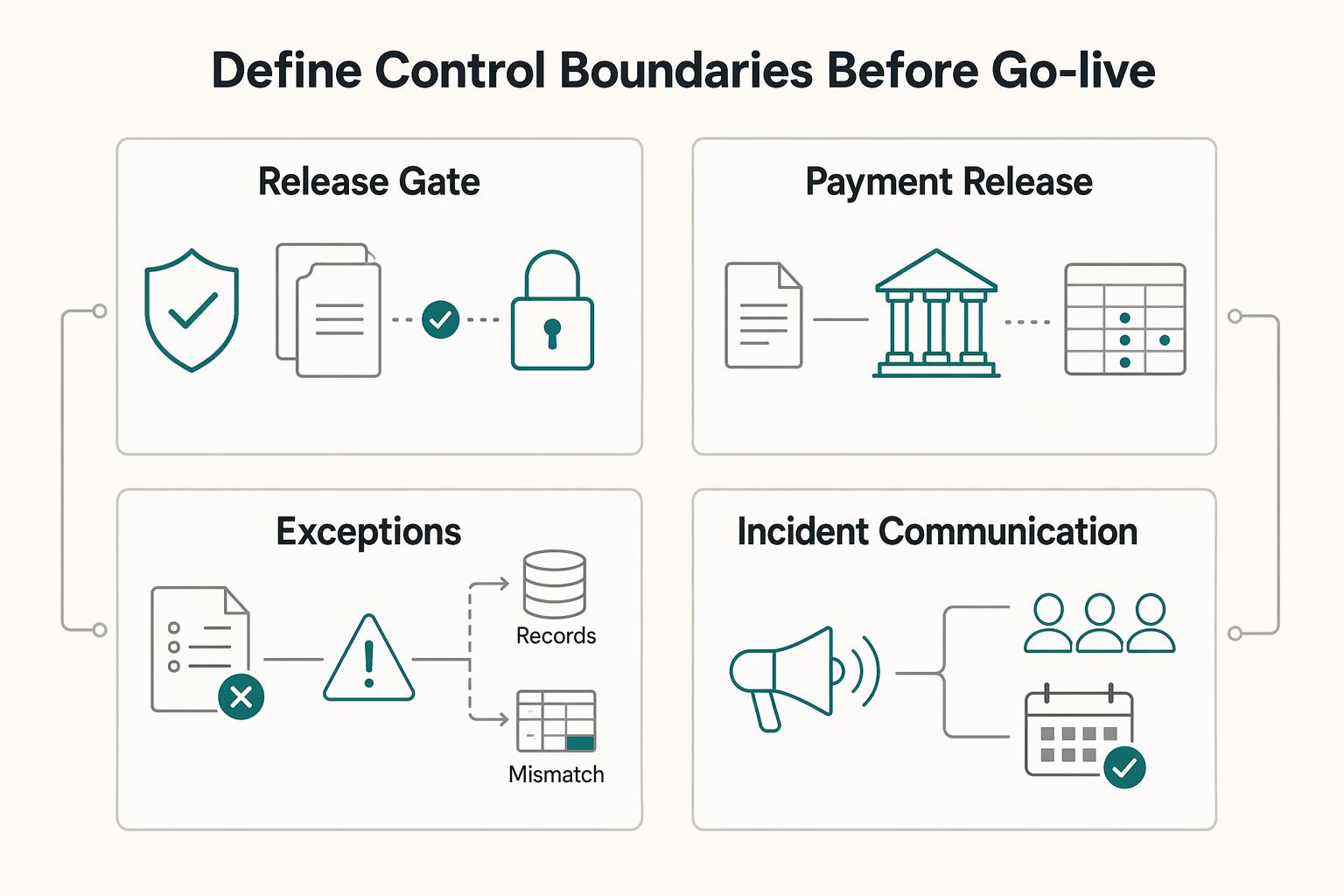
Centralizing execution without stronger controls just centralizes failure. Before volume climbs, lock in four controls: pre-run validation with dual approval, risk-based compliance gates, SLA-owned exception queues, and ledger-first reconciliation.
| Control | What to enforce | Key detail |
|---|---|---|
| Pre-run validation and dual approval gates | Validate approved totals, lock-window scope, and required compliance status by flow; require more than one individual to initiate payment | ACH guidance is explicit, and Nacha fraud-monitoring amendments take effect in 2026 |
| KYC, KYB, and AML gating by payout flow | Use KYC for individuals, KYB plus beneficial-owner information for legal entities, and ongoing AML monitoring for higher-risk activity | FFIEC frames CDD as ongoing and risk-based; cited rule timeline effective July 11, 2016, with compliance from May 11, 2018 |
| Exception queues with a named owner and SLA | Route failed, held, or review-required payouts out of the main run into a queue with a clear owner and SLA | Set SLA targets by rail and urgency, and surface items that are near breach before the next cutoff |
| Ledger-first reconciliation and audit trail review | Use the internal ledger as the operational source of truth, then reconcile outward to provider records and ERP postings | Keep approval records, payout IDs, provider confirmations, and ERP outcomes tied to the same entry |
- Pre-run validation and dual approval gates
Validate every batch before release: approved totals, lock-window scope, and required compliance status by flow. Then enforce dual controls at release so more than one individual is required to initiate payment. In ACH guidance, this is explicit, and Nacha fraud-monitoring amendments take effect in 2026.
This is your last checkpoint before funds move. If the same person can edit and release, errors and unauthorized changes are easier to miss until after provider acceptance.
- KYC, KYB, and AML gating by payout flow
Treat compliance as ongoing and risk-based, not onboarding-only. FFIEC frames CDD that way, with the cited rule timeline effective July 11, 2016 and compliance from May 11, 2018.
In practice, gate payouts by flow: KYC for individuals, KYB plus beneficial-owner information for legal entities, and ongoing AML monitoring for higher-risk activity. Match checks to your program and jurisdiction rather than using one universal checklist.
- Exception queues with a named owner and SLA
Route failed, held, or review-required payouts out of the main run into a queue with a clear owner and SLA. Set SLA targets by rail and urgency, and surface items that are near breach before the next cutoff.
This keeps exceptions from blocking routine payouts. When exceptions stay mixed into the main batch, one unresolved item can delay everything and ownership becomes unclear.
- Ledger-first reconciliation and audit trail review
Use your internal ledger as the operational source of truth, then reconcile outward to provider records and ERP postings. Post-run review should include both summary and drill-down evidence so mismatches can be explained quickly.
Keep approval records, payout IDs, provider confirmations, and ERP outcomes tied to the same entry. Reviewing only the provider dashboard can hide the expensive failure mode: funds moved, but books and audit trail do not align.
Build integrations that do not break during retries#
Retries are part of the normal payout path, not an edge case. To keep one approved payable from turning into duplicate payment attempts, lock one sequence for every run: create run, submit payout batches, ingest webhooks, then finalize reconciliation.
- Fix the order of operations before you write retry logic
Create the internal run record before sending provider calls, then attach payable lines, submit the batch, process webhook status updates, and only then close the run. This keeps late callbacks tied to an existing record instead of creating duplicate execution paths.
Keep a checkpoint where each run ID maps to its batch IDs, provider references, and close result. If a webhook reference does not map to an existing run, treat it as an exception to investigate, not a trigger for new money movement.
- Make idempotency mandatory on payout creation and retry paths
Require idempotency on every POST that creates a payout or payout batch. Stripe documents that client-generated idempotency keys let retries be recognized so repeated requests do not create a second object. Adyen documents that timeout retries are safe when you reuse the same key, and that keys are valid for a minimum period of 7 days. PayPal supports idempotency on REST POST calls with PayPal-Request-Id, and its payouts API rejects a reused sender_batch_id from the last 30 days.
The operating rule is simple: after ambiguous failures, retries must reuse the same keying material.
- Process webhooks as state updates, not payout instructions
Build webhook consumers to be duplicate-safe and delay-tolerant. Stripe retries undelivered events for up to three days, and when an event is already processed, you should ignore it and return success so retries stop.
Apply a processed-event check before updating ledger, ERP, or AP status, and store a compact event record: provider event ID, first-seen time, processing result, and resulting state. If you need manual recovery, remember Stripe event listing is limited to the last 30 days.
- Handle partial batch failures and stale ERP states at item level
Do not treat batch acceptance as item-level success. PayPal notes that some payout item values are not immediately validated, so later item failures can still occur after submission.
During close, keep the run open when provider and ERP states do not match. Verify each provider reference maps to exactly one internal ledger record and one AP payable line item. For Stripe, use payout-to-transaction linkage (payout on balance transactions) to trace payout-level status back to transaction-level records.
A reliable integration does not prevent every timeout, delayed webhook, or partial failure. It makes those events routine by preserving one traceable path from provider reference to internal ledger and AP records.
Related reading: Sync Royalties for Video Platforms and What You Owe for Music Licensing.
Best integrated payables models by platform stage#
The right model is usually the lightest one that still gives you reliable approvals, provider references, and close evidence.
| Stage | Model | Best when | Not ideal when |
|---|---|---|---|
| Early stage | Managed model with minimal API work | Speed matters most and the payout pattern is still narrow | Manual exceptions are already happening outside the provider UI |
| Growth stage | Hybrid model with provider UI plus internal controls | You need stronger approvals and reconciliation, but full API ownership is still too heavy | Your team cannot keep one internal run ID mapped to provider batch IDs, approval records, and close outcomes every run |
| Scale stage | API-first orchestration with custom webhooks and ledger controls | Routing flexibility and visibility matter more than setup speed | Your finance stack is highly customized and you cannot absorb the added integration work |
- Early stage: managed model with minimal API work
Best when speed matters most and your payout pattern is still narrow. Provider-managed setups reduce integration effort, and Stripe explicitly recommends Express or Standard connected accounts when lower integration work is the priority. The tradeoff is less control when edge-case rails or payout exceptions appear. Not ideal when manual exceptions are already happening outside the provider UI.
- Growth stage: hybrid model with provider UI plus internal controls
Best when you need stronger approvals and reconciliation, but full API ownership is still too heavy. Let the provider handle payee-facing flows while your team owns run creation, approvals, and mapping back to the books. The benefit is balanced control; the risk is dual tooling and state drift if records are not tied together. Not ideal when your team cannot keep one internal run ID mapped to provider batch IDs, approval records, and close outcomes every run.
- Scale stage: API-first orchestration with custom webhooks and ledger controls
Best when routing flexibility and visibility matter more than setup speed. An orchestration layer lets you integrate once and manage downstream providers, and integrated payables can dispatch one batch across different rails, for example ACH and virtual cards. The upside is control; the cost is higher engineering ownership across webhooks, idempotency, and internal ledger state. Not ideal when your finance stack is highly customized and you cannot absorb the added integration work.
If you want a deeper dive, read Accounts Payable Workflow for Platforms: How to Design an Efficient End-to-End Payables Process.
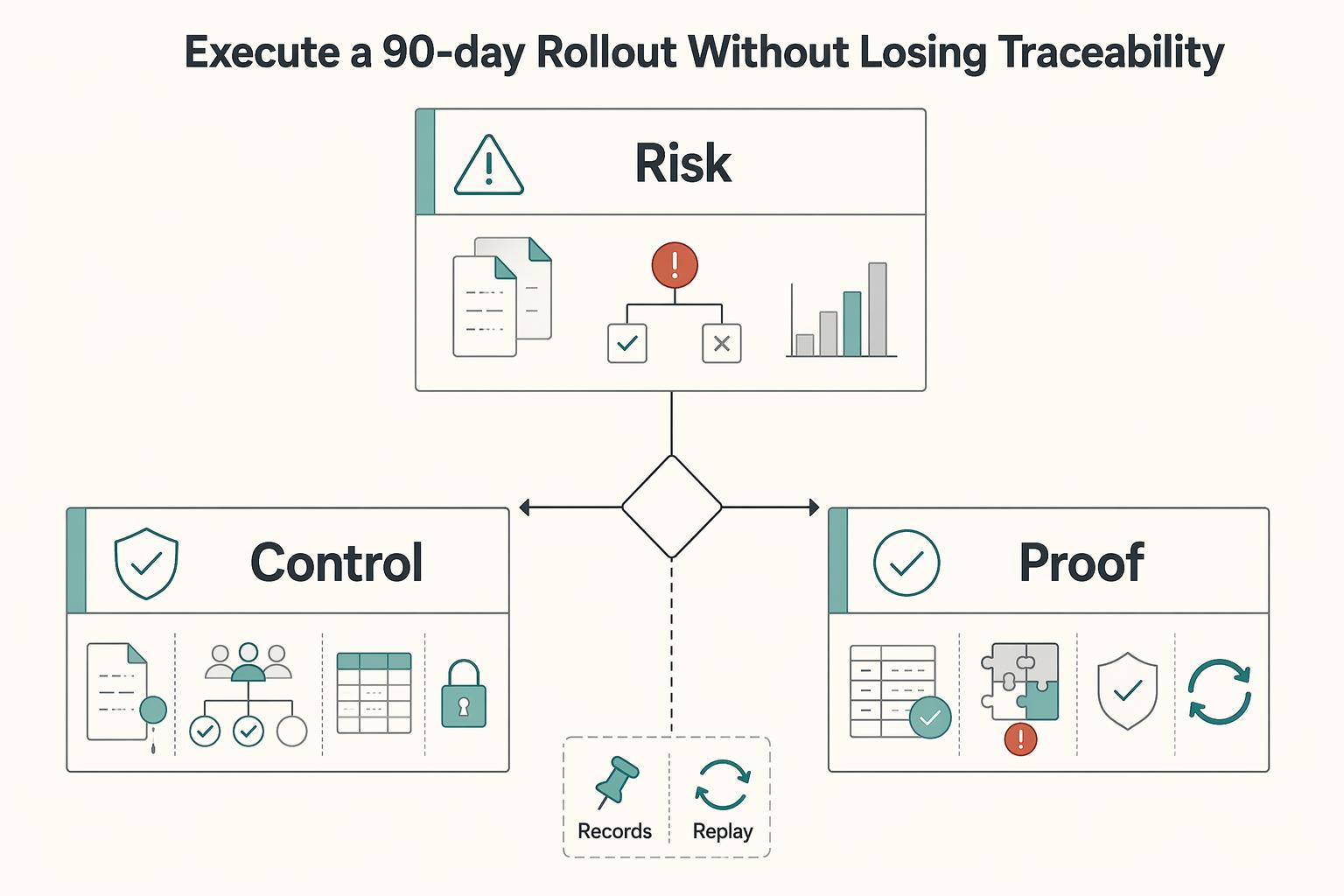
Execute a 90-day rollout without losing traceability#
Run this 90-day plan as a controls rollout first and a payments rollout second: if you cannot prove approval, payout execution, and reconciliation, do not expand scope.
- Days 1-30: map current flow and lock control evidence
Start from your live accounts payable path, not the target-state diagram. Document intake, approval gates, pay-run fields, and reconciliation outputs needed before posting. Lock the baseline now: every run should retain an approval record, provider reference, final status, and an audit trail finance can review later.
- Days 31-60: pilot real payout batches and test failure paths
Pilot on your highest-volume payment rails, then test failures, not only happy paths. Use idempotency keys on payout create and update calls so retries do not create duplicate operations. Treat webhook handling as duplicate- and retry-safe, since providers can resend the same event and retry failed deliveries. Keep the check simple: replay one failed request and one duplicate webhook, then confirm you still have one payout outcome and one reconciliation record.
- Days 61-90: cut over by rail and report defects early
Phase cutover by rail when that lowers disruption risk, and monitor exception queues closely during each move. Share defect and reconciliation reporting with finance and engineering on a regular cadence, for example weekly, so mismatches are visible across teams. Keep ownership explicit: your team is responsible for reconciling created payouts to transaction history. As one controller put it, this "helps to reconcile expenses more easily, because you're able to leave a very clear trail."
Consolidate pay runs only when your controls are stronger than your complexity#
Consolidate pay runs only when you can improve speed and control at the same time. If consolidation only reduces vendor count or forces every rail into one file, execution may look simpler while errors become harder to detect.
- Pick the architecture that preserves evidence.
Single-file consolidation can simplify execution, but the key test is whether each payout still carries what you need to prove the outcome: approval record, provider reference, remittance detail, and a clear path back to your books. If you cannot show one payable line item mapping to one payment result and one accounting record, you have consolidated submission, not consolidated control.
- Set cadence from payment terms, not tool preference.
Define invoice-matching policy and payment-term execution before standardizing pay runs. Group payments that truly belong together, and keep separate runs where urgency or review requirements differ. The goal is accurate, on-time payment against agreed terms, not batching the most rails into one cycle.
- Use segregation of duties as the baseline control.
Segregation of duties should anchor your control design as complexity grows. Internal controls should clearly separate who can set up payees, who can approve release, and who can review outcomes. Before scaling volume, confirm that no one person can edit payment details, release the run, and sign off results.
- Scale only after a pilot proves reconciliation, not just payout success.
Start with a small pilot and define pass/fail criteria up front, then continue only if those criteria are met. Verify on-time payouts, complete approvals, provider status matching your books, remittance detail quality, and post-run matching without manual guesswork. That gives you a defensible path to broader migration.
Frequently Asked Questions
What is an integrated payables setup for platform pay runs in practical terms?
It means managing outgoing payments in one place instead of treating each rail as a separate operation. In practice, teams define the pay run, handle exceptions, execute payment instructions, and keep each payout tied to status, provider reference, approval records, and internal books.
How do you consolidate ACH transfers, wire transfers, checks, and virtual cards without losing control?
You consolidate the operating layer, not the risk rules. A multi-rail setup can process checks, ACH, wires, and cards through one portal or platform flow, but controls should still be applied per rail. Your checkpoint is simple: for every payout, confirm records can be matched across the payable, provider result, and internal accounting record.
Which controls are mandatory before approving a pay run?
There is no single checklist that fits every platform. A practical baseline is dual-control approvals and post-run reconciliation so internal records match external statements. For ACH specifically, dual controls for ACH origination and account changes are an explicit fraud-control recommendation, so do not let one person both edit bank details and approve release.
What usually breaks first when pay runs scale quickly?
Incident handling around retries and events is a common failure point as volume rises. Webhook endpoints can receive duplicate deliveries, so your intake should deduplicate processed events rather than create a second downstream action. If you retry after a timeout, reuse the same idempotency key so the request can be retried safely.
When should we keep separate payment rails instead of forcing full consolidation?
Keep rails separate when timing, urgency, or exception handling is materially different. If one rail’s exception path can block the rest of the batch, split it into a separate run and review it on its own schedule.
Should we outsource accounts payable operations or keep them in-house with integrated tooling?
This is an operating-model tradeoff, not a guaranteed ROI formula. Outsourcing can help with operational capacity, while in-house integrated tooling can help when you need direct ownership of approval gates, reconciliation, and incident response. If you are weighing that tradeoff, this deeper guide on accounts payable outsourcing for platforms is the right next read.
How do idempotency keys, webhooks, and internal books review work together during incidents?
Use an idempotency key when creating or retrying a payout so a timeout does not create a duplicate request. Assume webhook endpoints will receive duplicate deliveries and store processed event IDs before taking action. Then work outward from your books: they should show whether one payout instruction became one completed payment, and whether that matches the provider result and your accounting records.
Try a related tool
Researched and edited by the Gruv editorial team. Gruv builds cross-border billing, payouts, and finance-operations software for global businesses.
Sources
- bsaaml.ffiec.gov/manual/AssessingComplianceWithBSARegulatoryR...trusted
- csrc.nist.gov/glossary/term/audit_trailtrusted
- docs.stripe.com/webhooks/process-undelivered-eventstrusted
- docs.stripe.com/api/idempotent_requeststrusted
- ecfr.gov/current/title-31/subtitle-B/chapter-X/part-1...trusted
- federalreserve.gov/paymentsystems/fedfunds_about.htmtrusted
- helpwithmybank.gov/help-topics/bank-accounts/funds-availability...trusted
- ojp.gov/ovc_fmrc_guide_sheet_internal_control_separa...trusted
Educational content only. Not legal, tax, or financial advice.
Related Posts
Accounts Payable Outsourcing for Platforms When and How to Hand Off Your Payables to a Third Party
Start with the real choice, not the buzzword. Accounts Payable outsourcing means shifting AP work from your in-house team to a specialized external provider. In practice, your decision is usually narrower: hand off execution now, wait until the process is ready, or keep it internal and automate instead.
Designing an End-to-End Accounts Payable Workflow for Platforms
Start with the process, not the product demo. Full-cycle Accounts Payable (AP) runs from purchase order through payment and reconciliation. Weak design usually shows up later as invoice delays, duplicate payments, missed due dates, and supplier disputes.
Accounts Payable Automation ROI for Platforms That Need Defensible Results
Most AP projects do not miss ROI because the spreadsheet was wrong. They miss it when real costs show up in exception handling and post-go-live process work. If you are evaluating AP automation, the useful question is not whether automation can create value. It can. The question is whether that value survives contact with your actual process.