
Quick Answer
Yes - platform teams should model sync as two rights plus two payment lanes. You typically need a synchronization license for the composition and a master use license for the recording, then you evaluate whether public use could trigger backend performance royalties through a performing rights organization. The practical move is to classify use first, clear both rights per asset, and only release tracks with complete documentation tied to payment routing.
What Video Platforms Pay for When Licensing Music#
Before you ship video features, break the music question into three parts. First, identify the right you need to pair music to picture. Then identify the license fee, which is often paid up front. Finally, ask whether any ongoing royalties could still show up later. That matters more than the deal label, because it is easy to miss obligations when all music spend is treated as one bucket.
| Item | Covers | Key point |
|---|---|---|
| Synchronization license | Permission to pair a musical composition with visual imagery | Covers the composition and does not automatically cover the specific recording |
| Master use license | Permission for a specific sound recording | May also be needed when you want a specific recording |
| Backend royalties and public performance | Possible later payment path when music is publicly performed or transmitted | Possible, not automatic in every deal, so do not assume the upfront sync fee settles everything |
In practice, music in video usually touches two separate copyrighted works: the musical composition and the sound recording you actually hear. If your product uses a specific commercial track, you are not evaluating a single permission. You are checking whether the composition rights and master recording rights are both covered, whether the same party controls them, and whether your contracts clearly show who gets paid.
- Synchronization license
This is the permission to pair a musical composition with visual imagery. If your platform is putting a song under video, this is a core right to clear. A sync license covers the composition. It does not automatically cover the specific recording, so a clean launch starts with verifying who controls the publishing side.
- Master use license
If you want a specific sound recording, you may also need a master use license for that recording. This is where teams get tripped up when "we cleared the song" gets treated as "we cleared the track." If the composition is one right and the recording is another, your evidence pack should show both permissions before any asset goes live.
- Backend royalties and public performance
An upfront sync license fee is not the same thing as every possible later payment. Under U.S. copyright framing, a public performance can occur when music is transmitted to the public through TV, digital service providers, and other public-facing channels. Performance royalties are collected from licensees who publicly perform works in repertory. The key point is that backend obligations are possible, not automatic in every deal, so classify the intended use before launch instead of assuming the upfront fee settles everything.
That is the lens for the rest of this guide. We are not trying to cover every royalty type or teach songwriter economics. We are narrowing the question to the one platform teams actually have to answer: what you owe, to whom, and when. That way product scope, legal review, and payment ops match the rights you are really using.
For a broader breakdown of sync, performance, mechanical, and master rights, see How Music Royalties Work: Mechanical Performance Sync and Master Rights Explained.
Start with the selection criteria that actually change outcomes#
Use-case scope is the first decision that changes licensing outcomes, budgets, and launch risk. If your team cannot verify ownership, rights scope, and payment routing before launch, treat that as a no-go and delay rollout instead of shipping partial licensing logic.
| Criterion | Article detail | Why it matters |
|---|---|---|
| Placement type | Advertising, YouTube series, film, television, and video game uses do not carry the same operational burden | Sync fees vary by media type and distribution scope |
| Payment events | A sync license fee is typically a one-time negotiated payment, while performance royalties can arise later | Keep those as separate lines, and do not assume ASCAP licenses cover sync |
| Rights topology per asset | A placement can require one license for composition rights and one for master recording rights | If ownership is split, approvals and payment routing are more likely to slow down or fail |
| Evidence pack before publish | For each track, verify who owns the composition side, who owns the recording side, what use is approved, and where payment should go | Uncleared or partially cleared music increases launch risk, including content removal on platforms |
-
Start with the placement type. Advertising, a YouTube series, film, television, and video game uses do not carry the same operational burden. Sync fees vary by media type and distribution scope, so define one primary use case per launch phase instead of clearing against a broad "video" bucket.
-
Model two payment events from day one. A sync license fee is typically a one-time negotiated payment for pairing music to picture, while performance royalties can arise later when music is publicly performed or transmitted. Keep those as separate lines in your model, and do not assume ASCAP's licenses cover sync; ASCAP offers public performance licenses, not sync licenses.
-
Map rights topology per asset. A placement can require two licenses: one for composition rights, the underlying song, and one for master recording rights, the specific recorded performance. If one party controls both sides, clearance is usually simpler; if ownership is split, approvals and payment routing are more likely to slow down or fail.
-
Require an evidence pack before publish. For each track, verify who owns the composition side, who owns the recording side, what use is approved, and where payment should go. Uncleared or partially cleared music increases launch risk, including content removal on platforms when music is not fully licensed.
Best option for curated premium campaigns with strict brand control#
Direct negotiation is the best fit when the song is part of the campaign idea and you need exact rights scope, including possible exclusivity. If your launch date is fixed and you cannot verify control of both publishing rights and the master recording early, use a pre-cleared option instead.
This is usually the premium path for high-scrutiny brand work, often led with a music supervisor to select and license preexisting music for visual media. You negotiate the synchronization license for the composition and the matching master use license for the recording, rather than accepting standard catalog terms.
The advantage is control: clearer use terms, tighter alignment between publisher and label approvals, and a cleaner signoff path for hero placements. That control matters because sync fees depend on use details such as duration and number of uses, and exclusivity increases cost.
The tradeoff is speed and operational load. When ownership is fragmented, approvals slow down; split publishing can require clearance from all shareholders, and one holdout can stall the asset. Also, PROs do not issue sync licenses, so approvals must come from the publisher or other copyright owner, plus the label for the master.
Before you lock creative, confirm in writing:
- Rights control: who controls composition rights and who controls the master recording; one-stop control is the cleanest structure.
- Use scope: approved media use, duration, number of uses, and any exclusivity terms.
- Payment routing: separate handling for composition-side sync fees and master-side fees.
Use direct negotiation when the song is important enough to justify slower approvals and higher legal/ops effort. If the track is only a nice-to-have, this route is usually the weaker operational choice.
If your team also licenses music and sound effects for creative work, see A Motion Designer's Guide to Licensing Music and Sound Effects.
Best option for speed when your catalog must scale fast#
Choose a pre-cleared, one-stop catalog when your priority is getting licensed music live quickly across formats like YouTube series and short-form branded video, not maximizing exclusivity.
- Best for: fast launch coverage across many video formats.
- Key pros: faster clearance, simpler licensing flow, and less track-by-track multi-party negotiation when one provider controls or pre-clears both sides.
- Key cons: less exclusivity, weaker catalog differentiation, and less flexibility for custom sync placement terms.
- Concrete use-case: MVP rollout where broad licensed coverage matters early, before deep catalog curation.
- Decision rule: if time-to-market matters more than uniqueness, start with one-stop coverage and add premium direct deals later for high-impact placements.
This route is faster because many catalogs are marketed as pre-cleared for sync and master use worldwide, with direct licensing built in. You still need both rights assets in every use: the composition and the recording. The speed gain comes from not having to clear those rights separately for each track.
Scale is a practical advantage. Some providers market very large inventories, including catalogs with 630,000+ tracks and sound effects, while others promote 55,000 tracks and 250,000 sound effects and variations. For early-stage launch needs, that searchable breadth can be more useful than slower, fully custom licensing.
Before launch, confirm the provider actually controls or pre-clears both sides for your intended uses, and verify that your planned distribution and reuse are covered by the license terms.
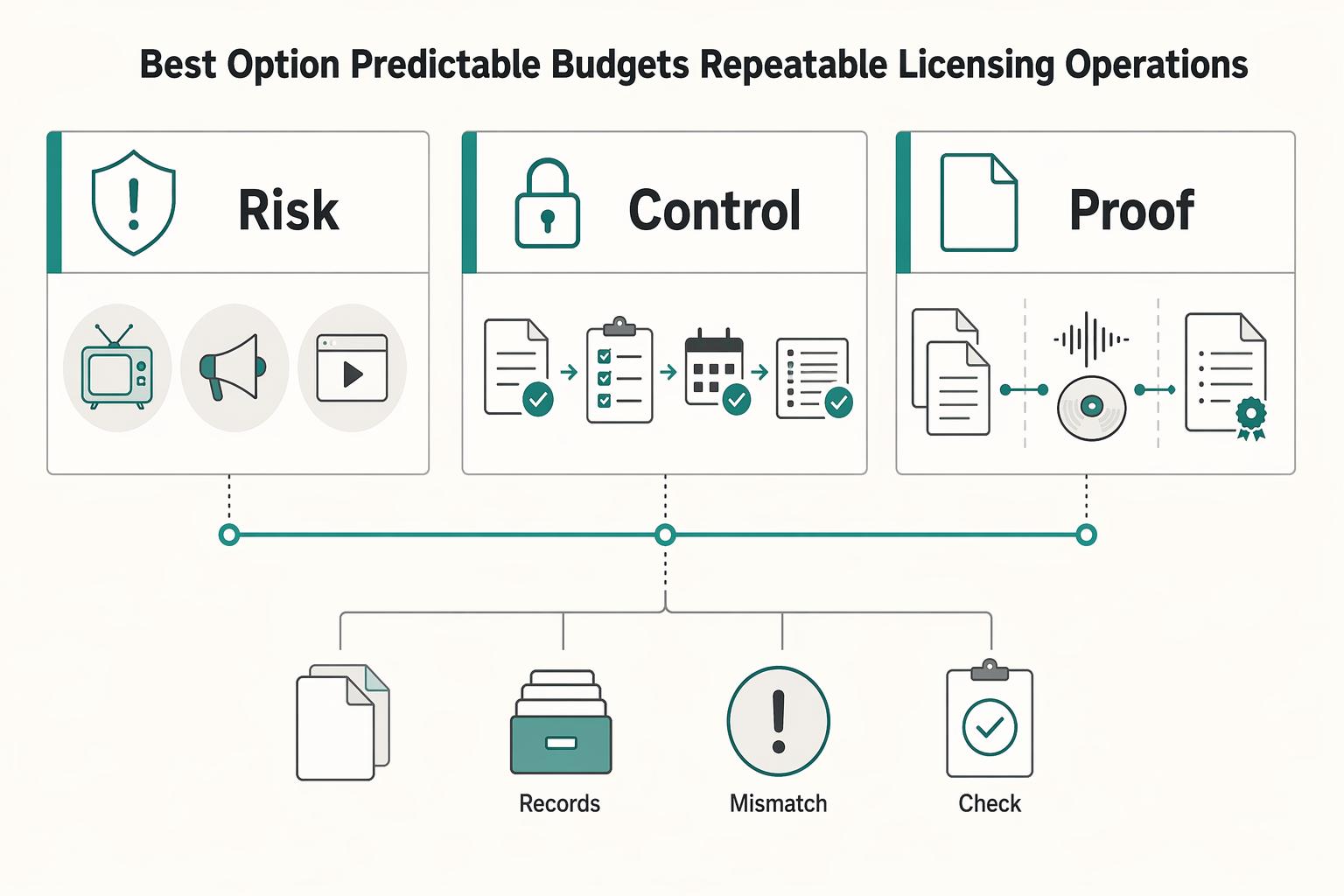
Best option for predictable budgets and repeatable licensing operations#
For recurring television, advertising, and platform-owned media, predictable budgets come from a repeatable per-use licensing workflow, not one-off deal logic. The benefit is operational consistency: you approve, document, and pay through the same controls each time, while accepting that terms can still vary by publisher, channel, and region.
A synchronization license covers the musical composition in an audiovisual work, and a separate master use license covers the specific sound recording. Those are distinct rights, and each use should be licensed on its own terms.
- Define the use before pricing
Treat each planned use as its own approval event, not blanket permission that follows an asset everywhere. Ad placements, reposts, cutdowns, and owned-platform streams can carry different terms, and publishers set their own fees and conditions.
- Track publishing and master as separate approvals
Store composition and recording clearances as separate records. Before you publish, require written scope for both sides, including rightsholder, territory, media, term, edit/reuse permissions, and the asset or track ID.
- Model sync and performance as separate payment/risk lanes
Handle the upfront sync fee as one control point, then evaluate downstream public-performance exposure separately. Streaming is treated as a public performance, and if audiovisual recordings are streamed, sync and performance licensing may both be needed.
The tradeoff is straightforward: repeatable licensing can feel less differentiated creatively, and clearance scope may still differ across channels or regions. For recurring programs, require an evidence pack for every asset and keep everything in writing so per-use economics stay predictable and rights scope stays defensible.
For a step-by-step walkthrough, see Music Licensing for Video Projects Without Scope Mistakes.
Best option when your product requires exclusive sonic identity#
When your product needs a proprietary sound, commissioned music is typically the strongest fit because it gives you tighter control over reuse, edits, and brand association than nonexclusive catalog use.
- Set ownership terms in writing at creation
Use a written, signed agreement that expressly states work-made-for-hire treatment when that structure applies. In that case, the hiring party is treated as author and copyright owner, which can centralize long-term control from day one.
- Use an exclusive license if work made for hire is not the path
An exclusive license transfers one or more rights to one licensee, giving tighter control than a nonexclusive license. This matters for signature audio, because nonexclusive deals allow the same rights to be licensed to others. Expect more creative lead time and negotiation than a pre-existing catalog route.
- Keep full sync rights checks, even for custom tracks
Custom creation does not remove sync clearance requirements: you still need to clear composition and master pathways for each placement. Before launch, confirm the signed agreement, rights scope, edit rights, media, territory, term, and exact asset or cue ID. The common miss is assuming "custom" automatically means fully owned or fully exclusive when the contract does not clearly grant that.
Compare the options before you commit engineering and legal resources#
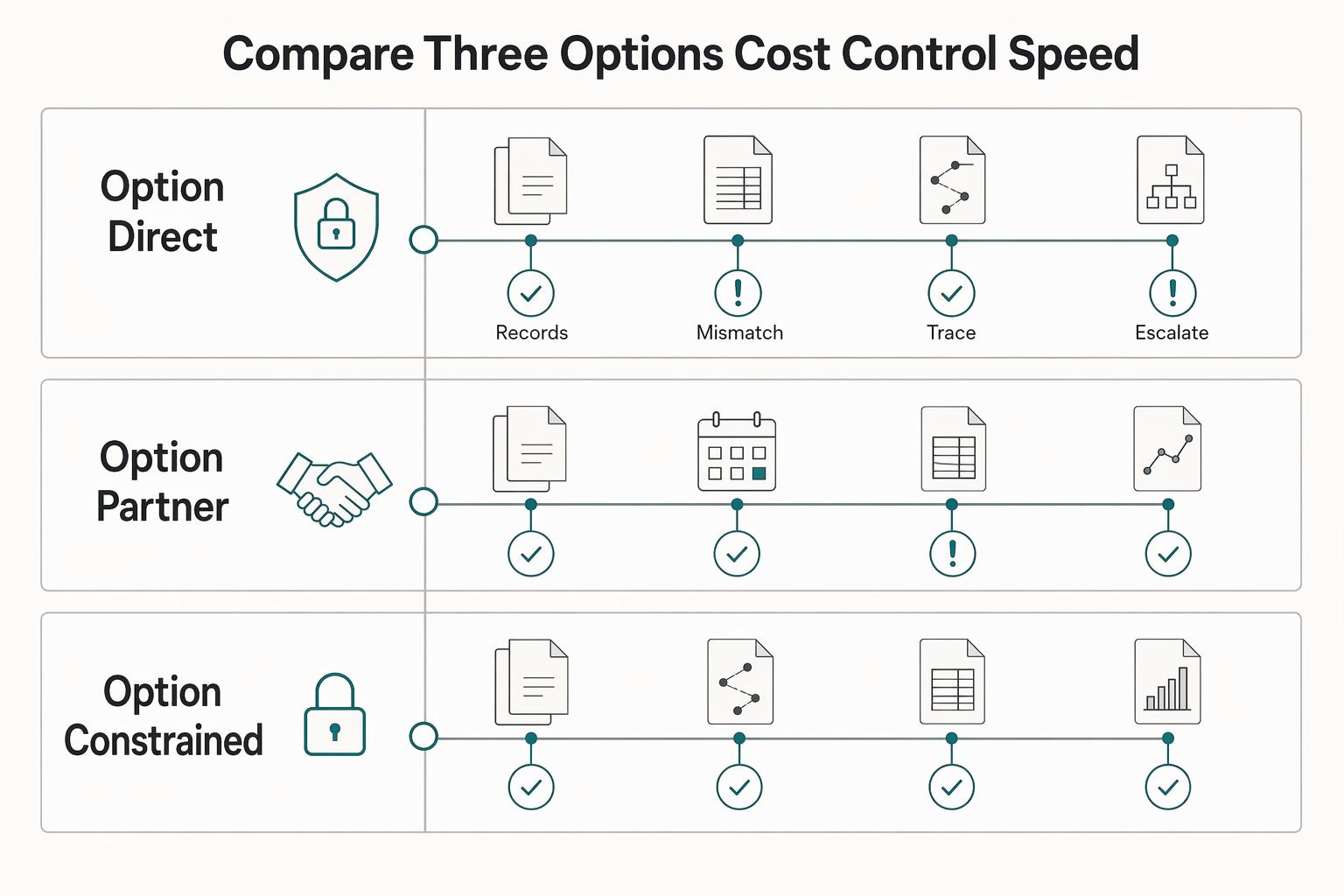
If deadlines are fixed, pick the option with the fewest approval points and the clearest rights evidence, then evaluate creative fit. Before modeling payments, confirm who can grant composition rights and master recording rights.
| Option | Best for | Required rights | Payment events | Operational risk | Launch speed | Failure mode | Recommendation |
|---|---|---|---|---|---|---|---|
| Direct negotiated catalog deal | Premium campaigns where a specific known song matters | Usually both a synchronization license (composition) and a master use license (recording) | Upfront sync license fee paid directly to the copyright owner or representative; backend royalties may apply if public performance exposure exists | High when ownership is fragmented or approvals are manual | Slow | Missing rights holders, or even small unresponsive ownership shares, can block launch; even 2.5% unresponsive ownership can jeopardize a license | If ownership is split and deadlines are fixed, avoid direct-only licensing |
| Pre-cleared or one-stop catalog | Fast launches across repeat video formats where speed matters more than exclusivity | Still verify composition and master coverage, even if presented as one deal | Usually an upfront sync fee; backend exposure may still exist for performance rights | Medium | Fast | Territory, media, or use scope is narrower than your actual release | Use for speed, but confirm scope before publish |
| Standardized repeat-use licensing arrangement | Teams that need predictable approvals and finance handling across recurring content | Confirm each asset maps to composition and master permissions, or that exclusions are explicit | Repeatable sync fee handling; backend obligations depend on actual public use | Medium to low if documentation is consistent | Medium to fast | Template exists, but asset-level proof is missing or inconsistent | Strong default for scale; require asset records with scope, term, media, territory, and cue/track ID |
| Commissioned original music or exclusive license | Flagship audio, branded themes, or launches needing exclusive sonic identity | Written agreement should cover both the underlying composition and resulting master recording | Upfront commissioning or licensing payment; backend exposure depends on public performance context | Medium on ownership, higher on lead time | Slowest at start | "Custom" agreement does not clearly grant exclusive use, edit rights, future recuts, or territory scope | Choose only when exclusivity is a true product requirement and legal review happens before production |
| Ongoing obligations across any option | Any use that may enter public-performance lanes after sync clearance | Sync permission is separate from performance-rights licensing and collection | Performance royalties may be collected through PRO systems such as ASCAP, BMI, or SESAC, separate from sync fees | Medium if teams treat sync as the only payment event | No launch delay if modeled early; costly cleanup if ignored | Public-use context is not classified, or finance never routes the usage into royalty handling | Classify performance exposure before launch; do not assume sync payment closes downstream obligations |
What actually decides the winner#
The deciding factor is usually rights topology, not headline price. For known recordings, you generally need permission for the song and the recording; when those rights sit with different parties, delay risk rises quickly.
Use one hard launch checkpoint: for every asset, store the signed agreement or license reference, named rights holders, media, territory, term, edit rights, and exact cue/track ID tied to release content. If that evidence pack is incomplete, clearance is not production-ready.
One backend detail teams miss#
Sync fees and backend collections are different payment events. Performance royalties come from public performance of musical works and can involve PROs such as ASCAP, BMI, or SESAC; SESAC reports licensing public performance for more than 1.5 million songs.
Working rule: if speed matters, reduce approvals; if exclusivity matters, accept slower contracting; if public-use exposure is possible, model that obligation before launch.
For the performance-rights side of the licensing stack, see Performance Royalties Explained: How PROs Collect and Platforms Distribute Performing Rights Payouts.
Execute in the right order to avoid expensive relaunches#
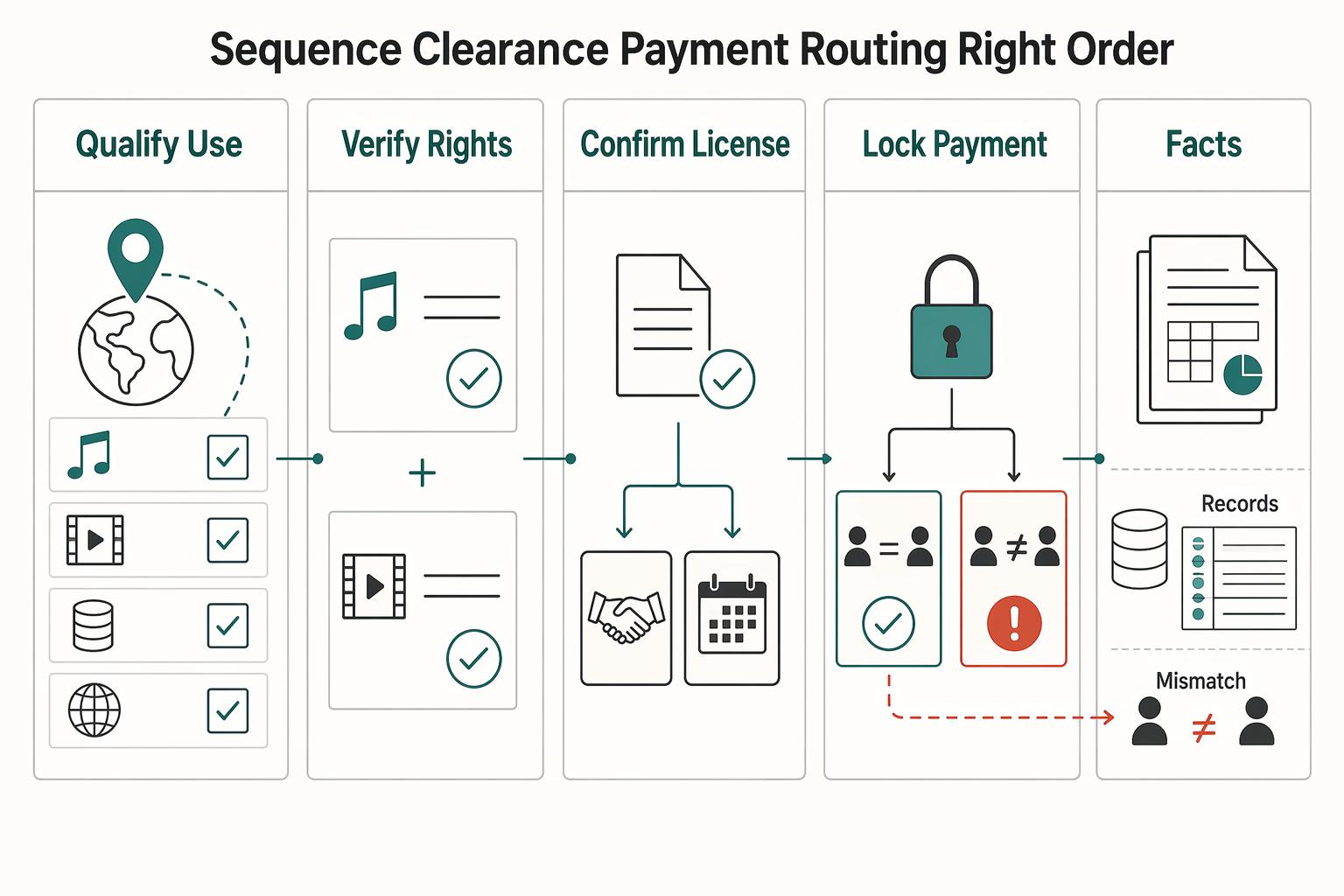
To avoid relaunch work, treat music clearance as an execution sequence: classify the use first, verify rights evidence per asset, then route payment events.
| Step | Article detail | Why it matters |
|---|---|---|
| Classify the use before you model payments | Decide whether the planned use is sync-only or could enter a performance-rights lane | BMI licenses performing rights only and does not provide synchronization licenses; public-performance exposure can include radio, television, and streaming contexts |
| Collect rights evidence per asset before publish | For a known released song in video, you generally need both composition permission and recording permission | Keep license references, rights holders, media, territory, term, edit rights, and exact track or cue ID |
| Wire payment ops to distinct events | Treat the sync license fee as its own settlement event, then separately track any performance-royalty pathway | One asset can be sync-cleared at launch and still create later obligations if distribution expands into public-use channels |
| Define exception handling for incomplete or disputed records | Hold the asset for manual review if a sync record is incomplete, disputed, expired, or missing part of the rights chain | Typical triggers are composition cleared without master clearance, territory mismatch, term mismatch, or unresolved rights-holder authority |
| Run a pre-launch audit sample | Validate that contract data, release controls, and payment routing stay traceable end to end across Film, Television, and YouTube series use cases | For film and television, cue-sheet readiness is a practical traceability check; for YouTube series, run the same contract-to-payment trace test |
-
Classify the use before you model payments. Decide whether the planned use is sync-only or could enter a performance-rights lane. That matters because BMI licenses performing rights only and does not provide synchronization licenses, so PRO coverage does not replace sync clearance. Public-performance exposure can include radio, television, and streaming contexts, which may add downstream royalty handling beyond an upfront sync fee.
-
Collect rights evidence per asset before publish. For a known released song in video, you generally need both composition permission and recording permission. A sync license covers the composition in audiovisual use, while a separate master use license is needed for the recording. Keep an asset-level record with license references, rights holders, media, territory, term, edit rights, and exact track or cue ID so the production asset can be matched to granted rights.
-
Wire payment ops to distinct events. Treat the sync license fee as its own settlement event. Then separately track any performance-royalty pathway tied to public performance of the work. One asset can be sync-cleared at launch and still create later obligations if distribution expands into public-use channels.
-
Define exception handling for incomplete or disputed records. If a sync record is incomplete, disputed, expired, or missing part of the rights chain, hold the asset for manual review before release. Typical triggers are composition cleared without master clearance, territory mismatch, term mismatch, or unresolved rights-holder authority. Delays often start with rights-holder identification, so make that checkpoint explicit.
-
Run a pre-launch audit sample across Film, Television, and YouTube series use cases. Validate that contract data, release controls, and payment routing stay traceable end to end. For film and television, cue-sheet readiness is a practical traceability check because ASCAP describes cue sheets as essential for audiovisual performance-royalty distribution; it does not by itself prove full sync and master clearance. For YouTube series, run the same contract-to-payment trace test. ASCAP's listed January 2, 2026 cue-sheet submission timing for March/April 2026 distributions is a useful reminder that documentation must exist early.
If any sample asset fails these checks, pause rollout and fix the record first. Related: Mechanical Royalties Explained: How Streaming Platforms Calculate and Pay Mechanical Rights.
Conclusion#
The winning decision is the licensing model your team can verify and settle repeatedly, not the one that sounds most complete in a pitch. If you cannot prove who controls the composition rights, who controls the master recording, how the payment flows, and whether your product triggers public use before launch, reduce scope or hold the release.
- Verify the rights chain before you publish
A video post with music can implicate rights in both the underlying song and the recording, so one asset may require more than one approval. Your checkpoint is simple: the evidence pack for each asset should show the composition-side contact, usually the music publisher, and the recording-side owner, usually the record label or other master owner. The point is certainty. If ownership is split and your team only has one side cleared, you do not have a complete file.
- Model payment events as separate lanes
Synchronization permissions and performance rights are separate lanes. ASCAP is explicit that streaming music on a website or mobile app to the public means you are transmitting music to the public and therefore require a public performance license, while BMI states that it only licenses performing rights and does not offer synchronization licenses. Keep the accounting honest. Do not let one invoice stand in for every downstream obligation.
- Choose the route your ops team can actually support at scale
The practical test is whether legal, content, and finance can trace every track from approval to payment without guessing. That means storing audit-ready rights references before publish and using a hold state for any asset with disputed scope or missing owner data. The deciding factor is not creative ambition. It is whether your team can clear, document, and settle the same type of use reliably as volume grows.
- Treat performance-side exposure as a launch input, not a post-launch surprise
If your product streams music-containing video to users, you should not classify it as sync-only and move on. That public use changes the rights picture and can affect who gets paid and through which channel, including performing rights organization administration such as BMI on the performance side. The value here is forward visibility: a product that starts small can still create bigger obligations once distribution broadens.
- Use incomplete licensing as a red flag, not a tolerable edge case
ASCAP notes that many social media platforms remove content containing music that is not fully licensed. That is the failure mode to keep in mind when launch pressure is high. The better call is to ship only what your team can document end to end, then expand catalog or use cases once your clearance and settlement logic holds up under real volume. Related reading: Merchant of Record for Platforms and the Ownership Decisions That Matter.
Frequently Asked Questions
Are sync royalties recurring or one-time?
The sync payment itself is commonly an upfront sync license fee for the placement, not a meter that automatically keeps running. What can continue later are backend royalties tied to public use if the content is broadcast or otherwise performed publicly. The practical rule is simple: model the placement fee and any performance-side exposure as separate events.
What is the difference between a sync license fee and backend royalties?
A synchronization license covers the right to pair a musical composition with visuals, and the fee paid for that permission is the sync fee. Backend royalties are a different path: BMI describes its royalties as performing right royalties earned when a musical work is performed publicly. If you use a released track, remember there may also be a separate master use license for the specific recording.
Who gets paid when composition and master rights are owned by different parties?
You usually clear the composition side with the publisher or other composition rights holder, while the master recording is cleared with the owner of that specific recording, often the label. That means one video asset can trigger two approvals and two payees. Do not assume composition-side approval covers the recording too; you still need master clearance.
Does the licensee keep paying after the upfront sync fee is paid?
Sometimes yes, but not because the sync fee itself keeps repeating by default. The upfront fee settles the sync permission you negotiated. It does not replace performance-rights licensing if the use later reaches broadcast or another public-use context. If distribution expands after launch, recheck the use instead of assuming the first payment closed the file.
When do ASCAP, BMI, or SESAC become relevant for platform operators?
They matter when your use moves into that performance-rights lane. ASCAP is explicit that it is not authorized to issue sync licenses, and BMI likewise does not grant synchronization licenses. PROs handle performance rights, not your initial sync permission. For operators, that becomes relevant when music is played, transmitted, or broadcast to the public, including streams from websites and mobile apps.
How should a platform classify performance-rights exposure versus sync-only usage?
Start with the trigger, not the invoice label. A sync license is about pairing music with visuals; the performance side turns on music being transmitted to the public or to a public place. Your checkpoint is whether the product actually streams or broadcasts the music-containing content to users. If the answer is yes, do not treat it as sync-only without a performance-rights review.
Try a related tool
Researched and edited by the Gruv editorial team. Gruv builds cross-border billing, payouts, and finance-operations software for global businesses.
Sources
Includes 3 external sources outside the trusted-domain allowlist.
- berklee.edu/careers/roles/music-supervisor-filmtvtrusted
- congress.gov/crs-product/IF11463trusted
- congress.gov/crs_external_products/IF/PDF/IF11463/IF11463...trusted
- copyright.gov/circs/circ30.pdftrusted
- media.justice.gov/vod/atr/ascapbmi2019/pc-534.pdftrusted
- americanbar.org/groups/gpsolo/resources/magazine/2025-nov-de...external
- ascap.com/music-users/types/website-mobile-app-condens...external
- ascap.com/help/career-development/how-to-acquire-music...external
Educational content only. Not legal, tax, or financial advice.
Related Posts
How Platform Teams Decide Music Royalty Readiness Before Launch
If you are deciding whether a music feature is worth building, start with rights complexity before you spend on product, partnerships, or go to market. The real question is not what mechanical, performance, sync, publishing, and master rights mean in theory. It is whether your feature creates obligations you can actually clear, route, and verify with confidence.
How Streaming Platforms Calculate and Pay Mechanical Rights
Mechanical rights in interactive streaming can fail at the operations layer before they fail in a legal memo. If you are building or expanding a platform, the real question is not just what counts as a mechanical royalty. It is whether your licensing, data, reporting, and payout choices will hold up once monthly usage starts moving.

How PROs Collect Performance Royalties and How Platforms Distribute Payouts
Treat this as an infrastructure decision, not a music-rights explainer. If you cannot connect PRO collection to a payout process you can verify, reconcile, and audit, you are not ready to ship a royalties product, no matter how strong the demand story looks.