
Quick Answer
Start with a two-layer rights check, then gate launch on evidence. For music royalties mechanical performance sync master rights, map composition rights and master rights separately, classify each usage event (public performance, reproduction, or video pairing), and require named counterparties before payout routing. In U.S.-oriented cases, BMI/ASCAP/SESAC may sit in performance collection, while mechanical administration can involve The Harry Fox Agency, but none of that replaces track-level approval records. If either ownership side is unclear, pause rollout.
What Music Royalty Readiness Means Before Launch#
If you are deciding whether a music feature is worth building, start with rights complexity before you spend on product, partnerships, or go to market. The real question is not what mechanical, performance, sync, publishing, and master rights mean in theory. It is whether your feature creates obligations you can actually clear, route, and verify with confidence.
This guide is for platform founders and operators making that call early. The goal is a practical decision path. It shows when you likely need to think about master rights, publishing rights, mechanical royalties, performing right royalties, and a synchronization license. It also shows when those rights become a true launch blocker rather than a legal footnote.
Before you start#
Step 1. Separate the two copyright layers. Every song involves the composition itself and the specific recording of that composition. In operator terms, you may be dealing with composition rights on one side and recording rights on the other. Publishing rights cover the underlying composition elements such as melody and lyrics, while master rights cover the recorded performance. If your team cannot explain which part of the feature touches which layer, you are not ready to scope licensing effort or payout logic.
Step 2. Classify the usage event, not just the feature label. Royalties attach to use cases like play, performance, or reproduction. That distinction matters because performance royalties and mechanical royalties are not the same bucket, and sync is typically handled as a one-to-one negotiation. For U.S. examples, BMI, ASCAP, and SESAC collect performance royalties, while the Harry Fox Agency administers mechanical royalties. That helps you map who may sit in the collection chain, but it does not mean those organizations cover every obligation.
Step 3. Treat sync and territory as immediate risk checks. If your product may require sync rights, assume sync review is required until you verify otherwise. Sync licensing is typically handled as a one-to-one negotiation, which makes it a planning issue, not just a legal cleanup task. Do not project U.S. collection patterns into other markets without local validation.
A useful checkpoint before you read further: write down one planned feature, one target market, and whether users, partners, or your platform are choosing the music. If you cannot also name the likely rightsholder touchpoints for both the composition and the recording, that is your red flag. Pause the launch case, because unclear ownership and unclear payer paths can get expensive.
Related reading: How UK Authors Handle US-UK Tax Treaty Royalties Safely.
What to Prepare Before You Scope a Music Launch#
Before you estimate cost or timeline, build a rights evidence pack for each use case. If you cannot document ownership, payment triggers, and approval evidence, treat that use case as not launch-ready.
| Prep step | What to record | Launch rule |
|---|---|---|
| Define use case as a rights event | Feature, territory, who selects the music, public performance context, and whether it is paired with visual media | If video is involved, run sync review; each placement needs separate composition-side and master-side licenses |
| Map likely counterparties | Probable rightsholder, copyright owner, music publisher, record label, and songwriter touchpoints | If either ownership side is unclear or contradictory, treat it as a launch blocker |
| Lock payment and audit surfaces | Who pays whom, what event triggers payment, and what finance will retain as evidence | For sync, plan project-by-project fees and possible 90 to 180 day reconciliation lag |
| Set one hard red-flag rule | Whether ownership is clear on both copyright layers | Do not launch that use case; a limited beta does not solve missing rights evidence |
Step 1. Define the use case as a rights event. Record the feature, territory, who selects the music, whether it reaches a Public performance context, and whether it is paired with visual media. Use one row per use case. If video is involved, run sync review: sync use requires permission to pair music with visual media, and each placement needs separate composition-side and master-side licenses.
Step 2. Map likely counterparties before outreach. List probable Rightsholder, Copyright owner, Music publisher, Record label, and Songwriter touchpoints for the tracks you expect to use. The goal at this stage is to confirm the ownership chain is discoverable for both Composition copyright and Sound recording copyright. If either side is unclear or contradictory, treat it as a launch blocker.
Step 3. Lock payment and audit surfaces early. Define who pays whom, what event triggers payment, and what finance will retain as evidence. For sync, plan for negotiated project-by-project fees and reconciliation lag; payment delays can run about 90 to 180 days, so your process should be built for that possibility.
Step 4. Set one hard red-flag rule. If ownership is unclear on either copyright layer, do not launch that use case. A limited beta does not solve missing rights evidence.
For a step-by-step walkthrough, see A Motion Designer's Guide to Licensing Music and Sound Effects.
Map the Two Copyright Layers Before Any Product Build#
Treat each track as two rights assets from the start: the composition and the recording. If you model them as one, approvals and payment paths become unreliable.
Step 1. Separate the asset into composition and recording. Create one record for the Composition copyright (Publishing rights / Composition rights) and one for the Sound recording copyright (Master rights). The composition covers underlying song elements like melody, lyrics, and chord progressions. The recording covers the specific recorded performance. Your checkpoint: each track or clip appears as two distinct rights objects, not one merged asset.
Step 2. Document why one song can map to different counterparties. The same composition can appear in multiple recordings, remixes, or live versions, and each recording is a distinct recorded-rights asset. That is why one use can require one ownership path for composition rights and another for recording rights, especially when the Songwriter side and Record label side are different. Keep separate owner, approval-status, and payable fields for each layer. If either owner field is blank or contradictory, stop scoping that use case.
Step 3. Treat video as dual-clearance until proven otherwise. If your feature pairs music with visual media, assume both composition-side and master-side clearance are required. Do not treat a label approval as complete clearance on its own. A common launch failure is clearing the recording but not the composition. If video is in scope, mark Synchronization license review as a release blocker and retain evidence for both rights layers in the launch packet.
Build a Rights Trigger Matrix by Product Feature#
Use your matrix as a launch gate, not a certainty map: ship only where counterparties are identified and approvals are evidenced, and treat everything else as unresolved work.
Draft a working matrix with assumptions, not verdicts#
Keep feature rows and obligation columns, and label each cell review, assume in scope, or not triggered unless the use changes. That keeps the model honest while you validate composition and recording rights chains separately.
| Feature | Performing right royalties | Mechanical royalties | Sync royalties | Synchronization license | Intermediaries or approvals to validate | Launch checkpoint | Caveats |
|---|---|---|---|---|---|---|---|
| Interactive streaming | Review composition-side performance obligations | Review U.S. mechanical path early | Review only if audiovisual pairing is added | Not assumed unless visuals are part of use | Validate composition-side owner path, recording-side owner, and U.S. admin path | No launch if owner or payout route is unidentified | Split economics and non-U.S. handling vary |
| UGC video | Review | Review | Review in scope when music is paired with user visuals | Treat as required until composition and master approvals are confirmed | Validate publisher, label, uploader terms, and approval evidence | Keep in limited beta if either side is missing | Master-side sync splits vary by track and contract |
| Ad-supported video | Review | Review | Review in scope | Treat as required unless cleared otherwise | Validate product format and rights packet for both layers | No broad launch without dual-rights evidence | Platform, advertiser, and partner roles can blur payer responsibility |
| Livestream | Review live use separately from replay | Review if content is stored, replayed, or reproduced | Review if clips, replays, or visual pairings persist | Treat as fact-specific; escalate when archive or clipping exists | Validate live and replay as separate uses | No launch if live and replay are modeled as one permission | Territory handling can diverge sharply |
| Background music | Review | Review if music is stored, cached, or reproduced beyond simple playback | Review if paired with branded or editorial video | Usually tied to audiovisual use; validate by context | Validate context, market, and both rights layers | No launch if context is vague or catch-all | Market-by-market treatment matters |
Verification rule: each row needs named counterparties, open questions, ticket owner, and expected evidence, not just royalty labels.
Map likely administration paths, but do not hardcode routing#
Treat commonly referenced entities, including Performance Rights Organizations (PROs) such as BMI, ASCAP, and SESAC, and mechanical administration references like The Harry Fox Agency, as validation targets in your workflow, not settled routing from this section alone.
For U.S. mechanical handling, the grounded anchor is the Mechanical Licensing Collective under section 115(d)(3)(B)(i) of title 17. The July 2021 Copyright Office report highlights "unclaimed accrued royalties held by the collective" when musical work owners are not identified or located, so your matrix should track identified owner yes/no alongside applicability.
Add a hard launch rule and a real beta constraint#
For every row, set one non-negotiable gate: if required counterparties are unidentified on either the composition or master side, do not fully launch. Keep the feature in limited beta until the rights packet includes named owners, approval status, and a payable route.
Make beta limits operational: restrict access to named testers, disable exports, and disable archived replays where relevant. Keep a caveat column for unresolved split economics, master-side sync splits, and non-United States handling, because territory treatment can vary.
If video clearance is your blocker, go deeper on Sync Royalties Explained: What Platforms Need to Know About Licensing Music for Video. For U.S. mechanical workflow depth, use Mechanical Royalties Explained: How Streaming Platforms Calculate and Pay Mechanical Rights.
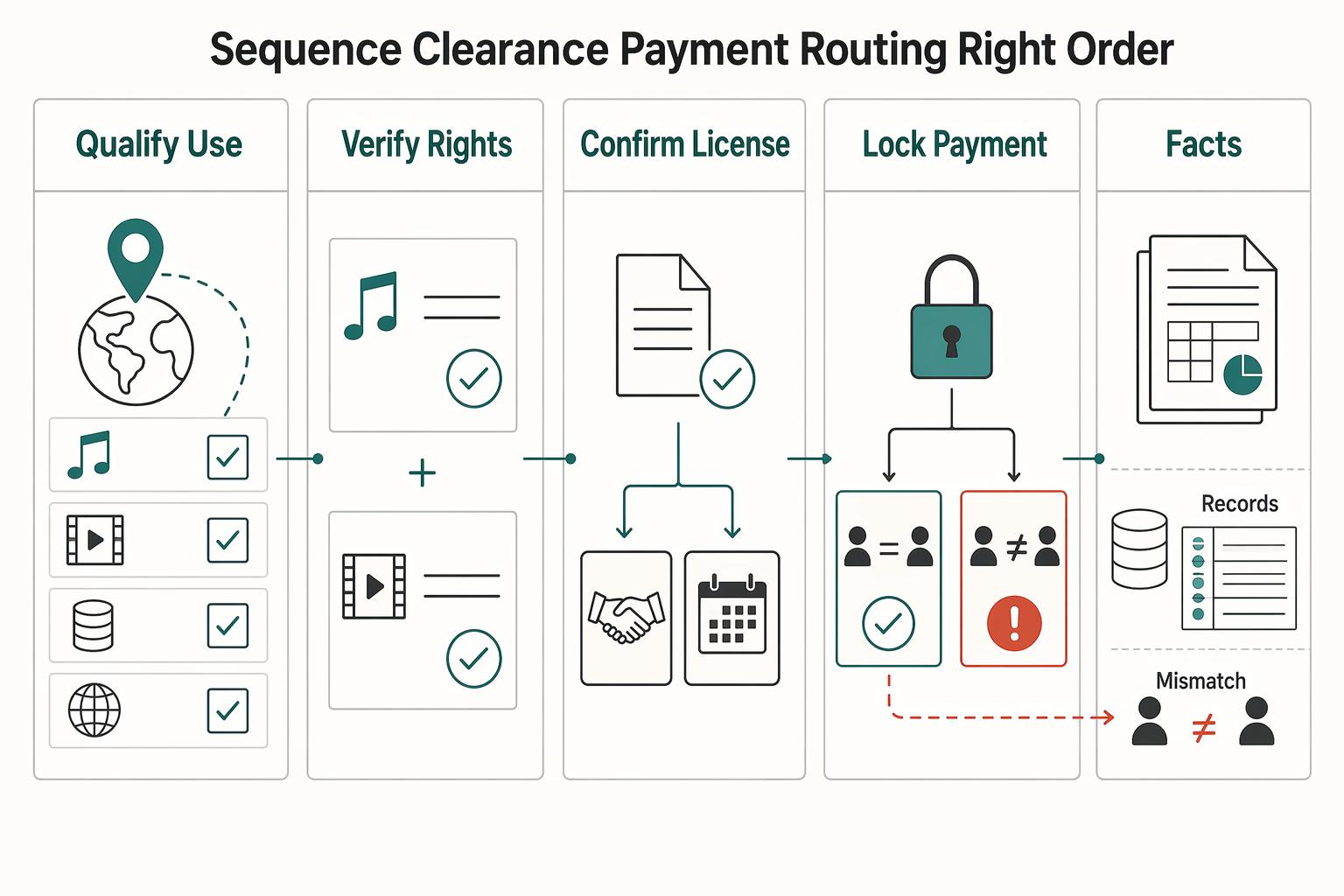
Sequence Clearance and Payment Routing in the Right Order#
Use a clear internal sequence: define the use, verify both rights layers, confirm how licensing and payment are handled, then finalize payout routing. Starting with payout logic too early can create payable records before you know whether the approving party and receiving party match.
| Step | What to verify | Hold point |
|---|---|---|
| Qualify the use case and territory | What the user does, whether the use is audio-only or paired with video, whether it persists, and where it launches first | Treat United States as one market row, not a default for all markets |
| Verify the rights chain on both sides | Copyright owner and rightsholder for composition and sound recording, plus legal entity, claimed role, and supporting document or signed confirmation | A label contact alone is not a rights chain |
| Confirm the license path before money movement | Whether an administrator or society is the licensing contact, payment contact, or both; if sync is in scope, mark synchronization license status as approved, rejected, or not applicable | Do not leave synchronization license status implicit before release decisions |
| Lock payment routing by scenario, not assumption | Scenario, minimum routing proof, and payout gate | Use scenario-specific routing proof before payout |
| Define reconciliation artifacts before go-live | Asset ID, use case, territory, rights layer, approving party, payable party, affiliation or administrator notes, approval status, and exception status | Keep payment automation off if usage cannot be tied to both approval and beneficiary records |
Step 1. Qualify the exact use case and territory. Write the product use in one sentence before outreach: what the user does, whether it is audio-only or paired with video, whether it persists, and where it launches first. Treat United States as one market row, not a default for all markets. The UK signal in the evidence pack ("Endless confusion with PRS and MCPS") is a reminder to avoid copying one-market assumptions into another.
Step 2. Verify the rights chain on both sides. For each asset, name the Copyright owner and Rightsholder for composition and for sound recording. A label contact alone is not a rights chain; capture legal entity, claimed role, and supporting document or signed confirmation. Settle early whether control runs through Record companies or self-release, because that changes who can approve and who may be paid.
Step 3. Confirm the license path before building money movement. After control claims are identified, confirm how licensing and payment are administered. The grounding supports that affiliation with a pay source or collection society can include licensing on a client's behalf and paying royalties to the songwriter. If a counterparty says an administrator or society handles this, verify whether that entity is the licensing contact, payment contact, or both.
If sync is in scope for the documented use, do not leave Synchronization license status implicit. Mark it explicitly as approved, rejected, or not applicable before release decisions for that use. If video is the open branch, go deeper here: Sync Royalties Explained: What Platforms Need to Know About Licensing Music for Video.
Step 4. Lock payment routing by scenario, not assumption.
| Scenario | Do not assume | Minimum routing proof | Payout gate |
|---|---|---|---|
| Platform pays a rights recipient directly | Approver and payee are the same party | Signed rights evidence and payable-party confirmation | No payout when approval exists but payee is unverified |
Record companies are in the chain | Label control also covers composition permissions | Master-side approval evidence and separate composition-side ownership record | No bundled cross-layer payment logic without proof |
Film and TV producers or similar partners are involved | Delivery packet resolves all downstream music rights | Partner contract reference, named rights contacts, explicit music-use approval status | Hold launch or limit use when authorization remains unclear |
Step 5. Define reconciliation artifacts before go-live. Agree on required fields before first release: asset ID, use case, territory, rights layer, approving party, payable party, affiliation/administrator notes, approval status, and exception status. If a usage event cannot be tied to both approval and beneficiary records, keep payment automation off for that asset.
Define exception handling for conflicting ownership claims: pause automated payout, open an exception case, and require documentary proof from each claimant before returning the asset to normal processing.
This pairs well with our guide on Book Advances and Royalties for Authors Who Need Steady Cashflow.
Decide Market by Market Instead of Assuming Global Portability#
Decide launch readiness country by country, not with a single global yes/no. A market should only move forward when rights handling, payout handling, and evidence quality are verified for that specific row, and United States work should not auto-approve other markets.
Build the country readiness table first#
Build the tracker before launch dates are discussed, and keep it operational.
| Market row | Rights collection setup | Contract and licensing assumptions | Payout and compliance constraints | Confidence label |
|---|---|---|---|---|
United States | Record only evidence-backed scope (for example, ASCAP licensing public performances of its members' musical works) | Record explicit limits (ASCAP says it does not license dramatic or grand rights) | Track payable setup and beneficiary verification separately from approval status | verified only when rights and payout evidence are complete |
Non-United States market with local evidence | Use the local path only when documented | Store the documented contract/licensing basis | Record documented payout or compliance constraints | partially verified or verified based on evidence quality |
Non-United States market without local evidence | Unknown | Unknown | Unknown | unknown |
A row is not launch-ready if key fields are blank.
Use United States examples as reference points only#
Treat BMI, ASCAP, SESAC, and The Harry Fox Agency as reference points, not automatic templates for other countries. One U.S.-scoped point you can rely on here is that ASCAP says public performance includes transmissions to the public (including via the Internet), and ASCAP also says dramatic or grand rights are out of scope.
Choose narrower launch when confidence is weak#
Force a clear tradeoff: launch fewer markets with verified clarity, or launch broader with higher rights and payout risk. Keep every market labeled verified, partially verified, or unknown, and keep GTM commitments aligned to that label.
Prevent the Most Common Royalty Ops Failures#
Even in a verified market, payout operations can fail if rights routing and allocation controls are unclear. Treat the following as release blockers for money movement, then clear them with explicit recovery steps.
| Failure mode | What to do immediately | What must be true before normal payout resumes |
|---|---|---|
| Ownership metadata conflicts across parties (for example, composition-side vs recording-side records) | Hold the affected payout line, open an ownership exception, and collect documentary proof tied to the approval evidence pack | For each affected asset, ownership for composition and sound recording is mapped to named counterparties, approved use case, and in-scope territory |
Public performance and reproduction activity handled as one bucket | Reclassify events and backfill allocation logic so Performing right royalties and Mechanical royalties are handled as distinct lanes | Reporting can show, per event, why usage was allocated to the performance lane or the mechanical lane; if not, the calculation is not ready |
| Sync-like usage shipped without both rights approvals recorded | Pause that usage and run a retroactive permission workflow | Approval records clearly show both rights layers, the use case, and market scope; if one side is unclear, keep the asset blocked for that use. If you need more depth, see Sync Royalties Explained: What Platforms Need to Know About Licensing Music for Video. |
| Payer responsibility unclear across platform, partner, and producer roles | Define one payer path per scenario before the next invoice cycle and store it with approval evidence | Each payable traces to one payer, one reporting party, and one beneficiary mapping; if teams answer differently for the same scenario, fix ops before invoicing |
Connect Rights Decisions to Finance and Payout Operations#
Rights approvals should control money movement states directly, not sit beside them. If finance can only see payment success, not the rights basis, you can still misroute funds.
| Control | Operational rule | Gate |
|---|---|---|
| Shared finance states | Use approved obligation, payable created, payout sent, and exception pending as one state model | A rights approval should create an approved obligation first, then a payable only after beneficiary mapping is confirmed |
| Evidence-based money movement | If one required rights layer is unresolved, keep the line in exception pending; for sync-like use, keep payables blocked until the approval record is complete | Do not recreate obligations or payables when rights evidence has not changed |
| Beneficiary mapping | Store an explicit mapping from rights-side entity to beneficiary record, with support for direct pay and intermediary collection | If the named rightsholder and bank beneficiary differ, require documentary support before release |
| Expansion stop rule | Set an exception-rate threshold in advance and pause rollout if ownership, beneficiary, or routing exceptions cross it | Hold unresolved lines back instead of pushing them through finance |
Step 1. Translate each rights event into a finance state. Use one shared state model: approved obligation, payable created, payout sent, and exception pending. A rights approval should create an approved obligation first, then a payable only after beneficiary mapping is confirmed.
Checkpoint: for any line item, trace the state change back to rights evidence, not just an invoice or payment ID. This matters because royalty flows can include partial owners, intermediary collection, and direct pay in some cases.
Step 2. Gate money movement with evidence, not assumptions. Add policy gates between states. If one required rights layer is still unresolved, keep the line in exception pending. For sync-like use, keep payables blocked until the approval record is complete, because reporting and calculation quality affect whether creators are paid correctly.
Use idempotent retries for rail failures, but do not recreate obligations or payables when rights evidence has not changed. Retries should replay safely, not create duplicate business events.
Step 3. Map rights-side parties to payout beneficiaries explicitly. Do not assume a Copyright owner or Rightsholder in rights data is automatically the payout beneficiary. Store an explicit mapping from rights-side entity to beneficiary record, with support for both direct pay and intermediary collection.
Verification rule: each payable line should resolve to one rights basis, one beneficiary, and one payer path. If the named rightsholder and bank beneficiary differ, require documentary support before release.
Step 4. Add an expansion stop rule before new markets go live. Set your own exception-rate threshold in advance and enforce it. If ownership, beneficiary, or routing exceptions cross that threshold, pause rollout until data quality improves.
Target outcome: not zero exceptions, but an auditable path from rights approval to reconciliation output, with unresolved lines held back instead of pushed through finance.
Conclusion#
Map rights first, then design payment operations. If you cannot verify both rights layers, the collection path, and the market-specific unknowns, treat launch as premature rather than "good enough."
Use this as your final release gate for any product touching music. The point is not to prove that every edge case is solved. It is to prove that your team knows who owns what, which use triggers which obligation, and what evidence supports every payable before anything goes live.
- Confirm the ownership chain for the composition and the recording.
Start with the two rights lanes that matter most: Composition/publishing and Sound recording/master. Your verification point is a named owner or rightsholder on each side, tied to the exact track or use case in your evidence pack. If either side is missing, conflicted, or supported only by informal metadata, stop release and open an exception instead of guessing from a distributor feed or partner spreadsheet.
- Confirm the license path for the actual use.
Match the feature to the rights trigger, not to a broad label like "streaming" or "video." If the product pairs music with visual media, treat Synchronization status as a required checkpoint before launch. In the United States examples discussed here, PROs such as BMI, ASCAP, and SESAC are tied to performance-side collection, while The Harry Fox Agency is an example you may see in mechanical administration, but those references do not clear every use and they do not travel automatically to every country.
- Confirm payer-of-record and beneficiary mapping for each royalty lane.
For every expected obligation, name who your business expects to pay, who is meant to receive funds, and which document authorizes that path. Do not collapse publishing and master lanes into one payout record. Your checkpoint is simple: every payable should point back to a rights basis, a counterparty, and retained proof such as the agreement, approval email, or ownership confirmation used to justify payment.
- Confirm market-specific unknowns before you make go-to-market claims.
United States collection examples are useful reference points, not a global template. If you have not validated local handling, contract assumptions, or counterparties in a market, label that market "unknown" or "partially verified" internally and keep external launch language narrow. A smaller verified rollout can be lower risk than a broader launch that creates ownership disputes or misrouted payouts.
- Confirm the exception and reconciliation path before public rollout.
Royalties are earned when music is played, performed, or reproduced, so operational mistakes become money mistakes quickly. Decide in advance how you will hold payouts, investigate ownership conflicts, and reconcile approved obligations against what was actually paid. If your team cannot explain that process in one page with named owners and evidence checkpoints, you are not ready to scale the feature.
Related: Performance Royalties Explained: How PROs Collect and Platforms Distribute Performing Rights Payouts.
Frequently Asked Questions
What is the difference between `Master rights` and `Publishing rights` in practical platform terms?
Start by splitting the track into the two copyrights that exist in every recorded song. Publishing rights attach to the composition, meaning the melody, lyrics, and underlying musical structure, while master rights attach to the specific recorded performance. In ops terms, treat these as separate rights checks and written permissions.
Do you always need both composition-side and master-side permission for a `Synchronization license`?
If you are pairing music with visual media, treat sync as a written permission requirement, not a metadata label. Sync licenses cover pairing music with visual media, and most commercial uses require licenses for both the composition and the master. If your video feature has only one side cleared, hold release until the missing approval is documented.
How are `Performing right royalties` different from `Mechanical royalties` for streaming and video use cases?
Use the trigger, not the product label, to separate them. Performance rights relate to public playback, while mechanical rights relate to reproducing compositions. A common failure mode is collapsing both into one “streaming royalty” bucket and then paying or licensing against the wrong basis.
Who usually pays and who usually collects each royalty type in practical examples?
Who pays and who collects can vary by rights layer and agreement. Copyright owners control their works, and licensing is a written agreement for specific uses. Your verification checkpoint is simple: every payable should point back to the exact rights basis and the document that authorizes payment.
Are `BMI`, `ASCAP`, and `SESAC` enough to cover all royalty obligations?
Do not assume that. If your use includes reproduction or video pairing, performance-side coverage alone is not a release green light.
Where does `The Harry Fox Agency` typically fit in mechanical and sync-related administration?
If a counterparty says “HFA covers it,” treat that as unverified until you review the written agreement and confirm which rights and uses it actually covers.
What should founders do first when ownership splits and territory rules are unclear?
Pause the launch decision and build the evidence pack before anyone ships. Get the composition-side owner, the master-side owner, and the intended use into one record, then require written permission for the specific use case. If either ownership chain is still disputed or incomplete, keep the line in exception status rather than guessing your way into a payout or a public launch.
Try a related tool
Researched and edited by the Gruv editorial team. Gruv builds cross-border billing, payouts, and finance-operations software for global businesses.
Sources
- copyright.gov/policy/unclaimed-royalties/unclaimed-royalti...trusted
- copyright.gov/policy/musiclicensingstudy/copyright-and-the...trusted
- crb.gov/proceedings/2006-3/copyright-owners/findings...trusted
- crb.gov/rate/16-CRB-0003-PR/rebuttals/2-17-17-pandor...trusted
- digital.library.unt.edu/ark:/67531/metadc115185/m2/1/high_res_d/thes...trusted
- federalregister.gov/documents/2019/02/05/2019-00249/determinatio...trusted
- iconcollective.edu/how-music-royalties-worktrusted
- justice.gov/atr/page/file/1305161/dltrusted
Educational content only. Not legal, tax, or financial advice.
Related Posts
Sync Royalties for Video Platforms and What You Owe for Music Licensing
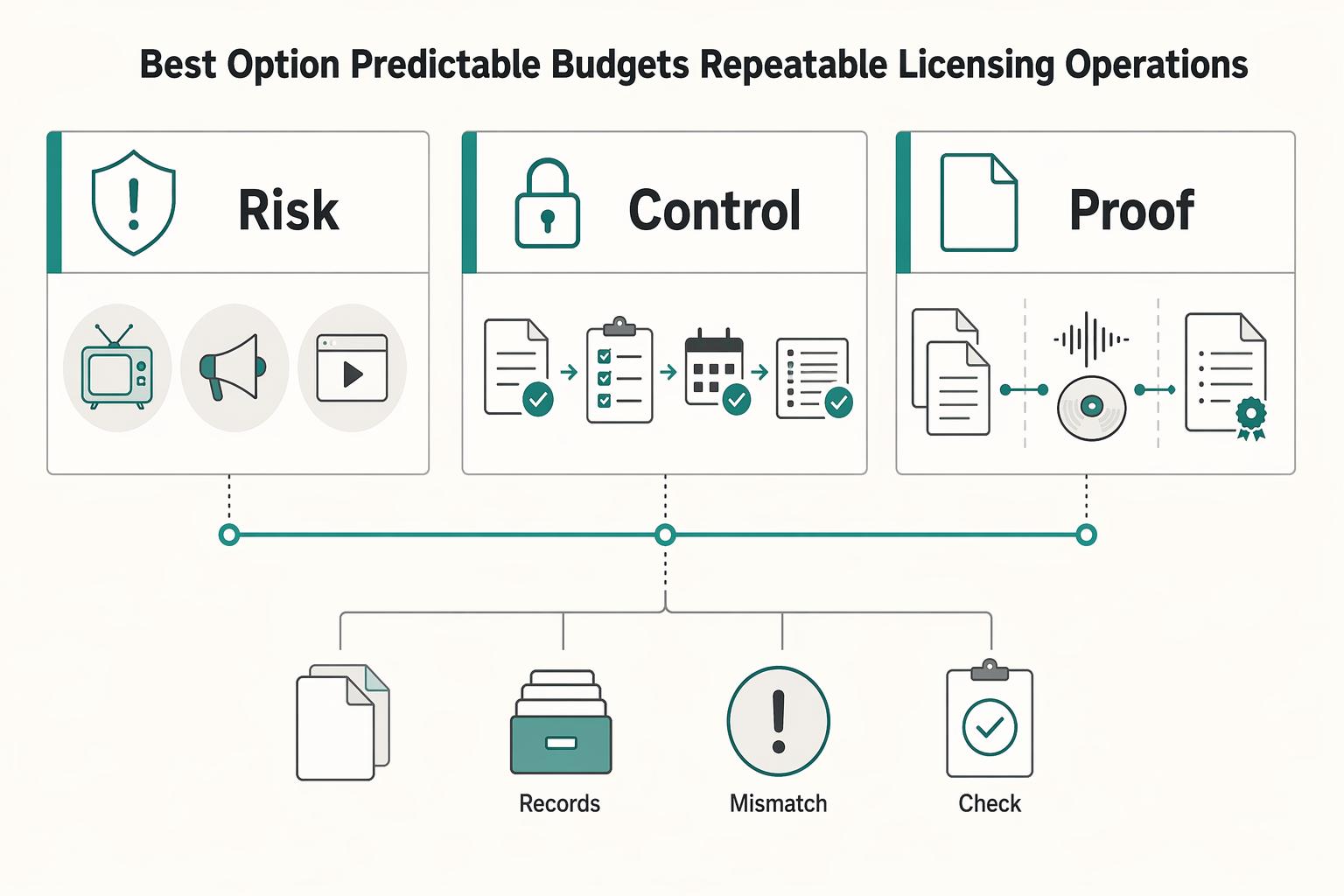
Before you ship video features, break the music question into three parts. First, identify the right you need to pair music to picture. Then identify the license fee, which is often paid up front. Finally, ask whether any ongoing royalties could still show up later. That matters more than the deal label, because it is easy to miss obligations when all music spend is treated as one bucket.
How Streaming Platforms Calculate and Pay Mechanical Rights
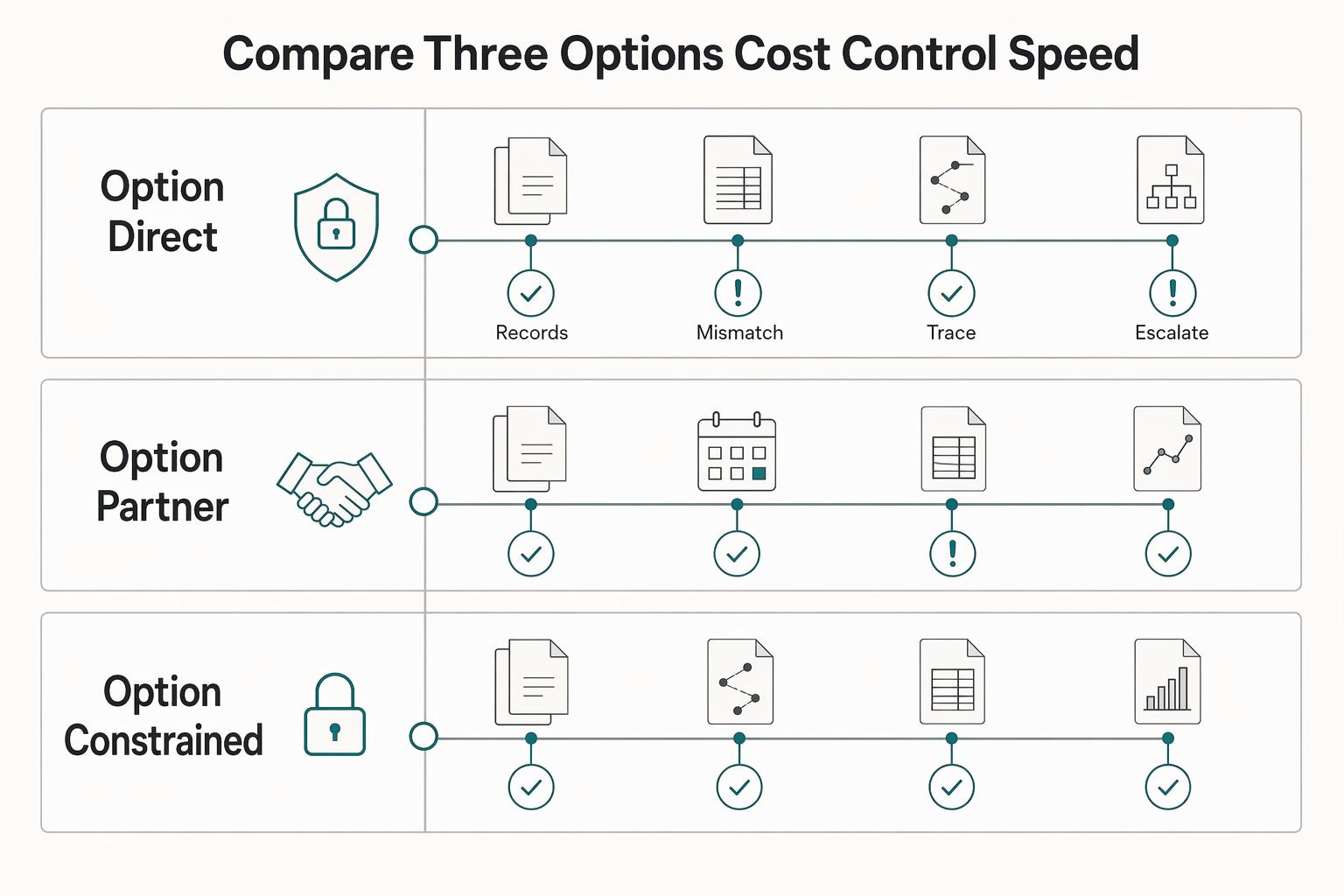
Mechanical rights in interactive streaming can fail at the operations layer before they fail in a legal memo. If you are building or expanding a platform, the real question is not just what counts as a mechanical royalty. It is whether your licensing, data, reporting, and payout choices will hold up once monthly usage starts moving.

How PROs Collect Performance Royalties and How Platforms Distribute Payouts
Treat this as an infrastructure decision, not a music-rights explainer. If you cannot connect PRO collection to a payout process you can verify, reconcile, and audit, you are not ready to ship a royalties product, no matter how strong the demand story looks.