
Quick Answer
Yes: virtual accounts for payment reconciliation are useful when inbound deposits frequently need manual interpretation and each credit can be mapped to a single owner record. In the pooled model here, routing identifiers sit beneath a real account and may have reported virtual balances, so success depends on deterministic posting logic rather than labels alone. Validate fit rail by rail, confirm repeatable handling for credits, holds, and returns, and phase rollout when mapping quality differs across ACH, SWIFT, wires, SEPA, or enabled stablecoin flows.
How Virtual Accounts Simplify Client-Level Reconciliation#
Virtual accounts are most useful when your core problem is client-level attribution of high-volume inbound transfers. They can reduce manual matching, but they do not remove the harder work around account design, posting logic, exception handling, and compliance review.
In the pooled-account model discussed here, a virtual account is a logical subledger or routing identifier linked to a real bank account. Cash sits in the underlying account; a provider may also report virtual balances. Confirm legal ownership, safeguarding and balance semantics rather than inferring them from the label.
Teams adopt this for a simple reason: in multi-payer environments, manual reconciliation is slow, error-prone, and operationally heavy. A common setup is to issue dedicated deposit instructions per beneficiary or counterparty so incoming funds can be matched one to one, instead of relying on free-text remittance references that can be incomplete or wrong.
This guide focuses on inbound attribution across rails seen in provider implementations: SWIFT, ACH, Domestic Wires, and selected stablecoin deposit flows where enabled. Support and rollout conditions vary by provider, legal-entity structure, technology requirements, and staffing capacity, so rail-by-rail planning is usually safer than assuming one uniform rollout path.
Payer errors and missing references still occur. A dedicated receiving identifier can reduce reliance on typed references, but it cannot prove that the payer used the correct customer's details. Keep an exception path for conflicting payer evidence.
Before you commit build time, pressure-test one question: can every inbound credit carry enough account-identifying and provider reference data to follow one posting path without human interpretation? If not, manual work can shift from finance to support or payments ops. If yes on some rails but not others, phase the rollout.
Treat compliance as part of attribution design, not a late overlay. Better visibility into origin of funds can support stronger monitoring and KYCC controls, but only if you define up front which fields are tied to each virtual account, what evidence is retained, and where holds or reviews can interrupt downstream movement without breaking traceability.
The rest of this guide gives you concrete checkpoints for fit, architecture, failure handling, compliance gates, and launch verification. If you are evaluating virtual accounts for payment reconciliation, the usual win comes from narrowing scope first, then expanding only after attribution is reliable in production.
Start with a precise definition so teams do not design the wrong thing#
A virtual account is a non-physical sub-account linked to a main bank account, not a separate physical account. In practice, you might assign one to a specific purpose, such as receiving payments from a particular customer.
The key design point is that segmentation is logical, not physical. The main account remains the anchor, and your records determine how each incoming payment is attributed. Cleaner attribution can reduce errors and discrepancies, but you still need to match records and resolve breaks.
A virtual account number is an addressable payment identifier in a provider's supported format. A virtual IBAN uses IBAN syntax to route receipts to an underlying account. Provider designs vary: confirm the account holder, accepted rails, currencies and reporting fields before treating these identifiers as interchangeable.
Before building around the concept, run a simple reconciliation check with sample data: gather documents, match records, resolve discrepancies, and finalize adjustments. Confirm each identifier maps to one intended customer purpose and to the same main account across the records your team actually uses.
Decide if virtual accounts actually fit your payment pattern#
Virtual accounts are usually a stronger fit when your recurring problem is payer attribution on inbound payments. They are less useful when attribution is already clear and most breaks come from internal mapping, posting, or control design. The value comes from the identifier layer: these are sub-ledger records linked to a physical account, each with a unique identifier, while transactions still post to the linked physical account.
Check whether attribution is the bottleneck#
Start with recent inbound exceptions and separate attribution problems from internal processing problems.
- Stronger fit: repeated unknown or ambiguous payer attribution, where mapping an identifier to a customer, entity, department, or project could reduce manual investigation.
- Weaker fit: attribution is already reliable, and most breaks come from internal mapping, posting, or control design.
Assess fit by rail, not by theory#
Treat each inbound rail as its own fit check. ACH and wire settlement flows are handled as distinct flows in OCC guidance, so do not assume one matching design behaves the same way everywhere.
| Fit check | What to verify |
|---|---|
| Reference fields | Arrive consistently enough to support matching |
| Account identifier | Maps to the intended owner record |
| Timing and exception cases | Still resolve to the same record path |
For each rail, verify with real samples that those three checks actually hold.
Count operating cost before rollout#
Better attribution does not make rollout light. You still need legal-entity, technology, and resource readiness, and implementation is usually more straightforward in simpler legal-entity structures.
Before you scale, make sure you can run identifier lifecycle operations cleanly: create, map, update, retire, and audit identifiers without ownership drift.
Practical decision rule#
Adopt this model when inbound attribution errors are a repeated operational blocker and you can govern identifier lifecycle with discipline. Hold off when exceptions are infrequent or mostly caused by internal control and mapping gaps.
For the general ledger side of the workflow, see Account Reconciliation for Payment Platforms: How to Automate the Match Between Payouts and GL Entries.
Choose your account architecture and attribution model up front#
Lock your attribution model before provisioning accounts. The bigger risk is not choosing the "wrong" account type. It is letting bank identifiers, your internal records, and your ERP use different owner keys, then trying to reconcile that mismatch at close.
For payment reconciliation, shared account memo matching, Virtual Account Numbers, and Virtual IBAN are all options teams evaluate. A universal ranking across them is not established, so outcomes should be validated in your environment with clear ownership discipline, mapping rules, and change control.
Compare the options by what must be true#
Do not force a universal ranking for accuracy, onboarding friction, or operating effort. Those outcomes depend on your provider setup, payer behavior, entity structure, and internal controls.
| Option | Attribution accuracy depends on | Onboarding friction depends on | Operational overhead sits in |
|---|---|---|---|
| Shared account with memo matching | Payer supplies a usable reference | No new receiving details per customer | Parse references and review missing or conflicting data |
| Virtual account number | Provider exposes the dedicated identifier on receipt | Issue and maintain supported account details | Maintain ownership registry; still allocate invoices |
| Virtual IBAN | Provider routes each IBAN to the intended underlying account | Issue IBAN instructions for supported rails/currencies | Confirm legal structure and preserve mapping history |
Test each option with real inbound samples. Can you prove each payment lands on one owner record without operator guesswork from free text?
Pick one primary attribution key per flow#
Choose one primary owner key for each flow, then keep that same key through bank intake, internal posting, and ERP export. The exact key set is implementation-specific, so define it explicitly and keep it consistent within the flow.
Mirror that key in both your internal records and ERP dimensions. Keep other fields as linked attributes, not competing owner definitions.
Keep the legal entity as a separate mapping dimension from the customer and invoice. An entity identifier alone cannot identify which receivable a payment should settle.
Account-level attribution identifies the likely customer; invoice allocation is a separate decision. A customer paying several invoices through one identifier still needs remittance data or an agreed allocation policy.
Assign lifecycle ownership and make changes traceable#
Set explicit ownership for who creates, rotates, retires, and audits identifiers, and who approves changes. Then version those changes so mapping history is auditable.
Keep a dated registry of identifier, owner, status, effective timestamp, approver and reason. Avoid reassigning identifiers to another customer: a late payment using old instructions could credit the wrong owner. If reassignment is unavoidable, preserve mapping history and quarantine ambiguous receipts.
Use one canonical mapping registry and version its changes. Compare the received identifier with the mapping effective when the payment arrived, and retain the evidence behind any manual reassignment.
Phase by entity when structure gets messy#
Phase complex setups by legal entity. Confirm which entity owns the underlying account and which ledger receives each receipt; logical segmentation does not itself authorise pooling funds across entities.
Start narrow, prove deterministic ownership and traceability, then expand in controlled stages.
Map payment rails and settlement behavior before writing code#
Build the rail matrix before writing webhook handlers. In this pooled model, cash lands in the underlying account while virtual subledger reporting supplies attribution. Separate notification, received cash, customer allocation, availability and later return states.
Build a rail matrix your teams can actually use#
For each rail or program you support, for example SWIFT, ACH, Domestic Wires, SEPA, or USDC, keep one shared matrix that records provider payload fields, your internal status meanings, and the posting path into your records.
| Rail | Capture from provider payloads | Define internally | Variance to flag |
|---|---|---|---|
| SWIFT | Provider reference, exposed remittance/reference fields, account identifier used | What "detected," "credited," "held," and "returned" mean in your workflow | Provider coverage, country/program setup, payload shape |
| ACH | Provider reference, exposed payer/reference fields, account identifier used | Status meanings and the posting path | Provider/program differences by market |
| Domestic Wires | Provider reference and account identifier used | Status triggers and posting path | Jurisdiction and provider differences |
| SEPA | Provider reference, exposed remittance-style fields, account identifier used | Customer-visible vs internal-only state changes | Country and provider support differences |
| USDC | Provider transfer/transaction reference, receiving identifier used | Detection, hold/review, and posting rules | Stablecoin availability, compliance gating, market support |
The goal is practical alignment: one primary join key, clear optional fields, and one posting path per payment.
Define status words once and use them everywhere#
Write explicit definitions for "credited," "held," and "returned" for each rail and provider program, then use those same definitions in UI copy, ops SOPs, and finance posting rules. Real-time webhooks are useful event signals for automation, but you should not treat them as final settlement by default.
Mark provider and country variance in plain sight#
Do not hide variance in side notes. Regulatory permissions and geographic coverage differ across providers and markets, and support for rails or stablecoin programs may differ by program and country. If KYC data collection and provider-side verification are prerequisites before account issuance, list them as gating conditions in the matrix.
Verification checkpoint before any production posting#
Before go-live, run sample inbound events per rail and prove each payment maps to one, and only one, posting route. Your evidence set should include sample payloads, the chosen provider reference, the received account identifier, the expected state transition, and the resulting ERP export outcome. If that mapping is still ambiguous, keep that rail out of production scope.
For a step-by-step walkthrough, see Key Best Practices for Improving Accounts Payable on a Two-Sided Payment Platform.
Design the reconciliation event model in your ledger and ERP#
Keep provider events as inputs, and let your internal posting model decide what gets exported to the ERP. That matches how virtual account setups work: identifiers sit under a linked physical bank account, transactions post to that physical account, and the identifier gives you attribution for a customer, department, project, or legal entity.
Make the event chain visible from first signal to ERP export#
Document one end-to-end chain instead of scattered logs: payment detected, reference data received, internal record written, export to ERP.
If a payment includes remittance detail, including addendum data on some business payments, store it with the event so AR and invoice reconciliation teams can use it. Keep the stronger join keys first, then use remittance text as supporting context.
For each event, preserve the original provider payload and your internal decisions so you can trace which identifier was paid, which reference arrived, when the system accepted it, and when ERP received it.
Make retries boring with consistent duplicate handling#
Treat duplicate handling as an internal control for inbound events. If retries or replays happen, route them to the same posting outcome so you avoid duplicate credits or duplicate ERP candidates.
Missing or conflicting references should hold customer allocation for review. Record evidenced bank cash in the appropriate finance-controlled clearing or suspense account, retain the payload, and assign the case an owner.
Separate operational review from accounting finality in the Ledger#
One workable pattern is to track non-final operational states separately from accounting-final states so operations and finance can work from the same event model without collapsing everything into one status.
Detection is an event signal, not proof of cash. Record evidenced receipts under finance's policy even when customer allocation or export remains open. A posted receipt can later require a return entry; waiting for an undefined final state can hide cash and liabilities.
Capture the audit fields you will actually need#
Use this proposed record checklist, adapted to the provider and accounting policy:
- virtual account identifier used for attribution
- legal entity context
- provider reference, plus remittance or addendum detail received
- status transition, before and after
- review actions taken on the event
Before go-live, replay one inbound event more than once, confirm one posting outcome, and confirm ERP exports still carry attribution even though settlement posts to the linked physical account.
Illustrative receipt: customer A owes $1,200 on invoice A-17 and receives a dedicated virtual identifier. A $1,000 receipt reaches that identifier with bank reference R-42. Attribute it to A, then apply $1,000 to A-17 only when remittance or the agreed allocation policy supports that decision; $200 remains due. Replaying the same notification must not add another $1,000. If a distinct second receipt arrives, record that cash and resolve the excess separately. If R-42 is later returned, post a linked return and reopen the receivable as appropriate.
Related: Payment Reconciliation for Freelancers: How to Match Invoices to Bank Deposits.
Build exception handling before you scale volume#
Build the exception layer before volume ramps, or manual clearing becomes the bottleneck once delayed credits, pending confirmations, and other exceptions start to stack up.
A generic support inbox is not enough for payment breaks. Create explicit queues for common break types, for example unmatched deposits, suspected duplicates, short payments, and returns, so each case has a clear owner, risk path, and accounting consequence. That is how you preserve evidence and accountability that still makes sense months later.
Queue by failure type, not by channel#
Sort exceptions by operator decision, not by where the issue arrived, whether email, webhook, or bank report. For each case, require a compact evidence pack before action:
- raw provider payload or bank message as received
- virtual account identifier used for attribution
- amount, currency, rail, and posting timestamp
- provider reference and any remittance detail received
- current posting state and ERP export state
- operator notes for hold, release, reversal, or reallocation
This gives you a defensible record of what happened, when, and why, and helps avoid cases where ERP edits cannot be tied back to the original payment event later.
Tie operator choices to Ledger status and ERP impact#
Record evidenced cash even when attribution is unresolved, using a controlled clearing or suspense account. Hold customer allocation or clearance until the case is resolved. Distinguish replayed notifications from two distinct bank receipts before deciding whether any accounting adjustment is needed.
| Exception type | Handling note |
|---|---|
| Unmatched items | Record evidenced cash in controlled clearing; keep customer allocation open |
| Duplicates | Separate likely replayed events from potential second credits, then apply the documented policy |
| Short payments | Decide up front whether partial ERP application is allowed |
| Returns | Create a traceable reversal path instead of silent overwrites |
Apply the same discipline to short payments and returns. Decide up front whether partial ERP application is allowed, and make sure returns create a traceable reversal path instead of silent overwrites.
A practical check is to sample one case from each queue and trace it from inbound event to final posting state to ERP result. If that replay is unclear, the process is not ready to scale.
Build timing into the review process#
Settlement timing and return risk are different. Confirm each provider's cutoffs, processing calendar and applicable return rules; a settled receipt is not necessarily immune to a later return. Do not treat one generic ACH waiting period as finality.
Set internal SLA targets by queue, then run a daily shared review between payments ops and accounting. Review queue aging, repeat root causes, time-zone-aware cutoffs, and reference-data quality so screening, reconciliation, and reporting stay aligned.
Use exception volume as a rollout gate#
Define a clear internal expansion gate before rollout: if exceptions stay above manual review capacity across repeated close cycles, pause expansion and fix mapping quality first.
Treat this as your internal control, not a universal benchmark. In practice, these pauses can expose weak reference data, poor identifier assignment, or unclear final-state logic that would otherwise scale into a larger reconciliation and oversight burden.
If you are building reporting around this process, How to Build a Payment Reconciliation Dashboard for Your Subscription Platform covers the dashboard layer.
Add compliance gates without breaking reconciliation throughput#
Compliance gates should freeze movement, not erase attribution. Define where KYC, KYB, and AML checks can stop funds, and make sure every held item still appears in your records with a clear status, owner, and evidence trail.
Payment operations are more reliable when compliance and regulatory requirements sit inside the flow. If a flagged payment is handled outside your reconciliation and accounting view, risk and close-cycle confusion can increase.
Put gates at named points in your flow#
There is no universal checkpoint sequence established across every provider, rail, or market. Document your intervention points and map each one to a posting outcome.
| Example intervention point | What the gate is deciding | What should happen in the ledger |
|---|---|---|
| Account provisioning | Whether the customer or business can be issued an identifier or use the product | Create only after approval, or keep the identifier non-active |
| First inbound credit | Whether incoming funds can be treated as usable value | Record the credit with full attribution, then mark it held pending review |
| Withdrawal | Whether value can move to an external destination | Keep balance and attribution intact, block outbound movement |
| Payout release | Whether a disbursement can be sent onward | Preserve the payable instruction and hold release until cleared |
If you run multiple programs, specify which gate points are active in each one. Then test one flagged case per point and confirm your payment dashboard, reconciliation platform, and accounting interface show the same hold reason and status.
Treat KYCC as evidence, not a label#
Treat KYCC as operational evidence, not a badge. In practice, that means defining what evidence links a payment to the underlying customer relationship and where operators retrieve it during review.
Make the policy explicit: what evidence is captured, where it is stored, who can access it, and how long it is retained under your legal requirements. Because these requirements vary, legal and compliance owners should approve this before launch.
Freeze movement, preserve traceability#
Design a compliance hold to block downstream movement without rewriting event history. Keep the original payment event, identifiers, timestamps, and attribution result in your records, then layer hold status and operator actions on top.
This protects replayability across operations, accounting, and compliance. When that trace breaks, one issue can disrupt cash flow and create significant costs.
Confirm market and program variance before expansion#
Gate logic and evidence expectations vary in practice, and consistent implementation is a known challenge in financial-crime compliance. Treat each new country, entity, or rail as a fresh approval step, not a copy-paste of an existing setup.
For a stablecoin program, confirm the supported network and asset, required confirmations, custody arrangement and compliance process. A chain transaction, provider credit and bank conversion are separate events; reconcile each conversion or transfer leg.
Roll out in phases with clear ownership and exit criteria#
Roll out in phases only when each phase has named owners and pre-agreed exit evidence. That keeps you from scaling complexity before you can clearly explain reconciliation differences across sales records, gateway activity, and bank deposits.
A tight first phase is about diagnosability, not caution for its own sake. Since each gateway or rail settles on its own schedule, differences are expected. The checkpoint is whether those differences are explainable, for example timing, fees, refunds, or chargebacks, not forcibly equalized.
| Phase | Example scope | Exit evidence before expansion |
|---|---|---|
| Phase 1 | Narrow initial scope, limited counterparties, strong event observability, regular finance review checkpoints | Inbound events are attributed into the posting system, exceptions are explainable, and ownership is clear for triage and resolution |
| Phase 2 | Add another gateway or rail | Exception patterns remain explainable after adding another independent settlement timeline |
| Phase 3 | Expand to multi-entity scope | Entity-level posting and ERP outputs reconcile with differences documented, owned, and actively resolved through a full close cycle |
Assign a simple RACI across the teams involved, for example product, engineering, treasury, and accounting, for provisioning, exception resolution, and ERP close support. The key test is operational: every exception type should have one owner for triage and one owner for final resolution.
Define exit criteria as evidence, not optimism. At minimum, set and agree phase gates for attribution quality, exception response performance, and tracked system-to-ERP breaks through one full close cycle.
Related reading: When Payment Links Fit and When to Route to ACH, Wire, or Virtual Accounts.
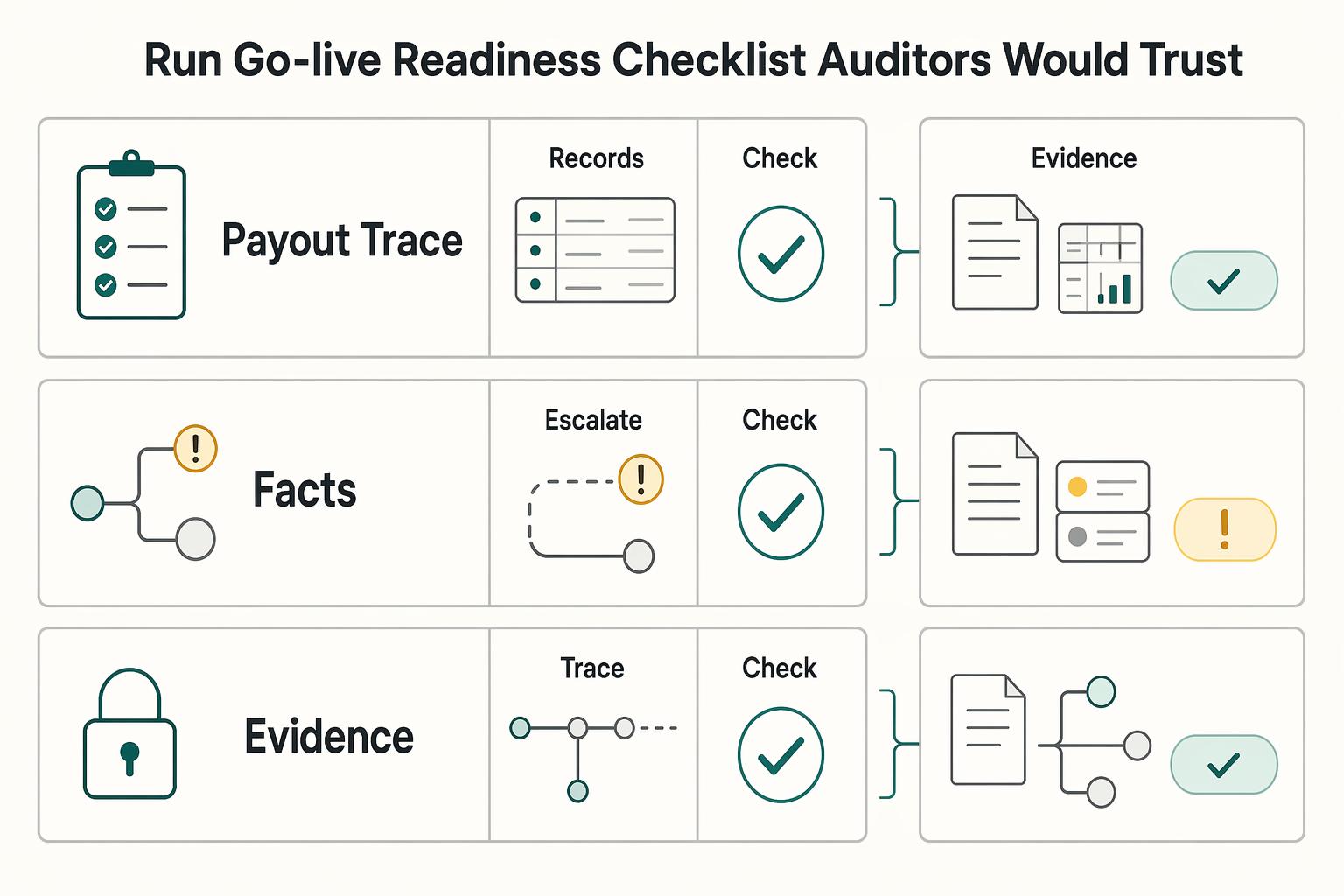
Run a go-live readiness checklist your auditors would trust#
Do not expand beyond the initial cohort until you can show evidence, not just confidence. A credible go-live file should show that records can be compared across systems, exceptions are routed for review, and every action is traceable for audit.
| Evidence item | What it shows |
|---|---|
| End-to-end traces | Straight-through and exception cases |
| Review queue artifacts | Review queues and action history |
| Clear scope record | What was in scope, what was tested, and what remains out of scope |
Start with record integrity in your own model. Verify that the core fields you rely on for reconciliation are complete and consistent across active records, and that operators can trace status and history without relying on ad hoc spreadsheets.
Then test the system-to-ERP trail on both normal and exception paths. Automated reconciliation is useful only when internal and external records can be compared and explained, and manual reconciliation is a known failure mode because it is slow and prone to human error. Before go-live, walk end to end through a clean case and an exception that routes to a review queue, then confirm the actions and outputs are visible in the audit trail.
Controls should be checked as implemented, not as designed in an earlier draft. Validate production behavior for the controls your rollout depends on. Rollouts often fail on execution details like data cleanup, team training, and integration quality.
A lean evidence pack usually includes:
- end-to-end traces for straight-through and exception cases
- artifacts showing review queues and action history
- a clear record of what was in scope, what was tested, and what remains out of scope
Sign-off should name the cohort, known limits, and expansion conditions. That is what makes the rollout controlled instead of just larger.
If you are running this flow on Gruv, compare your checklist against Gruv's Virtual Accounts module.
Track the metrics that reveal hidden cost, not just faster matching#
Match speed alone is not enough. Your scorecard should show where people still intervene, where exceptions sit, and whether the close process is actually improving.
Start with a small set of core measures, and define them once across teams:
- auto-match rate
- manual touch rate
- exception aging
- close-cycle delay impact
Keep a written metric spec with the source field, denominator, and exclusion rules. This helps prevent cross-team KPI drift and reduces the risk that retries or duplicate attempts create false improvement signals.
Break performance out by rail#
Track reconciliation performance separately by rail or system instead of relying on one blended number. Cross-system comparisons get messy, so segmented views help you find where performance is truly weak.
Tie each rail metric to traceable records in your audit trail. If you ingest in batches, validate unique batch numbers and header-trailer consistency before posting so skipped or duplicate batches do not contaminate reporting.
Watch for operational drag#
Hidden cost usually shows up outside the match engine. Track:
- manual journals in ERP
- repeat exception types
- time to resolution by team
Also watch errors and timeouts as a separate signal. They often point to processor or system issues, and even short error windows can create meaningful operational and reporting impact.
Use each review cycle to make a scope decision#
Use each review cycle to make one clear call: expand coverage, fix an architecture gap first, or narrow rail coverage by market. If manual touches and repeat exceptions stay concentrated in one rail across cycles, do not broaden rollout based only on improving aggregate match metrics.
Conclusion#
Treat this as an operating decision, not a feature request. Virtual accounts work when the identifier model, posting logic, and finance handling launch together, because the identifier alone does not fix attribution.
In the pooled model, cash sits in the underlying account and virtual records supply attribution. Prove that the received identifier maps to the intended customer and that invoice allocation, accounting entries and exceptions remain traceable.
A practical path is phased. Start with one entity and one rail, prove that the same identifier consistently maps to the same owner and posting result, then expand by rail and by entity. A practical checkpoint is simple: include the identifier in payment instructions, confirm settlement in the master account, and verify your ERP or treasury tooling auto-matches by identifier.
Expand only after constraints are clear. Rail behavior, market coverage, and provider programs are not uniform, so Virtual IBAN evaluation in SEPA or eurozone contexts should not be treated as a universal pattern for ACH, SWIFT, domestic wires, or other programs.
A common failure mode is operational drift. Reconciliation can still be hard in transfer-heavy environments, and adoption can stall because of organizational inertia. Missing identifiers, inconsistent entity mapping, or unresolved posting ownership just move exceptions upstream.
A practical recommendation is to prove the model with evidence before broad rollout. Keep a small launch pack showing identifier format, where it appears in payment instructions, how auto-matching works in ERP or treasury tooling, and what happens when attribution fails. If provider or compliance constraints are still unclear for a market or program, pause expansion until they are confirmed.
When you are ready to scope rollout by rail and market, use contact Gruv to confirm fit and implementation path.
Frequently Asked Questions
What are Virtual Accounts for payment reconciliation?
In the pooled model covered here, virtual accounts provide attribution or subledger records beneath a real account. Providers may report virtual balances, while cash remains in the underlying account. Confirm ownership and protection under the actual agreement.
How do Virtual Account Numbers improve client-level matching in practice?
They can improve matching by assigning distinct payment details to each customer, transaction, or invoice. That gives incoming payments a stronger attribution signal than relying only on free-text references. It can also reduce misattribution risk when payer-entered details are wrong or incomplete.
What is the difference between Virtual Accounts and Virtual IBAN?
Virtual account is the broader provider-defined arrangement. A virtual IBAN is an IBAN-form receiving identifier that routes a payment to an underlying account. It can help identify a customer without a typed reference, but supported rails, currencies and account rights depend on the provider.
Which rails can support this model, and where do SWIFT, ACH, Domestic Wires, SEPA, and USDC differ most?
Support depends on the account program. SWIFT supplies bank messaging, while ACH, domestic wires and SEPA have their own settlement and return rules. USDC requires a supported network and separate custody and conversion design. Obtain actual pricing, cutoffs and payload samples; a virtual identifier does not make these flows equivalent.
Do Virtual Accounts eliminate reconciliation work entirely?
No. Identifiers can reduce manual attribution, while allocation, returns, payer mistakes and screening still need controls. Confirm the applicable onboarding, sanctions and monitoring obligations with the provider and compliance owner.
What should product teams validate before launch to avoid costly rework?
Validate the core model first: each identifier should map cleanly to its owner and the underlying physical account, with traceable posting outcomes. Confirm documentation requirements early, since banks may require addenda to account terms. Then test failure scenarios such as incorrect payer details and confirm the outcome remains traceable for operations.
Try a related tool
Where Gruv fits
Researched and edited by the Gruv editorial team. Gruv builds cross-border billing, payouts, and finance-operations software for global businesses.
Sources
Includes 8 external sources outside the trusted-domain allowlist.
- blog.fvbank.us/introducing-virtual-accounts-to-simplify-inc...external
- clear.bank/learn/insights/are-there-banking-infrastruct...external
- clear.bank/learn/insights/what-are-virtual-ibans-vibans...external
- clearbank.github.io/eu/docs/accounts/manage-virtual-accountsexternal
- financialprofessionals.org/training-resources/resources/articles/Detail...external
- financialprofessionals.org/glossary/virtual-accountsexternal
- jpmorgan.com/insights/treasury/liquidity-management/virtu...external
- jpmorgan.com/payments/solutions/treasury/virtual-account-...external
Educational content only. Not legal, tax, or financial advice.
Related Posts

The Freelance Payment Penalty: A Modeled Audit of Platform Fees, FX Spreads, and Payout Delays
The money rarely disappears through a single, easy-to-spot fee. The real loss is stacked. A marketplace takes its commission, a processor adds a charge for international cards, a bank or payment company converts the currency at a spread, a platform holds the funds before release, and a wire sheds a little to intermediaries on the way in. Each layer looks defensible on its own, but the worker feels the combined result as a smaller deposit and a later payday.

How to Respond to a Subpoena for Business Records
Move fast, but do not produce records on instinct. If you need to **respond to a subpoena for business records**, your immediate job is to control deadlines, preserve records, and make any later production defensible.
A US Expat's Guide to Investing in UCITS ETFs to Avoid PFIC Issues
The real problem is a two-system conflict. U.S. tax treatment can punish the wrong fund choice, while local product-access constraints can block the funds you want to buy in the first place. For **us expat ucits etfs**, the practical question is not "Which product is best?" It is "What can I access, report, and keep doing every year without guessing?" Use this four-part filter before any trade: