
Quick Answer
Classify the service and customer, determine the tax jurisdiction, and identify whether supplier, platform, buyer or payment intermediary accounts for tax. EU digital interfaces have a specific supplier presumption; OSS is an optional filing route for eligible supplies, not a liability exemption. Reconcile taxable sales, tax and adjustments to returns separately from net PSP cash.
How to Use This VAT Compliance Map#
For platform operators, VAT on digital services is first a liability and evidence issue, not just a rate issue. If you facilitate cross-border transactions between buyers and sellers, the key question is whether a tax authority may treat your platform as liable for VAT or GST on the transactions it facilitates.
This guide is for compliance, legal, finance, and risk owners who have to defend that position in practice. The goal is practical control: decide when platform liability is likely, what to check each month, and when to escalate to specialist counsel.
Start by keeping the scope tight. This guide focuses on digital services and electronically supplied services, where VAT or GST has applied in many countries for years. OECD guidance also describes policy options that can make platforms liable for VAT or GST and increase data-sharing cooperation with tax authorities.
Keep that scope separate from low-value goods, which are outside this section.
Your core monthly checkpoint is simple. VAT or GST filings should reconcile with platform and payment data. In practice, that means:
- Confirm return figures align with platform transaction records.
- Confirm payment-flow records are consistent with the filed position.
- Escalate quickly when product or payment changes create mismatches.
Use effective dates on every market rule. A country’s registration, platform-liability and reporting requirements can change on different dates; a 2026 launch should use the rules effective for its own supplies.
Start with the terms that drive liability#
Liability decisions usually go wrong at the labeling stage, so define the core terms before deciding who files, registers, or remits.
Classify the product before selecting a rate. An automatically delivered software subscription or download can be an electronically supplied service; live advice or individually commissioned work does not become one simply because the customer pays online. Keep customer business status and location evidence with the sale.
A deemed-supplier rule can make a platform liable for VAT or GST even when the underlying trader performs the service. UK guidance treats a participating digital platform as supplying the consumer unless the underlying supplier is identified under the required contractual and invoice or receipt arrangements and the platform does not authorize the charge, handle delivery or set general supply terms. Pure payment processing is excluded. Apply this scoped rule to the actual flow rather than assuming every marketplace is liable.
Non-resident digital service provider status also changes exposure quickly. Tax obligations can attach even if your business is based outside the taxing country. For example, if supplies are liable to UK VAT, a business based outside the UK may still need to register for UK VAT. In practice, keep "no local entity" separate from "no tax obligation."
Draw the boundary early between digital services and other types of supplies so your team does not apply the wrong controls. They are often grouped internally because both involve cross-border activity, but the tax treatment can differ. Also, do not assume an order confirmation naming the seller or developer resolves liability. Keep product classification notes, customer-status logic, and payment-flow evidence aligned from day one.
Related Singapore rules: Singapore GST OVR Compliance Decisions for Platform Operators.
Decide when your platform is likely the VAT supplier#
For EU electronically supplied services supplied through an interface or portal, Article 9a of Implementing Regulation 282/2011 presumes that a taxable person taking part acts in its own name on behalf of the underlying provider. Treat that as a specific supply-chain rule, not merely a signal to review a contract label.
Rebutting that presumption requires the underlying provider to be expressly identified as supplier and reflected in the contractual arrangements and relevant invoices or receipts. A participant that authorizes the customer charge, authorizes delivery, or sets general supply terms cannot identify another person as supplier for this exception. A business that only processes payment and does not take part in the supply is excluded.
Use control questions before labels#
Assess the live flow, not contract shorthand. Focus on:
- Who authorizes or captures the customer charge
- Who controls access to the service or delivery point
- Who sets customer-facing terms such as pricing, refunds, cancellations, and usage
Any one of the charge-authorization, delivery-authorization or general-terms conditions can prevent that rebuttal; do not count how many controls the platform holds. Review the exact transaction flow and documentation. UK guidance similarly identifies these controls for consumer digital services. Apply other markets’ own rules rather than exporting this test globally.
Scenario contrast that changes posture#
| Platform model | Charge and terms control | Practical posture |
|---|---|---|
| Creator subscription platform | Platform sets general supply terms or authorizes charge/delivery | EU rebuttal is unavailable for a participant with any one of these controls |
| Pure listing service | Listing or redirect only; does not take part in the digital-service supply | Assess whether the platform is outside Article 9a; retain operating evidence |
| Mixed marketplace | Platform authorizes payment while seller controls delivery | Seller delivery control alone does not rebut the EU presumption |
Build an evidence file before you need it#
Do not wait for an audit to assemble the basics. Keep a compact file that shows who controlled the transaction at the time of sale, including:
- Checkout and payment authorization flow
- Customer terms and seller terms in force for the period
- Invoice or receipt logic showing whose name appears
- Payout and reversal flow, including who receives funds first and who can reverse
Keep version history as well. It helps show which terms applied during the audited period.
Record-keeping can still apply even where a platform is not treated as a deemed supplier, so "not supplier" is not the same as "no evidence duty."
When your facts are still unclear#
For a complex cross-border position, identify the applicable law and any national advance-ruling procedure with the tax owner. Retain the request, relevant facts and authority response with its scope and effective period; an informal explanation or another company’s ruling does not decide your transaction.
Decide and document supplier posture first. Then decide whether OSS is useful. OSS is optional, and OSS returns do not replace domestic VAT returns.
Related: A Guide to VAT MOSS for UK Freelancers Selling Digital Services to the EU.
Build a country triage map before you design process#
Use the map to identify who accounts for tax and which collection path applies. A registration portal is only one part of the decision: distinguish supplier collection, platform collection, business-customer reverse charge and collection through payment intermediaries.
If a market has potential VAT or GST exposure and supplier liability is still unclear, route it to the high-risk lane immediately and tighten evidence retention from day one.
Start with confidence, not geography#
Your map should show both your current tax posture and your confidence in that posture. Without both, country lists can look complete while hiding where legal support is thin or assumed.
The starting points below come from the relevant authorities. They identify concrete questions for a launch file, rather than approving every product or platform model. Record the legal supplier, customer type, service classification and effective rule before configuring a market.
| Market | Authority-backed starting point | What to resolve for your flow |
|---|---|---|
| EU | Digital-interface supplier presumption; eligible B2C services can use OSS | Participation/control test, customer location/status and Union vs non-Union scheme |
| Saudi Arabia | ZATCA Article 47 guidance covers marketplace-facilitated non-resident services and January 2026 changes for non-registered resident sellers | Platform/supplier role, customer VAT status and applicable exception; non-resident collection duties can arise without a turnover threshold |
| UAE | FTA requires a non-resident making taxable UAE supplies to register unless another UAE party accounts for VAT | Place of supply and whether customer reverse charge or supplier registration applies |
| Oman | Tax Authority e-commerce guide: non-resident collection obligations have no registration threshold; taxable customers can self-account under reverse charge | Customer taxable status, place of supply and marketplace principal/agent role |
| Paraguay | DNIT digital-service rules include IVA collection through specified payment intermediaries and non-resident-provider notification | Collection agent/payment route, local-use indicators and separate non-resident income-tax treatment |
| Peru | SUNAT requires designated non-domiciled digital-service providers to register in RUC and collect/withhold IGV for covered consumer transactions | Direct supply vs intermediation and whether customer is a natural person without business activity |
| Philippines | BIR digital-services rules impose 12% VAT; non-resident providers use the VDS portal | Registration threshold, Philippine consumption, business-buyer reverse charge and e-marketplace role |
| Brazil | Receita Federal publishes consumption-tax transition and electronic-document guidance | Applicable IBS/CBS transition, existing service taxes, platform role and document effective dates; do not treat this as one digital-VAT rate |
For each market, keep the authority link, effective date, registration or collection owner, filing path and unresolved transaction-specific questions. Commercial priority sets rollout order; it does not determine liability.
What the EU row lets you build now#
The EU row supports concrete controls now. Official EU sources confirm OSS schemes, single-member-state registration for OSS, and scheme-specific filing cadence: quarterly for non-Union and Union schemes, and monthly for import. They also confirm that OSS returns do not replace domestic VAT returns.
That is enough to define ownership checkpoints. If you plan to use OSS, confirm scheme fit before assigning filing operations. For example, if the business has no EU establishment, the non-Union scheme may be relevant and a taxable person can choose any Member State of identification.
EU sources also confirm record-keeping duties for marketplaces and platforms, including where they are not deemed suppliers. So "not supplier" is not a basis to reduce retention scope.
Separate known facts from open questions#
Use two explicit fields on every row:
- Known from source: what official guidance or signed local advice supports now
- Needs local validation: unresolved scope, registration trigger, liability split, invoicing, and filing-path points
This prevents two common errors: cloning the EU OSS model into every market, and downgrading risk because current volume is low while liability is still unclear.
For each open question, record the transaction fact needed to resolve it: for example, customer VAT status, who authorizes delivery, or whether a local collection agent already accounts for the tax. Route that question to the relevant tax owner rather than leaving the entire country blank.
Use a simple routing rule#
Keep routing to three lanes:
| Lane | Use when |
|---|---|
| Immediate implementation | Regime and core obligations are supported well enough to build now |
| Monitor-only | No active implementation decision and no source-backed trigger requiring immediate build |
| Counsel-required before scaling | Regime scope or platform liability remains unverified |
Prioritize unresolved questions that affect liability or registration before launch. Preserve checkout logic, terms versions, invoice examples and collection flows so the decision can be applied to the actual product.
For a step-by-step walkthrough, see EU Digital Services Act for Marketplace Operators.
What changed in 2026 and what did not#
Separate rules already effective in 2026 from adopted changes due later. Existing digital-service VAT rules continue alongside new platform and reporting measures; there is no single global switch-over date.
The core framework predates 2026#
In the European Union, key mechanics were already in place before 2026. MOSS started on 1 January 2015, and it was extended to OSS from 1 July 2021. That means the core tax architecture shown in this material is not new in 2026.
What matters operationally is the control burden inside that architecture. EU OSS materials confirm electronic VAT returns, declaration of supplies and VAT due, and transmission by the Member State of identification to Member States of consumption through a secure network. They also confirm that OSS returns are additional and do not replace domestic VAT returns.
What the European Union clearly supports today#
The EU source set is enough to design a concrete process now. It supports the following baseline:
- Register in one Member State of identification for OSS.
- Treat OSS as optional, with three schemes: non-Union, Union, and import.
- Run filing cadence by scheme: quarterly for non-Union and Union, monthly for import.
- Keep record-keeping and audit readiness in scope from the start.
For operators, two checks are critical each cycle. Confirm scheme fit based on real footprint and supplies. Confirm whether domestic VAT returns still apply outside OSS.
Track adopted ViDA dates separately#
The EU adopted ViDA on 11 March 2025. Commission guidance schedules minor OSS/IOSS clarifications for 1 January 2027, new short-term accommodation and passenger-transport platform measures from 1 July 2028 with a permitted national delay to 1 January 2030, and cross-border B2B digital reporting from 1 July 2030. Those sector measures do not replace the existing digital-service interface rule.
Outside the EU, version the market rules independently. Saudi guidance describes January 2026 marketplace changes for supplies from non-registered resident sellers. Brazil’s consumption-tax transition also requires its own implementation plan. Neither is resolved by applying OSS registration logic.
Related Brazil context: Brazil Digital Services Tax: CIDE and ISS Obligations for Platform Operators.
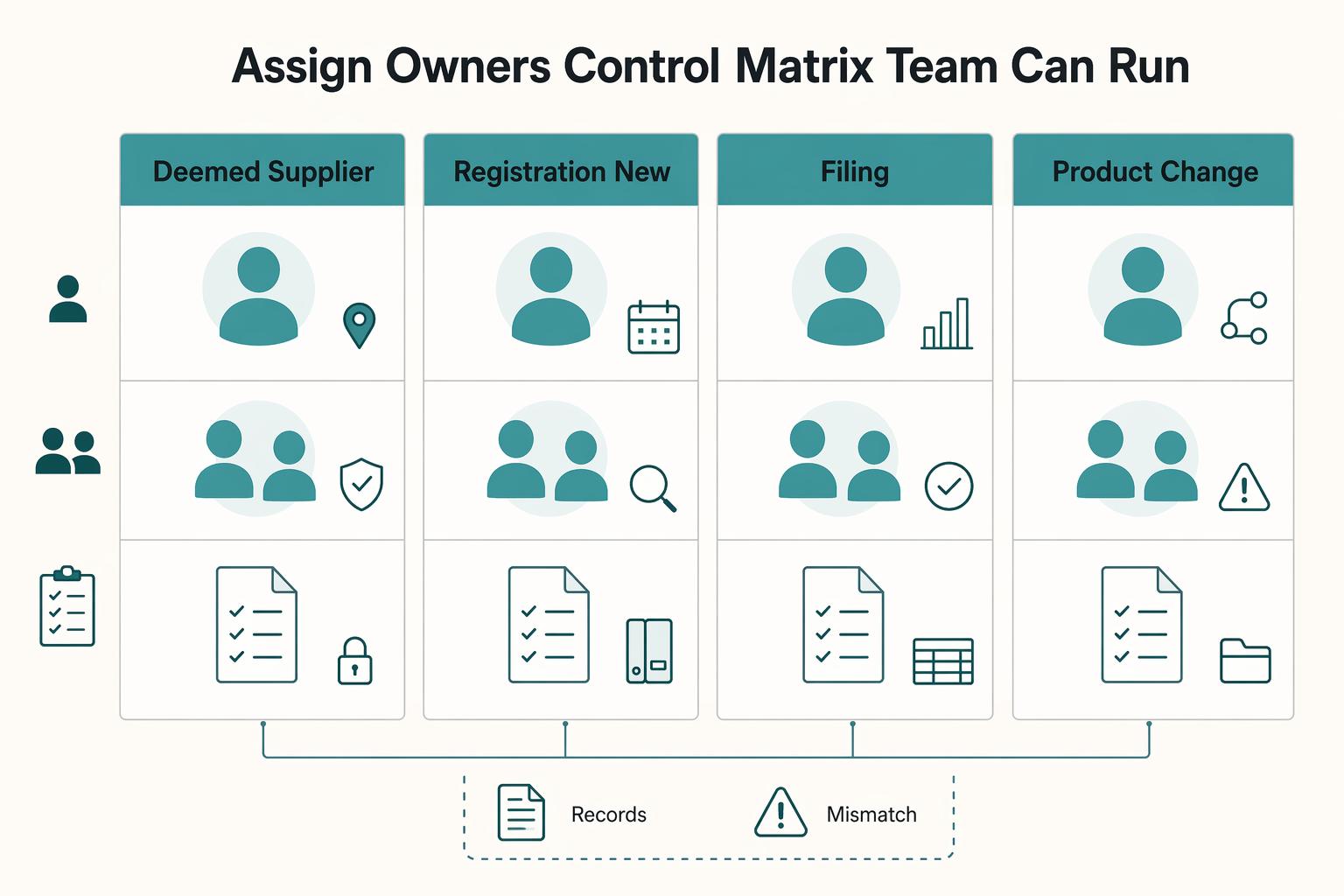
Assign owners with a control matrix your team can run#
Treat this as an execution problem. For each control, assign one primary owner, one backup reviewer, and a written procedure for each decision. Shared ownership without explicit criteria and retained evidence can make platform VAT controls brittle.
Adapt this matrix to your team structure. Each control needs a decision owner, the source record that supports it, and a retained output showing when it ran.
| Control area | Example primary owner | Core decision | Evidence artifacts | System of record |
|---|---|---|---|---|
| Deemed-supplier rule assessment | Legal with Tax review | Whether current facts support your chosen treatment, or whether the position is still unclear | Contract clauses, current terms, payout flow diagram, platform role memo, approval ticket | Policy-gate log, legal approval record |
| Registration check for new market or model change | Tax | Whether the current model needs local registration review | Scope memo, assumptions, launch ticket, counsel request if unclear | Policy-gate log, market launch checklist |
| Filing input preparation | Finance Ops with Tax sign-off | What transaction population, tax amounts, and adjustments feed the filing support pack | Reconciliation export, ledger journals, exception register, filing workbook | Ledger, reconciliation export, filing folder |
| Product change review | Product with Tax or Legal escalation | Whether checkout, invoicing, or payout changes affect tax treatment or evidence quality | Change request, invoice logic spec, updated payout flow, approval record | Product ticket log, policy-gate log |
What the evidence pack should prove#
Your evidence pack should prove two things: the control exists, and the control was followed. Keep legal and operational evidence together for each audit period, including tickets, logs, emails, or signed forms that show who approved what and when.
Map these controls to the records your systems actually produce: transaction journals, reconciliation exports, effective terms, approval tickets and filing receipts. Confirm an export includes the required data before making it part of the control.
Verification and failure modes#
Run one recurring checkpoint: sample the last 5 relevant approval tickets and confirm the required approval evidence is attached. If any sample is missing required approval evidence, treat it as a control failure and remediate.
Plan for unintended change as a core failure mode. When product or process changes are introduced, review downstream tax and evidence impacts before the next filing cycle. If execution is outsourced, keep internal monitoring and oversight in place.
What to escalate and how fast#
Escalate to tax counsel when the legal position is unclear, when operating facts and documented treatment diverge, or when a filing could be wrong because the product reality changed. Escalate when analysis relies mainly on non-binding reference material without a clear legal anchor.
Investigate missing evidence and reconciliation breaks with Finance Ops and Tax. A small amount does not automatically make a legal-classification error low risk; record whether the issue changes the filed position and how it will be corrected.
Run a monthly evidence pack and reconciliation cycle#
Run one monthly control cycle that produces both filing outputs and the evidence behind them. If your team can prepare a VAT or GST filing without the support pack, the control is likely not strong enough.
Use one fixed order every month#
Keep the sequence stable with one internal order each month: pull the full transaction universe, classify supplies, apply jurisdiction logic, reconcile tax outputs to source records, then lock the evidence pack used for submission. This helps prevent teams from adjusting totals first and explaining the population later.
For platform operators, start with completeness. Confirm the extract covers all channels that affect taxable events or the tax base, including refunds, reversals, credits, and manual adjustments. Then confirm classification logic still matches current product and payment flows, especially where platform liability may depend on how the platform facilitates the sale.
Define the minimum evidence pack#
Keep a defensible monthly pack tied to the filing period. A practical minimum pack can include:
- Transaction extracts used for filing support, including period dates, source system, pull timestamp, and filters
- Platform-role rationale, whether in a memo or approved ticket, for the treatment used in scope
- Contract snapshot for the period, including effective terms, seller agreement, and relevant checkout terms, not only the latest version
- Exception register for excluded, overridden, or unresolved items, with owner, reason, and status
This record set helps connect calculation to legal position and supports data-sharing or follow-up requests.
Build a transaction-to-return bridge#
Use a hypothetical VAT-inclusive EUR 120 sale at a 20% rate. The taxable amount is EUR 100 and VAT is EUR 20, not EUR 24. A VAT-inclusive EUR 24 partial refund at the same rate reduces the taxable amount by EUR 20 and VAT by EUR 4. The resulting net taxable sales are EUR 80 with EUR 16 tax. Keep sale and refund IDs and their tax-period treatment; a refund in a later period needs the relevant correction rules.
If the PSP deducts a EUR 3 fee from the remaining EUR 96 customer proceeds, bank cash may be EUR 93. That fee does not reduce the EUR 80 sale base in this example. Bridge transaction consideration, tax and settlement cash separately. Check provider fees as their own supplies, then tie the tax ledger to the return by jurisdiction and filing entity.
Set checkpoints before filing#
Do not rely on a vague reasonableness review. Use explicit pre-filing gates:
| Gate | What to define | Approval or escalation |
|---|---|---|
| Mismatch tolerance | Internal variance threshold between transaction support and draft filing totals | Mandatory escalation above that threshold |
| Exception aging | What can remain unresolved and how long | Who can approve filing with open items |
| Sign-off | Named approval that reconciliation is complete, exceptions are resolved or approved, and the evidence pack is locked | Named approval |
Set internal variance and aging thresholds by market and filing type, but do not use them to approve a known incorrect tax treatment. An unexplained difference needs a documented resolution or a lawful correction path.
The failure mode to watch is straightforward: product changes the payment flow, but tax classification logic does not change with it. When checkout, collection, settlement, or refund handling changes, rerun classification review before the next filing cycle.
For EU business-customer classification, keep the VAT-ID validation result and any accepted alternative business evidence with the transaction. The VAT Number Validator can support an EU-ID check; it does not classify the supply or validate every global tax ID.
Design contracts and payment flows to reduce avoidable VAT risk#
If your legal position and customer journey conflict, the customer journey can become the bigger VAT risk. For platform operators, the practical goal is consistent signals across contract terms, invoices, payment authorization, price display, and cancellation handling.
Pick a contract pattern, then make the customer journey match it#
Choose one operating pattern and keep every customer-facing artifact aligned with it. As a practical business framing, a platform-as-principal model presents the platform more directly in the sale, while a platform-as-intermediary model keeps the underlying seller or service provider more visible and the platform in a facilitation role.
Customer-facing documents should reflect the operating model, but document consistency alone cannot override a deeming rule. Test the facts against the jurisdiction’s legal requirements, including any conditions that prevent identifying the underlying provider as supplier.
For an intermediary model, identify the actual supplier in the relevant contract, invoice and receipt, then verify that the platform’s controls permit that treatment under local law. Renaming the seller while retaining charge, delivery or terms controls does not rebut the EU presumption.
The details that strengthen or weaken your file#
Small implementation details can decide whether an online-services setup is compliant or exposed. Price display, VAT calculation, and cancellation-right handling are core controls, not cosmetic choices.
A stronger evidence pattern is simple and consistent:
- The checkout names the same party shown in the T&Cs and invoice.
- Payment authorization wording matches that party and stays clear about who supplies the service.
- Refund, cancellation, and support wording follow the same role allocation as the contract.
A common failure mode is misalignment: intermediary language in legal terms, but platform-first wording in checkout, invoicing, and cancellation flows. That can increase VAT ambiguity.
In the European Union, digital services are treated differently from physical goods, so this alignment check matters even more. If your filing position depends on role analysis, retain the exact contract snapshot and live customer-flow evidence for the filing period, not just the current version.
Verify what an auditor would actually see#
Run one live-transaction review whenever checkout, invoicing, or refund logic changes. Confirm the named supplier, VAT display, payment authorization wording, invoice issuer, and cancellation path still match your intended position.
Keep a minimum document pack: effective customer T&Cs, seller terms, invoice template, checkout screenshots, payment confirmation wording, and a short role-rationale memo. Keep version and go-live dates. Invoicing and record-keeping are explicit compliance checkpoints for online service providers, so undated screenshots and generic templates are weak evidence.
Accept the tradeoff early#
Reducing operational friction can increase VAT ambiguity. A unified checkout and platform-first support and billing language can improve customer experience while blurring role allocation.
Choose the customer journey with the tax consequences understood. A platform can be the deemed supplier even when its commercial contracts describe facilitation. Design collection, invoicing and tax reporting for that role instead of using clearer wording as a substitute for the legal test.
Spot red flags that should trigger counsel immediately#
Some issues should not wait for a routine monthly review. Escalate immediately when the uncertainty is about legal character, filing scope, or evidence, not just a VAT rate.
| Red flag | Immediate step | Detail |
|---|---|---|
| A new EU launch where supplier role is unclear and undocumented | Involve counsel before launch | Identify the applicable legal rule and any suitable national ruling path |
| A mismatch between platform or payment data and filed VAT totals | Investigate and apply the correct filing/correction path | Confirm that all supplies within the chosen OSS scheme were declared through OSS, and confirm that no one treated OSS returns as replacing domestic VAT returns |
| Conflicts between contract language and product behavior | Escalate | Send counsel the primary evidence set from the filing period: signed terms, checkout and invoice snapshots, payment and settlement extracts, filed returns, and the reconciliation bridge |
| Any assumption that DAC7 reporting is enough for VAT evidence | Keep a separate VAT evidence pack | EU marketplace rules include record-keeping requirements even where the platform is not the deemed supplier |
Resolve supplier-role questions before launch using dated terms, flow evidence and the applicable rule. If a filed amount later fails reconciliation, investigate the population and correction route with Tax; stopping new filings indefinitely does not correct a submitted return.
Do not treat DAC7 reporting as a substitute for VAT-specific record keeping. EU marketplace rules include record-keeping requirements even where the platform is not the deemed supplier, so keep a separate VAT evidence pack.
DAC7 sits beside this work rather than inside it. It asks a platform to report seller identity and quarterly consideration to a tax administration rather than to charge anything at checkout, and it draws on the same seller record the indirect tax questions do. DAC7 and DPI reporting for platforms covers what that data set contains and when it is due, which is worth keeping separate in a control design even where the underlying record is shared.
Keep the indirect-tax map linked to the digital-economy GST/HST guide when Canada is in scope.
Implement in 90 days without overbuilding#
Use this 90-day template to prove the controls for your first markets. Apply the authority-backed starting points above to the actual supplies, resolve transaction-specific questions, and complete registrations or collection arrangements by their legal deadlines; the project schedule does not extend those deadlines.
| Period | Focus | Done when |
|---|---|---|
| Days 1-30 | Define terms, decision ownership, and escalation rules | Each item has a named owner, approval path, and effective date |
| Days 31-60 | Run a control matrix and evidence-pack process in Finance Ops | A reviewer can trace source records to dated filing support for a monthly sample |
| Days 61-90 | Complete one dry cycle and one live cycle, then measure exceptions | Open risks are explained, assigned, and tracked to resolution |
Days 1-30#
Standardize language first so Legal, Product, and Finance Ops are making decisions on the same definitions. Keep the first taxonomy short and practical: what the flow is, who approves, what evidence is required, and when escalation is mandatory.
Date-stamp every decision artifact. Effective dates and approvers are the minimum checkpoint if you need to show what position was in force at a given time.
Days 31-60#
Make controls runnable, not theoretical. Your control matrix should map each monthly step to one owner, one source record set, and one expected output.
Build a consistent evidence-pack template and use it every cycle. The goal is reconstructability: another reviewer should be able to follow the trail without collecting context from multiple teams.
Days 61-90#
Run one dry cycle on a closed month, then one live cycle with the same owners and approval path. Use milestone-style measurement with clearly defined metrics, then track exceptions and unresolved risks.
Start with the highest-volume or most consequential supply types, and expand after the source-to-return bridge is reproducible. Track unresolved questions by market rather than copying one region’s model.
Conclusion#
For platform operators, the priority is not a bigger rate table. It is a repeatable liability decision path, a market triage map, and a monthly evidence cycle your team can run and defend.
Identify the liable party under the market’s actual supply-chain rule before calculating tax. For EU digital interfaces, charge, delivery and general-terms controls have specific legal consequences; in other markets, check supplier, platform, buyer or payment-intermediary collection responsibilities.
Your strongest defense is period-specific evidence tied to transaction reality. Keep the transaction universe, classification logic for the period, contract or terms snapshots with effective dates, payout-flow documentation, invoice behavior, and reconciliations from filings back to source transactions and payment totals. If a filed figure cannot be traced back, it is not well defended.
This discipline matters more as tax authorities gain more data and better matching capability. In the EU, the trend is toward more digital reporting, updated platform VAT rules, and single-registration mechanics. More automatic information exchange raises the cost of weak reconciliation.
Keep country-specific unknowns on an explicit escalation list. Where platform control is significant, exposure can be broader than commission-only assumptions in some jurisdictions.
Run three operating rules:
- Document your liability decision path before launch, and update it when checkout, invoicing, or payout behavior changes.
- Maintain a market triage map that separates confirmed treatment from items needing local validation.
- Close each month with a locked evidence pack only after reconciliation to transaction, ledger, and payment data is complete.
A usable close lets the next reviewer reproduce the tax population, treatment and return totals from the period’s records. Keep open legal questions separate from unexplained arithmetic and settlement differences.
Related Canada guidance: Canadian GST/HST Registration for Platform Operators in the Digital Economy.
Choose one market and one product flow, then trace a sale and a refund from checkout through the tax ledger, return and payment receipt. Fix gaps in that chain before extending automation.
Frequently Asked Questions
When is a platform operator treated as the VAT supplier for digital services?
For EU electronically supplied services through a portal or interface, a taxable participant is presumed to act in its own name under Article 9a unless the identification and contractual/documentary exception applies. Authorizing the charge, authorizing delivery or setting general supply terms prevents identifying another person as supplier under that exception. Pure payment processing is excluded. Other jurisdictions apply their own rules.
Do 2026 changes under VAT in the Digital Age create new registrations for every non-resident digital service provider?
No blanket 2026 registration reset applies to all non-resident providers. ViDA was adopted in 2025 with staged implementation: 2027 OSS/IOSS clarifications, 2028 sector-platform and single-registration measures, and 2030 cross-border B2B digital reporting. Existing digital-service rules remain relevant now.
How is digital-services VAT different from low-value goods rules under the VAT e-commerce package?
Services use the relevant service place-of-supply and platform-role rules. IOSS is an import-goods scheme for eligible consignments not exceeding EUR 150; it is not a digital-services return. Eligible service supplies can use Union or non-Union OSS, with quarterly returns, while IOSS returns are monthly.
What minimum monthly controls reduce VAT surprise exposure for cross-border platforms?
Reconcile the complete sales and adjustment population by supplier entity, jurisdiction, customer status, tax rate and period. Tie tax calculations to tax-ledger totals and draft return boxes, explain differences, and retain approval plus filing and payment receipts. Bank payouts are a separate bridge because fees and settlement timing change net cash.
What evidence should we retain to defend deemed-supplier or intermediary treatment in an audit?
Keep effective seller and customer terms, supplier identification on invoices and receipts, checkout charge and delivery controls, customer-status/location evidence, dated rule decisions and the transaction-to-return reconciliation. Preserve the versions actually used for that period; separate VAT support from any DAC7 reporting.
When should a VAT issue be escalated to specialist tax counsel instead of handled internally?
Escalate when supplier-role treatment is unclear for the relevant market or platform model, when registration posture changes rely on template assumptions instead of market-specific analysis, or when a team assumes DAC7 reporting automatically satisfies VAT evidence requirements. Escalate early where registration and documentation burden is high, since errors can be costly to unwind.
Try a related tool
EU VAT number validator
Validate EU VAT IDs and keep evidence for invoicing (informational only).
VAT reverse charge checker
Estimate reverse charge VAT and copy invoice text (informational only).
DAC7 seller data checker
Check a seller export against the OECD DPI XML Schema in your browser and get a chase list of the gaps.
Researched and edited by the Gruv editorial team. Gruv builds cross-border billing, payouts, and finance-operations software for global businesses.
Sources
- bir-cdn.bir.gov.ph/BIR/pdf/RR%20No.%203-2025.pdftrusted
- bir.gov.ph/vat-on-dstrusted
- dnit.gov.py/en/web/portal-institucional/preguntas-frecue...trusted
- dnit.gov.py/en/web/portal-institucional/w/resolucion-gen...trusted
- eur-lex.europa.eu/legal-content/EN/TXTtrusted
- orientacion.sunat.gob.pe/igv-servicios-digitalestrusted
- tax.gov.ae/en/services/vat.registration.aspxtrusted
- taxation-customs.ec.europa.eu/taxation/vat/vat-digital-age-vida_entrusted
Educational content only. Not legal, tax, or financial advice.
Related Posts

The Freelance Payment Penalty: A Modeled Audit of Platform Fees, FX Spreads, and Payout Delays
The money rarely disappears through a single, easy-to-spot fee. The real loss is stacked. A marketplace takes its commission, a processor adds a charge for international cards, a bank or payment company converts the currency at a spread, a platform holds the funds before release, and a wire sheds a little to intermediaries on the way in. Each layer looks defensible on its own, but the worker feels the combined result as a smaller deposit and a later payday.

How to Respond to a Subpoena for Business Records
Move fast, but do not produce records on instinct. If you need to **respond to a subpoena for business records**, your immediate job is to control deadlines, preserve records, and make any later production defensible.

A US Expat's Guide to Investing in UCITS ETFs to Avoid PFIC Issues
The real problem is a two-system conflict. U.S. tax treatment can punish the wrong fund choice, while local product-access constraints can block the funds you want to buy in the first place. For **us expat ucits etfs**, the practical question is not "Which product is best?" It is "What can I access, report, and keep doing every year without guessing?" Use this four-part filter before any trade: