
Quick Answer
Identify the entity, supply type and marketplace role before counting Singapore GST exposure. Overseas OVR registration generally requires global turnover above S$1 million and Singapore B2C remote-service/LVG supplies above S$100,000. Track both retrospective and prospective tests, including deemed supplies and unresolved exposure. Once registration takes effect, apply the customer-status rule, charge the applicable GST and reconcile corrections and returns.
How Singapore GST OVR Applies to Platform Operators#
For platform operators, the real question is whether your Singapore-facing flows fall within GST under the Overseas Vendor Registration (OVR) regime, not whether there is a separate digital services tax. Get that call wrong, and downstream decisions drift with it: pricing, invoicing, registration planning, and customer messaging.
Use this sequence to decide which entity accounts for GST, which transactions count toward registration and what checkout and finance must retain. Start with the supplier's belonging status; overseas and Singapore marketplace operators do not use identical registration tests.
IRAS treats OVR as part of GST registration and reporting for imported remote services. Under the extended regime, imported B2C services can be in scope whether digital or non-digital when supplied and received remotely. Electronic marketplace operators may also be treated as suppliers when certain conditions are met.
Timing matters. Since 1 Jan 2020, OVR has applied to B2C digital services to customers in Singapore. From 1 Jan 2023, it extended to B2C non-digital remote services and to imported B2C low-value goods (LVG). If your internal logic still centers only on obvious digital products, you can miss exposure. Start with four concrete controls:
- Determine whether the customer belongs in Singapore.
- Determine whether the customer is GST-registered.
- Support refunds where GST was incorrectly charged to a GST-registered customer.
- Retain evidence for at least 5 years to substantiate GST collected and accounted to IRAS.
The rest of this article follows that sequence so you can decide where Singapore GST likely applies, what to monitor as obligations evolve, and when to escalate to specialist advice.
Start with the terms that change your liability#
Your liability turns on defined GST terms and customer GST-registration status, not on whether an account looks like a "business" account.
| Term | Plain-language meaning | Why it changes action |
|---|---|---|
| Remote services | Services the customer can consume without being physically present where the service is performed. | If a supply is remote and consumed in Singapore, you then classify it as B2C or B2B. |
| Digital services | Essentially automated internet/electronic services with minimal human intervention; a subset of remote services. | Apply remote-services logic without double counting a separate digital total. |
| Low-value goods (LVG) | Non-exempt goods outside Singapore at sale, delivered by air/post, value ≤S$400, that are non-dutiable or have customs/excise duty waived under section 11 of the Customs Act. | LVG is treated separately from remote services, so mixed marketplaces should classify goods and services in separate lanes. |
| B2C supplies | Supplies to non-GST registered persons, including individuals and non-GST registered businesses. | Under OVR, GST-registered overseas vendors must account for GST on relevant B2C supplies. |
| B2B imports | Supplies to GST-registered persons. | These may fall into reverse charge instead of an OVR charging path. |
The customer boundary that matters most#
The boundary that matters most is GST-registration status. A company can still fall into the B2C lane if it is not GST-registered, while B2B imports are supplies to GST-registered persons.
GST-registered customers not entitled to full input tax recovery, including relevant GST groups, may need reverse charge on imported services and LVG. This is a recipient obligation; a registered customer is not automatically subject to reverse charge merely because the vendor does not charge OVR GST.
Use a hard control here: store customer GST-registration status as a discrete transaction-level field. Do not infer B2B treatment from a company name, business email domain, or generic onboarding responses.
Read the right authority in the right order#
Use the IRAS guidance for operational definitions and treatment of imported supplies. If you need legal interpretation, check the GST Act directly.
Check exclusions from remote-services scope in the IRAS guide as well as the delivery model. For example, some services directly connected with land or goods outside Singapore can fall outside the OVR remote-services charge even if delivered online.
Do not assume when the fit is messy#
If a transaction does not clearly fit these terms, mark it unresolved and escalate. That usually means uncertainty about one or more of the following:
- whether the supply is truly remote
- whether the item is a service or LVG
- whether the customer is GST-registered at the point of supply
- whether your platform or another party is treated as the supplier for GST purposes
Record the unresolved facts and amount with an owner and review deadline. An unresolved label must not quietly remove potentially taxable supplies from threshold monitoring or delay a statutory registration deadline.
Related reading: Australia Tax Residency for Digital Nomads With GST and ABN Checkpoints.
Which platform operators are likely in scope under OVR#
Start with the entity's belonging status, the supplied service or good and the customer. Overseas operators may need OVR registration for their direct sales and supplies treated as theirs through the marketplace; Singapore operators use domestic registration rules on the relevant combined turnover.
- your entity acts as an overseas supplier
- your entity acts as an electronic marketplace operator supplying remote services or low-value goods on behalf of suppliers or merchants
For remote services supplied on behalf of overseas suppliers, IRAS treats the marketplace as supplier when any of five conditions applies: it authorizes the charge, authorizes delivery, sets supply terms, identifies itself as supplier in customer documents, or agrees with the merchant to bear GST liability. It need not receive the funds to authorize a charge. Test the actual checkout, delivery and contract behavior; payment processors and internet service providers are excluded from the marketplace definition. Supplies on behalf of local suppliers require a separate assessment of the extension and approval rules.
Separate your own supplies from marketplace supplies#
For each flow, split the analysis between:
- supplies where your entity is the supplier
- supplies where your platform facilitates a third-party supplier or merchant
This keeps the assessment tied to your role in each transaction, not to a single label applied across the whole product.
Use a hard evidence test before sign-off#
Do not sign off scope unless you can evidence, for each flow, the role your entity is playing and customer GST-registration status.
Keep a decision record for each condition rather than requiring all five. If documents and system behavior disagree, resolve the facts promptly and quantify the affected sales; use a potential-exposure view while final classification is reviewed.
For a comparable registration analysis in another market, see Canadian GST/HST for Platform Operators: Registration Rules and the Digital Economy Tax.
Map every transaction type before you discuss registration#
Map transactions before you test thresholds. If you classify supplies after the fact, you can end up testing the wrong revenue base, mixing B2C and B2B flows, and missing where marketplace operator exposure sits.
IRAS routes imported consumption through two lanes: OVR for relevant B2C supplies and reverse charge for certain B2B imports. Since these regimes were implemented in 2020, with scope expanded in 2023, the first practical step is a row-by-row classification of supply type, customer type, and supplier role.
Build the table around treatment-changing decisions#
Build your working table around the decisions that actually change treatment. Use these columns:
- transaction type
- customer type
- supplier status
- customer location evidence
- likely lane
- working evidence (internal)
Use lanes for OVR charging, recipient reverse-charge review, domestic GST, out-of-scope or excluded supplies, and unresolved cases. Digital services are a subset of remote services; separate them only when their delivery facts or controls differ.
| Transaction type | Customer type | Supplier status | Customer location evidence | Likely lane | Working evidence (internal) |
|---|---|---|---|---|---|
| Remote services | B2C (non-GST registered persons) | Platform as supplier, or third-party supplier via platform | How you determined the customer belongs in Singapore (remote-services guide section 8 checkpoint) | Usually OVR if Singapore B2C and supplier role supports it | Contract terms, checkout terms, invoicing entity, customer GST status record |
| Digital services | B2C or B2B (kept separate as an operating row) | Same supplier-status split | Same customer-belongs test as remote services | Subset of remote services; do not count twice | Same evidence set, plus product description used in catalog classification |
| Low-value goods (LVG) | B2C or B2B | Platform as supplier, or third-party supplier via platform | Destination, air/post delivery, value ≤S$400, non-exempt and applicable customs-duty status | B2C may route to OVR; certain B2B imports may route to reverse charge | Merchant terms, checkout flow, invoicing entity, customer GST status, goods value evidence |
Keep goods and services in separate lanes. Within remote services, distinguish automated digital delivery from human-delivered remote services only where that helps apply a rule. Do not count the same digital sale again as a second remote-service sale.
Supplier status is usually the highest-risk field for platforms#
For most platforms, supplier status is the field most likely to break the analysis. Map it explicitly as platform as supplier versus third-party supplier via platform. IRAS states that, under certain conditions, an electronic marketplace operator may be regarded as the supplier, and relevant B2C supplies made through the marketplace must be included for GST registration liability testing.
Validate marketplace treatment against contractual roles and what the platform actually does. Keep uncertain amounts visible in an exposure reconciliation; removing them from the validated total does not make them exempt.
Treat evidence as part of classification, not cleanup#
Evidence is part of classification, not something to collect later. For each row, capture:
- contracts or marketplace terms showing supplier role
- checkout terms showing what the customer was told
- invoicing entity details
- customer GST status evidence for B2C versus B2B routing
For in-scope remote services, the OVR default is a non-GST-registered customer unless the customer supplies a GST registration number. Verify and retain that number. A company name alone does not establish B2B treatment; unresolved evidence needs a prompt review without silently omitting the sale.
Use this map before tools, returns, or filing cadence#
Most failures start with bad classification, not filing mechanics. Get the map right before you build tools, set return logic, or assign filing cadence.
The overseas-vendor registration test combines global turnover above S$1 million with Singapore B2C remote-services and LVG supplies above S$100,000. Monitor the calendar-year retrospective test and reasonable expectations for the next 12 months. Include relevant deemed marketplace supplies, retain exclusions and track unresolved amounts beside confirmed totals; review uncertainty before the filing deadline rather than waiting for every row to become perfect.
For a step-by-step walkthrough, see GST Digital Marketplace Platform Comparison for Australia, Canada, and India.
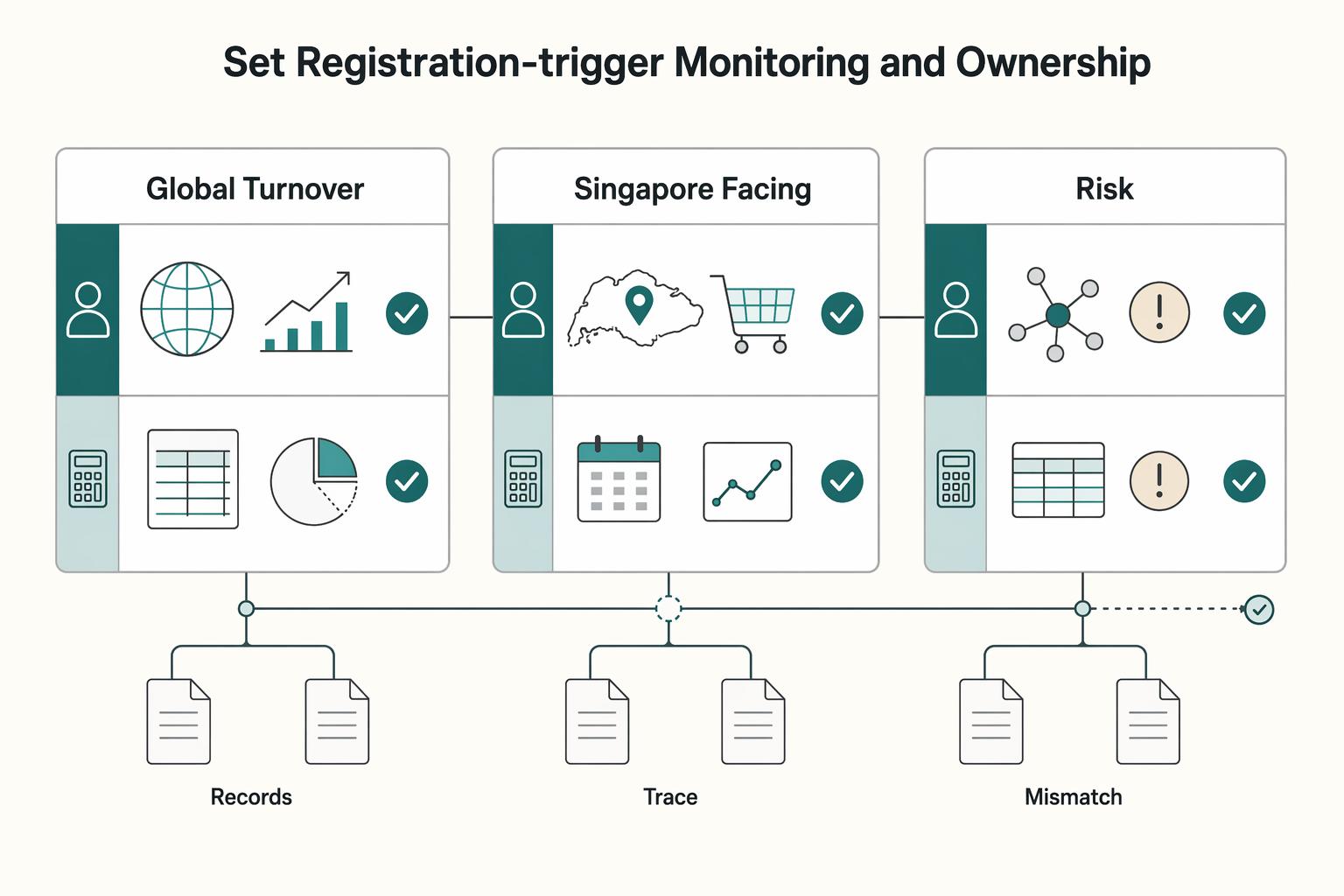
Set registration-trigger monitoring and ownership#
Once classification is in place, assign registration-trigger monitoring to both Tax and Finance. Tax should own scope decisions for relevant Singapore B2C supplies. Finance should own data completeness, close timing, and forecast tracking. A shared monitoring table is enough if it runs on a fixed cadence and ties back to source records.
| Monitoring item | What you are testing | Primary owner | Verification checkpoint | Escalation trigger |
|---|---|---|---|---|
| Global turnover test | Global taxable-equivalent turnover and required marketplace inclusions against S$1 million | Finance, reviewed by Tax | Reconcile extracts to the ledger close and document exclusions | Unexplained variance, new product line, or policy gap |
| Singapore-facing B2C supplies test | Relevant Singapore B2C direct and deemed supplies against S$100,000 for overseas vendors | Tax, supported by Finance data | Tie totals back to the classification map and customer-status evidence | Ambiguous customer status, missing location evidence, or supplier-role uncertainty |
| Forecast breach risk | Reasonable next-12-month expectations under the prospective test; apply within 30 days of liability | Finance, with Tax sign-off | Maintain a dated forecast note with assumptions and sign-off | Likely trigger crossing before period close |
Tie the table to records, not manual cleanup#
Reconcile billing/order extracts to the ledger and classification map. Show confirmed in-scope, confirmed excluded and unresolved amounts separately, with a possible-exposure total and owner. Resolve cases that could change registration promptly; sign-off on an exception queue does not extend IRAS deadlines.
Keep monitoring aligned to cited OVR scope changes#
Monitor against the cited scope changes, not legacy logic. Singapore implemented the OVR regime on 1 January 2020, and from 1 January 2023 the cited scope expanded so digital and non-digital B2C imported remote services are subject to GST. If your control logic still keys only to "digital services," your tested base may be too narrow.
| Date | Noted change or source |
|---|---|
| 1 January 2020 | OVR began for imported B2C digital services |
| 1 January 2023 | Expanded to non-digital remote services and LVG |
| 1 January 2024 | Standard GST rate became 9% |
| 30 January 2026 | IRAS remote-services guide sixth edition |
The remote-services e-Tax guide currently linked by IRAS is its sixth edition, published 30 January 2026. Keep the edition and relevant paragraphs with your rule version instead of treating the first-edition filename as the publication date.
Treat the simplified pay-only regime as contingent#
Overseas suppliers and overseas marketplace operators covered by OVR generally use simplified pay-only registration, which does not allow input-tax claims and relaxes local tax-invoice and GST-inclusive price-display requirements. This differs from a Singapore entity's normal GST registration. Record the regime and effective date before enabling charging; likely exposure calls for registration readiness immediately.
Related: Brazil Digital Services Tax: CIDE and ISS Obligations for Platform Operators.
Build GST charging and invoicing controls that survive audit#
Prepare charging logic before registration takes effect, then charge under the applicable effective date and supply rules. The liability belongs to the legal supplier or deemed marketplace supplier; a billing engine's tax calculation does not decide that role.
The core control is the transaction decision key: who the supplier is, whether the customer is B2C or B2B, and what evidence supports the Singapore treatment. Once registered, overseas suppliers must charge and account for GST on relevant B2C supplies to Singapore, so supplier-role logic has to live in system records, not in offline notes.
Make charging logic depend on role and flow#
Channel is not the rule. Transaction role and flow are. Selling through an online channel does not by itself change GST treatment.
| Flow | Charging control | Record that must persist to invoice and ledger |
|---|---|---|
| B2C remote services supplied by an overseas supplier | Charge GST when the flow is in scope and you are registered | Supplier entity, customer-status result, service classification, tax amount |
| B2C supply through a marketplace where the operator is treated as supplier | Apply operator supplier logic, not seller default logic | Marketplace supplier-role flag, seller reference, customer-status result, tax amount |
| Goods flow | Separate local Singapore delivery, qualifying export, and outside-Singapore to outside-Singapore flows | Delivery path, goods classification (including low-value goods (LVG) where relevant), tax treatment, export-document reference where applicable |
For qualifying LVG, retain point-of-sale goods value, destination, transport and customs classification. Goods already in Singapore, exports from Singapore and goods above the LVG criteria need their own domestic/import/export analysis; do not apply simplified OVR rules to every goods movement.
Require data that explains the result#
Your checkout and invoice records should preserve the data your team relied on for customer status and supply treatment. As a practical minimum, retain the legal supplier, customer-status outcome, location or delivery facts used, product or service classification, applied tax treatment, and tax amount posted to the ledger.
If a transaction is treated as B2B, retain the status evidence that supports that outcome. For B2B imports, certain GST-registered recipients may need to account for GST on imported services and LVG under reverse charge, so unsupported B2B treatment should be routed to review instead of defaulted.
Call out failure modes early#
Build explicit checks for these failure modes into release and close routines:
| Failure mode | Article signal |
|---|---|
| Treating sales channel (for example, online) as if it changes taxability by itself | Channel is not the rule. Transaction role and flow are. |
| Misclassifying customer status (B2C vs B2B) without supportable status evidence | Treat the B2C/B2B split as an evidence-based routing decision. |
| Missing supplier-role mapping where a marketplace operator may be treated as supplier | Supplier status is the field most likely to break the analysis. |
| Applying 0% export treatment without retaining the required export documents | Exports can be zero-rated at 0% GST only when the required export documents are retained. |
At close, reconcile charged GST to invoice totals and ledger postings, and investigate exceptions.
For marketplace reporting obligations across jurisdictions, see Digital Platform Reporting for Online Marketplaces: MRDP, DAC7, and UK HMRC Duties.
Keep the B2C and B2B boundary clean#
Treat the B2C/B2B split as an evidence-based routing decision, not just a customer label. In practice, each transaction should route to your internal treatment path, for example OVR-related, reverse-charge-related, or a review queue, based on what you can support at transaction time.
Apply the IRAS customer-status rule to the supply, then test whether any recipient reverse-charge obligation is relevant separately. A generic VAT checker or B2B onboarding label cannot decide Singapore OVR treatment.
A useful control is to test the same service under two customer records:
- A business customer provides no GST registration number: use the in-scope B2C default.
- A customer provides a verified GST number: do not charge OVR GST on that remote service; retain the evidence.
Those transactions may share the same product code, but they should not be auto-classified the same way.
Use a strict gate: if customer status evidence is uncertain at transaction time, hold for review instead of defaulting to B2B. Keep the review pack dated and simple: declaration used, status-check result, legal entity name, invoice party, reviewer, and final treatment decision.
Refresh the rule when IRAS changes guidance or your product, supplier role or customer-evidence collection changes. Keep the checked source and effective date in the policy log.
For a mismatched GST number, compare the customer declaration, registry result and invoice party, resolve the discrepancy and keep the correction or refund record linked to the original charge.
Maintain an evidence pack regulators and auditors can follow#
Freeze the decision evidence at transaction time so another reviewer can reconstruct why a transaction was routed to a specific GST treatment or manual review. Treat this as an internal control standard.
Keep a minimum pack for every decision type#
| Evidence item | What to retain | Why it matters |
|---|---|---|
| Transaction classification output | Final treatment result, transaction ID, date, legal entity, product or service type, and whether it was routed to the selected GST treatment or review | Shows the decision that was actually applied |
| Customer-status evidence | Customer declaration used, business details collected, status-check result, invoice party, and timestamp | Supports the status call made at transaction time |
| Supplier-role rationale | Contracting party, invoicing entity, checkout terms, and a short rationale for who was treated as supplier in your process | Preserves the reasoning behind supplier treatment |
| Policy approval log | Policy version, approver, effective date, and scope of change | Shows which internal rule was in force when the decision was made |
A practical check is this: six months later, the file should still show the facts, the rule applied, who approved it, and any exception from the default rule.
Anchor each rule to a real source of truth#
Anchor rules to named IRAS guidance and the specific condition the rule is meant to apply. For edge cases, keep a dated decision memo with the fact pattern, chosen interpretation, approver, and next review date.
Where the transaction record alone is not enough, keep written reasoning. An outcome without a rationale is a control gap.
Add operating evidence, not just policy evidence#
Keep proof that controls actually operated in finance and operations, not just policy text:
- reconciliation files showing GST charged, invoice totals, and ledger postings for the review period
- exception-resolution records for ambiguous customer status or post-close corrections
- change logs for tax-rule updates, including effective date, owner, and what data or product mapping changed
Date-stamp each exception closure and link it to the policy version used so retired logic is not reused.
Do not claim Singapore input tax under simplified OVR registration. A separately registered Singapore entity uses the normal input-tax rules and its own purchase documents; that is a different registration and accounting analysis.
As an illustrative charging test, a taxable remote service priced at S$109 including 9% GST contains S$9 tax and S$100 net value. A S$100 tax-exclusive price results in S$109 charged. Match gross payment, GST and net revenue; where GST was wrongly charged to a registered customer, retain the correction and refund against that same sale.
Handle timeline and rate uncertainty without freezing execution#
Use effective-dated rules for historical transactions and check the current rate before deploying a pricing change. The current standard rate is 9%, effective since 1 January 2024; historical or transitional supplies can need different treatment.
Use a compact effective-date register:
| Rule | Record to preserve |
|---|---|
| Registration | Liability-test date, application due date and effective registration date |
| Charging | Tax point, supply type, customer evidence and applicable rate |
| Change or correction | Prior rule, replacement rule, effective date, affected transactions and approved correction |
Verify the rate, registration date and time-of-supply rule together before changing checkout. For services, invoicing and payment timing can determine when GST is due; a service-delivery date alone may not establish the tax point.
Keep a lightweight Tax/Legal change log so stale assumptions do not leak into production:
- rule area affected, for example tax scope, customer type, or marketplace treatment
- source checked, including any
last revisedorupdated as ofmarker - decision taken, effective date applied, owner, and linked approval or ticket
The five marketplace conditions give a concrete first test, but unusual configurations still need fact-specific interpretation. Document exactly which contract term or system action is unresolved, its transaction value and the decision deadline. Do not replace a known rule with a generic request for legal confirmation.
Execute in 30 60 90 days without overbuilding#
Use this phased implementation plan only when it fits the statutory dates. A 90-day project calendar does not defer registration or charging obligations.
| Phase | Focus | Key actions |
|---|---|---|
| Days 1 to 30 | Visibility and ownership | Map entity, supply and customer facts; quantify confirmed and unresolved exposure and check statutory deadlines |
| Days 31 to 60 | Exposure monitoring for possible OVR risk | Review on a fixed cadence; keep treatments provisional where legal points remain open; create short evidence-pack templates; test exception handling on ambiguous supplier-status cases; label source quality explicitly |
| Days 61 to 90 | Dry-cycle close and reconciliation | Reconcile GST charged, invoice and checkout outputs, and ledger totals for the same period; investigate first if they do not tie; document unresolved items and escalation outcomes |
Days 1 to 30#
Start with the legal supplier, entity belonging status and the actual checkout and delivery behavior. Map the five remote-service marketplace conditions and goods-specific criteria; collect missing evidence alongside the exposure totals.
For each lane, capture in one working table:
- product or service as sold
- customer type captured at checkout
- invoicing entity and any seller-of-record field
- likely supplier status, including unresolved marketplace-role treatment
- evidence available now, for example contract terms, checkout terms, billing records, customer-status data
Assign owners across Legal, Tax, Finance, and Ops so classification, monitoring, invoice outputs, and escalation do not fragment.
Days 31 to 60#
Once the map is in place, stand up exposure monitoring for possible OVR risk and review it on a fixed cadence. Where legal points remain open, keep treatments provisional and escalate rather than hardcoding uncertain rules.
Create short evidence-pack templates for each reviewed lane, including:
- classification output
- customer-status evidence available at transaction time
- supplier-role rationale
- dated source note
- approval or escalation record
Test exception handling on ambiguous supplier-status cases before scaling.
Days 61 to 90#
Before you add more automation, run a dry-cycle close and reconcile for the same period:
- GST charged for transactions your team currently treats as in scope
- invoice and checkout outputs shown to customers
- ledger totals posted to Finance
If those do not tie, investigate first. Document unresolved items and escalation outcomes with owner, interim treatment, and date raised.
Pick the operating mode that matches risk#
Pick the operating mode that matches your actual risk profile. If volume is low and legal uncertainty is high, prioritize defensible manual review with tight exception handling and a documented hold path.
If volume is high, prioritize automation for clear cases and strict exception queues for anything below your evidence standard.
Close the cycle with a simple checkpoint: mapped, monitored, charged correctly, evidenced, and escalated where uncertain.
Conclusion#
For overseas platform operators, the sequence is simple: classify transactions correctly, monitor OVR exposure early, and only then scale automation.
Under Singapore GST, those classification calls drive everything downstream. Keep remote services and low-value goods separate, including LVG with a value not exceeding S$400 at point of sale, and keep B2C supplies to non-GST registered persons separate from B2B imports to GST-registered persons. In this IRAS framework, OVR applies to relevant B2C supplies and reverse charge applies to certain B2B imports.
Keep registration monitoring complete: include direct and deemed supplies, retain valid exclusions and keep uncertainty visible. Confirmed totals below a threshold do not prove no liability when unresolved amounts could change the result.
Once registered, the requirement becomes operational: charge and account for GST on in-scope B2C supplies to Singapore, and align invoicing and reconciliation workflows with that treatment. Reconcile charged GST and invoice totals against the same transaction population used for classification.
Automate clear, effective-dated decisions. For an unresolved supplier role or customer record, retain the amount, evidence and review owner, then resolve it before charging or filing deadlines. A queue is a workflow, not an exemption.
- Run a Singapore transaction-mapping table this week across all lanes, covering supplier role, customer status, product type, and required evidence.
- Assign named owners across Tax, Finance, Legal, and Ops for threshold monitoring, exception handling, and change control against current IRAS guidance.
- Validate unresolved legal points, especially marketplace deemed-supplier conditions and unclear B2B versus B2C facts, with Singapore-qualified tax counsel.
Related reading: DAC7 for Platform Operators: Scope, Seller Data, and Controls for EU and Non-EU Platforms.
If you want to operationalize this framework with policy gates, traceable records, and payout workflows where supported, talk to Gruv.
Frequently Asked Questions
Is Singapore digital service tax separate from Goods and Services Tax?
OVR is part of Singapore GST. It covers relevant imported B2C remote services and low-value goods, rather than a separate standalone digital services tax.
When does an overseas platform operator need to register under the OVR regime?
For an overseas vendor, test whether global turnover exceeds S$1 million and relevant Singapore B2C supplies exceed S$100,000 under the retrospective calendar-year or prospective next-12-month rules. Apply for registration within 30 days of the relevant year-end or prospective liability date. Singapore marketplace operators use domestic combined-turnover rules; they do not get the overseas S$100,000 threshold.
Can an electronic marketplace operator be treated as the supplier for GST purposes?
For remote services supplied on behalf of overseas suppliers, any one of the five IRAS conditions can make the marketplace the supplier: charge authorization, delivery authorization, setting terms, being identified as supplier, or contractual GST liability. Map those facts before deciding who charges. Apply the separate goods guide to LVG. Local-supplier arrangements require a separate extension/approval assessment.
What counts as remote services versus low-value goods in Singapore GST rules?
Remote services can be consumed without a necessary link between the recipient's location and where performance occurs, including digital services. LVG are qualifying non-exempt goods outside Singapore at sale, delivered by air or post and valued at no more than S$400, with the applicable customs-duty condition.
How should teams handle B2C supplies versus B2B imports and reverse charge decisions?
For in-scope remote services, treat the customer as non-GST-registered unless a GST number is provided, then verify it. GST-registered recipients not entitled to full input tax recovery may need reverse charge; that separate recipient analysis is not an automatic obligation for every B2B import.
What should a compliance team do first if key legal tests are still unclear?
Name the unresolved fact, estimate the affected exposure and assign a decision deadline. Start with entity belonging, marketplace conditions, customer GST status and location evidence. Keep a potential-exposure total while resolving the issue, and do not let an internal review delay a registration deadline.
What evidence should we retain to defend GST treatment decisions during audit?
Keep transaction IDs, supplier-role decisions, customer GST-number and location evidence, rate/effective-date logic, invoices or receipts, corrections, refund records and reconciliation for at least five years. For services, use two non-conflicting location proxies where relying on proxy evidence.
Do the key dates matter for classification?
Yes. OVR began for B2C digital services in 2020, expanded to non-digital remote services and LVG in 2023, and the standard GST rate became 9% in 2024. Preserve registration dates and tax-point evidence as well as the rule version.
What is the quickest red flag that your treatment may be wrong?
A practical red flag is when you cannot clearly evidence supplier role, customer GST-registration status, and whether the supply is remote services or LVG. If those checks are not evidenced, route the case to exception handling instead of automation.
Researched and edited by the Gruv editorial team. Gruv builds cross-border billing, payouts, and finance-operations software for global businesses.
Sources
Educational content only. Not legal, tax, or financial advice.
Related Posts

Canadian GST/HST Registration for Digital-Economy Platforms
A platform sells subscriptions to Canadian customers and pays overseas sellers. The Canadian GST/HST decision starts with those supplies and the platform’s legal role. It does not start with whether a payout succeeds or whether the platform has collected a large set of identity documents.
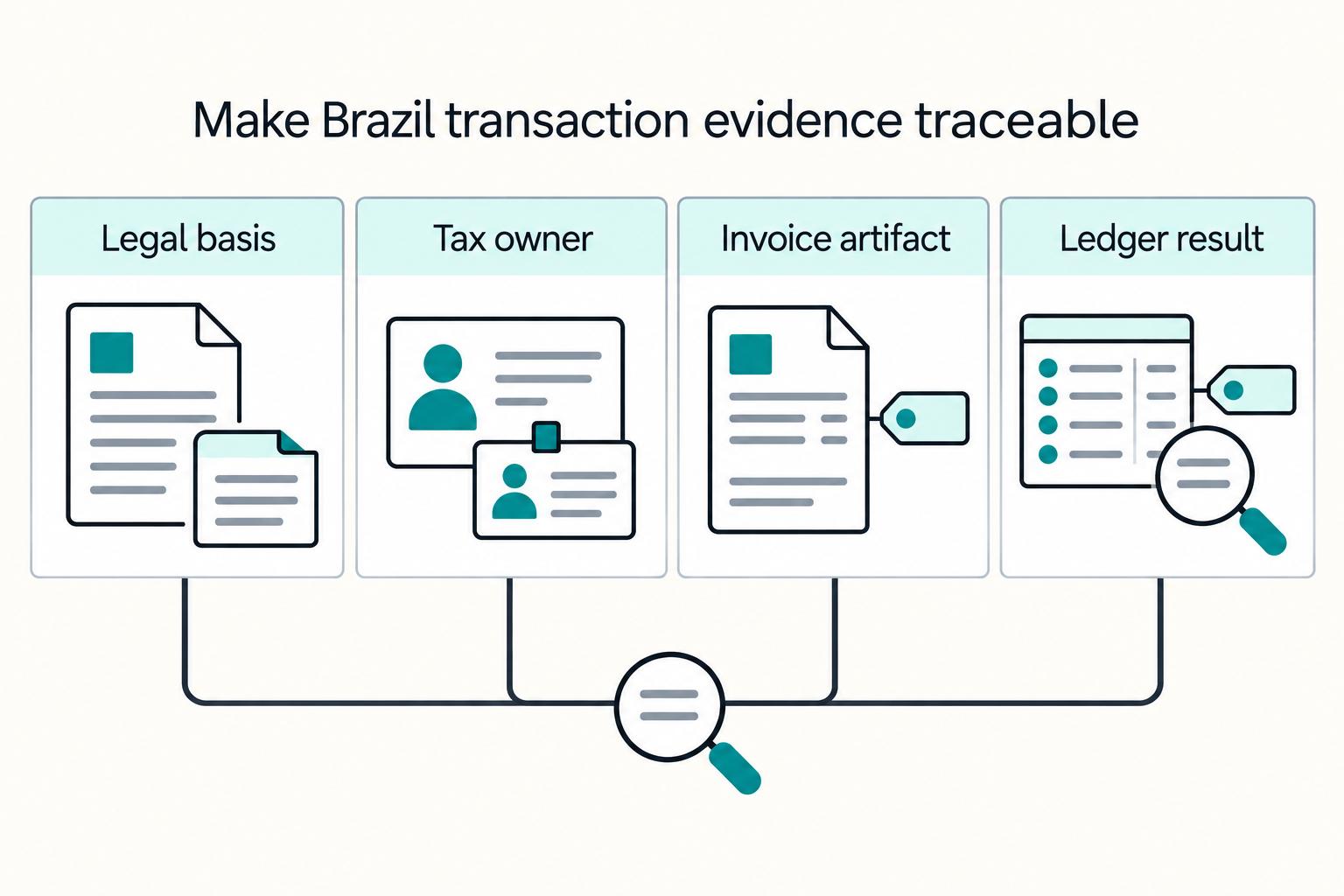
Brazil Platform Operator Tax Controls for CIDE, ISS, and CBS/IBS Transition
Brazil platform teams need three separate checks: existing CIDE on qualifying payments abroad, municipal ISS on listed services, and the CBS/IBS reform rules for their transaction model. A proposal for a new digital-platform tax does not suspend the rules already enacted.
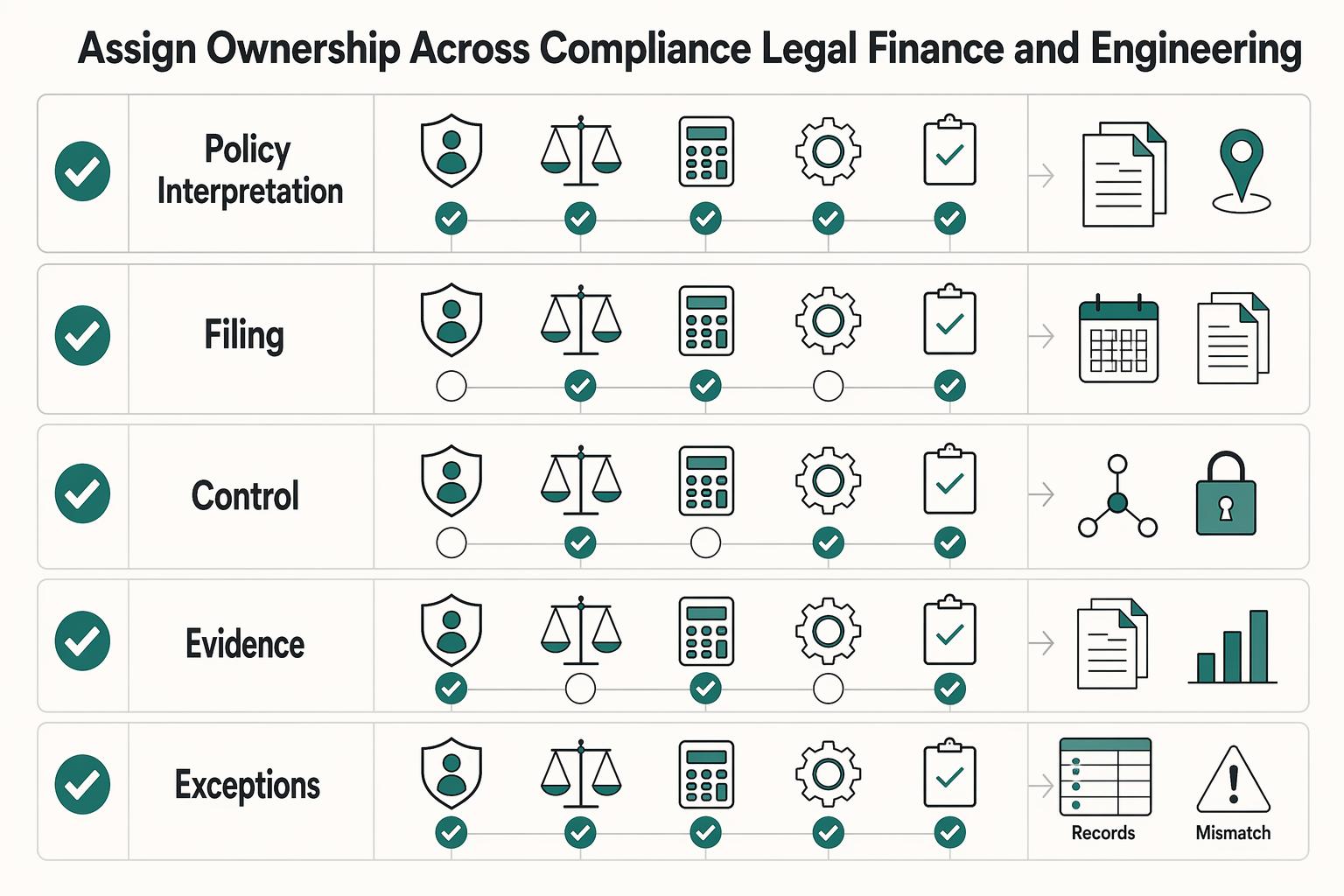
Making Tax Digital for Income Tax and UK Platform Operators: Confirmed Rules and Open Scope Questions
For platform operators, the first useful move is to separate confirmed HMRC and GOV.UK statements from scope assumptions. Most public guidance on Making Tax Digital for Income Tax is written for sole traders, landlords, and their agents, not for platform operators as a distinct audience.