
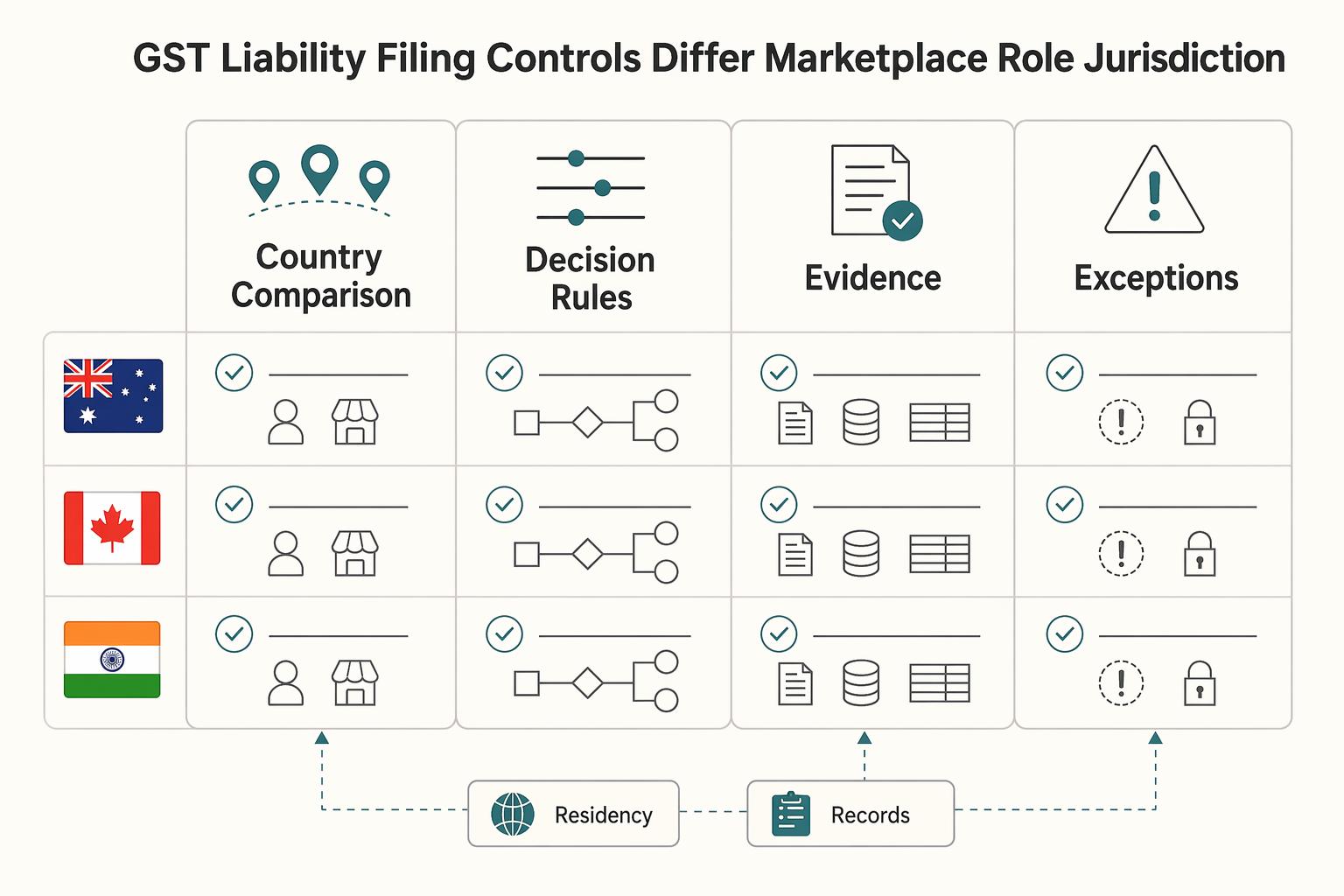
Quick Answer
Build the operating model around platform role and payment flow, then assign who registers, who issues invoices, and who files in each jurisdiction. This comparison gives concrete checkpoints for Australia, including the 21-day registration timing and the standard-versus-simplified non-resident split that affects tax invoices and credit claims. Canada and India are treated as local-confirmation tracks. Use the framework to lock record ownership, run reconciliation before submission, and escalate whenever checkout or settlement design changes.
GST Liability and Filing Controls Differ by Marketplace Role and Jurisdiction#
This comparison is an operator guide for Australia, Canada, and India. It is about control decisions, not software selection. The real question is who owns GST decisions, invoice issuance, audit trail quality, and launch readiness in each market.
You need enough control to avoid surprises, but not so much process that you create extra approvals, reconciliation work, and payout delay. Underbuild can create exposure. Overbuild can slow the business without a clear compliance benefit.
Australia makes the operating stakes easy to see. GST is 10% on most goods and services sold in Australia. If registration is required, it must be completed within 21 days, and penalties may apply for failing to register when required. In practice, that means GST design belongs in launch gates, onboarding, invoice logic, and close controls, not buried in policy notes.
The registration path also changes your system design. For non-residents, the standard path is tied to an ABN and requires BAS lodgment with GST paid monthly or quarterly. The simplified path is for non-resident businesses and issues an ARN. Simplified registrants cannot issue tax invoices or claim GST credits. If your flow assumes tax invoices or input-credit treatment, that choice affects product, billing, and documentation from day one.
This article compares operational GST implications across Australia, Canada, and India while flagging where local confirmation is still required, especially for Canada and India points not established. It does not assume one country's logic transfers cleanly to another, or that marketplace compliance can be solved by vendor features alone. You should expect four outputs:
- A country comparison centered on liability, invoicing, return ownership, and required operating data.
- Decision rules to use before launch and before transaction model changes.
- A reporting checklist that ties filed figures to transaction evidence, invoice records, and payout history.
- Escalation triggers so compliance, legal, finance, and risk owners know when to stop and review.
If your model changes who registers, who issues invoices, or who reports and remits, treat it as a formal rescoping event. In Australia alone, checkpoints like the $75,000 GST turnover threshold, the 21-day registration deadline, BAS obligations, and simplified-path invoice limits can change what is operationally defensible.
Australia Canada India at a glance for marketplace GST decisions#
Use this table as an Australia-ready control view and as a Canada and India confirmation checklist. Australia is the only market here with sourced operational detail. Canada and India remain local confirmation items in this section.
A complete-looking cross-country table can create false confidence. OECD comparison points are not sourced in this section, so treat them as unknowns and treat country law decisions as local legal and tax work.
| Decision area | Australia | Canada | India | What this means Monday morning |
|---|---|---|---|---|
| Liability trigger | Registration is generally required at $75,000 GST turnover for a business or $150,000 for a non-profit. Once required, registration must be completed within 21 days. | Confirm locally. Not verified here for GST/HST threshold or platform trigger. | Confirm locally. Not verified here for marketplace GST trigger. | Capture entity type, turnover basis, and threshold-cross date. Finance owns monitoring and escalates to tax or legal when nearing the trigger or when the model changes. |
| Who remits | Under standard non-resident registration, the business lodges BAS and pays GST monthly or quarterly. Under simplified registration, the entity lodges a simplified GST return online quarterly and pays quarterly. | Confirm locally. Do not infer platform versus seller remittance from Australia. | Confirm locally. Do not infer seller-led or platform-led remittance without local review. | Store registration type, effective registration date, filing frequency, and filing entity. Tax owns policy. Finance ops runs the filing calendar. |
| Invoice ownership | Simplified registrants cannot issue tax invoices and cannot claim GST credits. Standard registration requires an ABN. Simplified registration issues a 12-digit ARN. | Confirm locally. No supported rule here on invoice issuer or tax invoice format. | Confirm locally. No supported rule here on invoice issuer or tax invoice format. | Record the market identifier, invoice template version, and issuer of record. Escalate if checkout or contracts assume tax invoices while the entity is on simplified registration. |
| Return/reporting responsibility | Standard non-resident registration uses BAS and may require an Australian registered tax agent because electronic lodgment from outside Australia is not available. Simplified returns are lodged online each quarter. | Confirm locally. No supported excerpt on return owner, return form, or filing channel. | Confirm locally. No supported excerpt on return owner, return form, or filing channel. | Maintain a filing calendar with return type, filing channel, agent dependency, and evidence location. Escalate early on filing method assumptions. |
| Unknowns to confirm locally | Confirm platform versus seller liability allocation with the relevant authority. Payment flow, platform role, and supply classification still need local analysis. | GST/HST treatment, platform economy rules, invoice ownership, and remitter rules require local confirmation. | Marketplace operator rules, invoice ownership, and reporting obligations require local confirmation. | Make local legal and indirect tax review a go-live gate. If answers change who registers, invoices, or files, pause rollout and rescope controls. |
| Portability warning | Standard and simplified registration have different operational consequences and are not interchangeable for invoicing and credits. | Do not map Australia terms like BAS, ABN, or simplified registration directly to Canada. | Do not map Australia thresholds, identifiers, or filing paths directly to India. | Add a standing warning in requirements: do not port one market's GST model to another without re-approval. |
What matters most in Australia#
The key Australia control decision is the registration path, not just whether you register. Standard registration requires an ABN and runs on a BAS cycle. Simplified registration provides an ARN and quarterly online filing, but removes tax invoice issuance and GST credit claiming.
| Operational point | Standard registration | Simplified registration |
|---|---|---|
| Identifier | Requires an ABN | Issues a 12-digit ARN |
| Return filing | Lodges BAS monthly or quarterly | Lodges GST returns quarterly online |
| Tax invoices | Can issue tax invoices | Cannot issue tax invoices |
| Lodgment from outside Australia | Electronic lodgment is not available from outside Australia and an Australian registered tax agent may be needed | Can register, lodge, and pay online |
That choice changes invoice logic and downstream controls. Before launch, verify registration type anywhere your product or operating process assumes tax invoices.
How to use this comparison without overreading it#
Use this comparison as context for control design, then anchor decisions to local law. OECD comparison points are not sourced in this section.
For a multi-market rollout, capture at least jurisdiction, registration path and status, market identifier, invoice issuer of record, and return owner. Require tax and legal sign-off before mapping Australia ABN, ARN, BAS, or simplified-return logic to Canada GST/HST or India GST.
Related: Canada GST/HST for Platform Fees: What Marketplaces Need to Charge Track and Report.
Liability turns on platform role and payment flow#
Across markets, start by testing platform role and payment flow. Liability risk usually rises when your platform controls checkout and customer payment flow, though that shift is not automatic in every jurisdiction. The core design fork is whether you only connect buyer and seller, or whether you sit inside checkout and money movement.
OECD guidance describes policy measures that can make platforms liable for VAT/GST on sales made through them. It also reports better compliance and revenue protection where platform-involvement measures were implemented.
The OECD also notes that two-thirds of cross-border e-commerce goods sales are made through online marketplaces. That gives tax authorities a practical reason to focus on the party controlling payment and transaction data.
Facilitator versus principal#
Use this working split before local legal review, then test it against your checkout, settlement, and invoicing evidence:
| Model | What the buyer experiences | What payment flow looks like | Tax consequence to test |
|---|---|---|---|
| Listing-only facilitator | Buyer discovers seller on your platform, then pays the seller or is redirected | Platform may only bill a fee or commission | Seller is often a primary candidate to account for the underlying supply, while your fee may have separate VAT/GST treatment |
| Checkout controller | Buyer completes checkout on your platform | You capture funds, then settle the seller after deductions | Stronger case for platform-focused collection and remittance rules because you control money flow and core transaction data |
| Principal or deemed supplier | Buyer sees the platform as seller, or local law treats it that way for certain supplies | Platform is central from sale to settlement | Higher likelihood the platform handles underlying tax, invoicing, and return ownership for that transaction type |
If you stay outside payment, your position often starts closer to a service provider to the seller. If you take payment, apply deductions, and settle the seller, your position moves closer to the party tax authorities may expect to control collection.
The operator checks that matter#
Do not decide this from org charts or product labels. Verify it from operating evidence:
- checkout screens and terms showing who the customer contracts with
- payment processor setup showing who receives funds first
- payout logic showing whether fees or tax-linked deductions happen before settlement
- invoice fields showing issuer of record
Hard rule before go-live#
If your model changes from listing-only to payment orchestration, re-run tax and legal scoping before launch. Treat this as a formal gate.
Transaction taxonomy that changes tax treatment#
Once role and payment flow are clear, transaction classification is the next control point. Keep separate lanes, or VAT/GST reporting can drift. One failure mode is treating the seller's underlying supply and your platform commission as one tax line.
| Lane | What it covers | Why treatment can diverge | Cross-border question to test first |
|---|---|---|---|
| Goods marketplace | Goods sold by a seller through the platform | OECD scope separately covers goods, and platform-liability measures can apply to marketplace goods flows | Is this domestic seller-to-buyer, or a nonresident seller supplying into Canada or India? |
| Listed services | Services supplied through the platform | OECD scope treats services separately from goods even when the payment flow looks the same | Where is the service supplied, and who is treated as supplier? |
| Digital services | Digital or intangible supplies through the platform | OECD scope separates services and intangibles, so goods logic should not be copied by default | Is a nonresident supplying into the local market, and does that change collection obligations? |
| Platform fees | Commission, listing, payment, or similar platform charges | Classify this separately from the seller's underlying supply before applying jurisdiction rules | Who is the fee customer: resident seller, nonresident seller, or another entity? |
Canada and India need a separate cross-border lens#
For Canada and India, treat domestic flows and nonresident-into-local-market flows as separate scoping paths, not minor variants. This section supports that cross-border status can affect compliance design, but it does not establish exact statutory outcomes for either country.
| Field | What to capture | Why keep it separate |
|---|---|---|
| Seller residency | Seller residency at transaction creation | Separates domestic flows from nonresident-into-local-market flows |
| Buyer location | Buyer location at transaction creation | Supports the domestic versus cross-border scoping path |
| Supply lane | Goods marketplace, listed services, digital services, or platform fees | Keeps invoice lines and ledger mappings in the same lane structure |
| Fee type | Fee type at transaction creation | Helps avoid mixing platform commission with the seller's underlying supply |
Operationally, capture four fields at transaction creation: seller residency, buyer location, supply lane, and fee type. Then make sure invoice lines and ledger mappings follow the same lane structure. If one order mixes seller supply and platform commission under one tax code, reconciliation and reporting defects can follow.
This aligns with the International VAT/GST Guidelines approach to effective collection on digital sales. Classification errors can cascade into invoicing, reconciliation, and later data sharing with tax authorities and digital platforms.
Registration invoicing and return ownership by country#
Set ownership of registration, invoicing, return filing, and records before launch. Only Australia has enough evidence here for concrete ownership rules. For Canada and India, treat ownership as advice-required before live processing.
Operational ownership comparison#
| Country | Registration owner | Tax-compliant invoice owner | Return filer | Audit record owner | Known unknowns to confirm locally |
|---|---|---|---|---|---|
| Australia | The entity required to register for GST. Standard registration generally requires an ABN first, and once registration is required, it must occur within 21 days. | Under standard non-resident registration, the registrant can issue tax invoices. Under simplified registration, the registrant cannot issue tax invoices. | Under standard non-resident registration, the registrant lodges BAS monthly or quarterly. Under simplified registration, the registrant lodges GST returns quarterly. | As an operating control, keep evidence ownership with the registrant that files the return. Confirm detailed retention rules with the relevant authority. | Confirm whether your model should use standard or simplified registration, including for non-resident EDP operators and low value imported goods (A$1,000 or less). Confirm whether an Australian tax agent is needed where offshore electronic lodgment is unavailable for standard registration. |
| Canada | Not publicly documented | Not publicly documented | Not publicly documented | As a control choice, the filing entity should hold supporting evidence, but local rules must be confirmed. | Confirm who must register, who may issue GST/HST-compliant invoices, and whether filing remains supplier-led or shifts in your marketplace fact pattern. |
| India | Not publicly documented | Not publicly documented | Not publicly documented | As a control choice, the filing entity should hold supporting evidence, but local rules must be confirmed. | Confirm registration trigger, invoice ownership, and return ownership by transaction lane and payment model before launch. |
Australia's key fork is standard versus simplified non-resident registration. Standard supports tax invoices and BAS filing. Simplified is a limited registration entity model with quarterly returns where you cannot issue tax invoices or claim GST credits.
If your platform collects funds and settles payouts, assign one accountable entity for checkout data, invoicing operations, evidence ownership, and the filing calendar in each country. Confirm any supplier-led filing position with local advice for specific lanes. If your platform is listing-only, validate any supplier-led filing position explicitly by country and lane rather than assuming it.
For Australia, add an early timing control around GST turnover and registration deadlines. If registration is required, action is due within 21 days, and penalties may apply for failing to register when required. Common annual thresholds are $75,000 for businesses and $150,000 for non-profit organisations, but confirm against the correct entity and supply pattern.
Do not copy another country's platform rule#
Do not carry platform tax ownership logic across markets by analogy. Use Australia's registration path for Australia, and treat Canada and India ownership as local-advice decisions until confirmed.
We covered this in detail in MoR vs. PayFac vs. Marketplace Model for Platform Teams.
Reporting evidence pack regulators and auditors expect#
If your return cannot be rebuilt from source records, the control model is hard to defend no matter how polished the filing looks. Your filing entity should be able to trace each reported amount back to a transaction, the tax logic used at that time, and the related money movement or adjustment.
That is the defensibility baseline here. OECD platform VAT/GST work was developed in the context of the OECD/G20 BEPS Project, including Action 1 from the 2015 Final Report. It also includes data sharing and stronger tax-authority/platform co-operation as part of implementation design. If records stay split across product, billing, payouts, and finance, return prep and later authority queries become harder to defend.
Build a minimum pack around traceability#
Treat this as an operator minimum, not a legal checklist for Australia, Canada, or India.
| Evidence item | Primary source system | What it must let you prove | Common break to watch |
|---|---|---|---|
| Transaction ID and order event | Checkout or order service | The supply existed, when it happened, parties involved, amount, currency, and status | Duplicate or reused IDs after retries or partial failures |
| Invoice or receipt record | Invoicing or billing service | What was issued to the buyer, tax shown, invoice date, and any correction history | Invoice total does not match order total after refunds or edits |
| Tax determination snapshot | Tax engine or rules service | Which rule was applied at the time and which inputs drove the result | Logic changed later, but no versioned snapshot was retained |
| Seller and customer tax attributes | KYC, merchant master, customer profile | Why the transaction was treated as B2B or B2C, domestic or cross-border, registered or not | Attributes overwritten in place with no historical record |
| Payout linkage | Payouts, settlements, PSP exports | How collected funds and tax amounts linked to seller settlement or platform retention | One order split across multiple payouts with no common key |
| Adjustment history | Refunds, credit notes, dispute tools | Why a prior-period amount changed and whether tax treatment changed too | Manual adjustments posted outside the original order trail |
| Filing workpapers and reconciliation output | Finance ledger and compliance files | How transactional totals rolled into return boxes or schedules | Spreadsheet-only aggregation with no stable source extract |
If these records cannot be joined with stable keys, the return may still look complete, but the evidence pack is weak. That usually shows up later during reconciliation or authority questions.
Map records to source systems end to end#
Build the pack from the systems that created each event: checkout or invoicing for the commercial record, payouts or PSP data for cash movement, and ledger plus reconciliation outputs for filing totals.
If you run separate tax and invoicing services, keep the tax rule version and decision inputs captured at transaction time. Without that historical snapshot, later rule changes can make prior filings hard to explain.
Add one pre-filing verification checkpoint#
Before submission, reconcile filed totals to ledger-backed transaction totals for the same period and resolve breaks before close. This is an operating control, not a statement of universal legal duty.
Reconcile by the material lanes you use, for example marketplace sales, platform fees, refunds and credits, and manual adjustments, not only the grand total. If a difference cannot be tied to a named source record, escalate it instead of treating it as routine timing.
Retention and defensibility#
Preserve history, not just current state: versioned tax logic, event timestamps, correction history, and a stable evidence index. OECD's focus on platform involvement reflects how central platform data is to VAT/GST collection design.
The scale is material: two-thirds of cross-border e-commerce goods sales are made through online marketplaces.
If you also run DAC7 or similar reporting, treat it as a coordination check here, not as a GST duty claim. Align shared entity IDs, transaction references, and adjustment categories where possible. For background, see A Guide to the EU's DAC7 Directive for Digital Platforms.
If the filing entity cannot rebuild the return from transaction records, tax-logic snapshots, payout links, and reconciliation workpapers, fix that before expanding jurisdictions or automation.
If you want a deeper dive, read Digital Platform Reporting: What Every Online Marketplace Must Report to Tax Authorities Worldwide.
Before you finalize return ownership, map invoice, ledger, and payout evidence into one traceable flow. The Gruv docs can help your team design that control path.
Control design in product and operations#
Good control design decides each VAT/GST outcome once, records it once, and makes it explainable later. For a digital marketplace, that usually means a compliance-first operating flow instead of trying to fix tax issues after settlement.
A practical operating order is simple: classify the transaction, determine who carries the VAT/GST outcome for that flow, issue the invoice or receipt record, post the ledger event, reconcile to cash and adjustments, then file. This is not a universal legal sequence across jurisdictions. It is a defensible control order for keeping return totals traceable to source records.
Turn obligations into product gates#
OECD guidance frames platform involvement as an implementation problem as well as a policy one, building on earlier digital-tax work linked to BEPS Action 1. In operations, that means your controls should answer two questions at transaction time: what supply is this, and which party is treated as carrying the VAT/GST outcome for that flow.
If either answer is missing, route the transaction to exception handling instead of defaulting silently. Policy gates are often safer than fallback logic when core tax attributes are incomplete or uncertain.
| Control point | What to lock or record | Verification checkpoint | Common break |
|---|---|---|---|
| Classification | Supply type, parties, location signals, B2B/B2C indicators, platform role | Tax decision snapshot is stored with transaction ID | Required attributes are missing or inconsistent |
| Tax owner decision | Whether platform or seller is treated as the reporting actor for that flow | Decision can be reproduced from retained inputs | Decision logic changes without clear version history |
| Invoice and ledger posting | Issued amount, tax shown, timestamp, correction history, ledger reference | Invoice and ledger stay aligned for the same event | Later adjustments are not reflected consistently across records |
| Payment and payout linkage | Cash collection, retention, settlement, refund and adjustment links | Order, invoice, ledger, and payout reconcile with stable keys | Reconciliation links are incomplete after complex settlements |
Make retries safe and auditable#
You do not need complex engineering to improve defensibility, but you do need repeatable handling for payment and payout events. Idempotent retry behavior is often a strong control in practice, though it is not established as an OECD legal mandate.
A practical checkpoint is simple: one business event should produce one durable tax and ledger result, including when systems resend or reorder status updates.
Keep the scope honest#
Do not present controls as globally complete when they only cover selected lanes. A safer pattern is explicit market and flow qualifiers: where the control is enabled, where it is not, and which review path applies to out-of-scope cases.
That restraint aligns with OECD emphasis on data sharing and co-operation between tax authorities and digital platforms. Enforced, logged, market-scoped controls are easier to defend than broad claims that cannot be reproduced during reconciliation or filing.
Build buy and vendor evaluation without losing compliance ownership#
Keep the buying decision separate from the compliance decision. You may buy marketplace software to build and host the marketplace, and use separate tax capability tooling to support tax decisions and reporting operations. Blurring those choices can leave you with a strong storefront while VAT/GST liability and filing accountability still sit with your entity.
| Decision area | Primary role | What to verify | What remains with your entity |
|---|---|---|---|
| Marketplace software | Build and host a multivendor marketplace | Functionality beyond price or hosting model, plus access to transaction data needed for tax controls | VAT/GST liability, filing accountability, and audit response |
| Tax capability vendor | Support tax decisioning and reporting workflows | Whether it can support required data sharing and co-operation with tax authorities | Return accuracy and error accountability |
| Internal ownership | Tax, finance, product, and ops governance | Clear owners for decisions, exceptions, and escalation | Full compliance ownership |
In multi-jurisdiction operations, do not rely on ratings alone. Ask vendors to demonstrate, on your transaction lanes, what data they retain and what they can provide when authorities require data sharing or co-operation.
Use this short procurement checklist to screen options quickly:
- Separation between marketplace build-and-host tooling and tax-compliance capability
- Evidence that required transaction data can be produced for tax-authority data-sharing or co-operation requests
- Clear internal ownership for VAT/GST liability, filing, and authority responses
- Jurisdiction-by-jurisdiction review of where platform liability may apply
Hidden costs and common failure modes in multi market GST operations#
A common hidden cost in multi-market GST operations is remediation, not just tooling. When assumptions are wrong, teams can end up reclassifying transactions, correcting invoices, amending returns, and running cross-team escalations to reconstruct what happened.
Many of these problems start with small shortcuts: reusing one market's model in another without rechecking regional differences, or assuming liability always sits with the seller. That creates rework because liability can differ between the marketplace host and the individual seller, and cross-region operations need explicit handling of regional differences.
Where the cost shows up first#
- Reclassification rework: Multi-seller and multi-location orders are harder to classify consistently, so initial tax treatment can fail and force downstream corrections across invoices and return support.
- Retroactive correction: If logic failed at checkout, check cancellation and return flows too. A practical control checkpoint is tax accuracy across cart, checkout, and cancellation or return events.
Under-collection versus over-collection#
| Scenario | What breaks first | Hidden cost | Immediate operator move |
|---|---|---|---|
| Under-collection | Return accuracy and liability position | Exposure and remediation workload, plus ownership uncertainty between seller and platform | Isolate the affected lane, size impacted orders, and tie filed totals back to transaction and invoice evidence |
| Over-collection | Correction handling | Extra correction work across refunds and invoices, plus avoidable support escalation | Identify whether the error is in cart, checkout, or cancellation/return logic before issuing corrections |
| Mixed treatment across markets | Reconciliation and ownership clarity | Repeated cross-team escalations and recurring defects | Split rules by market instead of forcing one shared model |
Under-collection and over-collection create different risks, but both can cause operational damage. If your team cannot connect the original charge and correction path in one trail, costs rise quickly.
Red flags that predict pain#
- Reused another market model without rechecking local treatment
- Tax logic was tested at checkout but not on cancellations, returns, or split orders
- Regional differences exist in policy documents but not in product logic
- Liability ownership between marketplace and seller is unclear
The control standard is simple: make regional handling explicit and verify tax accuracy across cart, checkout, and cancellation/return flows. When those controls fail, hidden costs usually surface later as amendments and corrections.
Escalation triggers and ownership map before launch and after policy change#
Treat model changes and registration changes as stop points, not cleanup work for later. For Australia especially, the registration pathway changes what you can file and operationally support.
Use this rule: if the transaction model changes, or your team is unsure which GST registration pathway fits, pause rollout and get tax or legal review before processing live volume.
Trigger events worth treating as mandatory review points#
Use one trigger framework across markets, but treat Canada and India as confirm-locally lanes.
| Trigger event | Why it matters in Australia | Primary owner | Immediate action |
|---|---|---|---|
| New service category or product lane | New supplies can change whether the current GST setup still fits | Tax or legal | Re-scope before launch and reconfirm registration and invoicing fit |
| Payment-flow redesign | Checkout and settlement changes can alter GST-relevant facts | Product with tax or legal review | Hold release until treatment and evidence capture are rechecked |
| Australia entry or turnover growth | If registration is required, you must register within 21 days. Penalties may apply if you fail to register when required | Tax and finance | Check turnover against the applicable threshold (for many businesses, $75,000) and document the registration decision |
| Registration pathway change | Standard GST registration and simplified GST registration have different operating constraints | Tax or legal | Choose deliberately and document tradeoffs before filing or invoicing |
| Repeated reconciliation breaks | Return integrity risk is rising when totals cannot be tied back cleanly | Finance | Escalate as a cross-functional control issue, not a finance-only problem |
The key Australia check is pathway fit. Under ATO guidance, non-residents on standard GST registration use the ABN-based model and lodge BAS monthly or quarterly. They also cannot lodge electronically from outside Australia and may need an Australian registered tax agent. Simplified GST registration is also available to non-residents, including EDP operators. It uses a 12-digit ARN and requires returns quarterly, but you cannot issue tax invoices or claim GST credits.
Ownership map#
Use this internal control split. It is not a regulator-prescribed chart:
| Function | Responsibility |
|---|---|
| Tax or legal | Interpretation, pathway choice, and external-advice trigger |
| Finance | Return integrity, BAS or simplified-return readiness, reconciliation signoff |
| Product and engineering | Implementation of approved logic and evidence capture |
| Operations | Exception handling for holds, manual corrections, and escalations |
Before production filing, use concrete checkpoints. For Australian standard registration, confirm ATO written GST registration details, including the effective date. For simplified registration, confirm the ARN is recorded and mapped to the return process.
Change management after policy updates#
Set an internal review cadence and add event-driven review after major product changes. In this evidence pack, only Australia has concrete public update markers.
Conclusion#
The main takeaway is execution, not tooling. For each transaction lane in Australia, Canada, and India, you need a clear liability decision, records that support it, and named owners who can stop launch when facts change. If those are unclear, adding software does not fix the risk.
Use the comparison tables, evidence checklist, and trigger map as pre-launch gates, not post-incident cleanup. Before enabling checkout, seller payouts, or invoice generation in a new market, confirm finance can trace filed amounts back to transaction IDs, invoice records, tax logic, customer and seller tax attributes, payout linkage, and adjustment history.
Australia shows why these controls matter in practice. If GST registration is required, the deadline is 21 days, and penalties may apply for failing to register. For many businesses, the cited GST turnover trigger is $75,000. For non-residents, the choice between standard and simplified GST registration is an operating-model decision, not paperwork.
Under Australia's standard non-resident path, you need an ABN, identity proof, and BAS lodgment and payment monthly or quarterly. You cannot lodge electronically from outside Australia, and you may need an Australian registered tax agent. Under the simplified path, non-residents, including EDP operators, can register, lodge, and pay online and receive a 12-digit ARN, but cannot issue tax invoices or claim GST credits. If your model depends on tax invoices or GST credit recovery, that tradeoff has to be resolved early.
For Canada and India, this comparison is intentionally incomplete, so do not fill gaps by analogy. Validate locally, market by market, before go-live: liability allocation, registration path, invoice ownership, return ownership, and record expectations. Similar checkout flow does not mean similar tax ownership.
Next step: lock unknowns by market, get local confirmation where this comparison stops short, and then implement only the controls needed to be audit-ready. Aim for defensible liability decisions, fit-for-jurisdiction registration and invoicing, reconciliation before filing, and explicit escalation ownership across tax and legal, finance, product, and payments ops.
Frequently Asked Questions
Who is liable for GST in a digital marketplace transaction: the platform or the seller?
There is no single rule across jurisdictions. OECD guidance shows that some policy designs make platforms liable for VAT/GST on trader sales made through the platform, so liability can shift based on the local rules and transaction design.
What changes in GST responsibility when the platform collects customer payment?
If your platform changes how it collects customer payment, reassess VAT/GST treatment before scaling volume. Collection of funds does not automatically make the platform liable everywhere. Treat payment-flow changes as a tax and legal review trigger.
Is choosing marketplace software the same thing as being GST compliant?
No. Software can support calculation and reporting workflows, but it does not remove country-by-country differences in rules and obligations. You still need jurisdiction-specific decisions on registration, invoicing, filing, and control evidence.
Can Gartner-style tax software ratings replace a jurisdiction-by-jurisdiction compliance assessment?
No. Vendor ratings can help with shortlisting, but they do not determine whether your exact marketplace and payment model is compliant in each country. Use ratings as input, not as a substitute for country-level tax and legal analysis.
What minimum records should a platform retain for GST audits and regulator queries?
Keep records that let you explain how reported amounts were determined and reconciled. OECD guidance also highlights data sharing and co-operation between tax authorities and digital platforms, so weak records increase compliance risk.
How should finance, legal, product, and payments ops split GST control ownership?
This guide does not prescribe a legally required ownership split. Use a documented internal model so registration, invoicing, filing, reconciliation, and data evidence each have a clear owner.
When should a platform escalate immediately to external tax or legal counsel?
Escalate when core facts change, such as entering a new country, redesigning payment flow, changing supply or invoice-party setup, or facing reconciliation issues you cannot explain. If you cannot clearly assign who registers, invoices, files, or owns the evidence pack for a flow, pause and get advice before scaling volume.
Try a related tool
Researched and edited by the Gruv editorial team. Gruv builds cross-border billing, payouts, and finance-operations software for global businesses.
Sources
Includes 1 external source outside the trusted-domain allowlist.
Educational content only. Not legal, tax, or financial advice.
Related Posts

The Freelance Payment Penalty: A Modeled Audit of Platform Fees, FX Spreads, and Payout Delays
The money rarely disappears through a single, easy-to-spot fee. The real loss is stacked. A marketplace takes its commission, a processor adds a charge for international cards, a bank or payment company converts the currency at a spread, a platform holds the funds before release, and a wire sheds a little to intermediaries on the way in. Each layer looks defensible on its own, but the worker feels the combined result as a smaller deposit and a later payday.

How to Respond to a Subpoena for Business Records
Move fast, but do not produce records on instinct. If you need to **respond to a subpoena for business records**, your immediate job is to control deadlines, preserve records, and make any later production defensible.
A US Expat's Guide to Investing in UCITS ETFs to Avoid PFIC Issues
The real problem is a two-system conflict. U.S. tax treatment can punish the wrong fund choice, while local product-access constraints can block the funds you want to buy in the first place. For **us expat ucits etfs**, the practical question is not "Which product is best?" It is "What can I access, report, and keep doing every year without guessing?" Use this four-part filter before any trade: